
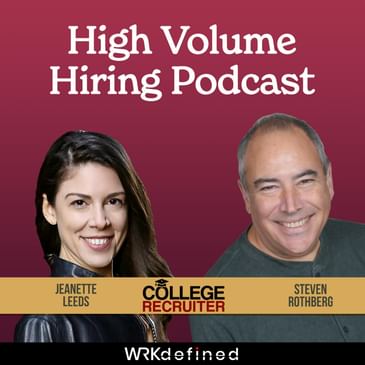
No matter the industry, long-time vendors (or those who have worked for any vendor for a long time) can be great sources of information. But nothing compares to getting advice from a practitioner in your profession.
Today cohosts Steven Rothberg of College Recruiter and Jeanette Leeds are joined by a practitioner who is also a veteran and great at providing advice. Dennis Tupper of Wells Fargo joins the podcast to talk about some of the more unusual high-volume hiring challenges he's faced (phlebotomists, anyone?) and how he -- and therefore you -- can overcome those challenges.
Powered by the WRKdefined Podcast Network.
[00:00:01] Dieser komplexe Finanzierungstalk ist ganz schön anstrengend. Ob ich mein Depot jemals angelegt kriege?
[00:00:06] Aber du hast doch schon ein Depot.
[00:00:08] Äh, nee.
[00:00:09] Doch, du hast das Vodafone Gigadepot.
[00:00:11] Ha, stimmt. Und da habe ich ja selbst in der Hand, wie groß mein Depot ist.
[00:00:15] Jetzt mit dem Vodafone Gigadepot und verbrauchtes Datenvolumen in den nächsten Monat mitnehmen.
[00:00:19] Go on im zuverlässigen 5G-Netz von Vodafone. Vodafone. Together we can.
[00:00:24] Welcome to Episode 75 of the High-Volume Hiring Podcast.
[00:00:43] I am one of your co-hosts, Stephen Rothberg, with College Recruiter,
[00:00:47] where we believe that every student in recent grad deserves a great career.
[00:00:51] And this is going to be an awesome episode.
[00:00:53] We have a real live, breathing practitioner on.
[00:00:57] But first, Jeanette.
[00:00:59] Hi, everyone.
[00:00:59] Good to see you.
[00:01:00] Good to see you, too.
[00:01:02] I'm Jeanette Leitz, the co-host, HR Tech Entrepreneur and Leader.
[00:01:06] And we, as Stephen said, we are here with Dennis.
[00:01:10] It's real to have you here.
[00:01:12] Dennis is an award-winning talent attraction professional.
[00:01:16] And he's currently the VP of talent attraction and engagement at Wells Fargo.
[00:01:21] He's really well-rounded, has great industry experience.
[00:01:25] You've done, let's say, recruiting marketing, employer branding across staffing agencies,
[00:01:30] recruiting marketing agencies.
[00:01:32] And now he's a direct employer.
[00:01:35] So, Dennis, welcome.
[00:01:36] We're so happy to have a practitioner in the house.
[00:01:39] Thanks for having me.
[00:01:39] I was really looking forward to it.
[00:01:41] So, thanks.
[00:01:42] Awesome.
[00:01:42] Well, I know we have you here by phone.
[00:01:43] So, thank you for making time.
[00:01:45] Give us a little bit of background.
[00:01:46] Like, how did you get into high-volume hiring?
[00:01:50] I went to school for communications.
[00:01:52] And then I, right out the gate, started marketing for enterprise on a car.
[00:01:56] And then I delved into recruiting because I liked relationship building quite a bit.
[00:02:01] Recruiting was kind of neat because all you're doing is building pipelines, relationships,
[00:02:04] talking to people about meaningful things, you know.
[00:02:07] Talking about, wow, wouldn't it be great to buy this car or rent this car at enterprise?
[00:02:11] Wasn't exactly fulfilling.
[00:02:13] So, got into recruiting.
[00:02:15] My favorite part of that was what would this job do for you?
[00:02:18] What would it do for your family?
[00:02:20] What would it do for your lifestyle?
[00:02:21] You know, it wasn't about like guns in the air.
[00:02:23] Does this rate work?
[00:02:24] You know what I mean?
[00:02:24] I cared more about the person, the outcome of connecting someone to work based on what
[00:02:29] it would do for them.
[00:02:30] And then I said, you know, look at the data.
[00:02:33] Where are these sources coming from?
[00:02:34] Why aren't we marketing things like that?
[00:02:36] So, it kind of piqued my curiosity.
[00:02:37] It was like, let me combine recruiting and a marketing background.
[00:02:41] And I was able to kind of leverage those skills and jump into it for a staffing firm.
[00:02:46] Thank you also for joining us.
[00:02:49] And for those who are kind of wondering why his videos narrow, like Jeanette said, that's
[00:02:54] what the phone does for us.
[00:02:55] But a couple of things.
[00:02:56] One is college recruiters done a lot of business with Wells Fargo over the years.
[00:03:00] And that might be in part because my wife, who's also our CEO, one of her first professional
[00:03:08] jobs was with what became Wells Fargo, which was Northwest Bank, headquartered here in Minneapolis.
[00:03:13] And then kind of the guppy swallowed the whale.
[00:03:15] Well, and the powers that be understood that the Wells Fargo brand was a heck of a lot stronger
[00:03:19] than the Northwest Bank brand.
[00:03:22] But you mentioned, Dennis, that you've done these different kinds of recruiting.
[00:03:26] Specifically for high volume, what kinds of roles have you personally been involved with
[00:03:32] for high volume hiring?
[00:03:34] I've been around the block.
[00:03:35] I've run the gamut.
[00:03:37] So, IT specifically, like sysadmin, software engineers, et cetera, accounting and finance,
[00:03:45] admin, light industrial, scientific, pharmacy technicians, warehouse, phlebotomists, registered
[00:03:54] nurses, travel nurses, bankers, and tellers.
[00:03:58] And that's a good amount of them, but not all of them.
[00:04:01] It's just off the top of your head.
[00:04:02] Yeah, it's a lot.
[00:04:05] It's a lot.
[00:04:05] I mean, that's such a big range.
[00:04:09] Like for me, just thinking through that range, lots of different tactics that you can use.
[00:04:16] Thinking about all of that, what tactics have you seen that really worked the best, you know,
[00:04:22] for hiring at scale?
[00:04:23] And, you know, thinking not just paying, but also the feel of the organic, the free.
[00:04:30] Hey, it's Bob Pulver, host Q podcast.
[00:04:33] Human-centric AI, AI-driven transformation, hiring for skills and potential, dynamic workforce
[00:04:39] ecosystems, responsible innovation.
[00:04:42] These are some of the themes my expert guests and I chat about, and we certainly geek out
[00:04:46] on the details.
[00:04:47] Nothing too technical.
[00:04:48] I hope you check it out.
[00:04:50] Yeah, a company likes the organic because it doesn't cost them a dollar.
[00:04:54] I mean, it's all about the approach, right?
[00:04:56] The approach is the same.
[00:04:57] You know, numbers are numbers.
[00:04:59] Performance marketing versus brand marketing.
[00:05:02] All that's the same.
[00:05:03] Who are you going after?
[00:05:05] What are the personas in it?
[00:05:06] What is running market intelligence for supply and demand for the skill sets?
[00:05:11] Finding sentiment analysis.
[00:05:13] What are people saying about our brand?
[00:05:14] What are they saying about our competition?
[00:05:16] What are we doing better than our competition?
[00:05:19] And jumping on that and pouncing on that and our messaging from a, you know, who we are,
[00:05:23] what we offer and why we're better in that market.
[00:05:26] And then paid is you're going to do job boards because they're hourly workers for the most
[00:05:31] part.
[00:05:31] You know, they're all over job boards.
[00:05:33] So you want to focus specifically on doing programmatic because you can do it at scale.
[00:05:37] You know, suppression rules like do not spend if we get 10 resumes in the first 24 hours
[00:05:42] or, you know, stop spend if we've had 25 views and no conversions because there's something
[00:05:47] going on either technically or with the job description, et cetera.
[00:05:50] Or I know very well that there are phlebotomists in Los Angeles is going to cost me a lot more
[00:05:55] than it is in Kansas City.
[00:05:57] And I know that for a fact because I have all this data to tell me that stuff.
[00:06:00] So from a paid perspective, you do search, you know, you can do job boards.
[00:06:06] And if you wanted to do display or for somebody who's data driven and drives me nuts out of
[00:06:11] home advertising, you can see what the lift is and stuff like that.
[00:06:15] That's good.
[00:06:15] But I'm a data guy.
[00:06:17] So that one's a tough one for me.
[00:06:18] And organic, of course, you want to do video.
[00:06:20] It's the most, you know, consumed, retained and shared medium there is.
[00:06:24] And do it by people, you know, for people.
[00:06:27] Do it on something like a phone.
[00:06:29] Don't have a Hollywood production.
[00:06:30] They're going to believe people in a real setting.
[00:06:33] Someone in a studio is obviously made up.
[00:06:35] And so doing things authentically and arming your recruiters with just those organic assets,
[00:06:40] whether that's going to be those videos and employee testimonials or landing pages
[00:06:44] as to why would you want to work here for the passive folks who might know your brand
[00:06:49] but might not be 100% like ready to go yet.
[00:06:53] And social media as well, you know, constantly having a presence, sharing your employees'
[00:06:58] stories out there and getting that in the hands of the recruiter.
[00:07:01] So all of those things you can arm people with, you know, and create as well as a performance
[00:07:06] marketing and brand marketing, depending on what does the market look like, supply and
[00:07:10] demand, how much performance, how much brand do I need to do?
[00:07:13] That's really interesting.
[00:07:14] So one of my big takeaways from what you just said, too, is how data driven you are.
[00:07:19] And I would assume, therefore, also employers that you've worked with in a talent acquisition
[00:07:24] capacity.
[00:07:25] When you think back to some of those conversations that you've had internally at any organization,
[00:07:32] or if you're talking to your peers in TA at other organizations that are also large, what
[00:07:38] are some of the challenges that you hear when you're going to a hiring manager and say,
[00:07:44] you know, I want to do video, I want to do out of home, you know, the job board piece,
[00:07:51] I would think that's a pretty easy sell.
[00:07:53] You're knee jerk, just throw it up there.
[00:07:55] It's going to be all set, right?
[00:07:56] Like, well, I wouldn't be here if that was the answer every time, right?
[00:08:00] Right.
[00:08:00] There is no silver bullet.
[00:08:02] And I think that's one of the lessons that TA kind of has to learn over and over and over
[00:08:06] again.
[00:08:06] But when you are talking with those hiring managers or CFOs, and you're looking for a
[00:08:12] pile of cash to do something, maybe give us a couple of examples of like real challenges
[00:08:16] that you've had to overcome.
[00:08:18] Yeah, it's budget every single year.
[00:08:20] So I'm going to be like, can you cut the budget back, you know, and do the same or maybe
[00:08:25] more, you know, and it's happened twice where I went in to meet, I was good enough to, you
[00:08:31] know, be able to get in with the CEO at a couple of different organizations and talk about what
[00:08:35] my annual plan was.
[00:08:36] And I'd come in, I'd be, you know, I want to increase the budget by 25 or 30%.
[00:08:40] The first thing they say is we're trying to cut costs, you know?
[00:08:46] Yeah.
[00:08:46] So immediately they have the mentality that you're a cost center, not, you know, you don't
[00:08:52] have ROI, which is, so it's these conversations, that's a challenge right off the bat.
[00:08:57] That's what they say.
[00:08:58] But then here you go, you know, you have your data.
[00:09:01] This is what we had.
[00:09:03] And for, I mean, in staffing, you would know what your margins were, what the average placement
[00:09:08] was for months, what the average revenue was per start.
[00:09:11] You could literally show like, you gave me $1.2 million or you gave me $7 million.
[00:09:18] And for every dollar you gave me, we built 14 back.
[00:09:22] Can I get 25% more budget?
[00:09:24] Yeah.
[00:09:25] It's like, here you go.
[00:09:26] That's not hard to do.
[00:09:27] You know what I mean?
[00:09:28] Here's the business case.
[00:09:29] It's done.
[00:09:30] Yeah.
[00:09:31] And then also like on the, more on the ground level with hiring managers, you can do, you
[00:09:35] know, why is it this difficult or whatever you look at, you show them supply and demand
[00:09:38] and what the competition is, what things cost from a CPA and a CPH perspective and what
[00:09:44] the ratios are and say, this is going to take this.
[00:09:48] I'm going to need this much.
[00:09:49] This market's hard.
[00:09:50] We're going to have to do more levers and it's going to take more time.
[00:09:52] So it's setting expectations, but everything is data driven, those conversations.
[00:09:58] Therefore, you know, it's like in a court case, you're just like, I rest my case.
[00:10:03] And then I've been lucky enough to have people understand that, read the data, listen to the
[00:10:07] data storytelling and, you know, give budget.
[00:10:10] So it's been helpful.
[00:10:11] But that's, it's a challenge every time because they have a mindset to cut.
[00:10:22] And then we're going to have a better customer experience.
[00:10:25] Better for the grandmother, better for the florist, better for the young man in house
[00:10:29] nr. 3a, better for you, better for all.
[00:10:32] Because while some say that the customer always has a right, we say that the customer always
[00:10:37] are people.
[00:10:38] And since we're also people, we want to do something good for us all.
[00:10:42] Zendesk, customer experience mit KI for Menschen gemacht.
[00:10:46] Agreed.
[00:10:46] That's certainly been my experience as well.
[00:10:49] Having the data is key.
[00:10:50] So I have two questions, but I'm going to just maybe a quick question is you got to have
[00:10:56] the data.
[00:10:58] So any tips to people who are, you know, maybe newer to the space that doesn't have the
[00:11:05] data or hasn't been tried?
[00:11:06] Like any advice there?
[00:11:08] Because if you don't have the data dead in the water, your budget's getting cut.
[00:11:13] Yeah.
[00:11:14] What houses data?
[00:11:15] Does CRM house data?
[00:11:16] Does the ATS house data?
[00:11:18] There's marketing data out there on the platforms that you're using, et cetera.
[00:11:21] So no matter what, something's being measured somewhere.
[00:11:25] Take everything that's being measured and tell as much of a story that you possibly can.
[00:11:29] You know, it all comes down to hires.
[00:11:31] That's the goal.
[00:11:32] You know, that's the golden ticket.
[00:11:33] If you can get that, great.
[00:11:35] That's in the ATS, but are they properly doing attribution via source?
[00:11:39] If so, there you go.
[00:11:40] But you're only as good as the available data to use.
[00:11:44] That's true.
[00:11:45] Just following more on that question.
[00:11:48] Again, newer to space, you're new to high value.
[00:11:50] You know, any just overall advice to give?
[00:11:55] Yeah.
[00:11:56] Newer to the space, talk to as many people as you can.
[00:11:59] Do as many webinars as you can.
[00:12:01] You know, I learned everything from mentors, coworkers, clients, webinars, you know, all
[00:12:07] of those things.
[00:12:08] Like no one taught me any of this.
[00:12:10] You had to be self-taught.
[00:12:11] And there's an industry of wonderful people.
[00:12:13] We are great people willing to help other people.
[00:12:16] We're the sunshine and rainbow.
[00:12:17] Everything's great people, you know, we're marketing.
[00:12:19] And we have a very small space, a small niche industry, and we all love to help each other.
[00:12:24] So talk to people, consume as much as you can, and you'll do nothing but educate yourself
[00:12:29] and get better and better and better.
[00:12:31] And I would add to that there, like listen to podcasts, right?
[00:12:35] I mean, there are some fans.
[00:12:37] As we're on a podcast now, listen to podcasts.
[00:12:39] Oh, oh, see, there's my bias going through.
[00:12:45] Plenty of those, yeah.
[00:12:46] In all seriousness, and just, you know, one comment.
[00:12:50] And Jeanette, if you've got like a final question, we can go to it.
[00:12:53] But the willingness in our industry of people to share.
[00:12:57] So true.
[00:12:58] I've been to probably 100 or 200 conferences, trade shows, whatever.
[00:13:03] And it's kind of hard at most of them to find people that aren't willing to share.
[00:13:09] It's like going to New Orleans and trying to find bad food.
[00:13:13] You know, that's a difficult challenge.
[00:13:17] And, you know, for people in TA who are new, definitely talk to the vendors too, right?
[00:13:25] Because a vendor that's been working with your organization or that has been around for a while,
[00:13:30] somebody who's been at that company for at least a few years, they've kind of gotten past that,
[00:13:37] I need to close this sale today mentality.
[00:13:41] And they're more relationship driven.
[00:13:43] So the trusted vendors that your organization has can usually be a real wealth of information.
[00:13:50] Always, you know, there's always a little bit of bias.
[00:13:52] But Jeanette, before we leave off, did you have another question?
[00:13:56] So obviously there's lots of new people, but then there's a lot who've been around the space.
[00:14:00] What about like advice around those who are experienced?
[00:14:03] And one question I have just because I do think it's a more sophisticated experience question.
[00:14:08] You were talking earlier about the mix of brands and performance.
[00:14:15] Be like that advice there, right?
[00:14:17] Because that could be a little tricky.
[00:14:19] So maybe that combination of someone who's more experienced.
[00:14:22] What's your thoughts around, you know, how to think about brand versus performance?
[00:14:28] Brand versus performance, really, it's about supply and demand and everything like that.
[00:14:31] So the challenges you're going to find, if you find challenges, chances are it's going to be a saturated market.
[00:14:37] You need to stand out.
[00:14:38] And it's very difficult to do that.
[00:14:39] And it costs a lot of money, a lot of levers.
[00:14:41] And, you know, everything's going to be very expensive.
[00:14:43] Or if it's a very rural area, there's not a lot of people.
[00:14:47] And, you know, in Wyoming and Colorado, I run into like it's a very wealthy town.
[00:14:52] Everything's really expensive.
[00:14:54] So the people who are hourly workers live 40 miles away.
[00:14:57] But there's mountains and bad weather.
[00:14:59] And it's really hard to attract people.
[00:15:01] So it's either going to be supply and demand or the difficulty in finding people because there's not many that are around.
[00:15:08] So understanding that, you can help weigh how much of each you need to do in whatever market you're attacking.
[00:15:16] That's awesome.
[00:15:17] Awesome.
[00:15:18] Love it.
[00:15:19] Dennis, thank you so much for joining us.
[00:15:22] This has been fantastic.
[00:15:24] Thank you.
[00:15:25] Jeanette, great to see you again.
[00:15:27] Thanks.
[00:15:27] Yeah, the next time that we're together, I think it's basically Halloween.
[00:15:33] It's Halloween and I expect a costume.
[00:15:35] So I'm putting it out there.
[00:15:38] I'm going to wear my middle-aged dad costume.
[00:15:41] How about you?
[00:15:42] Perfect.
[00:15:43] You'll have to tune in next week or two weeks to find out what costume.
[00:15:50] Dennis, thank you so much.
[00:15:51] We appreciate it.
[00:15:52] Thank you both.
[00:15:52] Yeah, it was fun.
[00:15:53] I appreciate it.
[00:15:54] Have a great rest of the day, everyone.
[00:15:56] Cheers.
[00:15:56] Take care.
[00:15:57] Bye.
[00:15:57] Bye.
Sponsors
