
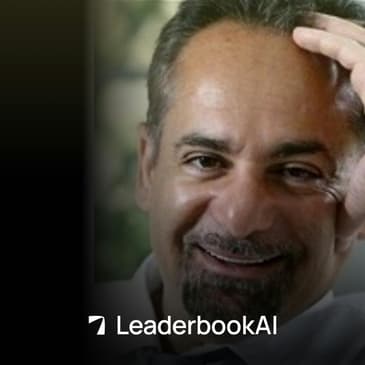
What does it take to lead innovation in complex manufacturing?
Amir Moghadam shares how leadership, precision, and technology intersect in lingerie manufacturing. This episode highlights enterprise technology, operational decision making, and business process automation—demonstrating how digital transformation enables quality, speed, and value creation.
—
Subscribe to the LeaderbookAI Podcast (formerly CPO PLAYBOOK): https://leaderbook.ai/podcast
Want to create 10x the value of your business or investments? Let’s talk: https://leaderbook.ai/contact
Powered by the WRKdefined Podcast Network.
[00:00:00] Feeling kind of left out at work on Monday morning? Check out The Barf, Breaking News, Acquisitions, Research and Funding. It's a look back at the week that was so you can prepare for the week that is. Subscribe on your favorite podcast app.
[00:00:15] I'm Felicia Shakiba and this is CPO Playbook where we solve a business challenge in every episode.
[00:00:23] The lingerie market size is estimated at $82 billion in 2023 and is expected to reach $121 billion by 2028, growing at a compound annual growth rate of 8.02%.
[00:00:54] However, orchestrating diverse perspectives and the iterative nature of the fitting process adds multiple layers of complexity to creating the best product, which makes lingerie manufacturing the most difficult of all clothing manufacturing.
[00:01:12] Managing a multidisciplinary team with varied expertise requires effective leadership and communication skills to align their viewpoints and ensure productive collaboration.
[00:01:23] Balancing conflicting opinions and decision making processes becomes paramount to extract the full potential of each team members insights.
[00:01:33] Amir, thank you for being here today. Welcome.
[00:01:37] Thank you.
[00:01:37] Can you elaborate on how your company leverages diverse perspectives in the design and manufacturing process to create the best fit lingerie products?
[00:01:49] Of course.
[00:01:51] Leveraging diverse perspectives in design and manufacturing process of brassieres can be highly effective strategy for creating the best fit and most inclusive product.
[00:02:06] Here is some of the company strategies that can make a diverse perspective in this context.
[00:02:13] Number one would be user research, design thinking workshops, collaboration with experts, and continuous improvement.
[00:02:22] And can you share a specific instance where incorporating an unconventional material or sourcing method resulted in a significant improvement in the fit and quality of your products?
[00:02:36] One such example was the new molding process.
[00:02:40] We were the first ones in the US used hot molding on the flat foam to create what is known today as t-shirt bras.
[00:02:50] Prior to that, the process was used to only create removable push-up pads for swimwear and bras, but was never done to create the actual bra pads.
[00:03:01] What was being done before to create a molded bra pads was carving process where they would take a big block of foam and would carve it to create the bra pads.
[00:03:14] And the depth and outer parameter of the carving would determine the size of the cup, like A, B, C, D cup, and so forth.
[00:03:25] But the problem with that process was that mostly the breast would not fully fill the cup.
[00:03:32] And that was resolved in a silver dollar impression on the outside of the bra, which was really a pointy cup.
[00:03:41] The hot molding of a flat foam process eliminated all those issues and being used by many bra makers around the world since.
[00:03:50] The process not only improved the fit and the quality of the product, but also allowed us to stay ahead of the competition in terms of innovation and sustainability in brazier industry.
[00:04:04] The success of this technology has led to its widespread adoption across various bra styles, demonstrating how incorporating unconventional materials and sourcing methods and innovative process can lead to significant improvement in product performance and customer satisfaction.
[00:04:26] And how do you foster a culture of innovation within your team?
[00:04:30] We would basically go in the design room with pattern makers, with the designers, and with details on the research we had done toward that particular type of bra.
[00:04:45] Like whether it was a push-up or a demi or a three-quarter cup or a full coverage and so forth.
[00:04:52] And then we will start with sketches that the designers had put together.
[00:04:57] We look at it, we will talk to the pattern makers and fitters to see whether they are practical.
[00:05:05] And then with the sample makers' discussion and the material that it was put together to try to create this, we will look at all the possibilities, the shape of the cup, the strength on the back, the size of the strap, the gauge of the wire, and basically the type of pads or without the pads brought to use.
[00:05:32] And explaining all of that to the sample makers.
[00:05:36] And then they will start working with preliminary patterns that it was provided by the pattern maker and using the materials to create the first sample.
[00:05:45] Once we get the sample passed by and we fit it on a particular leaf is a different size of the bra, this type of a bra we would use like 34B or 34C or 34D.
[00:05:58] And once we get that completed, then we will start the grading process.
[00:06:04] But we wouldn't just do a grading and go to production.
[00:06:07] What we did was we created different sizes and we fit it on different model sizes to see the actual fit and the grading that it was taking place.
[00:06:19] And then the last step was that we would go to the final grading and create a whole bra in all the sizes, the patterns basically.
[00:06:28] And we send it for production.
[00:06:30] And then once we get the samples back from the production, we will refit again to make sure the execution was done properly before they proceed with the mass production.
[00:06:42] And then again, we will have inspection done on the production line at the end of the line and right before shipping.
[00:06:51] And the last part of our inspection was done when the product would arrive and we'll open the boxes.
[00:06:57] We will double check and triple check different sizes and make sure they meet in the finished measurements and so forth.
[00:07:04] And that's when we could say that it was ready to ship.
[00:07:07] So it sounds like the process is a lengthy one, but more so even that you have so many different experts and perspectives that go in to making the best product.
[00:07:20] And I could only imagine how integrating these diverse perspectives from pattern makers, designers and models during the fitting process.
[00:07:28] How did you navigate those challenges with so many different people?
[00:07:33] Well, it was challenging talking about different people from different cultures, trying to really work out a team that they can discuss and communicate with each other effectively and holding everyone responsible for their part.
[00:07:49] And definitely a collaboration between among all the different areas was most important.
[00:07:56] And did we face certain challenges?
[00:07:59] Of course, but we had learned how to overcome it.
[00:08:02] So how did you learn to overcome it?
[00:08:05] Well, it wasn't that agreement was not achieved.
[00:08:09] We all knew what we need to create.
[00:08:11] It's just that if something was fall off the process, like the sample makers, maybe they didn't finish the first sample properly, which we noticed at the first time of the fitting.
[00:08:23] Maybe the number of stitches was not right.
[00:08:26] Maybe the number of stitches was not right.
[00:08:26] Or perhaps they cut the pattern a little bit, either short or wide or narrow and so forth, which will all show up on the first sample.
[00:08:34] And that's why we went through all of that.
[00:08:36] But once we see a problem and if it wasn't the sample maker, then would have been a pattern maker.
[00:08:41] Or the faulty material or something that it wasn't right for that garment.
[00:08:46] We have to change the components.
[00:08:47] It was all a matter of a meeting all together and analyzing and see what is wrong so we can identify it and then correct it.
[00:08:56] It wasn't just the one thing could happen in one area.
[00:08:59] It could be in multiple different areas.
[00:09:01] The whole objective was to identify the problem in order to solve the problem.
[00:09:06] And that's how we approach everything all the time.
[00:09:08] So it sounds like there was a common vision, a common mission, and everybody knew the end goal.
[00:09:16] And so regardless of the diverse perspectives, everyone was on the same page, rowing in the same direction.
[00:09:22] Absolutely.
[00:09:23] That was the only way that you could execute the product the way we want it to be produced.
[00:09:28] Just shifting mindset here to diverse suppliers.
[00:09:32] You had multiple suppliers across various regions.
[00:09:36] How did you ensure consistent quality and availability of materials when working with these different suppliers?
[00:09:43] Well, we had to do a lot of research and vet the suppliers based on their years of experience,
[00:09:52] the type of machinery they have, the capacities they have,
[00:09:56] the quality of what they've been producing in years and years, checking with some other clients,
[00:10:03] looking at how they've been performing before, whether it's been on time delivery,
[00:10:09] and also making sure the prices were right.
[00:10:12] So it was not the easy part to do because we had to investigate a lot of detail.
[00:10:20] And in the long run, we had so many suppliers that we had worked with over the 40 years of being in the business
[00:10:26] that we were pretty much aware of all the capabilities and the performances and the qualities and so forth.
[00:10:33] And at the factory level, always we determined the quality of the components coming in.
[00:10:41] And you're dealing with multiple suppliers because overall, on average, there are 55 different components in one bra.
[00:10:51] It's an average, you know, it could be less, could be more.
[00:10:54] And then there was some new product that would come, which will create a different challenge
[00:10:58] because the suppliers were just experimenting.
[00:11:01] We had to make sure that lab testing is done on all components to make sure there is in good quality
[00:11:10] and there are some standards in the industry that they had to pass.
[00:11:14] And after every component was tested, we also tested the final bra or samples of production
[00:11:23] to make sure that meets the variability and flammability, for example, or washability.
[00:11:30] All kinds of different types of testing had to be done.
[00:11:34] And some clients would even require more testing than the others, which we had to follow through with that.
[00:11:42] And also when it comes to colors, they had to check for color fastness and washability
[00:11:49] in order to come up with a care label for the product to meet that standard.
[00:11:54] So there is a lot of different things we had to do to make sure that we are coming up with the best product possible.
[00:12:02] We'll be right back.
[00:12:07] Hey, this is William Tincup.
[00:12:08] And I'd like to talk to you a little bit about Practitioner Corner podcast.
[00:12:12] It's a wonderful podcast about the journey, the paths of how practitioners, both HR and TA,
[00:12:19] kind of go from high school, college, all the way to where they are right now.
[00:12:23] Some of the things that they've learned, how they've been successful, people that thrive around them, etc.
[00:12:28] It's a fun podcast.
[00:12:29] You'll love it.
[00:12:30] You'll learn from it.
[00:12:32] Subscribe to it.
[00:12:33] Thanks.
[00:12:33] Back to the show.
[00:12:38] And so in order to manage all of those different suppliers, you still had the same consistent process of quality and consistency that you would need,
[00:12:48] regardless of the supplier that you selected.
[00:12:51] There was a standard that you upheld.
[00:12:53] Absolutely.
[00:12:54] You had to not only the suppliers and the components, but also the manufacturing process would have to be meeting the standard.
[00:13:03] Whether one bra maybe was made by two different factories.
[00:13:07] They have a different process.
[00:13:08] They have a different manufacturing facilities and the sewers and the cutting and accuracies in cutting and so forth.
[00:13:17] They all play the game into how to put the best product out.
[00:13:22] And it's a lot more extensive than unfortunately everybody think it is, but it takes a lot to put that product out.
[00:13:30] Were there any cultural challenges that you had to deal with across multiple suppliers?
[00:13:36] Yes.
[00:13:37] If they were from, let's say, Thailand or China or Vietnam or Indonesia, that process of learning and dealing with every culture, it was a challenge.
[00:13:53] And the way they approached the production, the way they approached the relationship, basically, it was different.
[00:14:01] We had to adapt and learn by experience and how to deal with those challenges.
[00:14:08] Could you provide an example where your team had to overcome a particularly complex fitting challenge?
[00:14:14] How did you approach the problem to achieve the best fit solution?
[00:14:19] Well, the molded cups were the most difficult because it wasn't a cut and sew pattern.
[00:14:29] You had to make multiple fitting changes that was related to the capacity of the cup.
[00:14:36] And in order to make a new cup, we had to create a new mold.
[00:14:42] In order to create a new mold, we had to communicate with the molder of all the different 3D measurements at a time.
[00:14:51] It was very challenging in the beginning.
[00:14:53] But now there's programs that you can do on a computer and create a 3D models of the pads and then communicate that with the molders and try to head it.
[00:15:04] And even then, we still have to wait for the pad to be done sample-wise and then put it into a finished product and then fit it again.
[00:15:15] And sometimes we had to add millimeters to the depth, to the parameters, to the height, to the width, and in order to finally fit it the way we wanted.
[00:15:26] And that continued also with the grading process because pads don't necessarily grade on a standard way.
[00:15:36] And that was probably the biggest challenge we had was fitting a molded cup bra.
[00:15:41] And so how did you and your team work through creating the solution?
[00:15:46] Well, we had to all come together as a team and respect everybody's opinion about their field in order to put it all together and finalize it.
[00:15:56] With determination of what needed to be done.
[00:15:59] It is not a standard way of going about this, except there really is the team that you have.
[00:16:07] It makes the biggest difference of how to achieve what you're trying to achieve.
[00:16:13] And every bra, every garment could be different than the other.
[00:16:18] They have different reasons.
[00:16:19] They have different perspectives, different approaches.
[00:16:22] I mean, multiple different ways.
[00:16:23] Sometimes you have to change the wire gauge.
[00:16:26] Sometimes you have to change the width of the strap.
[00:16:29] You have to maybe put more hook and eyes on the back in order to hold together.
[00:16:37] It depends on the purpose of the bra.
[00:16:39] Was it a push-up bra?
[00:16:40] Was it a demi-cup bra?
[00:16:42] Was it for smaller sizes?
[00:16:44] For medium sizes?
[00:16:46] For full sizes?
[00:16:48] The full sizes were even the most difficult one because that required a lot of engineering for it to hold the weight of the breast and be able to keep it comfortable as well and not to be too bulky.
[00:17:03] So there was a whole series of different areas that you had to deal with.
[00:17:09] And looking ahead, what trends do you foresee in the lingerie industry?
[00:17:14] How do you plan to stay at the forefront of creating the best fit lingerie products amidst the challenging or changing consumer preferences?
[00:17:25] As consumers' preferences basically shifts toward environmentally friendly options, integrating the sustainable materials and production practices,
[00:17:41] We have to look into all of that and be able to embrace a broader definition of a beauty by offering a wider size ranges,
[00:17:54] using diverse models to promote body positivity.
[00:18:00] And because the fits can be real different from one bra to another.
[00:18:05] I mean, you go right now and try a 34B, for example, of one brand or one type of a cup or the bra.
[00:18:13] It may not be the same, obviously, with another style.
[00:18:18] And it just does not give you the purpose of why you're buying that bra.
[00:18:24] So we have to look into all of that and try to come up with the best possible fit and the design of what today's consumer are looking for.
[00:18:34] We'll be right back.
[00:18:36] If you like swiping, then head over to Substack and search up Work Defined.
[00:18:42] WRK Defined and subscribe to the weekly newsletter.
[00:18:47] Back to the show.
[00:18:48] The technology integration is very, very important, such as smart fabrics and wearable sensors could offer, for example,
[00:19:01] personalized experiences and insights to consumers, you know, leading to better fit product.
[00:19:08] Because as long as we know what they're looking for, we can try to create.
[00:19:11] You have to go out there and dig out the information.
[00:19:15] You really need to learn about new technology, new fabrications and design perspectives in order to make bras and especially bras to be acceptable to the consumer.
[00:19:31] It is a very difficult garment to make, which requires not only the fit and quality, but it also at the same time has to be appealing as far as the look and the design perspective.
[00:19:48] Amir, thank you so much for being here today.
[00:19:50] I appreciate the opportunity.
[00:19:52] Thank you.
[00:19:52] If today's episode captured your interest, please consider sharing it with a friend and leaving a review.
[00:20:01] To learn more about how CPO Playbook can support you or a leader you know with executive coaching or organizational transformation, visit us at cpoplaybook.com.
[00:20:13] Your support as a subscriber means the world to us.
[00:20:17] So thank you for tuning in.
[00:20:19] I'm Felicia Shakiba.
[00:20:21] Let's connect on LinkedIn.
[00:20:23] See you next Wednesday.
[00:20:31] I get it.
[00:20:32] The podcast just isn't enough.
[00:20:34] That's all right.
[00:20:35] Head over to your favorite social app.
[00:20:37] Search up work defined.
[00:20:39] W R K defined and connect with us.
Sponsors
