
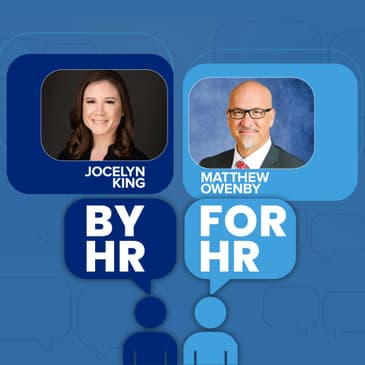
In this episode of By HR for HR, host Jocelyn King sits down with Matthew Owenby, Chief Human Resources Officer at Aflac, to explore how progressive benefits strategies and deep business alignment redefine modern HR leadership. Matthew outlines Aflac’s value-driven philosophy of caring for employees so they can care for the business, detailing their innovative on-site healthcare program that brings doctors, nurses, physical therapists, and mental health professionals directly to corporate campuses. He shares how offering preventative care and early medical detection yields $3 million to $6 million in avoided healthcare costs annually, providing a compelling template for HR leaders seeking to build high-impact, cost-effective wellness initiatives in their own organizations.
The conversation dives into what separates administrative HR managers from strategic CHROs who hold a true seat at the executive table. Matthew emphasizes the necessity of becoming a "ferocious student of the business" by mastering corporate financial filings, listening to investor calls, and understanding key metrics like earnings per share and total shareholder return. By framing HR solutions directly around executive goals and corporate values, HR professionals can effortlessly secure CEO buy-in for bold initiatives, rather than viewing wellness and benefits solely through a traditional cost-center lens.
Finally, Matthew offers a grounded, pragmatic perspective on artificial intelligence and workplace transformation. Drawing parallels to past industry hype cycles, he encourages HR practitioners to maintain a healthy skepticism toward grand vendor promises while focusing on practical AI tools that solve specific operational problems. He wraps up the episode by sharing how Aflac preserves its employee-first culture across a global footprint through long-form conversational recruiting, reminding listeners that sustainable organizational culture relies on clear human values and intentional hiring choices.
Learn more about your ad choices. Visit megaphone.fm/adchoices
Powered by the WRKdefined Podcast Network.
[00:00:19] Hi everyone and welcome to By HR For HR, the podcast where HR professionals learn from other HR professionals and workplace experts shaping the future of work. I'm your host, Jocelyn King, CEO of VirgilHR. At VirgilHR, we're passionate about helping HR teams navigate employment and labor law compliance with confidence so they can spend less time worrying about regulations and focus more of their time on people.
[00:00:43] Today, I'm excited to welcome Matthew Owenby, Chief HR Officer of AFLAC. We're going to discuss a variety of topic areas ranging from modern benefits strategy to CEO buy-in and AI in the workplace among many things. And I think you're going to walk away with some really valuable insights and practical takeaways for your own organization. Matthew, welcome to the show. Matthew Owenby, CEO of AFLAC, CEO of AFLAC, CEO of AFLAC, CEO of AFLAC, CEO of AFLAC. Thanks for having me. Glad to be here. Absolutely. I'm happy to have you here.
[00:01:09] Sure. So we had an opportunity to talk before the recording of this podcast. And so I got to learn a lot about you, which was amazing. And so one of the first things that I'd really wanted to dig into was AFLAC in general and how AFLAC addresses essentially the modern benefits strategy that you all employ. Because I think it's really interesting and, unfortunately, progressive, considering the fact that not many other people are doing what you all are doing.
[00:01:38] So can you tell us a bit about that? Sure. Yeah. I mean, the foundation of our strategy is really simple to understand. It's based on the idea of taking care of our people so they can take care of the business and that we're also in the health and life insurance space. It makes it makes it easy for an HR practitioner to to design a benefit strategy that is very comprehensive.
[00:02:03] And when we think about some of the elements of that over the years, being in HR here, we have we've done the traditional things, but we've also done what I think are is your your words, progressive things like having benefits administered on site, whether that's wellness checks or psychological care counseling.
[00:02:24] We brought that all on site primarily because we believe people don't have a lot of time and the more access we give to wellness benefits, health care benefits to our employees, the more actual they're going to use them and they're going to be better off in the long term. And then the company will be better off in the long term. So kind of think about our strategy more broadly. It's really fundamentally based on our values.
[00:02:50] We want to provide as many options as we can to take care of people the way we would want to be taken care of. Do you would you mind sharing maybe a couple benefits that you all offer to your employees that you think could perhaps be easily employed into somebody else's organization? For sure.
[00:03:09] I mean, the the having on site doctors, nurses, PT, mental health care professionals, that's it's pretty aggressive. You wouldn't have to have all of those, but you could certainly build a small program a couple of days a week where you contracted with local physicians and local health care providers to come in and offer screenings to offer wellness checks to offer healthy living habits, nutritional things like that.
[00:03:39] You don't you don't have to go as aggressive as we have been here by having staff on our campuses. So I think about if I were a smaller HR shop, who can I partner with in my local community? General practitioners, nutrition, coaches, psychological care, et cetera, to come in, do lunch and learn, just give people options and exposure to these benefits and probably do it at a fairly low cost. That's really interesting.
[00:04:06] What type of kind of I hate to say it like this, but like a return on investment have you seen on offering benefits like that? Well, I mean, it is it is really significant when we think about how we measure the value of the benefits. It is in a lot of ways. It's sort of the value of the benefits versus the cost of our benefits. We are self-insured.
[00:04:31] So that means that we're using administer to obviously distribute our benefits. We pay for them as we go. So if you think about the investments that we made about bringing in a partner with doctors and nurses and mental health care, et cetera, we see depending on usage, we see between three and six million dollars avoided in medical expenses, whether that be through early detection of issues or preventative care, mainly on the preventative side.
[00:05:01] One of the things that we're considering for the future, and we're still designing it, is offering it to the dependents of our employees, setting up perhaps a local in places where we have large employee bases, offering sort of after hours care in the same thing we do campus throughout. And we think that's going to be very easily demonstrated in lower health care costs for our people. That's interesting.
[00:05:28] Do you have other peers that are employing a benefit strategy similar to you? I am not aware of any, but I'm sure by this stage, I mean, we started this back in probably 2015, 2016, which was a massive advantage to us during COVID, as you can imagine, where we had on-site health care, doing testing, doing vaccines, ensuring that people were staying healthy. It was a massive advantage.
[00:05:58] I don't know if, I don't actually know anyone that's doing it like we are. It doesn't mean that they aren't, it just means I'm not right. Right. So then I guess kind of the natural follow-up question to this would be, what type of advice would you give to an HR leader who struggles to get buy-in from the CEO and leadership on a modern benefit strategy like this?
[00:06:16] Well, if a CEO, chairman, board, et cetera, is looking at the expenses of a health care plan, we know through our own research that benefits basically increase 8% to 10% per year, sometimes greater than that. And a small initial principal investment will not only cover that expanding expense of the 8%, 10%, but it will lower your overall benefits cost per provider.
[00:06:42] It's very, very clear in the data and there's no question that it's beyond a neutral payback. It actually saves us money in our broader play. And again, it's about prevention as well as ongoing care.
[00:06:58] There are numerous cases of people who have come to work not feeling well and we've prevented a stroke or a heart attack or some other, you know, more catastrophic health care outcome because they were able to just, before they went to their desk or their place of work, stop by the clinic. Hey, I'm not feeling great. And we were able to prevent bigger problems for us.
[00:07:22] And honestly, if it was just one person that avoided a life-altering event, I would tell you it was worth it. Yeah, that's amazing. So I'm curious then, you know, you've been with Aflac for a long time now. Yeah. You've been their CHRO for a very long time too. If you're the one who came in to implement this strategy, you couldn't have benefited from all the metrics that you have today on the value that it shows to the organization.
[00:07:50] So how in the world did you convince them to do this? Well, you know, it was actually quite easy because the culture here is employee first, employee focused, and it's value based. So the idea of, hey, look, I have this idea that is going to take care of our employees in a unique way was very popular.
[00:08:17] It was very easy to get in the door with our CEO who is still the CEO at the time. He was like, hey, that's an interesting idea. I've never thought about it like this. What can that look like, and can you show me how the numbers are going to work out?
[00:08:30] So for me, I benefit from working at a company that expects the HR team to be proactively looking at ways that are going to actually help our employees and give them a really different employment experience because we know employees have a lot of options. It's no different from any place we work in, 50 states across the United States and globally.
[00:08:54] And so it's just part of a broader philosophical and value-based approach to take care of our employees. It wasn't a hard sell because we already have the foundation and the connection to let's do things based upon our values, and then it just makes it easier to sell ideas that may be provocative or, in this case, pretty provocative.
[00:09:18] And I suspect you're probably also being a bit humble because it couldn't have happened without great leadership as well. And that's something that was going to kind of take me in a different direction here, which is around just the HR leadership capability. What do you think separates strategic CHROs from administrative HR leaders? And what advice would you give to an HR professional who's struggling to get a seat at the table?
[00:09:45] I think the thing that separates strategic HR leaders from more admin kind of operational HR leaders is simply like one thing, which will be easy to remember, is being a student of the business and as knowledgeable about the business as the people that are business leaders. So that I'm not necessarily sitting at the table as an HR person.
[00:10:12] I'm sitting at the table as a business person that may have HR solutions to solve problems that the business have. Sometimes I do, sometimes I don't.
[00:10:21] But I've spent the majority of my career just really attempting to be as knowledgeable or greater than knowledgeable about not only what we're doing as a business, what our objectives are, and then backing into the HR solutions that we may have that can help solve or remediate a problem. So the strategic element is really just being as good with the business as the business people are.
[00:10:51] How do you do that? You need to be a ferocious consumer of information. The day-to-day from an HR perspective is difficult enough, especially if you're in a smaller HR shop. It's a lot going on day-to-day. But I spend a lot of my own time pouring through 8Ks and 10Ks and proxies, dialing into our competitors' investors' calls.
[00:11:20] One of my mentors here who is no longer with us gave me some advice very, very early on in my career. And he just said, the business will teach you everything you want to know about it. You just have to watch. You have to be a curious watcher. And if you have questions along the way, most people, as you're probably aware, especially adults, they love to tell you about what they do. And if you just ask them, hey, how does the business, how does this work? How does our position to market work? How does our distribution channel work?
[00:11:50] They will likely tell you everything you need to know. Are there set metrics that you generally tend to lean on more or perhaps measure more often than others? From an HR perspective or a broader business perspective? From an HR perspective. From an HR perspective, it depends on which frame you're talking. If you're talking about sort of what the return on investment in the HR programs are, that would certainly give me, I would give you very specific measurements.
[00:12:18] If you're talking about just HR in general, how do I sort of dashboard the HR organization? Well, it's pretty traditional, meaning how long does it take us to fill roles? How are we doing on employee engagement, satisfaction, employee care? When we have events, do people show up? Do they like the events? Are they giving us good feedback about events? All the way over to the surveys that we do around our benefits programs, which we've touched on.
[00:12:47] So it's pretty standard. There's nothing necessarily unique about Affleck's HR strategy, although it is unique from a cultural perspective and values. The measurements are pretty standard. When I start seeing things move outside of the norm, for example, time to fill a position. Well, is that because something's changed in our process? Has our brand taken some hits somewhere along the way?
[00:13:13] Or if I'm seeing higher levels of turnover, whether it's in our call centers or more professional work, does it signal things to me? So I mainly look at things and metrics that are really standard and then make changes when I see a trend that is really indicating something. Yeah, I find often when speaking with HR professionals that the metrics generally tend to be the same. So I was curious to know if there is any secret sauce there.
[00:13:41] But as a master of the business itself, what business metrics do you think HR professionals should really be paying attention to? Well, really, they need to be looking at the business metrics that essentially their business is measured on primarily through the lens of investors. And that's usually going to be earnings per share, equity, expense management metrics, really the top two TSR, total shareholder return.
[00:14:07] I would be, as an HR professional in a business, looking at how the investors, if it's a publicly held company, are measuring the company and focusing on those. And obviously, the vast majority of publicly traded companies, the CEO's metrics are going to be the metrics that the investors want to see. And that's where I would start. Sure. Okay, great. Well, I want to shift a little bit, if that's all right, into AI, because obviously that's a really hot topic right now.
[00:14:37] And I find your take on it really interesting and I think something that people need to hear. So what do you think the biggest misconception about AI is in HR? I think the biggest misconception is that AI is going to deliver everything we're told it's going to do. I mean, the AI idea, I mean, I'm on the wrong side of 50 here.
[00:15:04] So it gives off big dot-com energy, gives off big great financial crisis vibes. It gives off, for me, for those that have been around as long as I have, this idea at the turn of the century that there was going to be this 30-year war for talent. And HR professionals would never be able to find the exact talent we needed to. And so we had to do all these things. Or the crisis around the baby boomers retiring at 10,000 per month since 2000.
[00:15:33] I can go on and on and on. And so what I would say about AI is we should all have some level of healthy skepticism around the promises because a lot of times I think we confuse the hyperscalers with the strategy around an investment book rather than the practicality of what these things are actually going to be doing for us, whether they're just tools.
[00:15:58] And so I think I would tell HR people, figure out a problem that you believe AI can solve, understand the baseline, and then see which AI tool can help you do that. I've not seen a lot of evidence of that so far, but we're still early. Most of the hyperscalers got started in 2020 and right before COVID, and we'll see.
[00:16:20] But I'd be less excited about it, and I would be less terrified about the headlines because I think a lot of the headlines are designed to sell an investment thesis that I don't really buy into. But I'm an older person. Well, what do you think about – well, I'd be really curious to get your opinion on what you think about workplace transformation as it relates to the impact of AI.
[00:16:48] What do you see that looking like? I see it being slow. I see it in the same way that I would have seen – this will sound crazy, but I worked in businesses before there was things like Windows. I would see it like an Excel, a PowerPoint, an internal messaging system that makes it easier to communicate or more effective to communicate.
[00:17:12] I would see it as kind of a Cliff Notes version if I had an idea where I needed some kind of spark or direction. I would see it much more as an augmentation tool of people that are already good at what they're doing and they just want to be faster or more precise. But I don't see it transforming the workforce any time. Yeah.
[00:17:35] Yeah, I think it's really important for people to hear that from an HR leader because there's a lot of fear around it right now. Yeah, I think the fear, again, I think gets back to humans are really good at sort of trying to neatly wrap up phenomenon that they're witnessing.
[00:17:56] So let's just take the notion of the sort of the constant drumbeat of AI is causing all these job losses in the tech industry and here and there and everywhere. Well, I mean, I guess if we took that in isolation, that could be true. But we know that during the COVID era, people overhired massively. And part of the reasons why they overhired is because there was a constant drumbeat of the great resignation. I mean, do you even remember that now?
[00:18:25] It was every single day of our lives. Everyone's resigning, quiet resigning. And so companies, I think, bought into that idea and overhired. And could it be that after two or three years post-COVID, they're just reconciling normal hiring practices? Or could it be scary AI that nobody really can decide what it does? Yeah, well, we will see what it is soon enough, I think. But I agree with you.
[00:18:55] I think that there's a reconciliation going on right now with decisions that were made a few years ago. Companies are really feeling the pressure now from a capital perspective. And the economy's changed. I mean, the economy's changed. We've had tariffs. We've had market dislocation. I mean, very, very rarely in my career, if ever, has there been one causality to a specific outcome. We would like life to be very neat and packaged that way, but it's just not been my experience. Sure.
[00:19:25] Well, I'll shift one last time before we wrap up, and that's around culture. You've talked a lot about culture and the uniqueness that Aflac has there. And I'd be so curious to know, having come from small companies and big companies myself, I've seen it's much easier building a culture at a smaller company than it is at a larger one. And it's even harder maintaining that culture. What have you all done? Is there any secret sauce that you're willing to share?
[00:19:54] Sure. It's easy to maintain a culture at a company when you have identified the elements of the culture that matter, and so you hire people that have your same beliefs. So it's actually easy to maintain it when you know whether it's honesty, communication, being forthright, trusting, teamwork. You can detect that, obviously, through interviews and conversation. And so it becomes relatively easy to maintain.
[00:20:23] And for the people that are just here, it's very easy to maintain it in the sense that our values are really based in what I'll call sort of common human standards. Treating people with dignity and respect, treating people with care, telling people what they need to know when they need to know it, being trustworthy. These are pretty universal standard human behaviors. And so when you have those as your fundamental value or ethos,
[00:20:53] then it's easy to go out and detect whether or not a person has that coming in or how we need to adjust that internally when we're not behaving in those kind of ways. How are you evaluating that in the recruitment process? Through long-form conversations, the old-fashioned way. I mean, we are happily a global company, but very Southern-based. And we like to have conversations with people over a period of time to see how consistent they are at answering very basic questions.
[00:21:20] And you can get a very good sense of a person's communications capabilities through long dialogue. Well, Matthew, thank you so much for joining us and sharing your expertise and overall experience. It's really incredible. And I'm honored to have you on the show. So thank you. You're welcome. If today's conversation gave you new insights, be sure to subscribe, leave a review, and most importantly, share this episode with another HR professional. This podcast is brought by Virgil HR.
[00:21:49] Virgil HR's mission is to help HR teams stay compliant, reduce risk, and lead with confidence. To learn more about Virgil HR and how we simplify confidence, visit our website. Thanks so much for listening, and we'll see you next time. Bye.
Sponsors
