
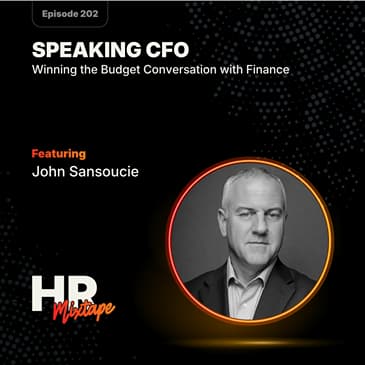
[00:00:01] You're listening to the HR Mixtape, a podcast for leaders who want to understand people, strengthen culture, and navigate change with clarity. Today's conversation starts now. Joining me today is John Sansusi, founder and CEO of Cognit, a business process management company that helps HR service firms and payroll providers scale operations through specialized offshore teams and process automation.
[00:00:29] With more than 30 years inside payroll, HR technology, and PEO operations, John talks about AI and the future of work from the operator's seat rather than the sidelines. John, thanks for jumping on the podcast with me today. John Sansusiak And thank you. I appreciate your time.
[00:00:51] So you have spent years as a CFO at HR companies before you built one of your own. So I'd like it if maybe you could take us back to the start. How does a finance guy end up running global operations for the HR industry? John Sansusiak Well, I recovered from my CFO days. It was hard, but I did. John Sansusiak Actually, the story of Cognit intertwines with that in that 20 something years ago, I outsourced. I worked for HR provider or PEO and we outsourced to India.
[00:01:20] So I was the client looking the other way. I was the CFO in that organization. Of course, financially, it made sense. Pulling it off, I found out, was much harder, which is what we try to share with our clients today. John Sansusiak So many years go by, we sold our company. Those folks were still trained. I was moving on and I hired all the best people I had, kept them and started Cognit. So there's where we began. So my perspective, not just from CFO to CEO, but also from client to provider.
[00:01:47] John Sansusiak I love that perspective. You know, I was, some people may know this, who've listened to the podcast before, but I was a Paylocity client before I became a Paylocity employee. And I think it just gives you a really unique perspective of being on the other side of things. You know, you, you've sat in that CFO chair and you've run the operations. When an HR leader walks into a budget meeting, you know, I think about this from that CFO perspective.
[00:02:11] What is the CFO hearing that HR doesn't maybe realize they're saying when they, when they walk into those budget meetings? John Sansusiak I used to, in my harsh CFO tone, I'll change tones for a moment. John Sansusiak We're the redheaded step children, my friends here in finance, accounting and HR. We're a cost center. We don't produce revenue or reduce costs. But, but along that lines, you know, and sticking to that, I'd say that that was the key word for them to get.
[00:02:39] How can we, how can accounting and HR both think about coming into those questions as to how do I reduce costs? How do I reduce turnover and not just soft costs? The thing a CFO once they hear is hard costs. Is there a lot of that running around HR? No, they're pretty lean operations to begin with. But, but to position HR, I think at least with finance minded folks, that would be the best first approach.
[00:03:03] Yeah. And that leads to my next question. You know, that cost to serve is everyday language probably for you, but typically nobody in HR uses it. So for somebody who's just kind of hearing that term for the first time, can you, can you break it down for us? What does that actually measure? You know, in our, I look at it transactively the way we run our business too, is cost per unit. You know, if your units higher, what's your cost and how do you affect that change? And what we do with our clients and HR should think the same in that we're process based.
[00:03:31] We're an ISO 9001 company. Are HR departments doing that? Are they saying, here's my documented process? Hey, by the way, technology could reduce these two steps and or an outsourcing arrangement could take care of three or four. How do I play with that process? Because it doesn't change. You're hiring people. That process is pretty uniform. Are there ways that you can address that cost to serve? And I'd also interject and say, don't get fancy with it.
[00:03:57] I have two or three measurements. I think people get, I just elevated somebody to a CPO in my organization. I saved 28,000 metrics I want. He called me back in a panic. I said, I tell you what, we're going to pick three. But they are all either cost or time based. And that's the things that HR leaders should think about when approaching finance. I'm glad that you mentioned the plethora of data that we can present. Oh, yeah.
[00:04:25] And often it's difficult to know which metrics are going to resonate with which CFO or CEO in particular, because they all have different things that they're trying to go in. And the businesses will dictate kind of some of those metrics that you bring to the table. But I think about when HR leaders are coming into the room and asking for more headcount, maybe a new system, a new program that they want to implement. And finance says no, right? They run into that no.
[00:04:53] I don't think it's typically because it's not a value and it's not needed. More likely it's that they're coming into that request ill prepared to have those conversations with finance leaders. So how do you coach HR professionals listening to bring a different perspective when they go in and request things? I'll start with my old favorite because I've worked at an HRS company myself as a CFO. And, you know, we look at, hey, I've got a new software.
[00:05:22] This is just fantastic. We've got to have it. Great. What's the five-year cost of ownership on that bad boy? I don't know, but it's really cool. Okay. You know, that's where that conversation changes quickly. We all understand the metrics of I've got a thousand more people. I need more people in HR. Okay. We get that. How can you be more efficient? And what's the true cost of ownership that you're bringing to me? And does it reduce cost? What we've talked about before, does it reduce in days time to hire?
[00:05:52] Because I understand that as real cost. Is there other metrics that you think about? I think time to hire is a good one. When you have been evaluating those kinds of new shiny tools, because, you know, we're sitting in this AI landscape right now where I think everybody's trying to adopt the right tech right now in the right way. And we're being pushed, right? Hey, we need to adopt it. We need to implement it.
[00:06:16] But I think a lot of people are kind of just buying and making suggestions without bringing kind of that perspective to, you know, here's where I really see the downstream impact. So that was a good example that you gave. What are other metrics that they should be considering or other data points they should bring to the table? You know, I think about, you know, if we add X headcount, we know that we can produce this more product or widgets and that's going to help us down the road. Things like that. Right. Big ratio fan.
[00:06:46] So find, you know, you look at cost per square foot in a retail situation. HR has a similar cost. You know, what's my cost per head? How am I delivering on a time basis? And I also look, I was in the shiny ball business. So, you know, I love when they bring us big software purchases. Oh, my God, we're changing payrolls. Again, you know, great. We're going to ruin payroll for three more months. This is awesome. What I would say is I was involved in a business that did HR data integration. That's all I found all day is what we did.
[00:07:14] Hey, I bought the new shiny new hire tool. Can you make it work with ADP? Well, of course we can, but it costs money. Integrated approaches, as much as we all don't like, you know, larger systems that are fully integrated or have all the things you're looking for can bring that cost to bear. So my, you know, my advice, though, is to stay easy on three metrics that make sense to you or that ring true with the people above you. At the end of the day, can you serve more people with less? And what money do you need to do that?
[00:07:43] Yeah, that's so true. And metrics, I like that you said it again, like surface the metrics that matter for your business and for your leadership, because it's not the same across the board. You know, I've worked in many different companies and in the HR space and every scorecard for HR looked a little differently because it really depended upon what that leader wanted. All right. I want to flip the table a little bit from, you know, asking you questions about how to help HR show up to have you put that CFO hat on.
[00:08:12] You know, where do you think my CFO and finance leaders who are listening get it wrong when they think about HR and HR processes? Yeah, you know, one in the PO business, we used to pitch people on this. It's a soft cost one, but I loved it. What's your true cost of turnover? Because it took you 90 days to replace that person. And we would pitch to say, hey, outsource to us because we can reduce that for you. If we reduce turnover 10 points, there's a real cost here because I went and found the person
[00:08:41] you spent your time interviewing them or 100 of them or however many. And how do we put numbers to that? Where I think the HR leaders need to follow up with finance people in specific is come back every quarter with those numbers. You know, what happens is I set your budget. We set some dynamics. Go. All right, great. I didn't talk to you until next November when I went for your next budget. Well, guess what happens to that budget? It's going down because the things I asked for, I didn't necessarily get.
[00:09:09] HR leaders definitely need to be more numerical or statistical in their approach. That works with numbers, people. That's who we are. You know, I graduated from that. It never truly leaves me. I ask my people those questions all the time. Well, that's great. That's a sample of one client. What about the rest of our clients? Then they all kind of look at me like I have two heads. So when approaching, you know, think of who you're approaching or somebody coached me one time.
[00:09:35] Write down the three things you think the CFO wants and come into that meeting thinking of that in the first place. I'm curious, have you ever had any HR practitioner do this in the past? Because I have recommended this to people. And the question is, prior to those meetings, right, you're either new to the organization or they're new to the organization. Them coming to you and saying, hey, John, in your role as CFO, what data do you like to see when I come and make a request of you?
[00:10:03] Or what data would you like to see on a regular basis? Have you ever experienced that where an HR practitioner has done that? Almost never. But at the same time, don't think, you know, we are quite, can be quite unemotional and numerically based as CFOs. And I, again, you know, I'm not that person, which is why I moved out of that role over time. But the cultural things do matter, too. I think that people might, the HR people might leave that short. And that, you know, imagine where I'd build a little more culture around here.
[00:10:33] And I know our turnover rate is going to go down because of it versus the place that we work in today. So don't be afraid of those, but definitely have some numerics attached to it. You know, none of them are free. I think that simple mindset of am I raising revenue? Am I lowering costs? Or is this just, you know, something we're sitting around chatting about? One of those things occurs to somebody that's more financially minded. Yeah. Yeah.
[00:10:57] And in the finance space, you know, your teams are going to get measured on, you know, accuracy and the data and the lowering costs on their side. When I think about HR, you know, most internal HR teams don't have that kind of measurement as closely linked to the work that they're doing.
[00:11:15] What do you think would change if HR really started to bring that kind of evaluation and statistical analysis of their work to the table in that way, in a different way, different mindset? Yeah. And sadly, both of them sit in the cellar. So you have finance and then you got HR kind of below it, at least in this mindset they were discussing. What's funny is accounting has none.
[00:11:39] I mean, if you really back up for a moment, my job was close the books on X date, period, and accuracy that was expected to meet gap. I didn't have a lot of metrics. Within HR, if you really look at most HR systems, there's more data than you know what to do with there. So I think if you really wanted to differentiate yourself, dig into that data and come back and suggest. You know, I would have loved it if one of my HR folks would come in and said, here's a few metrics.
[00:12:06] One I found recently, I'm trying to remember the name of it, but what's my loss rate on people I didn't want to lose? Like I have these star performers who left. What's that rate? I care more about that rate than I do my overall turnover rate in a lot of businesses because there's a natural turnover in nutrition. I'm fine with happening from a cost basis. But I think you've got to come to the table with those stats. I would say most people in the CFO position don't have those in mind. They haven't thought about that.
[00:12:35] But just bring them to the table. Yeah, I like that you mentioned that one. We call those regrettable and non-regrettable. Yes, thank you. Yeah. So yeah, that regrettable statistic is fascinating when you dig into it, especially if you're in a larger organization. Then you start to layer on things like, you know, management or director level. What does the turnover look like underneath certain parts of your organization? And you can definitely start to see some patterns that affect your bottom line.
[00:13:04] Absolutely. So I love that you brought that up. You know, if there are those listening that are like, okay, this sounds great. I understand. I have access to all this data. You know, in HR, probably about 10 years ago now, big data was like the big thing we talked about. That's kind of gone to the wayside. But we're still trying to figure out what is the best data to bring. So somebody starting out in this field, what would you say, hey, these are the numbers that have really resonated to me?
[00:13:33] Or as you work with your clients, what are the things that you're seeing that, you know, these are the numbers that they're really watching for success in their works? Yeah, I think cost-based units, actually. So pick your cost-based. That's easier. You have an HR department. What cost per hire, you know, cost per turnover. Come up with metrics that are measured against the cost that you're using to deliver that service. I think that's probably one of the most critical things you can think of.
[00:14:01] Do you think that any one of those shows whether the HR function is doing well or not doing well? Or is it kind of just a data point? It can be a data point. Let me look inward for a minute. You know, I have a CPO now. His job is to improve the quality of people we're hiring internally. In my business, 100% turnover is normal. In the BPO business, especially offshore. We're at 35. I'm like, great, I want to be at 25. You know, you got to set a KPI there, too.
[00:14:30] And it can't be, you know, audaciously terrible or something unreachable. But the data is there, granulate it, and get it down to three things. I remember, I can't get it out of my head, a Marine Corps study I read, believe it or not, where people remember three things. So if somebody comes to me with 28 slides about HR's delivery, I am asleep around three or so. And I'll admit it. So be precise. Pick three metrics that make sense to you.
[00:14:59] Make sure you can measure those against cost because that's going to ring more true. And realize this goes from CFO above, too. You know, as a CEO now, culture matters to me. I'll spend some money at HR. I have no problem with that. I want better people in our production environment. At the same time, there are costs that seem frivolous. So, you know, like all organizations, we have to decide between the two in the world with limited resources.
[00:15:26] How does HR build that relationship with finance if they don't have that mindset? So, you know, a lot of HR practitioners just kind of fall into their roles. They've either been in another role or they've, you know, a lot of them have been in the CFO org, right? Sometimes HR comes over from that because they take payroll and then, hey, you're good with people. And, you know, you kind of get put in these positions. Always going to stop with it. Congratulations. HR and IT is yours. Right, right.
[00:15:55] But if you don't have kind of that mathematical mindset or that statistical way of looking at stuff, you know, one of the things that I've encouraged HR practitioners is find a bestie in accounting. Like create that relationship. There you go. You know, what's your advice there on how to start that? If, you know, somebody is just approaching accounting or finance for the first time, how do they come across as like, hey, we're in it together instead of maybe coming across like they're working from a deficit?
[00:16:23] Well, I'm going to go ahead and tell for my people because I was a finance major. I was a financial analyst when I started. And that's never left me. It's today. It's how I look at my business. That person in an organization is going to their boss or the CFO and saying, hey, I have a new way to metrically look at something. And they go, wow, this is really good. I'm interested. That person has some sway there. No offense to my staff account and friends. We all need them. But debits and credits really doesn't lead to a new HR system.
[00:16:50] So I would say find that bestie or that center of influence. It's usually an analytical person within the finance organization or who does the budget, which used to be me, too. And not a lot of people figured that out. You know, there's nothing wrong with a little lunch here and there. There's a lot of ways to do it. But get that person who has the year. And that can typically be a junior person. So it's somebody that's approachable. I love that. Again, somebody who's approachable. You know, we talk about that a lot when we're rolling out HR programs.
[00:17:19] You know, it's always good to find that one leader who's willing to pilot and kind of back you on certain things. So definitely important to think about that. You know, you've spent a huge portion of your career kind of finding the error rates and other people's processes as you worked with clients. You know, when you think about how HR work typically gets done inside an organization, where do you see it breaking that maybe people don't know about or maybe we haven't looked at enough?
[00:17:47] You know, payroll is always under scrutiny because, as you know, it has to be perfect all the time. I mean, we're a Six Sigma company. We better be well above that or we're not in business. I think it's the other parts of HR that are unmeasured. Yeah, I do this with our clients. Like, so what's your error rate in open enrollment? I don't know. A bunch of people fix it when it's broke. It's always the chairman of the board's wife or husband that doesn't get their car. Let's just write these things down because they're going to happen.
[00:18:13] I think in the other tertiary portions of HR is where there's a lack of measurement, lack of characterization of process. I'd look there because, you know, payroll, hey, only two people complained this week. I guess we're good. You know, we'll fix it. And I'd also say, you know, take that process approach. Okay, we did have two errors. What's funny in my business is we want errors reported. We do not want them hidden. We're going to look at them, root cause them. Is it a human error? Is it a process issue? Is it a software issue?
[00:18:44] Where did it come from? How do I eliminate it? HR organizations probably need to think that way a little more too because, you know, quiet is better. As long as HR is quiet, or as I used to joke with my folks, just keep me out of jail, please. You know, that's your real job. But for those that want to, you know, be a part of it, we used to kid about, you know, that HR person wants a seat at the table. Like it or not, that seat usually goes to the CFO because it may be who they report to. And it may be the person who's going to say, guys, we're screwed up here.
[00:19:13] We really need to invest some money over HR because I think there's some money there. And more importantly, some productivity. You know, you mentioned your own company and that you want those errors visible. Is there steps you took as a leader to create that culture where there isn't that fear to bring things up? I've seen that before in teams where, like you said, like, hey, we don't have a lot of complaints. Let's not raise this as a red flag.
[00:19:38] But if you are having, you know, even three to four errors in your open enrollment or in your payroll batches, that's enough that you should be raising the red flag. And there's a whole bunch of other areas, right? Performance management, you know, learning development, some of those different types of roles that aren't statistically driven. How did you develop that culture as a leader to really portray how important it is to address these things?
[00:20:06] It's funny because that's into a little of that culture in my clients who are typically American. We operate in India. In India, oh, my God. I mean, it's personal. I made a mistake. I'm either going to figure out exactly why or I'm going to jump off the building, one of the two. So their nature and a part of us being ISO and Six Sigma is that too. Let's find out why. My clients are like they're afraid. Like I didn't want to tell you that they screwed up, but they screwed up. You know, I want to know that. I want to know that.
[00:20:35] And managing those two cultural differences is hard. I used to go in on Saturday to my finance account and probably look around for people that are hiding stuff. You know, there's an invoice somewhere in here that somebody has screwed up. Creating that culture is not easy. I think when people see how it can work, where an error is an opportunity, you know, we're not firing you today for that one. Let's figure out how to eliminate it systemically. And maybe it's not. Maybe it's something we can't eliminate.
[00:21:02] But it's got to become opportunity. It's usually, unfortunately, probably in American culture, more of a let's hide that one because I don't want to get in trouble. You know, that getting in trouble concept is definitely prevalent. You know, I've had a few leaders throughout my career who have done a really good job of building trust and psychological safety and, you know, coaching me through errors. I remember being really young in my career once and working on open enrollment documents.
[00:21:31] And there was a major typo in one of the premium benefit numbers. Right. And at that point, we were paper and I was, you know, I was folding the forms and putting them in envelopes. And I was probably, you know, halfway through a thousand envelopes when I noticed that I had made this error. And I remember thinking like, oh, my gosh, I have to say something. Right. We can't send this out. It's such an important number.
[00:21:54] And, you know, at the end of the day, it was, well, you got to fix it and you got to reprint this and you got to redo all the work. Like it was on me to do it. But I remember that fear of feeling like, oh, my goodness, I can't say this mistake. But the reality was it was much better to address it than send out something and pull it all back. So, you know, I think that there's there's conversations around, you know, process, discipline and automation.
[00:22:24] We know that they can lower cost, but I and and raise accuracy at the same time. But I think sometimes leaders assume that they have to pick one or the other. They have to pick, you know, process, discipline or automation to to do those things. Why are they wrong? Because I don't think I don't think that's right. I think it's I had this conversation strategically. It's picked both guys right now. Let's talk about AI's impact on HR. You know, I have staffing clients for staffing a warehouse.
[00:22:53] One day, very soon, AI will do all of it. There will not be humans involved in that process. It can do it today. It's just creepy and nobody wants to do it yet within the HR space. And what we do and what we provide our clients and what they should be thinking of is that, you know, I brought that up. Are we a BPO or are we a AI technology company? I said we're both. If we're not bringing to bear the current technology, which may cost us in the short run, but in the long run will benefit us.
[00:23:21] You know, I can't have the cotton gin come around and be sitting around trying to do it by hand. I think that shifts coming whether we like it or not. And whether we like it or not, you know, your friends at Bailowski, ADP, all of them, they're going to do it for us. We're not going to have the opportunity to sit around and wait for it. So back to what you were saying, I think both, you know, it could be are all three process, technology, people. And who are the people doing it? Can I do that with people that do it at half the price that I do it today? Probably.
[00:23:50] You know, and where's the benefit to that? I love that you made the creepy comment. I think about back to my days in college when, you know, Google was around, not Google yet, but Ask Jeeves. If you remember, Ask Jeeves is a search engine. And I remember professors telling us like, hey, you can't rely on the Internet. You're going to have to remember how to use the library's card catalog. You know, it's not going away. And here we are now. And, you know, I don't even know if my own children would know what a card catalog is if I told them what it was.
[00:24:19] So, but it is there's that sense of like, it's creepy. I'm not sure I want to use it, but there's efficiencies that are going to be gained for sure. So, John, as we wrap up our conversation, for somebody who's listening in the HR space, who's never thought about the terms of cost to deliver and the work that they're doing, what's one thing that you hope they walk away from? What we talked about earlier, you know, make a friend in finance because they've got those metrics. Have somebody help you build those metrics.
[00:24:45] You know, as somebody in my seat today or in seats that have been in a CFO, I'd love it if somebody came to my office and asked me what I wanted to see. Oh, I actually know because I've got to go tell my boss, by the way. You know, well, HR works for you, John. What have you done? Well, we've learned cost to hire a number of days by four and it costs gone down by 30 percent. OK, that's real. Thank God. OK, now I need one more person. OK, cool. You might be able to. You've got to realize that person's having other conversations on your behalf and for you.
[00:25:13] Make sure you set that stage. You don't let it happen without you because it typically does because that goes the other way. John, I appreciate it. This has been a great conversation. And I think your perspective is really important as we think about how HR continues to evolve and really lean into the data that we have to move our businesses forward. So thank you for your time. Thank you.
[00:25:34] Thanks for tuning in to the HR Mixtape. Like, share, review and subscribe to support the show and help more people discover these conversations. Until next time, keep the conversation going.
Sponsors
