
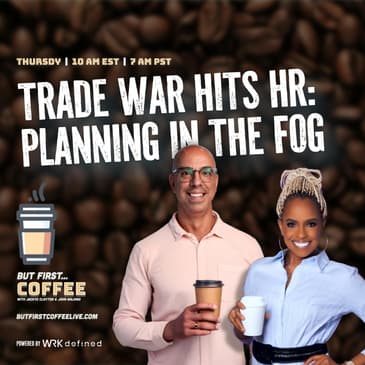
Tariffs, supply chain disruptions, and economic uncertainty have landed squarely in HR's lap. John and Jackye talk through what HR leaders are actually doing when the business environment shifts faster than any workforce plan can accommodate, and how to lead teams through decisions that cannot wait for clarity.
Key Takeaways:
- Trade policy volatility is not just a finance problem — it forces HR to make compensation, headcount, and hiring decisions under incomplete information.
- Scenario planning is the most practical tool HR has right now; waiting for certainty before acting is itself a decision with consequences.
- Leaders who communicate uncertainty honestly build more trust than those who project false confidence or go silent.
- Hiring freezes in reaction to tariff news often damage long-term talent pipelines more than the immediate cost savings justify.
- Compensation strategy gets complicated fast when cost pressures meet a labor market that still expects wage growth.
- HR needs a seat at the table when executive teams are modeling financial scenarios, not just when the decisions are handed down.
- Employee anxiety rises when external news is bad and internal communication is absent; proactive messaging is not optional.
- Global companies face layered complexity — workforce implications of trade disputes differ significantly by region and role type.
- Workforce agility, cross-training, and internal mobility become competitive advantages when external conditions are unpredictable.
- The best HR leaders right now are separating what they can control from what they cannot, and acting decisively on the former.
Keywords: trade war, HR strategy, workforce planning, tariffs, economic uncertainty, headcount decisions, compensation, employee communication, scenario planning, HR leadership
Powered by the WRKdefined Podcast Network.
Sponsors
