
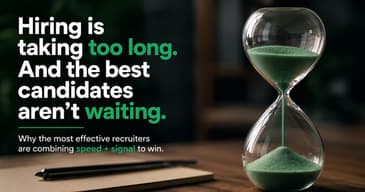
AI interviewers can engage every applicant at speed, but they cannot prove job readiness on their own. High-volume hiring works better when automated interviews are paired with job-specific skills assessments.
In this episode, Stéphane Rivard, CEO and Co-Founder of HiringBranch, and Prem Kumar, Founder and CEO of Humanly, and explain how AI interviews and skills assessments can work together to improve high-volume hiring.
Traditional hiring funnels spend heavily to attract candidates, then fail to engage most of them. AI interviewing changes the comparison from AI versus a recruiter to AI versus silence, delays, or rejection based on resume keywords.
Structured AI conversations help employers reach more applicants and collect consistent information. Humanly has found that candidates provide answers averaging 201 words and ask roughly one additional question, creating better information earlier.
An interview still cannot replace skills validation. Situational assessments allow candidates to demonstrate how they listen, communicate, solve problems, handle customers, and respond under realistic job conditions.
When an interview and assessment disagree, employers should examine the complete body of evidence and connect each signal to the skills and outcomes required for the role.
Portable candidate profiles could combine verified skills, assessments, work history, and development data. That could reduce repeated applications and improve skills-based matching.
Success should be measured through business outcomes, including candidate conversion, time to hire, onboarding speed, retention, absenteeism, productivity, and quality of hire after 90 days.
HiringBranch is a trusted partner of the WRKdefined Podcast Network and the You Should Know Podcast. Screening and assessments that identify top talent based on demonstrated skills. Reduce bias, speed up your pipeline, and hire candidates who actually perform.
Key Takeaways
AI interviewers solve an engagement problem. They give more applicants a structured conversation when the alternative is silence or automatic rejection.
Skills assessments add proof to the hiring process. Job simulations can reveal communication, judgment, listening, and customer-facing ability that resumes and interviews may miss.
Interview and assessment data should complement each other. Conflicting signals should trigger a deeper review, not automatic elimination.
Candidate experience requires a meaningful outcome. Collecting more information only builds trust when employers provide clarity, relevant feedback, or a path toward another opportunity.
AI hiring success must connect to business performance. Faster screening matters, but retention, productivity, onboarding, and quality of hire determine whether the stack works.
Chapters
00:00 AI Interviews and Skills Assessments
03:30 What Is Broken in High-Volume Hiring
05:22 Engaging Candidates at Scale
06:56 Where AI Interviews End and Skills Validation Begins
08:11 What AI Interviewers Can Reliably Determine
12:22 When Interview and Assessment Results Disagree
15:02 Can Hiring Become Fully Automated
22:33 Skills Data and Portable Candidate Profiles
25:06 What AI Hiring Could Look Like by 2030
29:38 Risks in AI-Driven Hiring
32:37 Measuring Recruitment Success
Guests
Stéphane Rivard, CEO and Co-Founder, HiringBranch
LinkedIn: https://www.linkedin.com/in/stephane-rivard-entrepreneur Prem Kumar, Founder and CEO, Humanly
LinkedIn: https://www.linkedin.com/in/premskumar
Resources
HiringBranch: https://hiringbranch.comHumanly: https://humanly.io
Connect with Us :
William Tincup LinkedIn: https://www.linkedin.com/in/tincup/
Ryan Leary LinkedIn: https://www.linkedin.com/in/ryanleary/
Connect with WRKdefined on your favorite social network:
Site: http://www.wrkdefined.com
TikTok: https://www.tiktok.com/@wrkdefined
LinkedIn: https://www.linkedin.com/company/wrkdefined
Facebook: https://www.facebook.com/WRKdefined/
Twitter (X): https://twitter.com/WRKdefined
Substack: https://wrkdefined.substack.com/
Learn more about your ad choices. Visit megaphone.fm/adchoices
Powered by the WRKdefined Podcast Network.
Sponsors
