
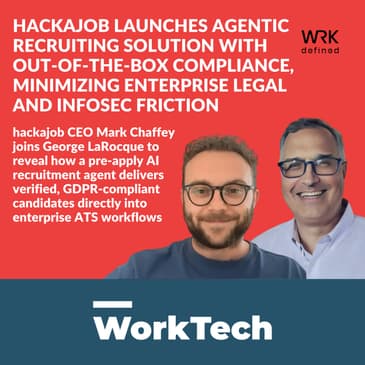
hackajob CEO Mark Chaffey joins George LaRocque to reveal how a pre-apply AI recruitment agent delivers verified, GDPR-compliant candidates directly into enterprise ATS workflows without triggering automated hiring liabilities.
In this episode of the WorkTech Podcast, host George LaRocque sits down with Mark Chaffey, CEO and co-founder of hackajob, to explore how enterprise talent acquisition can deploy autonomous AI sourcing while completely eliminating legal, regulatory, and InfoSec friction. As candidate-facing AI tools flooded recruiting pipelines with mass-customized applications, inbound resume volume surged up to 400%, destroying candidate signal and leaving recruiters overwhelmed. Talent acquisition leaders faced a critical deadlock: executive leadership demanded AI adoption for speed, while internal Legal, Risk, and InfoSec teams strictly vetoed AI tools placed inside the Applicant Tracking System (ATS) to avoid bias audits and liabilities under frameworks like the EU AI Act and NYC Local Law 144.
To solve this governance bottleneck, hackajob engineered Archer, an autonomous sourcing agent built natively for pre-apply execution. By managing outreach, vetting, and consent gathering entirely before an application is submitted, Archer operates completely outside internal ATS decision-making. This pre-apply architecture provides out-of-the-box recruitment compliance, allowing enterprise employers to deploy agentic AI without triggering internal legal vetoes, algorithmic bias audits, or complex IT overhauls. Archer connects seamlessly into existing enterprise TA tech stacks—including Workday, Lever, and Greenhouse—delivering interview-ready talent straight into existing recruiter workflows.
Central to hackajob’s platform is a strict reliance on first-party data integrity and verified trust. Rather than scraping unverified web profiles or purchasing third-party lead lists, Archer operates exclusively on explicitly consented candidate data compliant with strict GDPR standards. Archer acts as a dual-sided advocate, building long-term career relationships with candidates across all knowledge-work functions—including finance, sales, marketing, and engineering—by matching talent based on real skill context, compensation expectations, and work-model preferences.
To protect enterprise brands against the steep rise in remote applicant fraud, Archer enforces single-profile constraints and integrates government-backed ID verification through partners like Veriff. This ensures enterprise recruiters interact only with verified, high-intent individuals.
Consuming over 4 billion LLM tokens daily and generating 45,000 qualified monthly candidate introductions for Fortune 500 brands like Comcast, Barclays, and American Express, Archer demonstrates how agentic models scale across global organizations. Furthermore, hackajob aligns its business model directly with enterprise outcomes, replacing flat SaaS seat licenses and database access fees with performance-based pricing—charging employers only when Archer delivers fully qualified, interview-ready candidate introductions.
Key Takeaways
Out-of-the-Box Recruitment Compliance: Executing strictly in the pre-apply phase lets enterprise TA teams deploy autonomous AI sourcing without violating ATS governance, internal InfoSec policies, or automated decision-making laws.
Verified First-Party Profiles: Replacing scraped web databases with explicitly consented, self-reported candidate data restores top-of-funnel signal and yields 3x higher interview conversion rates.
Minimizing Legal & InfoSec Friction: Archer connects directly into existing enterprise ATS workflows (like Workday), allowing talent acquisition teams to adopt AI speed without waiting for lengthy corporate risk reviews.
Integrated Anti-Fraud Infrastructure: Single-profile rules, controlled job matching, and government-backed ID verification protect enterprise brands from fraudulent remote applicants.
Outcome-Based Pricing Models: Moving away from traditional SaaS seat licenses, hackajob aligns enterprise value with results by charging strictly for verified, interview-ready candidate outcomes.
On this episode Mark and George discuss hackajob’s Archer Agentic Recruiting Solution, Out of box recruitment compliance, Verified first party candidate profiles, enterprise legal and InfoSec friction, Pre-apply autonomous AI sourcing, ATS integrated, recruitment AI, Remote candidate fraud verification, Outcome based recruitment pricing
Learn more about your ad choices. Visit megaphone.fm/adchoices
Powered by the WRKdefined Podcast Network.
[00:00:02] HR tech, work tech, and investment are transforming the future of work. Are you in the know? Welcome to the WorkTech Podcast. Join host George LaRocque for expert insights on the trends, M&A activity, and strategies shaping the workplace. Brought to you by OneWorkTech.com and the WorkDefined Podcast Network.
[00:00:24] Hey, everybody. Welcome back to WorkTech. It's me, George LaRock. I've been looking forward to this conversation because you've probably been watching the market windows reports, and I'm looking at the shifts that are happening in the market. I'm looking at how AI is impacting things and really how AI is helping us do things we just couldn't do a few years ago and at scale now.
[00:00:49] So we're now looking at things at scale, and this is one of those conversations I'm excited to share with the market. Mark Chaffee, CEO of Hackajob, is with us to talk about what they've been working on, and I can't wait for you to see what I've been seeing lately. Mark, welcome. George, thank you so much for having me on, man. It feels like I've listened to so many of these shows with so many of the big industry titans over the years. So yeah, it's a bit of an honor to be here, man. Thank you.
[00:01:19] Well, you can put yourself up there now, I guess. I don't know. Let's start with an introduction because for a lot of folks that watch this, the Hackajob that they thought they knew, they're going to find out it's evolved. I won't say changed completely, but really evolved in an amazing way. So let's start with Hackajob and yourself, a little bit about yourself.
[00:01:46] Yeah, absolutely. So we founded Hackajob 11 years ago now. My co-founder and I were at college in London, studying together and decided that we wanted to take on the world of, at that point, technical recruitment and build a more meritocratic way to hire. I like to think we created skills-based hiring before LinkedIn made it cool. And naturally, business and product has evolved a lot over those years.
[00:02:11] But probably what Hackajob is most well known for today is being one of the early pioneers of a reverse hiring marketplace. So the product that we really scaled from sort of 2018, 2019 through to, you know, the last year or so was this concept of rather than candidates applying to jobs, we would flip the model and companies would apply to candidates. And that product works exceptionally well in tight labor markets where there is a lot more demand than supply.
[00:02:40] And so from kind of back end of 2020 to early 2020, we went on this incredible run, which led to us raising our Series B from Volition Capital and led to me moving out to New York. I suspect a lot of the people listening to this based in North America might be able to tell my accent. I'm originally from the UK, but now residing in New York. So, yeah, that's the last 11 years of my life summarized in a couple of minutes.
[00:03:06] Well, you know, you touched on a really interesting point, which is sort of the reverse marketplace and what you're known for. Or let's let's let's there's obviously a change in what you're bringing to market, an exciting change and not to bury the lead for everyone. But but let's start with, you know, so what's been happening in the market that led to, you know, the the conversation we're going to have today?
[00:03:32] What is the shift is the shift and what led to it? Yeah. So, you know, I think this will be no surprise to anybody, but in, you know, the second half of 2023, 2024 and 2025, the demand for software engineers fell through the floor. I still get a report sent to me every Monday morning, which looks at the volume of roles being advertised for software engineers. And it's down like 75 percent from the peak of 2021 or 2022.
[00:03:57] Interestingly, it's recovered over the last 12 months, which, you know, is a is a conversation for another day around what might actually happen. And I impacts labor. But what that meant was like the demand for our core marketplace product felt, you know, at that point, we were still predominantly just focused on software engineering. And, you know, when there was more talent available, actually, the reverse marketplace model made less sense. It still works to this day incredibly well for niche roles. So, you know, right now that obviously AI engineering market is super hot.
[00:04:27] And so that product works exceptionally well there. But for broad based kind of knowledge work hiring, actually, we are in this environment where there are more candidates available and that equilibrium is a lot different. And so one of the things I love, if I could spend my time just in the intersection of customer and product, that's all I would do. Fortunately, as a CEO, it's not all you get to do. And, you know, going through kind of 2024 and 2025, I was on all of these customer calls.
[00:04:52] And the same themes were coming up over and over again, which was our team are inundated with applications. We've seen a 3x, 4x increase in the volume of applications year over year. But these applications are being generated with AI tools that enable candidates to customize their resume based on a job description. And so we've lost all signal and all trust in this top of funnel. And likely the people that we actually want to hire aren't applying for our jobs in the first place. You know, they might already be employed. They might not be actively looking.
[00:05:20] They might not know who we are, but because their recruiters are spending so much time kind of sifting candidates at the top of the funnel, they're not doing as much proactive sourcing. And Ashby released this great report. Ashby's data is always really interesting. Probably about 12 months ago now where they saw for the first time since they've been releasing these reports, companies were making more hires from inbound applications than ever have done and less from proactive sourcing. And actually, when you peel back the onion with companies, it wasn't necessarily that was their preference.
[00:05:48] It was just the reality of TA teams and kind of this overwhelmed nature. And so the way that was playing out to us was like, we were speaking to our customers and we're like, you know, we're seeing some adoption drop on the marketplace. Why are your team sourcing less? And they're like, we have too many candidates. Like we are so inundated. We don't know who's good, who's not. And so it's hard for us to spend time proactively sourcing. And that's when we started to think about, okay, well, actually, if we're going to be successful in this era, we're going to need to reinvent ourselves as a company.
[00:06:17] And that's kind of the journey we've been on over the last 12 to 18 months. Yeah. So there's a lot to unpack there, but you do have some really big logos, big brands in your customer base. And to set some context as to like where some of these challenges are, which of those can you talk about? Can you share to sort of put some context around who your ideal customers might be? Yeah. So we're typically working with in-house talent acquisition teams at larger enterprise organizations
[00:06:46] or companies that are going through rapid acceleration. So in the US, that will be brands like Comcast and American Express. In the UK, that'll be brands like Sainsbury's and Tesco, BT, et cetera. And so these are organizations that are hiring thousands and thousands of people on a yearly basis. You know, we are predominantly now focused on knowledge work. Previously, we were just focused on technology. And I think, you know, I can't believe we're six minutes into seven minutes into a podcast.
[00:07:15] We haven't mentioned AI yet. But, you know, naturally one of the big things that's been changing, you know, one of the things that's been, you know, changed a lot over the last couple of years is obviously the adoption of AI. And one of the things that I find fascinating about AI in recruiting is it's going to be a highly regulated application for AI. The EU AI Act is calling out recruiting as one of the six categories. And we've already seen the workday and eightfold lawsuits here in the US.
[00:07:41] And so when you're speaking to these enterprise customers, you know, everyone's got more applications and they know what to do with. And there's been all of this investment in these post-application AI screening tools. But very few enterprise TA leaders are going to deploy an AI screening tool. And even if they want to, their InfoSec and compliance team are going to be like, absolutely no way are we using AI in that part of the journey. And so as we were going through this journey of reinvention, it felt really obvious, like go and build an AI screening tool.
[00:08:09] It's like where the market is right now. But actually, when you get really intimate with enterprises, you realize like, actually, enterprises aren't going to adopt that. And if that's our ideal customer profile, like how do we think about solving the challenge in a slightly different way? Yeah, it's that is right now what I'm calling the buyer's dilemma. It is in talent acquisition, they are stuck between an executive leadership team that is
[00:08:35] pushing on innovation, pushing on AI, whether the result is, you know, being more productive, whether it's lowering costs, whether it's automation, whatever they're pushing for all of those things. And on the other side, what they're stuck in between is legal and compliance. And so every enterprise head of TA that I talked to runs into this somewhere and it's, there's no consistency. And it's, I think that's the genius of, of, of what you're doing.
[00:09:01] So let's get into what you shipped and you're, you're still focused on the pre-apply, which I think really helps those TA leaders that are stuck from a compliance perspective. So they, they're, and let's back up and say, so what, what have you launched? And I don't want to steal your thunder. So firstly, George, one of the reasons why I love listening to your podcast is you come up with these gems and then I steal them and I'm definitely stealing the buyer's dilemma. I can see that in one of our sales decks now. So, so yeah.
[00:09:30] So last September we released Archer. Archer is a fully autonomous AI agent that is focused on going out, sourcing, engaging and qualifying candidates that aren't already applying to your roles. So tapping into that more passive talent pool. The big bet that we've made of Archer to your point is this is pre-apply AI. Um, and so Archer does not integrate into our customer systems. It doesn't take any decisions on their behalf.
[00:09:58] And ultimately Archer ends with a candidate choosing to apply for your position. And it says like, yes, I am interested. And so I have been on so many calls, one earlier today with a large defense and aerospace organization where the TA leader is exactly in the buyer's dilemma you described, right? They're getting downward pressure, upward pressure saying, you know, you must adopt AI in recruiting. And then they're getting compliance and legal and infosec saying there's no way you're doing anything in recruiting.
[00:10:27] And there's these light bulb moments I see in our customers where they're like, wow, hang on a minute. So we can deploy AI, but it doesn't touch our system and it ends in a candidate choosing to apply. And not only that, right? It's all about driving business outcomes. So what is Archer doing? It is like the most data-driven product we have ever built because it's like, there's no hiding. It is just purely about numbers. There are two core things that our customers are assessing Archer against.
[00:10:52] Of the candidates that Archer introduces, what percent convert to interview and ultimately to hired? Comcast are dropping a nice case study for us tomorrow that shows that Archer is performing X better than LinkedIn and like 7X better than they're just applications that come in. So you're driving more relevant candidates. And then the second piece is, are these unique candidates? And that's typically measured by, has this person applied to a job here before?
[00:11:19] And I think Comcast is somewhere around the 50% of candidates that Archer has introduced have never applied to Comcast before. Now Comcast is like the number one employer in Philadelphia by quite some distance. So, you know, so a pretty, um, you know, impactful, impactful stat. And so we're able to drive real business outcomes and solve some of those critical challenges that TA leaders have around top of funnel noise, but do it in this kind of pre-apply way, which
[00:11:46] means that it's very kind of risk-free, certainly, you know, very low risk from an AI compliance perspective. Right. And that's, that's all amazing, but it's also working for the candidate, right? It's, it's not one of these, you know, dust off your CV, polish it, homogenize it and mass supply. It's really getting to know the candidate and picking up signals from the candidate as far as what they're interested in. And I, every time we talk, you talk about that, that first party data.
[00:12:16] And I want you to, I want you to spend some time on that because that's, that's really key. All of that, this is really key to the value that you can ultimately deliver. Yeah, totally. So if you think about the way I see the TA landscape at the moment, you have these candidate tools to your point, you know, dust off your CV and we'll go and apply for 200 jobs to you. Not sure it's a good product for anyone, but there you go. And then you've got kind of a rise of these tools that are effectively building really nice, impressive UI layers on top of third party data, right?
[00:12:46] They're going by and collate all of the data and then they build these really nice UI layers. Bluntly, they're building the UI layer that LinkedIn recruiter should have had. And it's crazy that LinkedIn recruiter still doesn't have, because if LinkedIn recruiter did that, a lot of these products aren't, aren't that valuable. Now the challenge for us from that perspective is like, whilst I live in New York, we're still European in our DNA. And in Europe, we have this thing called GDPR, which is all around, you know, what are you doing with candidates data?
[00:13:11] And fundamentally, the core principle of GDPR is a candidate has to explicitly consent to give you access to use their data. And these companies just cannot meet that bar. They might claim they can. They've got some really great positioning around it, but they fundamentally can't. And so you go and speak to a large enterprise that wants to deploy one of these tools. Again, their data privacy team are just going to say, this isn't possible. So from a compliance perspective, it doesn't work. But actually, from a candidate experience perspective, it fundamentally doesn't work.
[00:13:38] Because all that's happening is now the same candidates are just getting spanned by recruiters using these tools for jobs that they're not interested in, because these tools actually don't know much about you. They don't really understand what it is that you're interested in. They certainly don't understand your salary expectations, how many days a week in the office you want to be in, what's your career goals, all of these things, because it's just scraped third-party data. Our bet with Archer is that in order to solve this problem, you have to own the relationship with the candidate.
[00:14:06] You have to be able to engage candidates, get to understand candidates, and deliver fundamentally an incredible candidate experience. And so every candidate that Archer introduces to our customers is a first-party candidate that has explicitly signed up to work with Archer, has explicitly given Archer consent. And this matters for like a couple of reasons. One, Archer's going to know more about that candidate than anybody else.
[00:14:33] And so when we think about relevancy, we can make sure the basics are covered, like right to work, and your office policy, and comp expectations, and all of that good stuff. We can obviously go way beyond that and to start looking at skills qualifications, and behavior assessments, and those types of things. And secondly, that actually means the candidate experience is really good because Archer gets to know you and makes better recommendations on the roles that you're interested in. And so that's kind of the big bet that we have taken, is that working on first-party data is going to be critical.
[00:15:03] And so Archer's only going to do that, and hopefully will be the key to kind of restoring trust on both sides. Well, I'm glad you mentioned trust, because I've been waiting to jump in and say, you know, there's, I think my hunch right now is that for more than ever before in our industry, because we've had these decades of growth, so the market has just been growing and growing and has behaved in that way.
[00:15:29] So just pushing jobs and, you know, candidates were in a very different position. Today, we really need to, I think employers need to step back and realize candidates are consumers. And there's a huge wave of, you know, individuals stepping back and saying, where am I putting my data? What are people doing with it? How, you know, what's the value for me? Because they have access to so many tools they didn't have three years ago, five years ago.
[00:15:59] So I think that's a critical, a critical point. And trust is one of the biggest elements in brand. And in this world of jobs and employers and providing an experience brand, I hope most folks who come into the marketplace category, whichever way they, wherever they fit, underestimate how important brand is. And it's not just the employer's brand, but if you look at, you know, the vendors that
[00:16:29] everybody loves, they love them and they love to hate them, like the LinkedIn's and Indeed's, what do they have? Massive brands. So that, I think that's, this is a new element, a new paradigm for brand and trust. So, all right, I'm going to, I want to shift gears because time, because of time and move to the employer side. One more question that we can use to branch over to the employer side. This is, or I just want to confirm, this is multimodal. So this is not just a chat bot.
[00:16:58] It's, it, it may be voice. It may not be voice. This is, this meets a candidate where they are and works with them the way they want to work. Right. Or engage, I should say. Yeah, absolutely. So again, one of our beliefs is that an AI agent should be multimodal like a human is. Um, I think there's the power of voice AI is incredible and, and arch has got a really powerful voice AI in there. I do think we've seen a bunch of products maybe use voice AI where it doesn't really make sense because it looks cool rather than actually like serves the purpose.
[00:17:26] And so archers multimodal, um, whether that be voice chat, email, text, WhatsApp, yeah, across all channels. Um, WhatsApp really big in the UK and India, still not in the U S but it is a far superior product. So eventually, uh, it will be, um, and, and maybe just to speak to the scale, cause this is still the thing that blows my mind. George archer will work across 15,000 jobs will assess 400,000 candidates for those jobs and we'll make intros to those that are, that are most relevant between, between the
[00:17:56] candidate and the job fully autonomously without a human in the loop. And you just think at like the scale that that is operating at versus like how many humans it would take to be able to go and do the same work. And, you know, to be clear, archer is not about replacing recruiters. Like our big bet from day one has been that where are we going to use AI to make recruiters more effective? And to us top of funnel is just like the obvious use case where we should be leveraging AI, which then enables recruiters to go and reallocate that time to, to deliver that
[00:18:25] candidate experience and, and hiring manager experience. Um, so yeah, multimodal. And probably the other thing to really hit home on is we are now far beyond tech. So when we were thinking about what do we name archer, it was deliberately something that maybe wasn't as technical as hacker job. Whilst I love the name hacker job, it certainly has a, uh, software engineering ring to it. And so archer is working across finance, sales, marketing, everything that's kind of white collar or knowledge work.
[00:18:53] Um, and we have aspirations for, for archer to be supporting frontline in the future. We're not there yet. We see absolutely no reason why archer can't be the agent that everybody is using to find meaningful work. Okay. So now, uh, we've covered, I think we've covered the candidate side. We started to touch on the recruiter side and the employer side. So while this is happening and archer is out, there's incredible numbers on a daily basis, you know, screening, vetting candidates on the employer side. What does that look like?
[00:19:22] Is it, you know, where do job descriptions fit into this? Where to, you know, how does that all work? Yeah. So, you know, I feel like I've just got loads of views. I guess when you've worked in an industry for 11 years, you get quite passionate about a few things. One of the things I'm very passionate about is recruiting is powered by two of the most flawed documents around the resume and the job description, both deeply flawed documents. You know, there's focus on the job description, right? The job description very rarely captures the nuance of what a hiring manager is actually looking for.
[00:19:52] And actually it's one of the areas where AI has made it worse because now every ATS has a generate job description button and it's like, great. They're all now just AI slop. Like they are like quite useless. So the key thing for a recruiter working with Archer is how do you calibrate Archer on what good looks like? Like that is critical. Yes, we will start with the job description. So we've got some basis and understanding, but we want more than that. And there's a lot of different ways that recruiters can calibrate Archer.
[00:20:21] Archer can join a call between a hiring manager and a recruiter when a briefing is going on. So they could join a team's call or a Google meets or a zoom and Archer listens in and then we'll send a summary afterwards being like, based on, you know, what I've heard, this is what that looks like. Great. We are seeing some more of the sophisticated TA teams have really rich ideal candidate personas that kind of compliment job descriptions. And so they can give those ideal candidate personas to Archer as more context and say, off you go.
[00:20:49] And then really importantly, you can calibrate Archer at a company level, a department level and a role level. So at a company level, you know, we work with some of the largest tier one banks and they might say, we are five days a week in office. There is no flex. And actually it's really frustrating. We get these good candidates that apply to us, but we're like, they don't want to do five days. It's a waste of everyone's time. So they've calibrated Archer to qualify every candidate, make sure they're happy with five days a week in office because it's just going to save all of us a bunch of time. That's like a company wide rule. You then have department levels.
[00:21:17] My favorite example on department is like your engineering team often want somebody from like the mag seven, like somebody that's worked at super scared at meta or Google or NVIDIA, et cetera. And you go into your sales org and they absolutely do not want an AE from Salesforce or one of these big companies. It's just like, you know, you get to dine out on the company's brand. Right. And so if you had a blanket rule that we hire from like the mag seven, it wouldn't work. And so you can calibrate Archer at department level and what that nuance is.
[00:21:45] And then naturally there is those roles inside an organization where the recruiter is going to work really closely of Archer on a role by role basis to really get tight on that. So that's kind of the calibration point. I think the point that we didn't realize was going to be as valuable as it is, is what we call like the candidate sentiment that comes off Archer. So Archer is reaching out to these candidates and saying, Hey, there's a role at Barclays you could be a good fit for. And the candidate can say, yeah, I'm interested or no, I'm not.
[00:22:15] And if they say they're not interested, they have to give a reason why. And that ends up becoming incredibly powerful data for our customers because they can then dissect that data and they can say candidates that currently work at the mag seven are declining us 40% of the time because they want more flexible working, whatever it might be. That's just a, just an example. Um, and so that then feeds back into the calibration, right? So you've got this really nice feedback loop of like, actually when Archer does identify
[00:22:44] the talent we're looking for, these are the reasons why they don't want to interview for us. How do we then improve the calibration? Yeah. And, and that's on top of the foundation that you had already built around skills and the ability to really match at a sort of a practical level from a job, a jobs perspective. There's four dimensions to how we think about assessing fit and those job fit, the basic stuff, salary, visa, days a week in the office, people roll their eyes.
[00:23:12] I still think that is the most valuable pre-apply stuff you can do. There is just so much like just wrong person applying for wrong job that happens that like just solve that. And both sides are much happier to your point. We've always been really strong on contextual skills matching. Uh, we were very early to adopt LLMs in, in early 2023. And the first thing we did was turn all of our old skills taxonomy into a knowledge graph that was powered by LLMs and is, is really clever. We then have behaviors, uh, which is a newer one that we've added.
[00:23:41] And so we will often see companies looking for some of those softer skills, some of those behavior bases, and then like experience and background. Often what we see is like, you need the skills, you need the behaviors, and then it's the context in which you've applied those skills and behaviors. That's really interesting. So if you're in a front office trading role, you probably need to have already been in a front office trading role. You know, if you're in a series B high growth startup, I'm probably looking for somebody that's worked in fast paced environments that's used, used to change, et cetera.
[00:24:09] So those four elements make up how Archer assesses a candidate. Yeah. So, uh, one of the things that is top of mind in almost every talent acquisition conversation is this challenge employers are having with fraud. And because your first party data, I feel like you have a leg up on that issue, but, but what else have you, what, what have you done around the fraud topic? Yeah. I mean, this is why I love our space because who would have guessed 18 months ago, this would become like the biggest issue in TA, you know, it's like candidate.
[00:24:38] And overnight it was literally 18 months ago. It didn't just sort of trickle in. It was like overnight the big issue. Yeah. Yeah. Yeah. I remember the first time a customer told me like the FBI have been in touch because we hired a North Korean spy and I'm like, this sounds like I need to learn more about what's going on. So, um, so how are we tackling this with Archer? There's a couple of foundational things and a couple of technical things. One of the really important things is candidates can only have one profile with Archer.
[00:25:03] So we're never in the situation where a candidate can create 10 different CVs and apply for 10 different jobs. Now that's not fraud, but it's still annoying for customers that are dealing with that. The second part is like Archer is not a job board. You can't sign up and browse jobs. You're only ever going to get introduced to jobs that Archer thinks you're a good fit for. So it just narrows the scope. The third thing that we do for anybody that is hiring remote in the U S we do ID verification.
[00:25:29] We have a partner with Verif, um, to actually verify the candidate's ID with government backed ID. Candid only needs to once with Archer and then every customer benefit. So a real huge thing. And then the fourth thing is we look for a lot of different online signals to understand like, is this person a suspicious behavior? Is there anything there that's any flag and got that? And so it's a incredibly robust, um, set of the measures that we've put in place to ensure we have a high degree of confidence.
[00:25:57] This is the person that is, that is interviewing for this job. Like the, the biggest traction that we have in the U S right now is customers that are struggling with fraudulent candidates because they just don't trust their top of funnel. And it's the fastest way for the talent acquisition team to lose credibility. If you're putting fake candidates in front of your hiring managers, if they get into office stage. And so naturally TA leaders are prioritizing this. And so it's a really strong tailwind because there are very few kind of pre-applied channels
[00:26:24] that are going to the level of detail that we are to, to prevent candidate fraud. Yeah. And you know, fraud is, I think top of funnel is the entry point. So it's a big issue there, but it's an entire, you've got to have a plan for this all the way through the process because somebody used an analogy with me once where it's sort of like Swiss cheese and there are these holes that somebody can get through, but the holes are different at each, at each layer. So you're going to block a lot as they go, as you go through the process, but you've got to have a solution
[00:26:54] at each step. Thinking of that process, how far does Archer go? So where, where, where do you hand off to the employer once a candidate is matched and applied and there's, there's interest there? Yeah. We'll hand off to the recruiter to run the process from that recruitment screen process. So it depends what the first stage for some companies that will be a business interview or hiring manager interview. For some companies that will be a recruitment screening call, probably more often than our case, it's more of a recruitment screening call.
[00:27:24] And so we hand off there, they go and run the process. We do track down funnel data. It is important for us to see how is our, how are the candidates converting at various different stages. But to us, that's like where the real opportunity is, is everything up until you've got a qualified candidate that's interested in your role. From there, like the recruiter's genius should come in and go and deliver an incredible experience and go and land that kind of. So we've covered a lot of ground and I know a lot of topics everybody's interested in, but
[00:27:51] it's, it's, you know, Archer is, is one name on an agent, but it really feels like two agents, right? It's, it's Archer on the employer side and Archer on the candidate side. And that, that, that pre-apply focus helps you with fraud. It helps you with, it helps the customer with compliance. It helps you build a richer profile. It helps you with trust in your building. More of an active pool of candidates that I don't really believe in passive candidates.
[00:28:20] I think, you know, but it's, but it's for those that use that term, that's kind of what you're, you, what you're building as well as active. And you're taking candidates right through to that first entry point into the process. And you're integrated with a number of ATSs and HCMs at this point. Yeah. Really exciting. We became an approved Workday partner earlier this year. Workday is by far and away the biggest, uh, HRS ATS that our customers are using. What's really cool is you don't require an integration for Archer to go live, but often
[00:28:49] customers want to integrate because then Archer gets all of that down funnel data to recalibrate. So just in real time, answer is, is constantly learning. And you know, you made an interesting point about Archer being two agents. When we were thinking about Archer, we're like, do we have two different agents? Do we have one? And it actually comes back to this principle of trust. Actually today, being working with a recruiter on a senior role for our team. And I really trust that recruiter and that recruiter works with me and works with a candidate. It doesn't, you know, there's no other person involved. Right.
[00:29:17] And so we felt like actually having one agent that is speaking to both sides, you know, it's, uh, as much, uh, a positioning piece as anything. But like, that's the trust that we want to build. We want Archer to be able to advocate for the candidate and we want Archer to be able to advocate for the job, you know, and kind of really focus on bringing those two parties together. But that's, that's probably the best argument I've heard for having one. I'm so glad that you kept it to one. I just, you know, the, uh, I'm glad you use a name like Archer. It could be, you know, it could be a name.
[00:29:46] It could be, it's, it's, it's a category. It's a per, a type of person. It could be a person's name. I like that. It's that, that, that works really well. Okay. So that all said, uh, you rolled this out and how's it going? What's, uh, how have your customers reacted? How have your new customers or prospects reacted? Yeah. I'll give you a sneak peek exclusives.
[00:30:09] We're just coming up to nine months of monetization and Archer will cost $3 million of, of ARR within nine months, which is like insane growth. You know, after doing this for 11 years, I've just never experienced market pool like that before. Um, and it's with like, you know, fortune 10, fortune 50 companies. Unfortunately, some of our biggest customers do not let us use their logo publicly. I'm working hard on convincing them otherwise. Um, but you know, I've already hit on some of the names that were partnered with brands like Barclays and Comcast.
[00:30:38] And American Express. And, and so it's been really exciting. And, um, you know, so that, you know, from a revenue perspective is, is really exciting traction. You know, we're, we're seeing a lot of appetite from, from companies to, to try this. We are doing, you know, free pilot periods for customers. We think reducing the friction on the way in is, is really powerful. So that's been, that's been great. And then it's just, we're operating at a scale that we've never operated at before. You know, all of our product usage charts are through the roof.
[00:31:04] Um, you know, this month where we are at 22nd of July, Archer will probably hit 45,000 qualified introductions this month. So that's 45,000, you know, recruiter to candidate, both sides interested, want to interview. And it's just like, you know, our peak in the marketplace, we were maybe doing two and a half thousand. Um, so yeah, it's certainly exciting on the AI side. The thing that always blows my mind, I've actually got a latest stat, but last time I checked, we were consuming more than 4 billion tokens a day.
[00:31:33] So there's a pretty cool, like a model orchestration that we're doing because we're certainly not giving all of that money to Claude for sure. So, uh, that's, um, yeah, so really, really exciting traction. Um, there'll be some big announcements coming in September. So that's going to be really fun. Uh, people should keep an eye out for that. And yeah, we're, we are full steam ahead. I think it's going to be a really exciting next 18 months. And you might not have all the answers for this, but, uh, as you're driving this kind of traction and the type of product it is, are you, are you thinking about outcomes when
[00:32:03] it comes to how, how do folks pay for it? What's the model? At the moment we're, we're pricing based on the number of roles Archer is working on and only roles where Archer delivers qualified candidates. Does it, does it count? Okay. So, you know, there's already an element of outcome in there. I am obsessed with this concept of outcome-based pricing. Sierra is like my model AI company that I follow the most. I just love Brett Tater and what the Sierra team are doing. And obviously they've been very early pioneers of this outcome-based pricing idea.
[00:32:32] One thing I think we need to be really mindful of is not to be too innovative on pricing before the industry is ready. You know, I speak to TA leaders every day. I don't think TA leaders want a consumption pricing model where they have no idea how much they're going to spend with Archer on a weekly or monthly basis. I think there needs to be more controls in place than that. I can totally see a world in which we evolve from jobs to qualified intros and, you know, based on the number of qualified intros that Archer is making, you know, it's going to be really powerful.
[00:33:00] But, but even today is far more outcome-based than any of the big players, LinkedIn and indeed anyone like that. The fact that it's based on the volume of roles that Archer is working on, but only when Archer delivers qualified candidates that those roles come. Yeah. That's a, that's a differentiator right there. I mean, you, you know, the, the trust that speaks to having confidence that you will deliver qualified candidates and that, that, that gives the customer a view. Excuse me.
[00:33:27] To look at a success and maybe if they're not getting it at scale, they can turn it down. Sorry. No, I think you're just, just to your point there, I think you're absolutely spot on. Like we have seen customers that say, we'll try Archer across every job family and then see actually Archer works exceptionally well in these two or three job families. And so we want to move forward there and we'll continue to iterate on these other job families. And, and that's great for us. Like, I think that's exactly where we want to be. So did I not ask you anything today that I should have?
[00:33:56] Is there anything you wanted to get out there that we didn't touch on? I think, I mean, Georgia and I could do this for hours and hours, so we'll save the audience that. But I think, look, I'm fascinated to see how our talent acquisition teams deploying AI and where is it having an impact? We have got a load of case studies coming. And one of, one of the largest technology companies in the world told us this week, this is the easiest product they've ever deployed. And to me, that is everything.
[00:34:25] Like, how would you make this seamless? Unfortunately, it's one of the companies will never let us use their logo, but but believe me when I say, you know, it's one of the largest technology companies in the world. So, you know, if people are interested in, in deploying it and seeing it in action, would love to chat. We'd love to chat more generally about how, how companies are thinking about deploying AI. Yeah. And how best to follow along on this and make sure they see that whatever that announcement is in September. Yeah, definitely follow a LinkedIn account and connect with me on LinkedIn.
[00:34:53] I'm very in the founder led marketing bucket. So I like to be nice and loud and active on, on LinkedIn. I love having conversations, right? We'll be at all the big events as we head into the fall. We'll be at rec fest in the U S we'll be at HR tech and the rest. So yeah, please, please connect on LinkedIn and would love to have more combos. Yeah. Well, Mark, thank you so much for the time, for the transparency and for telling the Archer story here on work tech. I really appreciate it. Really enjoyed it.
[00:35:22] And maybe we'll have you back around September and we can take a look at how things are going and maybe see the product a little bit at that point. Yeah, that'd be awesome. Like I said, George, I've been a fan for so many years, certainly a great moment for me today. So I appreciate you having me on. All right. Well, thanks a lot. Thanks to everybody, wherever you're watching or listening out on the work to find network and until next time.
Sponsors
