
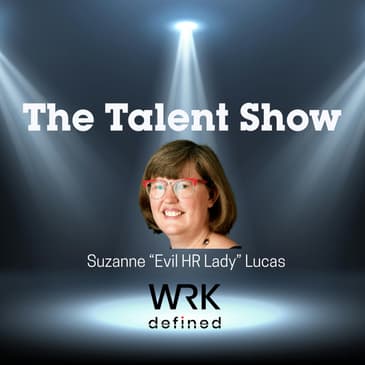
Suzanne Lucas is known far and wide as the Evil HR Lady - which is sort of like referring to a mafia hitman as the murderous hit man. Yes, we know, taking people out is your job. Though in fairness to hit men, they’re more efficient than your typical HR professional, and leave a far lower body count.
But Suzanne is not your typical HR professional or, more precisely, HR consultant. Unlike most competent, well-meaning, albeit deeply unfunny HR people (with apologies to HR people), she brings humor to her work…and by that I don’t mean that she’s just funny, which she is...she actually uses improv comedy in her HR workshops, when she’s not doing it on stage.
Suzanne joins us today from her home in Basel Switzerland, the Borscht Belt of Mitteleuropa (well, not exactly), to talk about her passion for improv comedy, how she uses it in her consulting work - and, demonstrate her chops with Tom as her intrepid improv partner (he came prepared, though add a level of complexity for trying to do improv over a Zoom call!).
Powered by the WRKdefined Podcast Network.
[00:00:00] Stay ahead in a changing economy with Visier's Workforce AI Edge. Optimize your workforce and thrive in an AI-driven world with Visier's real-time people data platform. Visit visier.com to learn more.
[00:00:26] Susanna Lucas is known far and wide as the evil HR lady, which is sort of like referring to a mafia hitman as the murderous hitman. Yeah, we know it's your job. Bumping people off is what you do. Though in fairness to hitman, they're quicker and more efficient than your typical HR professional. Maybe it's fair to say that. But Susanna is not your typical HR professional or more precisely, HR consultant.
[00:00:55] Unlike, oh, I don't know what, 98% of HR people, she brings humor to her work. And by that, I don't mean that she's just funny, which she is, but she actually uses improv comedy in her HR workshops when she's not doing it on stage. That's right. You heard right. Susanna joins us today from her home in Basel, Switzerland, to talk about her passion for improv comedy.
[00:01:22] And if we're lucky, even demonstrate some of her chops. We'll be back with Susanna Lucas right after these words. Have you ever wondered what really makes a generation tick? Who gets to pick the name and why the slang keeps changing? Don't worry. I can help. My name is Dr. Megan Grace. On Hashtag Gen Z, I share the voices and experiences of Generation Z, how they're different from other generations, what moves them, and why they do what they do.
[00:01:52] In each episode, we go beyond the buzzwords and the stereotypes to dive into real conversations and the insights that matter to making intergenerational collaboration a reality. You can catch Hashtag Gen Z on the Work Defined Podcast Network and wherever you listen to podcasts.
[00:02:16] I'm Tom Alexander and my guest is Susanna Lucas. She's talking to us all the way from Basel, Switzerland. Susanna, welcome. Thank you so much. I'm happy to be here. It is great to have you. And I have to ask, now you've been in Basel for almost 15 years. Where were you before and what drew you there? What and what keeps you there? Well, it depends on how much drama you want to know.
[00:02:44] I've been here for actually almost 16 years now. In April, it'll be 16. I came with my then husband, he's now an ex-husband's job. He got a two to three year contract with a pharmaceutical company here. And so who's going to turn down a chance to move to Switzerland, right?
[00:03:05] So off we came. And what kept me here is a treaty called the International Treaty on Child Abduction. So when we separated, I wanted to take the kids and go back to the United States and international law says, which is a good law. I'm not upset about the law existing. It's a good law that both parents have to agree or you stay where you are.
[00:03:34] And so my ex wanted to stay here. And so I was stuck. And I started my countdown until I could move when my baby turns 18, which is in a year and a half now. But that was when I started getting involved in improv.
[00:03:56] And I learned this concept of yes and which is you accept whatever is thrown at you and build on it. So I said, oh, OK, I'm stuck here. There's nothing I can do about it. Well, I could I could leave, but I'd have to leave my kids and I didn't want to leave my kids. So I'm going to build a life. I can't leave. So I'm going to build a life and I built one and it's fabulous. So now I don't know if I'll leave when my youngest turns 18.
[00:04:26] Wow. You love it. Love it that much. I do. It's fantastic here. Yeah. And you and I were chatting a little bit just beforehand. And you'd mentioned, you know, now for those folks, for those geography buffs or maybe even not necessarily buffs, but people who aren't maybe aware exactly where the town of Basel. First of all, I believe it's third largest city in the country behind. It might be. It might be second, but OK, it's definitely behind Zurich.
[00:04:55] I'm not sure how big Geneva is. Yeah, I. But Basel, Zurich and Geneva are the three top and I'm not quite sure where they fall. I should look. Right. Well, and we were joking. We say it's in the tri-state area. The tri-state area is France, Germany and Switzerland. The three languages, of course, you know, that are prominent in Switzerland are German, French and Italian. But you said you speak a little bit of German.
[00:05:22] I speak German. I learned German when I moved here. And I mean, I speak enough German. No one wants to hear me speak German, but I do speak. I speak for those of you that know how the language system works. I speak at a B2 level, but with a really bad accent. So, hey, you're trying. You get out there. You could, you know, if you get lost, you could find your way. If to order food, you can order food. You're OK.
[00:05:52] I can order food in any language. There you go. I've become very good at food ordering all over the world. Terrific. Now, I don't believe I got to say, I don't think I've ever heard anyone refer to Basel as the Borscht Belt of middle Europa. And I guess where you are, you know, is, you know, do we have strudel or croissant? But yeah, both.
[00:06:21] How is the comedy scene in Basel? You know, the international comedy scene is quite amazing and it hasn't always been. And so there's two different types of comedy. You have your stand up and your your improv. Yeah.
[00:06:43] And in the past five years, five years ago ish, five years ago, we started doing English speaking improv in Basel. And then there's two other German speaking improv teams, the Impro Lab and Impro Noten, who are just delightful people. And all of us are growing. Actually, the English speakers, we have a show tonight.
[00:07:09] And then the stand up comedy scene about four or five years ago, I guess for a comedian by the name of Teddy Hall, who's half Swiss, half Scottish. In the pandemic, he was living in London. Of course, everything shut down. He came home to Switzerland and he's like, there's no comedy scene here. And he said, I'm going to start one. And by golly, he did it.
[00:07:36] And one of the things he did is he said, I need other comedians. And so he started giving free stand up workshops. And with that, he has built this amazing comedy scene here in Basel. It's an English speaking comedy scene, which you might think, oh, that seems odd.
[00:07:59] But if you want to do anything outside of your small linguistic area, you got to speak English. Yeah. And so there's a limit to how far you can go if you're doing comedy in Germany. You're limited to Switzerland, Germany and Austria. If you speak English, you can do comedy anywhere in the world. So it's really a robust comedy scene. All different all different sorts of stuff going on. It's amazing.
[00:08:30] It's an amazing place. Yeah. Yeah. And, you know, you mentioned about some of the improv is in German. And I'm reminded of some of the, you know, the joke that Mel Brooks said, you know, the big German book of comedy is three pages long. But, you know, you power through.
[00:08:53] How did you get into, I know you sort of mentioned that, you know, you had to learn improv with the whole situation with your child and, you know, sort of staying in one place and curves thrown at you. So that informed being improvisational or extemporaneous. But how did you actually get into improv comedy?
[00:09:15] Well, how that started, one of my friends runs a theater company and she wanted to start improv classes. And so she found a teacher who had been trained through Second City out of in Toronto. Second City is a very prominent theater school for Saturday Night Live. Yeah. So she had been trained that way. She lives here in Basel. Her name's Jennifer Kane Birkmos.
[00:09:46] And so she said, hey, I've got this woman to teach. Please take a class. And I was like, and I said, honestly, I said, I'm an HR person. We're not funny. And she said, please, please, please. I just need people in the class. I know you could do it. And so I started the class because I'm a nice person who wanted to support my friend. And it turned out to be the best decision.
[00:10:15] And like I said, the whole concept of yes and, which is taking what's been thrown at you and building on it just resonated so much with me, not only on a personal basis, because like I said, I didn't want to be here. Yeah. The court said you have to stay unless your ex-husband gives you permission to take the kids back to the United States. And so, but it also within HR, so many people think HR is super powerful.
[00:10:45] Oh, the HR lady said this. The HR wouldn't let me fire them. The HR person made me fire them. The HR person is the one, the reason why you don't have that, that increase. None of that is true. None of that is true. HR doesn't have that kind of power. You know who determined what the increased budget was? Yes, finance did. Yeah. But nobody ever says, oh, finance said I couldn't have a big raise. It's, they blame us, right?
[00:11:10] So within HR, we have to spend a lot of our time building on decisions that other people have made. One of the things that's been really fascinating to me is watching this return to work thing that CEOs are pushing. And, and when you have HR fighting back, you have other leadership people fighting back.
[00:11:37] What happens is this disaster because the company becomes very divided. What a good HR person will do is behind the scenes say, here's my concerns, A, B, C, D, E, F, whatever. But once the CEO has made the decision, HR needs to be on board 100%. And they need to build on it from there. And if you can do that, then you can build a great company culture.
[00:12:02] But if you're fighting against that, if you're saying no, but instead of yes, and it's just as very, very destructive to, to the company. So all of those things work together. And I was like, oh, this is where I belong. Yeah, that's fascinating. You know, look, every comedian bombs. I mean, it's part of the process. You're aware of this. Improv is, is more than any form of comedy is really going out on a limb.
[00:12:30] Nothing's time tested, mother approved, if you will. You don't know what's going to happen one moment to the next. What's it like to be in the middle of an improv that's bombing? And for, I will ask you this just to go a step further for the benefit and amusement of all of us in the audience here. Feel free to share an example or two of utter and complete humiliation. Are there any of those?
[00:12:58] Are there any of those, Tom? Are there? There's one million of them. One of, one of the strong principles of improv is also fail with joy, because we know we're going to fail at some point. The absolute worst, worst, we were hired to perform at a company Christmas party.
[00:13:21] And it turns out that the employees were not thrilled about our presence there. So normally, when you're doing an improv show, people have purchased tickets to come see improv, right? So they're like, oh, I've spent money because I want to see improv.
[00:13:43] When you're doing a company Christmas party, and they had dinner, speeches by the executives, us, and then they had a band to do a dance. And I'm sure some drinks as well, right? And some drinks. Yes. Mm-hmm. The executives went on and on and on and on and on and on and on and on and on and on.
[00:14:12] They were supposed to have like five to 10 minutes. Everybody was like done. And so we're up there trying to pull things out of the audience. And one of the skits that that we were doing is you go around the audience before and have them write down words or phrases on a piece of paper. And then we put them into a hat.
[00:14:37] And then as we're doing the scene, you'll say like, and then my mother said to me, and you pull out the slip of paper and you read whatever's on it. And then you have to justify why that is. This usually kills. People just think it gets hilarious. It was just dead. And the things that these people had written on slips of paper were things like, Merry Christmas. And I like Christmas markets.
[00:15:06] And then another, Merry Christmas. Like it was just. Ryan, matter of fact. Nothing. Yeah. And we just tried our best. And the whole thing was like pulling teeth the whole way through. And I've never been more relieved to get off stage. I'm like, I am so done with you people. And the audience was thrilled to be done with us as well. Yeah. The feeling was mutual as they said. They were happy to be gone.
[00:15:35] And they wanted their band and their dance. And they wanted to talk with their friends. They didn't want a show. Now I have done other parties, other corporate parties where they were thrilled to have us. And they were engaged. And so I'm not saying don't hire improv people for your company holiday party. You can. You just got to make sure that it's something that your employees are actually interested in. These employees were not interested in it for whatever reason. I don't know why. It was terrible.
[00:16:03] That was my worst bomb. It happens. But again, a learning process and hopefully you grow from it. And that's how it all plays out, folks. My guest is Suzanne Lucas. And we're talking HR combined with improv comedy. I want to find out the idea of that. When did it occur to you? We're going to do that on the other side of this break. This is the talent show. I'm Tom Alexander. We'll be back with Suzanne right after these words.
[00:16:35] Optimize your business with a workforce, AI edge powered by Vizier. Make smarter decisions and achieve better outcomes with real time. AI insights delivered to every people leader. Explore more at Vizier.com. Back on the talent show. I am with Suzanne Lucas today and we are talking HR and improv comedy.
[00:17:04] When did it occur to you, Suzanne, to combine improv comedy with the HR world? What did you expect to accomplish and what was the reception? Well, as I said, I started to see these parallels with the building on the yes and some other principles of improv comedy are those of service.
[00:17:28] Where your goal as an improv comedian is to make it as easy as possible for your scene partner. Yeah. So to do that with an improv, we use big hands gestures. We use over exaggerated emotions. We don't say, oh, what did you do last weekend? You say, I cannot believe you ran off and got married last weekend, Tom, for this woman you've known for a week. What were you thinking?
[00:17:57] Like, because if I say, what did you do last weekend? This puts all the pressure on you, right? You have to come up with something. But if I say, I can't believe you ran off and got married to a woman you've known for a week, then you can build on that and be like, well, yes, but she was so beautiful or whatever. And I build on those things. And those things are very integral to how HR functions.
[00:18:21] So if you come to me as your HR person and say, hey, Suzanne, my boss is sexually harassing me. And if I say to you, what would you like me to do? That puts all the pressure back on you, right? How are you supposed to know what you'd like me to do? Do you know the law around it? Do you know what company policy is? Do you know what the options are? Probably not.
[00:18:49] And so instead I say, okay, I can do A, B or C, or this is what I'm going to do. Some things, you know, oftentimes when people report stuff to HR, they're like, I don't want anybody to get in trouble. I just wanted you to know. So, well, speaking from a US perspective, because even though I'm in Switzerland, my target market is the US. My clients are all US based.
[00:19:16] Once I as an HR person know about it, I have to act. That's the law. I have to act or the company becomes liable. So if you come to me and say, hey, my boss is sexually harassing me, I have to do something about it. And so even if you say, I don't, I just, I just wanted you to know, I didn't want anything to happen. I can't. So I need to tell you, okay, so this is what's going to happen. I'm going to do some investigation.
[00:19:43] And if your boss is a senior person, I'm going to hire someone from the outside to come in and do that. Or I'm just going to tell you whatever is going to happen. This is an act of service. I'm making it easier for you. So often we feel like we're making things easier when we give people, you know, the ability. Well, what do you want me to do about it? I can do whatever you want. Well, they don't know what the options are. And so I immediately saw these connections.
[00:20:11] And like I was saying with my improv instruction, Jennifer Kane, she's not just the second city trained improver. She's also the CEO of a tech company. And she had been using these principles with her staff for years.
[00:20:33] And so I was able to learn from her and work with her to help develop some of the things that I teach and do. You know, she's on a business side. I'm on an HR side. And it was really great to put that all together.
[00:20:49] And so now when I train HR people, when I speak at conferences, I will always incorporate some sort of improv into it because it's such a good foundational principle for how we as HR professionals should operate. Very interesting. Very interesting. Some of the scenarios you present in workshops, I'm sure they vary.
[00:21:14] And I'm wondering if maybe you and I might be able to play one or two of these out. If I if you if you were going to try to get me to go into a little bit of a improvisation, comedic improvisation with you, how would we start? Sure. Well, there are several things that I do. And if I'm doing a conference is composed to a workshop because they're different things being on the stage, giving a speech versus being in a group where I'm going to make you do exercises.
[00:21:43] I always bring people up on stage, though. So one of the things that I do, which I'm not going to make you do here, is we'll tell a story one line at a time. I'll get a group of people to tell a story one line at a time. And you have to start every sentence with yes, but so I say Jane went to the store and you say, yes, but the store was closed.
[00:22:09] And then I say, yes, but she was out of milk and you just go on with the story and then we'll flip it and do another story. But instead of saying yes, but we say yes. Yes, and. And when you see that difference, what happens is nothing ever happens with the yes, but you're always stuck. Right. Because you can't move forward because anything you try, the next person is going to but it.
[00:22:37] Yes, but, you know, Jane really needed, you know, milk. Yes, but they were out. So, yes, but Jane decided to buy, you know, Coke instead. Yes, but the Coke had too much sugar. Like there's never anything moving forward. There's no solution. Yeah, there's no solution. But when you yes and you can find a solution, you can get Jane her groceries or. Let's try a yes and let's just just do it. Sure. Let's try a yes and. All right.
[00:23:05] So, um, Jane went to the store. Yes. And she got there by walking backwards. Yes. And people thought that was rather strange. Yes. And we have to remember that it's a Saturday when it's legal. Yes. And Jane went into the store to look for new shoes.
[00:23:31] Yes. And she also wanted to find some socks, but they were out of socks because the silk manufacturer went out of business due to the fire. Yes. And Jane was still very sad about that fire. Yes. And the fire was started by a four year old boy who is playing with matches when his grandfather told him he shouldn't. Yes. And it was all over the news.
[00:24:02] Yes. And perhaps we should stop because I don't know what to say next. You don't have that option. No, we don't have that option. We just have to keep going. Right. Keep going. But that's how, but that's, that's generally the play. That's just kind of how it works. It gets people to think in real time. In real time.
[00:24:24] And so another game that I play is one called headlines, which is we're going to give headlines. And the trick is the first word of your headline has to be the last word from mine. And the reason why we do this is because when we communicate as humans, we spend most of our time while we're talking,
[00:24:53] we're going to be thinking about what we're going to say next rather than listening to what our companion is saying. And by forcing you to start with their last word, it forces you to actually listen to what the person you are talking with is saying.
[00:25:16] And this is a really good technique for HR and management leadership to stop and listen to what other people are saying. You've probably heard of this act of listening where they're like, you're supposed to say, so what you're saying, Tom, is that, and I find that to be so incredibly condescending. I just grates on me.
[00:25:40] But if I instead am just waiting until you're done to start thinking. Now, if I was trying to do this surreptitiously in a meeting, I wouldn't start with your last word, but I would force myself to start with the last letter of your last word. So it makes me want all the way through, but also gives me that flexibility.
[00:26:03] But let's do a headlines thing. So I'm going to give you a, a headline, which is scientists find sparkling water to be the best source of hydration. Hydration is overrated. I prefer to live a dry life.
[00:26:30] Life or work? Do they really have to be separate? Separate. Separate is for food groups, food groups. I don't know what the hell I'm saying. But you notice there's a little pause between each one of us. Yeah. Yeah.
[00:26:56] And that's OK. Culturally, we're kind of uncomfortable with pauses in conversations. Yeah. Awkward silence, they call it. Right. You're right. Because we're so used to thinking about what we're going to say while the other person is speaking. Yeah. So this is a force force you to stop and listen to everything before you speak.
[00:27:22] It does make you do that. And, you know, it's funny because I just I just had a self realization in that moment. All right. In doing this with with you, this exercise. I play jazz piano. And when I play a tremendous amount of it, 80 percent is improvised and I can improvise all day long when I'm behind a keyboard. Now, part of that is through.
[00:27:53] Years of experience and but also the ability to let go when I was on the spot here. Improvising with you in a different medium. It was much harder for me. I could do it for a few seconds, but not for a long period of time. Now, maybe with experience, I get better at it, but it is not the same part of the brain.
[00:28:18] At least I think I don't think it's the same part of the brain that improvises this form of improvisation versus music. So it's just just one of those observations I made in real time here as we're talking, because it's a real different expert discipline for me entirely. Well, it is a real different discipline and I'm a pianist, but I don't do jazz. I I need those notes. Yeah.
[00:28:44] In front of me, I'm a really good sight reader, so I can I can play. And when I say really good, I mean, I'm a terrible pianist, but but I can. I'm good at sight reading. I'm the opposite. I mean, I can't really read. I can read charts a little bit. The notation forget, but I can. Yeah. So it's a complete it's a completely different skill.
[00:29:06] So if you wanted me to sit down at the piano and and improvise on the piano, it would take me a long time to learn how to do that. And and like you said, you know, you can maybe read the note charts and you know what chords go together. Like I never learned all of that technical stuff. I learned to look at a page and reproduce it with the with the keyboard. Right. And could I learn to play jazz piano?
[00:29:32] Absolutely. Could you learn to do improv comedy? Absolutely. It is all about stretching your brain. And I also I teach improv comedy now as well, not just from an HR standpoint, but just a basic, a basic improv classes. And almost everybody that takes my class is doing it not because they want to be an improv comedian.
[00:30:02] They're not doing it to be on the stage. They're doing it to stretch their brains and to become better presenters and to become better at having conversations with people and learning how to think on your feet because it's all of those things. And it's done in a very fun environment where it's OK to fail. So often we're so scared of failure, but failure is is baked into to improv.
[00:30:31] That's it's just part of it. It's just how it goes. Yeah. Well, I've seen stories many times about on Saturday Night Live where they'll do dress rehearsal and something a bit will kill in dress rehearsal. And then when they do it on the live show, it fails or vice versa. They just kills and dress and then just just bombs horribly when it's on the air. So you never know. It could be the audience.
[00:30:58] It could be the moment what's in the air, whatever happens. It could just be one person gets off off rhythm a little bit and it just throws the whole thing into the, you know, into the grinder. It's just you just never know. But we do want to ask you one more question. We've got to take a quick break first. This is the Work Defined Podcast Network. And you're watching and listening to The Talent Show. My guest is Suzanne Lucas. I'm Tom Alexander. Back in just a moment. Hey, everybody, it's Libby again with fearlessness.
[00:31:28] So what's fearlessness? It's that underlying grit that empowers us to forge ahead, even when hope seems distant. It's the courage to walk through those fires of hell, knowing that we're going to come out better and stronger on the other side. Stay tuned and learn how to get fearlessness. Back with Suzanne Lucas on The Talent Show. You know, Suzanne, just wrapping things up here.
[00:31:56] You know, for the past 18 years, your primary brand has been Evil HR Lady. Now, you re... That's a great name, by the way. You recently changed it, though, to Improv... Improve, I should say. Improv or improve. Same thing. Improve your HR by the Evil HR Lady. Why the change?
[00:32:25] Because I have really started to feel like the world has gone so negative. Everybody's angry all the time. And I think back in 2006, when I adopted the Evil HR Lady moniker, it was a joke and everybody got it, right? It was just funny. And it is still funny. And I am a huge fan of funny, as you know.
[00:32:49] But I really started to feel like so many people are just so miserable. And a lot of times they're miserable because they refuse to accept what's going on and building on that. And so I really wanted to focus on positive things rather than negative things.
[00:33:16] And additionally, when I started Evil HR Lady, my target, my idea was I would help normal employees know what was going on behind the scenes in HR. So I'm going to be the HR person that sneaks out and tells you what's going on. And I've changed. And now my focus is on training HR people.
[00:33:42] And I still love to explain what's going on to normal employees. But my main focus now is to help other HR people succeed in what they are doing. And so I really thought that the improve your HR really built on that. Plus, then it also goes with the improv your HR, which I also do, which is the focus on improv comedy within an HR environment. Yeah. Yeah.
[00:34:11] And I'll tell you, I think this has a very interesting either book or web series or something, you know, queued up for you because it's fascinating.
[00:34:26] And I think more people, more HR folks can certainly benefit from this because it does have the reputation, if you will, being a tad dry and doesn't actually come power packed with humor and jokes and levity.
[00:34:47] So, so it's probably a good idea that, you know, maybe more than just, you know, a very small percentage of folks tap into this great resource that you're providing. I think, I think we got to get more people doing, following the Suzanne Lucas model here. Absolutely. Absolutely. They should definitely, more people should follow me. Invite me to come speak at your conference. I have a passport. I know how to use it.
[00:35:15] So I'm willing to go, go anywhere. I'm negotiating right now a speaking gig in Australia, which I hope goes through, but I'm afraid my price is too much for them just because I'm like, listen, if I'm going to fly all the way to Australia, I got to have a business class ticket. I, I, well, listen, that's a, that's a schlep. You need to be in business for that. That's what I say. I fly to the U S coach all the time. That's not a big issue. I mean, if you want to pay for a business ticket, I'll happy to come on a business ticket.
[00:35:42] But I was like, I can't go all the way to Australia and coach not, not to show up and then be able to speak. It would take me four days to recover. Right. But I'm happy to speak at people's conferences. I'm happy to communicate. You can follow my improv, your HR newsletter on LinkedIn. Um, you can join my Facebook group, which is improve your HR. Um, if you're an HR professional, we do screen.
[00:36:09] Um, and there's always my website, evil HR lady.org. Evil HR lady.org. There you go, folks. Plenty to learn plenty to absorb and plenty to laugh about, hopefully. And, uh, that's important. Humor is important. As they once said years ago, laughter is the best medicine. And I wholeheartedly agree. Absolutely. There too. I would put music right there as well. Suzanne, we really appreciate it.
[00:36:39] Thank you so much for your time. Thanks so much for having me. It's been super fun. Suzanne. Suzanne Lucas. There she is. The evil HR lady herself. I don't think she's too evil. I think she's, she is the, uh, the, what was the opposite of the wicked? The good witch of the North, you know, or the good witch. Was she from the, from the north? Yeah. Where was she? Where was she on the, well, it was, she wasn't the wicked witch of the West that I
[00:37:08] know that much, but Glenda, well, that was her name. I had to think I went the wicked movie out now. I had to like, you know, figure out what the, I'm just going back to the land of Oz. Anyway, there she is. Suzanne Lucas. Suzanne. Thanks so much. And, uh, hopefully we'll see you again sometime soon. Hopefully. And I guess in the language that's near and dear to your heart. Auf Wiedersehen. Auf Wiedersehen. You know. This is the talent show. I'm Tom Alexander. Thanks for listening. Thanks for watching.
[00:37:38] We'll see you again soon. So long, everybody.
Sponsors
