
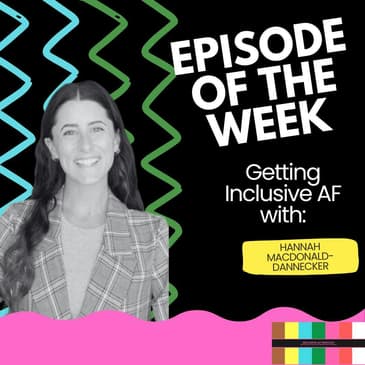
Join us as we get inclusive AF with Hannah MacDonald-Dannecker, managing partner of Better Together group! 🌍✨ In this compelling episode, Hannah dives deep into the mission behind her company’s staffing and consulting divisions, shares strategies for finding top talent in challenging industries, and offers invaluable advice on overcoming imposter syndrome.
Discover the story behind her book, "Well Shit Time to Grow Up," as well as her journey of personal and professional growth during the pandemic. Hannah also sheds light on the unique challenges faced by Gen Z in today's evolving workforce, and the technological advancements reshaping the industry.
Don't miss Hannah’s insightful perspectives on leadership, communication, and bridging generational gaps. Whether you’re an emerging leader or curious about the future of work, this episode promises to inspire and inform. 💡
📌 Key Topics:
- Better Together Group's mission and services
- Staffing in niche and technical industries
- Overcoming imposter syndrome
- Personal growth and career transition
- Gen Z workforce dynamics
- Technological advancements and their impact
- Management tips and resources
▶️ Tune in now for an episode packed with insights and inspiration!
🔗 Connect with Hannah:
LinkedIn: Hannah McDonald-Dannecker
Email: hannah@bettertogethergroup.com
#InclusiveAF #Podcast #BetterTogether #StaffingSolutions #LeadershipAdvice #GenZWorkforce #CareerGrowth #ImposterSyndrome #TechInWorkplace #HannahMcDonaldDannecker #PersonalGrowth #FutureOfWork #LeadershipTips
👉 Don't forget to like, comment, and subscribe for more inclusive content! 🛎️
🎧 Listen to the full episode on your favorite podcast platform!
Powered by the WRKdefined Podcast Network.
[00:00:00] You're listening to Inclusive AF with Jackie Clayton and Katie Van Horn.
[00:00:09] All right, all right. Hi, Jackie.
[00:00:12] Hello, Katie. How are you doing?
[00:00:15] You know, I'm living the dream. It's cooled off in the morning here.
[00:00:19] Yes, it's still 93 degrees right now, but, you know, at least the mornings are cool.
[00:00:24] So I am a very happy person because I can get out on the mountain and hike.
[00:00:28] So that's really all that matters.
[00:00:30] Well, my life has crossed a bridge of sorts.
[00:00:34] We have to run now with headlamps and it looks just about as cute as you thought.
[00:00:41] I love that.
[00:00:42] But see, what you can do is like my neighbor has headlamps for their dogs.
[00:00:48] So you just need to figure that part out of like how to take the dogs with you
[00:00:52] and get them their own headlamp, which is also hysterical because you'll like be sitting
[00:00:58] and see like a light flashing, like someone's putting a flashlight at your house.
[00:01:01] You're like, oh, no, that's just the dog.
[00:01:03] Like, hi.
[00:01:04] Walk me fast. It's fine.
[00:01:07] But yeah.
[00:01:08] So, hey, you know, this is the Inclusive AF podcast.
[00:01:12] We are two weeks out from the election.
[00:01:17] And I think the things that we will remind you all of again and again and again is please go vote.
[00:01:24] If you have not registered to vote, get on it.
[00:01:28] I think there's still a few states where you can register and vote.
[00:01:32] Texas opened up their voting today or this week.
[00:01:37] That's awesome.
[00:01:38] My little baby town has had the biggest turnout ever of all time.
[00:01:42] There's already been there's just under 150,000 people in Waco, Texas.
[00:01:48] And right around 67 people, 6,700 people have already voted in the first few days.
[00:01:55] That's amazing.
[00:01:56] That's amazing.
[00:01:56] All right.
[00:01:57] We're I Hannah, we're bringing you in now and we're going to probably continue about voting for
[00:02:01] just a bit.
[00:02:02] But first, Hannah McDonald is with us.
[00:02:05] Hannah, please introduce yourself and share a little bit about who you are.
[00:02:08] Yeah.
[00:02:09] So my name is Hannah McDonald Daniker.
[00:02:11] I come from the Better Together group of companies.
[00:02:13] I'm our managing partner, but it's a family business.
[00:02:16] So I was I tell people that I was raised in the industry that I teased on transportation,
[00:02:21] but I grew up in it and came into it in the midst of the pandemic and immediately absolutely
[00:02:28] fell in love with what we were doing.
[00:02:29] And so I never, never looked back, never spent, never, never spent another day trying to do
[00:02:35] anything else.
[00:02:36] Awesome.
[00:02:36] And where are you in the world?
[00:02:38] I'm in Orlando, Florida right now.
[00:02:41] So all right.
[00:02:42] We're covering coast to coast today then folks.
[00:02:44] Yeah, we are.
[00:02:45] Darn near.
[00:02:46] Yeah.
[00:02:47] So all right.
[00:02:48] So voting, let's talk about it a little bit.
[00:02:51] So I think these text messages might send me over the edge.
[00:02:59] And I know I just mentioned this, but the messages have gone down since I've mailed in
[00:03:03] my ballot, but it's still a lot of messages.
[00:03:07] A lot, a lot, a lot.
[00:03:09] Wait, we should preface.
[00:03:11] So Katie is basically holding you responsible for everyone that is a millennial and text messaging
[00:03:20] in this.
[00:03:21] No, no, no.
[00:03:21] Is this, is this what's going on?
[00:03:23] You're blaming me for it?
[00:03:24] Generational.
[00:03:25] Generational.
[00:03:26] No, no, no, no.
[00:03:27] That is what I am blaming.
[00:03:28] I am blaming all of the people running for office.
[00:03:31] Like I'm getting stuff for like, hey, in Florida, vote for X, Y, and Z.
[00:03:35] And I'm like, I'm in Arizona.
[00:03:37] I'm registered.
[00:03:37] I don't understand what's happening.
[00:03:38] But, but I am supportive of all things going on in Florida.
[00:03:43] You got some good stuff going on there.
[00:03:45] So it's good.
[00:03:46] But what, what, you know, you are our Gen Z expert today.
[00:03:51] So tell us a little bit about where the Gen Z vote is, where, where's, what is everyone
[00:03:56] thinking about?
[00:03:57] That's such a good question.
[00:03:58] And I wish I had an answer for you, but I, I just don't, I don't have anything that
[00:04:03] is backed with anything on this one.
[00:04:06] I admire from afar, but unfortunately I'm a Canadian raised individual.
[00:04:12] I moved to the U S really recently.
[00:04:14] And so I'm very much still learning about everything and don't want to take a stance
[00:04:20] on anything at this moment.
[00:04:21] So I, I, yeah, yeah.
[00:04:23] I'm not actually sure.
[00:04:24] I hear you.
[00:04:25] Okay.
[00:04:25] Well, I made one.
[00:04:27] I made a, I made a millennial born in 2000.
[00:04:32] So right in there on the cusp.
[00:04:34] That's why they refer to themselves as a zillennial because they're kind of millennial.
[00:04:40] And I have sweet baby TJ.
[00:04:42] He was born in 2003.
[00:04:43] I could tell you one thing that has really been interesting in watching this is that like,
[00:04:50] I love that your shirt's better together.
[00:04:52] And that's the bunch of companies, the companies and the conglomerate, because it really feels
[00:04:57] like they, people know that we're better together.
[00:04:59] They are feeling like we need to bring the world back together and having those things
[00:05:03] together in really big ways and more accepting like a various groups than we've ever seen
[00:05:09] before.
[00:05:10] Which has been nice to hear.
[00:05:13] Um, I am not taking a firm stance, but like I said, like I'm not a member, but I did make
[00:05:17] two.
[00:05:18] So I feel like it makes me kind of an authority.
[00:05:21] Just absolutely.
[00:05:23] Without a doubt.
[00:05:24] I would say it's just a little different kind of across Canada and the U S very different
[00:05:29] opinions from different generations.
[00:05:30] Uh, which I think just kind of goes back to the way that they were raised from the country
[00:05:34] that they're in.
[00:05:34] But yeah, absolutely.
[00:05:37] Absolutely.
[00:05:37] So tell us a little bit more about what better together does kind of what you're focused
[00:05:42] on.
[00:05:43] Um, you know, if, if there are different, what are the different groups focused on?
[00:05:47] Yeah.
[00:05:48] So we have a couple of different groups.
[00:05:50] We've got revolution staffing, which was the first one that was ever created.
[00:05:55] And my father started that 20 years ago.
[00:05:57] And the whole goal there was that he was watching my father-in-law who was a truck driver drive
[00:06:03] in the way that he was being treated in the industry.
[00:06:05] And unfortunately, truck drivers have just historically not been treated with the most
[00:06:10] respect that they are due.
[00:06:11] And so he started the agency with the hopes of revolutionizing the way that people saw
[00:06:17] the transportation industry.
[00:06:18] So that's where revolution was born.
[00:06:20] And the one that, that I truly, um, that I truly love.
[00:06:24] I feel like I was raised in that company for, for sure.
[00:06:27] And then in about 2018, they had had enough conversations with people who were like, Dave,
[00:06:34] we love you.
[00:06:34] We love working with you, but dang, could you just help us in the warehouse?
[00:06:38] Could you just help us outside of the truck?
[00:06:41] You're so good at that, but that's all you're doing.
[00:06:43] And so essential staffing was born and originally their goal was to do everything, but, but a couple
[00:06:49] years after that, uh, help unlimited was up for sale and help unlimited was the first
[00:06:54] company that my father ever worked for that taught him the staffing industry.
[00:06:59] And so he was like, Oh, my alma mater.
[00:07:01] And I have to go back to it.
[00:07:03] So he purchased help unlimited and help unlimited origins have always been specifically labor.
[00:07:09] So that forklift operator kind of role that general, general labor picker packer type of
[00:07:15] person.
[00:07:15] And so we really honed in on that, took everything from essential that was there.
[00:07:20] And then, uh, essential staffing turned into office personnel.
[00:07:24] So that could be anybody like myself.
[00:07:27] It could be a salesperson, someone from marketing accountants, different things like that.
[00:07:31] But we go across a couple different, a couple different things.
[00:07:35] And then the final portion of the better together group that rounds us all out is the better together
[00:07:40] group consulting division.
[00:07:42] So we have a payroll service that we offer to people.
[00:07:44] And then we also do consulting on stuff that if you don't work with agencies, um, but you
[00:07:50] still need some help, we will come alongside with you.
[00:07:52] We'll partner with you because we're better together and, uh, support you wherever that
[00:07:56] looks like.
[00:07:58] I thank you for going through that and telling us a little bit more about those.
[00:08:02] I love the beginning of the story when you're talking about the trucking industry and getting
[00:08:06] those like very specific.
[00:08:08] And that has been long held a market that people are like, how do you do it?
[00:08:13] How do you get in?
[00:08:14] How do you find truckers?
[00:08:15] It's always been like, oh, you put a, put a poster in the place or no, they're on the
[00:08:19] road.
[00:08:20] So put a, so, so, uh, again, we're going to hold you responsible for answering the question
[00:08:25] for everyone.
[00:08:27] Absolutely.
[00:08:28] You in Canada, Spain.
[00:08:29] Yeah.
[00:08:30] I'm going to find a trucker.
[00:08:33] A trucker.
[00:08:34] How do you do it?
[00:08:35] What do you do?
[00:08:36] Yeah.
[00:08:36] I mean, it's been like, you talked about some industries outside of the office, which
[00:08:41] is kind of how the personnel thing started, but you, you talked about some of the hardest
[00:08:47] industries in the market to staff and you love it.
[00:08:53] Love it.
[00:08:54] It is frightening.
[00:08:55] Say more.
[00:08:56] Say more.
[00:08:57] So, so I have this perspective and maybe it's because I was raised in staffing, but I have
[00:09:03] this perspective that every job is amazing to me.
[00:09:09] Every job, legal jobs, you know, we'll keep it at that.
[00:09:13] I'll, I'll leave a little bit of discretion on it.
[00:09:15] But if there is a job that somebody is doing, in my personal opinion, it is helping someone
[00:09:22] somewhere else.
[00:09:23] So give me, give me like a random job that you're like, it's so hard.
[00:09:28] Can never find them.
[00:09:29] It sucks.
[00:09:30] It's the most challenging thing.
[00:09:31] Do you have anything that comes to mind?
[00:09:35] Not ones that I can say right now.
[00:09:37] I was going to say, let me, I'm trying to think of some completely random, a engineer
[00:09:45] that works on a retired type of software or like a code of different, like an old code.
[00:09:54] ProBall.
[00:09:55] Amazing.
[00:09:55] Amazing.
[00:09:56] So, so good.
[00:09:56] So good.
[00:09:58] So the immediate thing that someone's going to think with that statement is, oh, it's
[00:10:02] retired and it's not, not a, not a regular software anymore.
[00:10:05] No one's using it anymore.
[00:10:06] Right?
[00:10:06] Like that's the concept that you think right away.
[00:10:09] But if you think about, well, the software that we're utilizing today would never have
[00:10:15] come to be without the software that once was.
[00:10:18] And the software that once was is still getting used to do lots of things in lots of places
[00:10:24] for people who don't currently have the availability to upgrade.
[00:10:28] So depending on what that software is, it could be anything.
[00:10:30] It could be a software that a grocery store uses to check people out.
[00:10:34] It could be a software that a transportation company uses to know what's getting shipped.
[00:10:39] Like it could be anything.
[00:10:40] Right?
[00:10:41] But if you take a really big step back and you go where that software is being used,
[00:10:47] the company probably doesn't have the opportunity to upgrade to whatever is newer.
[00:10:52] And they're frustrated because that thing that they're still using isn't exactly what they
[00:10:57] want it to be.
[00:10:58] This person allows that human to continue doing what they do.
[00:11:02] And that could be anything.
[00:11:03] It could be putting food in people's mouths.
[00:11:05] It could be delivering medical supplies to a hospital.
[00:11:09] Who knows?
[00:11:09] But I do think like if you take a big step back, you can see the beauty in most jobs.
[00:11:15] And so I have that ingrained in my heart.
[00:11:19] And when I get the hardest jobs, like truck drivers, like mechanics, like, oh my gosh,
[00:11:25] 310T mechanics, fridge truck mechanics, those are nearly impossible to find.
[00:11:29] Right?
[00:11:30] But if I can step back and talk to that human and say, do you know what you're doing?
[00:11:36] Like you're delivering the chicken that goes to the school that feeds the kids.
[00:11:42] Or you're delivering the milk that goes to the coffee shop that goes in every executive's
[00:11:48] coffee in the morning and gets them going.
[00:11:50] So everything they have to do gets done.
[00:11:52] Like it's just, I don't know.
[00:11:54] It's a mindset shift, but it makes it easy to keep doing the hardest ones every single
[00:12:00] day all day long.
[00:12:02] Awesome.
[00:12:03] So how do you find the talent that you're looking for to, you know, to fill these jobs?
[00:12:09] We never stop looking.
[00:12:12] So sometimes you take the real average approach, right?
[00:12:15] You've got all the job boards you can use.
[00:12:18] You've got Indeed.
[00:12:18] You've got Job Adder.
[00:12:19] You've got Monster, all those like similar things.
[00:12:23] You can do that.
[00:12:25] You can do social medias.
[00:12:26] You can try LinkedIn.
[00:12:28] You can try Facebook.
[00:12:29] Sometimes that can be really powerful because they have community groups that you can join.
[00:12:34] And if you can get yourself a part of communities, that is really valuable.
[00:12:39] There's lots of little things you can do like going to trade shows and putting signs at truck
[00:12:46] stops.
[00:12:46] But I think what we find most regularly is that referrals are phenomenal.
[00:12:51] If you can find a referral, you can find an employee who will really truly last a lifetime.
[00:12:57] But that comes back to your company.
[00:12:59] So are you a referable company?
[00:13:01] But that's, yeah, kind of a cycle.
[00:13:04] Oh, no.
[00:13:05] Oh, very cool.
[00:13:08] And so you wrote a book, Well Shit, Time to Grow Up.
[00:13:13] Tell us about that book.
[00:13:14] Absolutely.
[00:13:15] So I've done a couple.
[00:13:16] I'm actually just about to release my fifth book, which I'm really-
[00:13:19] Oh, wow.
[00:13:19] Oh, I beg your pardon.
[00:13:21] Yes.
[00:13:22] But this one is the Well Shit one.
[00:13:25] That's one of my favorites.
[00:13:26] She was my first.
[00:13:28] And she started as, in the midst of the pandemic, I was living in Florida, graduating university.
[00:13:35] I was a substitute teacher, living my life.
[00:13:38] It was great when the pandemic hit.
[00:13:40] And I was like, oh, my family lives in Canada.
[00:13:43] And I am legally not allowed to see them right now.
[00:13:46] Because if I cross into Canada, I have to go into 14-day quarantine and all those wonderful
[00:13:51] things.
[00:13:51] So I decided at that time to move back home.
[00:13:55] And I am so glad that I did, because it gave me the opportunity to live alone for the first
[00:14:00] time and to start my career.
[00:14:02] And it really kick-started a lot of phenomenal things.
[00:14:06] But in that time, I was struggling a lot just to process that the life I had once created
[00:14:14] was over, that it was not my doing.
[00:14:17] It was just a nature of what was going on in the world, and that I had to react to that in
[00:14:22] a specific way.
[00:14:23] And I had a lot of growing up that I needed to do in those first couple of months out of
[00:14:27] school.
[00:14:28] And it was hard.
[00:14:29] But I was alone in my own house by myself.
[00:14:33] And we couldn't do anything.
[00:14:35] In Canada at the time, we had a mandatory lockdown.
[00:14:38] So you couldn't see anybody.
[00:14:40] If you lived alone, you were allowed to legally go to one home.
[00:14:42] So I chose my parents' home, and I would visit with them.
[00:14:44] I could go to the office.
[00:14:47] But if I went to the office, I could be pulled over by a police officer who could ask for my
[00:14:53] designation to be out of the house.
[00:14:55] So all of these things were crazy and really weird.
[00:14:57] And it was like, what am I going to do with all of this time?
[00:14:59] I've got so much time now.
[00:15:01] I'm no longer a student.
[00:15:02] I'm no longer an athlete.
[00:15:03] All I do is 9 to 5, and then I'm done.
[00:15:06] And so I was like, well, I could write these in a diary.
[00:15:10] And I could give that diary to my kids one day.
[00:15:12] If I can write about what I'm experiencing and grow from it myself, I can feel much better
[00:15:18] about the hope that I can give it to my kids one day, and they could maybe learn from it
[00:15:22] or maybe not.
[00:15:23] But as I was going, all of my lessons revolved around other people and other things that different
[00:15:30] people had taught me.
[00:15:31] And I was like, well, I can't not share it with them.
[00:15:35] Like, that's a blessing, right?
[00:15:36] Like, to be like, wow, you've shaped and changed my life completely.
[00:15:39] Let me show you how.
[00:15:41] So I wrote everything out in a computer.
[00:15:43] And then, I mean, once it was in a Word document, it escalated very quickly into a book.
[00:15:49] And I couldn't help but publish because I just, I thought there was lessons there that I would
[00:15:54] find valuable.
[00:15:55] And oh my gosh, they're embarrassing.
[00:15:58] They're humbling.
[00:15:59] They are everything that you would find in a diary.
[00:16:03] But I think that they're valuable for people.
[00:16:06] So I had to let it go.
[00:16:08] Awesome.
[00:16:08] Awesome.
[00:16:08] And tell us about your other books then.
[00:16:11] Yeah.
[00:16:12] So after I did that, I was like, wow, that's not as hard as everyone thinks it is.
[00:16:16] And so I cut a roll.
[00:16:19] I really like to help share information with people.
[00:16:23] I've been blessed to grow up in an amazing home and incredible industries and meet phenomenal
[00:16:30] people who have blessed me with so much information.
[00:16:33] But I can't hold that to myself.
[00:16:35] So I have to do anything I can to get it out and make it accessible for other people so that
[00:16:40] they can use it should it support them where they're at.
[00:16:43] So the first one I made was how to get a job.
[00:16:45] What does that look like?
[00:16:46] You know, what do you do with a resume?
[00:16:47] How do you actually dress?
[00:16:49] What's going on?
[00:16:50] And then we did one after that about how to hire an employee with intentionality, integrity,
[00:16:55] and intensity.
[00:16:56] What does that look like?
[00:16:57] And what kind of questions do you ask that person?
[00:16:59] And how do you keep track of all those things?
[00:17:02] And then I wrote one about accidental leadership.
[00:17:05] I never really wanted to step into a place of leadership.
[00:17:09] And somehow I just rolled into it.
[00:17:12] But I see this around me with so many peers and so many people and so many companies that
[00:17:17] I walk into of individuals who were just great at what they did.
[00:17:22] And people started to look at them as leaders, but they didn't know how to manage those things.
[00:17:26] So that is a very short course and toolbook just for them.
[00:17:31] And it's like a resource that they can go back to when that person says, hey, hey,
[00:17:34] hey, how do I?
[00:17:35] They're like, hmm, give me a second.
[00:17:36] Let me pull this book out.
[00:17:38] And then the newest one, which I am so excited about, is my first kid's book of what I'm
[00:17:46] hoping will be a series of books that is targeted towards kids who are five years old and starts
[00:17:51] to share with them the joy of what careers could really be.
[00:17:54] So the first one is about truck drivers.
[00:17:56] And what does it mean to be a truck driver?
[00:17:58] Well, they really help the whole economy and world roll around.
[00:18:03] But how do you explain that to a five-year-old, right?
[00:18:05] So it's broken down into a really cute story with the best illustrations.
[00:18:10] And it's going to be so much fun to release.
[00:18:12] I can't wait.
[00:18:12] But that's, yeah, in a nutshell, there's a few of them now.
[00:18:16] Perfect.
[00:18:17] Awesome.
[00:18:17] And so the take that you have, the lens that you're looking through is through that Gen
[00:18:23] Z lens.
[00:18:24] So tell us a little bit about, you know, kind of what are some of the things that you share?
[00:18:28] What are some of the things that you focus on when you're meeting with leaders, when
[00:18:32] you're meeting with hiring managers, et cetera?
[00:18:35] Yeah.
[00:18:35] So I always go back to let's try and understand who they are, right?
[00:18:39] We don't really want to try and influence people until we first take a moment to grasp why
[00:18:45] they are the way they are and what made them that way.
[00:18:47] So we talk about three things specifically.
[00:18:49] We talk about technology, which has really shaped them as humans.
[00:18:53] We talk about globalization and human cooperation and what that means for them as people.
[00:18:58] And then COVID-19 and how that affected them and their journey.
[00:19:02] And really what that gets back to is technology is good.
[00:19:07] They do it well.
[00:19:09] Stop asking them not to use it.
[00:19:11] We say, look at the technology in front of you and look at the Gen Z in front of you.
[00:19:17] Gen Z in front of you because of the way that COVID happened, because of the way that human
[00:19:22] cooperation goes down and because of the way that technology has advanced.
[00:19:28] They kind of live in these offset worlds.
[00:19:30] They live in a physical world where I can pick up my water bottle and take a sip of it.
[00:19:36] And they live in a digital world where you and I are communicating right now.
[00:19:39] And most people just see the physical world and they don't see the digital world.
[00:19:46] And they see their kids in the physical world even when they're in what I would call their
[00:19:52] digital experience.
[00:19:54] And so oftentimes parents, leaders, managers, they look at people on computers, on cell phones,
[00:20:02] on whatever, and it looks lazy or the opposite of what it is.
[00:20:09] And they're not looking through the screen to the work that's truly being done.
[00:20:14] So that's kind of where we start and often where we end up at the end of it.
[00:20:18] We talk about why they are, what that means, and then for them.
[00:20:21] And we talk about the joys of it.
[00:20:24] You know, like, why is that amazing?
[00:20:26] They're going to come in as an entirely new generation.
[00:20:29] And all of them are going to have the skill to use technology.
[00:20:33] That's never happened before.
[00:20:35] For employers, that's so exciting because they can come in.
[00:20:39] They can adopt what they have.
[00:20:41] They can adopt what they will get in the future.
[00:20:43] They can help the other people around them learn.
[00:20:45] Like, there's so much value there.
[00:20:47] But then we talk about those barriers.
[00:20:50] Because that happened, there are some fundamental things that Gen Z doesn't know how to do.
[00:20:55] Because we were never taught that was necessary.
[00:20:57] And so in a lot of ways, employers are also going to have to come and stand beside them and say,
[00:21:02] Hey, it's not scary to shake somebody's hand.
[00:21:05] Let me go with you the first time we do it.
[00:21:06] And then you can do it yourself next time.
[00:21:08] And just kind of walk them through those fundamental steps.
[00:21:11] But I'm curious to see, you said you have two kids.
[00:21:14] Do you see any of that in kind of the way that shaped who they are?
[00:21:19] Yes, in weird ways.
[00:21:22] I say weird ways.
[00:21:24] My son, during COVID, was 16.
[00:21:27] It's like the worst.
[00:21:29] I don't even think we finished seeing what happened.
[00:21:33] Like, they couldn't go to prom.
[00:21:35] All of those various things.
[00:21:37] And my oldest was like 20.
[00:21:42] Yeah.
[00:21:43] We had 16, 18, 19.
[00:21:45] So then we went through like 21.
[00:21:47] It was the absolute worst time frame.
[00:21:52] So basically, both my kids hated me and my husband.
[00:21:55] And we couldn't leave the house.
[00:21:57] So that was cool.
[00:21:58] Yeah.
[00:21:58] Yeah.
[00:21:59] I think what was interesting was watching how, like, my son got his driver's license late.
[00:22:10] My oldest felt brave, like, moved to Brooklyn and lived by themselves.
[00:22:18] But it was a remote job.
[00:22:19] So it was, like, really weird.
[00:22:21] Like, you've been in the house for a full year in Brooklyn.
[00:22:26] And you haven't left the house.
[00:22:28] Like, it's been really weird, like, how we put all those things together.
[00:22:32] But I feel like we don't, we still don't know the impact of what that means.
[00:22:40] I think there's a part where it's like anything's possible.
[00:22:42] But at the same time, like, I can just figure it out.
[00:22:46] A lot of people change careers during that time frame, you being one of them.
[00:22:52] And also, like, you're right about stepping out of your comfort zone and doing those things.
[00:22:58] I was thinking about that the other day, about how we used to go to networking events.
[00:23:03] Like, there would literally be full networking events.
[00:23:07] And it would be, you know, North Miami Beach.
[00:23:11] Like, it's that.
[00:23:12] You would still meet 25 people.
[00:23:14] Now, you might meet, like, three people.
[00:23:18] You're on an online.
[00:23:19] Everything is doing, you know, doing those things.
[00:23:21] But there's so many things that we don't.
[00:23:25] Technology, you can't move during the speed of technology.
[00:23:27] I was laughing the other day.
[00:23:29] I don't even know if we can do it here.
[00:23:30] We put our thumbs up when we were talking on FaceTime.
[00:23:35] And then, like, the explosion.
[00:23:37] Oh, the, like, yeah.
[00:23:39] Like, what's happening?
[00:23:39] We kept doing the heart.
[00:23:40] And I was like, oh, my gosh.
[00:23:41] I don't even know what to happen.
[00:23:42] I can't turn it off.
[00:23:43] I don't know how you turned it on.
[00:23:44] Like, what's happening?
[00:23:45] The other day, John, I have another podcast.
[00:23:49] John Baldino from on Butt First Coffee.
[00:23:52] We asked him to turn the video around.
[00:23:54] We were at a conference.
[00:23:54] He was like, I don't know how to do this.
[00:23:56] He literally, we're live.
[00:23:56] He asked a person to help him, like, use his phone.
[00:23:59] It's like, how?
[00:24:01] And I was like, do you want it?
[00:24:03] This is after being lost.
[00:24:05] He was, like, calling from an Uber because he got lost because he went to the wrong place.
[00:24:08] Like, it is so fast.
[00:24:12] Do you feel like you had mentioned about, like, there's a group where everybody has the technology.
[00:24:18] But when you're talking to truck drivers and so they even have new technology for truck drivers where, like, historically or laborers where maybe they haven't used it before.
[00:24:28] Now they're being asked to.
[00:24:29] Oh, without a doubt.
[00:24:30] Those RF scanners.
[00:24:32] It's crazy.
[00:24:32] If you don't know how to use one of those things, you lock into a shipping receiving room and everyone's terrified.
[00:24:38] Yeah.
[00:24:39] It's wild.
[00:24:40] Automation is changing so much.
[00:24:44] Technology is changing so much.
[00:24:45] How do people reflect when they meet you?
[00:24:49] And I had another question earlier.
[00:24:51] Wait.
[00:24:52] So let's get back to you wrote a book about management.
[00:24:55] You were talking about how people don't have those things.
[00:24:57] That's one of, like, it's like a pain point for me and Katie with our various teams.
[00:25:02] And there's always new managers, emerging leaders.
[00:25:07] What tip would you give to somebody who either it's their first time to be in a stretch role as a manager or do you have additional resources that we could add in our show notes, like where to go so they could start learning?
[00:25:20] Of course, your book a million times.
[00:25:21] They probably need four of those.
[00:25:23] But some of the other things so that we can figure that out.
[00:25:26] Yeah.
[00:25:27] So absolutely.
[00:25:28] So I would say I have a couple pieces of advice that I would give that person specifically.
[00:25:33] One of my favorite pieces of advice that I give specifically to students as they're graduating, but anybody really is and would apply to this, is if you can find a way to be comfortable when you're uncomfortable, you will be just fine.
[00:25:50] If you can find a way to step outside of yourself and look back and calm yourself down in a moment where you are a little out of your depth, you'll be okay.
[00:26:05] But somebody said this to me a while ago, and it has completely shifted and changed my life.
[00:26:11] They talk about imposter syndrome and Gen Z specifically really struggles with imposter syndrome because of the pandemic, because they got taken away from all of those things because of technology and they didn't have to because of so many reasons.
[00:26:25] But 70% of people just in life struggle with imposter syndrome.
[00:26:29] And so specifically in this moment when you're stepping into this role, most often people think about imposter syndrome as like a stop sign or a stoplight, that it's the end of the road.
[00:26:41] But rather, when you start to feel imposter syndrome, I would suggest that you start to think about it as a warning light.
[00:26:48] Because you can step into anything and a warning light can go off.
[00:26:53] And that's reasonable.
[00:26:54] It's reasonable for your warning lights to go off when things are new, where things are scary.
[00:26:59] It's reasonable for you to say, I need to be aware of what's going on.
[00:27:03] I need to make sure my head is up, my eyes are open, and I am paying attention.
[00:27:09] But it's not reasonable to stop in the middle of the road.
[00:27:12] And so if you take that from fear and turn it into excitement, it can be like a really beautiful thing.
[00:27:23] Just within yourself to transition.
[00:27:26] But that would be my biggest piece of advice.
[00:27:28] And then go, I mean, find my father and I have a great thing that we do together.
[00:27:34] X to Z dot O-R-G is the website.
[00:27:37] You can find all of my books.
[00:27:39] I will give all of them to you for free.
[00:27:41] I just want to get the info into your hands.
[00:27:43] And we do lots of podcasts and recordings as well that could be pretty valuable for those people.
[00:27:48] I appreciate that.
[00:27:49] I mean, there's so many different things.
[00:27:52] And I feel like, you know, one of the things that's always funny, imposter syndrome, that's how powerful the brain is when you think about it.
[00:27:59] You're literally convincing yourself you're not doing the thing that you're literally doing.
[00:28:03] At the same, while you're doing it, telling yourself that you're not good enough to be able to do it.
[00:28:10] Mm-hmm.
[00:28:11] Yeah.
[00:28:12] It's crazy.
[00:28:13] It's like in your best moments when you're doing your greatest and you're accelerating the most, your body and brain just completely work against you.
[00:28:23] I love it.
[00:28:23] You're literally going on stage with like a thousand people audience and you're like, I shouldn't be going on stage.
[00:28:30] Bitch, you better get on stage.
[00:28:32] Because they invited you.
[00:28:32] You flew out here.
[00:28:34] You put that outfit on.
[00:28:35] You got through security.
[00:28:38] Yeah.
[00:28:39] And you're like, no way.
[00:28:40] Hop up.
[00:28:41] Yeah.
[00:28:43] Yeah, absolutely.
[00:28:44] Well, what about you?
[00:28:45] Have you, I mean, imagine you've stepped into some different roles.
[00:28:48] Do you feel like that would be a valuable piece to those people?
[00:28:52] I do.
[00:28:53] I mean, I don't think, and it's one of those things, and that's why I loved it.
[00:28:56] It was like, shit, it's time to grow up.
[00:28:57] Like, I don't think I ever was qualified for any job that I ever had.
[00:29:03] Like, fully 100%.
[00:29:05] Maybe most recently, 90%.
[00:29:07] We'll say.
[00:29:09] But like, you know, at age 47.
[00:29:13] Like, oh, and I still haven't, you know, figured those things out.
[00:29:17] So.
[00:29:18] Oh my gosh.
[00:29:19] That's insane.
[00:29:20] You know, but it changes.
[00:29:23] Like you're saying, it's like people are evolved.
[00:29:25] Like I brought up my kids.
[00:29:28] I'll say it again.
[00:29:28] I always say, you know, you were my first.
[00:29:30] You're my first.
[00:29:31] My oldest is now 24.
[00:29:34] You're my first 24-year-old.
[00:29:35] This is the first time that I've had a kid that was 24 that, you know, did all these things.
[00:29:40] And so I'm still learning.
[00:29:43] And maybe I'll get it in time for grandchildren to get it right.
[00:29:46] But I'm going to make mistakes.
[00:29:47] But I think if a manager, equally, if somebody said, it's okay, you're going to make mistakes.
[00:29:53] Make them fast.
[00:29:54] Make them loud so that you don't try to sweep them under the rug.
[00:29:57] And we can learn from those experiences.
[00:30:00] Yeah.
[00:30:01] We talk a lot at BTG about the concept of swinging the bat.
[00:30:04] It's like, just keep swinging.
[00:30:07] Like if I'm not going to get mad at you if you miss a couple balls, but if you throw the
[00:30:12] bat on the floor, we're going to have a problem.
[00:30:15] So just keep swinging, you know?
[00:30:18] Absolutely.
[00:30:19] Absolutely.
[00:30:20] So tell us a little bit about kind of what's coming up for you.
[00:30:23] What are you, you know, obviously new book, a kid's book, but what else are you excited
[00:30:28] about?
[00:30:28] What else are you thinking about as you kind of look for what's next for the business,
[00:30:32] all that good stuff?
[00:30:34] Yeah.
[00:30:34] So I am really excited.
[00:30:36] I just booked my first keynote presentation yesterday, actually.
[00:30:40] So I just got all the details about it today.
[00:30:43] So come see me in Calgary this May.
[00:30:46] I will look forward to it.
[00:30:47] And this is actually really special for me because my first presentation that I ever gave
[00:30:52] was two years ago to nearly the same exact date that it was scheduled.
[00:30:57] And it was in Calgary.
[00:31:00] So same city, two years later, the first time I came in to nearly crap in my drawers.
[00:31:05] I was so scared.
[00:31:06] And this time I'm excited to walk in and just feel so comfortable in an uncomfortable spot.
[00:31:13] But it's going to be so much fun.
[00:31:15] And yeah, I find a lot of joy just in really helping people connect.
[00:31:22] I laugh about it.
[00:31:23] I should have gone to school to be a mediator because there's something really special about
[00:31:27] being like, I know that you're an amazing human.
[00:31:30] And I know that you're an amazing human.
[00:31:33] And there's just something that's not clicking there in the middle.
[00:31:36] So what can we do to help that come together?
[00:31:39] And I mean, the more I get to give that presentation, the more I get to get in front
[00:31:43] of people and explain.
[00:31:45] And I'll give you a link for it.
[00:31:47] Send it out to your listeners.
[00:31:47] Let everybody have all the info.
[00:31:50] But yeah, the more lights I see in people's eyes go off saying, that makes so much sense.
[00:31:56] Oh, I finally get it.
[00:31:57] And that's, I mean, that's what fuels my fire.
[00:32:00] It's crazy.
[00:32:00] So I'm very excited to get back into it and just keep getting up on stage and talking to
[00:32:05] people.
[00:32:06] Awesome.
[00:32:07] And when you think about your career so far, what are the things, obviously you were,
[00:32:13] I'm assuming very close to your dad and, you know, in the business, all this good stuff
[00:32:16] and probably still are.
[00:32:17] But what, what is the, what are the one or two things that you maybe learned from him or
[00:32:23] that you've taken into your own career and now kind of practice?
[00:32:27] Mm-hmm.
[00:32:29] I think, and it's funny because most of these are our mottos, but I heard them as a
[00:32:36] kid when he was first starting.
[00:32:38] And then again, as, as an employee and a partner through the business, but he has something
[00:32:44] and you'll like this.
[00:32:45] It's a WTF motto.
[00:32:48] So you work hard, you tell the truth and you finish the job.
[00:32:54] And, you know, we're not always going to be so successful.
[00:32:57] We're not always going to be the winners, but if you can just WTF every day, you can
[00:33:04] walk into the next day knowing that it's, you've done everything that you can do.
[00:33:07] And I think that that is a really, it's a healthy thing when you're working with your
[00:33:12] family's business, because sometimes it just doesn't feel like enough.
[00:33:16] And it's like, no, no, no.
[00:33:17] Did you, did you WTF?
[00:33:19] WTF?
[00:33:19] Yes.
[00:33:20] Then that's, that's all that you can ask for.
[00:33:22] And that started when I was a kid about doing the dishes and continues today to contracts.
[00:33:27] So it's, it's funny how it translates.
[00:33:30] I'm stealing that.
[00:33:31] Please do.
[00:33:31] I love that.
[00:33:33] I want that on shirt.
[00:33:35] We have them on shirts.
[00:33:36] I'll send you one.
[00:33:37] Beautiful.
[00:33:38] Love it.
[00:33:39] I love it.
[00:33:41] So what is one thing that you want to make sure people heard during this episode?
[00:33:46] One thing that you want to make sure that folks understand about kind of the work you're
[00:33:50] doing and, and, and, and anything, any good things that they, you want to make sure they
[00:33:55] heard during this episode.
[00:33:57] Sure.
[00:33:58] I would say, take a second and think about someone that you don't communicate well with
[00:34:05] someone that you feel like you bat heads with all the time, whether that's a Gen Z,
[00:34:11] whether it's a millennial, an X, a boomer, it doesn't matter.
[00:34:13] Um, there is probably much more similarity there between you and that human than you think.
[00:34:21] And sometimes if you just take a really big step back and try to understand where they're
[00:34:25] coming from and why they are the way they are and why they're saying what they're saying,
[00:34:30] it might help you kind of bridge that gap in the middle.
[00:34:33] And it's, it's a powerful thing with Gen Zs, but it applies across everything.
[00:34:38] And every, every industry, there are always people who get frustrated with other people
[00:34:42] because we're humans and it's just nature.
[00:34:45] But yeah, that would probably be the one.
[00:34:48] What's the one thing that you guys took away?
[00:34:51] That's what we will do.
[00:34:52] Yeah.
[00:34:52] Jackie, you're up.
[00:34:54] Katie likes me to go first.
[00:34:55] So she can steal my ideas.
[00:34:57] And then say, oh yeah, same.
[00:34:59] And then that's what she likes.
[00:35:01] Um, I, I just am impressed about like making the pivot or making the change, like going
[00:35:07] to school, moving by yourself to this country, going into an industry that while adjacent,
[00:35:14] like not directly what you thought you were going into, like, um, just giving a chance.
[00:35:20] And it kind of goes along with what you just said about meeting people that are different
[00:35:24] or in situations that are different, but you might actually feel that spark or that light
[00:35:30] in your eyes of something that you never existed.
[00:35:32] As long as you're open to the, that change, give it a shot and see how it goes.
[00:35:36] So you might find your future career someplace where you never thought it would be.
[00:35:40] So I think I want people to take away that.
[00:35:42] And that Hannah's really nice and like really wants people to get the message across.
[00:35:47] I'm excited about go see and go see Hannah in Calgary.
[00:35:51] So that's like five things.
[00:35:53] So I like it.
[00:35:55] I was going to say free books too.
[00:35:57] So you can also get books from, from Hannah.
[00:35:59] So that's awesome.
[00:36:01] Um, so I, I think the, the pieces that I want to make sure folks here are really around what
[00:36:06] you're saying of just putting on a different lens for the Gen Z folks that are coming into
[00:36:12] your workplace of what they've experienced.
[00:36:14] Like we know that there are impacts that we, you know, have not realized yet, as Jackie
[00:36:20] mentioned for kids that grew up in the pandemic or during, you know, still kind of working
[00:36:26] through the pandemic.
[00:36:27] You, you know, you're in a city, you don't know you're, you're in, in a house by yourself,
[00:36:31] all of these things.
[00:36:32] And I think all of us have our own experiences and each one is so different, but what is
[00:36:37] that long-term effect?
[00:36:39] And, you know, the, what you mentioned about, you know, teaching them how to go shake hands
[00:36:43] with someone it's, you know, that type of stuff that, you know, for Jackie or I,
[00:36:48] um, I, well, Jackie knows I'm pretty much an introvert all the time when we're out in
[00:36:52] public, but you know, it is that, uh, that's pretty much like, that's something that I learned
[00:36:58] how to do as a child.
[00:36:59] But at the same time, you know, these are things that it is, how do we, how do we change that
[00:37:04] perspective, that lens that these are things that maybe folks have not experienced before.
[00:37:08] So, uh, do you remember, do you remember touching elbows in the pandemic?
[00:37:13] Oh yes.
[00:37:14] Oh yes.
[00:37:14] Yeah.
[00:37:14] That you, yeah.
[00:37:15] You said hello with the elbows.
[00:37:16] Yes, absolutely.
[00:37:17] Yeah.
[00:37:18] Which is, there are kids who'd be more comfortable doing that because that's what they know
[00:37:22] than shaking someone's hand, which is like twisting to think about.
[00:37:27] Well, and it's like, even just like masks.
[00:37:30] I, I mean, I, I thought about this the other day when I was in an airport and there were
[00:37:34] a bunch of people that had masks on and I was thinking, you know, if this was, you know,
[00:37:38] 10 years ago, five years ago, even, and someone was walking around or a group of folks were
[00:37:43] walking around with masks, I would be in a certain country or I, there would be something
[00:37:49] else going on, but now.
[00:37:51] You'd be thinking something.
[00:37:51] Yeah.
[00:37:53] So very, very interesting.
[00:37:55] But, uh, Hannah, where can folks find you?
[00:37:58] Uh, you can find me on LinkedIn.
[00:38:00] It's the best place.
[00:38:01] You can send me an email as well.
[00:38:03] Just Hannah at better together group.com.
[00:38:07] Uh, but then also that X to Z dot O R G has all the resources you could possibly need.
[00:38:13] So yeah, lots of ways to get in touch.
[00:38:16] Very cool.
[00:38:17] Well, Hannah, thank you so much for joining us.
[00:38:19] We appreciate you taking the time.
[00:38:20] Uh, this is Katie Van Horn and this is Jackie Clinton.
[00:38:24] Bye.
[00:38:29] Do you love news about LinkedIn, indeed Google, and just about every other recruitment tech
[00:38:35] company out there?
[00:38:36] Hell yeah.
[00:38:37] I'm Chad.
[00:38:38] I'm cheese.
[00:38:39] We're the Chad and cheese podcast.
[00:38:41] All the latest recruiting news and insights are on our show dripping in snark and attitude.
[00:38:48] Subscribe today, wherever you listen to your podcasts.
[00:38:51] We out.
Sponsors
