
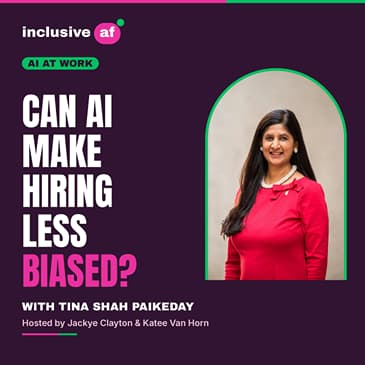
General purpose AI can be more biased than humans. AI built for hiring can widen the candidate slate and raise quality at the same time. Tina Shah Paikeday, Senior Advisor for Responsible AI at Findem, has tested both, and she explains what HR leaders should check before they buy.
Jackye Clayton and Katee Van Horn get into how to vet an AI hiring tool, why only about 5% of CHROs have real AI fluency, what new laws mean for anyone using automated hiring decisions, and how recruiters move from order taker to consultant.
Key Takeaways
General purpose AI draws on vast, unstructured data, and in Tina's testing it produced more bias than humans.
AI built specifically for recruiting can widen candidate slates and raise quality at the same time.
What goes into the data and the algorithm decides what comes out. Ask every vendor how theirs was built.
Hiring teams now need AI to sort through the flood of AI written applications.
Critical thinking and judgment are gaining value while tool specific skills lose it faster.
Of roughly 7,000 US CHROs Tina reviewed, about 5% showed strong AI fluency.
AI should make the recruiter role more strategic, not just faster.
The person you need may already work for you. Check inside before you post the job.
What you put into an AI tool can come back to you. Use tools with guardrails built for HR.
Hiring laws are moving from guidance to enforcement in New York City, California and the EU.
Timestamps
00:00 – Why general AI can be more biased than humans
03:36 – How AI can reduce bias in hiring
05:00 – How to vet an AI hiring tool
06:52 – The biggest hiring challenge: AI to sort through AI
12:17 – Only 5% of CHROs have AI fluency
14:33 – From order taker to consultant
20:27 – The scariest part: no guardrails
22:24 – Are your AI prompts protected?
25:54 – AI hiring laws: from soft law to hard law
27:27 – AI as a bias interrupter
Keywords
AI in hiring, hiring bias, responsible AI, recruiting technology, talent acquisition, AI regulation, CHRO, AI fluency, skills based hiring, HR technology
Before your next AI vendor demo, ask two questions: was this built for hiring, and how did you test it for bias?
Remastered from our original conversation with Tina Shah Paikeday, former partner and global practice head at Russell Reynolds.
Powered by the WRKdefined Podcast Network.
[00:00:00] But when we conducted our testing, and I think there have been other studies that have replicated this, what we find is that because large language models are drawing from vast and unstructured data sets, the level of bias that can be built into just how large language models are processing data actually results in more bias than humans.
[00:00:24] You're listening to Inclusive AF with Jackye Clayton and Katee Van Horn. Well, welcome to the Inclusive AF Podcast, folks. We're happy to have you. We have a wonderful guest with us today. And so I'm going to just go ahead and kick it over to you, Tina. Would love for you to introduce yourself, share a little bit about who you are.
[00:00:47] Great. Thanks so much for having me, Katee and Jackye. It's great to be here. My name is Tina Paikide, and I am the Senior Advisor for Responsible AI at Findem. Findem is a talent intelligence platform. We're about a six-year-old venture-backed company that's grown through basically providing insights through both data, business intelligence, and AI that powers our platform.
[00:01:09] Prior to joining Findem, I was a partner and global head of the diversity, equity, inclusion practice at Russell Reynolds. And in addition to that, I started my career at McKinsey, so bring a strategic lens to the work that I do. Very cool. So I'm going to ask you the question that I think I'm sure you get all day every day. When you think about AI, what is, you know, the most important thing on your mind? And then secondarily to that, how do you think about just bias that can creep in when it comes to AI?
[00:01:37] So the first part of that question I'll take pretty quickly, and then the second part is a longer answer because it's what brought me to the work. And so, you know, as I think about AI, I think about how rapidly it's evolving.
[00:01:47] I gave a talk just earlier this month on kind of four stages of AI. And I think that, you know, if we think about it as an assistant or a point tool to be able to help us do our work more effectively to, you know, really changing workflows and being able to process, you know, whether it's in recruiting many more searches at a time through this concept of a super worker to then being able to use it more autonomously to be able to run on its own.
[00:02:15] I think the thing that, you know, I think about and, you know, I haven't even talked about digital twins and when we can actually replicate human cognition, but being able to use it responsibly and ethically is probably top of my mind as it continues to progress probably faster than anyone would have thought.
[00:02:32] And so the second part of your question, you know, is what brought me to my work at Findem is, you know, the questions that I kept getting asked in executive search as it contemplated bringing AI into the work was whether I thought it would amplify or accelerate the biases that we know already exist in talent processes. Or, and I thought, you know, perhaps it could actually reduce and mitigate bias because it's helping us to make better decisions.
[00:03:01] And so, you know, I had a chance to look under the hood and do some experimentation work and compare human recruiting to AI-powered recruiting, whether that's through, you know, solutions that are domain-specific to recruiting and or large language models, and found that, in fact, those solutions that are focused on recruiting and powered by AI actually increase the diversity of slates while increasing quality at the same time. And I'm happy to talk to you about how does it do that, if that's helpful.
[00:03:29] Yeah, no, for sure. I think our listeners would love to hear that because I think it's front of mind for so many people. Yeah, yeah, no, it's quite interesting how it works. So first of all, I must say that in order to do it better, the data sets and the algorithms need to be built in the right ways. And so I think many of us know about cases from the past, even before the pandemic, where this has been tested and recruiting AI learned to penalize the word woman because it was fed a lot of male resume data.
[00:03:56] And the algorithms then were trained on that data. So it's important that what goes in will affect what comes out. And so if it's structured in the right way and really the AI algorithms or the algorithms that are making automated decisions are directed by humans to decide what are the important skills and experiences that we're looking for,
[00:04:17] then, you know, the data set can be evaluated much more consistently and without the kind of bias that humans bring when we use heuristics to make decisions. So examples of that are I might use, you know, proxies like the school somebody went to, the companies that they worked at, their job titles as proxies for skill evaluation. And what AI can do much better is it can actually use the data to understand what skills and experiences does this person actually have,
[00:04:46] as opposed to what their titles are to move us from what I call sort of fast, unconscious thinking to more slow, differentiated thinking. And that's based on, you know, the great work of Kahneman back from 1974. Awesome. I had a question. When you're looking at it, you had kind of mentioned about having to know that there is the right model. And so as people are going through this, just as fast as we're trying to have ethical AI,
[00:05:16] there are organizations that are doing the exact opposite. And so what do you tell people when they are trying to test AI tools, what to look for to make sure that this is not or that the assessment of a candidate is does have that ethics piece to it? It's a great question. The first thing I would say is that, you know, there's been a proliferation of the number of tools and what people have access to.
[00:05:43] So I'd like to make a big distinction between large language models or general purpose AI and domain specific AI. And I think I made the point earlier, but when we conducted our testing, and I think there have been other studies that have replicated this, what we find is that because large language models are drawing from vast and unstructured data sets,
[00:06:05] the level of bias that can be built into just how large language models are processing data actually results in more bias than humans. And so I want to be sure that as we're thinking about recruiting and talent decisions, that those who are looking to discern are focused on solutions that have been specifically designed for the talent domain, because those are the ones that are mindfully building these kinds of inclusive guardrails in place.
[00:06:34] And, you know, as you know, there's lots of regulation around this. I think that, you know, the New York Local Law 144 was the first to go in place. California FIHOP followed thereafter. And, you know, while the EU AI Act has been looming, some of the requirements go into effect in August of this year. Well, what challenges do you think people are just having with hiring? Like, we talk about the AI part, but we have so much data. It's like wild.
[00:07:02] And so I know that that's a piece of it, that AI really can be helpful. But what else are you seeing? Like, what are the challenges that people seem to be having with hiring right now? Yeah, I think the biggest challenge, it's almost like we need AI to cut through AI because there's just such a proliferation for the number of candidates that are applying to each job. Part of that's, you know, part of labor economics.
[00:07:25] But in addition to that, it's just you're able to apply to many more jobs as a candidate by leveraging AI. And so almost what's necessary, right, is to be able to use technology to filter through those resumes as quickly as possible. I would also say the other thing that we look at quite closely, and, you know, sorry to keep focusing on AI, but like the skills that we need in the workforce are changing quite dramatically.
[00:07:48] So I often talk about, you know, the fact that the half-life for certain types of skills is diminishing pretty rapidly. So, you know, whether it's tool-specific skills like coding in a particular language, and even domain-specific skills where, you know, in law or medicine, for example, we might have relied on experts much more in the past, the value of those skills is actually diminishing,
[00:08:12] and the perishable skills like critical thinking are the ones that are increasing in terms of their value or their relative value to the other types. In addition to that, I would say that the thing that humans need to do is to be able to apply judgment along with the critical thinking skills to know kind of what good outputs are. So I think that, you know, looking for that judgment and critical thinking is where folks are moving or need to move in terms of how to think about the skill set for the future.
[00:08:40] You know, I'm so glad that you said that, especially some of the pieces are diminishing, and being open to the technology and using it, I think our listeners and Katie know, like last, like I went to the hospital, I had to go see somebody, I live in a small town, I had to wait for days. I had the answer according to AI, but then you're kind of scared, right? Like, okay, maybe it's not the answer. And then you realize, like, so many people have been hesitant in the past,
[00:09:09] but I got the answer not telling anyone what the computer said the answer was, waiting to go through the process, only to find out we had, because of the way things are moved historically, we had to wait four days before getting the official answer that just happened to be the same as the answer. And I think people need to trust the technology because we're seeing that in hiring too.
[00:09:34] There needs to be human oversight and a balance, but also consistency so that we can move fast when we need to move fast and know what to stop on when there's things that we, you know, instead of having that balance, especially in the hiring space, there's so many where it's like, just hire the person. I've seen so many people, it's like, AI said it was the best candidate. But your evaluation, we're using your job description and what you're looking for,
[00:10:03] and it says this person's the best candidate. Then they say, let's interview eight more candidates. And then they're like, okay, let's go back to that person. And that person's now gone. I think this notion of human in the loop is incredibly important, right? And so, like, as the capability of AI accelerates, like, it can move from, you know, once I think we started as point solutions, being able to use AI as an assistant to make us more kind of effective and faster at the things that we're doing, that quickly moved to being able to use it more as agentic.
[00:10:32] And, like, if you think about, like, car analogies, this is moving from, you know, the taxi driver to kind of the Tesla, right? That you're directing it, but it's self-driving. And then finally, right, moving towards Waymo. Like, I'm based here in San Francisco where the Waymo's on, you know, the strip between, you know, that connects the Golden Gate Bridge to the other side of San Francisco is just filled with Waymo's where, as it once was not, like, being able to drive on its own.
[00:11:01] And I think there needs to be a very methodical approach to putting a human in the loop until we're comfortable getting to that more autonomous level. And I think that's the thing you're talking about is, like, it knows a lot of the good answers, but we need to start to trust it. And to be able to trust it, we need to put the right guardrails in place. You will love this story, Tina. I think Katie knows where I'm going. So Katie and I took a Waymo. And besides the fact that we had to cross the street, Katee lives in Phoenix. I am in Waco, close to Austin, but we, I love them.
[00:11:29] I think they're fabulous and fascinating, especially when I need to get dropped off at the airport. Katie and I went and took a Waymo and it said it dropped us off at the location. We were literally next to a dumpster, like, couldn't get, couldn't find the front door, looking at people that look awfully suspicious. We pressed the button and it was like, no, we're not there. Like, this isn't working. This isn't happening. This is not the right place. The person's like, yes, it is. Okay.
[00:11:57] And so we're getting so close to knowing where this is. And I'm like, literally, Katie, I'm going to, I'm stuck in the back of this hotel and they're not taking me. I don't know what, what is happening. So it's like also making sure that we're looking at the results, auditing on a regular basis. Sorry. I feel like I've monopolized a lot of the conversations, Katie. No, I think those are all great questions. And, you know, I think we do need to be careful and do all the auditing and accountability, right, that Jackie was talking about. Let me bring up two examples.
[00:12:25] One from the lens of just kind of your everyday recruiter. And then the other example I'll bring up is the example of the chief HR officer. Because, and maybe I'll start there because I think like HR has such an important role in all of this as we think about the workplace being redesigned for the future, right? It is the leaders who are going to embrace AI and learn how to put bots on a chart, org chart right next to humans that are going to be the ones that succeed, you know, in redesigning their organizations.
[00:12:55] And, you know, as we look at, you know, I did a data query of 7,000 chief HR officers in the U.S., what I found was that about 450 or 5% had AI fluency. And this is pretty robust AI fluency. And those that did fill kind of one of three archetypes. One is kind of the CHRO who is basically the strategic CHRO. So an example of this is someone who came from strategy, went into the chief people officer
[00:13:21] role and is able to think about the redesign very strategically and not only how it changes the business, but the workforce in addition to that. The second kind of archetype I like to think about is the digital CHRO, right? So the examples of these are people who have either added AI enablement to the chief people officer role or, you know, partner very closely with the chief digital officer to say, here's when humans do things, here's when people should do things and how they come together.
[00:13:50] And then the last one is the transformation CHRO who goes from the chief people officer role to the digital transformation role because they understand like how humans need to adopt AI to be ready for the future. And I think this gets to your, you know, question from the beginning, which is like, we're all a bit scared. What does this mean for us? Let me bring it back to the individual recruiter. You know, and I think I think the key is to like learn AI fluency, right?
[00:14:15] So if you can do that and bring it along with you, you can go, you know, from being that recruiter who does one search to compressing the search timeline by using AI to screen and therefore cutting the time in half. And then you can multiply the number of searches. And here's where it gets more exciting for me. It's not necessarily about efficiency. It's about elevating the role of the recruiter. So all of a sudden what that enables you to do is to spend time developing relationships with both the hiring manager as well as the candidate.
[00:14:45] And in addition to that, being able to elevate and have a more strategic conversation on sort of how do you find the right talent as the whole future of work is shifting. So I'll stop there. I love that because I think that's it's a conversation that I'm having with my recruiters of just like, OK, you're and I think part of it is just the nature of where we are and we don't need to get into politics and the economy and job reports and all that fun stuff.
[00:15:12] But, you know, we know that there is there are a lot of people who are looking for work currently and being able to sift through six, seven hundred resumes when you used to have maybe a hundred, which is still a lot of resumes. But having to sift through all of them and do it in such a way that you aren't missing out on great talent, that is absolutely a challenge that I think every recruiter is looking at. So I love the idea of positioning them again is more that consultant.
[00:15:36] That professional that is developing and really that, you know, in that consultative role where they're able to say not just, hey, let me be the order taker. You need 10 X to fill these seats, but really what do you need and how do we get you there? So I love that idea. That's great. And I like how you put it, right? The strategic sort of consultant rather than the order taker. I think that sums it up nicely. Absolutely.
[00:16:01] You need to like I it is understanding not just the relationship, but bringing more people into the fold of what the role is actually going to be. And I think we can be surprised if we're looking at the skills right now, who's going to be the best one to have the conversation that can speak the language? I think we are in a unique position because of AI, because we have all these people, you know, forget everything that we used before in how to find candidates. It's what is a profile of the best person for this role? These are the things that we're needing.
[00:16:31] These are the gaps. This is what's missing. This is what we would like to have and putting it all together. You know, we don't have to. AI can help us build the recipe once you have a trusted source that's built for that to get. And I think we all here are our love, like what DEI can do for organizations and understanding of being inclusive means taking the 700 million and looking at it a different way of the people
[00:16:59] that maybe we haven't looked at before because we can get more specific and not density of keywords, but actually look at potential solutions based on the skills these people have. Right. Am I right? Am I getting am I too optimistic? Am I being too optimistic? I love that. And I think, you know, you're also talking about the power that any organization has internally, right? So much data that the HR department is sitting on to be able to evaluate both success as
[00:17:27] well as to be able to label that data and say, you know, here's how we think about the people that are sitting in our organization and the future of the organization. Maybe the skills are actually sitting right here and we don't necessarily need to go outside. And I think that would actually help to solve a lot of the diversity problems because, you know, all the data shows that the big reason, right, for diverse candidates leaving organizations is to get those advancement opportunities. And what if they're sitting right there within the organization? That's right. Yeah, we have to stop.
[00:17:55] I hate seeing people leave to get the promotion that they could have gotten in the organization if we could have just pulled those together. That's a really important point. Yeah, I feel like I remember somebody introducing the iPhone and them saying to me, I was like, why do I need an iPhone? I don't remember what phone I had at the time, but they were like, well, what if you want to go fishing and you don't know how to fish? And you, but now you have an iPhone, so now you know how. And I responded, it's a nightmare now where I was like, like, why would I even ever do that?
[00:18:25] Right. And now it's like, oh, I can do whatever it takes. I see so many people that are like, I can do that. Hold on. And they just start looking. They didn't have the skill that are willing to take those risks. So now we see that and we're in a point where it's like we can say, okay, this is the people that, what can we build at our organization? These are the people that we have. What should we be building that we're not? What can we, what do we have the capability of doing?
[00:18:50] And if we changed a couple of technologies with our jobs that we could be doing better than we're doing today and looking at it as something that can enhance our experience instead of just not, it's not replacing it. It's giving us the capabilities of doing more than we imagined. I hope in theory. I love that, right? Just being able to like using your iPhone, look at, you know, whether it's chat to be Z-Cloud or another tool to be able to quickly figure out how to do something that you may
[00:19:19] not have approached like fishing. It's an amazing example. Love that. Still haven't fished though. I'm still like, I'm afraid I'll drop my phone in the lake. But I mean, potential. I would take a fishing pole versus an iPhone just as an FYI, Jackie, just something to consider, you know. But it goes to the point though, because I think that's also where some of this fear comes from for people is what prompts do I put in or what question do I ask or how do I set
[00:19:46] this up in such a way that like right now I'm working with my AI team to figure out how do we set up kind of a, an HR chat bot, if you will, to be able to answer policy questions from our handbook versus, you know, having to have tickets or whatever it might be. And so I'm, I'm all of the, you know, Claude, ChatGPT, co-pilot, all of them, I'm asking them, you know, similar questions to say, tell me what your thoughts are on this. But it is, I think that's part of the fear too, is the, what if I put the wrong thing
[00:20:16] in or what if I asked the wrong question and then it returns back or gives me or sets up something in such a way that the wrong thing happens or we set ourselves up for a really not so great response? I think like those are all the things that we as leaders and managers are worrying about. I actually think the scariest part is that, you know, people are using these tools without the guardrails in place and they're just going with the answers.
[00:20:40] And I think we need to, as leaders within the HR realm, put the right kind of guardrails in place while enabling the adoption so that we're striking the right balance, right? With good information that was not as accessible as it once had been. And doing it for themselves. That's the part that's scary. Like people who are like this, you know, I use AI to like update my bio and then sometimes it's like, oh wait, that sounds really good. Yeah, but is it accurate?
[00:21:08] Like, like, we're going to have to like, you've never done that before in your life. Like, don't just put those things out there. But you, you know, another point that I think is really important is understanding that there should be those guardrails. And you brought it up at the very beginning of making sure that you have those specific models and understanding that, you know, like you, what you're using may not be great for
[00:21:38] that and keep going because the odds are there's somebody who's made a very specific tool for your use case before you embarrassed yourself. And this is where I think like, you know, really being transparent about how the tools work and being able to explain, right, to very simple audiences, whether that's at the fifth or sixth grade level is incredibly important because understanding kind of what the output
[00:22:05] means is going to be so important for the kinds of things, Jackie, that you're worried about, right? Because AI tends to have like this pro-social behavior where it might put, you know, a really positive spin on something you put in about your resume that may not actually be true and you wouldn't want to be put in a place of misrepresenting yourself. So I think that's a great example. Oh, and I recently read, and I am not going to be able to remember where it was that I read this because I take in way too many pieces of information throughout the day, as we all do,
[00:22:33] but that there was a court case that just was settled or, you know, went through the entire process. And it was basically talking about attorney-client privilege for HR people who were using AI for writing performance improvement plans or corrective actions and things like that. And the fact that, no, it is not attorney-client privilege if you put it into some sort of LLM, you know, you cannot say that that, oh, well, but I said it to my attorney as soon as I
[00:23:01] drafted it, no, they can use that and it is subpoenaable and it's not protected under attorney-client privilege. And I think that's another piece to just be aware of is that as HR folks, regardless of your role in HR, you need to be very aware of what you're putting into AI because it, yeah, might return the result you want. But also, what does that mean down the road? Because even if it's, you know, doing, you know, using a tool to say, hey, review all
[00:23:27] these resumes for me and tell me the best candidates with, and here's the job description. How, you know, can that come back and get you on the back end if, you know, someone does go, I wasn't selected, why not? And what, you know, what did you write in your prompt that, you know, got this resume thrown out or whatever it might be. So it is just some interesting, it's an interesting time in this space. So I, yeah. And I think what you're kind of referring to also is like, you know, deployment risk or
[00:23:57] bias, where I think a lot of us think about sort of historical bias or representation bias when it comes to putting the wrong data in. But on the back end of this, like if you use AI tools that were not kind of, you know, the fit for purpose reason, you can end up in a lot of situations like that. So I think it's incredibly important for us as, you know, folks guarding very sensitive information to be able to use the tools that have been designed with those guardrails in place for the specific use case, as you point out. Absolutely. That's scary.
[00:24:26] When I think about starting in talent acquisition at the, you know, beginning of time, always was asked to do an analysis of the top 5% and then create a persona or, you know, prompt, even though it wasn't called, it wasn't AI at the time of to find like candidates. And I always asked, first of all, like, what if they're not the best? What if they were just the best today or the best of the worst that you have?
[00:24:55] Instead of that, why wouldn't we just hire better? And then the other one is like what, you know, we're using historic data. Tell me about your inclusionary practices to make sure that this is a good benchmark of talent in the first place, because that's what broke up all of those algorithms before when we looked at Amazon with the things that happened with them years ago and some of the
[00:25:19] other language tools is like knowing that historically and the historic bias is that if you've always hired, you know, men a majority, then that's what comes out. And I don't think people recognize that the nuance that happens just from being who you are or where you live or where you go. We're taught still, still right now, limited into if you're not careful, the words we're
[00:25:48] evaluating how good somebody is, is putting, you know, developing a resume. If we're not looking at the whole piece and you want to be careful because again, like Katie is saying, it's not up to you to put somebody's full information out there to some, you know, algorithm that they haven't selected. That's when you start getting into trouble and they are starting to do regulations. I think we're seeing kind of a back and forth. We're stuck somewhere between over-regulated and not regulated.
[00:26:13] Like depending on where you live or what's happening, what are you seeing in your research as you're talking to people? How are people feeling about that? Is there anything new that's coming around the corner? Yeah, I mean, I would say that there's been a lot of soft law and, you know, now the hard law is starting to go into effect. And I think I may have talked about it earlier, but with the EU AI Act looming, right, anything
[00:26:38] recruiting times AI is under high scrutiny and a lot of those requirements, right, go into place in August of this year. I live in California. As I mentioned before, kind of we're ahead of the curve on almost everything, whether that's, you know, CCPA, our version of GDPR, California FIHA, which is now governing, you know, anything that's making an automated decision in recruiting, whether that's AI or not at any point in the cycle, you know, that starts going into effect very soon.
[00:27:06] And so I think, you know, we're seeing this transition, right, from soft law to hard law. And I think more and more organizations are thinking about sort of proactive governance through certifications like the ISO 42001 for managing AI when it is involved in very highly regulated industries like our own in terms of employment decisions. Yeah, I think it is such a, it's an interesting time. And yes, I agree. Like the guardrails that are being put in place, what will they mean and how will they change
[00:27:36] the way that we look at this work? I am curious, you used a term prior to us connecting, and I think it was actually while we were chatting at HR Tech about, you know, bias interrupters, that using AI as a bias interrupter. Can you talk more about that and kind of the way that you're, the way that you frame that in your head and as you're talking about it? Yeah, absolutely. So if we think about human decision making, we all have to use shortcuts or mental models to
[00:28:05] make decisions, otherwise we wouldn't be able to get through the day. So I think I talked about them a little bit earlier, proxies for skills, whether that's, you know, title of job, the company you worked at, the school that you went to, we're using those as proxies for our capability. And so, you know, as we think about disparate impact ratios, so that's, you know, for those who are not as familiar as both of you would be, right, the measure of whether, you know, there's a bias in the recruiting decision that's being made.
[00:28:33] Humans actually perform well below the four-fifths EEOC threshold. And if you actually look at recruiting AI platforms, they actually perform well above it. And the reason for that, right, is because of these, this fast thinking that we use that enables us to get through the day, introduces systematic error into the decisions that we're making. What happens with AI is it can actually slow down the thinking to what's called system two thinking.
[00:29:01] And that's kind of conscious, differentiated. We're evaluating all of the data against all of the criteria, doing it very systematically. You know, as long as there's no bias in the data or the data is not training the algorithm in a biased way, then you'll actually result in less biased decisions. And that's true, right, for the vast majority of HR systems that have been developed, powered by AI.
[00:29:27] And so that's what, you know, I think is the silver lining of hope is that, you know, at a time when so many of the policies have been dismantled, programs have been dismantled, functions have been dismantled, AI can actually be a novel bias interrupter that is actually much less biased than humans if and only if it's designed in the right way. And if you don't do it that way, you're going to be found out. Right. Like maybe not today, but as we evolve, then I mean, it's going to, you know,
[00:29:56] and it happens quickly. We're seeing it so fast. And it's up to us in talent acquisition and HR to keep up with the speed of technology before it just, you just get ran over. It's moving so fast. Yeah. I think it's one of those things that, you know, as you think about how we move forward with AI and, you know, it's not going away. It's not something that, you know, we can avoid, but it is, you know, how do you use tools like Findum, whatever tool you use in the right way.
[00:30:25] And, you know, I love the fact that this is front of mind as you built this tool and as you continue to make this tool even better, because I think it's one of those things that, again, so many HR folks are saying, how can I do this the right way? Or how can I dip my toe into AI without it being too scary or whatever it might be? And so this is a great way to do that. So I would love to hear from you, Tina.
[00:30:48] What is one thing that you want our listeners to hear about AI, about the tools that are out there or about, you know, kind of how you're thinking about AI? You know, I would say that we've seen both real world examples and causal experimental findings that show that when AI is designed with the inclusive principles in mind, both for data and algorithms, that it can actually lead to not only reduced time to hire, but in addition to that,
[00:31:16] both higher quality and diversity at the same time. And I think that solves a problem that we've been sort of battling between choosing between the two. And we can have both diversity and excellence at the same time. And that's one thing I'd like to leave the audience with. Yeah. And I thank you for saying that because I think everyone has tried to figure out or for years have been trying to figure out, maybe not recently with latest situations going on, but it has been,
[00:31:43] how do we overcome this diversity question mark challenge that we need to find great talent, but we're not knowing where to look or how to look or whatever it might be. This is a great way to use tools and really augment what we're already doing to make sure it's even better than if it's just a human going on LinkedIn or doing whatever to find great candidates. So that's fantastic. Jackie, what do you got? Well, then on top of that, as you're bringing people into the mix,
[00:32:10] you have to make sure that you have a culture that can help people, is safe enough for people to do their best work. You don't want to lose the top talent once you get them in a place. And so that's the whole point of making sure that people can do their best work and bring those things to the table. If you're making the investment and doing all this work and then not building an infrastructure internally to nurture the talent,
[00:32:37] then none of it matters at that point. You're going to have to start over with something. And so make sure that you are intentional. You're using a model that is built for talent and that you continue to audit and analyze so that you can make sure that you're keeping that talent. Awesome. Thank you. And I'm going to say, you know, for me, and this is my kind of stance on things and what I've been, the mantra I've been sharing with my team is, you know, what we all know.
[00:33:06] AI is not going to take your job, but it is going to help your job evolve. And I think that's the piece that it needs to not be as scary for folks. And for any HR person out there, reach out to any one of us. And I will tell you, I'm good enough to be dangerous on the AI front. But, you know, I think anyone that has access to any AI tools, which everyone does, play around with it and just see what it does.
[00:33:31] And remember that it's always going to need a human touch at the end of the day, which you mentioned already, Tina. So awesome. Well, Tina, thank you for taking the time to chat with us. We truly appreciate it. Where can folks find you? First of all, thank you, Katie. Thank you, Jackie, for having me. And people can find me at tina.shotfindem.ai. Happy to be helpful. And thank you again for having me today. Absolutely. All right, Tina. Thank you so much. This is Katee Van Horn. And this is Jackye Clayton.
[00:33:58] You're listening to Inclusive AF with Jackie Clayton and Katee Van Horn.
Sponsors
