
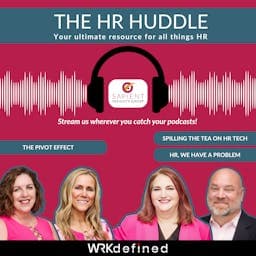
In this episode of HR, We Have a Problem, Teri Zipper and guest Tricia Shields, Chief Human Resource Officer at Naviant, discuss the critical intersection of technology within HR leadership. With over 15 years in both IT and HR, Tricia shares her unique perspective on how technology can transform HR departments and enhance cross-functional partnerships. They also discuss the challenges of maintaining up-to-date employee information across disparate systems, the role of strategic planning in HR tech adoption, and the increasing influence of AI in streamlining HR functions. The conversation also covers emerging trends in employee development technology and the importance of connectivity across platforms
Key points covered include:
↪️ HR technology adoption requires strong partnerships both internally (with IT departments and executives) and externally (with vendors, HR networks, and technology communities)
↪️ Organizations often struggle with multiple systems containing employee data (average of 11 different sources of record), highlighting the need for better integration and connectivity between HR tools
↪️ Employee development technology remains a gap in the HR tech landscape, particularly in creating comprehensive solutions that connect performance management, career pathing, learning content, and skills development
↪️ HR professionals should start their technology transformation by identifying paper-based or disconnected electronic processes that could be digitized or automated, rather than being intimidated by the scope of change
Special announcement! Fostering a more inclusive and positive culture in a workplace of constant change is hard and messy but not impossible. In our in-depth and collaborative learning program, we break it down. Join Navigating Change with Confidence, a cohort-based immersive program launching in January 2025. Click here to learn more.
Powered by the WRKdefined Podcast Network.
[00:00:00] I definitely think that digitization is one of the core foundations of how to be successful on your, you know, technology adoption journey. Because if you're working with primarily paper processes, you're going to be stinted as far as the capabilities of what you can use technology for. And I would say it's paper or, to your point, Excel spreadsheets. Those are great.
[00:00:30] Indicators that there isn't a lot of opportunity as it relates to that technology journey. And you might just be really early on in that journey. And, you know, and if you're trying to figure out kind of how do I get started with, you know, figuring out where should I maybe be utilizing technology more? I think those are great starting places is where do you still have paper processes?
[00:00:54] Welcome to the HR Huddle podcast presented by Sapient
[00:00:59] Sapient Insights Group, the ultimate resource for all things HR. It's time to get in the huddle.
[00:01:13] Hello, everyone. Welcome back to the HR Huddle. I'm your host, Terri Zipper, CEO and managing partner at Sapient Insights Group. And I'm back for another exciting episode of HR, We Have a Problem. This is the show where we like to break down the big and most relevant issues of the day. We help you make sense of what they mean for you. And we can
[00:01:34] talk about what you might do about them. Joining me today is Tricia Shields. Tricia is the CHRO at Navient. Welcome, Tricia. Great to have you today.
[00:01:44] Yeah, thanks, Terri. I'm glad to be here.
[00:01:46] Yeah, I know you've been at Navient for a while now, 15 plus years. You've seen a lot of things come and go. I know you have a passion around HR technology. But interestingly, you also have a background in IT. And so I've always thought the marriage between HR and IT is pretty critical. So I'd love to talk a little bit about that today. Does that sound like a good plan to you?
[00:02:11] Yeah, I'm looking forward to sharing. Awesome. Then let's get into the huddle. All right. So I talk a little bit. I'm CHRO of Navient. I'm talking a little bit about Navient and like what your career trajectory is, because I'm very interested in how you ended up in HR from IT. And, you know, maybe what you what you see from a CHRO perspective, that's helpful to you in that role.
[00:02:39] Yeah, yeah, just to start about Navient as an organization. So we work in the technology space, which is great that I have kind of that blend of IT and HR, it certainly helps me in my role, but we work in process automation technology. We're a remote employer. So that's kind of a unique experience as well. We have employees in about 30 states across the nation, working in in that technology industry.
[00:03:06] So my career path started actually by background and my degree is in business technology. So that is, you know, I wasn't even thinking about HR when I kind of started my journey. And I've spent the majority of my career at Navient, as you mentioned, 15 plus years. So I've got, you know, I've gotten an opportunity to really experience the different lenses of HR throughout my growth at Navient, as well as, you know, my careers as a whole.
[00:03:35] I did start in the commercial general contracting space. And that arena is completely different as it relates to HR than the technology sector. So that's been kind of neat to see that evolve and grow. So yeah, right along with HR, I've gotten to see, you know, the IT, I guess I'll say the merging of IT with HR over the last, you know, 15 to 20 years as well.
[00:04:00] I know we'll talk more about that maybe more specifically, but I think that's been really unique and interesting. So I've always been really interested in technology. I don't know if that's just, you know, kind of my upbringing or what I was exposed to pretty early on.
[00:04:14] And certainly I didn't grow up with technology, but I understood pretty early on. And certainly as I was selecting my major in college, the importance and the impact that technology was going to have on business in general.
[00:04:27] And I think that was really kind of my early on desire is to pursuing a business technology degree. The HR part, to be honest, I really fell into, you know, in some of my early roles right out of college, I was working in more of an office management and administrative capability where you're really kind of doing everything back office for a company.
[00:04:49] I think the people part of HR really resonated with me and I really felt like, you know, that was a piece that I could lean more into and really, you know, do really well with some of my natural talents. And so that's how the HR piece evolved.
[00:05:07] The technology and HR emerging piece has really just been happening over the last 15 years as I've been exposed to more of what the capabilities are and the availability around HR technology and starting to lean into those and using them and really seeing the benefits around them as we've, you know, adopted more technology at Navient.
[00:05:29] I think people that's a common experience. I know I had a similar experience. If you, if you know anything about tech and you're in HR, people sort of gravitate to you because there's this need to have technical expertise, but it's generally not the first thing that people in HR are looking for. Right.
[00:05:52] Right. And I had this similar experience when I got into HR because I had done like an, an implementation of a finance system. Ooh, you know, tech, right? Yeah.
[00:06:04] In fact, not to date myself, but like early days of my career, I was using the internet using Veronica and Gopher before the worldwide web. So it was like, you know, if you knew how to do, write a few commands, people thought you were genius.
[00:06:20] Yeah. So that's, that's always fun. Well, I mean, do you think CHROs need to understand the tech? I think there's a bit of an argument about that, but you know, I can see it both ways. I do think their relationship to the CIO, CTO needs to be a very tight partnership in terms of, you know, their work, but I don't know, what are your thoughts on that?
[00:06:46] And you're coming at it from the perspective of somebody who has that background, but a lot of CHROs don't.
[00:06:53] Right. Yeah. I mean, I think it's vitally important. You know, I really think it helps drive the either adoption or resistance to, you know, the HR department strategic approach to technology.
[00:07:08] Like if your CHRO is really resistant to technology and hesitant to kind of lean into that landscape.
[00:07:15] I think that, you know, in a lot of ways kind of defines how your HR department is utilizing technology and really the things that they're going to be working on.
[00:07:24] And I like how you talk to about just the partnership with the rest of the executive level leaders in your organization.
[00:07:31] You know, our organizations are really innovative in a lot of ways now.
[00:07:36] And if your HR department is not keeping up with that innovation and the work that they're doing, you know, that really creates, you know, in a lot of ways, maybe a lack of buy-in or just a lack of collaborative, you know, strategy across the organization that, you know, can really hinder an HR department.
[00:07:55] I even just look at our example, you know, definitely a member of the executive leadership team and part of, you know, the work that we do as it relates to HR technology.
[00:08:06] You know, I'm sought after as somebody that is an expert in that field.
[00:08:11] And I get opportunities to talk to prospects and customers about, you know, what does that look like?
[00:08:15] And really just participate in this kind of ongoing conversation around HR technology.
[00:08:21] So, you know, I think it's vitally important for our CHROs and top level HR leaders and organizations to not necessarily be technology experts, but certainly not be hesitant to what technology is and spend, you know, part of their strategic time leaning in to understanding more, you know, how can they utilize technology?
[00:09:12] What technologies are available?
[00:09:13] Because I think a lot of people are kind of shying away from that if they don't quite understand it.
[00:09:20] And you're right.
[00:09:21] I think they need to lean into it.
[00:09:23] Yeah.
[00:09:24] Look for partners who can help them better understand it and then help them better leverage how they're going to use it in their organization.
[00:09:32] And I think the CHRO and the leadership within HR is critical to that communication.
[00:09:40] Yeah.
[00:09:41] Yeah.
[00:09:41] And I love that like partnership within your organization.
[00:09:44] And I also think it's important, the partnership outside of the organization, like, you know, who is within your HR network that is already kind of maybe a bit further along in their adoption journey than you.
[00:09:59] There's a huge HR community.
[00:10:02] You know, I spend a lot of time out on LinkedIn, creating some of that connectivity and just being a part of that connectivity.
[00:10:09] And I think that's another important partnership is there's a ton of different organizations that have already adopted or, you know, are farther along in the adoption journey.
[00:10:19] And there's just all those examples I think that you can pull from to help, you know, encourage yourself in the work that you do in ways that you can utilize technology.
[00:10:28] So I feel like that external partnership is really critical as well.
[00:10:32] Yeah.
[00:10:32] And your vendors as well.
[00:10:34] I mean, don't just count your vendors who have people in their customer success areas or your account manager who, you know, wants to help you be successful with any of these technologies.
[00:10:45] And we'll make sure they get answers for you and kind of help.
[00:10:49] Some of them are really good at helping sort of bring you along on the journey.
[00:10:54] So it really just depends.
[00:10:56] Yeah.
[00:10:57] And we kind of talk about our vendors as our partners.
[00:11:00] Absolutely.
[00:11:00] That if we see you as a vendor, you know, that's probably not a very strong partnership.
[00:11:05] We don't want to just buy technology from you because it sounds good in that singular use case.
[00:11:12] We want you to understand our business and really what we're trying to accomplish from a really holistic perspective.
[00:11:18] And we're seeking partners, you know, in those vendor relationships that have that model in the way that they partner with their customer organizations.
[00:11:28] So, yeah, I think that's really important as well.
[00:11:31] You're in a bit of a unique role, one, because you're the CHRO in your organization, but the organization that you operate within is also a vendor who is, you know, out there working with organizations on technology.
[00:11:45] I think you guys work across the spectrum, but HR is one of your, one of the areas you focus on.
[00:11:52] One of the things we talked about in our last conversation was about tech jargon.
[00:11:58] Yeah.
[00:11:59] And as we've talked about this sort of HR connection and sort of how IT and HR can talk to one another, how IT talks to HR in their own language to kind of help them solve the problem.
[00:12:13] Because it's very easy for us to use acronyms and, you know, things that just don't make sense to people and they just not.
[00:12:19] Right.
[00:12:20] Yeah.
[00:12:20] I think I understand what you're saying, but maybe I don't.
[00:12:23] Talk a little bit about that.
[00:12:24] Like what have you seen in you?
[00:12:28] Cause you've got those two viewpoints, right?
[00:12:29] So you've been able to see it.
[00:12:31] And if you're going to client meetings, which is great, you sometimes are probably able to make that translation.
[00:12:38] Yeah.
[00:12:39] Or the technical people back to the HR people.
[00:12:44] Yeah.
[00:12:44] I actually just did a presentation at an HR conference last month and we played a game to learn some of the tech jargon that we're hearing more and more.
[00:12:54] And so that was kind of a fun way for as HR professionals for us to, you know, try to understand these IT jargons.
[00:13:02] But I think it is kind of a equal part.
[00:13:05] So, yes, we absolutely, you know, we can't ignore it.
[00:13:09] There are some common terminologies that, you know, fit maybe more in the general IT space.
[00:13:16] But, you know, we need to know what that, you know, what those mean and what they mean to our organization within the HR department.
[00:13:24] But absolutely, you know, we need our IT professionals to know our jargon as well and what matters to us.
[00:13:31] So that is kind of a unique space that I get to work in.
[00:13:34] Just, you know, that helping IT folks understand, like, what matters to me?
[00:13:40] You know, what are the words that we're using and just the space that we work in?
[00:13:44] And I think that's another piece just with that partnership.
[00:13:46] You know, certainly when I'm working with a technology company that we're looking at potentially adopting new technology or even just consulting services around, that's part of what we're talking about.
[00:13:59] You know, I'm not just adopting to your space and kind of your tech jargon is I want to see a genuine interest in actually kind of an expertise in your knowledge of the work that I do.
[00:14:12] So that I know that you are going to be a really good partner in kind of pairing those things together so that we're not buying technology.
[00:14:20] We're buying almost just maybe like a new approach to how we're doing a certain way of work.
[00:14:26] So I think it's kind of that 50-50, like we need to lean in, but they also need to kind of lean into the HR space as well.
[00:14:33] Yeah, yeah, we do.
[00:14:35] We use a lot of acronyms.
[00:14:36] And I mean, even in HR, and then if you look at that from an IT perspective, you know, we use HRS and HRMS and HCM.
[00:14:46] And like some of these things are just sort of interchangeable.
[00:14:50] Sometimes they're not, but they don't really get explained.
[00:14:53] Everybody thinks, you know what the acronym is.
[00:14:56] You guys do digitization, right?
[00:14:59] So digital creating digital platform for HR.
[00:15:02] This is an interesting space because it kind of reminds me of, I used to be, I used to do comp sales and I did, I had some comp technology.
[00:15:12] And I was always surprised at the number of times I was competing against Excel spreadsheets, right?
[00:15:20] The sort of, you know, basically the old paper-based version of doing comp planning.
[00:15:26] And it was probably 60% of the time, right?
[00:15:31] It wasn't competing against another technology.
[00:15:35] Digitization reminds me of that because I would think that you're still seeing a lot of organizations who haven't made that step to sort of digitizing their HR function or even kind of have a good concept of what that means overall.
[00:15:50] Yeah.
[00:15:52] Yeah.
[00:15:52] I mean, I definitely think that digitization is one of the core foundations of how to be successful on your, you know, technology adoption journey.
[00:16:04] Because if you're working with primarily paper processes, you're going to be stinted as far as the capabilities of what you can use technology for.
[00:16:15] And I would say it's paper or to your point, Excel spreadsheets.
[00:16:20] Those are great indicators that there isn't a lot of opportunity as it relates to that technology journey.
[00:16:28] And you might just be really early on in that journey.
[00:16:31] And, you know, and if you're trying to figure out kind of how do I get started with, you know, figuring out where should I maybe be utilizing technology more?
[00:16:39] I think those are great starting places is where do you still have paper processes?
[00:16:45] Because I think a lot of organizations have adopted, you know, electronic documentation and some automation capabilities that are built into some of the technologies that we already have.
[00:16:56] But there's still a lot more to go.
[00:16:59] I would say, you know, you don't hear much about HR departments and organizations that are 100% paperless.
[00:17:05] So those are opportunities to identify, could it be?
[00:17:10] And what would that look like?
[00:17:12] And would that save us time and money, you know, to make the investment worth it?
[00:17:18] So, yeah, digitization, that's really where we started 15 years ago, even with our internal processes.
[00:17:25] Yes, I had Excel documents, but I also had a bunch of filing cabinets sitting next to me in my office with paper.
[00:17:32] And just looking at the work that we do at Navient and knowing that that's the place I was at, it just it was a great opportunity to, you know, just start that transformation.
[00:17:44] And now we're in a totally different space.
[00:17:46] Now, I mean, we've been, you know, paperless for many years, we hugely lean into automation processes.
[00:17:54] But I always like to use that as kind of a early start encouragement for organizations that maybe are still sitting next to their filing cabinets, and they are still using Excel documents for tracking.
[00:18:06] Yeah, it's gotten, you know, definitely gotten harder because like your company, our company is the same way.
[00:18:13] We're completely remote, right?
[00:18:15] So if you're doing paper-based work, people are having to put stuff in the mail, which they're not doing, right?
[00:18:20] That makes no sense.
[00:18:21] Yeah, right.
[00:18:22] And even though, oh, go ahead.
[00:18:24] I was going to say, I mean, they've got multiple systems, right?
[00:18:26] They've got a recruiting system, which hopefully is, you know, managing all of their, you know, hiring and that kind of thing online and through technology.
[00:18:36] Onboarding is another area where, you know, you're doing things that definitely have to be digitized and online.
[00:18:44] But there's just a lot of pieces and components that kind of come together.
[00:18:48] Are you guys doing anything?
[00:18:51] Are you looking at it from the perspective of how do we bring everything together so we can take advantage of or democratize that data across the organization?
[00:19:02] You know, because it's all potentially in different places, depending on how many different systems you're using to do some of this work.
[00:19:10] Right.
[00:19:11] And even if you're not a remote employer, you know, you might be a multi-location employer.
[00:19:15] And how are you sharing that data, you know, across those different locations as our organizations continue to grow?
[00:19:23] So we look at it as a how do we give employees, you know, both within the HR department organizationally, but just the employee experience piece,
[00:19:33] how do we give them access to the information they need real time?
[00:19:38] You know, so kind of the old day of, you know, I need to change my address.
[00:19:43] So I need to email HR and let them know that.
[00:19:46] Why can't we just empower them to have that information kind of, you know, right at their fingertips to be able to make those,
[00:19:53] you know, make those updates and changes on some really simple things like that.
[00:19:57] But we're also doing it as a way to change the work that HR is doing.
[00:20:02] So we don't want to spend our precious HR professionals time on processing paper and, you know, routing things when there's technology available to do that.
[00:20:16] We want to be really strategic and impactful.
[00:20:19] And I'm sure you can appreciate, too, just the way the work that we that we're doing has changed over the last 20 years is really significant.
[00:20:28] And I think that technology has been one of the greatest impactors of that.
[00:20:35] You know, we used to be seen as more of an administrative function within the organization where now we're seen as a strategic leader in a lot of cases.
[00:20:46] And so, yeah, so I think that's how we see that adoption of technology for ourselves is we want to be able to be strategic and we want to be in front of our employees.
[00:20:57] You know, I love that I have time and the ability to connect with employees to just talk and have meaningful conversations about what their experience is like,
[00:21:07] because I'm not doing that administrative work, nor are, you know, most of the other people on the HR team.
[00:21:13] Yeah, that is a crucial point.
[00:21:16] I think organizations in order to be HR does need to be strategic and in order to be viewed as strategic, they need to not be viewed as a compliance organization.
[00:21:29] It's it's but you still have to do it. Right.
[00:21:31] So somehow you have to do it without without showing that you're doing it.
[00:21:37] I mean, right. You know, the reality is it just needs to be happening.
[00:21:40] And some of that comes with I think some of the examples of the work that you guys are doing.
[00:21:46] I think the reality is, though, they need to be able to tie whatever they're doing, whether it's digitization, whether it's, you know, new technology to support AI or anything else they're doing in HR.
[00:21:59] They need to be able to tie it back to the business outcomes.
[00:22:03] Right. They need to be able to ensure that the solutions they're putting in place are living up to the expectations that get set for them.
[00:22:12] And I think that's probably a core area for HR to focus on.
[00:22:17] Yeah. And I think even like with the enterprise technologies, you know, we talk a little bit about that as well.
[00:22:22] Like rather than seeing this as like these are the HR technologies that we're utilizing, are there HR technologies that are really have capabilities to support the organization as a whole in the work that they do and perform?
[00:22:37] And are there enterprise solution technologies like we use automation technologies as our example that the organization has really adopted that your HR department can take advantage of to help support the work that they're doing?
[00:22:54] Yeah. I mean, even the smallest organizations right now are using a lot of different HR tools.
[00:23:01] I don't know what your traditional market is or where you feel like you guys are spending the most time.
[00:23:07] But when I look at organizations, you know, under 500 employees, they're using on average 15 different tools in HR.
[00:23:18] Yeah. Now, I mean, we're including a lot of different things now, like document management.
[00:23:24] We're, you know, including teams, right?
[00:23:26] Because that becomes a tool that gets used from an HR perspective, financial tools.
[00:23:31] But there's a lot of systems that HR is having to deal with.
[00:23:36] And, you know, there's a there's a lot of connection there, connectivity that needs to happen in order for some of these things to make sense.
[00:23:43] And as soon as they continue to grow, those numbers really just go up, right?
[00:23:49] They don't go down.
[00:23:50] There's more tools and technology that they're integrating to try to to make the most of what they're, you know, what they're doing.
[00:23:58] Right. Or not integrating.
[00:23:59] I think that's one of the challenges that we're seeing now as well.
[00:24:02] I had heard somewhere that there's the average organization has 11 sources of record as it relates to core employee data.
[00:24:10] So you think about that, like 11 different spots of things like an employee's name might be stored.
[00:24:16] And if you're not using integrated technologies, you're literally updating that in 11 spots.
[00:24:23] And think about all the different data that as HR professionals we have and we're managing.
[00:24:29] You know, if you're trying to keep that up to date and you don't have strong processes and integrations,
[00:24:34] the likelihood of, you know, something getting missed is just so much more likely.
[00:24:39] So I think that's one of the kind of future opportunity pieces that I see coming in a bigger way around HR technology is just that connectivity in all the different components of work that we do.
[00:24:55] So I don't know.
[00:24:56] I'm really excited to see kind of the future of HR tech.
[00:24:59] Yeah.
[00:25:00] Yeah.
[00:25:01] One of the things we've been doing, it's really popular subject right now is sort of the HR technology strategy.
[00:25:08] We literally just finished like a six month cohort where we brought HRS leaders or those responsible in some way for the HR tech and their organizations through a program to build their strategy.
[00:25:22] Right. Make connections in the business, build business cases, really sort of helping them think about HR tech because it has become as much good as it does.
[00:25:33] It also becomes a real challenge when you've got so much going on.
[00:25:37] The single source of truth is out the door because like you said, you've got too many different places where name is is in the system versus just, you know, one place where that data is connected and managed.
[00:25:51] And I don't think we're going to go back to like one system to rule them all.
[00:25:57] Right.
[00:25:58] I think there's going to continue to be niche products that need to be part of of HR and sort of these HR systems clusters.
[00:26:09] Right.
[00:26:10] Technologies that cluster around solutions or things that are your core, you know, the core value for an organization.
[00:26:18] So, yeah.
[00:26:20] Yeah.
[00:26:21] I was definitely hoping I will tell you, like over the last several years, I feel like I've evolved with that as well.
[00:26:27] Like I just had such a hope that there would be more singular technologies and singular partners creating HR technologies that, you know, really would understand our space and answer all of that and provide all of that connectivity.
[00:26:44] But I will tell you through that evolution.
[00:26:46] I'm absolutely with you.
[00:26:48] I think, you know, it's now more about finding different core technologies that, you know, really do the work they do best in class.
[00:26:59] And part of that best in class is connectivity to other technologies.
[00:27:04] So, you know, I think that's a lot of things that are going to be part of the core technologies.
[00:27:10] But I love what you're mentioning about the cohort and just creating that strategic plan around technology.
[00:27:17] Because I think so often now we've been really reactive to, you know, the company is growing.
[00:27:23] Now we need a new ATS system or HCM system or whatever that might be.
[00:27:29] But having a more strategic, you know, a laid out business plan and a strategic plan around the technology that's maybe, you know, built more under the insights of what the changes in the company, you know, what are coming, I think is, you know, we should see more of that.
[00:27:49] Yeah.
[00:27:49] As a tech person, do you see some gaps in HR technology?
[00:27:55] I mean, is there, I think there's an opportunity there where we just described how people get, you know, somebody sort of the glue that brings all this stuff together.
[00:28:06] But are there some areas, I'm just curious in your experience, you know, based on everything you've seen, are there some things you look at and go, I can't believe we haven't solved that problem yet, right?
[00:28:17] Yeah.
[00:28:18] Yeah.
[00:28:18] I guess two things that come to mind for me.
[00:28:20] One is around the integration piece.
[00:28:22] So I do think that there are some singular technologies that, you know, we're utilizing that are at a disadvantage to our organization.
[00:28:31] And it, you know, I think that's interesting that with the capability of integration technologies, that there are some of those singular technologies that really kind of do make our work more challenging.
[00:28:42] So I think that's one of the gaps.
[00:28:44] I think we'll just see that continue to evolve and change and really kind of drop off as, you know, our work continues.
[00:28:52] The other piece that I'm heavily diving into now, and maybe this isn't a gap, but it's certainly a gap that I, you know, I'm trying to learn more about is around the employee development piece.
[00:29:03] So that whole experience as an employee, you know, where are we pointing our employees to as it relates to employee performance, development, core competencies, career pathing?
[00:29:19] Where's the content that we're giving them for learning management?
[00:29:24] How are we helping to support them as they look at what is my career path look like within the role that I'm in today?
[00:29:32] As well as, you know, what are my hopes and dreams as I, you know, continue down that path and the alignment with our company growth.
[00:29:43] And that's a piece that I'm wanting to really solve at Navient and provide more connectivity around.
[00:29:50] But I'm not seeing a lot of technologies that answer that whole, you know, that whole component.
[00:29:59] I'm seeing a lot of technologies that maybe do these three things or these four things.
[00:30:04] But I think it becomes challenging when you have to point employees to a lot of different places.
[00:30:11] So we are looking at that actually, as well as more of a hub-like approach to provide some connectivity to these technologies.
[00:30:19] But right now, the one that's challenging me the most, and I feel like as I'm seeing it, there is a gap is around the employee development experience as a whole.
[00:30:29] Yeah, I think we're seeing something similar.
[00:30:32] And a lot of people are looking for skills capabilities right now and talent marketplaces.
[00:30:38] And, you know, one of the things I think is important about that is it requires an investment by the employee to want to be a part of that, right?
[00:30:49] It's not something you can force.
[00:30:51] I mean, you can put it out there and you can make it available.
[00:30:54] But unless people become engaged in it or you provide some incentive for them to want to, you know, do things within that environment and learn and grow and develop, it's a challenging space.
[00:31:12] Yeah.
[00:31:13] And I think people interact with it differently depending on the culture within the organization as well.
[00:31:19] So I think there's some interesting things to come with that, though.
[00:31:23] I'll be curious to see how that – I'd like to stay in touch on that and see how you guys evolve with that capability.
[00:31:30] Yeah, absolutely.
[00:32:00] I think there's a lot of things to be easy to use and easy to understand and navigate in order for both employees and managers to have that desire.
[00:32:36] Yeah.
[00:32:38] I think we've managed on that briefly, but are you seeing that become something that people should be looking at from your perspective?
[00:32:46] Because I know, as I mentioned earlier, I mean, HR is, I think, lagging a little bit in terms of their use of AI and maybe rightfully so given some of the challenges with it.
[00:32:58] But, you know, what are you seeing?
[00:33:00] What are your thoughts there?
[00:33:01] Yeah, I feel like the generative AI and just maybe AI in general, I feel like that piece is such an opportunity for us to continue the ability to be more strategic and allow technology to own the more administrative functions.
[00:33:22] But now it's bigger than that. You know, it's even some of the thought functions within the HR department. So, you know, I do see HR professionals leaning into AI more and more, which I do think is encouraging.
[00:33:36] It might also be the space that I work in because obviously I run into HR folks that are like, I am not, you know, I'm not comfortable with AI yet. I, you know, I don't even know where I would apply that.
[00:33:46] But, you know, I think it's been, I think it's, there's a lot of opportunity with AI, yeah, to allow us to be at a higher level and to be a strategic partner within our organization.
[00:33:58] I think there's a lot more to come as it relates to that because I feel like right now we're, you know, maybe utilizing some technologies that have AI components in it, or we're utilizing some of the generative AI technology to do maybe some singular functions.
[00:34:14] So I think there's, you know, wildly more to come with what those capabilities are going to be. And hopefully with some of that, it's generated by the partners that we work with as to what those use cases and how we can utilize it.
[00:34:32] Because in some ways, I feel like HR professionals are just going out and trying some things right now, like, I'm going to create a new policy, maybe I'll see what generative AI has to say about that.
[00:34:41] So, you know, we are kind of adopting it and maybe being some early adopters of generative AI. But yeah, I think there's a lot more to come with that. And I'm excited about what that's going to look like. Some of it's scary.
[00:34:54] I will say that some of the capabilities that I've seen, but yeah, I think there's a lot of opportunity.
[00:35:00] Yeah, I do too. And I think what you hit the nail on the head with the use cases, I think we need to make it more tangible, like what, let's talk about some specific things where I think it could help us because just using it randomly, or, you know, is not really moving the needle, we need to think about how we could actually solve a particular problem with it.
[00:35:24] And I think that's gonna drive some of this further when people start, you know, thinking about it in that way.
[00:35:30] Yeah, agreed.
[00:35:32] So this has been a great conversation. I'm just curious, is there one thing you might leave the audience with today that might help them, whether it's, hey, how do I, you know, better build the relationship with my IT department?
[00:35:46] Or, you know, how do I think about or start building use cases for AI? Is there something that you want to leave the audience with today that they might be able to start working on tomorrow?
[00:35:57] Yeah, well, I guess I always like to leave with this concept around just the adoption of technology. And there's, you know, maybe a common thought that technology is going to replace the work that that I'm doing.
[00:36:09] And just my words of encouragement always around that is we're not going to be replaced by technology, we're going to be replaced by people that are ready to adopt and have adopted technologies. So almost using that not, you know, in a negative way, but really as as as a means of encouragement that we can do this, we can do this as a collective HR profession.
[00:36:33] The other piece I would share is leaning in to your general network, who are other HR professionals that you can connect with, whether it's within the industry that you work in your geographic area, the general LinkedIn community, I love connecting with people to hear more about how they're utilizing technology and even outside the technology space, just how are you doing HR in your within your organization, because we get a lot of great ideas.
[00:37:01] And I feel like HR professionals, and I feel like HR professionals, we do like to share.
[00:37:05] And then I guess as far as that just partnership piece, I'll just say, I, you know, I'll go back to kind of the early beginnings of it.
[00:37:13] I think you can find a lot of success with HR and technology, just by solely looking at where do I have paper processes, or just singular electronic processes that don't have connectivity to other, the other work that I'm doing, and just identify a few of those.
[00:37:34] And just ask the question, like, could this be digitized? Would it change the way I do work with this data? Or could it be automated? And would that change how I do work with this information? And just take a couple of those. That's how I started. And then it kind of blew up into what it is today. So I guess I'd share that.
[00:38:24] That's great.
[00:38:25] World at work, if you're in comp, join IRAM, if you're kind of on the HR technology side, ATD for Tatton. There's a lot of different organizations and groups that people can join to meet other people that are doing similar work and learn from them.
[00:38:44] Yeah, you know, it's great to grow up in an organization.
[00:38:46] But it's also great to see it from the other side. And to hear from other people, you don't have to move to another organization to do that, right? You can, you know, can work with other people. So yeah, that's, that's, that's great. I love it.
[00:38:58] Yeah.
[00:38:59] Well, this has been a fantastic conversation, Tricia, I really appreciated having you join us today. Thank you for the conversation.
[00:39:07] Yeah, for having me.
[00:39:08] Yeah, I, we, just so you know, the annual HR system survey report that talks about HR tech and a lot of the stuff that we talked about today is available already with along with the individual segment reports. So go check that out on the website.
[00:39:23] Be sure to listen to Stacy and Cliff while they spill the tea on HR tech next week.
[00:39:30] That's all the time we have for this episode today. I want to thank our producers, Brand Method Media Group, our marketing team, and especially you. I want to thank you for tuning in.
[00:39:41] If you enjoyed the episode, please leave us a review, subscribe to it on your favorite podcast app.
[00:39:48] Also feel free to drop us a line. Let us know what topics you want to hear about. We we'd love to make sure that we're talking about the things that you want to hear about.
[00:39:55] We will be back in two weeks with another episode of HR. We have a problem. Thanks everybody.
Sponsors
