
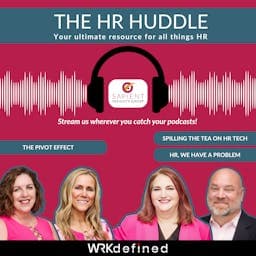
In this episode of HR, We Have a Problem, Teri Zipper along with special guests Susan Richards, Founder of Sapient Insights Group and Marc Moschetto, Founder and CEO of KickMotor, discuss the complex interplay of external global events and their impact on HR and organizational management. They explore how to better support teams through both high-stakes growth and quieter times, emphasizing the importance of empathy, flexibility, and proactive planning.
Key points covered include:
↪️ Organizations face heightened uncertainty with economic fluctuations, global events, and emerging technologies.
↪️ Adaptive leadership and open communication are critical to sustaining employee trust and engagement.
↪️ Effective change leadership requires empathy, proactive support, and consistent follow-through in actions to align with team motivations.
↪️ Embedding change management into everyday practices cultivates a culture where adaptation becomes second nature for the entire organization.
Special announcement! Fostering a more inclusive and positive culture in a workplace of constant change is hard and messy but not impossible. In our in-depth and collaborative learning program, we break it down. Join Navigating Change with Confidence, a cohort-based immersive program launching in January 2025. Click here to learn more.
Don’t miss this exciting thought leader conversation! Follow the hosts and companies mentioned below:
Sapient Insights Group
Download the 2023-24 HR Systems Survey White Paper
Instagram | Twitter | LinkedIn
Teri Zipper
Instagram | Twitter | LinkedIn
Susan Richards
Instagram | Twitter | LinkedIn
Marc Moschetto
Powered by the WRKdefined Podcast Network.
[00:00:00] There's this interesting tension right now between a need to get ready for something and be ready to turn on a dime and then this unease in the market, in our organizations.
[00:00:20] It just feels like everything that we're doing is getting ready for something and we don't necessarily know what that something is.
[00:00:28] You know, organizations have been holding their breath since January and we've seen all kinds of conflicting market indicators about is the economy good? Is it not good?
[00:00:44] It feels different depending on where you sit in an organization, whether you're a gig worker or whether you're a full time employee,
[00:00:53] large organizations versus small organizations versus public sector organizations are experiencing this very differently.
[00:01:01] Welcome to the HR Huddle Podcast presented by Sapient Insights Group, the ultimate resource for all things HR.
[00:01:12] It's time to get in the huddle.
[00:01:21] Hello everyone, welcome back to the HR Huddle. I'm your host Terri Zipper, CEO and managing partner at Sapient Insights Group.
[00:01:29] And I'm back for a very special episode of HR We Have a Problem.
[00:01:33] This is the show where we like to break down the big and most relevant HR issues of the day.
[00:01:38] We help you make sense of what they mean for you. And then we talk about what you might do about them.
[00:01:43] So I've got two very special guests with me today. Joining me is Mark Moschetto. Mark's the CEO and founder of Kick Motor. Hi, Mark.
[00:01:52] Hey, how you doing?
[00:01:53] And my partner, Susan Richards, who you guys know, she's the founder of Sapient Insights Group. Welcome, Susan.
[00:02:00] Hey, it's great to be here.
[00:02:02] So this, I think, is going to be a great show. I love doing specials. There's a lot going on in HR and we talk about these things all the time as we do a lot of work with Mark and he helps us with our messaging and marketing.
[00:02:19] And as we continue to talk about some of the challenges that are going on in the world right now, we thought, hey, let's talk about this with everybody else. Let's bring some other people into the fold here.
[00:02:31] So there's just a lot of tech. There's AI layered on top of that, integration, data governance. And then on top of all of that, there's like all this stuff that's going on in the world right now.
[00:02:44] We just had an election in the US. And while we might be discussing some of its impact on us on this show, we have no idea right now who our next president is.
[00:02:56] And we actually may not know on November 7th when we have this conversation. There's that, there's wars, there's some major conflicts abroad, dangerous and life-threatening weather, economic challenges.
[00:03:09] I was really hoping we could just talk about how some of these things, among other things, regardless of your point of view, impact us as organizations, they impact our people.
[00:03:20] And by virtue of our roles, they impact HR. So does that sound like a good plan to you guys?
[00:03:27] Yeah, let's do this.
[00:03:29] How much time do we have to cover this? It's a lot to unpack.
[00:03:34] Yeah, we can go as long as we want. It's my show. I do what I want, right?
[00:03:39] Yes.
[00:03:40] Eric Cartman.
[00:03:41] I love it when she's in charge.
[00:03:44] Well, that is the plan. And let's get into the huddle. So the last few years, obviously, since COVID, and in particular, the last 18 months, we've, I think we've been on quite a ride.
[00:03:58] And there's so many things we talk about in our, you know, daily lives and our social circles, maybe at work, but the reality is the same things that are impacting our personal life are also impacting our work life.
[00:04:11] There's no doubt. Mark, what are some of the challenges you see a lot of companies grappling with right now?
[00:04:17] Just, you know, things that are impacting the work, not just their ability to do their jobs and deliver the products and services that they deliver, but just the ability to run a business right now.
[00:04:29] Yeah. I mean, a lot of the things that I'm seeing out there is it, it just feels generally stuck. Like I wish I had a more technical, fancy, buzzy word for it. But, you know, all the things that you mentioned, right?
[00:04:42] All the challenges that are going on in the world, all the challenges that are going on in the workplace, all the change that's being driven. Like, I think there's a recognition of an acute need to do things differently, right? To understand that everything that we've kind of done in the past has been in the past. AI in and of itself can be a game changer and all kind of the ethical considerations around that.
[00:05:04] So there's at once this need to move forward. And on the other side of the coin, there's this, like, we don't know what's going to go on with the economy. We don't have a really solid idea of where things are going to go based on the recent elections. And it just feels like there's a little bit of a holding pattern in a lot of organizations.
[00:05:26] I think the ones that are really going to, you know, make a difference and are making a difference today are the ones that are kind of recognizing that there's when everyone else is kind of taking a breather. That's a great opportunity to kind of surge ahead. But it's a tough place to be when you're kind of looking at the balance sheet. Maybe things are looking a little differently than years past. And, you know, it's a tightrope walk. And then you've got the workforce on the other side of it, too. Like, everyone is just on edge. We're so polarized culturally.
[00:05:55] That there's, again, that tightrope walk between, you know, how do we create an environment that is, you know, at once kind of everyone has a voice and everyone feels welcome. But we also know that, you know, sometimes conflicting viewpoints can bring some really strong reactions from others. So, yeah, I mean, it's just a lot of plates spinning right now. And I think a lot of organizations are just looking for guidance on how they take those next steps. And what does the next step after that look like?
[00:06:24] Yeah. Susan, what about you? I mean, as a founder, and somebody who runs a small business? You know, we're feeling it every day.
[00:06:32] Every day. Yeah. So there's, there's this interesting tension right now between a need to, like, get ready for something and be ready to turn on a dime.
[00:06:48] And, and then this, this, like, you know, this, this unease in the, in the market, in, in our organizations.
[00:06:58] It just feels like everything that we're doing is getting ready for something.
[00:07:02] And we don't necessarily know what that something is.
[00:07:05] You know, organizations have been holding their breath since January.
[00:07:10] And we've, we've seen, you know, we've seen, you know, all kinds of conflicting market indicators about, you know, is the economy good?
[00:07:20] Is it not good?
[00:07:20] It feels different depending on where you sit in an organization, whether you're a gig worker or whether you're a full-time employee.
[00:07:30] Large organizations versus small organizations versus public sector organizations are experiencing this very differently.
[00:07:36] And it feels like we don't have a real clear roadmap of where to go and what to do next.
[00:07:48] And all of that leads to, you know, a sense of ambiguity and unknowing.
[00:07:55] So we don't know exactly what to do.
[00:07:59] And, and it, you know, I've seen it show up in organizations in different ways.
[00:08:03] You've got organizations who are kind of taking the bull by the horns and say, we're going to continue to march forward and act as if we're coming out on the other side of whatever this thing is that we're in right now.
[00:08:17] And making plans for 2025 and, and using what they know from past experiences to drive their future decisions.
[00:08:30] And then you've got organizations who are really stuck.
[00:08:33] You know, Mark, I like that word that, that you use because I see that in action every single day.
[00:08:39] We can't make that decision yet.
[00:08:41] You know, we're in the budget season or we're in open enrollment season, or we were in vacation season.
[00:08:48] And, you know, using whatever the, you know, I'm going to be really frank here.
[00:08:54] Whatever the excuse of the day is to just say, we, we, we can't make that decision.
[00:08:59] And those organizations, I think are going to really struggle in the, in the coming months and year.
[00:09:08] So, yeah, I think it depends on where you sit and what your perspective is to, is to how you're experiencing this roller coaster that we're on right now.
[00:09:18] I've seen it, I've seen it from a lot of different perspectives.
[00:09:22] And as a business owner, I am holding on for dear life and ready to see whatever is over that next hill.
[00:09:30] Yeah, it's impacting everybody though.
[00:09:32] And I think, you know, you think about the leadership and the C-suite and the people making decisions about how it's impacting their business overall.
[00:09:42] But they also need to be looking at how it's impacting their people.
[00:09:46] And this is that time of year where you start seeing, you know, it's, it's riff time, right?
[00:09:51] Let's, let's reduce our workforce.
[00:09:54] It happens every year, right before the holidays.
[00:09:56] I'll be curious to see how, how big it is this year, but just based on how the rest of the year has been, I wouldn't be surprised if it's, if it's pretty large.
[00:10:05] And I don't know, you know, how much organizations are thinking about that whole ripple.
[00:10:11] Obviously we have to sell product and services.
[00:10:14] I mean, we have to make money to even run a business, but at the same time, you know, these, these are people that are being impacted by the same things we as an organization are being impacted by.
[00:10:27] And it's impacting their work life, their home life, you know, everything.
[00:10:31] And, you know, are you seeing organizations or HR people in particular paying acute attention to this right now or, or thinking about better ways to, to solve for this or, or at least to keep people engaged in the, you know, during this, this time.
[00:10:52] Mark, your, your thoughts?
[00:10:53] Yeah. And I think, you know, when you think about the workforce and you mentioned how much it just impacts people and work from home certainly blurred that kind of work life line even more.
[00:11:05] If there ever was a balance before, it's kind of thrown out now, but, you know, you look at things like social media, for example, and there's this new phenomenon of workers that are starting to like record and post on TikTok.
[00:11:20] There, there are, there are RIF Zoom calls with their bosses.
[00:11:24] And it's remarkable how consistent every freaking conversation is that goes down, right?
[00:11:32] Like, you know, we're, we're moving in a different direction.
[00:11:35] Your role's been eliminated and it's this very kind of cut and dry, you know, here's, here's a curt message from your manager.
[00:11:43] Here's a slightly less curt message from HR with your documents and your severance, if you're lucky enough to have it.
[00:11:50] And then, you know, make sure you send your laptop back.
[00:11:53] And I think that that is kind of amplifying the sensitivity or, or the heightened sense of the shoe is going to drop amongst workers, especially the, you know, generations that spend a lot of time on social media seeing that, that aspect.
[00:12:09] And I think it makes those folks who are in HR, it makes your job that much harder, you know, first of all, because these sorts of things are never easy.
[00:12:19] I mean, I've been a CMO at a couple of different organizations and have led teams for, for longer than that.
[00:12:25] And if you ever, as a leader, get to the point where those types of conversations are comfortable and, and you don't lose sleep at night, I think that's a real time for introspection.
[00:12:35] They're never easy, but I think in today's world where people expect maybe a little more candor, a little more openness, a little more kind of detail.
[00:12:45] As we think about all the changes that we need to do specifically around layoffs and stuff like that, boy, I would love to see people taking a little bit of a different approach in, you know, just maybe being more, more open and honest with the workforce as they have those conversations.
[00:13:01] And I understand you've got to, you know, you've got to protect the company and you've got to make sure that you're saying, you know, coloring within the lines of labor law and things like that.
[00:13:10] But I think one way that organizations can start to kind of come out and build that faith and confidence as they get ready to take that next hill is to just have a little bit more authenticity and a little more candor around tough conversations like that.
[00:13:24] Or maybe even have those tough conversations before, you know, move as drastic as riffs and things like that come up.
[00:13:31] And then, you know, you're going to get more engagement if people feel like they're more integrally a part of the workforce than this kind of commodity that can be, you know, that can be rifted without much notice.
[00:13:45] Boy, I really sunk into dark territory there.
[00:13:49] I'll lighten up in a minute, I promise.
[00:13:51] Susan, bring us back to the light.
[00:13:53] Yeah, yeah.
[00:13:54] So, you know, Marcus, you were talking, the word formulaic came to mind.
[00:14:00] And, you know, HR organizations, you know, for the last 50 years or however, at least as long as I've been part of the workforce, have been very formulaic about the way we treat our employees, our staff, our talent.
[00:14:18] And as you were talking about, you know, the words that we use when it's time for a downsizing or rift, you know, change restructuring, mergers acquisition, it's formulaic.
[00:14:32] And we get, you know, we get the script from the consultants or from HR or whoever is guiding us down this path.
[00:14:41] And I, I am craving more humanity in this process.
[00:14:50] And I believe that organizations and let's, let's like get rid of the word organizations.
[00:14:58] Let's just talk about people, leaders of people, managers of people, our frontline staff.
[00:15:04] If we, if we go ahead and take that mind shift of getting out of the formulas and into just being humans, we're going to do much better.
[00:15:16] And that also brings up the thought around transparency and getting real with people.
[00:15:24] You know, we see it every day because we're a small business.
[00:15:28] And, and so our staffs know, we, they know where we are.
[00:15:33] We're really transparent with them about how well we're doing or how well we're not doing and what we need to improve our position.
[00:15:40] You know, I think if more leaders could just get real with their teams and step away from the, the fear of not saying the right thing or saying the wrong thing or looking vulnerable or maybe not having all the answers.
[00:16:01] If, if, if we could just say, look, you know, we're people just like everybody else.
[00:16:06] Yeah.
[00:16:06] I have a different title.
[00:16:07] I've been doing this a little longer than my frontline folks have, but at the end of the day, we're all humans.
[00:16:13] We, you know, we, we all like go home to our families and we pet our dogs and we have a lot more in common than, than we, we probably give ourselves credit for.
[00:16:24] So I'd like to see us get to a point where we can start to have those, those authentic conversations with, you know, with our peers, our staff, ourselves, you know, throughout our organizations, because social media is, is one life or one slice of life.
[00:16:47] But, you know, those of us who work from home every day and the, our colleagues, our clients see, see our homes, see our, our everyday life.
[00:16:59] I think there's, there's just a different expectation now.
[00:17:02] And I'd like to see HR and leaders in organizations kind of catch up with that and say, let's, let's just be people again.
[00:17:12] I think this is Susan, where that skill of change leadership is really starting to become so critical in an organization.
[00:17:23] I mean, if you want to be a leader in your organization, you need to understand how to navigate change in the organization.
[00:17:31] And this is a great example.
[00:17:32] I don't think most organizations think about, or even plan for the change management around a reduction in force or any sort of, you know, they, they think about it in terms of bigger projects.
[00:17:46] Like we just implemented a new technology or we're going through an org transformation or something really big like that.
[00:17:53] But there's things happening every day that are considered change.
[00:18:00] And I just feel like that's such a critical skill these days that people have got to take on, right?
[00:18:07] So that, so that they can help organizations navigate that road.
[00:18:13] Absolutely.
[00:18:14] You know, change leadership is, it sounds really fancy, but it, I mean, it's basics.
[00:18:19] It is building relationships.
[00:18:22] It is creating connections with, with the people around you, whoever those people are.
[00:18:29] It is communicating and, and not, you know, not the communications program, but really talking to people and, and listening, you know, listening and listening actively, listening in a way that is not to respond, but to understand.
[00:18:50] And, and, and then it, it's collaborating.
[00:18:54] So, you know, bringing people into the fold, breaking down those silos, you know, working across functions and sometimes working across, you know, we have, you know, initiatives that happen in our companies all the time where we were collaborating with people who don't even work for us.
[00:19:14] So it's collaborating with our clients, collaborating with our vendor partners, collaborating with our staff.
[00:19:22] And we can learn as much from, you know, you know, someone who hasn't been with us for 10 years as we can from somebody who's been with us since, since our company started.
[00:19:32] So, you know, the change leadership skill set is, you know, again, it sounds fancy, but when you, when you strip all of the consulting words away from it, it really is about figuring out who, who's important.
[00:19:51] What's, what's, what's the impact that, that, that an event is going to have and, and then who is going to be impacted by that.
[00:20:01] And instead of thinking of change in a programmatic perspective, thinking about it as an everyday thing.
[00:20:11] You know, when I get up in the morning, things are not going to go the way that I have them planned out in my head.
[00:20:17] And I've got to be adaptable and I've got to be agile and I've got to be flexible.
[00:20:24] And all of those skills go into helping you be a more, you know, more skilled and a better leader.
[00:20:35] And really leading that change that's going to happen day to day, month to month, year to year, or on a programmatic perspective.
[00:20:42] Yeah.
[00:20:43] I was just thinking about, you know, when I wake up in the morning, I think about who are the two or three people that I need to have a conversation with today.
[00:20:53] And it may not be people that I have on my calendar.
[00:20:56] It's just somebody who I've got to, to move the conversation.
[00:21:01] I've got to move some change.
[00:21:03] And so I need to talk to these two or three people just so that they understand what's happening or get a message from me or, you know, whatever it is.
[00:21:15] I just, I feel like there's, it's, it's a component, right?
[00:21:19] It's part of that skill set of thinking about not just the meetings I have on my schedule, but where do I need to step in?
[00:21:28] Yeah.
[00:21:29] You're just, you're describing being intentional.
[00:21:32] And, and that's, that's another component of change leadership is being very intentional about what we're doing and paying attention to the impact that we have on those around us.
[00:21:48] Yeah.
[00:21:49] Yeah.
[00:21:49] And I think too, and another component of that is, is empathy, right?
[00:21:53] Yeah.
[00:21:53] And one of the things I love most about the way things are evolving now is, is those concepts of intentionality and empathy.
[00:22:02] They're, they're not soft skills anymore.
[00:22:05] Like they're, they're necessary skills, right?
[00:22:07] These are business critical.
[00:22:09] Right.
[00:22:10] I mean, it goes so hand in hand with everything that you were talking about, Susan.
[00:22:13] And, and to, you know, well, we'll go back to the light now, Terry.
[00:22:16] So when you talk about organizations that are going through just these amazing explosive growth periods, I've been so blessed to be part of a couple of organizations that went through that.
[00:22:27] And like, it felt like every couple of quarters, we were taking a new mountain and the team was growing and the company was growing and that's chaotic.
[00:22:37] And that can be just as confusing as when the opposite happens.
[00:22:41] And, you know, if you're, you're leading with empathy, if you're leading with intentionality, if you're leading with transparency and having discussions with your growing teams and say, Hey guys, here's what we got coming up on the horizon.
[00:22:55] Man, is this exciting?
[00:22:57] I need your help.
[00:22:58] I'm not quite sure.
[00:22:59] I know I'm supposed to be leading this team, but like, I need your input.
[00:23:02] I don't know how I'm going to get there.
[00:23:03] That, the type of vulnerability always paid so many more dividends for me than the times I walked into the room and I'm like, guys, here's the plan.
[00:23:13] Here's what we're going to do.
[00:23:14] Right?
[00:23:14] Like when you coauthor a plan with the people around you and then you execute it together, you have the, the agility is built in.
[00:23:22] Right?
[00:23:23] Because you're kind of reacting in real time to what's going on and everyone's part of the equation going forward.
[00:23:29] And you can have that.
[00:23:30] I think it takes a lot of the weight off of the, well, we started going down this road and like, it was okay, but not quite knocking out of the park.
[00:23:37] So what if we turn it 20 degrees and try it this way?
[00:23:40] Like when I think about the best leaders that I've had an opportunity to work with and I tried to emulate and probably fall short on a regular basis, it's the folks that have that openness and that understanding.
[00:23:53] And that extends down to teams too, right?
[00:23:56] Like I've had folks that I've managed that I was ready to kind of bump them up and put another team under them so they can spread their mojo.
[00:24:04] And they're like, look, I, I love being an individual contributor.
[00:24:07] Like I don't want all that sort of stuff.
[00:24:09] And being able to have the room in the organization that someone like that can stay in that role and still grow and still prosper and still take advantage of all the positive things without some of the other stuff that goes along with it.
[00:24:24] It's just, it's awesome.
[00:24:25] And, you know, hearkening back to something that you talked about, Susan, right?
[00:24:29] It gets rid of that formulaic approach to leadership and takes it more to like a one-to-one level.
[00:24:35] And I think that if we can make that turn collectively, if we can help organizations to make that turn, like you've got a whole different ballgame in how your company grows and reacts to, you know, setbacks and headwinds as well as like rocket ship growth opportunities.
[00:24:53] It's just, it's an awesome thing to see in action, right?
[00:24:55] Yeah, as you were talking there, Mark, I was thinking about the influence that we have on those around us and creating buy-in for whatever it is that we're trying to make happen.
[00:25:10] And when we use our influence as leaders, change leaders who are getting better every day, when we use our influence to understand what is it that my peer or my staff member or my colleague is interested in and what's in it for them?
[00:25:32] How do I influence them?
[00:26:02] And maybe my plan for how that person was going to buy-in is not what really happens.
[00:26:09] Back to your point of somebody that you thought was going to be a fabulous leader of people and they're like, oh, I don't want to do that.
[00:26:16] I want to be an individual contributor.
[00:26:18] Knowing that is as important as building that team under them.
[00:26:25] So knowing what really motivates them and what they're really interested in and then crafting your message and not just crafting a message but following through with actions that set that individual or that team or that organization up for the most success that they can possibly have.
[00:26:48] That's magic.
[00:27:17] Mark, you talked about the rapid growth and expansion.
[00:27:21] And that's all great.
[00:27:22] And that really gets people energized.
[00:27:26] And, you know, to the point where, you know, some of the things that a leader is worried about is burnout.
[00:27:31] Right.
[00:27:32] But on the flip side, when things are soft, I think we forget that this is also stressful for people.
[00:27:41] Right.
[00:27:42] That I'm not sure I'm contributing to the level that I need to contribute because I don't have, you know, maybe I don't have the same amount of work I had six months ago because things are soft.
[00:27:53] Right.
[00:27:54] Right.
[00:27:54] Right.
[00:27:54] I'm feeling anxiety and I'm feeling stress and I don't know how can I better contribute.
[00:28:00] Right.
[00:28:01] I think we underestimate those periods.
[00:28:04] We're always in a state of flux.
[00:28:06] We're always in a state of some sort of change.
[00:28:09] And I think, you know, we need to look to keep our pulse on that.
[00:28:14] Right.
[00:28:15] Yeah.
[00:28:15] And I think, too, you know, one of the that's such a great point.
[00:28:18] One of the things that I always tried to do with my teams is that we we know these times will come.
[00:28:24] Right.
[00:28:24] Just by by virtue of being a human being on planet Earth, you're going to bump into like boom times and bust times.
[00:28:30] And there's always like that eternal to do list of things that like wouldn't it be cool if dot dot dot.
[00:28:37] But it doesn't quite make the cut when you're just running a million miles an hour.
[00:28:41] Yeah.
[00:28:41] Like always keep that list on warm idle.
[00:28:43] And, you know, even if there were like just crazy busy times, making sure there was time carved out so you could get to those passion projects or you could get to those like wacky ideas that you want to try.
[00:28:56] I mean, it's a great way to kind of fill some of the quiet space if you're if you're hitting some doldrums and you're maybe not quite running at full tilt.
[00:29:06] And then, you know, another part of it, too, is just having the realization that life happens.
[00:29:12] Right.
[00:29:12] And, you know, I'm a Gen Xer and, you know, I've I've gone through at that same company where we're just doing rocket ship growth.
[00:29:21] My my dad's Alzheimer's was accelerating, you know, and that was an incredibly stressful time for the family.
[00:29:27] I've got three kids.
[00:29:28] So you're kind of like the was it the cliche where the sandwich generation?
[00:29:32] Right.
[00:29:32] We're taking care of folks and kids.
[00:29:34] You know, when you have those opportunities where things get quiet and you have, you know, encourage your teams to spend some time with folks like some all too often we get into these busy environments.
[00:29:47] We'll carve out that time when it's something emergent or when it's something special or, you know, you kind of forget the day to day.
[00:29:55] Right. So, again, kind of leading with empathy and understanding the pulse of your team, creating those windows of opportunity for them to to take advantage of some of those things, too.
[00:30:06] Can take the edge off a little bit because, you know, Lord knows things will ramp up again.
[00:30:11] And it's always great to make sure that people are, you know, have that flexibility and they know that you're tuned in on it, too.
[00:30:18] Yeah. Susan, a lot of companies are diving in, like trying something new, like we're this is not happening right now.
[00:30:26] So let's let's turn the corner. Let's do something different, kind of like we did in 2020 when the pandemic was hitting.
[00:30:32] We decided to, you know, acquire the HR system survey.
[00:30:35] We went out and acquired a company or acquired part of a company.
[00:30:39] Yeah, let's do that.
[00:30:41] Starting a whole new line, starting a whole new line of business.
[00:30:44] I think I kept saying to everybody, what's the worst thing that can happen?
[00:30:49] Oh, maybe this doesn't work, but what if it does?
[00:30:53] And and there were days when I was like, OK, I got to tell myself that just as much as I have to tell my new business partners and my team that that that that this is something amazing and new.
[00:31:06] And, you know, this year has been an interesting year for consulting.
[00:31:10] We we came off of just this banner year of fabulous growth and adding people to our team.
[00:31:18] And and and in 2024, some of some of that work evaporated, you know, that we usually see a slowdown in in the summertime of an election year.
[00:31:30] And this year that slowdown happened in late December and early January.
[00:31:36] And we started to hear not just us, but other organizations were were taking a pause.
[00:31:43] And so we took that opportunity to launch a new practice, leadership and culture and coaching and and also took that opportunity to build a change leadership cohort that will be presenting to the market in 2025.
[00:31:59] So, you know, OK, in 2020, we we started a new line of business in 2024.
[00:32:06] We're starting a new line of business.
[00:32:08] And and I, you know, I think that having that foundation of being being willing to go wherever the the path leads us and knowing that we've built a very strong foundation made it a lot easier for us to say yes to some of those passion projects that are now turning into core business elements for us.
[00:32:35] Yeah. And one of the things I love most about about you all starting that up is that you might be ramping it up now, but I've I've known you all for years.
[00:32:45] Right. Like Stacy and I go back a ways and Terry and I used to work together at least a couple of whistle stops.
[00:32:51] Right. These are things that that you all have been doing for like years and years and years.
[00:32:58] Right. Like these these best practices and helping companies to make the turn and internalize these coaching best practices.
[00:33:05] And I'm I'm thrilled just as, you know, someone who's been a fan of the business to see you roll this out because I've seen you do it for years.
[00:33:13] And it's so cool to be able to encapsulate it into these programs and help other folks get to it.
[00:33:18] I think I think it's awesome. I think it's awesome.
[00:33:20] Shameless plug, I know, but I had to throw it out.
[00:33:22] Oh, thank you. It's crazy to think that, you know, people ask me, how long have you been doing change?
[00:33:29] I was like, well, I think I've been doing it my whole career without calling it that.
[00:33:34] You know, we went through the I'm a project manager and I couldn't get people to spend the money on change.
[00:33:42] So I'm like, OK, we'll just incorporate change into project management and we'll put it in that budget.
[00:33:47] And and then, you know, we finally got people to to realize that change was important and putting some budget toward change leadership and change management would lead to better business outcomes.
[00:34:03] And our data supports that we've been we've been looking at that for over 10 years and for 10 years consistently.
[00:34:10] We see a very strong correlation between the investment in change activities and business outcomes for projects and programs.
[00:34:21] And now evolving that into change leadership.
[00:34:25] So it's not just doing the day to day change work, but it's really elevating the the the game for those individuals that are leading change,
[00:34:39] not just at a program level, but throughout their organization and recognizing that that's a leadership capability that is not just a nice to have anymore.
[00:34:48] But with an average of 10 to 14 changes, major changes in every organization every year, it's a core critical skill.
[00:35:00] So, you know, I think we're just growing along with our clients and I absolutely love where we're taking it next.
[00:35:08] Now, it's and changes.
[00:35:10] It's a squishy like to use another technical term.
[00:35:14] It's squishy, right?
[00:35:15] I mean, a lot of people don't instinctively.
[00:35:19] They understand what you're saying, but they don't know how to, you know, how to manage it, how to, you know, build programs around it.
[00:35:31] And I think that's where, you know, we're looking at it and saying there is a way it's it's it's not just training.
[00:35:37] It's not just, you know, a project plan.
[00:35:43] It's much more specific than that, but it's also a lot of soft skills.
[00:35:49] It requires a lot of people.
[00:35:51] Right.
[00:35:52] It's not just one person saying I can execute this change because I, you know, wrote some emails to the employees.
[00:36:00] There's a lot of work that goes into it, but it's it's also not something that has to be overwhelming for the kinds of work that people need to do.
[00:36:09] And yeah, yeah.
[00:36:12] And if you embed it into everything that you're doing and you build change capability into the organization, it's not just me thinking about it or Terry thinking about it or Mark thinking about it.
[00:36:25] It's all three of us coming to our work or what we're doing with that perspective of what is going to be the impact of this change on me, on my team, on my organization.
[00:36:42] And is it good?
[00:36:43] Is it bad?
[00:36:44] Is it neutral?
[00:36:45] And what do I need to do about it?
[00:36:47] You know, the practice of change people do think is squishy, but it doesn't have to be.
[00:36:54] It can be very, very tactical and specific.
[00:37:00] And it can be embedded into everything that you do.
[00:37:04] And I think, too, like you.
[00:37:06] Oh, I'm so sorry.
[00:37:07] Go ahead.
[00:37:07] Go ahead, Mark.
[00:37:08] No, I was just going to say we mentioned something at the top of the call about like moving away from the formulaic.
[00:37:14] Right.
[00:37:14] And being more kind of in the moment.
[00:37:16] And what I love about kind of leadership coaching and leadership, you know, training and just preparing for change when it's done right.
[00:37:26] There's a big difference between a framework and a formula.
[00:37:30] Right.
[00:37:30] Like being armed with, OK, here's how I approach this.
[00:37:34] You know, the variables are going to change.
[00:37:37] But having some way of kind of getting your arms around it and rallying troops and understanding how to work with different people.
[00:37:47] That's anything but formulaic.
[00:37:49] But it's not some like voodoo spell that only certain people are born with.
[00:37:57] And like you're imbued with it or you're not.
[00:37:59] Like you can learn it and you can learn it in a way that that's not just, you know, a mathematical equation.
[00:38:04] Right.
[00:38:05] Right.
[00:38:06] Right.
[00:38:06] And, you know, if we if we think about it, I mean, human interaction, interaction with with our colleagues, with our peers, we can we can make some assumptions and we can make some predictions about how they're going to react to a specific instance.
[00:38:23] But we can never know for sure.
[00:38:25] And with change, it's an individual activity.
[00:38:30] So a change that I'm really excited about today, I might not be excited about tomorrow because I got another piece of information about how that's going to impact me.
[00:38:40] So I need a lot of tools in my toolkit to be able to pick and choose what are the what are the right tools to use at any given time?
[00:38:51] So it can be anything from creating a vision and knowing what the strategy is to being really tactical around crafting a communication or creating some sort of learning content to figuring out, oh, is the job description going to change?
[00:39:10] Do I need new skills for to be able to operate in this new world?
[00:39:15] And is that going to lead to some different compensation?
[00:39:18] And how do I measure the effectiveness of my work going forward?
[00:39:26] And how do I measure the effectiveness of this change or this program or this transformation or insert your favorite consulting word?
[00:39:34] And then what do I need to make sure happens after this project, quote unquote, goes live?
[00:39:41] And all of the consultants that we hired are off focusing on something else or what happens after the team changes so that we're operating in this new world?
[00:39:55] And how do we make sure that the change sticks and that it's not just it will do this until everybody stops paying attention to it and then we'll go back to operating the way that we used to.
[00:40:07] So a framework that our framework gives you the opportunity to pick and choose the right tool for the right time in the right situation.
[00:40:18] Yeah, I'm laughing because it's fine.
[00:40:21] Yeah, we see that every day, right?
[00:40:24] I mean, we have a tendency to fall back on our old patterns and old behaviors unless they really are very sticky.
[00:40:36] Yeah.
[00:40:37] Right?
[00:40:37] And it forces us to move to do something different.
[00:40:42] Great example.
[00:40:44] I decided I was going to work out in the mornings.
[00:40:47] So I started getting up every day early to do my workouts because I normally work out in the evening.
[00:40:53] I mean, that lasted about three weeks.
[00:40:55] And then I was like, just something came up one morning where I couldn't do it.
[00:41:00] And then all of a sudden I just fell back into my old pattern, right?
[00:41:03] It was easy.
[00:41:05] Like, that's what I normally do.
[00:41:06] It's like that with so many things that we do.
[00:41:10] You know, I know no podcast would be complete if we didn't talk about AI, the magic words.
[00:41:18] You know, Mark, is AI going to help us here?
[00:41:21] Is that something that we see that we think is going to help us with everything?
[00:41:24] Although I think a lot of us are still sort of waiting for the big ta-da.
[00:41:29] But, you know, what are your thoughts on that?
[00:41:32] Yeah, I mean, I think it has unlimited potential.
[00:41:36] I think it certainly has a role to play.
[00:41:38] There's no question about that.
[00:41:40] But, you know, I do think there's a couple things that we need to be mindful about.
[00:41:44] One is as we're not entering the season, but we're in a point in time where people want
[00:41:51] more connection, right?
[00:41:53] You know, we talk about working from home and we talk about leading with empathy.
[00:41:57] We can't say those words and then say, here, we've got this killer chatbot.
[00:42:02] Like, if you're having a problem with your family, like go to the chatbot first because I can't be bothered.
[00:42:07] You know, it doesn't scale.
[00:42:10] Mark, what do you mean?
[00:42:12] I know.
[00:42:13] Heresy.
[00:42:14] I know.
[00:42:14] Come on.
[00:42:15] My HR people are screaming at this point.
[00:42:18] I thought it was going to solve everything.
[00:42:20] I know.
[00:42:21] I'm sorry.
[00:42:22] But, you know, I think that there is a tremendous opportunity for AI to help and streamline and accelerate everything.
[00:42:27] But we just need to be sensitive about where we drop it in.
[00:42:29] And then the other piece of it, I just saw there was a new academic study that highlighted how AI models kind of take on some of the world views and the biases, you know, intentional or unintentional, of the folks who are programming that AI.
[00:42:49] And it's just something we've got to be really careful that we safeguard around, right?
[00:42:53] Because the speed and scale that AI tools can work at, boy, you can do the wrong thing really fast across a really wide area if you don't have some guardrails around it, right?
[00:43:09] So I sound like a Luddite.
[00:43:12] Like, I hear myself talking about it.
[00:43:13] I'm like, this is not me.
[00:43:14] I'm the guy who, like, every year Apple's like, hey, we move the on button from one side to another.
[00:43:18] I'm like, I need that.
[00:43:20] But when it comes to AI, like, I've got a lot more.
[00:43:23] I think I spent a lot of time watching, like, too many James Cameron movies in my formative years, right?
[00:43:28] So I've got a healthy skepticism.
[00:43:31] But, yeah, that's kind of my take on it.
[00:43:33] I don't know.
[00:43:33] How do you guys feel?
[00:43:34] So we've talked about building relationships and getting to know your colleagues in a kind of a more human, deeper fashion,
[00:43:47] getting to know your teams, being savvier about the way we talk to each other and about the way that we interact.
[00:43:57] And I think the more we do that, the smarter we're going to be about how we bring AI into our ecosystem.
[00:44:10] It's already here.
[00:44:11] We're using AI every single day, all the time, 24-7, whether we know it or not.
[00:44:18] And I don't think that it's going to take over the world if we continue to treat each other with respect and with kindness and with transparency.
[00:44:30] I think AI can help us get to a better place in terms of how we operate with each other.
[00:44:40] And I'm pretty excited about it.
[00:44:44] I watched a lot of those movies and have a lot of those same fears around what AI could be and taking it to that dark place.
[00:44:56] But I'd rather stay on the positive side of things and believe that with good people in charge and with a lot of research, a lot of homework,
[00:45:08] and a lot of vulnerability and willing to test and learn and fail and change,
[00:45:16] that I think AI is going to have a great place in our future.
[00:45:23] Yeah.
[00:45:23] Yeah.
[00:45:24] I don't see it as any different than any other technological age that we've been through.
[00:45:30] And we're on the front end of it right now, and it just feels different.
[00:45:35] I mean, some of the – obviously, we weren't alive when the industrial age started, so we can't really relate specifically to that.
[00:45:43] But, you know, we were alive when the Internet –
[00:45:45] I remember when the Internet – literally, I was using the Internet without the World Wide Web sitting on top of it.
[00:45:53] So, you know, you're having to ask questions through, like, something called Veronica.
[00:45:58] And it was just very, very bizarre.
[00:46:01] And I remember lots of people thinking their jobs were going to go away because of the Internet.
[00:46:06] So, I think, you know, we need to get a little farther along in this process.
[00:46:11] I also think from a change perspective, not to get too tactical, but just the basic nudging and knowing where people are and they're starting to move away.
[00:46:25] Like, if somebody would have been nudging me like, nope, go back and get your workout done in the morning.
[00:46:29] Like, it might have helped me stay on that course.
[00:46:33] Yeah.
[00:46:35] And everything we do is online now, so it's not like they don't know where we are, right, where we are with things.
[00:46:43] Like, you know, it wouldn't – that, to me, is going to be one of the very small, subtle things that, to me, helps change.
[00:46:52] Yeah.
[00:46:54] And, you know, we're already using tools like that in small ways and in big ways.
[00:47:00] And, you know, one of the things that I get really excited about is the use of technology in leadership and in culture building and in coaching.
[00:47:10] And there are some, you know, some great products out there right now that are on the leading edge of that, that, you know, we've been playing around with and have had some great results with.
[00:47:23] So, you know, it's not something we want to depend on to replace our human coaching and our performance, you know, performance coaching and, you know, communications with our team members.
[00:47:35] But it's certainly a nice tool to have in the toolkit.
[00:47:39] Yeah.
[00:47:39] So, Mark, what's – you know, this has been a really interesting conversation.
[00:47:43] A lot of things we've talked about today.
[00:47:45] But is there – as you reflect on the things that we have talked about and especially from a change leadership perspective, is there one thing you might want to leave the audience with today that sort of would help project them to the next level?
[00:48:00] How do I think about this differently?
[00:48:02] How do I get it into my, you know, lexicon or, you know, start to focus on the skill for myself?
[00:48:09] Yeah.
[00:48:10] I mean, it's a great question.
[00:48:11] I mean, to me, I keep – again, I go back to – I've been more blessed than I deserve to have great, great leaders.
[00:48:19] And, you know, the ones who move the needle the most in their business and another benchmark of success is what happened to the people who worked with you and on your team and what have they gone on to do?
[00:48:33] You know, you know, the leaders that were successful by both of those measures were the ones that truly just invested of themselves in their teams, right?
[00:48:44] Like, I think we've probably all been part of organizations and we don't have to name names.
[00:48:49] That was at HR Tech when we were at the bar and we talked about such things.
[00:48:52] But, you know, I think we've all worked for organizations where that wasn't the case, right, where there was a leader in place that kind of pontificated from on high and, you know, projected confidence whether it was there or not.
[00:49:04] And every move they made was, like, taken down from the heavens.
[00:49:07] And then there's the folks that will just have these conversations and be authentic.
[00:49:10] And, you know, you've both talked about this during this session is, you know, have those really candid moments with your teams where, hey, I'm not a thousand percent certain on where this is going to go next.
[00:49:23] But, boy, I'd love your input on it.
[00:49:25] Or here's what I'm thinking of doing.
[00:49:27] Here's where I think we should go.
[00:49:29] Let's get your input.
[00:49:31] And, you know, don't just ask the question, like, listen, internalize, develop a relationship with your teams.
[00:49:37] Because good times, bad times, when you need to rely on them and they need to rely on you to get you through the other side of it, when you have those bonds already in place, it just makes everything else so much easier.
[00:49:52] And, you know, you'll also, you can also kind of revel in their successes too, right?
[00:49:57] I've had people that have found tremendous opportunities elsewhere and have left my team.
[00:50:02] And it goes from, oh, my God, how are you abandoning us?
[00:50:05] To, man, I am so proud of you.
[00:50:07] That's outstanding.
[00:50:08] Like, let's keep in touch.
[00:50:09] And it's amazing how, like, I'm old enough that I've been through cycles where, like, we end up working again together down the road.
[00:50:17] And just kind of having those bonds in place.
[00:50:19] There's no way, there's no easy button.
[00:50:22] But investing the time necessary, I think, makes everything better.
[00:50:26] Susan, what about you?
[00:50:27] Last thoughts?
[00:50:28] Mark put a really fine point on everything.
[00:50:33] That the importance of relationships and building real connections can't be emphasized too much.
[00:50:41] So I just leave it there.
[00:50:44] Well, as we close out, do you want to do a little quick promo for the cohort that might help people to think about this?
[00:50:52] I'd love to.
[00:50:53] We are starting a change leadership cohort in January of 2025.
[00:50:59] I think our first session is on January the 22nd.
[00:51:02] It'll go for eight weeks.
[00:51:03] And we'll be covering topics such as how you become a great change leader and maybe even a change catalyst.
[00:51:13] Leading your teams, having an impact on your organization.
[00:51:17] Considering the impact of culture on change leadership.
[00:51:22] Getting really down into some details around how we figure out who our stakeholders are and how we lead them through change.
[00:51:32] And putting that all together into an overall change strategy.
[00:51:37] So 90-minute sessions every week for eight weeks.
[00:51:42] Working with colleagues from across the nation, across the world.
[00:51:47] And I'll be leading that along with our change catalyst, leadership catalyst from the LATOS organization.
[00:51:56] I'm excited.
[00:51:57] A few more just quick promos.
[00:51:59] The annual HR system survey report is out.
[00:52:03] And, you know, available as well as some of the individual segment reports.
[00:52:09] So go to the website.
[00:52:11] Check it out.
[00:52:12] Check it out.
[00:52:12] Also, be sure to listen to Stacey and Cliff next week while they spill the tea on HR tech.
[00:52:19] Thanks, Mark and Susan for joining me today.
[00:52:22] I also want to thank our producers.
[00:52:24] Brand Method Media Group led by Kelly Kelly.
[00:52:27] Our marketing team.
[00:52:29] Summer.
[00:52:29] Shout out to Summer.
[00:52:30] And thank you for tuning in.
[00:52:32] We really appreciate it.
[00:52:34] That's all the time we have for this episode of HR.
[00:52:37] We Have a Problem.
[00:52:37] If you enjoyed the episode, you can subscribe to it on your favorite podcast app.
[00:52:42] Leave us a review.
[00:52:44] Drop us a line.
[00:52:45] Let us know what topics you want to hear about.
[00:52:47] We definitely want to be talking about the things that you care about and that are important to you.
[00:52:52] We will be back in two weeks with another episode of HR.
[00:52:56] We Have a Problem.
[00:52:57] Thanks, everybody.
[00:52:59] Thanks, everybody.
Sponsors
