
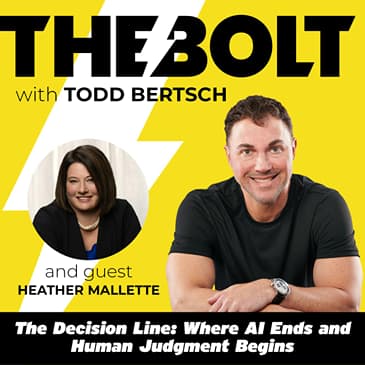
AI can give leaders more information, recommendations, and answers than ever before. But having better answers does not automatically mean we are making better decisions. In this episode of The BOLT Podcast, Todd Bertsch sits down with Heather Mallette, SHRM-CP, Founder and CEO of The Decision Line®, to explore why human judgment becomes even more important as artificial intelligence becomes more capable.
Drawing from more than 20 years in HR and business leadership, Heather shares how leaders can use AI without outsourcing critical thinking, why pressure can narrow our judgment, and how curiosity creates space between what we think we know and what might actually be true. Todd and Heather also explore career growth, recognizing when you have outgrown an old definition of success, taking action before you feel completely ready, and the opportunity HR leaders have to develop better human decision-making in the age of AI.
What You’ll Learn in This Episode
- Why having more information does not automatically lead to better decisions
- Where AI should inform a decision and where human judgment needs to take over
- How leaders can use AI to pressure-test ideas without outsourcing their thinking
- Why AI cannot solve broken organizational systems, processes, or accountability
- How pressure narrows judgment and causes leaders to mistake partial information for the whole truth
- Why pausing before reacting can improve leadership decisions
- How curiosity helps leaders challenge assumptions and uncover missing perspectives
- Why personal growth sometimes requires redefining what success means
- How taking small actions can create clarity when the path forward is uncertain
- How HR can prepare leaders and employees to exercise better judgment in the age of AI
https://www.toddbertsch.com/podcast/the-decision-line-where-ai-ends-human-judgment-begins/ Thanks for listening/watching! We appreciate you.
Follow us at:
https://www.linkedin.com/in/toddmbertsch/ https://www.facebook.com/theboltwithtoddb https://www.instagram.com/theboltwithtoddb/ https://www.youtube.com/@theboltwithtoddb
⚡ Ready to ignite lasting transformation in your team or event? Book me for keynotes, corporate training, or Positive Intelligence® coaching at ToddBertsch.com
Powered by the WRKdefined Podcast Network.
[00:00:05] Welcome to The BOLT Podcast. I'm Todd Birch, entrepreneur, keynote speaker, and mental fitness coach. Whether you're a new listener or one of our loyal listeners, I'm glad you're here. See, I believe we're all a work in progress. No matter where you are in your journey, there's always another lesson, another challenge to overcome, and another opportunity to grow. And that's what this podcast is all about.
[00:00:31] With my guest, we'll have honest conversations about leadership and personal and professional growth. I'm excited for this next episode, so let's get to it. AI is getting really good at giving us answers. But here's a question I've been thinking about lately. Are we getting better at questioning those answers? Because having more information doesn't necessarily mean we're making better decisions.
[00:00:57] My guest today, Heather Mallette, calls the moment where information ends and judgment begins, THE DECISION LINE. Heather has spent more than 20 years in HR and business leadership helping CEOs and executive teams navigate transformation, workforce strategy, culture, and difficult people decisions. Today, she's the founder and CEO of THE DECISION LINE, where she focuses on executive judgment in the age of AI.
[00:01:27] Heather, I'm so excited for this conversation. Heather, I'm so excited for this conversation. Welcome to the Bolt Podcast, my friend. I am so happy to be here and excited for this conversation. So you and I have had a couple conversations, and we're going to unpack some of that in this episode today. But I want to start off with the decision line. I love that name. Great name. So you describe it as a place where information ends and judgment begins. So what exactly happens at that line?
[00:01:58] So at that line, the decision line is really where you no longer can wait to make a decision. Leaders need to gather data. They have to seek advice, run scenarios, ask AI questions and recommendations. They also have to reach a point where they may not have the perfect answer, but they need to make an answer.
[00:02:18] Someone has to interpret the context of the information, and someone also has to deal with the consequence, the downstream effects, make the call, and own the decision that's being made. And AI is making it even more important to look at information because there's an abundance of information, and judgment isn't simple anymore. The question isn't whether AI can give us better answers. It's whether the leaders are becoming better at questioning those answers.
[00:02:48] AI can give us the decision line faster. It cannot cross it for us. Gotcha. Okay. So you posed a question that I wanted to unpack where you say, AI gives us more answers, but how do we make sure we're still doing the difficult work of thinking, growing, and deciding for ourselves? I think that's bigger than AI.
[00:03:16] I would agree with that. And that's basically what my work is centered around. And what it is, it's actually the contextual thought process and working backwards. What is the ultimate goal that you're trying to reach? So what are you trying to do? And then from there, using AI to pressure test those ideas and thought process. Pressure test. Yeah. So do you think we're at risk of outsourcing not just our thinking, but some of the struggle that actually is necessary for us to grow?
[00:03:44] I do believe it could be if you're solely using it as the single decision maker. There's still the human aspect in this. There's still judgment that has to be made. And that's really the new leadership tool that we need to be using. I mean, we've always had that tool, but it's going to be sharpened even more while using AI. Right. So where do you see leaders?
[00:04:11] In your experience, in all your years of HR and working with executives and leadership teams, where do you see this big struggle? The biggest struggle I see is what context do we use? How do I interpret the data? And then what do I do with it? I often see leaders using AI to fill it, to help with efficiencies, but then they're filling that time.
[00:04:38] Maybe they have five hours extra a week and they're filling it with busy work instead of adding value to the business, driving the culture, making a difference. And I see that's really where leaders can make really make a difference and improve in the process of AI. Gotcha. So what are some things that leaders could do? Sure. To leverage that time a little bit better. So they can, they need to start with value added.
[00:05:07] They can, what, again, what kind of problem is it that they're trying to solve? Is it a retention problem? Is it an attrition problem? Is it a judgment call? Is it, they're not providing enough context to whatever the problem might be, or is it something else?
[00:05:22] Is it something else?
[00:05:53] What would be an example of one of those systems? It could be anything from like handbook. It could be, it could be something related to guardrails around who actually is owning issues with the system, problems, procedures, things like that. It could also be a system process. The way that the flow, the way things are coming in and out isn't proper and, or is it, is a system not locked down appropriately?
[00:06:22] Are we protecting our intellectual property and not allowing certain confidential documents to go out into the world? Because that is a concern. Right, right. Yeah, absolutely. Yeah, I think it's interesting. One of the things that I've been talking about with a few leaders, especially in the HR space, is that AI is in every single conversation. It's making us more efficient.
[00:06:49] There's been some new data that says, I believe it was Gallup that stated that we are seeing the highest revenues that we've seen before. And that could be caused by a number of different things, but essentially we're getting time back. So to your point earlier about, are we spending that time wisely?
[00:07:15] And one of the things that I think we need to do, because I'm seeing this in the gap, in particular in the middle management gap, where we're not training our leaders. So we're not investing and giving them the time to invest in themselves. And they don't understand how important it is to then give that time to their team, like really spending the time to have those one-to-ones, to really get to know your people and create that safe space.
[00:07:45] So I think for me and what I've seen in the conversations, it's time. Like, let's really leverage the time to put back into ourself, because that is what I've seen as the biggest problem in a through line in all of this, in particular in the last six to 12 months. What do you think? I would agree with that.
[00:08:06] And I also think in addition to that, the supervisors need to spend more time understanding what's actually going on in the business.
[00:08:16] I think so much time is wasted on transactional type things that to get the best value out of it, we need to be spending time with the people doing the work to make sure that as we're using all these other tools, that we're applying what the pinch points and problems where they need to be in solving problems using these tools. Yeah. So how do we do that? Do you have any examples of where you've seen that work really well?
[00:08:46] I think the best way to start and where I've seen it be most successful when we're using, for instance, AI, just since that's the topic we're discussing, is when you have a couple champions, you start small. I think too often leaders want to start, let's implement AI, everybody use it, and we're just throwing spaghetti at the wall, versus having a small controlled group of champions who understand somewhat how to use the technology.
[00:09:13] We're using it to solve a real business problem, a pinch point for them, getting those wins, and then they can help champion that effort out to the organization. And I've seen it be extremely effective when done that way. Yeah. Yeah. And I think that that goes back to my framework, the Spark framework, one of those three core drivers being action, start small and stay the course.
[00:09:38] So just with any change, whether that be trying to create a new habit for personal growth or professional growth or implementing a new system within the organization, starting small is incredibly important. And I think I shared the story about Apollo 11 and how they didn't accomplish that crazy mission through one giant leap.
[00:10:04] They broke that mission down into a thousand small steps that they called one-inch wins. Start small, stay the course. And then you build that confidence, which allows you to build the momentum and really start to make some change. Nope, that makes perfect sense. Now, I want to come back to the talk. So you and I were at a SHRM chapter, Nora, up in Toledo, Ohio.
[00:10:31] And after the talk, you had a post about my talk, which I loved. And you said, pressure doesn't test leadership. It narrows judgment. And that was really interesting because I haven't had anybody really pull that out of a talk before. So I want to just to unpack that and what your thoughts were on that particular statement.
[00:10:54] Sure. I believe that judgment, as we get into this era of AI, we have to be very specific on what we're looking for. And we really, to your point in your framework, have to look at the judgment calls we're making and the data points we're using because we do have an abundance of information. And we have to be able to hone in on what is the most important pieces of that information.
[00:11:18] And then not only, okay, now we've identified those pieces of information, but how do we apply it? And through the discussion that or conversation at the Nora meeting, it really got me thinking about all of these things and how do we apply it?
[00:11:34] And now with your framework and AI, how can we use these things together and make better sound decisions that can be executed throughout the organization and really impact the business in a positive way? Yeah. And it's interesting because we do see this with, and this is even before AI, right?
[00:11:56] Anytime that we are in a situation where it's high stakes, there's some pressure or there's some uptick in stress, we do start to narrow our judgment. And I had shared the story about the three blind men encountering the elephant for the first time where, you know, you only see your piece of the elephant or your piece of the problem. And you think that's the whole truth.
[00:12:25] But when you get curious and you ask those second and third questions, what else might be true? What am I missing? What assumptions am I making? Very simple, right? It's very simple in theory, but the practice of that is not so simple. And I think that really all comes back to one very simple word in all of this, which is pausing and just stopping.
[00:12:53] What do you, how do you feel about that? I do agree with that, but I also think that we, with the analysis that we're doing, there's some pattern recognition as well that we need to be looking at. And we also need to be thinking about how does this decision impact the business and the people? I think sometimes we just think we need the technology. We have to apply it.
[00:13:18] I went to ABC conference, ABC training plan told us we need to be implementing this, but we're not thinking about how it's going to be implemented and rolled out. So to me, I think there's multiple tiers to think about when we're going through this process. Right. Absolutely. Yeah. And I'm just thinking about judgment in particular, being able to stop and pause, right?
[00:13:43] Because if we, if we don't, if we haven't built that habit in, then we're reacting. Regardless of how much abundance of information we're getting from the internet, from AI or whomever, we still, as human beings, we can't really make a great judgment call, a great decision, unless we take a minute to just pause and sit on it, sit with it so that we're not reacting
[00:14:12] and responding quickly because that's when we get in trouble. And I think that the pause is incredibly important for that. Yeah, I do. I do too. And I think we really need to look at in that pause while we're there, we need to think about what am I missing? Is there something I could see differently? What assumptions am I treating as fact that maybe are or aren't? And with that pause, that's really going to help.
[00:14:40] And we know that pressure doesn't test leadership. It can narrow judgment. And that's really, you know, where in your elephant metaphor, it kind of summed it all up. And I really feel that to be true in this situation. And your listeners, I'm sure can apply that to different scenarios that they're seeing in their businesses right now and in their work, their day-to-day life. Absolutely. Yeah. Yeah. Yeah.
[00:15:08] Because a lot of times, you know, we're just looking at something and thinking that it's the truth, the absolute truth. I'm right. You're wrong. Right. And when we take a step back, it opens up the conversation and allows people to have some opinions and to be a part of it. And it also allows us to leave with a little more empathy as well, which is usually good for, you know, a conversation in particular, a really difficult decision to make. So. Yeah.
[00:15:37] And I think too, curiosity plays a role in all of this as well. That, you know, curiosity says, I know, or certainty says, I know. And curiosity says, what am I getting wrong? Right. Because that's also part of the pause. You can give yourself a minute there. And it doesn't mean that the leader's indecisive. And I think that's the part people confuse too, is that a pause isn't saying, I don't know.
[00:16:02] It's saying, I need a second to process or I need, before I react or do make a decision, I'm allowing myself space to breathe and to make sure that it's a sound decision. Because the worst thing you could do is make a snap decision that could have catastrophic effects or major downstream problems. Yeah, that's a really good point.
[00:16:26] It's a really good point to consider not being worried about what other people are thinking about you in that moment. Like, oh, he just, he must be dumb. He doesn't have an answer right off the tip, you know. And no, I'm just taking it in. But I think if you start to practice that in public, then your team sees that as, okay.
[00:16:53] And honestly, my own team had to get used to that because I was the one that was just, they called me the knee jerker. And they're like, wait a minute, Todd, is he even still on this call? You know, especially virtually what I wasn't saying anything. I said, no, guys, I'm just taking a step back here. I'm taking in the information. And I'm also empowering you guys to, you know, to make a call or at least to have a conversation. And then I'll chime in when I'm ready.
[00:17:23] And I feel like, you know, I have all the information or enough information that I feel confident in making, sharing my opinion or making a decision. Right. And I'm sure with that, you're also in what's great about the pause too. And this is another point. And I'm reading between the lines on what you're saying is that you're taking a minute and you're going to question things, right? What am I assuming? What evidence should I change? Could change my mind, should change my mind, or maybe it shouldn't be changed.
[00:17:51] And then whose perspective could I be missing? And then what happens if I'm wrong, right? You're doing all of those things when your team's thinking, is he there? Is he even paying attention? What's, is he multitasking? No, you're going through all of these questions in your head, checking them off to make sure, again, that we're with the pause, it being so great that you can do those things. And you're allowing that time. And maybe that's something we need to start teaching leaders that, you know, this isn't taught in business school.
[00:18:19] The pause really isn't, it is so important and yet so underused. Yeah, I'm with you on that. Absolutely. And I think curiosity too. I think that is, you know, that is definitely a trait that can be learned. Some of us are just innately more curious than others. But I wholeheartedly believe that curiosity is our number one superpower.
[00:18:45] And in the age of AI, which we're talking a lot about today, I think curiosity is, you know, that one trait that is, if we leverage it, is going to keep the conversations, the decisions human, right? Because we're the ones that can ask the questions, but we need to continue to ask. And I love how you said pressure test. I use AI to pressure test ideas all the time.
[00:19:10] But I'm still, even once we go round and round, I'm still questioning it, you know? And I think that's where we need to really take that moment to pause and just say, now, when we're running quickly and we just need to get something done and out the door, that's when we make bad decisions, right? And we're just copying and pasting and taking that, you know, as the full truth. And we know when you see the full elephant, that's when you're not thinking clearly.
[00:19:38] So yes, I'm all in on curiosity. I think when we talk about questions, when we talk about staying in a growth mindset, continually learning and developing, you know, we all had curiosity as a kid. And over time, as we get into a box, we get out of college, we get into our careers, you know, we do tend to, it's the first thing to go. And once you start to lose that curiosity, then that's when you settle into kind of a comfort
[00:20:08] zone and your spark begins to dim. It is the one tactic that is the easiest to help ignite a spark, but it's also, you know, the one that we can lose the quickest. And it's just like anything else. It's a muscle. If we don't practice it, it's, you know, I tell my folks, use it or lose it. Use your brain, use your body. If you're not moving, if you're not really testing your brain, then it's going to go. Like, it's a muscle.
[00:20:38] We have to use it. Yeah. And I think too, curiosity creates space between what I think I know and what might actually be true. So certainty will say, I know, right? And then curiosity asks, what am I getting wrong? And that doesn't mean leaders become indecisive. It means they are challenging their thinking and committing to the decision. The questions that I usually ask myself are, what am I assuming?
[00:21:04] What evidence would change my mind and whose perspectives am I missing again? Yeah. Yeah. I like those. Yep. And one other thing too, curiosity is a discipline of challenging your certainty before reality does it for you. And I think that's something that I need to keep reminding myself because I, to your point, always want to be curious and always learning. And I think that's actually a new leadership tool as well is constantly learning, being a lifelong learner.
[00:21:34] And that's a curiosity piece. It is. Yeah. Yeah. We can, yeah, we can. Let's unpack that because one of the biggest challenges, and I teed it up at the beginning that I've seen in really just about every conversation, especially in the HR space, but we're seeing this globally and in all different roles and responsibilities, the leaders not putting the
[00:22:00] oxygen mask on themselves and really settling in to a comfort zone. And I don't mean this, I don't mean to call anybody out. Like this is, it's not your fault necessarily. We don't wake up one day and say, oh, I want to, I want to just be in a comfort zone. I'm just going to suck today. You know, no, nobody wants that. You know, we all, we all truly want to be the best version of ourselves.
[00:22:28] But as I said, with all the smoke signals, right, there's all these things that happen in different seasons in life. And there's a ton of variables. And for whatever reason, we, all of us at some point end up dimming those sparks, right? And that's when we become less curious. And when our sparks dim, we're not growing or we're not growing as enough, right? As we really should be to keep, to keep going. And you're right.
[00:22:56] The curiosity piece is that constant asking the questions and seeking to learn more, to know more. Um, and that's where we have those great tools. The internet AI can really help us learn quickly about a subject matter. Um, but then, you know, we're the ones that need to discern that information and, and, and take it and figure out what to use and how to use it in different scenarios.
[00:23:24] But yeah, lifelong learning. I always say, look, and we've said on this show, I mean, this is a personal, this show is focused on leadership, personal growth and professional growth. If you're not leading, you're not living. I mean, it sounds brutal, but at the end of the day, it's, it's true. And if you think about those people and, and, and let's, we're going to come into your, your personal situation here next.
[00:23:50] Um, and I've been there too, like, yeah, a part of me is, is dimmed out, right? That's, I'm not living up to my true self. My spark is not lit. So great segue into your transition. So you're in HR 20 years, you know, successful doing wonderful things. And then one day you're like, Hey, um, I assume my spark's not lit. Something's something feels different.
[00:24:20] So let's kind of talk about, cause this leads us into the decision line and where you're at now. So what led you to that work? Did you see smoke signals? What were they and how did you go about, um, this next journey of this next chapter? It happened by accident. I think as all good things do, um, I, I am part of, as you spoke about earlier, I'm the president of the Toledo SHRM chapter, nor also known as Nora.
[00:24:48] And we have a subgroup, which is senior HR for director level and above. And we meet quarterly to discuss different topics. And of course our friend AI came up. And during that conversation, um, the group was kind of split on, you know, how they felt about it. We were, people were voicing concerns who's using it, who isn't. And it really got my, um, the idea of the decision line was born out of this.
[00:25:15] So what hit, when they're discussing the topics, I'm thinking to myself, why aren't you asking AI this? Why aren't you? And from all of that came the decision line. And when I look back, um, on some of this, it, it kind of energizes me now because if when one door was closing, another one was opening because I thought I'd always, I, my track was HR always, you know, I started as an HR assistant and then worked my way up from there.
[00:25:42] And now here I am doing consulting and there was not necessarily anything wrong with that track. And I'm not trying to discourage anyone from that, but after 20 years in that, I kind of, I did feel that it was time to try something else. I felt that expansion, that spark, as you talk about. And I started recognizing that although this might be right for someone else, it wasn't my right. And I didn't want to spend the rest of my career doing something that I wasn't really passionate about.
[00:26:12] And sometimes the signal isn't that you're failing, it's that you've outgrown the definition of what your success is. And that's kind of where I was at. And now I have this second chapter that's exciting and new and different. And it's really helping me reignite the spark that I had in having your, your conversation just a little bit ago, really ignited that again for me too. And reminded me of all the reasons why I started the decision line.
[00:26:41] Yeah, no, that's awesome. I love that. And, you know, that's a difficult thing to do. Not a lot of people can or will make that type of transition for a number of reasons. One, it's extremely risky, right? So you're in a very, well, not that any job now in corporate is safe, but, you know, you had a job and you were good, right? There was no reason to shake things up.
[00:27:09] But you notice something inside you that just wasn't lit up anymore. And you could have just stayed and just stay complacent. And we see a lot of people do that, especially, you know, once we get to that age where we've been at our jobs for 20 years, especially if you've been at the same company for a long time, it can be very easy to fall into that complacency and what I call groundhog day, right? Where you're just Bill Murray and you're just churning out next thing, next thing, next
[00:27:38] thing, you know, the days turn into weeks and then you're living the same year over and over again. You're like, oh crap, what happened? You know, here I am 60 years old and what did I really accomplish? What am I, what's my legacy? And, you know, do I have regrets? So, no, I love that you're following your hearts and your guts and you've made, you know, decision to, you've made a decision to start the decision line. Right.
[00:28:07] And how long have you, have you been doing this now? Almost a year in November, it'll be a year. Okay. Awesome. And I've been posting on LinkedIn for right around the same amount of time. Yeah. Good. So what are you, what's the focus of the decision line with the types of clients and problems you're trying to solve? So we are, the decision line is focused around executive decision making and the clients that
[00:28:36] I focus on are mid-sized companies. But that doesn't mean large companies I've worked with too, as well as smaller companies, but usually the mid-size is where my sweet spot is. And we focus in on the executive judgment there. And I have some frameworks that I use and some, my consulting from in my previous HR life comes into play there as well. Nice.
[00:29:05] You know, it does remind me of kind of the action piece, which is one of the core principles in the Spark framework is, so you, it's one thing to recognize that something needs to change. Um, it's another to actually do it. So how are you able to push yourself? Because that's going to be uncomfortable. And most people don't like to experience any discomfort whatsoever.
[00:29:35] We're just not, we live in a bubble as human beings in this day and age. We're just not accustomed to it. So what, what tools or tactics or tips can you share? Cause I can see a lot of people, you know, going down this road of consultancy, which can be a very difficult venture. I'm in it right now. And, and I know it to start all over again and to build that client base, you know, can be, can be difficult, but what did you do?
[00:30:03] What, how, how can we maybe encourage or help someone else? Who's thinking about making a big transition like this? Sure. Um, I think step number one is to stop feeling completely ready because it's never going to come. If you're waiting for like, if this happens that, cause I'm very much that person previously and I had to take inspired action. So I felt it, I had, I pressure tested it to my own by putting feelers out there on LinkedIn
[00:30:33] to see how are people going to respond to this? How are they going to get some data points? Right. And then from there I took momentum and, um, the path isn't always obvious because I w I would never, if you would have asked me two years ago, was, would I be a consultant? I would have said no, but I'm, I'm now I can understand how I did it. I started small. I took little steps, um, that I thought would happen. I started the decision line, open my LLC.
[00:31:02] Then I started writing about it. I've, um, had some speaking engagements. I've been on podcasts. I'm working on some intellectual property. I am going to be launching my own podcast, the decision line with my husband who his name is Doug Millett and he is a VP of IS for Rudolph Libby. And we're together going to be testing ideas and doing our own podcast. And again, taking some inspired action on that, um, as well as having conversations with people
[00:31:30] in the HR realm to understand what are the problems that they are. And that action created clarity for me. And every step gave me more information about the next one to take. And it just kept going from there. And I, I believe you don't always think your way into clarity. Sometimes you act your way into it. And for me, that's kind of what I had. I don't really love the fake it till you make it, but in this place, this case, I think you really do.
[00:31:59] You don't always think your way into clarity. Sometimes you have to wait. You have to, pardon me. Sometimes you have to act your way into it. And I can't say that enough. Sometimes I have to remind myself of that. I'll, and it sounds a little crazy at first, like having this affirmation or mantra, whatever word you want to use. And I'll say to myself, you don't always think your way into clarity. Sometimes you act your way into it. And you know, it's like the little engine that could, it sounds crazy, but it works for me.
[00:32:27] Oh, I absolutely love that. And I wrote down here, inspired action. Um, and, and that's your, that's your spark. That's, that's guiding you. Right. Um, and you're absolutely right. The journey, it's going to twist and turn. It's not going to be straight. Um, you know, if you have something that's just heavy on your heart that you need to do, that you need to get off your chest, you need to share out into the world.
[00:32:55] Now might be the time, you know, take that inspired action. And, and it is a bit of, it is fake it till you make it. Um, but there is a foundational element to it, right? That you're like, okay, I'm an expert in this. I know that this needs to be out in the world and I'm going to do everything I can to get it out there. It's just to fake it till you make it is just really going out there and doing it and speaking and, and getting the clients and building out your book of, of business.
[00:33:24] Um, but, uh, yeah, you just got to take that first, first step. And it's interesting, this conversation, we did not, uh, tee this up, but it's, it follows my spark framework beautifully, uh, with starting off with curiosity and then building that mindset, you know, being able to reframe challenges, build an internal pause button, and then, you know, being able to take that intentional action, the small steps, staying the course. That makes perfect sense. Hey, it's Todd again.
[00:33:54] Look, our leaders are facing incredible challenges right now with burnout, disengagement, and stress among our teams. We see the data. Gallup shows us that 80% of employees and managers are disengaged. SHRM reports that burnout and stress are at the top of workplace challenges. And the global business index reports a 180% increase in business disruption. Those are real problems. And that's why mental fitness matters more than ever.
[00:34:24] Mental fitness is your ability to respond to pressure and challenges with clarity, confidence, and laser focus. Instead of being derailed by negativity, self-doubt, or stress, it's about building that self-command, especially when it matters most. How do I know? Because I went through a mental fitness program called Positive Intelligence during COVID. Change my life.
[00:34:54] Change the way that I live, lead, and run my business. And through the Positive Intelligence program, I work with leaders and teams to help them reduce burnout, strengthen resilience, and create a culture where people feel supported, engaged, and capable of performing at their best, even under high pressure. It's a neuroscience-backed program. It's only eight weeks, and it works.
[00:35:20] So if you're interested in learning more about the program, visit my website, ToddBurch.com. Let's set up a call, and I'll walk you through a quick demo. Now back to the show. Well, let's bring this back to HR for a minute because you and I have both spent a lot of years in HR. A lot of people don't know. I'm not your traditional HR person, but I own a small business, 10 to 15 people. Over the past 17 years, I was in HR role for 15 years.
[00:35:50] And I learned a lot. Let's just say that. I have a deep respect, which is why I have this shirt that says I love HR because I absolutely did not love HR, but I learned to love HR and have a deep respect for it. So anyhow, so bringing this back to HR, HR leaders are now like, man, they are at the intersection of so much stuff, right?
[00:36:14] AI, people, culture, organizational change, like crazy, and some incredible consequential decisions, right? So how does technology become more capable, which allows us to be more valuable? Like where does AI fit into HR? How do we leverage it?
[00:36:38] How do we continue to devote ourselves to the human impact, which is really what HR is responsible for? HR has enormous opportunity right now. How I see it is we're talking about AI adoption, what tools we're buying, what processes, what we're automating, what efficiencies we're doing. We also need to ask what happens to human judgment and technology as it becomes more capable,
[00:37:08] right? And if AI removes routine work, what are we developing in its place? We need, again, that curiosity, the context, courage. I think we've talked a little bit. We haven't put a word to that, but I think courage. And the other piece that I think we've danced around but haven't talked about, what about accountability? And where does that go? And the ability to challenge the answers which we've discussed rather than simply accept them. And I think sometimes that's the other part you and I have kind of discussed here is not
[00:37:37] just accepting it as fact, using that human, that thing between your two ears, the brain to help us come up with the answer. And HR should help organizations become more AI ready. We should have better judgment that we're helping leaders make. And the future of HR is really protecting people. It isn't protecting people from AI. It's preparing people to exercise better judgment in the era of AI. It's kind of how I see it. Yeah.
[00:38:06] What's, where do you see us going? Do you see, is there hope? Do you see some companies that are doing it well, getting it right? Right. I do see, I think it's a mixed bag right now. And I know that's a very diplomatic answer, but I think we're all in the era of figuring it out. And that I think we're all taking inspired action, sometimes a little too much and sometimes not enough.
[00:38:35] And sometimes it's right in the middle, but I see some companies are doing it right. They're getting those small groups, getting the small wins. I see them partnering with all the different parts of the organization so that not just one part particular component is owning the whole AI piece. Because I think it is an issue that legal has to be involved in.
[00:38:59] It's a discussion with marketing, with sales, IS, HR, because so many different departments are impacted by AI that when we, we all know we are better problem solvers. When we have a group helping guide a decision, provide input on a decision, we know that better outcomes are going to occur. Yeah. And happen. Yeah.
[00:39:24] What's interesting to me is, you know, I think about AI and where we're at now, you know, we've been here before. Honestly, if you want to talk about, and I know I've seen some presentations where they go all the way, all the way back to, you know, the car or the telephone, but let's talk about the internet.
[00:39:46] Like that was a huge disruption, but also brought about a ton of opportunities and lots of information. So kind of the same thing we still had, right. We could go out and we could download an HR handbook. I did it, you know, but I still had to make that judgment of what's right for my business and my people. So I don't know.
[00:40:12] I feel like a lot of people are getting in a bit of a tizzy, if I'm being honest. It's like, guys, look, it's here. It's not going anywhere. Let's just settle down and let's build, right. Let's think about this appropriately. Like you said, I love it. It's the communication. So, hey, we don't have all the answers. We're going to pilot. We're going to test this. We're going to get some small groups together from different departments.
[00:40:41] So everyone kind of has a say, right. We're going to work together. We're going to start small, see how it really applies to our business, how we can leverage it, and then just start to build from there. We don't need to have all the answers right now. And maybe we're behind the ball. It's okay. Like literally, I don't know. I see AI, and it's just like this crazy. I just can picture all these people just running around with their heads chopped off like, I don't know what to do, and I'm behind. I'm going to lose my job.
[00:41:11] And we've been there, man. We can do this, right. We can do this. It's not going to take over. We're still going to be humans at the end of the day taking care of the humans. Agreed. I think the other point to make for my HR friends out there, it's no different than when the HRIS systems came in or the learning management or any of the other platforms that were using payroll systems, any of this.
[00:41:39] Heck, even the benefits portals that we're using. Those were all new technologies at one point, and they've all been another tool that we're using and that helps assist us. Yeah, that's a good point. Yeah, and there's always going to be something, right?
[00:41:55] There's going to be some sort of technology, some tool, and that's our job to be curious and to see what's out there, bring it in, break it down, pressure test it, pilot test it, and then go about our way. But no, I love this. And I do. I feel like there is hope. You know, we're obviously having a ton of conversations about it.
[00:42:22] If you go to any conference, AI is going to be a topic, some more than others. But, you know, I think we're smart people. We've been here. We just came off of COVID not too long ago. If we can make it through COVID, we can make it through anything. But I do have hope that we're going to get through this and leverage this tool, you know, to the best of its ability.
[00:42:47] But I do want to end with kind of a bigger question that you posed that I think kind of captures the entire conversation. You said technology can help us become faster and more capable, but can it help us become better humans, better leaders?
[00:43:35] Yeah. I know. The knowledge is abundant and judgment is scarce. Yeah. Absolutely. I love it. All right. Well, if you could leave our audience with one final thought or quote, Heather, what would that be? I would say AI can inform the decision. It can't challenge the decision. It can accelerate the decision. But a leader still owns the decision. That's right. You own it.
[00:44:04] You got to stick to it. That's right. No, I love it. This has been great. Well, thank you so much, Heather, for being on the show. I've danced around and stayed away from the topic of AI for quite some time. But you kind of forced my hand, which I needed. And we needed to have the conversation. So I'm glad we did. But lots of good stuff here. Looking forward to continuing our conversation.
[00:44:32] And obviously wish you the best of luck with the decision line. And we'll have some links to that in the show notes as well. Sure. And if anyone would like to continue this conversation, they can follow me on LinkedIn at Heather Millett. They can follow me on Instagram at Hey, It's Heather M. Or on Facebook at Heather Millett. Or visit my website at www.thedecisionline.net. And I'm building... I have a little freebie for you guys.
[00:45:02] If you DM me, Decision Line, I will have a three-question pressure tester for your decision that you can use. So if you DM me on LinkedIn that message with your email, I'll send you that information. Awesome. Always love a good freebie. A good freebie. Yeah. With some value there. Cool. Well, thank you. Well, this has been awesome, Heather. Have a great rest of your day. And I look forward to continuing our conversation. Me too.
[00:45:32] Have a great day. Wow. Another great episode. Thanks for joining us on the Bolt Podcast. Look, if today's conversation sparks something for you, pass it along. Every share creates a ripple. And that ripple has the power to change somebody's life. If you want more information, more conversations, show notes, resources, or free tools, check out my website, ToddBurch.com. Look, leadership is pretty simple.
[00:46:01] It comes down to taking care of yourself and your people. Ignite that spark, protect that spark, and light the way for others. We'll see you next time, my friends.
Sponsors
