
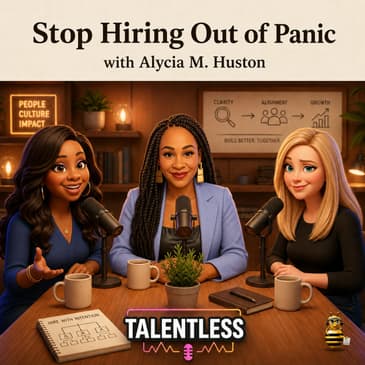
Alycia M. Huston, Founder & CEO, The Culture Cru
LinkedIn | Website: theculturecru.com | Instagram | Threads: @alyciahuston | YouTube
Alycia M. Huston built and sold a biopharma company, then built The Culture Cru to help founders stop hiring out of panic. This episode covers the one question that stops a bad hire before it happens, why "urgency" and "precision" aren't opposites, and the AI-bot screening story that went exactly how you'd think.
Resources/Links:
- The Culture Cru: theculturecru.com
- The Culture Constellation (Alycia's newsletter)
- Book: Leadership is a Practice, Not a Personality — out October 2026
- Talentless at RecFest USA and HR Tech Conference this fall
Powered by the WRKdefined Podcast Network.
[00:00:06] Recording in progress. Des, what is your favorite board game? This is a good one. Thank you. I don't think you'll be surprised though, but it's Monopoly. I was about to say, is it Monopoly? I think you know why Monopoly, right? Because I get to buy a lot of people's stuff. I'm like, give me that, give me that. How about you, Alicia? Emma, your favorite board game? My favorite board game is Trouble. I love Trouble.
[00:00:37] Mm-hmm. I like to pop that little bubble. Popping in the south. That's what I was, yeah. That's exactly what I was about to ask. Yep. And I like to knock people off the board. What's yours? Okay. As a kid, and honestly, even still now as an adult, Candyland was my jam. Yeah. However, he also was very competitive. So much so that like once I made it past like the Green Goblin Man. Yeah. I would secretly remove his card from the deck because like, as a child,
[00:01:05] I would get almost to the end and then I would get that stupid card and it would send me all the way back. And I remembered it so much so that I created strategy to ensure I would not get taken back out of the game. These are only child problems I hear. Wow. Because you're paying adults. Wow. Okay. I mean, I just have to say it was whenever I flipped the board after my aunt and uncle caught me. See what I mean? I knew it was an only child problem.
[00:01:35] You knew it too. I got clocked. This is the worst. Today, folks. Today. Wild and crazy as usual here in Talentless, but we are joined by someone who's very, very lovely and we are so glad to have her in the room. This is Alicia Houston. I am so bad at names. Ashley will tell you, I read everybody's name wrong. Alicia Houston in the building. We're talking about something near and dear to my heart, which is founders intention behind
[00:02:03] building strategies and intentional teams, which I live for because I think they all do it wrong now. I'm just joking founders out there. Please nobody come at me in the comments. Alicia co-founded a biopharma company in San Diego, ran it for a decade, sold it, and stayed through the acquisition where two completely different operating systems had to merge into one. Now she wants her own company called The Culture Crew, and her whole practice is built
[00:02:30] one idea that it's basically our episode thesis. The org chart gets finished long before the people are ready for it. Alicia, welcome to Talentless. Did I forget anything? No, ma'am. Thank you for having me. I'm so happy to be here and have this conversation. You nailed it. So here's, you know, I'm going to start on my soapbox, but here's what founders get wrong, right? They treat recruiting and people and thing like a task list, right? Yes. Let's check it off the box.
[00:03:00] They'll think about it, right? As a strategic whole, they'll spend months on the PR press release and they'll spend months on the dedicated time, but they really never really truly think about how, when they scale, how this is going to affect people and hiring and recruiting. The things that who all the recruiters who work for startups feel and like intensely and probably don't sleep at night about. So I'm interested.
[00:03:29] I'm going to give you your overall thought about this first before I dive into questions. Talk to me a little bit about the work you're doing now. Sure. So the work I do now is I, my joy is working with small and medium-sized businesses. Let me be clear. That is my joy because that is where I see the most impact in the work that you're speaking about right now. I absolutely still enjoy our larger organizations and corps, but it's a little harder to really
[00:03:56] kind of, I'll say, see that change, that mindset infuse itself throughout the full organization than you see with the small and medium-sized orgs. So what I do now is I work with these amazing individuals, these founders, these small business owners, these departments, and I support them in this intentional hiring as you're talking about and doing it from a space of what does it look like for your organization, you know,
[00:04:26] a year from now. I know we have the five and 10 year plan. I'm totally cool with that. But like even a year from now, like something that is really tangible and something you can bite into. So that is what I and my organization help other organizations do, that true intentional hiring. Where do you want to be? What does it look like for you as a founder? What would bring you joy in that next year? And then we just kind of reverse engineer from there.
[00:04:52] So it's all about leadership, culture, desires, values, mission, all those things. Yes. All of those things. I like it because I, you know, I do similar work. And so people are going to be like, why'd you have her on the show? Like, you weren't in it. But it's a very specific kind of work. And I wanted to have somebody else in the room to validate all my feelings about this work. Right. Yeah. Yeah. Because it's so intentional. It has to be so intentional.
[00:05:17] But I want to make sure that recruiters here too, that the questions they should be asking is they build these systems, right? Are we asking the right questions? When we're working at these very small companies, are we just like, let's get butts in seats because we're scaling so fast. Are we stopping and breathing all of this? And so what kind of questions are you throwing out there for the founder in particular? And then maybe the talent person. I love that.
[00:05:44] So I'm going to just even speak real time. Last week in Chicago, supporting a founder. She's about 25 million and really supporting her because to your point, as a founder, sometimes we feel the burn of, I need to fill this seat. I need to get someone in here. And you're telling this recruiter, this is what I'm looking for. And they're throwing people at you. And you're like, okay, I talked to three people. That's great. Let me just have that person.
[00:06:12] Because you're feeling such the angst of having an open role. So we really had to sit down and have a conversation last week. And just being honest and just, I asked her, you said, what question do I ask? I asked her, do you see this individual truly representing your mission, your values, when you say you want to be out of the office in six months? You don't want to be a part of the office anymore. She's looking for a VP.
[00:06:39] And so when you don't want to be in the office anymore, do you see this individual truly representing and emulating your values, your mission, all the things that you have worked these 20 years to build? And she had to sit down and think. And she said, I do not. I said, there's your answer. So sometimes it's really having that founder slow down and really understand what it is they're looking for and helping them to talk through it and process it.
[00:07:08] That's what I believe my role is. It's being that process, that sounding board and making you feel. Think differently than just pulling the trigger so you can relieve a level of pain, which we all know more pain will come down the line when we do an incorrect hire. I mean, we don't have a crystal ball, but we sometimes do need to slow down and just be a little more diligent in who we're bringing on. Right.
[00:07:33] And I always tell people urgency and speed don't have to negate precision, right? Like they don't have to be like in these totally different worlds. You can still move quickly and with intention and do all of these things and fix a problem, but you can also do it with precision and asking the right questions and doing the right things. And I think that's super important because I think so many founders, like you said, are just on like, I just want, you know, scale ups.
[00:08:01] I can sell this company and I just want to do all these things. And along the way, are not really thinking about the intention behind it, whether those people actually meet, they fill the skill set. Maybe they don't fill the other pieces of the puzzle. And there's some very interesting things going on there. I'm interested to hear, you came from biopharma and like that world, which is his own fascination fascination for me. I worked for Astromark a long, long time ago.
[00:08:29] And I believe that pharmaceuticals have their own thing. What principles did you take from working in that world into the work you're doing now? Well, that is a beautiful question. So I started in a lab. That's where I started, like truly in a lab working. And that wasn't for me because I need people. A lab, you know, you're talking to pipettes and different equipment. That wasn't for me. I like people.
[00:08:56] And so honestly, though, in the realm of biopharma, what I will say I took from that, right? There are the clinical trial side. There are things that you do in clinical trials to go from phase one to phase two to phase three to phase four. All the phases in clinical trials that we have to go through to get to the approved product through the FDA, right? Where you finally have made it. Everything is approved with the FDA.
[00:09:25] So I would say it's the phased approach that I truly have an appreciation for. And it's making sure that the product has been proven at each phase. So that I will say, that's a great question. The phased approach, I see the value in it. I see the need for it. I see that's where the metrics come in, the data points where the information informs the next phase. What needs to be tweaked? What needs to be completely just thrown out the window?
[00:09:53] So that's what I would say from that biopharma realm is the phased approach. I have a deep appreciation for that. And yeah, that's what I would say. Yeah. Yeah. Interesting. Yeah. Right. Yeah. I mean, the phased approach, it's so cool because, right, we talk about a lot on this show about thinking about what's working and what's not and deleting those things that aren't
[00:10:19] working, but looking at the data that says this isn't working or this is working. And I think founders who are rushing, right, so fast, they skip all the data points along the way that said, hey, by the way, this wasn't working six months ago. Why would it be working right now? And they skip that part. So it's very interesting when it applies to hiring because I think the phased approach
[00:10:45] of how you intentionally hire can definitely take that method approach and make it make sense. Can I say one more thing? Because something just came to me as well. You're not allowed. I only had you on this show to listen to me. I love it. I love it. And I will do so. One other piece that like it just dropped in preparatory to research. That's from the science realm as well. You prepare for the research you're about to step into.
[00:11:12] And so as we're talking about intentionally hiring, creating a culture that we desire, you know, with that new hire or those new hires, it's that preparatory to research. And what preparatory to research is, is you prepare for what you're stepping into, what you're moving into with that research, with that clinical trial, with that outcome you're desiring. So preparing with your questions, with an understanding of who you are and your mission, your values,
[00:11:39] being honest, being transparent, being all those things, right? Understanding that we're not here to be emblematic. Like, do you really practice what you're saying, that mission, that value statement? And so where is that preparation needing some honing and some, and for you to take a second look even at yourself and what you're going to be inviting another individual into, right? Because now I'm inviting you into my world.
[00:12:06] And so into what I've created, into an outcome that I'm desiring. So what do I need to prepare so that your place is actually ready for you when you say yes? So that's another thing I would say is preparatory to research was huge in the realm of sciences. And I believe that that is part of the work that I do even in this realm of culture and leadership and acquisitions and people and all of those things.
[00:12:33] It's preparing our organizations, preparing our people for those new people that could potentially say yes to joining this team. Very interesting. Yeah, right? This brings up the, because this goes back to me and I swear our audience is probably like, if you talk about the intake one more time, the intake process for a role one more time, we are not going to listen anymore.
[00:12:59] But honestly, it's part of this prep work for the next step, right? It's like making sure you come to the intake with all of these right prepared things to go in with that hiring manager and say like, hey, do you need all these things, right? What do you need? What don't you need? Why do you need this? All of those pieces of the puzzle. So I love this idea of that preparatory research and remember that. Yeah.
[00:13:27] To attach it to the work that recruiters do even before they, as soon as they open the role, right? They should be doing this kind of work, right? Yeah. Am I wrong? No, of course you're right. What are you talking about? Am I wrong? She just threw that in there because she wanted to hear how right she was. That's a joke. Are you joking? My gosh. The only thing that I would say that I'm adding, which isn't even an ad at all, but I agree with phased approach because it is like a intrinsic form of continuous improvement
[00:13:57] because at every stop and start is a new correction based off of previously learned items. So it's kind of like you're always honing and I don't know another way to say it other than just, you know, correcting, I guess you could say. Yeah. So there's that. And then the other thing that I would say is, so I came up through research as well, but not physical. I did behavioral research and science. And so a lot of that prep is actually like, at least for us in behavioral research, a lot
[00:14:27] of it is like priming, priming, even though it's like we're doing an intake paper filling out, what we're really doing is priming our managers to say, this is what looks good. This is what looks bad. And we're setting them up for going into that environment to assess talent, to assess people, to maintain it on objectivity and doing so through exercises like an intake or a launch call or whatever that may be. So that would be the one thing that I, which is kind of connecting both of y'all thoughts together because y'all were spot on.
[00:14:56] But just to say that like, even in behavioral research, there is preparation, but a lot of it is even just mental priming, whether it's of the subject of the person you're reading, like whatever it might be. And so for us in talent, I feel like a lot of it is like managers, the peer interviewers and assessors on like just ensuring that we align. Half of that is just priming them to look for the right thing versus at all these other flashy objects that could snag their attention away. Yeah. Yeah. That is good. I really like that.
[00:15:26] I think you're absolutely correct, Ashley, with that, that priming the brain, right? Priming the people for what is the yes and what's the no, what's the gray area? Where's the comfort? Where do we need to have a conversation? And honestly, I think that's a little bit, there's a deficit there. There's a deficit. People are truly looking just to get sometimes butts in seats, right? Let's get this filled. Let's get this going.
[00:15:53] And, you know, Desiree, you said earlier that both are true urgency and excellence, right? We can still meet the goal with that level of knowing there's urgency, but how are we also supporting that recruiter, that HR hiring manager with priming them with this is an excellent candidate. This is a candidate. How do we do that in this time where there is a level of urgency? And so we're supporting both.
[00:16:20] We're supporting both the org and we're both supporting the hiring manager and the individual that with their time that is applying. So an individual that has applied is very clear with that. This is for you or this is not for you. And this is why. Just to connect this for the audience. One great example of what she was just saying is like a timeline. So like if you've primed the managers that your average timeline is three weeks and then you've told the candidate it's three weeks. Now we've set that bar of expectation.
[00:16:49] And so whenever it's five weeks, we're going to say, okay, there's something off. So it's kind of like that. It's like you're teaching them what is what's good to look at and what isn't. And you're setting the tone by creating that anchor bias of what they're going to say is the norm. So anyway, just to kind of expand on like how that actually works and looks in real time, you could do it with something as tiny as the timeline. How much are they thinking about the candidate experience at all? Right. Are they? Do they think about it?
[00:17:17] You know, because I believe that it's talent's kind of function and responsibility to infuse the candidate experience at every point of all of these relationships. And if we don't do it, founders aren't doing that. They're never going to really think that through. And I'm not saying every founder, again, don't comment. Right. But I'm saying like the majority of them aren't thinking that through. Do you find that in the work that you do? So first, let me out myself that that was me in the beginning. That was completely me.
[00:17:45] I was not really thinking about that experience for the person who was interviewing their time. Right. All the things that they're sacrificing, quite honestly, to also be present for this conversation to be. And even to the point that I had a gentleman tell our receptionist my interview. I will never forget this. My interview was at 11 o'clock. It is 1108. And, you know, I'm like, whatever. But you know what? That is the experience.
[00:18:15] We want that individual to have an experience. I don't want them to have that experience. I want them to have an experience. To your point, to both of your points, that is, okay, this employer values me, values my time, is an employer of their word, all of those things. And quite honestly, Desiree, at this juncture, I will say, so I'm just going to think of my own base of clients in the last six months that we've kind of navigated this space.
[00:18:43] I will say it's 40, 60, 40 yes, 60 no. And then helping them to see the value as you are talking about why this is so important, what we need to be considering, what it does for that person on the other end, having the conversation with the hiring manager and or the recruiter about the value of these things and why it's so important as well. Yeah, I also think founders have a different mindset. I've been working with them for years, and I think that they're like, I built this awesome thing.
[00:19:13] And so everyone should want to come work for me, and I shouldn't have to explain why you should come work with me. Right? It should just be understood. And that is such a failure of a founder mindset. Right? It's such a failure of, and even a talent person listening to that should be like, like, guess what? I came to work with you because you're super cool.
[00:19:40] But that does not mean that everyone's going to think you're super cool. And we need to make that experience really, really awesome for them. And I do believe, again, that this is part of talent's responsibility to push back on that founder and say, this is great, Jimmy Bob. But, you know, yeah, you got to love Jimmy Bob. Your tech is awesome, but, you know, yada, yada, yada. That part.
[00:20:06] In the world of AI, excuse me, it's gotten worse. Yes, yes, yes. So it's like automated. Oh, my goodness. Yes. Yes. And even, and it's, you know, you talk about AI, right? We are here to utilize AI to support us, right? Not to replace us, to support us.
[00:20:25] I had one founder that, to your point with AI, he said, I'm just going to create an AI bot and have the AI bot do all of the screening, all the things. And I said, and you're going to have a hot mess. Yes. You're going to miss out on amazing individuals and you're going to bring in individuals that are absolutely not aligned with what you're doing. I said, I would advise against that. This was an advisement call.
[00:20:51] We were just feeling it out to see if we were a fit for each other. And he went on ahead and he did it anyway. And in three months, we were in another conversation. He was like, what happened? No doubt. I thought you were going to say he had a lawsuit. I was like, I saw that coming. Sheesh. Yeah. But this answered to another question for me.
[00:21:19] Ashley and I believe in the culture of not just the talent, but talent and culture and all of those things as well. First of all, I believe hiring influences culture. But how much of the work is in actual creation of culture? Yeah. Honestly, I will say 80% of my work is in creation of culture. There are a lot of cultures. And as we're saying, this is not to poo-poo on any founders or poo-poo on any organizations.
[00:21:49] That sometimes the person, the tone at the top has not been set appropriately. Do as I say, not as I do. All of those things, the part of that there's not a valuing of those who are boots on the ground. There's almost a devaluing sometimes of those individuals. So I will say, as I come in for, I did a listening session recently for a very large nonprofit. And that was a lot of the conversation.
[00:22:18] They don't understand the work that we do. They don't understand the need for newer technology, right? Because our laptops are dying. I can't do this. I can't do that. They don't understand. They're calling me on my own cell phone. I'm doing work for the company. So there's a lot of these things where culture has been created and it's just kind of created itself. And it has not been intentionally created. So I will say, especially in our small business environment. Yeah.
[00:22:46] It's about 80% that we've got to do some. And they don't bring me in necessarily. Let's be very, I want to be very honest. They don't say, we need support with our culture. You know, that's not usually what it comes from. It comes from the conversation, the pain, and then the solution with the phased approach that we present and we converse about. And we talk and we hit those metric points. And then we move to the next phase.
[00:23:14] So honestly, it's about 80% of people that are 80% culture work. Like honestly, communication. Oh my goodness. Communication, lack thereof. And then that translates to the new hire that you've chosen. They've come in. They've joined the team. And now they're a part of this culture that is not necessarily the best and the most communicative and the most joyful.
[00:23:38] And so then they're already looking like, okay, I may have made a decision that's not in alignment with myself. And they're looking to exit. So it is all interconnected, right? And I know you understand it. This episode of the Talentless Podcast is brought to you by Do Better Consulting. Do Better Consulting. Hiring is broken. Job searches are broken. And honestly, most career advice out there is just recycled nonsense.
[00:24:07] Do Better Consulting exists for people who are done guessing. They work with mid to senior leaders, founders, and talent teens to get clear on their signal. How they show up in the market. How they hire. And how decisions actually get made. No fluff. No templates just to say you have them. Just strategy, structure, and honest feedback that actually works. If you're tired of spinning, it might be time to do better. Head to dobetterconsulting.net.
[00:24:36] My gosh, I talk about onboarding all the time. Like, what's one I think HR's biggest failures in general is I've been through some horrible onboarding. If I even got one. Right? Like, if I even got, I mean, Ashley, you've worked for a lot of scaling companies. How good? I mean, you don't have to call anybody out, but do you find like that is a complete issue is the onboarding or usually they're pretty good at it? You know something?
[00:25:05] It really depends on the startup. If they made it a priority to hire some form of some HR admin, chief of staff, something to create, streamline something of some effect. It's all in the effort of the person. So there's that. And they could have it. They could not. I will actually say I went to a Fortune 200 company and that was probably one of the worst onboarding experiences I've actually ever had in my whole career to where I was so disappointed.
[00:25:33] That's why whenever she was like, and then the candidate starts and this isn't what they told them it was. And oh boy, have I lived it. Like, girls, please. Please. But so, yes. So I will say that onboarding definitely matters because research even shows. Actually, you know what? Let's save that for telling outside the box. Let's save that little nugget. Let's save that nugget. I'm going to job that down. But I altogether, I will say in general, you can have an excellent hiring experience.
[00:26:01] And if you have a terrible onboarding experience, it's just going to feel like a gaslit bamboozlement for like 90 days until you really find out what the truth is here. And truth is usually that if the priority was to get butt in seat, then it's not going to course correct itself. They probably didn't have a phased approach. Yeah. Yeah. Correct.
[00:26:24] Now my question goes to what if you do when you go into cultures that are already completely destroyed, I'm assuming you still use that phased approach. I'm more interested to hear how you identify what the actual issues are. Yeah. Is it communication? Is it onboarding? Is it like how to what's your kind of framework to do that? You got it.
[00:26:49] And I love I love this because I'm just thinking about one particular client and and how she thought, baby, it was everybody but her. It was everybody but her. And so this is what I've learned in my experience. Right. We're having the conversations with said client. He, she, they are telling me everything that's wrong with everyone else. OK, great. So part of that phased approach is we need to come in. We want to come in. And we have to let us see because I hear what you're telling me.
[00:27:18] But let us see. We want to sit in. We're going to be quiet. We're going to be listening. These are some of the things we're going to be looking for. We will ask some departments for. We'll have some conversations with some department heads, things of that nature. So that is number one. That is like we've got to get our our bodies into the space, our ears into the space, our energy and expertise into the space and and do some listening. Right.
[00:27:47] Because it makes no sense for me to give you some type of this is how we see ourselves moving forward. We really don't even we're only taking your word for it. We don't really know what's going on. That's subjective. That's completely subjective. So coming in with our team and listening, just listening, being curious, asking questions. And then from that time together is then the conversation with the stakeholders sitting down face to face.
[00:28:16] This is what we see. This is what we hear. This is data. And this is what we see our how we see ourselves with our expertise supporting you in moving to that goalpost that you said you wanted. That's how we do it. Yeah, I love it. I think, you know, the listening part is some of what we don't talk about this a lot on this show, but I do think talent and HR people think they're listening.
[00:28:43] We think sometimes aren't always doing the best job of assessing what's happening. And if we took a step back sometimes and listened and didn't react, we'd be in a much better place. First of all, I believe it's a skill set most people don't have. They think they have it, that they don't know how to actively listen. And it is a skill set people should work on.
[00:29:07] And I think that it does make a difference when you go into a culture and you're on the sidelines, but just listening and taking it all in and really hearing and listening to the complaints of the many. And it helps you devise a plan and you go into your face approach. I love that. It's a really good way to get into a space and then listening to that founder again. How are all or most of your founders so very disconnected from what's actually going on?
[00:29:36] The version the founder thinks is happening and the employee thinks is happening is usually off, right? Yeah. It's way off. I will say most of the founders are disillusioned. I hate to say that. They're disillusioned and they think it's everyone else but them. And then it comes down to a lack of communication, changing initiatives at the drop of a hat because they just, can, just the things that they don't consider those that are doing the work.
[00:30:04] And so it can be very small, but those very small things are very large as they roll downhill, right? And so a lot of it does, it boils back to what does leadership look like, act like, smell like, and move like? And then how do we as leaders take ownership of our failures, right? Because that's hard. And where we drop the ball and then bring that to the whole so that there is a level set conversation for us to move forward differently.
[00:30:31] So to answer your question, my dear Desiree, a lot are disillusioned. But there are some that say, there is a problem and we need help and we don't know what it is. Right. I can see it both ways. I could see them coming to you and being like, listen, I don't know what happened in my culture. This is not the culture I wanted, created, believe in, and I need to fix it. I could totally see that happening. Yeah. So that makes sense to me. Yes. No question. Okay. Okay.
[00:31:01] Because I will say some of the things that I've heard y'all say, at least from my experience as being in talent at startups, there are some like common themes that I've noticed. And I want to hear from y'all like what y'all think are common themes among founders and C-suite in startups. But for me, one was one that y'all mentioned, which was like, they don't understand that like people have no idea who they are and they don't want to just auto work for your brand.
[00:31:29] And they're not dreaming about this place at night like you are. And so there was at one point a C-suite who, if the candidate was like, well, I'm motivated in it because of the technology or because of the pay or because of the whatever, they would reject them because it wasn't because of the company brand. And I remember having to have a talk with him like, look, these people are not trying to call your baby ugly. Like that's because that's kind of how he felt it was like this company was his baby.
[00:31:58] And by them saying, I'm interested in this for anything other than what his baby is, was like calling his baby ugly. So it was something to where like it was a cohesive effort to have to be like, that can't be the reason. Like we have to give them the opportunity to let that brand love grow.
[00:32:17] And because we have such little footprint, like you have to like it was it was just such a conscious effort that it made me wonder, like, what are other themes that founders have in these startups that may affect hiring in ways that you wouldn't think? Another one for me is the fact that they have usually no idea what the talent function does. So you're also having to validate and show your own worth to these people at the same time that you're working. But I'll just leave that to myself. What about you two? Yeah. Go.
[00:32:46] No, I was just going to say, first of all, on that theme, I think one of the worst application question is questions in the world is like, why do you want to work here? I like absolutely hate it. First of all, I want a job, especially in this market. Second of all, what are you looking for in that answer? Like, are you looking that this is my dream company? Like, I don't know. If that's the answer and that's how you're leading people out for me is.
[00:33:13] And I find that in a lot of startups, they love to ask that question because of the founder brain where they're like, I think everybody should be passionate about the mission. And they should, you know, and you're like, dude, like it doesn't really work like that. And people, they're trying to pay bills and they don't equate this to I could talk about this forever. Or let's say it's an AI company. Well, I saw what you do and I really want to be part of it.
[00:33:42] It's a fine answer to me. But does it hit what you were looking for? How is somebody supposed to know how to answer that question? Right. Right. So when we make up these AI driven things right now, they're like, I'm so passionate about the world of AI and taking over the world. I mean, it's a really not smart question because it doesn't get to whether the person could do the job, first of all. Whether they're truly passionate, who knows?
[00:34:08] It's like those founder questions that said they're like, I really want somebody to be here. So the recruiter puts it in. Right. And it's just not useful at all. If you had to tell a founding talent leader to stop doing one thing right now, what would it be? I could see it in the world of like AI engineers and like prompt engineers right now, like being so aggressive to get this person or whatever.
[00:34:35] I could see that happening over and over again where I need this person to make, you know, to scale my company or move it through the AI version of the world or whatever it is. So I could totally see that happening. I have not experienced it as of late, but I know founders who thinks that everybody should want to work with them. Right. It's like then you feel like there are time limitations to what you do and there are these things that need to happen and over and over again.
[00:35:05] And I do think that founding talent leaders could take on that energy as well. If you're the third person or fourth person in a company, I could see you definitely embodying that spirit from a founder. And I encourage talent leaders not to do that. It's the worst. Yeah. Because it's not always right. I've been number four. And so number four feels very different than being number 224 to 1024.
[00:35:35] It's a different energy in the room. And you are working so many long hours and doing all these things to move this company forward. You all start to embody this kind of weird spirit that comes naturally from the founder usually. And make things awful depending on what kind of founder you have. So depending on how this startup or this scale up or whatever starts to bring in talent in HR, you could be one of four. Right. You could be one of five.
[00:36:05] And that is a huge responsibility for talent leaders and HR people. I just will say that if you come into that world and you do get the honor or probably dishonor working in that position, it is a different level of responsibility. Ashley's worked in those environments and scale ups. And it's just a different level. So I appreciate the aggressiveness comment.
[00:36:27] And you hit the light bulb for me too when I think about it is that we do take on those moods and those, you know, the reflection of the founder talking about how great everything is. And we start to repeat things that probably are not necessarily true. I am a founder and I'm deciding whether to hire a talent leader now or to push it further down the line. Where is the point where you say it's necessary to have that person?
[00:36:58] And do you make that recommendation or is it influenced by something else? I say the same thing. Like, don't keep scaling without somebody who's helping you do that from a people perspective. It makes no sense to me. But I've seen people wait. Founders wait till 15, 16, 20 people till they get somebody in there. And then all the problems start. Right, Ash? I mean, yeah. A lot of them, you got to think they're hiring out of the garage. So they're calling on people that they already know. They're doing like first degree hires.
[00:37:27] Like, for the most part, the first, like definitely the first handful are like cousin of a cousin of somebody who knows somebody. But I mean, even there are even some startups that once they hit around 200 people, they're still. I know. It's all referral based style because that was their hiring strategy for so long. So and you see the ripples of it all throughout. But only thing I have to add is that dude who's telling people 15 minutes to respond. Like, let me tell you something.
[00:37:54] You scarcity affect one of my new hire offers or something like that. I would lose it. One, if I was a candidate, I'd be like, you can tell your 15 minutes to shove it. I'm not going to respond just because you told me that. I'm going to wait till minute 16 and say, oopsie. I'm going to make you have gone through all that work and lose a candidate because you said 15. And let's stick to the rules. So yeah, no, that's a little ridiculous. That guy can jet. But yeah, no, bye. Like, see you later, dude. This has been awesome. Fantastic.
[00:38:23] But now we need to get into the section. Ash, do you have a talent outside the box for us? The cognitive psychological side of what we've been talking about. Hey, some people, it's their first time. Let's go. I agree. It's my first time too, honestly. Nine times out of ten. Today, we're going to be discussing something that crossed my mind as we were talking about onboarding today. And that would be the hazing effect.
[00:38:48] So research has been done to show what cohort style implementing of groups can do whenever you're bringing people on to a project. In this consideration for research, it was specifically looking at fraternities and sororities and seeing the impact of hazing, starting people in a cohort group and seeing how well they retained or attrited based off of the experiences that they had.
[00:39:15] And turns out trauma bonds, it can help your retention, honey. That is not a suggestion to anyone that works at a business. But nope, I'm not. But I am here to say that it turns out whenever you do start people cohort style, whenever you do place little events and nuggets and things where they can create memories and bonds, no trauma, please. It actually helps retain those individuals longer.
[00:39:41] Because even in moments where they think, maybe I should leave, they're going to think of the crew and then they're going to think of their memories and they're going to have kind of this spider webbing around them that actually keeps them in spot a little bit longer than had they had none. So there's your little tidbit for your onboarding. Do it in a cohort style. Have a little haze. Also do some fun events. Only bond. Never traum. And that's it. Thank you very much, Ashley. That was a good one.
[00:40:09] Alicia, thank you so much. This has been one of my favorites. I love this conversation. I could probably talk about it all day. So thank you so much for joining us. You guys know what to do when this comes out. Please follow us. You know, do the newsletter thing. Do all the things wherever you get your podcasts. We are going to Wreckfest this year. If you haven't seen the video, please look for the cartoon video because it's hysterical. We are also going to be at HR Tech this year. So we'd love to see you.
[00:40:39] Please come up, shake hands, introduce yourself. And I have to give a plug for my book. As usual, Leadership is a Practice, Not a Personality is coming out in October of 2026. Thank you all. Bye.
Sponsors
