
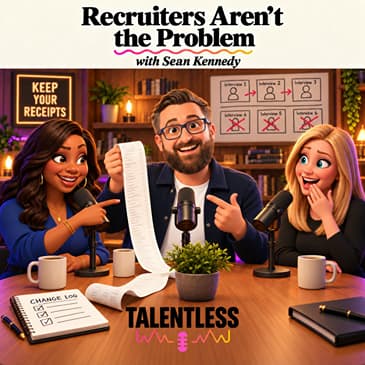
Sean Kennedy (“Sean The TA Guy”), Founder & Chief Content Officer, Kennedys Content; fractional Head of TA
Guest links: - LinkedIn: https://www.linkedin.com/in/seanthetaguy/ - Newsletter: The Recruiter Reality Check: https://www.linkedin.com/newsletters/the-recruiter-reality-check-7420456125470318592/ - The Talking Talent Podcast (RecTalk, guest host): https://www.linkedin.com/company/rectalk-podcast/
Recruiters take the blame for everything, but is it deserved? Sean Kennedy, aka Sean The TA Guy, joins Desiree and Ashley to break down what it actually takes to earn a hiring manager’s respect: saying no, keeping your receipts, and following through. Plus a Lord of the Rings slide deck, the promotion “conspiracy theory,” and four words of advice every recruiter needs.
Resources & links
Sean Kennedy on LinkedIn: https://www.linkedin.com/in/seanthetaguy/
The Recruiter Reality Check newsletter: https://www.linkedin.com/newsletters/the-recruiter-reality-check-7420456125470318592/
The Talking Talent Podcast (RecTalk) https://www.linkedin.com/company/rectalk-podcast/
Desiree’s book, Leadership is a Practice, Not a Personality (out October 27, 2026)
Watch Talentless on The HR Channel (Roku and Fire TV)
Talentless newsletter, The T-Hive: talentlesshive.beehiiv.com
This episode’s sponsor: JiMMYBAR, https://jimmybars.com/TALENTLESS
code TALENTLESS for 15% off
Powered by the WRKdefined Podcast Network.
[00:00:00] I broke my tooth at breakfast. Can I actually introduce this story? Because I don't know that anyone has ever Taco Bell-ed so hard that they lost their tooth. Is this a phrase, Taco Belled themselves? Recruiters, turn it up. Recruiting has some explaining to do. And these two? Two industry vets, zero filter. Bringing in sharp guests and leaving the corporate script at the door.
[00:00:27] Make some noise for Talentless. For recruiters, by recruiters. Let's get into it. Oh my gosh, welcome back folks. We are here with another awesome episode of the Talentless Podcast. And I'm actually super excited for this one. But first, funny story for those of us listening. I broke my tooth at breakfast. Can I actually introduce this story?
[00:00:52] Because I don't know that anyone has ever Taco Belled so hard that they lost their tooth. Is this a phrase, Taco Belled themselves? We ate Taco Bell. I was really hungry. I was really hungry in the middle of the night. So I decided to DoorDash. It was a 1 a.m. DoorDash event. And all we know is the next day. It was great. It was a good time. And it's a memory we'll never forget. Yeah, I won't forget it now for the next three weeks. It's great.
[00:01:22] For sure. But I'm excited to be here anyway. So if I sound a little crazy, please excuse it. But it's so I don't look like Mike Tyson. I bet anybody knows who Mike Tyson is. It's a whole thing. So I'm excited today. But first, before we jump in again, this episode is brought to you by Jimmy Bar. It's a high-protein functional bar that sparks that energy. So recruiters, when you're feeling down, you skip that lunch. Go buy yourself a Jimmy Bar.
[00:01:53] Our code is talentless for 15% off. I have them at home because I never get up from my desk. I eat them all the time. And maybe if we had eaten that at 1 a.m., we'd all have our... We'd have all our teeth. Yeah, we'd have our teeth. That's the advertisement for today. So today's guest is one of the funniest people I know doing it out here talking about recruiting. And that is Sean Kennedy. He is the TA guy. And he is so funny.
[00:02:21] So I'm hoping we get some of that energy today. And we're going to be talking about hiring managers and doing all the crazy stuff. But he is also the founder of Kennedy's Content, where he helps HR and rec tech brands actually reach recruiters instead of talking past them. He spent over 10 years in talent acquisition, agency side, and in-house before turning that experience into sketches, parody ads, and blunt takes that rack up more engagement than most brands' entire content calendars.
[00:02:49] So he also hosts a podcast, I believe, right? I do. Well, it's my podcast. I just guest host on the Talking Talent podcast, which is part of the rec talk world. I'm done by a very, very interesting guy, a very fun guy called Nitin Sharma. Very much, very kindly lets me jump on every now and then to, you know, to shoot the shit with him. Am I allowed to swear? I didn't. You're allowed to say whatever you want on this show. Okay, good. If you don't, we'd be sad. We'd be very sad.
[00:03:17] Good, because I have no control over my potty mouth. I'm not going to lie. And it's after six here. So, you know, corporate rules go out the world. They go out the window. That's right. Absolutely. Absolutely. So here's a topic set up, kids. Recruiters take the blame for almost everything, right? We take the blame for, I mean, whether the sun doesn't come up in the morning and, you know, go down at night. I mean, whether, you know, all these things are happening. I believe a lot of things, but I believe this is one of these to be true is that Hiring
[00:03:46] managers are part of the problem. And so we're going to talk about that and how this like also, you know, leads into recruiter burnout, scheduling. I mean, all the things that we're going to talk about, but first I'm going to start with Sean. You know, you've built a body of work about making parodies out of recruiting and talent takes and doing all these things, but this is like a real serious topic. Why don't you give me your overview about how you think about this? Well, I think no matter what industry you're in, so like whether it's recruitment, whether
[00:04:15] you're a hire manager, whether you're an engineering manager, whether you're an, you know, UX manager, no matter where you're going to work, some people are going to be dicks. And there are just dicks everywhere in the world that live amongst us. And sometimes they're hiring managers, but also at the same breath, there are recruiters who are also just as big as dicks. That's where the bad name comes from, right? So it's just all about figuring out how we work with them and how we don't work with them.
[00:04:43] Because I think where recruiters have got a bad name is because they don't know how to work with hiring managers. Then hiring managers get frustrated and then the frustration gets taken out of the industry as a whole. And then it becomes this big ordeal of like, oh no, recruiters are just like this add-on. They're not really like super important. You know, I don't see the value in them. And that's like one of the biggest shifts I ever saw was going from agency to internal. I was like, there wasn't much of a shift. You were still viewed as the exact same. You were still like just an add-on to the business.
[00:05:11] I used to assume that when I went internal, I'd be one of the gang, you know, with the engineering team being like, we're going to go for brunch. No, not a chance. Like you really got to like work on it and like become a partner to them and show the value. But again, like you've got to be good at what you do. Sometimes there are, you do get people who just don't want to see that. So you've got to persevere and you've got to be the person to, you know, literally make it unequivocal. I don't know if it's good in that context, but it works.
[00:05:40] I think we get the point. Yeah. If that makes any sense. So, I mean, I think that's a great place to start because here's what I can say. I think that in getting yourself to be liked by or valued by a hiring manager is probably the key, but you know, I would love to hear your thoughts on how you actually do that, right? It's not just showing up in the intake and telling them they're beautiful and gorgeous. So what does that actually mean? Yeah. Well, there's two differences you just mentioned.
[00:06:10] There's a big difference between being liked by your hiring manager and then being respected and having the value shown. I've had like hiring managers that I thought were like really, like really good friends, right? And I'd be like, oh, I can just, I can just go to them or something and they'll smooth it over. They'll just crowbar this person through the process because we're buddies. And like, this would be on a call with like senior stakeholders. I'd be like, hey, Tony, my man. And Tony's like, Sean, fuck off. Not Tony, my man. But they haven't seen the value. Like I've shown them no value.
[00:06:39] I've just shown them a guy that they can get along with. Like they can go for a beer with. But then I quickly learned that that's like a different part to it. So you've got to really show value in that part where why are you presenting certain candidates? What language are you talking into the hiring managers? Are you meeting them on their level or are you bringing them back down to yours? Or are you on an even playing field? Because I think that's where a lot of people get it wrong as well is that you're assuming a lot of hiring managers do also assume.
[00:07:05] I'm going to go off on a tangent here a little bit is that they assume because they've interviewed a lot that they know everything about recruitment. It's like, I've got a buddy who's a pilot, right? I've been on some planes on holidays. I do not know how to fly that plane, right? And weirdly, there's a statistic that 40% of men think they can actually land a plane. I'm surprised it's not higher. Actually, I was going to say the same thing. Yeah, actually, to be fair. The confidence, the Dunning-Kruger of it all.
[00:07:32] There is a little bit of me that, you know, maybe does think, you know, put up to shove. Maybe I could get the wheels down. You would jump from it in there? You would be flying the plane? I don't know. It's weird. Go ahead. I could get the wheels down, maybe, I think. I think that's the hardest part. I could control the autopilot for show. But, like, do you know that you actually fly a plane with your feet? You don't even fly it with your hands. Yeah, see, that's the face that lets me know the plane's going down. You're not getting, like, you actually fly it with your feet.
[00:08:01] It's wildly cool. Cool your loved ones who are going down. It's going down. I think you bring up a good point, though, because I think it's interesting whenever we talk about the relationship with hiring managers and how, like, whenever everything's going great, the hiring managers are like, yes, everything's going great. But whenever everything's going bad, they're all like, well, I can't find anyone. It's recruitment. It's the end. It always comes back to recruitment.
[00:08:29] And it's like, it's kind of the annoying side of the pancake because if we just turn that pancake over, then does that mean I get your bonus when it goes well? Like, when it's always going good, is it also me? Because when it's bad, it's me. But does that mean when it's good, it's me, too? So it's actually an interesting dichotomy. And to be honest, I kind of like it because whenever they scream out like, hey, I can't do this because of this, it lets me know. So recruiting does play a role in how successful you are.
[00:08:58] So they know the power we hold. They just don't want to admit it whenever it's all going good and attribute that to anything else other than themselves, unfortunately. That's at least a trend I see. Well, yeah, they wouldn't be in that position if they didn't have a recruiter. And like, it's funny how the relationship changes. The moment they're like, buddy, I'd love this job. Please, like, this is the best job I really need. Of course, I'm happy to accept. They start and they start hiring. Listen here, douchebag. Hire me some people and get on with it.
[00:09:27] And you're like, whoa, where was Mr. Nice Guy? Where was this guy? I just hired you. What are you talking about? Dude, I did you a favor. It was like five of you. And I picked you as the best CV. Like, chill. But I think that goes back to the like versus value thing, too. Yes. Everybody could be liked on that phone interview you have with them. You put them in the seat as a hiring manager. Now they're like, you better show me the money, right? Show me the value here.
[00:09:55] And that's where I think a lot of recruiters start to miss the point, right? Like, they're still trying to be liked instead of valued. And so what do you think are your top three? If you had to give top three tips to being valued as a strategic partner with a hiring manager, what would they be? Say no more. Because typically a lot of us recruiters will go into an intake call.
[00:10:18] And I'm not speaking like for everyone because they're, you know, good recruiters who do really good intake calls because that's the first one of the most important parts of the job, you know, to understand what our hiring managers are looking for. But a lot of people go into it straight away and be like, yeah, of course, I'll do that. Yeah, yeah. No worries. Six stages. Oh, yeah, absolutely. Oh, yeah. No worries. We can add on to if you like. People get like turned into a yes man or yes woman. Yeah. And just become very complacent and like just agreeable. And then when things start to go wrong, it's, well, you agree to that.
[00:10:48] Right. You decided this would be the case. You decided this was going to be our process. And that's when it started like shit rolls downhill, basically. Yeah. I have to say, I think it's the biggest fault of the whole industry is the yes. Like stop saying yes. So many. I can't say yes. Stop saying yes so many times and start saying no a lot more. Right. And I think we'd be in a much better position right now.
[00:11:16] And maybe not even just no's, but just more of thoughtful responses. Like I literally I we're getting our bathroom remodeled hopefully here soon. And the way that we selected the business was based off of who gave me the most feedback from what I wanted and was like, well, you can't do this because of building codes and you can't like it let me know how intelligent they were about this because no one else mentioned that you needed a 15 inch building code. Thus, you couldn't do this.
[00:11:46] You couldn't do that. And in a weird way, them telling me no, let me know that they would have been a better strategic partner than any of the others because they came to the table with more than just their plate. So to me in recruitment, like your discretion and your discernment and how you strategize in your responses, because there are so many people who like, especially if you have a diversity requirement, they're like, we want X, Y, Z. Well, no one in this town lives there.
[00:12:14] And the only way you can know that is if you're a decent recruiter. So to give that suggestion back to kind of counter whatever they say with, you know, just better responses, I think it already gives you a leg up like as far as, you know, that strategic partnership goes because now they know you know what you're talking about. This episode of the Talentless Podcast is brought to you by Do Better Consulting. Hiring is broken. Job searches are broken.
[00:12:40] And honestly, most career advice out there is just recycled nonsense. Do Better Consulting exists for people who are done guessing. They work with mid to senior leaders, founders, and talent teens to get clear on their signal, how they show up in the market, how they hire, and how decisions actually get made. No fluff, no templates just to say you have them. Just strategy, structure, and honest feedback that actually works.
[00:13:09] If you're tired of spinning, it might be time to do better. Head to dobetterconsulting.net. Yeah, it's like, no, I had a hiring manager before. I was like, no, you know, I don't. I want to do a six-stage interview process. I'm like, well, not really. I don't operate like that. And neither will most of my candidates that I'm trying to put through the funnel. Can you explain to me like where your thought process has come in to having six stages? Because we've always done it this way. Okay. Well, that's also one of the worst things you can hear from someone in a business.
[00:13:37] Let's try and move on from those archaic ways of interviewing. And here's some reasons why this is a better process to have like three stages, maybe four at Bush, you know. We don't drop candidates. We don't, you know, we retain people throughout the process even better. Candidates will actually want to interview with us rather than being like six stages. And that does happen, right? Like we see a lot. But then again, unfortunately, there's a lot of people at work at the moment. So we'll grin and bear a six-stage interview process. I know.
[00:14:07] Which has a knock-on effect. Yeah. And it has like that knock-on effect as well when NPS scores go up and how was your process? How did you get on? Six stages was a lot, you know. And you start talking about that kind of stuff. But that saying no, not just no itself, but no and trying them to understand is like a really important part of like... Education for me. Yeah. Like, right? Here's why I'm saying no. And I also think it makes you look just like Ashley said. Like, you know what you're talking about. Like, you're a subject matter expert, right?
[00:14:36] I know what I'm talking about. I've done this for however many years. Now I'm telling you, I don't tell you how to direct engineering. I'm telling you, right? Like, you can't tell me what's best in recruiting as well. And I think that it changes the dynamic of the relationship super quickly, right? It makes it even playing field for sure. As far as like how we view one another. Like, we're both, again, bringing something to the table.
[00:15:06] Number one, what's your second one? Say no. Number two is like, this is your own personal bodyguard. Keep your receipts. Every conversation and keep almost like a log of any like change log, or we call it. So anytime something happens that gets noted down, it gets recorded. Notetakers are really handy now because they do a lot of run of the work. But any kind of change in process, anything that happens that has been different from before, anything you've agreed upon goes into the change log.
[00:15:35] Because as I mentioned at the start of the call, there are some hiring managers that will like to throw you under the bus because recruiters are at the bottom of the pile. However, when you're in a C-suite conversation and, you know, Bob from engineering says, well, no, Sean fucked up. Bob, let me just pick this page out. Yeah. No, I love that. I love that. I love the idea of that. It's perfectly reasonable.
[00:16:00] Like you're not someone who, you know, has respect for themselves and is an actual decent recruiter with value to add to the table and not to be trifled with because, you know, no one likes to push over a recruiter because hiring managers will walk all over them. They'll get away with bad hiring process. They'll lose candidates or they'll just get poor candidates for a process. And then no one's happy then because we've all got to start over from scratch. So you've got to be a bit tougher. Keep that change log. Keep your receipts and just be on top of it.
[00:16:30] Because I love that. Just be honest. I love throwing stuff back in people's faces. So I do. I'm like, no. It's great. Yes. Oh, I never said that. Yes, you did. Yes, you did. Yeah. That's it. We're in such a good position now where we've got all these note takers on calls. So it's like, it's so much harder for people to say, no, I didn't say that. Actually, at 9. Let's pull up that transcript, honey. Yeah. Yeah. That's perfect.
[00:16:59] And then number three, I think is, I don't think these are maybe in order, but like this number three is if you're going to say you're going to do something, do it. A lot of people will be like, give a lot of lip service. I feel like, because, you know, like from agency where we used to try and like schmooze clients and be like, yeah, I'm going to promise you the world. Those kind of behaviors didn't leave certain recruiters when they went internal. So then the whole schmoozing of the client thing became like a normal, natural thing to try and do.
[00:17:28] And then it'd be like, why haven't you done that? You said you were going to do it. He goes, oh yeah, we work in the same office. You know if I've done this. Like, just. It's so true though. Cause that your, half of your job and agency is the schmoozy business development part of it. Right. So you spend a lot of time like saying whatever and going back to your desk and not doing any of that. Yeah. You're like, well, I promised him all those stuff. I promised him all that stuff. I'm just going to send him the CVs. Right. So that's what he really wants. Yeah.
[00:17:58] That's what Bailey wants. Cause he doesn't want all this other crap. And then be like, you go internal. They want all that other crap. Yeah. So you're like, all right, well I've kind of got to do it now. So if you're like, if you're going to say you're going to do something to a hiring manager, again, that's that value add where they start to see you as a real partner where they're like, okay, Sean said he's going to do this. He did it. He agreed to do it on this point. Like for example, if we're talking about processes, once you've done the intake form, Hey, I'm going to have a, I'm going to have a small batch of CVs with you by Friday,
[00:18:26] just so I can align if I'm on the right track, because we're talking on Tuesday by Wednesday. I just want to see if I'm in the right ballpark after we've done our intake, you know, just to make sure we're safe. If those are good, great. If not, then I can go back to your processes. And by Monday, I'll have, you know, more relevant people for you that offer back of our notes, go back to them, do that tiny little thing. Right. It depends if you, you know, it depends on the role, but I think that really helps. I mean, I think that is such a good way to look at it.
[00:18:53] And I mean, accountability and anything is great. And I think an ownership, right. And I don't know if we always own and are accountable to some of this stuff. We're like, ah, it's out of, you know, the hiring manager being slow or, you know, whatever. But a lot of that does live with us and that, you know, doing what we say we're going to do keeps the process moving just like a hiring manager can stall it. Right. And so I love that. I really, really enjoy that idea of, I mean, I think we all know it.
[00:19:22] Probably say we know that we're supposed to do what we're supposed to do. Oh, don't get me wrong. Yeah. I've been falling victim to my own hubris before. I've been like, yeah, yeah, I'll definitely do all this stuff. I just get CVs over and be like, I'm done. Yeah. And I've done it numerous times. Yeah, of course. Well, now when you look at recruiting teams, right. When you look at recruiting teams and the size of them, right. And the bandwidth they don't have. Right.
[00:19:50] A lot of this stuff starts to fall through the cracks. Yeah. Very quickly. Because then you're just like, I just need to get candidates over. Yeah. Yeah. You know. I do think that it's like the second part of the puzzle with the proof in the pudding. Like if you want to be seen as a strategic partner, you're going to have to show up. Which means that if you say you're going to meet one level and you already don't meet it, then why on God's green earth are they going to think you're about to be their strategic partner?
[00:20:18] Like you can't even follow through with what you said, let alone what I want. So there's no way. And then the other thing that I was thinking about is the idea of like, well, we've always done it this way. Honestly, that's one of my favorite responses in a weird way because there's one, it's so flimsy and there's one easy way to break that down, especially if it's a replacement role and that's just asking like, okay, and how has that gone for you? Like you're sitting here with me now. Like you're talking to me right now for what reason then?
[00:20:46] If it works so, so well with your six steps and now we're replacing that person. Um, so it is something that I think in all points, it's kind of about, do you add your product, advertise yourself as a strategic partner? Do you show up as a strategic partner demanding that type of energy, if you will? And then do you actually execute? It's like those kinds of three pieces all in one. Can I, can I tell you a fun story? Fun story. Okay, good.
[00:21:14] Now, as you may have noticed from anyone watching and both watching here, I'm a huge fucking nerd and I love it. You know, that's me. That's who I am. And I was working with a hiring manager once who had this six stage interview process and he didn't want to change anything, but discovered like myself, he's also a huge fucking nerd. And I realized that he was very, very much into Lord of the Rings. So I went away. I'm a little bit eccentric if you haven't noticed, like, and I go in, I like to do things like
[00:21:43] a little bit extra sometimes and just go like a little bit further, just a bit of pageantry. You know, if you, so, so I decided to go and like get this slide deck together of his six stage process, but it was Frodo going from the Shire to Mordor. And each part of those like processes was like, you're getting hunted by the race and then all these different things. And then they eventually was destroying the ring. It was like, they're hiring someone. And at the end of it, he was like, okay, I see, I see. I'm relating to this. I'm relating to this.
[00:22:12] I said, okay, cool. Wouldn't it be easier if Frodo just flew on the fucking bird and listened to the recruiter? We had like a little bit of a joke around it, but I said, look, wouldn't it be much easier if this had happened on this journey, like marked out on the journey where he could have avoided danger, where he could have done this. And this was like all graphics as well, by the way, this took like, this was before ChatGBT, by the way. So you had to do this by hand. I canvered like the hell out of this, right? And I worked on it for like a good week.
[00:22:42] I was expecting like round of applause to stand up. Like people were going to be walking through the corridors and people were going to be throwing flowers at me. Realistically, there's just one guy in the room who was like, yeah, you know, fair enough, Sean. All right, cool. Not what I was expecting, but you know, I got the result I wanted. At least it worked. Yeah. Yeah, I do think there's some dedication that went into it, right? And the dedication was appreciated and it got across your point, right? I knew my hiring manager. I understood them. I spoke to them.
[00:23:10] Luckily for me, it was in my own language, being a nerd. You know, we were able to have a conversation on a mutual ground and that built a little level of respect because it might have been an eccentric way to show it, but I showed him I knew what I was talking about in a way that he could understand. And that then, you know, helped follow that on. I did try it again. I tried it again with another hiring manager. Didn't learn very well. Didn't.
[00:23:35] I was about to say, that's going to translation services like that only work so, so, so often. Yeah. Because I, yeah, I have managers that I knew I could be dramatic with. And then I had managers that if I gave them one ounce of drama, they'd be like, get out. Yeah. I tried to do it in like a conversation with one hiring manager who he liked it, but there were two members of the C-suite in this meeting as well. And not so unserious guys, apparently. Sometimes we learn. Okay.
[00:24:02] Well, you know, I'm, I'm very much like, like, I never apologize for being neat. No. Whether it gets me in trouble. That's the way to be. Yeah, I am. I do think it brings up a good point though. It's like, I feel like sometimes we make hiring managers just like fantasy thing. They're just people, right? You can understand them and figure out what their little thing is or whatever. I've, so many hiring manager relationships I've had have changed because I figured out what their one thing was, right?
[00:24:31] And that one thing would drive them insane. And as long as I didn't do that one thing or did that thing, right, it made the relationship 10 times better. Or I brought myself to their level. You know, I'm a huge Marvel fan. So I, you know, you're, you're a superhero person. Like I'm into you. Right. But if you're a DC comic fan, I don't know. Well, then I have to like stretch myself and like, I mean, I, I, I also, I also am like
[00:24:58] in this office, like in my, it's like the spare room left slash office. There is Batman mask up there somewhere. There's like, there's like a skeleton and all these kinds of things in here. It's, it's fantastic. So sorry. I really got distracted. Well, I liked that. I sold the X-Men comics back there because I have, I actually collect comics and I used and Spider-Man you got. So I, yeah, I used to do that whenever I was in college, I used to go find them. I found one that was like 10 cents at a thrift store, sold it for like 400.
[00:25:27] Like I used to flip to make money. So I know a ton about them, but I, uh, I haven't done that in a while. I still have a big case of ones that I'm hoping to sell that were like first editions. I'm like, you're good. You make so much money. But this, this is exactly what, you know, when you just talking about there, right? We spend a quarter of our lives are just, just over that in the working world. Most of us are just dying to work with someone. We can understand, we can get along with to make work just that little bit more bearable.
[00:25:56] Imagine turning up to a job every day. Most of us, we get a job because we need a job. We've got bills and shit. Like most of us, like we all can't get our dream jobs, right? So a lot of us are sat in jobs that we're like, okay, I need this job. I can do it. I'm good at it. What's going to make it more tolerable? Okay. Yeah. I'd like to enjoy it, but you know what would really make me enjoy it? If there was someone I could work with who are on the level with, I could understand them. You know, I connect with them on some level.
[00:26:23] And that's what we're looking for is just to connect with somebody on some level in work as well as outside of work, right? But mainly that's what makes, that's what makes it more fun. We've all worked at a place where there's been like the ultimate, like the ultimate vibe of the ultimate kind of office mentality. For me, it was 2018 working in an agency office, one of the best offices I've ever worked in. Everyone was just on point every day, made work so enjoyable. When I left there, it went downhill.
[00:26:54] That's the way it is sometimes. I mean, I'm my boss and I hate working for me. I was talking about this last night about managers, like great recruiters who become horrible recruiting managers. And I would love to get your take on, because I think you have, I was looking at your stuff and I know you have this great like whole thing about this and about recruiting management and stuff like that.
[00:27:20] So I would love to hear your take about why a recruiter, a great recruiter becomes like a horrible hiring manager themselves, right? Or recruitment manager. So can you dig into that? Yeah, of course. I think, well, I think I'll use myself as an example, because I'm not a good manager. Like genuinely not. Like I've made people cry. Oh, geez. Yeah, no, not intentionally, just because I was, I was stressed and being a dick.
[00:27:47] Like, and I didn't mean to make people cry, but like. Geez, Sean. I know, I know it's bad, but like I would be, I would expect everyone to work the way I did to become a manager. So then when people weren't working at us, I was, why aren't you working at us? What's wrong with you? Like, why, why can't you do what I'm doing? This is easy. This is, come on, do it, do it. And you become like very much like a micromanager because you haven't been trained how to be a manager. You're forced into that position. So when you don't know how to manage, you manage by numbers. Right.
[00:28:15] And it becomes like that meritocracy of, well done, you've hit this target. Now you're a leader. Right. Realistic should be well done. You've hit your target. Where would you like to go? How can we support you and get in there? So that's when like bad leaders start to happen. And it's one of the reasons when I went to work in startups, I said, I was asked like, what? Cause they'd seen my background as like director of UK recruitment, you know, TA director and all these kinds of things. I was like, do you know what? I want to be an IC.
[00:28:40] I feel like I operate at a level where that suits me and I can, you know, really, really help there. And that became so much more valuable than me trying to pretend to be a good leader. I'm not. There are some people who can lead, you know, it's not me. Yeah. I've always said on this show, one of my big things is that I'm so sick of people talking about that hiring manager is bad leaders, but because most 90% of them get sat in the seat and have no training to do that job at all.
[00:29:10] Absolutely. Right. They were great performers at doing what they did before. And now they're all they're doing is to take those numbers they hit and now they have, they're in control of people's lives. I'm like, but we gave them no training to do any of that. Right. No training whatsoever. And then they're like, they're expected to have a profit and loss in that. By the way, here's all, here's this. Right. Don't break that. Right. Absolutely. And outperform.
[00:29:40] Right. Whoever was in the seat before or if there was no one in the seat, we expect you to be a top performer here. Now we want you to be a top performer here, but also the five people or 10 people underneath you also need to be top performers. Yeah. As well. I mean, it's, it's absolutely illogical. If you actually think about it, it makes no sense whatsoever. You just think there was like a somewhat of conspiracy theory behind this.
[00:30:07] So like if your best performer being your best performer year on year, he would take more money from the top end of the company, from the highlight, the leaders, and then you would have to keep paying them that money. But then if you give them a higher base where they can't overachieve on their target and make them a leader so they don't have the stresses of being, you know, uh, you know, a performer with a target, then that was my conspiracy theory behind it. I don't think it's conspiracy theory. I think it's actually true.
[00:30:37] Right. I mean, probably is. Yeah. I mean, because if you think about it, let's give you a base that's really high. So you don't have to go out and be a top performer. We're going to throw you a bunch of duties and do all these other things. Yeah. Yeah. And I never have to pay you what you would have made if you would continue on the trajectory you were on. I mean, kind of makes sense to me. Yeah. As I said out loud, I was like, that's not conspiracy theory.
[00:31:06] That's just business logic. I was about to say, that's the way the world works. Yeah. You know? And so I, I'm, I'm interested too, because I, one of my biggest struggles is hiring manager feedback, right? Like getting it from them, having them go quiet, even though they have pressed upon, you know, you that the role is urgent, that they need somebody in the seat, but then they, they kind of go dark.
[00:31:33] Do you have any strategies around like getting a hired manager to come out of the quiet zone or, you know, at least give you feedback? Yeah. Tell them you're going to stop recruiting. Right. I mean, yeah. Like there's, there's the, sure for like, honestly, it'd be like, there's a certain way you can say it, obviously, but like, Hey, look, by the way, I haven't heard any feedback for you. So I'm just going to pause on trying to find any more talent at the moment until I get feedback on these. This may make a significant delay in our process by one to two weeks.
[00:32:02] If you're okay with that and fine, but like, unless I can get feedback from you today. Yeah. Feedback. Thank you. Thanks Bob. Thank you so much. Poor Bob. Bob's dancing the ringer today. He is. But, but I agree with you. This goes back to the saying no a little bit more, right? That's not saying no, that saying here's what is happening. It's a cause and effect theory, right?
[00:32:28] Like because you're not giving me feedback, I technically can't do my job, but then back to you, here's the effect on you. This process completely slows down for you. And now you don't have somebody in the seat. That's not just saying no, that is explanation behind the no, which is, I think is beautiful in its own sense. I have a big mouth. So I usually don't have a problem with this, but I know that younger recruiters really struggle with it. Right.
[00:32:57] Because they, you know, when you're a junior recruiter, I don't mean junior is a thing, but if you're anymore, but if you're a recruiter sitting in the seat, you're brand new to the company or brand new to this work, it does take time to develop that skill. I, I, you don't just wake up as a recruiter and know how to do that. I think if you're a person who's really diplomatic maybe, but most people do not inherently come with that knowledge. Yeah.
[00:33:24] It comes with like, you kind of have to, you end up taking a beating over a career, like as a recruiter and you end up getting thick skin and then you're like, okay, well, how do I stop this? All right. Like it is kind of lessons learned, but don't be wrong. I don't want people to have to go through all the crap that the recruiters before us had to go through. There needs to be more of like a development of training around this particular thing, which I don't think we do enough of because a lot of people just like, it comes with,
[00:33:54] you know, time and it comes with experience. But realistically, if you could like manage someone or like train someone to, from day one to be in a business, they would send, set the level of expectation from day one and be like, Hey, look, this is what I'm about. This is what I need. This is what I'm going to be here. Expect this and you won't be disappointed. Like. This is a good point too. And Ashley actually runs a company that is a recruiter university, but I have this theory
[00:34:21] that, you know, most recruiters were never taught to do this job the way it not actually should be done, but should be done in a more strategic way. And so we keep saying out loud on LinkedIn and all these other places, even here, be more strategic, more, be more. Well, we were never really taught anything. So. Most of us were taught in a boiler room. How to do agency recruitment by a guy who had done, like a guy or girl who had been really successful in their career. Right.
[00:34:51] Then like sold a company and then were sat there trying to give us advice on how it worked for them back then. Right. Which was very different from how it was now, which was like, when I say now, it's like 10 years ago. And then that's completely changed now from what it is. And then I always find it very weird. Sometimes there was a, we always get training from like recruiters who weren't recruiting anymore. And that always used to make me laugh. And then they would give you advice. It should make you laugh. And I was like, it's so redundant.
[00:35:18] Like you haven't recruited in like 10 years. Why are you telling me how to recruit? Like it's one of the reasons I actively stay on the tools now as like a fractional head of TA. Like I still recruit, but like very minimally, like very, very minimally. But I still recruit because how is anyone going to listen to me if I, if I haven't recruited and I don't know what the pains are. I don't know what they are. I say this all the time. Why are you listening to people that haven't recruited in 20 years or 10 years or whatever?
[00:35:47] Like Ashley and I are still, obviously she had to jump for a work call to her candidate. I, you know, I'm still in the mix every day doing this and less than I was before. I want to be honest with people, but like it, unless you stay in it, you, you lose some of that. My first recruiting manager recruited off of index cards. He had like all of his candidates and like a Rolodex still. Yeah. And would pull them out and be like, I'm going to call. This was an agency.
[00:36:16] And he'd be like, I know so-and-so is perfect for this job. And I'm like, did you just pull out an index card? Like from a Rolodex? Just be like. Yeah. Yeah. Like a Rolodex of people. And I was like, what is happening right now? Like, are I supposed to learn something from you? Like. Well, we, we had a guy similar who would come in and train us when we were an agency and he would start off again. And I remember like back in my day that we used to have to post job adverts in the local newspaper.
[00:36:42] And I'm like, sorry, did you go there on your dinosaur? Like, I don't need to be taking recruitment advice from you here. I don't know. Some of the stuff, some of the stuff they came out about like the basic stuff was pretty good. But like some, some of the bits that came, they came out and be like, you can't do that anymore. Like, I won't do that. Like, I'm not going to do it. It's not even compliant anymore. Yeah. But I think too, the world of AI is changing that too. Right. About like, I can't imagine.
[00:37:10] I mean, I do recruiter training now, but I think in two years, I probably, unless I keep up, right. Like wouldn't be able to teach everyone in the room how to be a great recruiter in this day and age, because it's moving so fast. So if you had a guy come in who, you know, was putting job ads just on Indeed, you know,
[00:37:36] and comes in and trains an AI person right now, like it's, it doesn't make sense anymore. Totally different. Right. Totally different world. Totally. Okay. I'm getting totally, I could talk about this forever. Like, good. I could talk about this part of like, because I believe that, I do believe that there is a lot of fault that lies in the fact that hiring managers aren't trained and sat in the
[00:38:04] seat and, you know, really are asked to do things that are impossible for them most of the time. But I also believe the same sometimes about recruiters haven't been trained to be anything like strategic at all. We worked in boiler rooms. We worked in, you know, get candidates out the door, push CVs. Those were the things that we were taught. And so now you have this clash of somebody who's not supposed to be in the seat, someone
[00:38:29] who's pushing CVs, and you get this mess that is right now what's happening. Well, it's so good you say as well, because one of my best managers I ever had was Celine, who worked with one of my old companies. I'm not going to mention their name because they'd laid a lot of people off recently and screw those guys. But Celine, Celine was one of my favorite managers because she was very, very strategic in her approach to how she did things. So before any role kicked off, before any hiring manager became a hiring manager and
[00:38:55] interviewer, they would make them go through the interview practice labs that they used to run. So basically like an interview training for the hiring team to ensure everyone was aligned, everyone knew how to interview, knew how to do these things. Nice. And they worked with their recruiter to do it. And they were like, oh, this is going to slow the process down. It's like, we made it part of onboarding. Wow. Onboarding, we integrated like this, this training into like our hub. When people were onboarding, if you came in at a certain level and you were expected to
[00:39:23] be an interviewer, you had to complete the interview training as part of the practice lab. So I do work with founders right now in startups and I do similar for them because most founders, you know, they don't know what they're doing. Oh, love you guys. Yeah, come on. Love you guys. How's your own basement? But they, you know, they, they haven't hired before there. They had an idea in their basement. They show up and they made it. Most haven't had jobs before. Right.
[00:39:53] Right. Right. Right. But it's true that you get the experience we've, we've found as like, this is how we're going to do it. Like, tell me about your experience and the job you never had before this. Never had a job. I worked at McDonald's and I came up with this idea in my basement. I mean, it's like, it really is that serious, especially nowadays when you can develop something like that. It is crazy. And so most of the time I have to do some sort of interview because they've never done it before.
[00:40:22] And I think that is a great, I, whoever she was, I think it was a, she, you said, was the smartest person in the world. Right. Let's train these people to actually do interviewing and understand why things are done the way they're done. And, you know, being strategic and knowledge skills and all those things and things they don't truly understand is brilliant. It's brilliant. It's honestly mind blowing, but do you know what's even more mind blowing? They always assume we know less.
[00:40:52] Okay. Let's, let's answer it. Why is that? How do you think this journey happened that we got to where we're at right now? I think we're always less than. We have an image problem as a, as an industry. We've had so many bad recruiters ruin our reputation that it's kind of affected the good ones, like the good recruiters who are just, you know, there to do a job. They turn up properly. They, you know, they do their process. They look after their hiring teams. They look after their candidates. They, they're strategic. They are partners. They show value.
[00:41:22] However, like I mentioned, you know, I'm going to refer back to this, like in any job in any world, there are dicks. There are dicks. There are dicks. And the dicks will ruin it for the rest of us. And it's like, it's like engineers, like any job you go into, there's going to be some people from that are just a nightmare to work with or just have somehow got into that job because of either years experience because of nepotism or whatever. Yeah, whatever. They're just like, they're just, they're just there for a paycheck.
[00:41:49] You know, like most people are in fairness, but you know, they just, they don't care about the reputation that that holds and that carries on. Don't get me wrong. Like without training before I've gone through my cowboy phase. Yeah. That's why I call it the hoe phase of recruitment. You know, you go through it and you're like, I'm just going to do some real wild shit. Yeah. They're doing some crazy shit. God, they're doing some crazy shit. That's what agency's for. Okay. Go and do it there. Agency's like college. It's like a big frat house.
[00:42:19] It's ridiculous. What are you going to do over there? And then come back and then we're going to go to the real world. Come in the house and be a normal person. You're back from college now. It's time to get a job. Time to get a real job. Yeah. No offense to agency. It's great. No offense to agencies. No, not at all. There are bad TAs as well. I do think the difference in recruiting is when you are a bad recruiter, you affect someone's
[00:43:13] livelihood. Well, that's why I think the best recruiters are actually those that are empathetic. We're like, who understand there is an emotional attachment to the stuff that happens on the other end of this. It's not just moving. It's not just moving some jigsaw around to try and get the ball from one end to the other. There's a human being with lives, with kids. Honestly, I didn't properly understand that until I got a little bit older. I had a family and I had kids.
[00:43:41] I got laid off and I started looking for work. As a recruiter, you start looking for work and you start understanding things a little bit more. You're like, oh my God, is this what I've been like to other people? Yeah. And you kind of grow up a little bit and you're like, shit. Like, I was a piece of shit. I just recently went this because I was deciding whether to stay in corporate or go on my own, which I chose my own. But the- Nicely done. Yeah.
[00:44:07] But being on the job market for the two months I was on, I wasn't very much because I couldn't take it. But I had some really awful recruiters. I mean, this is really bad. And I was like, this can't be what my whole industry is like. But it happened so much in those quick span of time. I was like, wow, we really struggle as a total industry of just bad, bad eggs in it.
[00:44:35] And it can ruin a whole experience, right? It can. My worst experience wasn't with a recruiter. It was with a hiring manager recruiter who put me forward to. Okay. So I was interviewing for a job and I had downloaded my CV and my CV was a little bit longer. I think it was like two and a half pages, right? So let's look at three pages as a max, right? Now I downloaded it on the Microsoft Word format because I knew that's how most people would look at a CV. All right, fine. So I interviewed with someone.
[00:45:05] Yeah. Look at me being immature. And they were like, the first thing they said to me was like, as a recruiter, don't you think it's a little absurd? You've got a nine page CV. I was like, I don't. I have a three page CV on Microsoft Word where I downloaded it. It goes, well, I'm looking at here now on my notes. I said, out of interest, are you looking at it on notes? And they were like, yeah. That'd be why. And then like the whole conversation went downhill. They were like, well, you know, there's no need to be like that. I went, you called me out.
[00:45:34] And I'm very much like, if you're going to call me out, I can get ready for the surf. Here I come. You know, I love that. I had some really bad hiring manager interviews too. You know, and, but I think, you know, I don't know if I almost expect bad hiring manager interviews anymore because they never know what they're doing. But I always expect so much from recruiters that I think my own, because I'm in it, my
[00:46:04] own like check box thing is probably a little larger than most. Like I'm sure most recruiters are when they go for a job interview. So maybe I'm being a little unfair that they were horrible, but I do think there's a level that is just not there for a lot of these recruiters. And it's, and it's, and I believe in, like I said before, is that it does come down to just them having a lack of understanding of how to add value and how to do the things that we've talked about here today.
[00:46:32] Any last thoughts about what you would give as advice to recruiters really thinking about how to deal with their hiring managers better, Sean? Be on the level with them, right? Remember like, actually you gave this advice earlier, but they are just another human. Don't put them up on this massive pedestal that they're, they're the judge, jury and executioner. Like they are still just another person who has a job like you. They're just in a different role.
[00:46:58] They are also looking to work with someone who can help make their lives easier, who they can get along with, who they can also like have a mutual agreement with. They're looking to see you as a value, not just your friends. Like what we were talking about earlier, like there's a difference between liked and being respected. You know, you can be both though. I'm not saying that they're not mutually exclusive to one another. You can be liked and respected by your hiring teams. That comes with like a little bit more empathy as well, as we've spoken about, you know, the best recruiters are empathetic. You know, they, they are liked and respected.
[00:47:27] And remember when you're dealing with people, deal with them in a human nature because everyone is human and deserves to be treated as such. So don't be a dick like some of the world is. I'm going to leave it there. Don't be a dick. Yeah, don't be a dick. And that's the whole episode. The whole episode. Where can people find you? I live on LinkedIn. LinkedIn is, is my world. In terms of like creating content, like showing up on there. If you, if you want to find something mediocre, really funny again, just made up another word.
[00:47:57] You're really brilliant. If you want to find like some meat, medium, funny size stuff. I just don't know where we're at now. And you work with brands directly too, right? I do. Yes. So a big part of my job is content creation, which I do for fun. Like I would have done a post today about LinkedIn DMs, how like help you react to them. But then I also work with brands to help tell their story as well. And like get their message across in a fun and articulate way.
[00:48:24] But also another part is also getting them in front of the right people. Like when their new product gets released or a new feature, when that brand is, you know, has a go to market team who have never worked in the TA world. It falls to me sometimes to be like, Hey, look, I can help you get in front of the right TA leaders because I am a TA leader. You know, I can get you in front of my network. I've spent the last five years building a TA network, which I think is really valuable to those kinds of people. So that's, that's basically my job in a nutshell.
[00:48:52] Try and make people laugh, try and get people in front of people and try not to get fired doing it. Yeah. I love it. And don't be a dick. That's great. Don't be a dick. I want to thank everybody for listening, watching, whatever. Don't forget. We're on the HR channel on Roku and Fire TV. You can find us anywhere, anywhere that talentless it could be. I tell you, I don't know how I spend so much time putting us everywhere, but it's so you won't ignore us. So just go ahead and follow us. Give up.
[00:49:22] Do it right now. Thank you so much. And we'll see you next time. Bye.
Sponsors
