
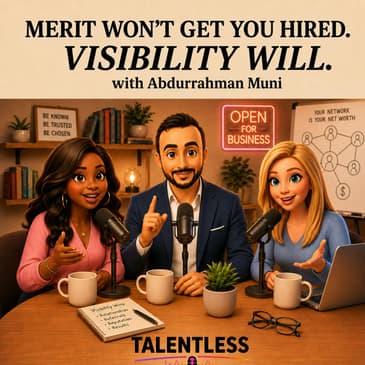
Abdurrahman "Muni" Muni, Founder @ Dreampath, Ex-Head of Global Talent Acquisition @ ApplyBoard
LinkedIn: linkedin.com/in/ammuni
Website: dreampath (site TBD, confirm URL with Muni)
Booking link: calendly.com/muni-dreampath/careerchat
Merit isn't dead, but it's not driving the bus alone anymore, and this episode is Desiree and Ashley pulling that apart with Abdurrahman "Muni" Muni, founder of Dreampath and former Head of Global Talent Acquisition at ApplyBoard, where he helped scale the company from 300 to 1,000 people in two years.
Muni opens by self-introducing himself the way he actually talks to clients: if you're seven-plus years into your career and suddenly having an existential crisis in the job market, he's the guy who fixes that. From there the conversation moves through relationships versus resumes (and why the answer genuinely depends on which "group" a candidate falls into), what actually happens to an application once it hits an ATS, and Muni's central reframe: you are a business of one, your experience is your product, and target companies are your customers.
Ashley brings the recruiter's side of the table, walking through what hiring managers actually mean when they say they want an "autonomous learner," and calling out the ugly reality of back-channel referrals, where a manager's cousin or neighbor gets fast-tracked past a legitimate process. She draws a hard line between a one-way relationship (an employee genuinely recommending a great company to a friend) and a two-way one (a manager strong-arming a recruiter into an interview because they personally know the candidate).
The conversation also covers ageism and why Muni tells clients to stop spending emotional energy on bias they can't control, the return of the long resume as AI keyword-matching reshapes what gets screened in, and a real debate between performance-based hiring versus tenure-based hiring, including Ashley's blunt read that most companies claim to be meritocracies but are actually just capitalism for their friends.
Talent Outside the Box closes the episode with Ashley going deep on why back-channeling candidates is functionally unethical outside of true C-suite hiring, and how it introduces anchor bias that sets candidates up to fail before they've even walked in the door.
Powered by the WRKdefined Podcast Network.
[00:00:06] Do you think massages are weird? No. No. Here's why. Here's, here, let me tell you what. Complete stranger though, y'all. We go from like, we can't sit and touch hands without Germ-X to, you know what? Let me climb into the buffet with this stranger. Here's my thing. There's a certain amount of stress that you get to in life where massage is never weird. You're like, I'm just way too stressed out to be weird. Thank you. Thank you. I'm a therapist and esthetician most of my life.
[00:00:34] So it changes how I feel about them. But I will say I have a weird foot thing. Silly, you can't touch my feet. But like, other than that, it's so relaxing. It's so relaxing. Do you think you're weird? I wanted to try reflexology. Did you? You wanted to do reflexology? I wanted to, but like Desiree, it's just a weird ticklish thing. Like anybody, if they start massaging my foot, I'm like, please, just, if you don't want me snorting and twirling. And yeah, just, let's just go back.
[00:01:04] I can't get my feet done because of that. It just sounds creepy. I've literally almost kicked someone in the face because I've laughed so hard. I mean, I get massages all the time. Yeah, no, I could. But also, okay, I could never touch another person's foot. Like, can we all calm down? Like, that is the nubbin that goes across the world on who knows what. And you want me to go and just give it a little, no, sorry. No deep tissue from me. No Swedish massages. My life's always like, do you want a foot massage? After I've been like, had a busy day.
[00:01:34] I'm like, what about me and you that we've been together this long? You think I want you to touch my feet? It's like such a weird thing. I just can't touch another person. They can touch mine. Folks, we are back. It is year two of the Talentless Podcast. And I do my sports announcer voice at the beginning of every episode. So let's get it started. We're here to talk today about a topic that most people clutch their pearls about and get a little bit nuts about. And that's merit and who gets access to things.
[00:02:04] And I brought someone on the show that I worked with and admire and just think the world of. And I, to this topic, cause I think he's built the systems. He's, you know, helped a hundred, 700 people or more get hired at senior levels. I mean, he's just an all around awesome guy. So I'm going to let him introduce himself. Take it away. Oh, that's right. I really appreciate being here. I'm going to preface this by saying I have no idea what I'm getting into today, but that's exactly how I like it. Really happy to be here.
[00:02:33] And honestly, when it comes to introducing myself, like I always ask the question, like if you've ever been somebody where you've built a really successful career, you're, you know, you're seven, 10 plus years into the game. And now you're coming into the job market thinking like, what the heck is happening? And having an existential crisis and thinking if your career is over, I'm the guy that comes and helps fix that. Right. So that's really me in a nutshell. You know, there's a quick background. I've had a tech startup.
[00:03:02] So I've been in the tech space where we built out HR tech to help companies make better hiring decisions. Went from that, did a complete 180, went into leading a global talent acquisition team, where we helped scale a company from 300 to 1,000 people in two years. I was actually reflecting on this. I'm like, 1,000 people, 700 people in two years is 350 people a year. That's like a hire a day. I was just reflecting about the math the other day. I was like, that's insane. And now my full-time gig is helping other people get full-time gigs. And then in the evenings, I'm Batman and we'll work for Cheesecake.
[00:03:30] So that's a little bit about my love cheesecake. Well, I thought we've done a Merit episode before, but I thought this was a different spin on it because sometimes as recruiters, I think we talk about gatekeeping all the time on this show. And I think sometimes the recruiters forget about the job seeker perspective in some of this and the rules they're playing and how recruiters can help. And I kind of want to tie all of those together, if that makes sense.
[00:03:59] And if you've listened to Ashley for more than 10 minutes, she loves to talk about gatekeeping. And I think this directly ties to how visible people are and who we give access to. So it's a great topic for me and I'm excited to get into it. And, you know, I want people not to clutch their pearls. This isn't a political commentary on the world, but it definitely is a commentary of how we choose to do our jobs and how we can do it better, especially for the candidate that's involved.
[00:04:27] I want to talk about relationships over resumes a bit. And I'm sure this is going to lead into the resume conversation and so many and the breakdown of a resume and what a recruiter is looking at and all of those things. But, Mooney, from what from a you know, how you are looking at placing senior leaders and all of that, you know, I know visibility matters. How much does that relationship matter versus the resume, especially in the world of AI? How do you influence that? How do you change that? Right.
[00:04:56] How do job seekers and then recruiters change their look about how these are built? How does that work, Mooney? So when it comes to relationships, it depends. Right. Like it's so I'd start off by saying it depends on what stage the person is in their career relationship wise. Right. So you have people who, again, and I've worked with these types of with these types of professionals that they're 10 years in. They've never had to job search. Right. They were maybe either at the same company, always got promoted or they were always headhunted into another role.
[00:05:25] And so for them, it's like, what do I got to network for? Right. And so you have that group of people where it's like they haven't really ever had to build a massive network or build a relationship over the years. They kind of just were focused on the career. They didn't really focus on, oh, what would happen if I was ever laid off or I need to look for something? So that's group A. And then you have group B where these are like serial relationship builders, like whether they're employed or not, they're always connecting with people. Right. Like they're always setting up coffee chats. They're always building up relationships with people in their company, outside of the company. And then they're always maintaining those relationships on a regular basis.
[00:05:54] And some of them have it down to a sign. So when it comes to relationships over resume, it depends on the group. Right. If somebody's in group A where they haven't really built a relationship, they're going to place a lot more emphasis on their resume. I'm not saying it's right, but because that's really all they got at that point in time. Right. And they think about this mountain of networking they got to do. It's like, you know what? Let me just let my experience speak for itself. Let me let that merit speak for itself. And then, you know, that should get me hired. And then especially when you have the market that we have right now in 2026, you have fewer
[00:06:23] opportunities compared to the candidate market we had in 2020 and 2021. You have AI making things so much more noisy with AI applications, AI tailored resumes. And so they end up finding a rude awakening where it's like, okay, wow. Yeah. My experience is not enough anymore because I'm just either not getting seen or there's a bunch of other people with very similar level skills as me. What's my differentiating factor? But then you have the people who've been sharpening their acts for the past 10 years and they have just been cranking out those relationships and really investing into that.
[00:06:49] What I find is that they have a much, much more straightforward time even in this market. Right. And so they end up cutting through the noise where there's all this AI because they know the people. They're able to just like I look at AI as like this weird wall of cloud. Right. Like you can't see past it, but it's really easy to walk through it and see the other side and see the sunshine. But in order to do that, you need to know who's on the other side that you can just pull on and get into. So that's my perspective on it. Like I'll keep it at that. I'm sure there's gonna be more questions on this.
[00:07:16] But like relationship versus resume, different people will weigh it based on where they're at in their networking or outreach or relationship journey. Let's go back to a little bit about the merit part of that, though. Right. You know, because I could go on and for hours about this topic. But, you know, you look at it as a recruiter. Let's go back. I'm sorry. I'm a job seeker. I've been to Harvard. I've done all these great things. I have 10 years of experience. So I'm not in this job market, people. But normally I would be top of the pile.
[00:07:46] Right. I'm looking at it like I have all these credentials that are going to get me through the door and then it gets to a recruiter. They let me through because they see Harvard. And we just like kind of move on. And hopefully I get hired in this job market. And I think it's changed a bit. Right. I think you can have a trillion credentials. If you're sitting in a pool of a thousand applications, Harvard doesn't necessarily get you to the pack at the top of the pack anymore, though it still helps.
[00:08:14] I want to ask Ashley, as a recruiter now in this market and those type of things that we normally look for. What should we be looking for? And what are we doing wrong around who gets the, you know, gets the interview, gets the opportunity, gets builds who who gets to build that relationship? Yeah. Yeah.
[00:08:42] But I think that's one of the things that we're doing right now. That's one of the things that we're looking for. Not necessarily intangibles, but things that you have to seek that are undertones. So like the number one thing a manager really tells me they seek almost every time is what we've coined an autonomous learner. So someone who is proactive in their own pursuit of curiosity and seeking things out, finding that information and able to stabilize their own learning growth through their own autonomous structure.
[00:09:09] And so, so many managers are like, I just want to see people who are proactive, who are willing to go, who will seek the answer. And basically what they're saying is I'm looking for someone who can take the initiative to do what they need to do without crossing any, you know, no good bounds. And so I would say that's usually across the board anywhere I've ever worked. That is what they're describing is an autonomous learner and some other words. So I would say if you're a job secret, that's the number one intangible you could have, in my opinion.
[00:09:36] And the way that that looks is like, let's say you're a recruiter and you've only ever worked in a greenhouse ATS, but the place you're going to is Ashby. Okay, say go to the Ashby website, get a little demo or look at things on YouTube or whatever and just barely nugget drop that in the interview. Like, oh yeah, I have never worked on Ashby, but I did look up a demo last night and it really seems like super like easy transition. It could be.
[00:10:02] And just drop things like that because it shows that you're making effort before anyone's even paid you or even considered you for that matter. And that goes a long way. So that's what I would say as far as skill set. And that's what I would say is the nugget to a candidate that's listening. The one thing that I would say about Mooney's comment is, in all honesty, relationships fun. And it's kind of interesting.
[00:10:22] But whenever it comes to relationships general and how they impact jobs, it's actually how I feel majority of hiring has always been done. And it's just like just now it feels like we're putting guardrails around that to where it's like, okay, equitable hiring, equitable hiring, equitable hiring.
[00:10:42] But the number one thing I see at every company I have ever worked out under the moon, you will be in a doing a candidate pool, going through those first screens. And some manager is going to message you. Hey, this referral was just sent to me. Joe knows them. Will you screen them and make sure that they get to the interview with me? Almost as if now my discretion doesn't matter because Joe said they were good.
[00:11:12] But I think what's rough is because it's relationships general, that could be their neighbor. That could be just someone they ran into at kid pickup. And now they're in front of a line. And it's all because someone just said they knew them. And we never defined what relationship meant or what referral meant. I used to have someone that worked at a business I worked at that used to put their referral code up on Twitter. And so that way they could just make more referral money.
[00:11:42] But everyone that they pushed through was getting pushed to the front of the line to where we were like, how do you even know this many people? They're like, I don't know anybody. Well, no one put parameters around these quote unquote relationships that could qualify you for a job. And so it seems like even just now people are like, oh, we've never asked what's the relationship of this. Like people don't really dig in to whenever it comes to conflict of interest and stuff like that. Unless you're like in the UK, even more than before you have to.
[00:12:07] But the point is, is just for me, I actually feel like it's almost like, yeah, like that's a lot. Like almost every single conflict in a candidate pool process is always going to be some rinky dinks cousin who needs to get in. And it always causes havoc. Like that's the ickiest feel as a recruiter because the manager is telling you and your HRBP is going to be like, I don't know nothing. I'm not looking. And then it's just like, it's all on you. And so you have the ick.
[00:12:37] This episode of the Talentless Podcast is brought to you by Do Better Consulting. Hiring is broken. Job searches are broken. And honestly, most career advice out there is just recycled nonsense. Do Better Consulting exists for people who are done guessing. They work with mid to senior leaders, founders, and talent teens to get clear on their signal. How they show up in the market, how they hire, and how decisions actually get made.
[00:13:05] No fluff, no templates just to say you have them. Just strategy, structure, and honest feedback that actually works. If you're tired of spinning, it might be time to do better. Head to dobetterconsulting.net. That relationship, I happen to be half decent at this game, right? And so like a lot of my career is just because I knew so-and-so from so-and-so, right?
[00:13:31] And not because I didn't earn the respect once I was there, not because I don't have the experience, not because of all those things. But I did happen to know so-and-so who got me so-and-so. And unfortunately, I've been telling people recently, like unless you're trying to make connections with people at that company, I don't know how you get in the door right now. It's almost impossible. I was talking to a recruiting team the other day, and they opened the job for like 24 hours.
[00:14:01] They had something like 3,000 applications. And this was for a recruiting role. I mean, this is insanity, right? Who becomes visible in that, right? Because there may be a million Harvards in there, and there may be a million Princetons. And if you want to talk about my school, Georgetown's in there, right? And there may be all of us who have 10 years experience doing the exact same thing. What then, right? And it becomes so difficult right now.
[00:14:27] And I think the work at Mooney Teph is particularly this. It's like how do you get seen in a pool like that, right? How do you pull yourself out of that to be seen? You drop the nugget. Mooney, how do you handle this now with your clients? Like how do you make them visible in like a place that's invisible? So it really has to start with a fundamental shift. Like so on LinkedIn, I'll, you know, promote myself as a career coach, right? Like just because like that's the term that's known.
[00:14:55] But once I bring my clients into the fold, like one of the first things I tell them is like, you know, guys, like this, we ain't doing job search here. We're getting into the game of sales and marketing. Like this is really what it is, right? And so it always has to start off with like, even before we get to like, hey, how do we actually make you visible? Like I have to get my clients to understand like what does it even mean to be visible? Because for the longest time, like this, I'm going to take it a step back. I'm going to go to the book of Genesis here for a second, right?
[00:15:21] Because when we go through school and life and whatnot, nobody, like has somebody ever taught either of you how to job search? Like, was there ever like a formal course or thing where it's like you sat down and it's like, this is how you do your taxes. This is how you job search. This is I have. I did, but I was in college for career counseling. So they, so it was a different, like it was a career counseling course in my master's program. So very different. That definitely helps, right?
[00:15:48] So for the, I'd say for the vast majority of people that I've spoken with who kind of go through non-career counselor pathways, like they're not, they're not really taught that. And so it's this idea of like, Hey, the, one of the most important things you're going to need to do in your life, which is learning how to get a, how to get fulfilling employment, which will then fund your entire lifestyle, your home, your family, your car, your vacations, your investment, whatever it is. The most important thing we're never formally taught. Right.
[00:16:14] And so people go into the job search and they're like, again, they could be 10, 15, 25 years into the game. And it's like, they never really learned what promoting yourself really meant. And for the longest time, they could get away with that. I'd say up until like 2022, you can kind of get away with that. It's just apply and you do enough of it and you'd make it. But then there was such a major shift after the pandemic hit that now it's like all that lack of learning how to promote yourself has finally caught up.
[00:16:41] Because now we're in a market from how I'm seeing it, where there's more workforce participation looking for roles and there's fewer opportunities. So the supply of roles is less than the demand of people who are looking for those roles. And then I think that what makes matters even worse is because it's not like we've ever never never not been in a market where there's more people than roles. But what makes matters worse now is that we have the advent of AI being pushed everywhere. And so AI has really made things so much more noisy. People are you'd be very surprised how many people will be using these AI application tools.
[00:17:10] It's like, hey, here's my resume. Go on, apply to like hundreds or thousands of jobs for me. It's wild. It's wild. Again, Desiree knows this about me. Like I've personally tested this tool myself with our clients. And at a certain, like those tools, in my opinion, rely on just mass sheer volume. It's like, let's just hit as many numbers as we can, flip as many coins as we can until something clicks. And that can get very exhausting. And so to answer your question, how do people get promoted?
[00:17:37] They first have to understand, well, you have to now forget what you thought you knew about job search and look at it from a different perspective. And it's really business fundamentals. Like the mindset shift, as simple as it might sound that I take my clients to do is like, listen, you are a business of one. You are the product. Your experiences are your product features. The target companies want to work at are your customers. And then you are your own CEO, sale, head of sales, head of marketing. Right? Once you internalize that and you look at it that way, it's like, okay, great.
[00:18:06] So now how would any business actually promote themselves? They would make sure they have a really good product. They would make sure that the features that they are selling actually solve problems for their target customer. And this is like such a fundamental thing. So many people forget. It's like, especially in this market, what problems are you solving specifically and for who? If you're trying to solve many different types of problems for many different types of customers, you're going to have a generalist problem. I think I heard a quote. It's like, you can't sell every, you can't sell something to everybody unless it's chocolate.
[00:18:34] And even then, not everybody likes chocolate. Right? And so I was hoping that wouldn't come out in this podcast. That's okay. I know. Like I judged her after hearing it too. So it's like, I think we just went down a notch. Listen, it happens. But in order to get promoted, in order to know how to promote yourself, you need to know what you're promoting. And so it really comes down to really sit down with yourself and identify what problem are you the absolute best at solving? Like full stop.
[00:19:02] Just a very specific problem that people are like, yeah, you know what? Desiree is the go-to person for this. If you need this done, Desiree is going to solve your problem. And then you got to figure out who it's for. Right? And when I say who, it's like, you can't just say any tech company. It's like, specify what industry, what company size, what company culture, what company product. Right? All of these things, you have to get so specific. Right? And then from there, once you know exactly what you're selling, then you use the mechanisms you have. Right? And you use your resume. You use your LinkedIn. Then you use relationship building skills.
[00:19:31] Again, I'm not going to get into the technicalities of that. But any good marketing and any good sales happens when there is a product that solves a genuine problem for a specific customer base. And then you promote that. Like that takes care of half of the promotion. Yeah. Yeah. Going back to these apply all things. I just, first of all, it's the worst nightmare for a recruiter. Right? You know, now you can click a button and apply to hundreds of jobs in a day. Right?
[00:20:01] And then the influx coming into recruiters is so, it's just insanity that we probably aren't really surfacing the ones that should be visible. And I wish people would just stop doing that and stop applying to all and everything because it doesn't change this problem. Right? You now would make yourself just annoyed. It's not, you're not even going to get seen. And you're clicking a button. I don't know. I find them, I find that model just to be so awful.
[00:20:30] And I do agree with you. It's like a volume game. Yeah, eventually something's going to hit because you just created this mass amounts of places you're applying to. So, yeah, eventually the math will work. Right? You'll hit on something. But for a recruiter, to me, it would be a nightmare that these things exist. As a recruiter, it is a nightmare that these things exist. And it's just sad that that's where we're at in the world of AI and recruiting, that that's the motion. And what was your well? Okay.
[00:21:00] So what I was going to say is literally the social psychological term of effort justification. Everyone type that into your Google board and look up what is effort justification. It's probably going to talk to you about how it works in our brain if you're looking into cognitive psychology. But here's the point. Is effort justification matters because what that does is it actually filters out people. And our whole point of strategic partnership and talent is to be able to provide people what is that proper line of effort justification.
[00:21:30] If your brand is one of the things in the big four and a huge national brand, you can make them put a lot more effort justification into what you're demanding of them in the apply path, into what they need to provide in their application, into what they need to do in their interview. Google gets away dirty with like 12 round interviews, at least back in the day they used to. Why? Because they're bloody Google. That's why.
[00:21:57] And so we as strategic partners need to be telling them that branding type of ebb and flow line of what is it that a candidate will actually put effort into. And we're talking high performing candidates because that's how the one click apply happened is people were not getting any quality of top of funnel. They weren't getting any quality candidates. And so they were like, fine, we will minimize the justification all the way down to nothing to where all you have to do is click a button.
[00:22:24] So now they get a billion trash applicants and they realize maybe making someone put in that effort of having to do a resume and actually do all these different things and not just make it one clickable, but maybe answer some questions. And it really filtered out who gave a darn and who didn't to where it gave them a better pool. So I will say there is a reason. And then, you know what, let me do the other side of the pancake as well. I use one click apply actually all the time as a recruiter.
[00:22:54] I love the LinkedIn one click apply job post. Not that this is an ad for them. We can all take that. I don't think you would enjoy it right now. Well, no, no, no, I do. But here's the thing. I use it very, very strategically for very niche jobs. And the reason why is because a lot of times their search function does not return back everyone.
[00:23:15] But if I can post that job with the proper words and someone has their notification set, like I can't tell you how many people I've hired putting niche, niche, niche jobs on one click apply on that website. Like, holy smokes. And it's because it kind of auto finds people for you a little bit. So I will say there's a pro and a con. But again, it's that effort justification plus what's the brand? What's the pool? Like, there's so much else that goes into it.
[00:23:44] But yeah, I definitely think that last thing that I'm going to say, because we keep talking about relationships in a weird way. As a hiring professional, I actually think relationships should be one way in this format. And what I mean by that is if you're an employee and let's say, well, my name is Ashley. I'll be like, let's say my name's Ashley. I'm about to take you on this pretend land. That's very real. But let's say I have a friend named Ben.
[00:24:11] And Ben, I've known as an accountant because he is my best friend's husband. Like, I'm making all this up. Right. And so if I tell him about the role and he chooses to apply and we get a quality candidate, that was because I was a conduit of the business. Like, I liked the business enough to speak out about it to Ben to be like, hey, you should apply, blah, blah, blah. And I think that is a good one way relationship. Right.
[00:24:39] Like, your business is so good that someone's willing to tell a friend about it and say, hey, you should apply. Right. Or look on our website. We're a good company. And then there happens to be one, whatever it is. Where I think we mess up is the other way of the relationship, where if I tell Ben to apply and then I go to the hiring manager and say, hey, my friend Ben is applying.
[00:25:00] You better, with my pin shiv up to his throat, take him to be an applicant and, you know, give him an interview. And so that's where I think we mess up because managers never say no. It's disgusting. They're like even half the time they again, they'll bypass you to make sure that it happens because they told that Ashley girl, hey, for Ben, we will. And so that's where I think we mess up.
[00:25:27] I think it's cool for us to have the one way relationship because it makes a company treat you decently and makes the brand like that you're verbalizing about actuality. You're willing to take it on, you know, and tell your friend about it. But where I think we fudge in the relationship is it shouldn't be we shouldn't have the audacity to say, well, now you need to do this because I told my friend about you. Like, I get where it comes from. It comes from distrust of the business, LOL. But that's another topic. But here's the deal is that's where we need a haul.
[00:25:55] And I think we need to teach managers how to also say our recruiter will go through this and we need to teach recruiters how to say this candidate sucks and I'll be the one to tell them. Don't worry. Like that, I think, would be cool, too. Yeah. And also teaching candidates that this is how to build relationships the right way, not not the wrong way. Right. And I you know, that's the word. Well, no one owes you anything, by the way. Like every single job except for my last one I got because someone knew me like same as Desiree. And even there, I knew someone, but it wasn't like that.
[00:26:24] Like I just I knew of them. But it's something to where like I've been a product of both. And I'm here to say like nobody owes you an interview. And if you think that company is a good company, they would stand on that because then that means that they're equitable. Like you not standing on that actually reveals more to me, in my opinion, than anything else. So don't get me wrong. I've loved my jobs. I've gotten all these times with half the time, no interview. Woohoo.
[00:26:50] But at the same time, that lets me know they ain't as firm on a few things as they say they are because I'm a product of it. Happy to be. Not going to lie. But, you know. I think part of this too is. Like 25 year plus experience, resumes and candidates that you get in front of you. Like how do you tell them to deal with that? Because agentism is real, right? And like, you know, do you make them take everything off that's not relevant to that topic?
[00:27:17] And as recruiters, are we making them take it off in the right way? Like don't we care about their breadth of experience? I'm curious. But I have my answer. But Mooney, I want to hear yours. Yeah. So here's the thing. I always tell people like, you know, there's a lot of elements of human nature that we need to keep in mind. You know, the human nature of passing judgment or even having bias. Right. Like it's there. Like, you know, Desiree, you say you don't like chocolate. I immediately judge you right away. Right. But anyways, we'll get over that. But within hiring.
[00:27:47] I don't know. I'm saying it for the camera. I don't know. I mean, yeah, we'll handle that. We'll handle that another day. We'll handle that behind closed doors. But I like, yeah, even despite companies, you know, throwing in bias training. Right. Just to make sure that their hiring teams are not, you know, throwing bias towards candidates in a way that's unfair. I always tell people like, because ageism is one of the biggest questions I get with the clients that I have because they're typically a lot more experienced in their careers and they're further along. So like, hey, you know, is ageism going to impact me?
[00:28:16] And I always tell them straight up, listen, people are people. Humans are humans. Are there going to be recruiters or hiring managers in companies that will look at your profile and be like, hmm, might be a little on in years here. So let's just look for somebody else. And then they'll throw you a rejection that says, hey, we just moved on with another candidate who more closely matched the, you know, the type of responsibilities and experience that we're looking for. Like that's such a blanket catch all email that will work and almost nobody will question it. So I always tell them, listen, you can't control whether somebody will have ageism bias towards you. You can't control that.
[00:28:46] And 99.99% of the time, you won't even know. Right. Just focus on showcasing your value, showcasing what problems you're really good at solving. There's going to be a company out there that's going to want that. Right. And so with job search, anybody who tells you that there's no element of luck or probability in there, like, you know, they haven't gone through job search enough. Like there's always that element. I think with anything, finding the right candidate, even as a recruiter, there's going to be an element of luck and probability. Like you may, you might get a great candidate in the pool.
[00:29:15] It's an algorithmic game. There it is. There it is. Right. It's the luck of the algorithm that day. Literally. Literally. So, you know, that's why, and that's why like companies will repost like, oh, we didn't get good candidates in this, in this round, in this pool. We're going to repost the role and see if we can get some better candidates next month or the month after. So ageism is there. Bias is going to be there. And as long as humans exist, those types of inequities will exist.
[00:29:39] What I always tell people is that if you just spend time thinking and dedicating mental, emotional, and spiritual resources towards problems you can't control, you're just going to spiral out and get tired for no reason. So if you, I always ask them, can you control if somebody has bias towards your age? No. Okay. So don't even think about it. If they do have bias, move on. Right. And then just keep putting out your value and what problems you're good at solving until you find a company that you click with. Right. I just look at it so simplistically like that.
[00:30:07] I'd also say just to the person that's, because there's actually a lot of people and it's because a lot of people are getting rejected a lot right now. And after it happens a certain amount of time, you start finding weaknesses that you've identified in yourself and been like, this must be the reason. It must be because I'm this. It must be because I'm that. And I want to say one of two things because Mooney's right. It either is true or it isn't true. Right.
[00:30:35] Like, and if it is or it isn't, there's nothing you can control about that. But what I will say is I hope you reflect on the fact that you're getting saved from a place that if on that 50% chance that you are right, they wouldn't have appreciated you the way that you deserved anyway. So, like, it sucks. It's not fun. But if you do find yourself pinpointing it to that, again, whether it's accurate or not, we'll never know.
[00:31:01] But I do think that it's something that I hope in a weird way you give yourself a sense of relief because that place wouldn't have been for you anyway. And I know that sounds like backwards weird advice or, you know, consolement. I mean, I only bring up the question because I just saw a LinkedIn post by a recruiter. I'm not naming names.
[00:31:21] I was very sad for her that she was talking about the, you know, 400, you know, the four page resume and like how long it was and like nobody should write those. And I'm thinking to myself, like, what is happening in the world that this is where we're at, where we're where we're so nitpicky and recruiting that we're now. I mean, I remember the days of the one page resume, right? But we're not there anymore.
[00:31:50] And I just hate to see recruiters being those people out there in a very public platform, discouraging people to do what they do. If they're the right person, who cares how long their resume is? Do I think it's the right format? No. But I just it was that's the only reason the question came up for me. Can I throw my hot take in here? Yes. Yeah. OK. So here's the thing. My hot take is that I don't think the job search problem will ever be fully solved. And there's a caveat.
[00:32:18] And the reason I say that is because you see so many different types of tech companies coming in and saying, hey, we're going to make hiring better. So many companies that will say, hey, you know what? We're going to adjust our hiring process so that we have a much more equitable process. Right. And then AI is coming in and saying, hey, hiring will be better than ever before. I think the only version where hiring in the job market would be completely fair is if you have 100 percent government intervention where they say every company has to hire in this way. And if you are a candidate, you have to hire in this.
[00:32:46] And again, I think in much of the Western world, I don't think that'll ever be accepted. You're like, oh, that's going to be way too restrictive. Like, what is this? And so I think as long as there is a free market and free commercial market, hiring will always continue to evolve but never be completely fair for all parties. And this is my perspective on that.
[00:33:04] And so I guess the second kind of the subsection hot take to this hot take is, yeah, like, you know, does it suck that, you know, recruiters are now having these types of thoughts where it's like, oh, this four-page resume is so long, right? Yeah. And my thought process is like, as everything gets easier, we're going to notice a lot more of these things. Like right now, if you were to ask people like, hey, you know what, I need you to go from this city to this city that's an hour away, but you should take a horse and buggy. They're like, why would I do that?
[00:33:32] Like, I have a car or I can take an Uber, right? And so as technology makes things easier, the things that we used to do begin to seem inconvenient. Like reading a four-page resume back in the 90s or the early 2000s, it was like, yeah, that was just a normal part of the job. People will do it happily. But now it's like, oh, we got so used to tech making things so easy and summarizing Cole's notes and then AI and scores for you. It's like, it's always going to be something else, right? There's never going to be a complete solution.
[00:33:58] So to add on to like what Ashley mentioned earlier about kind of how companies are hiring and what the number one skill is now that, you know, these companies are looking for, I also like to add on adaptability. Right? I think being adaptable is, I always tell Candace, even in my hiring days, I'm like, being adaptable is going to be your number one skill. Right. Right? And when I coach clients, I'm like, listen, it's not that your experience is moot now. It's not that your experience is all of a sudden not valuable.
[00:34:26] It's that the systems that you're using for your job search are no longer viable for this market. I.e. you haven't adapted. Right? Like you kept searching the way you were 10 years ago. And so it's like as unfair as the market can be. And it's like, oh, well, I have a four page resume. You need to adapt. You need to understand, okay, well, how is hiring generally done right now? Right. If four page resumes typically will get screened out, let me, let me adapt my approach and find a way to take that same experience and insert more brevity into my resume and make it two pages, for example.
[00:34:54] But like, just as a general rule of thumb, I don't let most of my clients' resumes go past two pages. Some rare cases, it's two and a half, three, some rare cases, but two pages. So you got to adapt. You have to adapt. And so it's like you could spend energy on complaining that the market is the way that it is or take that same energy, adapt, and still get the outcome that you want. Yeah, absolutely. Absolutely. And I agree with you. I think adaptability is right up there. It's like one of those things you can't do without, to me, to be able to survive at all in this workforce. It's fun.
[00:35:24] I think the more that AI gets involved with Top of Funnel, the more four to five page resumes are going to come back because everything's going to be based on hot words. So I actually think that in a weird way, we are going to find ourselves in this like 30 page off resume, small book, pamphlet. What can you upload? Your whole yearbook. Like it's going to be redonky. Because again, if they're going to start really using that, well, then people are going to have to take time to write out the words that they did.
[00:35:51] And they're going to want to write out every employer because it's going to look and it's going to be like, they did it here. They did it here. Like you don't know what they're going to put in the AI that says it's important. So you're going to start listing everything. So my hot take is that I love this one page era because I think it's going to come to an end shorter than we think in the worst way. And then I think, well, I think that's if we really lean into AI. I think if we run out of water soon enough, then we lean out of AI and then we lean out of resumes too.
[00:36:18] Well, I think I agree with you to some degree that I think the world of AI has made it that everybody's resume looks alike. And so eventually there has to eventually be a break where how do you now make it stand out from AI? And that might be the length and how long it is and the description of what you did. And so I do think there's going to be a turn. Whether that's four pages or not, I don't know.
[00:36:42] But there definitely is going to be a shift in how we're evaluating resumes and also what that resume looks like. Right. And I definitely agree with you there. Yeah. The other thing that I think is that we have gone in hiring, thinking about the whole era of the United States, like we have gone from relationship style hiring to years of experience hiring.
[00:37:08] So like whoever has the most tenure to now, we're going to performance based hiring to where it's like, OK, I want to see you do a sample of the job in the interview and then pick who does it the best. And to be honest, I think the best thing hiring could do could become performance based hiring, because then you're actually getting the best person for the job. Not who's been in it the longest, not who has the most education around it and can quote the most books,
[00:37:38] not the ones who wrote the most research, but the one who can actually do the job to the best of the company's liking. Like that's who I think should get it. The issue that we have with performance based hiring is it creates what people would say is ageism, because there does come a point where tenure is heavily what people have to rely on sometimes. And so it it alters that it's going to alter the makeup of your whole org.
[00:38:08] It could. And so it changes you from a again, from a tenured, maybe gentelligence type of environment to a performance, agility based and focused environment. And so it's something to where I actually think that would help with hiring a lot. Most of the times that I'm creating an interactive session or some form of an assessment, it is an on the job style like this is something they would be doing in real life. Let's see how they do type.
[00:38:36] And those have been excellent indicators for us. They have given us some of the best signals of who would be the best. And I will tell you, it's not always who we would have picked if we had just relied on interview auditory. Auditory and the actual resume, because the resume can have labels and logos and people can talk about an experience way more sometimes than they can actually give you quality product.
[00:39:01] So it's something to where I actually think that if we would get rid of the fear that someone might get out, because at the end of the day, if we're all lucky enough, we're all going to hit that 40 number where it's, you know, we're now in that limit where we're of the age, according to the EEOC, as far as ageism goes. And like I'm 51 civil rights act. I know. But now that you've turned 40, now that you've barely turned 40, Desiree,
[00:39:31] what I'm saying is the reason that I think a lot of younger people don't care about ageism is because they're like, we all, if we're lucky enough, we'll all get there one day. And they're just like, I'll handle it then. And I'm saying like, if we leaned into that performance thing, it would definitely be our problem then. So like, think it through. But at the same time, no, we should definitely be performance. If you really want what is the best for the business and capitalism is supposedly what we actually are,
[00:40:00] then yeah, the best of capitalism is going to be picking the best performers. Like that's where we're fudging up is we're picking all our friends because it's only capitalism for your friends. It's not actually capitalism for anyone who can perform. That would open up too much opportunity to too many people. Well, you know, that can't happen. Thoughts on that, Rooney? Not in America. Thoughts on that, Rooney? I like the hot takes on my hot takes. No! I'm worried. I thought you were going to be like, I don't think I should be on this show anymore. No, no.
[00:40:29] Honestly, it's like, would there come a point where it's like everything is so AI that the best way to apply is to have the most context-rich 30-page document about your entire career? This time next year. I bet you. This time next year. You heard it here first, y'all. It's happening. Quote me. Trademark. Copyright. That's it. This is the time of the episode. Do you have a talent outside the box, Etch? You know what I will talk about is, I'm going to talk about this real quick. Let's close with this one on talent outside the box. This is a real...
[00:40:57] If you are a recruiter and you are either not recruiting for a two-person in the garage startup and you're not recruiting for Fortune C-suites, back-channeling candidates is so unethical. And I just want to bring up a few reasons as to why. I don't know why. This is what's in my head right now. It's because we've been talking about relationships. Roley is going to be a wild ride. It is a wild ride, but you're on the rollie and it's almost coming to a stop. I can't get off. I can't get off. Yeah. He's trapped, y'all.
[00:41:26] He's blinking twice. You can't see it, though. But back-channeling candidates is the worst. Why? One, it's unethical. Why is that? Because whomever you're going to ask, unless they were their direct manager, they do not know them in the capacity within which you are evaluating them. So whatever feedback you get about them is not going to be valid to the extent to which
[00:41:52] you are comparing, one, any other candidate, but two, any other person in that process. The other thing that I would say that is icky about back-channeling is that, one, it creates what's called, because Desiree wants a bias out of nowhere, anchor bias, which means that once you get that information about them, it sets an anchor in your mind, even good or bad. So the back-channel could have been like, they're the best person I've ever known, ever met, blah, blah, blah. And the anchor in their head is that you're going to be a 10 and you walk in there as an
[00:42:22] eight. And guess what, honey? You just disappointed them. And so sometimes back-channeling can backfire. Sometimes back-channeling just gives so-and-so new of them. And oh my God, they hated them. They hated them so much. Well, the person who hated them also had like 50 voodoo dolls in this issue with 900 other people. So yeah, like, you know what I'm saying? So it's something to where it's like, there was nothing wrong with that actual candidate. We just created our own problems because we had so many viable candidates for this.
[00:42:52] So all I'm saying that unless you're in a garage or unless we're recruiting for C-suite, which at some point, and I'm just going to be honest with y'all, it's all networking at that point. Like, let's not even play games. Like, there's actually an ethical way that people select CEOs. Like, it's whose hands in whose pocket at that moment. Moving past it, for the rest of us mere mortals, we should not be back-channeling. That is not the part of your process. Back-channeling is not an EEOC verified assessment tool.
[00:43:20] It is not something that is real. And it banks on people remembering something of somebody, maybe. And it dictates their future and career with that company. So let's not be silly. Let's have good processes. And let's not rely on somebody's rinky-dink cousin's opinion of whoever our candidate is. I've said rinky-dink twice. I gotta meet rinky-dink. Sounds like a great guy. I don't know who rinky-dink is in this scenario, but...
[00:43:49] You're clearly thinking we need to... I'm having you. Do all the plugs. Where can people find your company? You. How do they connect? Where do they go? Shake it up for us. Man, listen. I keep things simple. I never like to overcomplicate it. You can find me on LinkedIn, my LinkedIn profile. I post almost every single weekday. And if you need help landing a job because you're stuck and you haven't adapted yet and need help adapting, you can book a call in my Patreon section or just send me a DM. You're going to get like 700 recruiters. You think?
[00:44:18] They are a fun job. It's a sad world. Well, I want to thank the listeners for joining us and you can see us wherever you get your podcasts. I want everybody to follow us, subscribe to the newsletter, do all the things. We're also going to RecFest and HR Tech this year. So if you're going, please find us. We're speaking and hosting at RecFest and we are speaking at HR Tech. And my book is coming out this October, folks. Yay!
[00:44:47] So we are going to hear that plug every time we do this show. It is leadership is practice, not a personality. It comes out in October. You will buy it. Thank you so much, everybody. Thank you. Bye. Bye.
Sponsors
