
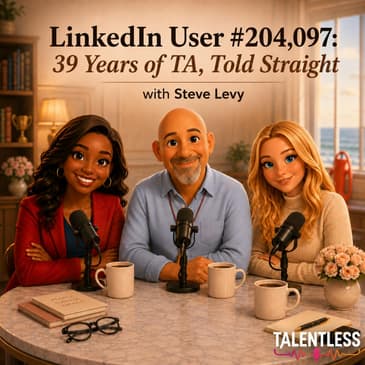
Steve Levy is LinkedIn user #204,097. He co-founded ATAP. He was doing AI in hiring at Pitney Bowes before AI had a Wikipedia page. And unlike a lot of "thought leaders" in this space, he never stopped practicing, he's currently at R1 RCM building production AI/ML sourcing prompt stacks while simultaneously training the next generation of ocean lifeguards at Jones Beach (34 years and counting).
If you don't know Steve, Desiree said it best in the intro: babe, what are you doing? Pause the episode. Google him. Come back.
For our biggest episode of the year, Des and Ashley sat down with one of the actual founders of modern TA and asked him to zoom out. What did the profession get right? What did we get embarrassingly wrong? What's AI actually doing? And what do the recruiters listening right now need to be doing to survive what's coming?
Steve came ready. This one is a masterclass wrapped in a roast wrapped in an hour of the funniest, sharpest TA conversation we've had all year.
What You'll Learn
Why "keeping your job vs. doing your job" is the single most important frame for TA right now
The three problems AI won't solve: character, leadership, and knowledge
Why resumes and job descriptions are both "big piles of monkey poop" (and what happens when you smush them together)
The intake question that will stop any hiring manager cold: "What must this person deliver in the first 6, 12, 18 months to be considered a strong hire?"
Why cost-per-hire is "the singularly dumbest metric" ever created
The difference between excellence and perfection (and why we're chasing the wrong one)
Steve's genius interview question for recruiters: "What would you do if LinkedIn went down?"
Why "densely good" is now the new Talentless bar for candidate quality
The Marquis de Sade School of Talent Acquisition intake technique (you have to hear it)
Why board-director behaviors are the same behaviors great TA leaders need
Best Quotes
"You become so good at using a hammer, everything begins to look like a nail." — Steve
"We have a character problem in TA. We have a leadership problem in TA. We have a knowledge problem in TA. AI is not going to solve any of this." — Steve
"Resumes are a big pile of monkey poop. Job descriptions are a big pile of monkey poop. And we think that magically by smushing this stuff together, some system will produce a five-star Michelin meal." — Steve
"We're not a service function. We're an excellence in performance function." — Steve
"Striving for excellence motivates you. Striving for perfection is demoralizing." — Steve (quoting Harriet Braiker)
"I'm not a psychic. I have no psychic abilities. You have to ask a lot of questions. You have to study. You have to learn." — Steve
"I am here for a purpose, and the purpose is to grow into a mountain, not to shrink to a grain of sand." — Steve (quoting Og Mandino)
"If your presence adds no value, then your absence makes no difference." — Ashley
Where to Find SteveLinkedIn: linkedin.com/in/levyrecruits (fair warning — if he hasn't touched your baby belly, he might not accept your connection request. IYKYK.)
Recruiting Inferno Inc.: 30-year TA strategy practice
ATAP: Association of Talent Acquisition Professionals — join it
Lex Duo: lexduo.net — TA for TA, AI tools for in-house recruiters
R1 RCM: r1rcm.com/careers/r37-lab
hireEZ: Recruiter Therapy, For Recruiters By Recruiters Conference, Outbound Academy
Also Mentioned
Katrina Collier's The Robot-Proof Recruiter — Chapter 5 on intakes (Steve's rec)
Harriet Braiker's The Disease to Please
Og Mandino (the mountain quote)
Connect with Talentless Subscribe wherever you get your podcasts Instagram • LinkedIn • TikTok • YouTube • BlueSky • Threads Newsletter: talentless.beehiiv.com Come see us at RecFest Nashville — announcing our session soon Got a #DumDumTalent story? Email desiree@talentlesspodcast.com
Powered by the WRKdefined Podcast Network.
[00:00:06] All right, y'all. Today we are joined by the GOAT, the master of all, Steve Levy. And I'm going to keep this intro real short because like, bang, little Billy. Desiree, you did this. I don't like GOAT. I am not a GOAT. I don't like, here's the deal. I am grown up. I am not one for idolatry of any form. Okay. But here, but here's why. I mean, that's why I don't like anything on lists. I don't like, actually, are you a laugh snorter? Are you going to laugh snorter?
[00:00:36] No, I'm more of a wheezer. Okay. Well, that's right. Our goal is to get you to wheeze. Here's the thing about, here's the thing about all the lists. We seem to be in list season on the Blue Devil. For those who don't know, LinkedIn is the Blue Devil. Yes. Fine. I said it. We need lists. X this company. I'm so pleased. I'm so proud to be included on the list for a company that won't be here in three years. Wow. Maybe I'll add that to my LinkedIn profile on my resume.
[00:01:04] That'll get, when the recruiter reads that, they'll go, they're a top 100 list for, you know, like boring AI. We should hire them. I mean. I'm going to tell you, they're getting a little ridiculous out there. I don't know what I saw the other day and I was like, what list is this now? Well, so many of them are paid. Like half of them are like paid lists that these people are on. And I'm like, y'all come along.
[00:01:30] Well, no, no, no, I, I, I don't, some are, but there are certainly, you know, you remember, we all remember, uh, we're lights. We'd like to include you in the who's who of business executives. And the marquee. And, but you know, with that, you're going to get a prominent page, this and that. Yeah. It will cost you $5,000 though. Yeah. Pay to play. I mean, does the word chump and all its rhyming words come to mind? Yeah. Okay.
[00:01:59] Well, like I'm on the noon AI list and I didn't pay for that. I'm not going to mention that. One thing Desiree, what are you going to find for me? I'm not going to, I won't, I won't mention names because, no, because you're already went there. You already went there. And, um, well, I'm on the list. Well, I mean, you are user like 200,000 on LinkedIn.
[00:02:25] So I'm sure you've seen like multiple, multiple changes of that world. User number 2000, 204,097 to be exact. You have to know, it's like your social security number in TA. What's your LinkedIn number? That's your social security number on TA. So we're going to just jump in. Desiree, you knew, you knew what you were getting into. Listen, I'm having you on because I, I genuinely adore you and, you know, do what I was going to get. I do too, actually.
[00:02:52] I kind of want to tell people how I met Steve because it is such a unique story. And, you know, I've told him this story. So the first year I met him, this story happened. Second year I meet him. He's like, I've never met you before in my life. I'm like, yes, you have. Let me tell you this story. Look, Ash. And then as I'm about to say it this third time, I think he's still like, I have no idea what this story is about to be. The funny thing is something you're, the both of you were too young for that. There's something called CRS syndrome. It's a disease. It's a heart.
[00:03:22] I can't remember shit syndrome. Okay. I have CRS syndrome. It's fully engaged. And there are so many things that are going on. There's so many little hamster wheels competing inside this bald head of mine that I sometimes forget, you know, and nothing, no, nothing, no disrespect. Never. Oh, now, if anything, it's going to be recorded. So anytime I'm like, I'm not, you're going to be like, I have CRS. I'm going to be like, hold on. I'm going to play this clip for you real quick. It'll be like the 51st dates and I'm Adam Sandler in this scenario. I mean, that is funny too.
[00:03:52] That is one of the best movies of all time. Isn't it? So cute. It is. It is cute. So cute. But okay. So when was that again? Yeah. Let me set the scene. So we're at RackFast. It's our very first year and Des and I are speaking. And I am waddling around eight months pregnant with my second child, a little girl.
[00:04:19] And about both of my pregnancies, I never, everyone was always like, people will come up to you, touch your belly, do things. I guess I'm just very unapproachable seeming sometimes. I don't know. Probably. I'm not a mad at that. Actually, that's a nice skill to have. But the point is, is I never got that. Well, waddling around at RackFast, eight months pregnant. Here comes Steve out of nowhere and touches my belly and goes, baby.
[00:04:50] It's like, who is this man? Like, I remember looking at one of our friends. Her name was Brooke. I looked over at her and I pointed and I was like, who is this? And Brooke just laughed. She knew. And so, so anyway, so I thought it was one of the most funny, awkward, memorable things because I'll never forget it because it was my very first time. And it was a TA famous Steve.
[00:05:16] And so long story short is the second year I saw you at RackFast, I was telling you because as you were cutting my belly. Yeah. You were telling me about your daughter. Yeah. I was not. And so that year I came up to you to tell you, one, I loved so much all the stories that you told me about your daughter and you told me even more then. And it was my favorite thing because you love that baby so much. Ask Steve about his baby. Oh, goodness gracious. We call her B.
[00:05:44] And because of that, I have a B on my chest. Yes. Sweet baby. Where's your Bebe tattoo? I know. I need one. I need a few. You need a Bebe tattoo. I do need a Bebe tattoo. Yeah. But so anyway, so that's how I know Steve. It was a great interaction, actually. So, thinking that you're feeling feisty today, so let's do it.
[00:06:09] Let's talk about, I want to give you an overall broad conversation and ask you, what right now are we doing so wrong in TA in 2026? What are we getting wrong? I don't know if I want to say it's getting wrong. It's just there's a, the adage, you become so good at using a hammer, everything begins to look like a nail. And, I mean, part of it is there's so much pressure. Let me take a step back.
[00:06:34] Do either of you remember the Sorkin movie, An American President, with Michael Douglas? Yeah, I'm that old. Yes. Yeah. Okay, fine. In the final scene, his final soliloquy, the president talks about saying, I've been so busy keeping my job, I forgot to do my job.
[00:07:02] Mm-hmm. In it, I started by saying, try to get to the womb here.
[00:07:26] I said, it's not my intention to talk about this issue without aggravating many of those in the targeted roles. Alas, the only way to get to improve our profession is to identify the barriers that get in the way of clear thinking, decisive action, and a bold future state. There's no doubt that one of the most polarizing and most important advances in business is the one that has taken up most of the space inside the heads of not only P&L-minded company leaders, but also heads of talent acquisition.
[00:07:50] While AI is unequivocally important to long-term viability of most all organizations, when it comes to doing the jobs of functional leaders, success ultimately comes down to two things and only two things. Leadership and character. And so as a result of the last few years, all the escalating talk about AI, and I know we talked about Desiree at some point, certainly we talked about it, is AI is going to replace this.
[00:08:15] AI is going to replace, we don't need, we're going to be able to screen thousands of people at one time. Higher better, this better, that better. And we got on that bandwagon and we forgot most important element is not being discussed. And so the actions of way too many in TA, and from the perspective of the audience, I've been in TA now for 39 years. What the heck am I thinking? But that's not worth a woo. I mean, that's more like a woo.
[00:08:41] But the bulk of the profession, hearing that the C-levels are looking for ways to cut, we've seen the thousands upon thousands of people in our profession get cut through no fault of their own. Strategy gone bad, keep the people who created the bad strategy, get rid of the worker bees. There's nothing more aggravating than that to me. That's not leadership to me. Leadership is admitting you're wrong and fixing the problem.
[00:09:05] Leadership in TA means saying the things that need to be said at the right time for the right reasons. Job be damned. That's hard. That requires, you know, that's where the character piece kicks in. And, you know, are you happy being a whipping post? Bend over, you know, please may I have another. It's not my style, you know? No. I mean, like most of my really close friends that are not in recruiting, we're first responders. You know, I have my best friend Merton on 9-11 running in the towers.
[00:09:35] That's who they are. That's who we are. There's no need to explain it. So keeping your job versus doing your job impacts the rest of the team. I mean, everything, you know, shit rolls downhill whether you like it or not. And that is, but we're in a place where people believe that the technology is going to make things easier, make things better. Technology is going to be able to generate lists of people that you don't even have to look at. They're perfect. And then you realize ultimately that no human being is a job title. Right.
[00:10:03] But there are different archetypes in how you respond to those. We are not there. AI is not there with being able to detect all these little subtle nuances. One day, absolutely. I mean, I grew up reading Isaac Asimov's Foundation Trilogy, iRobot, stuff like that. But where we've in the, you know, this paradigm shifting AI era is finally a lot of the reality is kicking in and AI is not going to do everything.
[00:10:29] We still need to understand that there are basic aspects of our profession that people still don't do well. And, you know, a good place to start is job knowledge. You know, I'm not a psychic. I have no psychic abilities whatsoever. You can talk to my partner. She'll tell you. None whatsoever. So, you know, you have to ask a lot of questions. You have to study. You have to learn. You know, a good example, you know, those of us who do tech recruiting, ask many tech recruiters what API stands for.
[00:10:57] And you're asking from a software standpoint, you're asking for these things. What does it stand for? What does the acronym mean? How do you know someone's good then? I don't know. Is it application platform integration? What is it? Application programming interface. Programming interface. Nice. Okay. But the point is, I knew that. Because I use API keys to integrate. My bad. Okay. That's why I was thinking integration. Yes, you do. Use API keys for endpoints for systems to talk to each other. But how do you know that somebody's good? Right.
[00:11:26] What is your rubric? In order to have a rubric, you need to have knowledge. What is a good answer? And then comes the real, you know, some of the biggest challenge, the real challenge that we have. There are a couple of real challenges we have in TA. You know, resumes is dead. We don't need resumes. You know, we're going to have blockchain. Blah, blah, blah, blah, blah, blah, blah, blah. On the one hand, we have the bulk of job seekers write shitty resumes, CVs, and profiles. Wholly nonsensical. Then they're the ones who have resume experts doing it.
[00:11:56] They're worse. And why they're worse? Because they're all the same as the others. Right. Become so good at using a hammer, everything begins to look like a nail. Then we go to the other hand, on the corporate side. Job descriptions. This episode of the Talentless Podcast is brought to you by Do Better Consulting. Hiring is broken. Job searches are broken. And honestly, most career advice out there is just recycled nonsense.
[00:12:23] Do Better Consulting exists for people who are done guessing. They work with mid to senior leaders, founders, and talent teens to get clear on their signal, how they show up in the market, how they hire, and how decisions actually get made. No fluff, no templates just to say you have them. Just strategy, structure, and honest feedback that actually works. If you're tired of spinning, it might be time to do better. Head to dobetterconsulting.net.
[00:12:51] Big piles of monkey poop. They're all bad. So here's what people think C-Systems do. And I love Amy Miller for this. Amy just keeps hammering, hammering. So here we have the reality. We have one big pile of monkey poop. We have another big pile of monkey poop. And we think that magically by smushing this stuff together, some system will be able to discern some incredible goodness and we'll get a five-star Michelin meal out of it. Knowledge.
[00:13:18] The more you know, the more you can dig in and really understand. Like, for example, just arbitrarily engineers and accountants are very similar. They don't like interviewing. Right. You know? For those of us who have ever, you know, asked someone to, you know, for their hand in marriage, I think that's less stressful than interviews. And so we're taking the fact that maybe at 13 years old, people told us secrets that we can smell things. We know somebody's good. People tell us things.
[00:13:44] And so we get in interviews and we somehow, we don't even acknowledge that people are really bad at interviewing. We expect them to be perfect. No human being is perfect. As one of my favorite authors, Hugh Proud wrote in the book on notes on love and courage, perfectionism is very slow death. I don't want to be perfect. I know that I've got, you know, I got big ears. I've got a pretty big nose. It's been hit a way too many, broken way too many times. I know I have faults. I know in interviews, I probably talk too much. Get over it. So what?
[00:14:14] Just slow, slow down. Take time. The more you take time to know somebody, get to know somebody, the more comfortable they'll be. So we have, we have a character problem in TA. We have a leadership problem in TA. We have a knowledge problem in TA. AI is not going to solve any of this. And so we're left with, what do we have as an option? And this is where I love what John Blastelica has made his life's mission. Being a talent advisor means you have to speak your mind. You have to be knowledgeable.
[00:14:41] You just can't just run a, you know, single line prompt in an LLM and think that's going to solve your problems. You know, how do we attack? And I probably shouldn't have worries you. No, maybe I will use the word attack. You know, let's talk about the stuff, you know, there's where this real near and dear to our heart. It's DEI. Right. And, you know, how is AI going to address what is in fact a socio-political issue now? No, but, you know, how do we solve issues like that in TA?
[00:15:06] I mean, if we're not standing up for people who are clearly skilled but aren't making it through the front, making it to the front door, why are we even in the profession? I don't know. I've said that a million times. I think Ash has too. Like, what are we doing in this job? Well, at that point, and we're just a paper, like, for your, again, if your presence adds no value, then your absence makes no difference.
[00:15:32] So, like, if you're not actually standing up to see a difference whenever you're added to the process, whether it's your pipeline, whether it's the outcomes and your hires, whether it's whatever, then you're not really actually a catalyst for change. You're just a paper pusher. How do you make people feel? How do people feel when they speak with you? Me? No, it's a rhetorical question. That's a mixed bag. Oh, it's not her again. Fire Sam.
[00:16:01] She's going to ask me questions about when we first met. I can't handle that again. How in this profession do we address the hard issues? Yeah. How do we address leadership that we know they don't have the experience? You know, they talk to others. Why aren't hires being made faster? Well, tell them the truth. I imagine. Keep rescheduling. We want more information about the job. We want to know what the real job is, but we can't seem to get that. It's not that important. I want to be professionally.
[00:16:31] If I can get one person to maybe say, screw it, I'm going to talk to the CEO directly. Look, I'm going to tell you, you need to know this whether you know it or not. And by knowing this, this company is going to fly on your back. But if you don't know it, it may not. What do you want to do? You want to know something? I'll show you something. This is why we need, this is why we're doing it this way or that way. This is why, you know, the applicant tracking system that the CFO signed off on is not the best one for us.
[00:16:59] Gee, I wonder what ATSI could be talking about there. Do you know? If you know, just shake your head which one I'm talking about. Desiree knows. I know. Someday. I'm going to make her laugh. Look at work. But we need to do that. You know, we're not a service function. We're an excellence in performance function. But how did we get there? How did we end up in this spot where we are treated like a service function? I mean, my mouth is bad enough. I'm never treated like that.
[00:17:29] But I, you know, I just. But Desiree, but exactly. Mine too. But it's not. But we say big mouth and we kind of laugh ha ha ha amongst each other. But we're not big mouths when it comes to talking about how important this is. No. And there's a reason why I write at times just to get a wider audience to see if there's anyone, if it will resonate with anyone other than, you know, the 25 people who regularly comment on my post. That's the only thing. Can I reach one other person to go and make a difference?
[00:17:59] Yeah. You know, when I, when I, when I, when I, right now I'm, I'm interviewing engineers, not in Europe, not in Africa, not in Asia. You can figure that middle spot in between. And culturally, there are cultural nuances of interviewing in the Middle East, which if you don't know, you're not going to get the best information out of people. Right. So you have to know these things going in.
[00:18:23] You have to be able to go up and tell somebody, you know, this is the expected, you know, if we don't know what expected performance is, for example, if they're done intakes, you know, what will a person have actually delivered? 90, 180, 360 days from their hire date that tells you hiring them was the right thing to do. I want details. What will they have delivered? Yeah.
[00:18:48] You know, and if you ask that question, most of the time you'll get a, well, that's a good question. No, but that's not, I don't mean, but you will. Right. No, I agree. And then the snark, you have, you have to keep yourself from snarkily, snarkily responding. Well, I'm kind of looking for a good answer if it's a good question. And, and so, but, you know, we have to be able to explain people that we hire people to get things done, to solve problems. What specifically are these?
[00:19:16] What will a person be doing here that they're likely not to be doing anywhere else? Maybe it's scale. Maybe it's different audience. Maybe it's a different industry. Maybe it's a different technology. Articulate that. Spend the time and don't leave the room until you have that information because you're not going to figure it out later on. I'll just read stuff. It's not up to you to read it. You're not the hiring manager. I mean, but that's, but, but that's it. It's, it's not having a big mouth.
[00:19:40] It's, it's knowing that the right answer is far more important than annoying people. You know, you can always buy someone a cup of coffee afterwards and say, look, I'm sorry if I came across as a jerk. And listen, managers are always so happy whenever someone's hired. They don't even care in the end. Like if you actually do the job and you do it well, trust me, I have had managers that were like, girl, you annoy the junk out of me, but you do your job better than anybody else. Come back over here right now.
[00:20:10] I mean, cause it, that is the thing with the intake is no recruiters nor are managers developing recruiters to really do that, to create talent infrastructure, to support a wide net role that they would need. To actually have agility and sourcing, pipelining and assessment and evaluation. Like all of these different aspects that create our data points.
[00:20:39] They just, they don't ask, like, they just basically are like, oh, is this the JD? Okay. Is this a location? Are these the hours and the monies? Okay. Like they're not asking any introspective questions that actually. I agree with you. I just think that's a leader problem, right? Like, cause we have these TA leaders who aren't training their teams to even ask the questions. If I have junior recruiters, they don't know any better. So I think it is.
[00:21:05] I think it's companies that have these grade A brands and logos that get inundated with applicants. Yeah. And then those people go on to be leaders at smaller orgs and they don't actually know how. I mean, I definitely think that's part of the issue. At least the majority of the people I've seen, I'm like, whoa, you've worked for Oracle and blah, blah, blah, blah, blah, blah. And they're like, well, yeah, we had a sourcing team. We like, everything was so broken up that like sometimes that fool had a full life cycle,
[00:21:34] like actual specialty to develop other people. I don't feel was really, they have big name and logo, but that's about it. But that's just, that's me in a weird tip. All right, Steve. But Ash, it's not just you. We all privately and Desiree, I'm sure you've been on these conversations. Yes. You know, when someone says X this, X that. Oh my God, it drives me nuts. I can tell you who they likely reported to and what they didn't build or learn. Right. And it's, it's, it's, it's not, I think I just killed this. You're back? Good.
[00:22:03] Yeah, we're here. It's, yeah, it's not, it's not a quick, it's not, it's not being negative. It's just that the chances of anybody working at those companies, they, they're not going to build anything from scratch. No. Yeah. If they're way too developed, they may, I will, I learned to become a leader by osmosis. I mean, what did you, did, did you put on, I can't, well, I won't mention a person's name. So-and-so sweaty shirt after they worked out and you dripped all that knowledge in. What do you mean you learned like that? But you know, the whole thing about, you don't want to, I want to go back to what you talked
[00:22:32] about, about, about intake questions and, and, and, um, and things of that nature. It's, you know, there, there, there are always some, you know, basic, you know, the core intake questions, which work really, really well. I'm trying to find one here to give you, I should know these by heart since I, you know, I love Katrina. She's great. She's as great. She wrote a book called The Robot Proof Recruiter. Actually, I don't know if you've ever read that. Mm-mm. Okay. But it's, it's, and I don't mean to hump it here, but it really is one of these books.
[00:23:02] Do it. It's really one of these great books here. Yeah. And chapter five is about the intake. It's a great book. And a large number, a lot of stuff came from the stuff that I've been talking about at conferences for 20 years. And none of that, I don't consider any of it to be, you know, be a, you know, mind blowing, anything of that nature. That's just, it, it, it doesn't work like that. I don't have that sort of, you know, those capabilities, but it's, the questions are really important.
[00:23:30] Like what I have is what, what I built now is, and I haven't shared it, but I'll share, I'll share with the two of you. Uh, this came out as a result of a, uh, small little presentation I did for, uh, for the Hire Easy Conference a couple of years back. Uh, and, and, and my brother from another mother, Dean DeCosta and I, we kind of worked on this together to build out, and ours are, we have slightly different versions of this.
[00:23:54] I have a, uh, a role persona and hiring strategy prompt, 10 page long, which, which generates so much goodness that I can't stand it. But in it, based on the actual job, the actual role that's coming up, and this, this thing is run prior to the intake, and there's a whole, so much information in it that you will not believe it. You're, you're, you're, you'll just go. Is it like the talent insights you take with you to the intake that you. It's more than just that. And I'll have to show it to you privately and then you can talk about it.
[00:24:24] But in it is like, I have like, you know, my, my must answer intake questions, things like what business problem does this role solve? What happens if we don't hire this person? Hmm. Yeah. You know, what must this person deliver in the first six, 12, 18 months to be considered a strong hire? What evidence would prove someone has done this successfully before? You know, in many cases, these are the kind of questions that the manager's going to go, that's a good question. And then you have to say, I'm looking for a good answer. But these are the types of things that we don't do.
[00:24:51] But, but every unique position has, every position has unique intake questions. Not like, what are three companies where you'd like to recruit from? I don't give a crap what the manager, that's, that's not their job. My job is to tell them through analysis and TI, which companies they want to, that's the talent advisor. That's the part about becoming more knowledgeable and studying this stuff. Yeah. That's what, that's what I mean. You know, the future TA practitioners and leaders are going to have to do. Absolutely.
[00:25:21] They are, especially when they are around, they better be doing it. They better be more than filling an order, right? They better be that advisor and be leaning into the fact that they're the subject matter expert. And if they're not, go read a book. I don't know what to tell you, but like, they got to do better than they're thinking. Read a book. Read a book. Read a book. But, but, but actually you said something interesting there that is, that I want to, want to, want to talk about here.
[00:25:48] It's, and it goes back to how often, I'm going to read to Ashley, just slightly earlier on in your career. How many times has a hiring manager said, it must have, you know, eight to 12 years experience. They must have that. Then you ask, what problems are they? My response, my usual response is, what do they get at eight that they don't get at seven? Well, actually that's nice, but that, that, that I'll give you another way to answer that. That will make them go, damn. All right. Give it to us. What is expected to be delivered? Then you say, okay, that's good.
[00:26:18] So if I sign somebody with six years, who's actually delivered that, you don't want to speak with them. Am I right? And you know something, there are actually some managers that even after you bust the logic and you're like, are we truly evaluating who can perform the best? Or are you just wanting who has the most historical linear experience? Those are two very different asks. And you break that down of like, if I find someone in five years who can do it and do it well, are you interested in them? I still have some managers say, oh, I need.
[00:26:48] Funny thing is like, I don't in any way, shape, or form, you know, even remotely impress myself by the years or the number of interviews. But I think of the number of interviews I've conducted, easily half to three quarters of them were horrible. Why? You know, I thought I knew. Yeah. You know, self-awareness is like, man, I did a, I did a really crappy job. I have to, I have to call to apologize. When I finally realized that people aren't good at interviewing and I had, and I had absolutely
[00:27:17] no psychic abilities whatsoever. And I wasn't as knowledgeable of the job as I, as I thought I was. Things changed. Yes. I go into every interview. I tell people exactly. We have a little bit. We always have banter, especially with technical people. Cause I know if you jump right into interviews with technical people, you will not get best interview. You just won't. I don't care what level it is. You just won't. I want to banter. I want to take that down before I do anything. That's why all my initial screens, I prefer 45 minutes.
[00:27:46] Cause 15 of it is just kibitzing and, you know, centering and level setting and things like that. I tell people why I'm talking to them. Why you, I want to tell you why, just exactly why I chose you. Tell them what we're doing. No questions are off. No questions are off the board. I put links in, read this later. These, these are the, these are the five areas that we're going to talk about and let them know. I used to send those things ahead of time, but now, you know, I just show right at the beginning, these are the things we're going to talk about. Don't worry about it.
[00:28:14] And then, you know, I asked them ultimately the most important thing is, why am I talking to you? I mean, I know I, I created this connection, but why? You say yes. What's happening in your life? What's happening in your job? What would you like to do next? You haven't done before. You know, what's, what's, what's, what's your take on all this? I mean, it's not hard. It really isn't. No, but so many people don't. Don't do that. They don't care about their intrinsic motivating factors anymore. Sorry. Keep going. But yeah. No, I want someone to go, you know what? I got a fair shot.
[00:28:44] I received a fair shot. You know? Yeah. Right. Right. You know, the recruiter, you know, the recruiter wasn't as. Right. Or at least knew what they were doing. Sometimes I get, I mean, bad calls with recruiters lately. I'm going to be honest. It's scary. Like how little they do in these recruiter screens or how much they're failing. Especially when you're interviewing a recruiter, you think you would come with your A game. It's not really not that good.
[00:29:08] I mean, that's, but even then, that's an interesting point is what I do if I'm hiring recruiters, I'll ask them, I said, my mantra is don't tell me, show me. And, you know, you know, this is good. Like when you interview agencies, we both have, all of us have friends who work for agencies. Yes. We all do. I like posing the question. Okay. What happens if LinkedIn goes down? What do you do? Well, I will network. They go, tell me, what does that mean? Show me, you know, where do you find these people? You're going to network. Okay.
[00:29:37] Show me something that's going to make me go, first, just kind of innovative. Show me something, anything, you know, and then depending on the role, I'll ask him, come on, let me ask you a quick, how do you determine that somebody is a. Recruiters aren't hard to interview. It's just, you got to ask basic questions. I don't know. I've had some really bad experiences lately where I felt like I don't even know why you're in this job. And to me, that again goes back to the leadership problem we have in TA.
[00:30:05] Like these people aren't getting trained well enough to even function at a basic level to get the right questions out. And then we're asking horrible questions at intake. And I don't know how you ever hire anybody good for the job. And I've gotten passed on with some horrible intake interviews. And I'm like, what is happening? You didn't even find out anything about me. How do you know I can even do the job? I'm not complaining, but I'm just saying. Based on vibes. Based on vibes. Right. Based on vibes. Well, we know how much that works.
[00:30:33] It's a horrible system right now. You know, we also have another problem is historically how we measure success in TA is still a challenge. I'm not going to beat a dead horse. And I say that we love horses on this side here. But where did TA come from? I come from HR. Yeah. You know, so you see metrics like cost per hire. Yeah. I'm a strategic business partner. I have a metric that says cost in it. It's the dumbest metric ever created.
[00:31:02] It is the singularly dumbest metric because it's not, there's non-normalized. Your recruiting mix is always changing. The economic situation, the seasonality stuff, political environment, economic environment, social environment, technological environment, they're always changing. So you're always comparing apples to orange. But we reduce costs for hire. You manipulated the numbers. Give me a break. That's not true. Time to fill. The face value time to fill seems important. We fill the position fast.
[00:31:31] Tell me how long they've stayed. Word. Right. Let's look at that retention number. Tell me what they've delivered. Mm-hmm. Because if it's revolving door, who cares? Who gives a crap? Yeah. That's why your time to fill has to be fast because you're just getting put in a warm butt in a seat. Mm-hmm. And we're not actually, we're spending more money. Talk about cost per hire. Blah, blah. Yeah. But, and even, you know, source of hire attribution too. Oh, I got passive candidates. Are we still talking passive versus active?
[00:32:00] You know, do you get hives when you see a green open a work banner? What is wrong with you? Yeah. Really? That seems like fundamental problems in this career though. I feel like we just go round and round and round and say the same things every year and never do anything. Well, and I think even going back to his data point, like so much of TA data is char bits confused with sales.
[00:32:26] Like, and sales is such a quantity driven sport. Like every dollar spins. So you want so much versus quality, which is what recruiters really want. So even if I only have a, fill the pipeline with five people, if they're all five highly qualified, like dense, densely good individuals. Then who cares? They're dense. They're pound cakes. Densely good. They are densely good.
[00:32:56] That will be, that will be a new thing. I think maybe I am talking about pound cakes. Nothing inherently wrong with that. You know, like, you know, like, is it, you know, pound cake is really good. If you have dense pound cake. Dense pound cake? Like get out of here with that. That's way too good. But to me, especially as a leader, that's more important. But some leaders, because they have just that basic surface knowledge, they don't understand. Okay.
[00:33:24] You need to look at the funnel pass through ratios, not necessarily the exact digits of what's going in. But I want to see for every person that they send, are we at least getting a 50% or higher hit? To be honest, if they're a senior recruiter, it better be like 85% or higher. And so there should be agility with who's in the seat, what's in the role. Like that's why matrices are, that's why, that's why this product that I'm building is going to be amazing. But the point is, is just, I know. Yeah. But the point is.
[00:33:55] Aboganza. Aboganza. Yeah. It's going to be Italian too. You use, when you use it, when you use the platform, you're using your hands. When you use the platform. That is true. You do use your hands. That could be a slow. But yeah. So there's that. I just think that densely good would be great. I just think that. This has been a densely good conversation. Most of the time we're sending through mediocre, unmoist pound cake. What? I don't think so.
[00:34:24] I think everyone's. But this one was just densely. You know, you can't, you can't, you know, we committed a cardinal sin. We use the word dense and moist. I know. I know. That was Desiree to be specific. Oh, no problem. That word. So what else? So, so, so, so, so what, what bothers you Des about the current state of TA? Think about when you first got into it. Yeah. I mean, I loved it. I love, I got into it because it was the through line of people.
[00:34:52] I thought I was really doing, I don't know, not to say God's word, but I was really doing work to change people's lives. And I come from sales and marketing, which is, you know, I never felt like anything was achieved but money. And so, like, I really wanted to do work that was valuable. And now I feel like sometimes I'm, I don't know, we're just, I don't know, I get lost in the work sometimes because I feel like we lost the point of the work. And I think we talk about this a lot on the show about how this job can mean so much if you let it.
[00:35:22] And we're not taking that to heart anymore. And I'm really frustrated with a lot of TA leaders right now. I see some bad, really bad leadership going on and really bad organizations and teams being built and things being said, even from recruiters on LinkedIn. And I'm like, why do you work in recruiting? I know it's very frustrating right now. And then the world of AI, I think it's like, it's like a distraction for everything, right? To not fix anything. Let's just put some AI into it. We're not going to fix all the problems we have anyway.
[00:35:52] Let's just throw some AI in there. I, you know, I, I, I think you're, you're describing a problem about excellence and excellence definitions of excellence have changed over the last few years. It was like, where, where, where does that come from? I mean, I, I don't know. I mean, I just know that the, um, trying to find out the one thing that I did here, uh,
[00:36:19] I wrote, and this is again, just another, another thing that I, a presentation I did that I just can't remember what, what, what the actual quote was on it, but I'm trying to find it as fast as I possibly can. Striving for excellence motivates you. Striving for perfection is demoralizing. That was Harriet Breaker who wrote the book, uh, the disease to please curbing the people pleasing syndrome.
[00:36:47] And I, I think people are confusing, you know, excellence and perfection. I completely agree. On the job, excellence is something that motivates you to keep getting better. Striving for perfection motivates you to not make a mistake. So excellence is expansive. Perfection is narrowing. So I think we have, you know, an entirely new, a whole new tranche of people in the workforce
[00:37:11] who grew up, I mean, look, if, if, if I had social media, when I was Ashley's age, my LinkedIn picture would have a front and side view picture on it. My profile and things, we were just, I'm glad that stuff wasn't around when I was a teenager and then young adult, although. You know, adulthood and then often comes around 50, 51. And if you were wondering, I'm an adult now, barely. But so there's this whole new, so many people coming into the workforce who, you know, you
[00:37:41] didn't have, I don't want to say you didn't have to work as hard, but you learn things in very different ways and you learned, but you also grew up in an era where maybe both parents were working. There were much, there was more pressure on them, more social pressure on parents and kids to be this, be better, be perfect net. And that got you away from that. Got it, got a whole slew of people away from being excellent. Yeah. The part of the, of the excellence process is in fact making mistakes.
[00:38:07] And yet we have this, we have, as an example, whole new wave of hiring managers. I'm going to category for this one, but I don't care who were weaned on participation trophy and blue ribbons for finishing eighth or 17th or 36. It doesn't matter. And they all think that their mood doesn't stink. They know everything. They're hiring experts. They're experts at everything. Why? Because they were told they were expert. He did a great job. Even if it was average, he did a great job. Great job. Here's a trophy. Right.
[00:38:34] How do you get people to, to come over to a side of abandoning everything that is, you know, second nature to them and changing the way and moving towards this concept of excellence where, you know, you don't have to be perfect. You just keep learning and moving and, you know, moving forward. And striving for that thing. Yeah. Striving, striving for that. And so I go back to this presentation and this was SourceCon Austin 2017.
[00:39:03] I think it was. I think it was. And I found there was a Russell run of global board culture survey, understanding the barriers, the behaviors that drive board effectiveness. And the two most important behaviors at the time were possessing the courage to do the right thing for the right reason. Because this whole talk was about courage. And the second thing was willing to, willing to constructively challenge management when appropriate. Those are board behaviors.
[00:39:31] And I realized very quickly that the same qualities that embody great board directors are also embodying great TA leaders, TA practitioners. But how do you get people to be courageous in the workplace? And essentially, that's part of being a talent advisor. You have to be courageous. You have to be able to give messages and give data, give information in ways that people go, Ashley's right. How do you do that? It's a rhetorical question. I don't have any magic, magical things, magical words for that.
[00:40:00] No, but it's a great question, right? The great question is how do you get people to do that? But then again, but the other side of, but the other side, but Desiree, the other side of courage is fear. Yeah, right. And this goes, and this goes back to the original premise. The first link is like, you know, doing your job versus keeping your job. And so what do people in our profession fear? They fear losing their job. They, you know, they, you have to be deaf, dumb and blind.
[00:40:30] I'm not disparaging that as a disability at all to not know that it's hard to get a new job these days. And so, yes, please sure may have another, whatever you say. Yeah. And I feel for people, I know what they're going through. I've been through that before. And, and who, who is it? Who, who, who am I at my advanced age? You know, late, you know, probably in twilight of my career, maybe 10 more years, maybe. Who am I to tell them what to say and what to do? I'm, I don't give a shit.
[00:41:00] You know, I'm going to say what I think I need, what needs to be said, because what are you going to do to me? Nothing. You can't hurt me. And so a lot of people are like, oh, you need to create a safe space or have a safe space. I think it's more of creating your own brave space. Meaning like once you're able to gain the confidence in your own skill set and your own knowledge, whenever you know what you bring to the table, whenever you are an autonomous
[00:41:24] learner and don't mind, you know, getting that education, getting that talent intelligence, doing all of those things to really be a business partner, not just, you know, the order taker bit. Like that's whenever, I don't know, that's whenever I think all the good things happened. Right. And it's also where TA changes, right? Once we do all these things, you get somebody in the seat who's willing to, to be a little, you know, have a voice to be courageous to do.
[00:41:54] That's when I see the excellence in TA teams. I feel like we've gotten stuck in this loop because we've seen all of our friends get laid off and fired first that we're just like, okay, I'm just going to keep my mouth shut and like keep my head down. They kind of gave us a whiplash. I'm not going to lie. Like, that part's really true. No, you're 100% right. And, you know, especially me, I have now have my contrary of friends who have, like myself, over 60.
[00:42:20] And, you know, they're, they're, if I get laid, I'll never get a job again. Yeah. I tell them, yo, believe me, you, you will. And, and, you know, but don't lower yourself. You know, when people, if people say things like, aren't you old? They go, I'm old. I've made the mistakes you haven't made yet. And I've learned from them. Oh, did that just bother you? You little one. Oh, you know, it's, um, there's again, just another quote that I'm reminded of. I actually have it up here.
[00:42:50] It's, uh, you know, Agmandino. This is great. I am here for a purpose and the purpose is to grow into a mountain, not to shrink to a grain of sand. Henceforth, I will apply all my efforts to become the highest mountain of all. And I will strain my potential until it cries for mercy. What have we done? So it's, it's, it's the message to the industry. What do you do to strain your potential until it cries for mercy? Because if you're not at least doing something like that, you're hurting yourself. Yeah.
[00:43:20] That's all you're doing. You're hurting yourself. What is that? How does that feel? Do you like, what are you doing to, to, to really? And that's why the learning, that's why I am lucky. I am fortunate that I live two miles away from Jerry Crispin and Jerry, Jerry's my boy. We've been friends for 30 years. I was over two weeks. So we came and calling out, come, I see them, get a little bourbon. We'll drink, we'll drink a little bourbon. We will talk TA. We will call friends, you know, people who know that we've called them up. We've FaceTimed them and go, hi guys.
[00:43:50] You're holding up our little glasses. But I have somebody who was, he has, it was the life. I am a lifelong learner for as long as I've known him. And that is the one thing that I think the most important thing that we can do is never stop learning. It doesn't matter, you know, whatever your company's product, sit in on meetings, go read journals. I read way too many things. Don't let AI summarize them. I read them. You just schedule time if it's really that important. And you really want to strive for excellence.
[00:44:19] That's what you do. And don't be afraid to use your voice, you know, for the right time. You can have side conversations. Go to your head at TA and just, I want to talk to you about something. I need you to listen. I may not be able to, I may not articulate it perfectly, but just please listen. Start there. Do something. It's no different than any relationship that we have. Absolutely. You know, you have to, you have to work at it. Nothing good. There's no, there's no easy street on anything. There's no easy street. So.
[00:44:49] There's not. Unfortunately. I wish I could find it, but it does not exist. You know, you know. Go ahead. No, but you're right. Look, I play the Power Bowl lottery. Why? I don't gamble. You know, four, four dollars when it hits a certain, I can handle that one. I couldn't. I can't. I don't care. I don't like the concept of gambling all the time. I only play it when it's high, which makes it the least amount of chance that I'll win. Doesn't that make sense? No, but. But it's, it's, it is absolutely that your chances of winning are one and so.
[00:45:19] It's still a, if the numbers say if they do, they do or they don't. That's the way I view it. I so agree. It's less than a Starbucks coffee. Right. And you know how much joy the Starbucks coffee gives you? It's just a ticket. I want to be, but you know, I, I scan it. Seven dollars. I'm happy. I, I, I'm happy. So ridiculous. Ashley, do we have a talent outside the box today or we? We do have a talent outside of the box today. All right. What does this mean? Inside the box. All right.
[00:45:48] So this is based off of some of the conversation that we've actually had here today, including what Steve Levy mentioned as far as whenever he's interviewing for recruiters, one of the questions that he asks, what would you do if LinkedIn shut down? I personally think that this is one of the most brilliant questions that you can ask a recruiter. And here's the reason why.
[00:46:11] Prior to having the internet, like internet has evolved recruitment more in the past, probably 20 to 30 years than it had in the more 300 before it. Like it has revolutionized the way that we do it so much so that a lot of those organic skills have now left the building. What does Ashley mean by that? So prior to really using the internet for a ton of things, we had to go to, if I was
[00:46:40] hiring CDL drivers, I would have to go to truck stops and I would have to go put up a sign that says, send me or mail. Ashley, Ashley, Ashley goes to truck stops. That's the take home lesson. Pretty much. Damn, girl. That is the take home lesson. Yeah. And so there was this piece of like, you had to look into the persona in a completely different way. You had to look at it in the sense of, okay, where do they go? What kind of music do they listen to? What are their daily habits? Where would they eat? Where would they stop? How do I find them?
[00:47:10] And it's a question that whenever we ask it now, it's conducted so differently. It's what HR tool, what Boolean can bring me? What this, what that. And that is so different than the organic from networking, who knows who, even prior to that, barter and other type of employments that we're not going to discuss today. But what we are going to discuss is the type that has just changed all the ways in which that we do hiring.
[00:47:37] And so I say this to say that don't forget some of those organic roots in talent, because when you do, you will also lose your grip on how to really analyze a persona. You will forget the critical questions to ask. And we don't want you to do that by just replacing an AI and saying, hey, what should be my go-to-market strategy for this job description? It's going to hand you stuff, but you're not really going to understand why.
[00:48:04] And you are going to be a much better catalyst for change whenever you can do these things in your own brain on your own time. Then I have to go get the internet or I have to go do LinkedIn, which back to Steve's question, what would you do if you don't have LinkedIn? It's a beautiful question, beautiful analysis, and a great way to see how these individuals would autonomously learn and actually be motivated on the clock and how they would operate.
[00:48:33] How is your talent outside the box today? And by the way, when you ask that question, you share a screen, you go, there you go. Show me. Show me, honey. You know, even in this era, I think one of the most, you know, the old school, new old school methods, tariff sheets still work. You know, if you go to your favorite market, you know, wherever it is you're recruiting, especially for the, you know, more of a, I guess, service workers, you know, we have in healthcare, we have patient access, financial counseling.
[00:49:03] They're very localized, plenty of medical recept, medical related things. You go to your big famous, after you go to your supermarket and you check out, there's these massive community boards. Make the most, the gaudiest, most elaborate tariff sheets that pertain to that. And on it is you can do one of two things. There's a QR code or you can have a tariff sheet with an email, email your resume here, whatever it might be. Yeah. They work.
[00:49:32] I'm sure they do. But here's even another one. I don't have it here, but I remember using this, I helped move a company from Connecticut to Pennsylvania back in the late nineties. And two of our key competitors were within 20 minutes, not 20 miles, 20 minutes of us. And so, um, Wawa's. So what I ended up doing was, was buying like 10,000 of the coffee sleeves and printing them with some company logo stuff and get, and giving them away. Yeah.
[00:50:02] Real estate agent logic here. I don't know about real estate logic. I mean, I would, I suppose I could put on a pair of Louboutin pumps and do the same thing, but it wouldn't have, but it really wouldn't have the same effect in my opinion. Well, maybe it would. I don't know. Red bottom Steve. I think they might. Red bottom Steve has many, many connotations. I don't want to go into most of them. Steve, this has been a joy. Where can people find you?
[00:50:29] I mean, if you don't know where to find them, I'm sad for you, but go ahead and plug because it's already in the chat. If you're in the profession, you know, it's, um, it's, I'm Denim Levy recruits, L-E-V-Y recruits. I mean, I'm also on, you know, if, if you're a, uh, if you're a financial counselor, you're selling capital, I will absolutely troll you if you try to connect with me. If you're a salesperson and I haven't met you first, I can accept your connection request either.
[00:50:57] If he hasn't touched your baby belly, he is not accepting it. So just, I may have, I'm going to add that to my profile. If I ever touch your baby belly, don't even think about connecting with me. If I don't touch your baby belly, don't come knocking. Like, don't even look my way. Yeah. I wonder how that'll be taken. Part of it is, you know, I, I, I'm a big community person and, um, you know, if anybody, I, you know, like there are so many of us who do the same exact same thing I do.
[00:51:24] I'm not very unique that we will sit with anybody anytime if they want to speak with us or ask questions. Doesn't matter. I'll sit with you and it won't cost you anything. Well, maybe, maybe a cup of coffee. Steve, I've been waiting for this one for months. Thank you so much. We were honored to have you to all the people that are listening. I don't know what you took for this, but took from this better taking something. There's so many. I'm so excited for it, for this to come out, for people to listen.
[00:51:50] If you don't want to, we're at finest Apple, Spotify, we're on Instagram, blue threads, blue sky, all the things YouTube. Yeah. Please go like our YouTube. It's really sad out there. How about this one? How about this one? Before we go, where, where might the two of you be appearing next? Uh, we, I mean, for example, we will be at breakfast next. Next is our breakfast thing. We are speaking. Are you going to be there this year? Bye. Bye ladies. I'm Desiree.
[00:52:20] And I'm Ashley. And thanks for listening to Talentless, where we keep it real in the world of HR. If you loved what you heard, don't forget to hit subscribe and give us a follow on blue sky, Instagram, and LinkedIn. We're here to keep your feedback with everything you need to level up in recruitment in HR. And be sure to subscribe wherever you get your podcasts. And Hey, don't miss out. Sign up for our newsletter for fresh insights and follow us on socials to stay connected with both Ashley and me. Thanks again for joining us on Talentless.
[00:52:50] Until next time, we'll see you then.
Sponsors
