
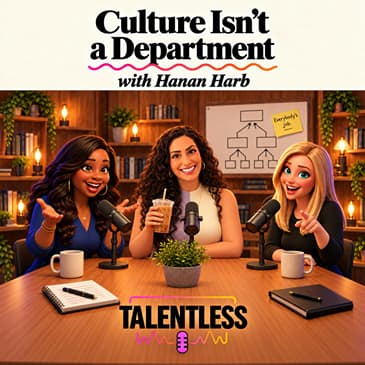
Guest: Hanan Harb, Principal and Learning & Development Consultant, Everybody, Be Cool!; author of Everybody, Be Cool!
Guest links:
• LinkedIn: https://www.linkedin.com/in/hananharb/
• Website: https://www.everybody-be-cool.com/
• Book: https://www.everybody-be-cool.com/buy-the-book (Amazon, Barnes & Noble, Bookshop.org)
Who owns company culture? Everybody points up. L&D consultant and Everybody, Be Cool! author Hanan Harb joins Desiree and Ashley to make the case that culture is everybody’s job. They also get into why the work won’t speak for itself, how to ask for what you need, and how companies win back trust after they’ve broken it. Resources and links
• Hanan Harb on LinkedIn: https://www.linkedin.com/in/hananharb/
• Everybody, Be Cool! (book and consulting): https://www.everybody-be-cool.com/
• Desiree’s book, Leadership is a Practice, Not a Personality (out October 27, 2026)
• Watch Talentless on The HR Channel (Roku and Fire TV)
• Talentless newsletter, The T-Hive: https://talentlesshive.beehiiv.com
• This episode’s sponsor: HIDIZS ST2 PRO Nebula earbuds.
Use code TALENTLESS8 for 8% off at hidizs.net or on Amazon:
https://www.hidizs.net/products/hidizs-st2-nebula-2-in-1-high-performance-dac-usb-c-hifi-digital-in-ear-earphones.
We earn a commission when you buy with our code.
Powered by the WRKdefined Podcast Network.
[00:00:00] I know people say empathy, empathy, and it's become a buzzword, but empathy is a pretty good concept. Look into it because It's a pretty good concept. I love it. I'm quoting that for the rest of my life. In Google, see what comes up. Recruiters, turn it up. Recruiting has some explaining to do. And these two? Two industry vets. Zero filter. Bringing in sharp guests and leaving the corporate script at the door.
[00:00:28] Make some noise for Talentless. For recruiters, by recruiters. Let's get into it. All right. Welcome, welcome back, folks. This is another episode of a crazy show we call Talentless. I am excited for this one. But Ashley, first, weird question of the week. What do you have? Weird question of the week. I think so. Is there any food item that you love that you think other people think is weird? And it's like, but I love this and it's delicious.
[00:00:58] Oh, I love squid. But I think a lot of people eat that. I think a lot of people eat that. So I don't know if that's weird. Maybe here's what I'm trying to say. Okay, maybe let's do it like this. Because squid just made me think of this. What is something that... Change a question. All right. Reel it back in. Blink our mind out. What is something that everybody else thinks is luxurious, but you think is disgusting? So, for example, squid. Caviar. Me too. That squid made me think of it, but caviar was mine. Why are you eating these balls of fat? Baby salt balls.
[00:01:28] Yeah, just little baby salt balls. I don't understand it either. They're so disgusting. And everybody's like, you have to have beluga. I'm at it. It sucks. No, it's terrible. And I've never met a different caviar that tasted any different either. Stop them. But all right, Hanan. What is one thing that people think is luxurious that you're like, maybe not? One thing... Well, I do love luxury, so that's hard to pick. Most of the things are pretty good.
[00:01:57] I don't think I've had caviar ever. You're missing my... Now I want to try it. Maybe in that same like bougie seafood, like what are those ones where you like shuck them? Is it the... Oh, oysters. Oysters. Yeah. Yeah. It was good one time, but it's like too much of a... You have to have them right. Yeah. I don't want to gamble. Yeah. They're foul.
[00:02:22] I will say the only way to eat an oyster, in my opinion, is if you get the true char broiled out of like New Orleans. Yeah. Yeah. But anything other than that, like the raw oyster, all... We go to New Orleans every year and it's like one of my favorite things to eat. I make it a point. I go to Mike Anderson's every single time I go there. I don't care if I have to drive through Dangdoll Lafayette to get it. I'm going to get it. And it is so good. They do it over the open flame for you.
[00:02:50] They do not sponsor this podcast, but with... We're looking for it. Let's do it. All right. Quick one before we dive in. Today's episode is all about how people treat each other at work. Half of that is actually listening. So this episode is brought to you by... I can't say their name. It's H-I-D-I-Z-S. They're ST2 Pro Nebula earbuds for back-to-back calls. I actually got mine in the mail the other day and I hate headphones. Obviously, I'm never wearing them.
[00:03:20] And I actually listened to a whole podcast with them and they were super comfortable. So please go check them out. It's 8% off. They're on Amazon. Super cool. We'll have a link to the website in there and everything. But I'm more excited about having Hanan on the show. Welcome, welcome. Just so everybody's aware, Hanan actually won this episode. Why that was a prize, I have no idea. Hey, because we're a gift. That's why. Yeah, you really are.
[00:03:50] Winner. You don't have to lie. That's better. Reader on two questions. How people learn and how they treat each other. She spent nearly 10 years at DPR Construction, first in marketing and then leading learning development for a workforce of 9,000 people where she turned a full day electrical class into a two hour hands on session and co-created a coaching program for employees coming back from parental leave that took participants life satisfaction from a two to an eight out of ten. She's the author of Everybody Be Cool.
[00:04:19] Great title. The framework for feedback and conflict and repairing trust. And she also runs a consulting practice working with clients like UKG and Palo Alto University. She's keynoted the ATD Sacramento Learning Conference, Judge Chief Learning Officers Learning Elite Awards. It's the retainer kids. And most importantly, she's a Buffalo Bills fan. I'm going to allow you on the show, though, because I like you.
[00:04:49] Yeah, that is a point of concern. Thank you for having me. There's such a lovely introduction. Oh, my God. Sometimes I read people's bios and they're like, all right, stop. Right. And I'm like, no, I have to give the full, you know, scoop. Stop. Right. Yes. But let me just add, I wasn't leading all of learning and development, but I was on the team. I was on the team. Yeah. But she led that whole thing. She was the CEO of it. She owned it. I was one of the founders. I was there. You go.
[00:05:18] But I will say I have to be a Bills fan because I was born and raised in Buffalo. So that's just like part of my DNA. So I'm an Eagles fan. Same reason. It's part of what is it? I'm a Eagles fan. OK, that's that's fine. I feel like Philadelphia, Buffalo, like a similar vibe. It's always sunny. They love the Eagles, too. And yeah, they're cool. I like them. Thank you. Thank you very much. All right. Topic today, kids. We're talking about culture and who owns it.
[00:05:47] And this is one of my favorite topics. I think it's one we don't talk about enough about, you know, who's running culture, right? And who's responsible for it and who's driving things. I mean, we were look I was looking at stats for this show and it was like manager engagements at 22 percent, like all these crazy, horrible numbers, horrible, horrible numbers that I think we should all be a little shocked by.
[00:06:14] And there's so many people out there preaching the culture thing. But what does that really even mean? And so we're going to dig into that a little bit. But first, I want to talk about your book because I think it's a good starting point for us. So why the title? You know, why'd you write it? Like dig into that for me a little bit. Yeah. So I basically wrote the book that I wish that I had starting out in my career because
[00:06:38] I feel like I was this English major, no idea what to do with my skills in college, just knew that I like to read. I like to write. I was good at it. And then kind of fumbled through, you know, the workplace after that. So, you know, just working in different situations and then getting into learning and development and learning about personal and professional development, I really just saw how important
[00:07:04] it was that people treated each other well, could communicate, were collaborative, had tools to get through situations where you're working with difficult people, had ways that they could work on themselves personally to be better professionally. And I just I'm really passionate about that topic because I feel like anybody who's worked in a space where, you know, people are difficult or people are not self-aware, total bummer.
[00:07:34] And it's just like total bummers, right? And then it's like a ripple effect, right? You bum out the employee, then there's their family, their friends, their community. So if we could just all kind of look inwards, do the inner work, journal a bit, look inside, build up our communication, the workplace and the world could be much more tolerable.
[00:07:58] So that's where I came up with the book and the six chapters and the six, you know, parts of Everybody Be Cool and just wanted to kind of spread that message and that awareness because I think a lot of people can resonate with that. Yeah, I love that. I think that the ripple effect is super so real. There was a stat that my husband used to quote to me around 2020 because of a thing I was going through at the company I was working at.
[00:08:25] And the stat was that the number one person your spouse hates is your boss. And so and it was kind of this like notion, like however they treat the person is how they're coming home. And so the spouse is like, you know, it's making our lives more toxic because of how the boss is treating them. So the ripple effect is very much a real thing. And it's a weight that people carry and it impacts how you raise your kids day to day. It impacts so much.
[00:08:54] So what were some of those like, well, actually, and Des, I'll pass this back to you. But just in case, what were some of those like core components of things? Because I know you mentioned self-awareness. You mentioned kind of looking inward, maybe even journaling a little. What do you think are some of those those chemical makeups that if you have it, it really helps to get through all of this? Yeah. So the first chapter of the book is really hefty and it talks about the history of the
[00:09:21] workplace and the history of work, because I feel like that's important when people enter the workplace, like where we are in the trends, what happened before, what's happening after, all the generations involved and everybody's different perspectives. So I think that's a little bit of a shock for, you know, people starting out in their careers, just all the depending on if you got into the workforce in the early 2000s or the 80s or today.
[00:09:50] It's it's always, always changing. It's hard to get a grasp on it. So I felt like that was important, especially for folks that are trying to understand dynamics and everything just to lay that groundwork. But then, you know, the different chapters are just about, you know, the important parts of ourselves that we bring to work or communication style, how we talk to ourselves, how we talk
[00:10:15] to others, how we address conflict, how we see the world. And I had to sprinkle in my little spiritual business moments where I try to see that, hey, I'm a person, you are a person. Think the way that you feel, I could feel also just really, I know people say empathy, empathy, and it's become a buzzword. But empathy is a pretty good concept. Look into it because it's a pretty good concept. I love it.
[00:10:43] I'm quoting that for the rest of my life. Put it in Google. See what comes up. It's just like, yeah, you're going through it. I'm going through it. Everybody's going through it. So you could either be this me versus you thing. Dog eat dog. Like this very Ayn Rand, very toxic, early capitalism. Step on each other to get ahead versus I win, you win. You know, it doesn't have to be me versus you.
[00:11:10] We could find something that uplifts each other and uplifts the workplace and ultimately the world. Yeah, I was reading a report again for the show and I was thinking about leadership and culture and who's responsible for it and all of those things. There was some stat about 83% of people always point to the person above them. And I was, I find that fascinating, right? It's never your responsibility to kind of help shape the culture.
[00:11:39] It's always somebody else's. And how do we keep deflecting that blame into someone else when we realize no one is doing it, right? So it was a very interesting stat to me. How do you feel about that stat as well as where does it, where should it live? Where should it be? Yeah, yeah, absolutely. I think it's so easy to point a finger, but they say like you point a finger at someone
[00:12:08] else, you have three pointing back at you. So manager is definitely important and leadership's important. But the reason that I wrote the book and my philosophy was like, okay, you can't control this person or that person. All you can control is yourself, really. So culture, it really is everybody's job because the way employees show up, the way leaders show up, it all adds to it. Like culture doesn't exist in a vacuum.
[00:12:38] It's kind of like everybody's vibe and all these accepted behaviors that kind of grows into its own living, breathing organism. So the way that you choose to model behaviors that you want to see, if you want to be spoken to respectfully and productively and you feel like you're not, you could either think down to that level or you could say, hey, I'm going to use these tools.
[00:13:04] And even though my manager isn't quite at that level, I'm going to be the change I want to see, I guess, and show that by developing myself and making the most of the situation that you're in. And hopefully when people start making these little changes, that's when culture gets affected. But to your point, it is really easy to blame somebody else and to have a villain rather than
[00:13:31] looking inward and saying, okay, what is my ownership in this? What is my blind spot? What could I do differently? Because, you know, there's always something that you could bring to the table or do differently. Absolutely. I completely am on board with that. I do think so. A few things I thought of while y'all were talking. So one, because culture is technically claimed by no one, it gives like the diffusion of responsibility,
[00:13:59] in my opinion, where like there's so many cooks in the kitchen that nobody's claiming to be the cook. Everyone's just like, I'm just here to, you know, whatever, whatever. I'm not the chef. I'm not the chef. And it's like, so then who's cooking the food? We got 50 people in here. Like, what's the ballgame here? So there's that. And then the other thing that I was thinking is, I think company culture has kind of become a buzzword as well. And so just to kind of break it down for the listeners, like what that technically is,
[00:14:27] and Hanan had kind of said this, is it's your socially accepted corporate norms. It's essentially saying, what will we allow here? What will we not? What will we draw lines in the sand for? What will we not? So if it's a senior leadership team that might sound like a funny example, but it's one that has always drawn a clear line for me. If it's a senior leadership team that says, oh, well, every time we do client meetings, we go to the golf course, then that means to me that we're probably not super inclusive
[00:14:55] of like people with maybe different disabilities or people who maybe that's a very male dominated aspect. Whenever you have other females on the team, they may not want to go play golf. And so it was something to where what is acceptable? What is encouraged? What is that? Let me know what the culture would be. And sure enough, that was a very bro culture. And that was that. But the culture is something that you have to be able to try, at least whenever you're
[00:15:23] interviewing, perceive, gauge what they allow, gauge what they don't. And you can do that through many different cues. You can pay attention to what they're wearing. Are they allowed to do this interview from home? Or did they have to go in the office to go do this? All these tiny cues that you find out along the way of a business, it all adds up to essentially what their company culture is. I will say, though, in my personal opinion, whenever I think of company culture, I do think that there are two responsible parties.
[00:15:50] For me, that is your top leadership, which I know we were just like, aren't we looking at the top? In my opinion, fishes rot from the head. All decisions start and stop with them. The big ones that matter. Are we going to allow this? Are we not? So to me, they are a massive power player because I can sell and embody any type of culture I want. If they shut it down, then it doesn't matter. Right. So that's like one piece of it to me. The other piece is HR and TA.
[00:16:18] And the reason that I say them is because HR is that first filter of what do we allow? What do we not? They're the company police, essentially. And then TA is the one who picks the bodies that are the culture. So we used to always say culture fit. Now it's culture contributor because now we're realizing every single person that you add to this party contributes to how fun or how not fun it is. And that's the responsibility of TA.
[00:16:44] So it's like TA is the party promoter and club bouncer that gets you in the door. HR is the inside security. And C-suite is pretty much the people from the balcony being like, nah, get that dude out of here. He's not cool. Like, like all of this is basically a nightclub. And so that's the main thing that like comes to my mind a little bit whenever I think about that. I work with a lot of founders too. And the thing I always find is most of them have no idea what they want their culture to be.
[00:17:13] They're trying to build something. Right. So they don't start out and be like, or maybe they do. They started like, I want a fun, cool company. And as it starts to scale, they start to lose that very quickly. Right. And they nowhere along the line stop the presses and be like, wait, we need to think about the culture we're building here. We're scaling so fast. We're just adding people to the bucket. We're not thinking about what all we've done to tear down what we were trying to do from the beginning. And so it gets so skewed.
[00:17:42] I also tell people like, if you're number 50 at a company, like, you know, beforehand, that culture was shaped by probably three people. Three or four people when it started. And so now you're inheriting what was originally probably these three guys in a basement or three literally with their phones like out in the middle of nowhere working at Starbucks doing like those kind of things. And they nowhere stopped to build a culture that was intentional.
[00:18:12] And so you're inheriting a lot of the bad practices of that. And unless someone comes in who's actually responsible, right? We keep talking about this responsibility aspect to build a culture and look at the culture and demise a plan, really. Just get this like weird culture that just kind of goes on. So by the time you're 250 employees, you're messy, right? You're like a disaster at that point.
[00:18:41] And your culture is all over the place because you've never designated who is really responsible for that. And I agree with you. I think HR and TA should be raising their hands all the time for this, right? They should be like first in the room saying like, we need to be part of this solution. But I think that doesn't happen a lot. I think we are so busy doing the TA stuff, we get wrapped into it. And I do put this on HR a lot.
[00:19:07] Obviously, I'm not an HR person, but I do put this all on the HR team to kind of do this. But TA is right there with it. Absolutely. This episode of the Talentless Podcast is brought to you by Do Better Consulting. Hiring is broken. Job searches are broken. And honestly, most career advice out there is just recycled nonsense. Do Better Consulting exists for people who are done guessing.
[00:19:36] They work with mid to senior leaders, founders, and talent teens to get clear on their signal, how they show up in the market, how they hire, and how decisions actually get made. No fluff, no templates just to say you have them. Just strategy, structure, and honest feedback that actually works. If you're tired of spinning, it might be time to do better. Head to dobetterconsulting.net.
[00:20:01] One other thing that Hanan said that I thought was actually really interesting, and I think a lot of people really don't talk about this enough. And this is the persona differences of once you have that scaled company, all these different mixtures of cultures, of ages, of so many other things. And that kind of brought me to a concept of, and maybe we'll save this for talent outside the box, but of this whole gentelligence segment of it all.
[00:20:27] Of like, how do we get different generations to mesh well together? Because we're dealing with a group where, depending on age, every single thing that they learned in their life, they learned from another human being, from mom, dad, from teacher, from book. And now we're dealing with a Gen Z generation where 99% of what they have learned has come from the internet.
[00:20:50] And so even just in how you get people to do change management, whenever looking at those generations, it's different. Because whenever I'm asking someone from, I know they're called boomers, but what is their actual generation title? Baby boomers. Okay, my bad. Sorry, I should have put baby boomers. They're boomers. No. But I was like, because if it's Gen X, does that mean that they're Gen Q or something? Oh, they're baby boomers. Baby boomers.
[00:21:17] So like, whenever you think of change management with a baby boomer, me trying to say, actually, and give you new information to let you know what you're thinking is wrong. I'm basically saying, I need you to tell your granddaddy what he told you wasn't correct. Versus if you tell someone at Gen Z what you found is wrong, they're just like, oh, maybe I misgoogled it. Like, it's two totally very different reactions. Because one is, we've always done it this way. My grandpappy did it this way. All the things have been done this way.
[00:21:45] Change management is much more intrinsically volatile than it is for someone of a Gen Z culture who acquires their knowledge, not really through people anymore. They bypass them often. They don't even ask their parents. They'll go Google it themselves. So even just in that respect of how we move and get information and change our minds, I feel like it's such a different ballpark.
[00:22:08] So like, how do you set a culture that is inclusive and able to mesh all of that and also allow those people to be who they are, but within the realms of what we need for our company culture? I know that was a big, broad question and a big, broad stroke here, but I'm just going to let you all yap with me for a minute. No, I think y'all are making some really good points about, you know, who owns culture.
[00:22:34] And HR is a big part of it, but leadership's a big part of it. So, you know, HR is really guided by the leadership. So if leadership cares about something, they're going to make it a priority. HR is going to be like, okay, this is what leadership wants. And then ideally everybody kind of embodies that. But I think, I think it goes back to like having a space where you could be curious.
[00:23:03] I think having like a lower, I don't want to say a lower ego, but having that curiosity where you can learn from others, where you can come and say, you know, I'm younger, I'm starting my career. I'm open to how you've always done it or your experience, because that's interesting.
[00:23:23] But then having that person who's talking to the younger person be open to this new, different kind of approach too, because there's beauty and there's strength in those different viewpoints. But everybody has to be open to it. So if you brush people off and say, oh, they're a boomer or you brush them off like, ah, you're like, I remember very early in my career, a manager telling me, you're a baby.
[00:23:51] It's like, okay, maybe I'm 23, but like, you know, I have some ideas, but okay, thank you. So just that curiosity and that openness and that space where you feel like you can learn and collaborate. I think that's huge. And I don't know if that answers your question, but that's just me. I think that it does, because what you're saying is exactly right. You kind of have to have this mode of agility and not being married to being right, but being married to finding what's best.
[00:24:20] And sometimes I think that that marriage, the one of wanting to find what's best, will allow you to leave space for one, you to be wrong, but two, you to learn from others. And I feel like that's where most of the time we mess up. Most of the time we're married to being right, regardless of what it is. That's the thing. So Des, what are your thoughts? I'm yapping here today. No, no, no. I just, I know you are yappy today. I am. I'll stop. I'm sorry. It's okay.
[00:24:50] I like when you're in a good mood and yappy. So that's, we do run a podcast. I know. Yapping is good. Yapping is good. Listen, I, you know, I have so many comments on inclusivity and how you build a collaborative culture. And I think we're doing all the wrong things currently. Mm-hmm. 99% of the time. And I, you know, I think we're still, it's so funny. We're in the world of AI.
[00:25:18] And I was, you know, I was reading a book last night about the world of AI and where we're going. But we're in the world of AI. But I swear most cultures are stuck in 1975. I've never seen anything like, you go into these companies and you're like, what is going on? Like, why are we still treating people and be, and, and moving people through a system like this? Why are we doing everything?
[00:25:42] Like we're trapped in some world that doesn't understand real, real things like technology and critical thinking and all, all of these things that we've moved past. We haven't changed any of that for culture and people really. Right. Right. And that is holding back some of these cultures from really doing the right thing because we're still trying to put it through a process that started in 1975. I want someone to come in and just throw out the book, right? Right.
[00:26:11] Not know the book exists, right? Don't even come with the mind that whatever anybody else has done is the wrong way and start that. But that's not how companies form, right? No. It's just unrealistic to say that they form because there's a proven process to what works and makes you successful and especially in capitalism. And so we keep repeating that same box over and over. And it's shocking to me.
[00:26:36] It's shocking that we're still doing it and still treating people as usual like a, you know, I think Ashley brought this up on a recent show about, you know, like a data point. They are people and humans and there's bodies in there. And I think we just need to be more responsible to that. And I feel like we've moved so far away from it. But I do have a question for you, Hanan. We talk about this all the time on this show. It's one of my biggest sticking points for anybody who's ever listened to this show.
[00:27:05] I have this thing about middle managers being like just inheriting the position, right? And they just get it and they're told to go run and lead a team and build a culture in their department and do all of these things, right? Who's coaching them to do that? Right. Where are we missing the mark there as far as that middle management lane, do you think? Yeah, I think that's a really important role. And it's a very hard role.
[00:27:34] And it's very challenging because you could learn all the tools and all the best practices, but get thrown in there with other humans and their lived experience. And you never know what you're going to get as far as the people who are on your team. So I think as much training as you can get, the quality of the training is important.
[00:27:56] And what I love and what I'm a big fan of and I think is make or break I've seen in companies, especially when there aren't a million rules, having a foundation of communication principles. Yeah. You know, I know it's been out for a while, but one of the companies I worked at, we had everybody go through communications training. It was a crucial conversations.
[00:28:22] So I think it was good not only for communication, but for conflict resolution. And I think these skills are really, really important for managers and for also employees, because when you have the same vernacular, it's everybody has like that foundation of understanding of this is how we treat each other. This is how we navigate challenges. And this is how we get over it. If you can't, or there isn't that understanding, that's where things break down.
[00:28:51] It's like marriage counseling, right? Trust me, I've been there. You go to marriage counseling and they sit you down and they're like, hey, you guys aren't speaking the same language. Let's get you on the same path. And we're all going to speak that same communication. And this is how you get to a better path. By the way, marriage counseling works. I'm just saying. For sure. For sure. For sure. Any resource to help in different. Because it's hard. But it does.
[00:29:19] Because you would, especially if take two different, very different people. We talked about my wife. She's probably sick of hearing her name on this show. But my wife, Tammy, and I are very different people. It's like that freaking day. Right? And so like putting those two people in a space together is, you know, was bound to create conflict. I don't care how it was. It was ultimately going to happen. And so it did.
[00:29:43] And so then you learn a new language and you learn conflict resolution skills and you learn all those things. And I think that's just what you're talking about. To coexist in a space, right? You need to be able to have those tools in your little toolbox to be able to pull out. But you all have to know what that language is. Or that one person's toolbox is not talking to the other person's toolbox. And we just end up in the same mess. So I love that. By the way, big proponent of training. I know people hate them.
[00:30:12] And they're like, oh, I am beginning of this training. But I've seen them be so, if they're done well. If they're done well. If they're done well. They are so, so effective. I agree. Great work. And it really can work. Yeah. And sometimes, yeah, it's just about getting on the same page. And that's one way. And that's, you know, if managers are frustrated about something and it's a conversation, there's a lot of trainings that could cover it. It's like, okay, there's training for it. And it's something, right?
[00:30:41] It's something where it's like this. You don't have to recreate the wheel with every issue. But there's resources that you can go to and that you can pull from where this is the best practice in this. So I think, yeah, that makes a huge difference. I definitely think level setting of any kind. It, that setting any form of expectation is like the best you can do. Like even whenever thinking about, again, generational differences.
[00:31:10] I actually sat through a communications training that whenever I got the invite, I was like, this is a joke. I was like, are these people thinking we're straight out of college? What little sillies. But I'm actually going to tell you right now, it was stunning to see people from different generations. The older generations were very much like, we need a face-to-face conversation about this versus the Gen Z was like, why can't I put it in Slack?
[00:31:33] And it was so totally polar that as I was thinking about it, because I was managing people from all these different ones. And I was just kind of going with whatever medium was their preference. And then the more that the training started going through of like, well, you should create a norm. If it's this level of importance, then it should go and be an email. If it's this, then it shouldn't be a Slack. And of course, they basically created a whole branch flow of what should be and got really into it.
[00:31:59] But it was something to where I realized, again, going back to just cultural norms, generational norms, even things as tiny as communications. And the way that people prefer in which to do that and the mediums of that. It's so different to where even just that simple level set, even if it's just to say like, this is the expectation and the norms here. Not that it's right for everywhere. Not that this is your norm. Not that it's, you know, you're going to like it. But this is our expectation.
[00:32:27] I think one, it helped every single person in this company like say, hey, this person knows what to do. So if they're not communicating the way that we're hoping to, then we know that this is a them thing. But then also, too, it gave us that level set opportunity to where all these new people who had then come in who usually don't know the norms. And a manager could be like, oh, I don't like this person because of X, Y, Z.
[00:32:52] It gave them the opportunity to learn what our norm was without having to make a mistake or do anything awkward first. And it kind of because that was the other thing is we had a lot of interns that would put the most important shit you've ever seen in Slack. It's like, what is happening? I don't even I don't even send it in an email, honey. Like what? So it was just it's so different. But again, that's what shapes your culture.
[00:33:17] And if you let it go unchecked, if you let it go without that training, without that, then you're going to have all these different mediums, all these different angles. And nothing will actually be built to scale because it's going to be it's Wild West. It's whatever makes it. Yeah, absolutely. Absolutely. Yeah. Asking for what you need is one of the things in your book. Right.
[00:33:42] And it's like and it really stuck out to me because I'm like a person that does not do this. I don't ask you for anything. I feel like, well, no, I was going to say you demand what you need in a bad way. But in like a she knows what she wants and she's going to get it. Like you should. Like that. So that's why I'm like, what? Not in a bad way, but in a very much like this woman works. You can say it's a bad way. It's okay.
[00:34:12] No, I don't think so. I mean, if you want something like I think I've learned over my years of this nonsense that unless you like demand a little bit, like you're not going to get what you need. But I think it was a really important part to your book because I think people like even on the job market, I was thinking about the job market and people struggling right now and like all the things around that and and not.
[00:34:38] And and this brings up the next point is how do you ask for what you need without being the difficult one? Right. Or being like the overly demanding one. Right. Or like the person that just always needs help. And I and it really got me thinking about that. Can you explain why you put it in the book and like kind of the concept around it? Because it really pulled out for me.
[00:35:03] Yeah, well, I think I'd seen and experienced situations where maybe it's naivety or lack of experience where you feel like, OK, if I just put my head down and do the work, the work will speak for itself. Yeah. And then I think I was explaining that to somebody and we both just cracked up after I said that because it's like that's just not how it is. So if you can't advocate for yourself, then who is going to advocate for you?
[00:35:30] So it's possible that you could be seen as annoying or demanding or needy, or it's possible that you could be seen as ambitious and executive presence. It kind of depends on how you're being perceived in this environment, which kind of differs wildly from organization to organization. So, you know, one of the beautiful things that I think that comes with age is more of that confidence and more of that. You know what? This is who I am.
[00:36:00] I'm not going to tiptoe around and not like want to disturb anything or rock the boat or remind people that you exist. It's OK to exist and it's OK to have needs. It's OK to breathe and live. Right. It's OK to bring an iced coffee to an interview to anything. Thank you. I'm glad you did. Hydrate, girl. Well, your girl didn't get much sleep last night. So I wanted a little pup in my step.
[00:36:26] So, yeah, I think it's just, yeah, that's that's what I felt like. Some of some people who are maybe more introverted or more, you know, just not comfortable in these anxiety driven folks who are trying to understand the norms and do all these things that if you wait or if you just are afraid to advocate for yourself, you might go a decade, two decades and not be in the place that you want to go.
[00:36:56] So why not shoot your shot and go for what you want? Because, you know, nobody's going to like pluck you from obscurity and be like, they're really talented. You should take them on a rocket ship to the moon. You have to kind of, you know, be your own. Isn't that something? Ask for just do it. Ask for permission later or something like that. Forgiveness. Yeah. Forgiveness later. Yeah. Like that's my philosophy now, but I only got it after 45.
[00:37:23] Like, it took me back to be like, I do not freaking care if you want to yell at me, yell at me, whatever later. But I'm going to go ahead and do what I'm going to do. And I think that's where some of the directness comes from. But it really took me so long to get there. Right. Yeah. You know, it took me forever to establish that as a thing. And maybe that's why Ashley thinks. Ashley was a little shy.
[00:37:50] No, it's what honestly, don't make this sound weird, but it's one of the skill sets that you have that attracts me to you. Because it's something that I, and we've talked about this a long time, but I am shoot, shot, sheet at sales. All right. I was trying to say that word just in case they're listening. But I'm terrible at sales. But Desiree could literally be in the same exact room doing the same exact thing. And she's like, I just got 12 deals. And it's like, Jesus, how did this even happen?
[00:38:18] I was like, I just asked one person how they were doing today. Like, how'd you already get 12? She knows what she wants. She knows what she needs. She knows her audience. She has discernment. Like, she can do things that I literally, they could be like, oh, what's your business? And I'm like, I don't know. Who am I? Like, do you want me to give you things for free? Like, I walk out with reverse business. And I'm like, now I owe people stuff and they're not paying me anything. Yeah.
[00:38:43] So it's very much just a, I do think it is a confidence difference because I am someone that I have so many things I've created that have never been put out in the world just because I'm like, it's not perfect yet. And I, and she is someone that's just like, bloop, let's put it out. Let's see. And it's success. It is every single time. And so there is that element of confidence. There is that element, like I said, of discernment, of knowing when to turn it on, when to turn it off, things like that. And so, no, I think, I think you're very, very good at that. I've always said that though.
[00:39:13] Even my pop-up. I think you get it when you get older. That's all. Yeah. Or you learn it over time and then you just don't care about the bullshit anymore, to be honest with you. I just, it's why I'm not going back to corporate or at least I'm hoping not, please, please, just whoever, I don't ever have to hit those rooms anymore. But, but it's also when I'm going, cause I can't take it anymore. Right. And it's like. It's rough. It's rough out there.
[00:39:38] I will say I feel a little bit of the opposite because it's at least on this aspect, I definitely don't ever want to go back to corporate America either. But in the sense of, I actually felt my most confident in corporate America because I could see my data. I knew my audience. I knew my, I don't want to say opponents, but my peers who, you know, were my competitors, if you will. And I loved it because I got to be the weird one in the office. Cause it's like, you can't fire me. I'm too good. You can't like, I wish.
[00:40:08] Like, you felt confident there. Cause you were the smartest person in the room all the time. It's my own business. And there's no one there saying there's no data point to prove I'm the best. There's no boss saying, yes, baby, you are the best. Like there's, so there's, and I lack that so much. So I'm the same person in both environments. Whenever I'm at a fortune 200 company and they're like, this is the best thing we've ever seen. And I'm like, I can do it. But then I could go to a tiny mom and pop shop and they're like, are you super good at this? So I'm like, I don't know.
[00:40:36] So it's, it's, it's environments too. Cause I'm the same person in every room, but it's like the environments make me lose my confidence. And being my own brand was something that I had to learn. And I've talked about this before, but the personal power aspect of this, where you understand your personal power and understand what you, and this goes to culture as well. How much you can affect things, change things, whatever.
[00:41:01] Also in changes, how you start to think about how things aren't associated with a title or they're not associated with a this or a that. They're associated within you. And then you start running with it. I think that is where you get to eventually. I've had every title known a man except for CEO. I mean, technically you are at Duke. Technically I am a CEO, but that I'm not real. I refuse to call myself that. But you know what I mean? Like, but you know, I've been every title.
[00:41:29] And so it's none of those ever meant anything. I was always doing more work or better work or, you know, than my station. And so I think there's a place where you just learn that none of the fricking stuff matters anymore. And I don't need anybody telling me, yeah, you got this girl. I got a new act. I don't need anybody else. One day I'll get there, dude. One day. But I still need my pat on the back and my taco and my attaboy. All right. Before I'm going to tell an outside the box, I want to ask another one more question.
[00:41:57] I think when cultures and things break down, there's a trust element to this, right? Mm-hmm. How do you think companies get that trust back after they've already demolished it? Like, how do we do that? Yeah, that's a good question. I think people want to be in on something.
[00:42:19] So as much as companies can kind of just tell it to them straight, like, listen, this is what we're going through. This is how you can help. And I think people appreciate being part of something and knowing exactly how they can contribute.
[00:42:38] And I think back to the point of digging into what's important culturally so that, you know, if you're trying to get people's trust back, you're having these conversations that are difficult and people are feeling like they can communicate effectively. They're feeling like their fellow employees and teammates have their back.
[00:43:01] So as much as creating that camaraderie as much as possible and just really encouraging that type of empathy and understanding among the workforce. Because if you're in a situation where it's everybody against everybody, you don't know if there's going to be layoffs. You don't know, you know, whose intentions are this or that. That's a really difficult and a really nonproductive environment. So just really leaning into those.
[00:43:29] I always take it back to the EQ stuff and all that and just having these like roundtables or fireside chats or whatever it is. Or even, you know, like a note from leadership, but one that isn't super robotic. Just getting that communication flowing, I think, is one way that they could start to earn trust back. But it's not easy once you've lost it to regain it.
[00:43:55] So I really keep it, you know, at a decent level. Oh, no. Don't lose it. Yeah. Because then you're going to be working. Well, I always say what about layoffs. Layoffs happen, people. Like they do happen, but it's how you handle them. I've just seen the bad management of handling these layoffs. It's like, wow, you could have taken five minutes and you could have fixed the whole situation. Yeah. And I think people get it. They get it.
[00:44:24] They're like, okay, I understand there's layoffs and you can do it in a human or a humane way. It's like, listen, I'm so sorry. This is the situation, but we did appreciate this. And we did rather than your computers cut off. We threw your phone in the garbage. Yeah. Like, it's just like, be a human, even though we're all in this system and we're contributing to a business. Remember your human hat first and foremost. And don't just be like a business robot.
[00:44:54] Oh, look, it's horrible. It's horrible right now. Everyone, this is the time of this episode where we turn it over to Ashley King. If you're new to the show, this is where we talk about the cognitive or psychological side about what the topic we've been talking about. Hit it, Ashley. All right. Well, today we actually talked about a lot more L&D than I thought as far as just like personas in a business, how you would get people level set, things like that. And because we have an L&D specialist, I was thinking maybe we could do a talent outside the box around that.
[00:45:23] So Hanan, once I finish, please feel free to add in any nuggets that you feel. But essentially one of the things that I learned as someone who's a recruiting manager that had to partner with L&D was how do you make a training? How do you actually go? And what would be your first step? And one of the number one things that I learned was whenever you are building a training, the number one rule is to seek relevance, meaning whatever the topic is, it must be relevant to your learning body and the individuals that will be your learners.
[00:45:53] So one of the ways that you could do this, whether on a micro scale with individuals or an overall scale with the organization, is some form of a needs assessment. It doesn't have to be a survey. It doesn't have to be that. It could be collected data points throughout attrition or retention or any of those things. It could be feedback in a voice of the employee survey or anything like that. But anytime that you're building a training, you should seek out relevance because there should be a need that it's covering.
[00:46:22] And the reason that this matters is because whenever you have an audience that already feels like they are aware of the topic, they will zone out. Whenever you have an audience that is maybe too junior in the topic and you provide it at a certain level, they will not be able to understand because they have not yet arrived yet. So things that I would say that you need to do are your needs assessment, whatever methodology and medium that may be. Again, it doesn't have to be a survey every single time. And then the other thing is the level of information density.
[00:46:51] So that means the level at which your learners is a 101, 102, 103. So those type of things really make and break the difference for something as small as a communications training, starting with, okay, what is the need? What is broken? And what would be the relevance to the learners in the room that we're providing this to? Hanan, any cool things to add to that? Yeah, you're hitting the good nuggets though.
[00:47:16] Definitely love a needs assessment, you know, all the Addy learning best practices. But I think just like we were talking about HR kind of running to what leadership wants. A lot of times in learning and development, it would be like, you know, leadership says, create this training. And then L&D is running like, okay, right away. And it's like, yes. And you can pause and ask those questions about the relevance to the business, the relevance
[00:47:44] to the learners, the, you know, make sure that you have everything super clear. And so that you have that information and those stats for before the training, after the training, make sure you're talking to the subject matter experts, make sure you're talking to the managers of the people who are going to go through the training to see what they'd like to see the trainers be able to display or do or know after the training.
[00:48:13] So just being really clear on those intended outcomes and asking the questions and being super annoying and being like, why, why, why, why, why? You know, and not just, you know, running with like, okay, we have to make this and we got to turn it out. Really understanding what this looks like and what's, what good is going to look like once it's done and what you're trying to do. Otherwise you're just kind of turning something out to turn it out.
[00:48:39] And you just really want to be intentional with what you're doing. All right. This is a part of the episode. We let our guests plug away. So please do all the plugging for yourself right now. Where can people find you? Connect with you. Read the book. Get the book. Do all the stuff. Yeah. Everybody be cool. So you can find me on LinkedIn. I like to yap there.
[00:49:02] You can find the book on places like Amazon, bookshop.org, all those different places. My website is everybody be cool with little dashes in between. And yeah, I'm always happy to, to connect with, with more folks and keep this conversation going. Well, we loved it. We love having you. Everybody, culture isn't a department. It's not a poster. It's not HR side project.
[00:49:31] It is you and all the things that you do in your actions and in your intentionality. Please remember that. Go have a great conversation this week. Tell us how it went. You know, follow us everywhere. Cause I think I spent half my time just putting us on places. So Apple Podcasts, Instagram, Blue Sky Threads. You have no idea how many platforms. Please go follow us and also subscribe to us on YouTube. Thank you so much. Everybody have a great week. We'll see you next week. Bye.
[00:50:01] Bye. Bye. Bye. Bye. Bye.
Sponsors
