
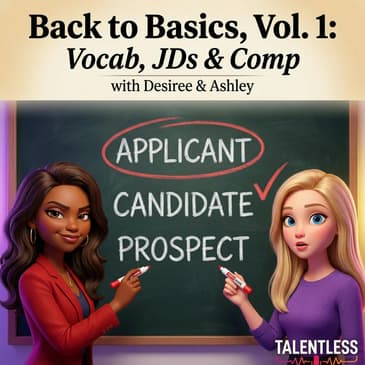
In this episode, Desiree and Ashley ditch the guest chair and go one-on-one for a back-to-basics refresher — the terminology, habits, and blind spots that trip up even experienced recruiters. After a suitably unhinged icebreaker (where would you not want to die?), they dig into three fundamentals: the real difference between a prospect, an applicant, a candidate, and a new hire — and why mixing these up costs you money with vendors and credibility with hiring managers; how to actually vet a job description before it touches a sourcing tool, including how to spot an unedited AI-generated JD and the "Frankenstein role" problem (rockstar, ninja, unicorn); and a full walkthrough of how to build a comp business case with real, named data sources instead of a gut feeling. Ashley closes with a Talent Outside the Box segment on research showing how gendered language in job descriptions changes who applies. They ran out of time before hitting two more topics on the list — when to challenge a hiring manager, and what to do the moment a req lands on your desk — so consider this Part 1.
In This Episode:
0:00 – Cold open: the "where would you haunt after you died" icebreaker
3:14 – Why they're doing a two-host, no-guest basics episode
4:02 – Prospect vs. applicant vs. candidate vs. new hire, defined for real
18:26 – The case for training recruiters instead of blaming them
22:07 – Did a hiring manager let AI write this JD?
23:40 – The "Frankenstein role" and why rockstar/ninja/unicorn JDs backfire
33:01 – Vague JDs create legal and operational liability, not just bad candidates
38:07 – Comp 101: BLS, Salary.com, LinkedIn, O*NET, and internal ATS data
44:14 – How to actually negotiate comp with a hiring manager who won't budge
48:56 – Talent Outside the Box: gendered language and who applies
52:26 – Where to find them + fall event schedule
Resources & Links Mentioned:
BLS Occupational Employment and Wage Statistics (Bureau of Labor Statistics)
O*NET
Salary.com · LinkedIn (salary insights) · Glassdoor · Radford
Kat Kidman (Kat Kibben) — job description writing expert
Dr. Amanda Diekman — research on gendered language in job descriptions
HR Data Labs — Desiree's consulting engagement
Erin Risco — recommended follow for BLS/comp content
Steve Levy — referenced for his "6/9/12 month" hiring manager question
RecFest USA 2026 and HR Tech Conference — where to catch them this fall
Note: This episode intentionally left two topics on the table , challenging a hiring manager, and the "got a req, now what" routine for a Part 2.
Powered by the WRKdefined Podcast Network.
[00:00:06] Well, we're back and we are into year two of this show. And I have to say thanks for hanging out for anybody that pushed us to get this done and all the support. But today we thought we'd do something a little wonky, which a year and two days in, we decided to go back to the basics and really start from like what we don't, we think we know what we don't know really sometimes in recruiting.
[00:00:34] And I think that's exciting times. I love to talk to basics. How about you, Ash? I mean, yeah, but I was supposed to ask you a random question. What was a random question? I'm sorry. Yeah. Here was the question of the day. It's a little morbid actually now that I'm thinking about it. What is a place that if you died there, you would just be pissed? Like you would haunt it. Like you would just, you would be so upset. For me, it is any toilet. Like if I died on a toilet, please understand.
[00:01:01] Oh my God. It's a cool place. I was going to tell you New Jersey. No offense to any gray in New Jersey. So you're going to haunt the crap out of New Jersey. That's good to know. That ain't good to know. I will be at all the toilets. You're a Philly girl. I'm a Philly girl, but I, no, I'm, the toilet would be horrible. Oh, I think so too. Could you fathom? I don't think the worst way to die is by fire. So I would, I would actually pick drowning. So people. Oh yeah. Drowning would be bad.
[00:01:31] Oh. Those are all like bad ones. I want to know the one that would just like make you so upsetty spaghetti. Like I just lived this whole life and died. Like what? Like what? A wagon? I don't really want to die. I want to just go to sleep and like make it happen. A morbid question. You know, I don't know. I was actually thinking about it on the way and I don't know why I was driving and I was like, man, I bet that would suck to die like that.
[00:01:58] And then I was thinking, I was like, what would be like, not even the worst or the most painful, but just one where you're just like, what the heck? Like after everything I did, like, you know, became president of the United States and then I slipped on a river rock. Like it's just, you know, it's just so anticlimactic. It is. All right. Let's get back to this episode. So anyway, back to what we're talking about is back to the basics.
[00:02:24] And I think we've had on so many guests who talk about their frameworks, their ideas. And we thought this would be a good spin on like, what are the basics that we should be talking about right now? And we think like four or five things to kind of put on the table. But we're going to start with Ashley with the prospect versus applicant. Yeah, with our language. Yeah.
[00:02:49] Yeah. So I truly feel like language is actually really important, especially whenever you know what it means. So there are a lot of people that use the term applicant, candidate, prospect, all these different things to describe these people.
[00:03:05] And they use them so interchangeably to where there are times where perhaps if you are an individual who uses these terms interchangeably, doesn't know that there is a difference, that there is a threshold that brings it from one term to another.
[00:03:19] Whenever you go into rooms and you go into meetings with people who might specifically be HR tech or might specifically be tools or a vendor, they will speak to you using this terminology in the assumption that you understand it because it's industry standard. And so sometimes I have been in rooms where they have actually brought me in to help solve problems.
[00:03:41] And the only problem was, is that people were using all of the wrong terms and thinking that they were talking about three different separate things. When in reality, they just needed to refresh their vocabulary in a way of determining the actual definition of these terms so they can comprehend and fully have a conversation where everyone knows what we're talking about right now. Can you give me an example of where this was a problem? Oh, heck yeah. Yeah. Yeah.
[00:04:09] So there are a lot of people who you can have a prospect, right? And so whenever we were working on trying to purchase CRMs and we're talking about you can have this many prospects versus this many applicants. Well, the reason that that matters is because prospect is just the market of the pool that these people could be in. These are, you know, this initial touch potential person, right? Versus an applicant is an actual click.
[00:04:39] That's an actual button push. That is someone who is actually applying into our system and has now met us at that apply path door. And that's a very different thing. Now we have someone that has had an official touch. They've come to our brand. They've shown interest in it, put effort justification in to apply and are now in our systems. Even whenever you're just talking to vendors, you want to be able to differentiate those two because one produces results.
[00:05:08] One is just the possibility of a pool of maybe. So if you're saying how many prospects can we get, how many applicants, and y'all are interchanging these terms, you may be confusing them saying we could give you a 1,000 person prospect pool. Or they could say we could get you 1,000 applicants. Now that you've heard the difference, those are two very different things you're selling me.
[00:05:31] You're selling me 1,000 people who are interested and actually applied and went through the process or 1,000 people who just know our name might be interested and will generate what you could consider maybe like an impression, right? And so just even the difference in these terminologies are important. Another thing, whenever you're talking to managers, if you're sourcing candidates that have not applied, those are prospects.
[00:05:54] Those are prospective people that we're trying to generate interest with in hopes that they will become an applicant. Everyone should know first you have gen pop, your general population of human beings. Then you have what is considered your prospects. Those are your people that would be like those impression reaches. Those are the ones that we're thinking about this in internet terms. These are the ones that are in the pools that whenever you're looking for people sourcing or trying to create a brand,
[00:06:21] they're going to be in those community spaces that you find. Those are your prospects. These are people who have not actually made any effort of touch or have been touched before enough to make it to the apply path. Let me ask you a question. Yeah. Because in my head, you know, and tell me I'm wrong, prospects, you know, for me would be a little more tight. Is it that broad, a little more tight that they would fit the ICP? They're not applicants yet, right?
[00:06:51] They would fit the ideal fit for the role, but they've never been touched or they're just part of the general community. Is that still applying to a prospect? I would say so. So I think it's anyone in this bad pool market that could be a potential for the business, right? Like their perspective, which means that there's some form of potential. So for instance, if we are a software tech company, CDL drivers will never be my prospect. Why?
[00:07:19] Because there is no potential there. So there's like gen pop, like CDL drivers, the whole world. And that's how you can look at your brand reach. Are we actually getting out to CD? Does a CDL driver know what Salesforce is? I mean, that's how you know that they have a great brand footprint, right? Because never would Salesforce need to hire a CDL driver. But I guarantee you there are CDL drivers that know what Salesforce is. You never know what Salesforce is. You never know. You never know. They've done well with our marketing.
[00:07:45] So yeah, so you kind of have this gen pop, but then your prospects are those that there is potential there that they could one day be an applicant. Whether that's based off skill set, location, whatever it may be, there's just some form of potential. Right. Awesome. And so they move from applicant, then they become a candidate? Well, so technically they would go from prospect. We hit that apply path window. Boom. Now they're an applicant. So everybody that's made at this point that has gone through that apply path door is an applicant.
[00:08:15] So now what happens is they're in your ATS. They're holding. And you will then review them and then disposition. And so this is where it's important is whenever you disposition to a rejection, they are a rejected applicant. Whenever you disposition to someone that at least at this surface perception on paper matches qualifications, they are now qualified. Thus, they are a candidate.
[00:08:41] So whenever you even think of the term candidate, like that means that it is someone so past potential of just maybe might apply. Now this is actually someone that could sit in seat. So this isn't just someone that has heard our name. This isn't just someone that has potential. But this is someone who's heard our name, has potential, has interest. And now we've said on paper for this first round ocular pat down, they do in fact meet the minimum qualifications. They can have candidacy into this.
[00:09:11] I think it's really, really important that we talk about this terminology too because so many people don't know the difference between qualifying in and qualifying out candidates. And that is when this happens is at this stage. We consider the qualifying rounds to be the recruiter resume review, the recruiter phone screen, and the hiring manager interview.
[00:09:36] The reason for that is the recruiters give it the look ocularly again on paper, making sure that it meets those minimum qualifications. From then, they will then do that auditory interview to get some more exploratory information around that to support it, to corroborate it, to make sure it is in fact aligned with what we need. And then from there, it goes to the hiring manager who then again is qualifying from a much more technical standpoint.
[00:10:04] Because for the most part, recruiters are going to be qualifying based off of are they going to be a soft skills fit? Do they meet the minimum qualifications? Can we corroborate that the experience they're showing us on paper is actually legitimate? And can I validate their actual intrinsic interest for this role and maybe get a little bit of more information about their motivations as well? Those are going to be things that really the recruiter set in on. The hiring manager themselves, they are going to be the ones that are going to be qualifying based off of that technical side. So do they meet all those technical needs?
[00:10:34] Once those two steps have happened, so your resume review, your resume screen with the recruiter, and then your initial interview with the hiring manager, from there, that hiring manager decides who they would like to proceed with. That is where from this point it switches from we are qualifying candidates to now we are disqualifying people. You go from we've qualified everyone on paper. Now they've met with a manager. The manager says, yep, they have the skills.
[00:11:02] Every next step after that is strictly elimination. We don't plan to add at that point. That's whenever you check for your healthy, robust pipeline. And then what we will do is we will then from there on just be picking the best person for the job. So in your search, it starts in your pipeline with who can do this job, who is qualified, and then it flips to, all right, who will be the best for this team? Who will be the best for this specific vacancy? Because that can change role to role even with the same title.
[00:11:31] Who will be the best for this specific team? So that is kind of how it works once they move to a candidate as far as how we qualify, disqualify, and who are exactly those players that do that. And I think it's super important for us to get this nitty gritty since this is a basics episode. Because I think whenever we explain, hey, we are gatekeepers, people don't really understand. We can cut you off at any point. And we are one of the most pivotal cuts. Right.
[00:11:59] And so I think it's important that to qualify you, that is the recruiter. If the recruiter leaves themselves as an essential, you know, strategic partner, right? A lot of recruiters do try to eliminate themselves and be like, oh, do you like this? Okay, screen them. So if that's the case, I'm talking about true talent practitioners. This is the ideal scenario. We're not talking about order-sacrest people. We're not. We're not. So if you are hearing this and you're like, that's not how mine went, well, ask yourself a lot of questions about yourself. That's all I can say. Yeah. Go look in the mirror.
[00:12:28] Just RQ real quick. Oh, and by the way, is your name Claude? Because I just can tell you the clue. I think what's important is once it goes from candidate, you have qualified and then disqualified. So those are your disposition candidates post-hiring manager, whether it be at peer, at executive, whatever interview happens next. Those are now disqualified candidates, quote unquote, rejected. And then you move from obviously candidate to offered and then offered to new hire.
[00:12:56] Hire, offer accepted, which, you know, whatever jargon. There's a lot of different jargons in that one. But I will say from the most part, you're moving to an offer stage, which is another opportunity of dropout. That's essentially what all these stages are for. They are titling in you what part of the pipeline people will be dropping out at. That's something significant to know. If you drop out at prospect, you never applied. If you drop out at application, you applied. You never had an interview. If you drop out at candidate, you've been interviewed, but you're not going to get a hire.
[00:13:24] If you drop out at new hire, you got the offer, but you decided not to proceed. If you start as a new hire, then now you got the offer. You did proceed, and now you're officially a new hire. So, again, these terminologies do matter because when people are in a room that just throw things around, you can think we are talking about these same things. You will sign a vendor contract and find out you just paid for 1,000 little rinky-dink prospects.
[00:13:52] Not a single applicant in that bunch. And now you owe us money because we did this labor for you for free. You're welcome. I don't think this applies when we're talking to agencies and executive recruiters like myself. You know, just because we say we can supply you with 400 prospects does not mean we're supplying you with 400 true applicants, right? Or people that are going to fit the job.
[00:14:18] And I have argued with people about this over and over, right? They're not the same one, right? Well, not only that, can we talk about – I can't stand the sell of the numbers anyway. I don't care that you get me 1,000. Going for 1,000 pieces of junk doesn't actually help me find a gem, right? It's the problem we're having now as recruiters, right? It's great that we post a job and there's 2,000 if any of them are qualified.
[00:14:48] Right now we're seeing this like 85% to 90% of the applicants not even being qualified for the job. Well, that's not really helpful that you got 2,000 applicants, right? And in fact, it makes us duplicate efforts because at least before I had time to go out and source and do and find what's qualified. Now I'm having to go through these applicants because we have so many. And if I don't, people are going to be like, well, silly Billy, you have 2,000 applicants. Why don't you look through those? So now we're duplicating efforts.
[00:15:17] We're taking double the time. It's just super apparent to me that a lot of the people who started this, we can get you. Because again, so many people use sales metrics that they were like, top of funnel, top of funnel, tofu, tofu. And everybody's freaking out. We got to get top of funnel. Well, this is what happens whenever you only quantify your top of funnel and don't actually look at the quality of everything else through it.
[00:15:39] Because then all you're doing is, again, chasing numbers and hoping that these pass-through rates will carry through consistently every single time, even though we're dealing with people, not machines. And that, you know, you can rooney roll your way out of this. And you just, it's a waste of time. It's something that if you can do it smarter, not harder, and actually learn to do better. This episode of the Talentless Podcast is brought to you by Do Better Consulting. Hiring is broken. Job searches are broken.
[00:16:06] And honestly, most career advice out there is just recycled nonsense. Do Better Consulting exists for people who are done guessing. They work with mid-to-senior leaders, founders, and talent teens to get clear on their signal, how they show up in the market, how they hire, and how decisions actually get made. No fluff, no templates just to say you have them. Just strategy, structure, and honest feedback that actually works.
[00:16:34] If you're tired of spinning, it might be time to do better. Head to dobetterconsulting.net. But if you can actually learn how to do this in an efficient and effective way that produces better results, which you can, you should. But it comes down to your recruiters being educated on how to do it. That's the difference. Just so everyone knows, whenever they're paying a vendor, they're paying just a recruiter who they think is smarter than you. Just FYI. In case anyone needs to know.
[00:17:01] By the way, let's go back to that for two seconds before we jump into the JD thing. For me, this show, particularly this episode, is about education. And the fact that we are not educating our recruiters when we bring them in or not developing and then turning around to an agency or something else and saying, you're not smart enough to fill my role is horrifying, right?
[00:17:29] Now, if it's a bandwidth thing, I get it, right? Like, yeah, right. But if you're saying you have not shown me a million applicants for my role as a hiring manager and we're saying we need to go to agency, let's take a step back and say, why isn't that person filling that role? Or is it the intake? Is it the JD? Is it the recruiter needs to be trained? I mean, there could be so many other reasons than the recruiter is bad. And I, you know, I'm big. For sure.
[00:17:59] Yeah, you know. And so I just, I just want to state that. Education, your people. Educate your people. Train your people. Even recruiters. I think whenever I think of vendor usage, because for the most part, I think about the process, right? So there's a manager who either, there's a vendor in his ear whispering sweet nothings to them. Oh, yeah. I'm getting them tickets to the game and getting them all this stuff where that is happening.
[00:18:23] But for the most part, nine times out of ten, vendor usage usually comes from operation slash hiring manager request, which to me means they think there's some form of incongruency. Whether it's that they're not congruent to the sweet nothings whispering something into their ear. And it doesn't even have to be real. I've had managers who have had me as their recruiter. This was years ago. But have wanted to use a vendor.
[00:18:47] And so I had to learn how to come hot off the press to meeting with these managers to catch the cues of, oh, this is a vendor manager. And start being that sweet nothing whisperer of, let me help you show you because here's what happens. And I've learned this. A lot of those managers that go to vendors for hiring, then even if it's not a legitimate case, there is just, again, something that they feel is incongruent that isn't going to bring it.
[00:19:16] And the number one thing that has helped me solve this, even with my own recruiters that I've been managing and the hiring managers come to me, say, we need this, is it sounds weird, but dropping little tidbits of micro learnings to the manager. And I'm not talking sending them a URL. Well, I'm talking about you know this stuff in your head. And you are telling them, well, based on the market, X, Y, Z. Well, this and that. The moment you show up to the table with more than your plate, they will see an incongruency of the vendor and no longer with you.
[00:19:46] Once they see that you're able to whisper those sweet nothings and focus on them and bring them that intel. And it sounds weird. But for me, nine times out of ten, educating the manager on something. It don't even matter. It could be the market. It could be the title. It could be something about the competitors, how they do it. Well, I think we're about to get into two of them, right? Which is the JD. Yes, bring us. Right? Yeah. Like, those two are real points where you could be educating in an instant and very quickly. So quickly.
[00:20:15] I mean. And it should happen in the first conversation. Like, you should be laying the foreground for all of this. But his first question in their mind to be right now to the hiring manager, and maybe don't say this out loud depending on your relationship with the hiring manager. Did you write this job description with AI? Do you want me to answer it for you? Yeah. I know they did. I'm saying that should be the first question to me anymore. Because then it's not role specific.
[00:20:43] I've seen some JDs out here lately, and I'm going to tell you. First of all, they look all the same. Yeah. I mean, because they are. Second of all, I can literally see Claude poking its head out. See him himself. Yeah. Himself. He was typing it. Writing the job description. It's very sad. This is an important part of, to me, how you represent your brand, your organization, how you represent yourself as someplace people want to come work for.
[00:21:11] Work and be with and be part of. And also helps them decide whether this is going to advance their career, hurt their career, all of these things. But with these generic job descriptions out here, I can't say enough. And for people who don't know, if you really need help in this area, please work with Kat Kidman. She's amazing. She's written books about this stuff. And I'm nowhere near as proficient in my understanding.
[00:21:37] But I will tell you, a lot of this starts with asking the right questions in the intake to get to the right job description. And, you know, I was just having this conversation about the Frankenstein role, what I call the Frankenstein role, which is like those words that we use like rock star, ninja, unicorn.
[00:22:00] Those for me are such high level, like we don't really know what we need or we need this person to do 52 things. So don't say that word. Say you need them to do 52 things. And what are those 52 things? The rock star ninja thing just means you're going to work a lot and get paid very well. And then I also think the vagueness in the scope of job descriptions for me is the scope creep.
[00:22:30] It's great for me, right? I need a self-starter who can take on multiple tasks and adapt to an ever-changing environment. What does that mean? Let me tell you what it means. It's a whole bunch of fluff and stuff. That's all that is, honey. So what is the role going to do on a day-to-day? What are they contributing to the team? What skills do they need? Soft skills and those technical skills to do the job.
[00:22:55] I mean, these should all be in the writing of a job description. I know it seems so... I think people skip this part because it's like, you know, especially right now in this job market, people are going to apply. But it's so fundamental to your organization to really understand what you're looking for. Or else you get into the process of recruiting for the role and you're spinning wheels, right?
[00:23:22] Because you've never truly defined what the role is, how it contributes to the team, how it contributes to the organization, how we move forward. I think Steve Levy was on and talked to, said a great question about, he asks every hiring manager about what they're going to do in 6, 9, 12. How are they, you know, moving the business forward? I agree with that. And I think that should be in the job description from the gate. I shouldn't even have to ask that at intake.
[00:23:49] But most of the time, that question isn't resolved by the job description at any level. And it's very frustrating. It's just like this blanket statement. And I really want people to go to school on this. But it's like, it should be its own training course. Because it's really... I mean, welcome to town, Ed. Yes, I'm sorry. Recruiter University, y'all. Talented.
[00:24:16] I mean, it's just, these are really, really bad. And one of the questions I always ask when the hiring manager gives me this, like, laundry list of things this person does. I'm like, okay, but you only have this amount of money. So what gives in from this or the budget? Like, what are you willing to give up? What can I trade off on?
[00:24:39] And if we, if to get all these 52 and you need every single one, are we willing to increase the budget? We're going to get into comp in a minute. But all of those things incorporated, you can't just list a bunch of duties if you're not willing to pay for it and understand what the market is. Again, we're going to get into comp, but this is still the JD. This is JD, comp, go together. So I think, and I'm going to take this all the way back to baby basics with this JD.
[00:25:08] Because I think people have genuinely forgotten what it is for. And it is not because people think, to be honest, people mostly think this is a compliance checkmark. We have to have something on a piece of paper to say that we, whatever. And that's what this is. I think you're giving them credit. So I might be, actually. But I think a lot of people, so you even saying they used AI, I actually think is advanced.
[00:25:34] For the most part, most people just go look up another job description. Like, look up the job. They'll swipe that JD. And you know what's dumb? They leave the stupid other company's name on the JD still. Again, group read the JDs. I mean, AI could do that for y'all. Y'all just need to take it that next step, okay? But no, here's the deal. Here's what I think is important. Because I've known a lot of managers who have said, so it's kind of interesting. Out of an effort of true care, I've had managers that have been like,
[00:26:03] we don't want to inadvertently disqualify people who could be qualified. So for, on our JD, we want to be a little bit more vague. We want to kind of be a little bit more open so we can have a little bit more whatever. I completely understand what they were saying. I understand why they wanted it. It's the same reason people don't put the term rock star, ninja, whatever in there. Because it creates a bias that will either make people apply that aren't really a fit,
[00:26:30] that are maybe overzealous, maybe over-egotistical because they're a rock star. Or it will make people not apply. The deal is the JD is a standard. It is for accountability. And it is for accountability for the business. And it is for accountability for the candidate. Because here's what's happening. If you create a JD that's real soft on the skills, we just need three years of general working experience. And this is for a software engineer, by the way.
[00:26:57] They just didn't want to, again, they didn't want to deter anyone. They wanted to be very open. And again, this is a manager who is making strides to try to incorporate diversity onto their team, incorporate different communities as best they can. So I understand the effort. I understand where we're headed. And I understand the goal. But here's what's important. Whenever we go to hire people and whenever we go to disposition and reject,
[00:27:23] the job description is our standard that gives us that yes-no process. And what I mean by that is if we have a general JD that just says three years of work experience, but I actually can be really, really stringent in this job pool because so many people have applied. And I know we really need a software engineer. So I'm really going for people with, you know, five to six years of software engineering core experience, regardless of what we put on the JD, right?
[00:27:52] You can have applicants who can come back to you and say, hey, I qualified on every single thing that you have on this job description. And they would. And they would say, why aren't you giving me a call back? And for one, two, three, maybe 10 people, not that bad. But whenever you have a massive company and you are hiring people all the time and you have people inquiring, why for three-year general skill set roles am I not even getting a callback,
[00:28:21] an email, a personality test, a BuzzFeed quiz, like nothing, honey? Like I'm not getting anything. And so what you're doing is you're dissolving that standard that recruiters can use to give an efficacy point to say, hey, you didn't meet this threshold. You didn't match this. And the other thing that I had to educate our manager on that had this was you want that threshold. You want that standard.
[00:28:46] Because this job description is what it will come back whenever you have performance issues with whoever you hire. This is the job description that you'll come back to. And you want it to be sturdy. You want it. Because you also need to think whenever you're advertising something, whenever you have a job ad or a JD, that is the, how do we say this? That's the anchor point, right? That is where we're saying this is what we need.
[00:29:11] And then pretty much people one to two standard deviations away from that anchor point of skill will apply, right? So if I'm a recruiter, we may have sourcers and coordinators, again, two standard deviations out that will apply. If you have just a general three-year whatever, your two standard deviations is going to be huge. It's going to be too much to actually be able to decipher and have good logic as to how you're dispositioning these people.
[00:29:40] So again, I think people have forgotten the job description is really there to hold us to a standard, to be accountable. And so as much as people have diminished and dissolved it to generalize it so we can soften the blow and get more applicants, it's actually doing you dirty. And it actually sets you up for way more liability issues and way more at-bats to lack of compliance because now you don't have consistent logic for why you're dispositioning.
[00:30:09] Because I guarantee you one of those hiring managers is going to have a cousin who needs a job and it only has three years and cousin can get the job. But whenever everybody else, now we need six, seven years. So that's why I'm saying you as a recruiter want stringent JDs. You want very descriptive, very detailed, very this tech, that tech. And I know people may say, no, God, that's going to... Guess what? We wouldn't have hired them anyway.
[00:30:37] Unless you're just trying to create your own CRM through your ATS process, you weren't going to hire them anyway. Stop wasting their time. Stop making them apply. And stop trying to seem like you're doing charity work. You're not a 501c3. You're a bidness. And you're a Fortune 200 and you hire 60,000 people a year. Put on your big girl pants. Write out the real words that you need.
[00:31:00] And let's attract the people that we're meant to be attracting and get our good standard deviations versus just casting the widest net on this bloody planet. I know. It's the worst. And you get these applicants and you wonder why you're getting the applicants you're getting. No, they're trying. I mean, no offense, but it's because of the standard deviation. Again, well, look from now on, recruiters, look at your JD and then go look at your applicant pool. I guarantee you it'll be it'll be like two positions away, the max.
[00:31:28] So the looser it is, you're going to have CDL driver, a surgeon, a hair pathologist. Like, I don't know. This, I believe that it's like you said, it is the beginning of the relationship of that job and that person and that candidate getting into the seat and all of the things. And it is the hiring manager's brain on a piece of paper if he didn't just copy on a piece, you know, copy and paste it. And if he copied and pasted it, we got a bigger problem.
[00:31:55] But it usually, to me, it's the start of every problem in recruiting. Yes. The job description. Because if you can't articulate it on paper, honey, how are you going to guide me? Right. Right. Exactly. And then how do you come up with questions? I don't know. There's so much to a job description to me that starts this process in such a bad way. And it just gets worse over time. It never gets better because it started with a crap JD. It does.
[00:32:23] And it's just, I've seen it so many times. And again, we talk about on this show, and I just want to reiterate this too. The ability you have as a strategic partner is the ability to push back and ask really deep questions. If you're not asking those, you are an order taker. Right. You are just taking that JD and going off into the world of sourcing and trying to find that person,
[00:32:49] which when it's generic, you probably can find them very quickly, and come back with candidates. And you're going to be in this loop all the time. Do yourself a favor. Become strategic about your job. Stop. Go back to the basics. It's the name of the show. Go back to the basics of everything that you do and figure out how to do it strategically. And that means sometimes pushing back, asking more questions that you want to.
[00:33:16] I mean, my one friend who was a reporter was like, I don't want to spend that much time with this guy. And I'm like, I get it. But he's still- You can have one meeting with tough questions or six meetings to figure this out. Right. Where you're going to be 90 days with this guy trying to fill the role when you could have had it of 30. Word. You know what I mean? Like, you need to be doing these things very strategically and asking the right questions. Okay. I want to move on to- Well, hold on. I do just want to say one last thing, and we're going to move completely.
[00:33:44] But I do want to say, us talking about JD from the basics, this is like sentence one of a 50-page book of just job description. Because I'm telling you right now, in job description, it comes down to your intake, your launch call, all your talent infrastructure on the back end, how they request a rec. Like, this conversation is 100% not finished. So I do want people to not think that just because we're talking about teeny little bits of language and of JD that we're trying to say we're explaining it all. Honey, no.
[00:34:12] I think that this is an episode about the fundamentals in a very short framework. For all that we're talking about, please take what we're talking about and expand your knowledge, right, on this. We will probably have episodes that come up about all these topics again. Right. And say, this is the things we are sometimes not thinking about in the basics of what we do. And let's get at it. Right.
[00:34:38] And like, let's start getting real work done, becoming strategic, doing all the things. So, yeah, I want to make sure that people don't think we're talking about everything. I know. But I don't know why I was thinking that. But as I was, I think it's because we're moving so fast. I was like, dang. Okay. Don't let the people think this is all. We have brains, I promise. All right.
[00:34:57] But I do think we're going to get into comp, which is for so many is, I think, one of those things they probably don't think about that much unless they're using like their LinkedIn market insights, right? Like they're using the tool and looking at it. I will tell you, and to be honest, I joined HR Data Labs as a consultant to their team. And I know more about comp than I actually want to. I know. I know enough to be dangerous.
[00:35:27] But I would love to know as much as you do. So, like, you guide us through this. I mean, listen, first of all, I think people need to understand where a lot of this data and this market data comes from, right? You know, Radford is a big name out there. But we start with the fundamentals and we start with the BLS, Occupational Employment Wage Statistics, which gives you like an overall view of a role and its comp, right?
[00:35:54] And so starting there is probably, if you've never been to that site, go check it out. It's the Bureau of Labor Statistics, correct? Yes. Yes. Correct. It is very, very cool. If you follow Erin Riska, she talks about this stuff all the time. There's so much data in there. And, like, if you really, you could spend, I mean, weeks just trying to, like, figure out a role and where it's, all the things. But it's actually a good source of data.
[00:36:23] When I really jumped into it, it was really, really interesting. But then you can move on from there. You know, your company can buy salary.com or all these other cool tools that do comp market analysis if you don't have a compensation person. And you can actually subscribe to those as well. I mean, some of them are relatively cheap.
[00:36:44] To have a subscription to be able to look at true data of what the market is right now for a role and understanding how to apply that to your industry, to your company size, all of those things, and actually get real data out of it. And it's very, it's been an interesting journey because there's also a ton of factors in compensation benchmarking, right? What are all these things telling you?
[00:37:11] And then figuring out whether you're paying above market price, not market price. Like, what is happening in there? Figuring out the differentials between what you're paying and then coming up with what actually works for your organization. And I think one of the greatest things I've ever learned from being a consultant with the team is that all of this comes down to what the compensation philosophy is of the organization. What do they pay?
[00:37:40] What percentile do they want to pay in? Like, you know, startups sometimes pay way higher. They're like paying at that, you know, real high level, the 75th percentile. Percentile are like, you know, bucks. And then when after year three, they're like, you know what I mean? We need to back down to the 50th percentile because we're way, you know, we're paying our people a lot. And I think we've determined these calm factors without a lot of data. I can't say anything else.
[00:38:09] Don't trust one sort. At least trust two. Go to four, right? Because all of them are a little different. All of them aren't going to meet your industry. All of them are going to do the things they need to do for you and your particular use case. The other piece of this is that this is an essential part of a recruiting game. I want people to understand that most of the time we're given us some salary range for finance and we're like, hey, great.
[00:38:37] It's $100,000 to $180,000. I'm going to go roll with that. But we need to be asking better questions. How was it determined? Why was it scoped this way? Did we use any insights or market data to get this information? How did we get to this number? And what qualifies in this numbers at three years or five years or 10 years? How are we doing that comp rationale? Because when it comes down to when you start recruiting for this world, you can't find anybody willing to accept the salary.
[00:39:06] You're just coming with nothing. Right? And saying, I can't find anybody who's willing to take $100,000. Right? Instead, again, going back to being a strategic partner, coming with, here's what BLS has, Bureau of Labor and Statistics has. Here's what salary.com said. Here's what whoever said. And coming to the table with those three data points and saying, we are paying way below or we're paying right on course and we still can't find somebody.
[00:39:36] Or whatever the situation is, you're coming with actual insights and actually teaching that manager, like Ashley said, in those micro moments of how you figured out that we're paying below or right on target. Yeah. And comp is a huge thing. We're never going to be able to get to all of it. But these are some of the basic things you're able to use as tools to have more complete conversations about comp with a hiring manager. Yeah.
[00:40:05] And just to kind of reiterate on what Des said, because I was writing it out here, because I think it's important just for the sake of our candidates that we know how to negotiate and how to maybe challenge what HR and our hiring managers are. Have brought to us. And so typically what I do is, one, I always get internal market data. What do I mean by that? I mean, people who actually applied to our job, had interest and would be flexible. They're going to be the most flexible, right? Because they're not just a prospect.
[00:40:35] They're not just gen pop. They are an applicant. And so what we want to do is we want to make sure that we're providing any intel that we've gotten from that pool directly to them because those are the most movable, right? Those are going to be the most flexible candidates that we would have in our pocket. And if they're not willing to flex, then that is beneficial to know.
[00:40:56] So, for instance, if I've interviewed, screened 10 candidates and let's say six of them say I need 150 and it's 120, I would let – even though I still have four that would take 120, I'm still going to push for the 150, at least the information. So what I would do is I would send, hey, six out of 10 right now are looking for 150. At the current rate that you have, these are the four skill sets that said that they could do the job for what the work is worth.
[00:41:22] It looks like, based off of the pay, this is the skill set you'd be looking for. It might be a little below. Tell me what you think. So that's one piece of it, right? The other piece of it is more than just that internal pipeline market data, you're going to have to do exactly what Des said. You're going to need to either do BLS, so Bureau of Labor Statistics. The Department of Labor has some things as far as market context. You're also having O-Net. O-Net is an excellent resource that is very neutral that can provide these things.
[00:41:51] And then one other thing that I do as well and it's something that Des mentioned, I do Glassdoor, Salary.com, LinkedIn. I do all the little basic players and I make a little table. And I just send it five – the five of them and say, look, this is the data points because here's the deal. There are reasons that they would be unable to flex, but if they were able to flex, if money exists somewhere in some pocket under some cushion, I have yet to have managers that after I've made the case and provided all of the numbers and given all the research,
[00:42:21] as long as internal equity can be balanced – that's why working with HR is very important – because nine times out of ten, the reason you can't get that salary increase is because someone in seat already makes way less than that. And they don't want to start somebody off making more. So what will HR let you do? Well, you get a little sign-on bonus. You might do a little quarterly bonus for the – you do different things that don't impact their base salary. So if you get audited or if you do an internal audit, you are consistent.
[00:42:49] You are ethical, quote-unquote, and equitable as well. So that's what I would say is bring and tee up all that information, all the sites that Des said, all the intel that you're looking for, and serve it on a platter. Make it hard for them to say no. If they have coins in the cushion, make them want to use it on this. That's what I would say. I think that you made a broad, a good point, too, and I think this is just in general in recruiting, that we don't use our ATSs in an effective way.
[00:43:19] You know, internal data sometimes is your best proof point, right? Always. Like, if you think about posting a role or a job description or whatever, you should be looking at what happened three times before. Mm-hmm. Right? If you can. If you can. I'm sorry. If it existed, right? Yeah. Or even if you start a new TS or you're a new startup, I get it. This stuff doesn't exist. But if you have an ATS and it's been running for a while,
[00:43:48] you should be able to pull data from your own ATS as well. And a lot of recruiters I've met, I'm like, do you know how to pull reports out of Greenhouse or Lever or Astrid, whatever you have? Can't even tell me how they would do that. And so sometimes understanding your own ATS and pulling data from there, sometimes it's a better proof point than going out into the mass world and saying, you know, here's what everybody else is paying. No, we paid more last year for this role. What happened?
[00:44:17] And those kind of questions can happen just from your own internal data. Yeah. I think that's an important, important, important note to make just because comp is one of those things that for me in the past has been one of the hardest conversations I've had with hiring managers. But I've always succeeded because I always come with way too much data. It's me too. Because you know what I'm thinking? I'm thinking about that person's family. I'm thinking about their kids.
[00:44:44] I'm thinking about their dog that needs treats and all these cupcakes. And I'm just thinking, hey, if all it takes is me doing just this little bit more, it's worth it. Absolutely worth it. And I think it's also brings us back to being strategic about this and gatekeepers and all of these other things that we talk about all the time in the show. This show went crazy fast. Okay. And I am going to let you do talent outside the box and then wrap it up.
[00:45:12] But we're going to have another one of these because I think this is important. We left off some conversation that I still think needs to be had and to bring us back to the basics. So we don't have a guest next time. We'll see you guys. But I'm not mad at that. All right. Outside the box, I'm going to be honest with y'all. If you're in recruitment and you have not heard about this research, just know that I'm giving you like a pat on the head. Like just, I don't love. Like you little baby? I need y'all to read a book.
[00:45:40] Like just, I just, like, like a baby, but like a baby that's like, come on, baby. You can do it. And it is this. It's research that I actually did in graduate school. I got to study under Dr. Amanda Johnston, who was actually one of the research assistants on this study. Because it is Dr. Amanda. I can't think of her last name right now that does the actual research, but you can look this up and you will find it very quickly.
[00:46:07] But essentially what the researchers did was they took job descriptions that were female dominated jobs. So they looked at nurses, teachers, account, or not account executive, sorry, executive assistants. That's what it was. And they took those job descriptions and took out terminology that was more feminine. So things that were perhaps very we-centric. So like we do this, we do that. They found that males like to be more of the carrier. So they would say you do this and you do that.
[00:46:36] And they took away the team orientation. And then they went back to the JD and they said, ah, well, look at these terminologies. Some of these terminologies might be a deterrent to some people, again, based off gender. So things like rock star, ninja, I don't know, cutthroat, wonderful, whatever. Some of these are really intimidating type of terminologies. And so what they found is that it actually can deter different genders based off of the terms.
[00:47:02] It can also deter them based off of the way that you use your terminology. So if the way you write your job description is a very we, we do this, we do that, very collaborative, you'll actually get more female applicants than if you make it sound very isolated, very much like they're the determining factor, very much like they decide decisions, not very collaborative. You may actually get more male applicants.
[00:47:27] If you use terminology that is egotistical, things like rock star, ninja, you might get more male applicants versus female. But also you can take actual jobs that are, like I said, more female dominant in field or male dominant in field. Do these small changes and actually see inflections and juxtapositions on your applicant pool. So I wouldn't say it's something to test unless like you really want to.
[00:47:55] But it is something that's interesting. Amanda Diekman, that's her last name. Dr. Diekman. Sorry, guys. I'm sorry. It's been years since I've been in school. I've had two babies, lost 10% of my brain is what it is. We're dealing with the 90. But here's the point, okay, is pay attention to what you're doing. Stop using AI for your JDs. Stop using other companies for your JDs and start really doing task analysis. Case I got like, what is this person actually doing? What value are they bringing? What are the duties that they do every day? How often do they do them? How important are they?
[00:48:24] Like those type of things that come with an analysis to create the JD, that talent infrastructure is what is needed. And it's what we're missing to where if we skip step and only talk about the JD, then yeah, we're missing it by a long shot by just copy and pasting. So pay attention, folks. Thank you all for joining us today. You know where to find us. If you don't, just put Talentless Podcast in pretty much everything. In anywhere. I'm trying to take over the world with it. So please go ahead and do that.
[00:48:54] And for those of you going to RecFest, we are speaking this year. We'd love to see you. And HR Tech will be there as well. So that's our fall schedule. So please, please come find us at either one of those if you're going. I'm going to keep talking about it until we finish out the fall. So RecFest and HR Tech will be there. See you soon, everybody. Bye. Bye. Bye. Bye.
Sponsors
