
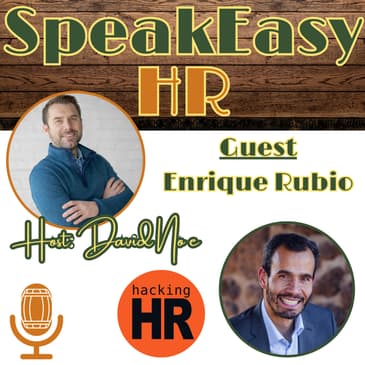
Artificial intelligence is no longer a future trend—it's transforming the way HR leads today. In this episode of SpeakEasy HR, we're joined by Enrique Rubio, founder of Hacking HR, globally recognized AI thought leader, and author, to explore how human resources professionals can confidently lead in the age of artificial intelligence.
As AI continues to reshape the workplace, HR leaders are uniquely positioned to guide organizations through one of the most significant workplace transformations in decades. Enrique shares his perspective on why AI should be viewed as a powerful tool to enhance human potential rather than replace it. He discusses how organizations can thoughtfully adopt AI to improve efficiency, elevate the employee experience, and enable HR professionals to spend more time on the strategic, people-focused work that truly drives organizational success.
Throughout the conversation, we dive into practical AI applications that HR teams can begin implementing today—from recruiting and talent acquisition to employee development, performance management, and workforce planning. Enrique also addresses many of the common misconceptions and fears surrounding AI, offering a balanced perspective on both the opportunities and the challenges organizations should consider as they integrate these technologies into their people strategies.
The discussion also explores the evolving role of HR in an AI-driven workplace. What new skills will HR professionals need? How can leaders foster a culture of continuous learning and innovation? And what responsibilities come with ensuring AI is used ethically, transparently, and in ways that strengthen trust across the organization? Enrique provides thoughtful insights on how HR can lead these conversations while keeping people, culture, and purpose at the center of every decision.
Whether your organization is just beginning to explore AI or you're already implementing advanced technologies, this episode offers practical advice, forward-thinking perspectives, and actionable strategies to help you navigate the future of work with confidence. You'll walk away with a better understanding of how AI can empower HR leaders, enhance organizational effectiveness, and create more meaningful experiences for employees—all while reinforcing the human connection that remains at the heart of great leadership.
If you're looking to stay ahead of emerging workplace trends and better understand how AI is redefining the future of HR, this is an episode you won't want to miss.
For more information about Enrique's two books, visit https://enriquerubio.ai/
Powered by the WRKdefined Podcast Network.
[00:01:02] Hey, what's going on everybody? David Noe with SpeakEasy HR presented by Payroll Partners. We are back for a brand new episode, episode 82. It's August, August 3rd to be exact. And we're just rolling along here this summer with some fantastic guests. And I've been looking forward to this episode with this guest for quite some time. We've had it booked for a while and I am thrilled to have on to SpeakEasy HR today, Enrique Rubio. Welcome. How are
[00:01:30] you today, my friend? David Noe. Thank you, David. Happy Monday. Thank you so much for inviting me to be part of this conversation with you. So I am really excited to see where we go from here. Thank you. David Noe. Yeah, absolutely. When we first connected and I've known obviously about hacking HR for a while, I've been in HR for a few years and I've been following it. And now to have a chance to have you on and be a part of an
[00:01:58] episode is very exciting. So we are live on LinkedIn and YouTube. If you are watching live, have a comment, have a question, put it in the chat. We also are going to be putting out a drawing for people watching. So you have 24 hours to go in the comments section and put the word human in the comments section and you will be in a drawing for one of Enrique's
[00:02:23] books that we will get into as well. And so we have a lot to unravel. And so I think where I wanted to start with this conversation, Enrique, is just to get people up to speed on what you've been up to in your background and what you've kind of created with hacking HR that started what, 2017? Is that right? Correct. Yeah. Yeah. Yeah. It's we are next month, which it's still
[00:02:48] unbelievable to me that next month is September to begin with. And it is still even more unbelievable to me that next month we're turning nine years old. Yeah. It's a, got the air horn for that. I know, man. Well, you know, we got, we got to celebrate, you know, it's been, it's been a journey of a lot of work and a lot of passion and sacrifices, you know, to, to put this together.
[00:03:15] And, you know, it's been for me, it's been the, the honor of my life to, to serve the HR community in the way we do in hacking HR. But I know we'll, we'll talk more about hacking HR in a, in a later today, but, you know, just quickly, you know, my name is Enrique Rubio. I am originally from Venezuela. I've been in the U S you know, for the past 16 years of my life, uh, living in what I consider to be the most beautiful city that I have ever been in my life, which is Flagstaff,
[00:03:42] Arizona, a beautiful town up in the mountains of Arizona. And, um, from here remotely from my home office, you know, I manage this entire, uh, hacking HR operation, uh, you know, and, and I've been doing so for the past six years since living here in, in, in Flagstaff and my background, I come from the world of technology. I am an electronic engineer by academic training.
[00:04:07] I spent about 10 years of my life working as a, as an electronic engineer in, um, in telecommunications. And then I, I decided that I wanted to do something else. And I did my master's degree in public administration with a focus on HR. And this was back in 2011. And ever since I've been in the world of HR, as a consultant, uh, the, uh, as a corporate HR, as a community builder, facilitator
[00:04:35] and whatnot. Uh, so that's what I've been doing for, you know, six, 50 years now. And with Hacking HR, we are a global learning platform and community bringing people together from all over the world to upgrade and elevate HR, lift it up to live up and rise up to the challenges of the day. I will say
[00:05:00] one more thing and then I'm going to turn it over back to you. Um, I do believe, you know, and I have an unwavering belief in the power of HR to be the trailblazer, leading people, organizations, and leaders forward into the future of work. Now, having the belief that we can do that doesn't mean that we have the skills to do it. So we first have to begin by believing, and then we say, all right, I can do that. Let me learn how to do it. And I do believe that HR is sitting at a fantastic
[00:05:30] intersection, which is understanding for the most part, how businesses operate and understanding for the most part, how people operate. And if you add now AI on top of that, if we learn how to, how AI operates, then we are sitting at our intersection that not too many people are sitting at. So that gives us a vantage point that is unique and is phenomenal and it's powerful. And I do believe
[00:05:55] if we start closing the loops and closing the gaps, we are going to be able to lead HR in, to lead the world and to lead workplaces and organizations and people forward into the future. That's what I believe in. And I have spent the last nine years of my life building, making people have the same belief as I do in HR and number two, building the capabilities for them to be able to do so. So that's a little bit about me and a little bit about hacking HR. Ooh.
[00:06:25] Love that. I love that. Yeah. Hats off to you and all the accomplishments you've done with nine years of hacking HR and just excited for what's to come. And, and so the, the, the recent books that you have written on AI, and that's what we're going to be kind of uncovering a little bit and how it intersects with HR. So these both came out, what in June, these two books, correct? Okay. Yes.
[00:06:51] Yeah, absolutely. So you've got a couple of books out there. So again, this, this is a way for people who may not be able to watch this whole episode live. It'll be on demand, obviously after the recording, but you have 24 hours to put in the comment section human, and you can go into a drawing for a copy of the book. So I'm shifting back to this screen here. So Enrique, so you've,
[00:07:17] you've been around a lot of people in HR and you've, you've kind of seen how the industry has evolved in your career. What's been the biggest piece of advice you've ever received? You know, um, I always think about that because there are so many people who have, uh, said things to me. Um, but there's one that I will never forget from a boss who I didn't like that much, by the way.
[00:07:44] Um, but of the, of the, you always learn something from everybody, right? Even the people that you don't necessarily like working with, or that, that you don't see eye to eye, you know, but this, this boss said to me, because I tend to move really fast. The same way I speak is the way I move in life. You know, my, my wife is always complaining and not complaining. I'm telling me like, you know, just take your time and breathe. You know, I want you to live more years. I want you to live longer, you know, but you're always going so fast with everything. So this boss told me
[00:08:12] once, you know, not everybody can go at your speed, you know, so you're going to have to understand that. That doesn't mean that you have to slow down. It just means, it just means that you have to understand the speed at which people move. And you know, that stuck in my mind, uh, because I have been trying for a long time to build a different kind of HR. And the, the, the time that HR has not been this is so much longer than the time we're, we've
[00:08:38] been trying to build a different kind of HR that to remove that inertia requires us to first slow down and stop the snowball that has been snowballing down a cliff to them moving in a different direction. So it is not enough for me to say, you got to believe that you can be the trailblazer leading people, organizations, and leaders forward into the future of work. It means that I first need to stop HR from thinking and believing that
[00:09:03] all they do is back office stuff, transactional stuff, administration stuff. And that's the way traditional HR was created. And it's been around like that for 100 years. So I got to stop that snowball effect. I got to stop that inertia. And once I stop it, then we've got to move it in a different direction. So I have to be okay with the fact that the snowball has its own reality. You
[00:09:28] know, it, it has its own physics to it. And I can't just my wishful thinking of, Oh, I wish everybody in HR would think this way. That doesn't change the snowball effect. It doesn't change the inertia of that snowball. So I have to just be patient, you know, that things are happening, that we're building things, but they take time. So I always go back to that, uh, to that reference from this boss that I had, by the way, I know that this is a flash round and I am taking like a half an
[00:09:55] hour to respond to each of the fast questions. Oh no, we haven't even started that yet. You are good to go. You are good to go. So yeah, I, I always, I'm always curious what people respond with on the biggest piece of advice. Cause I, I've started asking that over the last six months and it's just fascinating to hear what people say and who inspired them. What is your biggest piece of advice? What is the one that you have received?
[00:10:20] It's what this podcast is. It's be authentic, you know, to, to be authentic, will really show people your, um, true self and you'll, you'll gain people's trust. You'll show empathy and it just helps with that human connection. So yeah, I love that. That's it. Um, all right. So now we're going to shift gears. You, you knew about, uh, you, you knew about this right before we started.
[00:10:47] So we're going to shift gears to the world famous envelope ice break. All right. You get to pick one through 15, one number, and we'll see what you got in here. I'm going to go to seven, seven. Okay. Number seven for Enrique is what's a TV show or movie you quote way too often?
[00:11:20] Friends or Seinfeld. Yeah. Yeah. Oh my gosh. I mean, I have watched those, those shows like a million times. Um, those two, I'm going to say those two classics, you know, and I have a very, I work in a chart, which is a contradiction with my personal life sometimes because I have a very dark, sarcastic sense of humor. And you know, so it's like, it's like, uh, I need to quote those shows, you know? So yeah. Those are the ones that I quote the most, especially because I like
[00:11:48] to be funny too. So, uh, yeah. Have you watched Curb Your Enthusiasm? I have obviously. Yeah. Oh my gosh. Larry David is phenomenal. So good. So good. All right. Well, we are live on LinkedIn and YouTube. We are here for you to learn from Enrique. I've got questions for him, but if you have a question, throw it in the chat. Would love to hear from, from you if it's a question on HR and what we're
[00:12:14] going to dive into here. So just a couple of words from our sponsor payroll partners, and then we're going to get into this topic. So hang tight for one minute. Finding a new employee takes time and money for one position on a single job board. You could easily spend a minimum of five to $10 a day advertising a job post. It's worth noting that the average time it takes to hire a new employee is 36 days. However, it can take longer than that. You could find yourself paying hundreds of dollars a
[00:12:41] month for a single job board. And if you're using multiple job boards for multiple positions, this could add up to thousands of dollars a month. There is a much simpler and more affordable way of finding the right candidate at payroll partners. We offer an applicant tracking system to help manage your hiring process. Our ATS is customizable, allowing you to decide which days you want to run the job and when to close it so you don't break the bank. And this feature lets you e-blast your network,
[00:13:09] hosting jobs on multiple boards at once, all managed in one location. Payroll partners, elevating your payroll and HR experience. There's some great technology in the world of HR and payroll. I've seen it, I've lived it, I've breathed it and everything in the last 20 years. And so for us at payroll partners, it's about the right connection, the right partnership,
[00:13:34] the right system. And if you aren't getting that out of your current provider, look us up, see how we can help you check me out on LinkedIn and would love to hear about your situation and see if we can help you. So, all right. Well, we are going to get into this topic and to start out, just to warm up, we're going to do this rapid fire question segment. This is the quick five to 10 second answer segment. So Enrique, one word to describe the future of HR.
[00:14:06] Interesting. One AI tool every HR leader should explore. Courser or anything infrastructure, plot code, cursor, codex. Okay. Biggest AI misconception in HR today? That it will resolve the problems that we haven't resolved yet. Human skills that will matter most in an AI world.
[00:14:33] The intersection between technology and humanity, that intersection, not just human, not just technology, the intersection. All right. Last one. Will AI make HR more human or less human? I don't know yet. Nope. We don't know. We don't know. We don't know. Yes. So that, you know, you know, the answer to the question actually is,
[00:15:00] I don't know. That depends on us. Actually, let me just, let me just wrap it up that way. I don't know. It depends on us. It depends on us. Absolutely. Yep. So if you are watching live, have a question, comment, put it in the chat. Again, the contest for this episode is to get a copy of Enrique's book. All you got to do, get in the contest, put the word human in the section, the chat section,
[00:15:28] within 24 hours of this recording live, which is today, August 3rd. It's 2 p.m. Eastern. So you have 24 hours to put in that and you will be in the drawing. All right. So Enrique, we've connected a few times before today and it's been exciting to hear and learn more about you. So Hacking HR was founded in 2017, almost nine years ago, and you've worked at the intersection of HR, technology and innovation since.
[00:15:57] So what inspired you to focus on this space? Yeah, I got into HR. I mentioned this before in around 2011, as I was completing my master's degree in public administration with a focus on HR. I was coming from the world of technology. So it took me a little bit of time to learn the ins and outs of HR. But after a while learning the ins and outs of HR, I realized like, holy smokes, these people move slow. That's what I was thinking back then. I was like, I just can't believe that
[00:16:25] we're doing things in this way. And I kept reflecting about what would have happened if I was doing things like that in electronic engineering. And to me, the metaphor in my mind always was, if I am doing what HR is doing, but in electronic engineering, I would be working with a typewriter and not a
[00:16:49] computer. That's how, and it is true, by the way, even chronologically is true. Even today, we are still using performance management systems that we're creating in the 1970s. We're creating recruitment strategies that we're creating in the 1950s. We're using science. You know, we're calling some people the father of modern HR with theories that we're creating in the 1990s. If I was doing that
[00:17:13] as an electronic engineer, I would have been using a typewriter and not a computer. So when I came to that realization, I said to myself, well, Enrique, you know what? You got to do something about this, you know, because you know about technology. You are now in HR. So you are in the weeds of what HR operates. So what can I do about this? And I decided, you know what? Because I am a little bit
[00:17:36] of a self-directed entrepreneur, an entrepreneur. I said to myself, well, maybe let me put together one conversation by, at that moment, 2017, I was living in Washington, D.C. And I wanted to put together a conversation between technologies and HR with the goal of closing the gaps between the speed of which HR was moving and the speed of which technology was moving. This is all pre-generative
[00:18:01] AI, by the way, you know, 2017, five years before Chagipity became available. So I put together this conversation. It was phenomenal. You know, we got a bunch of people, great speakers, but the content of the conversations was not just technology and HR. It was much more than that. So then I repeated that event in New York, in Boston, Chicago, in Tampa, and I realized, wow, you know what? I think people
[00:18:27] have the need to have these conversations. And well, you know, that was the origin of Hacking HR, you know, beginning with that idea of we need to move a little faster. We need to move in a different direction. Can I do something about it? The answer is yes. What can I do? Hacking HR, some events, I can do it. Nothing is preventing me from doing it. I made it happen. And here we are, nine years later, we've had our own evolution as well, by the way. You know, we started in 17,
[00:18:55] then we had COVID happening, you know, three years of, you know, pretty much a shutdown around the world. So we had to reinvent ourselves as a, more as a virtual community. Then we launched our learning programs, but that was, that's the origin story. And that was the, the sort of the, the incentive behind it. You know, I don't want HR to be, to be left behind and it will, if it continues to operate in the way it is operating today. So it was just that observation
[00:19:23] that became my incentive. And here we are nine years later. Yeah. So you've, you've grown it into this global learning community, you know, where HR professionals and vendors and consultants and business leaders kind of get together and collaborate, you know, so what, what have you learned from bringing so many different voices together at that global level, you know, and what advice would you give HR professionals who want to stay ahead and continue
[00:19:51] evolving? Cause I've heard a lot of people are getting out of HR, like 30% of people, you know, so what, what advice would you give them to stay ahead and continue evolving with, with so many new HR platforms and AI platforms out there? Well, you know, I mean, I think the advice would be probably applicable across the board because what's, what's happening in the world right now, all this space of change, it's not just true only for HR. I mean, I just happen to work in HR, but if I was hacking finance, you know, I would
[00:20:19] probably be saying the same thing, you know first of all, it's hard to keep up with everything. You know, I, I, I, we're living in a time when things are changing extremely fast, budgets are getting caught, resources have more constraints. As I mentioned before, the speed of change is massive and we're being asked to do a lot more with less. So this is incredibly overwhelming,
[00:20:46] right? But even in the middle of all of that, I would still say we have to find, you know, that 5% of our time, you know, the couple of hours a week that we can have available to learn things that impact our profession, whether it is finance, HR, whatever it is, that may not be within the normal things that we look at every day. And I want to share with you actually a data point about this, which is very interesting. There was a research by the OpenAI Institute. I don't know
[00:21:13] what they call it. I forgot the name right now. The Economic Research Institute or something by OpenAI, the creator of ChatGPT. It came out, if not last week, the week before, and they found, they analyzed something like a million chats and they found that on average, 43% of all the interactions that somebody in one department has with AI, those 43% of those interactions are about something else that are not within their own department. So what that means
[00:21:41] is that HR people were asking questions about IT, finance, whatever. It also means that IT people were asking questions about HR, et cetera. So I found that incredibly interesting. And I saw this morning, literally this morning on LinkedIn, somebody complaining and criticizing that saying like, well, you know, now we are, you know, in the Donning-Kroger effect where now we want to be experts in things that we're not experts at. But I'm seeing it from a different perspective. What I'm
[00:22:07] seeing is this has given us the opportunity to be able to do our work better by understanding better the people that we're working with. So instead of having people in a company speaking the language of HR, it is much better for us to be able to understand what their language is and translate our things to their language. And if that 43% of the chats have some of that content, if people are asking something along the line, I'm not saying that this is what they're asking,
[00:22:34] but imagine for one second that what they're asking is, I have an engagement strategy that I want to present to the CFO, but I want to make sure that I present it in the way that a CFO understands. That to me is so much more powerful than us in HR being great at creating engagement strategies. You know what I'm saying? So that's the advice that I would give anybody in any profession.
[00:22:58] Take that 5% of your time and learn things that would not be traditional within your current sphere of work. Because those things, when you connect the dots with them, you will be creating the kind of value that somebody only inside or outside your sphere of influence will not be able to create. That's why I said before, HR is sitting at a phenomenal intersection. People operations,
[00:23:25] AI strategy, business operations. But we need to connect the dots. And to connect the dots, we need much more than just understanding people operations. We need to understand, again, AI strategy and business strategy, and then connect the dots. So if anybody works in marketing, if anybody works in IT, whatever you work, the advice is the same. If you work in IT, learn about HR. If you work in sales, learn about marketing or IT. If you work in marketing, learn about engineering.
[00:23:55] You know, I'm not asking you to become an expert in those fields. I'm asking you to have the basic understanding of what it is that they do. Because then you're going to find an intersection, a connecting point that only you can see because only you are understanding these two areas of work. So that, David, is my advice for HR and across the board as well. I hope every HR professional listens to that because that was phenomenal. I've been saying this for nine years, by the way. This is not new right now. You go back to,
[00:24:24] you know, podcast interviews, events, recordings of things that I have said in the past, and I have said the same thing every time somebody has asked me or had asked me, what do you think HR people need to remain relevant in the future? I always said the same thing. You have to learn things that are outside of HR. And I wasn't just referring to technology, by the way. I was referring to, you know, P&L. I mean, how many people understand P&L today? And how many people are capable of understanding what they do in HR with the P&L of their
[00:24:53] organizations? I bet that it's, you know, 1% of the people, maybe 2%, right? So if we don't understand the basics of how our work impacts the long-term sustainability, strategy, profitability, or impact of a company, how can we claim that we're doing something meaningful in the organization, right? So even going from the very basic to more, you know, meaningful things, you need to learn things that are outside of your sphere of influence.
[00:25:23] Yeah. So let's shift gears a little bit about really something that I think HR plays a significant role in, and it's more of the human connection within an organization. So how can HR leaders embrace AI while still protecting that human connection that makes the employee experience positive and makes it possible?
[00:25:46] A good question. And maybe I will begin by saying that, I mean, you know, one thing that I have learned to do may not be the best way to do it. You know, it's create a sense of urgency and reality of what is happening right now in the workplace, right? So I'm going to use another example, and then I'm going to come back to your question. So when people ask me questions like, you know,
[00:26:13] do you think that just by being more human, we're going to be able to preserve our jobs in the age of AI? The answer to that is no, that's not enough. You know? So if you hear from others, which I continue to see on LinkedIn, a bunch of people saying like, you know, learn how to be a better, more empathetic and more curious and, you know, have better critical thinking, and then you can beat AI. You won't. You can't beat AI. You know, this idea of another human using AI, you know, will beat the
[00:26:39] person who doesn't use AI. That is not true. And we've seen that this year in the massive layoffs that we've seen in the technology sector where they are letting people go who were using AI already and they were still let go. So the reason why I'm using this example is to say, you know, we have to have a sense of urgency that whether we want it or not, the advancement of AI is inevitable, but the consequences are not. The consequences are more, depend much more on the way we influence
[00:27:08] and steer the progress of AI. AI will continue advancing. What we do with it now depends on us. So let me bring back, bring that back to your question. You know, what does HR do with AI? So let's just begin, you know, by saying that, you know, using very mundane example, just bring your team together and map out everything that you do. And you're going to do it in two different ways.
[00:27:33] Take a process, whatever you do, put it on paper and list all the activities that you love doing about that process and all the activities that you hate doing about that process because maybe they are repetitive, they have no meaning to them because they are transactional or administrative, you know, but you still have to do them, right? So you, you, you, you, you map them out. Then think, how can I, this is very simple, by the way, how can I use AI to take over the things that I don't want
[00:28:02] to do, but I have to do them today because, well, I don't have any option. How can I use AI to take over these functions so that I can take back that time to do more of what I love? So what that's going to allow you, allow, allow you to do is a little exercise of process transformation, a very basic exercise of process transformation, embedding AI as a capability in your process. You take something that you currently do, you list all the things that you love doing and, you know,
[00:28:29] whether as a human or with AI, and then you list all the things of that process that you hate doing and the things that you hate doing for whatever reason it is, then see how AI can help you do them so that you can do more of the things that you love. One example of this, there are low-hanging fruits, right? There are many functions or many processes in HR that require a lot of automated communication, whether it is recruitment, onboarding, engagement, you know, learning programs, etc.
[00:28:59] So imagine for one second that there's one process that has only two components, and this is not true, by the way, but let's imagine for one moment that there is a process that only has two components. One component is chatting with people to understand them better so that you can serve them better, and the other process is communicating with them via email to send them updates. I'm making it up right now, right? If that is your process and you spend, which probably you do, 75% of the time in the
[00:29:25] communications via email and only 25% of the time in the conversations with them and in the communications via email, you can use AI to automate part of that to give you back, say, another 25%, meaning, say, another couple of hours a week, I take it. If AI can do that better, faster, more efficiently than I do, and I don't have to do that boring part of my work, and that gives me two hours back to do more engaging, meaningful conversations,
[00:29:51] I take it. So begin there. Begin with the simple things, the things that are paying your company, the things that are paying you in HR, the things that are boring, annoying, you know, meaningless, and that way you begin a little bit of a process of process transformation. Obviously, from there, you go into a more developed approach. I will begin there, David. That's what I would tell, you know, HR leaders to do. You can lead the way doing this, by the way, and one thing that is very
[00:30:20] interesting is that you can do this not just for HR. You can help others do this in their own functions as well, in IT, in finance, whatever. That's what I mean by taking a leadership role, right? That's what I mean by becoming the trailblazer. Begin small, grow from there, grow from there, have some quick wins that you can show value very quickly, accurate and reliable value, by the way, and scalable value, and then you go to the next thing, and then you go to the next thing until you are in
[00:30:49] a place where you can now start talking about business transformation and not just a small process transformation. That would be my approach. That would be my recommendation. Absolutely. So there's a lot of fear out there about AI will replace jobs and where and when. So how should HR leaders think about AI as an opportunity rather than a threat?
[00:31:12] Well, AI will replace jobs. You know, I mean, there's no doubt about that. And there can't be any doubt about that because there is not one single technological revolution in the history of humanity. that has not replaced jobs. Every one of them has, right? And by the way, in my book, Our Existential Advantage, I talk about five technological revolutions, beginning with the printing press all the way up to the internet revolution. And I take some parallels between those revolutions
[00:31:39] and the AI revolution. One of the most significant differences between them and this is the speed at which this is happening. You know, the printing revolution took about 150 years to start creating productivity gains and for the what is called the ascribes or scribes to be replaced by printing press, even though many of them were reluctant, you know, and, you know, to let the printing press
[00:32:05] revolution advance. Hey, it just didn't stop, right? The same thing is happening in the world of AI, only that is happening faster. So AI will replace jobs. So the way I think about this, and this is very personal, by the way, and I like to tell this story just because I think it turns my insights into real, into realness. If I continue doing what I am doing today in Hacking HR, my company, we continue doing
[00:32:33] what we're doing today, what we have been doing for the past nine years, and we continue doing that for the next couple of years, I won't have a business in two years from now because the world is changing. The way people learn, the way people consume content and knowledge, the way people put that knowledge and those concepts into practice has changed dramatically just over the past three years
[00:32:57] because of AI. So I know that my company can't stay the same. I don't exactly know yet, I have to confess this, I don't exactly know yet what the new direction will be. We have some hints, some insights about what that new direction will look like, but I know it can't be what it is today. So number one, know that AI will replace jobs. Number two, be aware that you and your company are
[00:33:25] disruptable. It's very rare that anybody would have full control over a market, over a product, or a service, especially when now everybody goes to open a cloud code account and can build whatever they want in a couple of hours, right? So there's got to be some realness in here. The third component of this is there has to be some, I'm going to go back to authenticity, right? There has to be some,
[00:33:50] there have to be some authentic conversations in the workplace where you tell people, you know, will we stay in business as an industry, as a company? The answer is we don't know. Will you have a job in six months from now, in 12 months from now, in 24 months from now? The answer is we don't know, you know? So this is what we want to invest on. We want to invest in making sure that this company remains relevant. And we want to make sure that, that we invest in you to remain
[00:34:15] relevant, whether for this job that you have right now or another job in this company or another job outside of this company. There has to be realness in these conversations. I know this is hard, but I don't know. I prefer these hard conversations than going, than working in Facebook and finding out at 4 a.m. that I was sent an email by my boss saying goodbye, thank you for your job, which is what they did to 8,000 people about a couple of months ago. They told them don't come to work today,
[00:34:44] work remotely. And they received an email at 4 a.m. saying thank you, but AI is replacing you. You know, I mean, you, right now, we can imagine the things that will happen down the road. We may not know exactly how they will impact us as a company or the individuals in the company that we can say, because we don't know there is a likelihood that we will, you know, serve or ride
[00:35:08] this wave and be successful at the end, or that, that we may need to make tough decisions. So let's be real about these conversations. Hopefully it can lead the way in that sense too. Yeah. Yeah. You've, you've answered a few other questions and I, and I think you can expand on a little bit. So more so with just an organization as a whole, you know, to avoid implementing AI just because it's
[00:35:34] the latest trend and what everybody's talking about, you know, and, and instead focus on solving real business and employee challenges, you know, beyond what you've already kind of explained, you know, what, what can HR professionals do to kind of steer that ship for an organization in their, in their role? Have conversations with a lot of people, you know, begin by having conversations with a lot of people, especially with the managers and the leaders in the organization, begin having the conversations
[00:36:02] with them. I myself have so many conversations with people that I, I, I appreciate and I respect very much. And I sometimes think that they are very sophisticated in AI and they are not, you know, so, so by default, I am already making an assumption about their level of proficiency when it comes to AI. And more importantly, I am making an assumption about their level of proficiency when it comes to business transformation for the age of AI. So you gotta, you gotta know where you are,
[00:36:32] right? You know, I mean, things are moving fast, but you may be making assumptions that even your CEO knows what, knows what to do. You know, there have been a, I have been working with a couple of companies where they told me the CEO is mandating this thing, but when we go to reality, it's like completely different from what the CEO is mandating. It's like, that's, that's an unattainable, you know, goal that they are trying to establish in here. So you got to have the conversations with the
[00:36:59] leaders in your company to understand where they are, where they want to go, what they think AI is, what they think the opportunities and limitations of AI are, and how you can create a strategy around that. So have a lot of conversations. You're going to need that very much. Yeah. Yeah. So you've written recent books on AI and the future of work, and that's, you know, something that we're offering to the listeners, um, to potentially get a copy of your, of your book.
[00:37:28] Um, all you gotta do put the word human in the comment section over the next 24 hours, and you'll be in that, in that drawing. So what is one lesson you believe every leader needs to understand about where work is headed? Good question. Um, I, you know, I, it's just very difficult to respond to that question because, you know, I mean, this idea, like you have guys like Elon Musk who has been wrong
[00:37:58] about pretty much everything he has said about everything. Um, you know, in very nefarious ways, by the way, uh, you know, but people look at him and say, well, this guy is living in the future. Well, he's not, you know, he's not living in the future. He doesn't know. I mean, he's building things for the future, but the timelines of the things he's saying are completely wrong. And I'm using this as an example to say that it's very difficult to predict what's going to happen down the road. Uh, especially when you have periods of political instability, like here in the U S where
[00:38:26] things change, you know, pretty much overnight about everything. Right. So it's pretty difficult to define what the next few months or years will look like. But to me, that is the lesson. To me, the lesson is we have to be prepared for everything. You know, you have to be prepared for everything. You have to be prepared for tomorrow, somebody turning off all the AI data centers and there no AI anymore. And I don't think that's going to happen, obviously, but you have to be prepared
[00:38:51] for something like that. You have to be prepared for something that we should be preparing for, because I do think that this is actually going to happen. A lot of companies are building massive amounts of infrastructure on top of AI because the tokens that we are using for AI right now are heavily subsidized because of all of these companies, they don't care going, you know, losing money to, you know, like all companies that, that begin their journey, they lose money until
[00:39:16] they don't lose money anymore. So right now we're building massive, massive, uh, technology infrastructure on tokens that eventually we're going to have to pay more for. And when we start paying more for what's going to happen is that we, we find out that we can't afford that or that we ended up replacing humans, which were better than the cost and the efficiency of AI. So we have to be prepared for that too, or we have to be prepared for the future where AI does everything. And all we
[00:39:43] got to do is just see what AI is building and say, Oh yeah, good job. You know, I don't know if that's going to happen. And I hope not, but we have to be prepared for a future like that. So to me, the name of the game here is adaptability, uh, preparedness, you know, flexibility, because we're going to need a lot of that. Uh, but I'm going to add a second component to this, right? One thing is being adaptable and a different thing is believing that things that we think are unbelievable will actually happen. And I want to give you one example of this, you, you know, BlackBerry, you know, you
[00:40:13] know, you, you, of course, I'm going to imagine that most people here know about BlackBerry, where does anybody have any BlackBerry anymore? Probably not. I don't think anybody has a BlackBerry anywhere in the world, except for a vintage, you know, um, you know, window thing, you know, where you can see it and you say, Oh my gosh, look at what life looked like in the early 2000s, right. Or in the mid 2000s. Why am I bringing up BlackBerry to this conversation? Very interesting.
[00:40:40] When the iPhone came out in 2007, the Microsoft and the creators of BlackBerry are researching motion they, both of these companies, Steve Ballmer had a, has a phenomenal interview saying, I don't think people would want to use phones that don't have a keyboard. I think people love using keyboards. They won't interact with a, with a, uh, with a touchscreen. So I don't think the iPhone will, will become anything. The people from researching motion, many of them, except some,
[00:41:08] some very, you know, a small layer of leaders. They also didn't think that iPhone was going to, was going to do anything to their company. And at that moment, uh, researching motion had almost all of the markets of smartphones in the world. So 2007, the iPhone comes out in 2008 research
[00:41:29] emotion, BlackBerry made more money than in 2007. In 2009, they made more money than 2008 and 2007 in 2010, the same thing happened. So these people are like, see, we were right. We are safe. Nothing is going to happen to us, but then things changed in 2011 and 12, the line starts to come down and down and down. And they, they are nowhere to be found right now. And Apple became again,
[00:41:57] recently the most valuable company in the world. So what is the story here? These people didn't believe that something like an iPhone could disrupt their business. So even if they were flexible, which they were, even if they were innovative, which they were, even if they were adaptable, which they were, if you don't believe that something like that can happen to you and disrupt your business, adaptability, flexibility, innovation don't matter at all. Yeah. Another great example
[00:42:25] of this is Kodak, you know, Kodak, what is Kodak today? You know, I mean, like Kodak owned something like 90% of the film photography market and something like 85, 85% of the camera, of the film photography camera market. This was back in the 1970s. This was the most innovative company in the world. Everybody loved Kodak. So they invented digital photography in the 1970s.
[00:42:51] And the executives at Kodak said, cute, let's patent that technology. I don't think it's going to do anything to us. Well, they were wrong. So they were the most innovative company in the world, but they didn't believe that the very technology they invented was going to disrupt their own business. So David, all of this to say in very simple terms, you have to be adaptable. You have to be flexible. You have to be innovative, but you have to believe that some things could happen to you,
[00:43:17] even if you feel 100% safe that they want. Yeah. Yeah. It is. It is a fascinating time to be in work and HR. And, you know, I, I, I want you to speak to the young professionals that have entered the workforce primarily in an HR capacity. You know, they've maybe gone to school, gotten certified or a degree in human resources. You know, what, what advice would you give some of those younger
[00:43:46] professionals or, or people that are just entering the profession in human resources? The same thing that I mentioned before, for the most senior, for the most seasoned professionals, you have to learn things that are outside of HR, your value. Yes. HR is awesome and I love it and whatever, but the value of being a great HR professional will not come just by being the
[00:44:11] most knowledgeable HR professional. I know that's kind of a counterintuitive, right? The value of being a great extra professional is when you're able to do great HR with other things, you know, with, with, you know, in, in, in, in, in, in, in, in finance, embedding IT, embedding marketing, embedding sales, using AI, you know, using analytics, the value and the same thing would apply for, again, I say the same thing. This is not just because I'm talking to HR people. If I was talking
[00:44:39] to marketers, salespeople, you know, engineers, I would say the exact same thing. The, the greatest value of your, of you as a, as a, as a, as a professional in any field comes from what you know about that field and how well you can connect with the rest of everything that impacts an organization. And I'm, I'm, I am not trying to imply that you have to be as an HR professional, that you have to be an expert in finance. That's not what I'm trying to say. You have
[00:45:04] to know enough about finance so that you, as an HR professional, you can serve finance, you can connect the dots and create more value. So that to me would be the advice that I would give to younger professionals. You know, it's very easy to get demoralized by the fact that you read all of this research that says, you know, younger workers won't have a job anymore because they, I can replace them. Well, AI can replace what they do in a vertical, but they wouldn't, it wouldn't be able to replace what they do horizontally. So that's why you
[00:45:30] have to invest in being better in your own vertical, but also learning across the board, other fields, because then AI is a little bit more sloppy when it comes making those connections. Right. So that's, that's powerful to me. Yeah. Yeah. So thinking of like an HR generalist that gets involved in the recruiting cycle, the onboarding, the employee experience, the employee relations, all of the different facets
[00:45:56] in HR that a lot of people have to experience on a day to day, you know, schedule and in their job, where, where do you see the most opportunity for someone to use the AI technology that's out there today? Everything that is transactional, everything that is transactional. And I go back to the same example before, take your, take your processes, put them down on a, on a design board, begin with the simplest of
[00:46:23] things, which is map out the great stuff about a process, map out the boring stuff about a process, think about the AI tools available and what you can automate with AI from the, from the boring stuff, So that you can do more of the meaningful stuff. That is a very simple process that you can start pretty much right now. Yeah. So within Hack in HR, tons of programs you offer boot camps, AI, AI Academy. Tell us about,
[00:46:52] you know, what you are offering HR professionals if they have not been able to go out there and, and kind of take a look at it. Yeah. Well, we offer a certificate programs, micro certificate programs, mini master programs, boot camps on a number of topics. And a lot of them are on AI. The ones on AI, I deliver myself and they are for all levels. You know, we have from, you know, the very basic AI essentials to, you know,
[00:47:17] a strategic leadership, which is my most advanced program. And the one that create that I use to create all the content for my book, our existential advantage. So you have everything on the spectrum of all, all AI things. Just go to, um, uh, Hacking HR lab that I owe, and you will see in there, everything that we're doing. That's our website. So you can take a look in there at everything that we're doing. So speaking to the people out there who have not used AI a lot, because every time I go
[00:47:46] to a conference and people are like, all right, show of hands, who's, you know, an expert in AI, they've used it for over a year and so on. And then there's a lot of people that I don't ever use it really yet. Right. So, and I've heard people say, well, I just, I'm going to go to chat GPT and it'll tell me how to terminate an employee or, you know, like what are, what are some of the, you know, risks that people are experiencing or that you have heard about when it comes to
[00:48:14] instead of having an HR professional expert handle some HR functions, where have they gone wrong? Well, it's not just being the expert in something. If you use AI and you blindly trust what AI is telling you, that's already, it doesn't matter if you're an expert on AI or if you're an expert on whatever it is that you do, that alone, it's a mistake, right? Because AI does make mistakes.
[00:48:42] And we humans too, by the way. So it's not that AI is unique in this way. You know, AI makes mistakes the same way we do. So you need what is called a human in the loop. So you can't just rely on AI and click send. You know, that's what, that's what Facebook did, by the way. You know, Facebook used AI to see who they would, they would fire. And, you know, there's, there's a lawsuit against them right now. I don't know if you saw it, you know, some of their employees found out that Facebook used AI to determine which employees should be fired,
[00:49:12] you know, euphemistically laid off. And they, they, they use the AI too. I mean, like, I don't know, this, this is a case that is going to go into litigation. So maybe, you know, this alleged, uh, you know, AI discrimination. So we, we have to wait and see, but ultimately it is the same phenomenon that I am explaining right now, which is if you use AI without the human in the loop and you blindly trust what AI is telling you to do, you're making a mistake,
[00:49:37] you know? So, so you can't just do that in that way, especially if you are less of a proficient AI user, in which case AI will sound even more, even smarter than it actually is. So the less proficient you are as a user of AI, the, the more intelligent AI will sound to you. So you need to increase your level of proficiency because in doing so the kind of questions and the kind of scrutiny that you exert upon the AI
[00:50:05] output would be different than if you don't know anything about AI. You know what I'm saying? So if you go now and you would say, write a book about, you know, I don't know why the sky is blue, you know, and AI is BSing you about the response, but you don't know anything about AI and you don't know anything about why the sky is blue, then you will believe that everything that AI is telling you is the truth and it may not be so. So you need to increase your level of understanding of AI,
[00:50:29] the potential problems and sloppiness of AI so that you can, you know, uh, be a great human in the loop. That's what I'm saying. Yeah. It's, uh, it's fascinating, you know, and, and, uh, I, I feel like what I hear from a lot of people who have studied AI for many years, it's like, you will have to understand it and use it to stay up with the latest. You can't just ignore it. Um,
[00:50:59] you know, there's some situations where you probably can ignore it in, in a, in a certain situation when it comes to a business and how they, how they operate, you know, old school, um, you know, ways, but, but yeah, I, I, I love your, your philosophy around just taking a look at everything you do and the processes and what you love to do and what you hate to do and what takes a lot of time and, and how you can really eliminate a lot of the steps. And, uh, so yeah, that's,
[00:51:27] that's great. Um, there is one exercise that I won't be talking too much about it now, but there's one exercise that I do either with the students of my programs or the clients that is served as a, as a, as an AI, you know, facilitator. And I, I call that exercise, the AI native competitor. And the exercise is let's take your company. So what I do in, in advance before getting into this, uh, exercises, I, I do a lot of research about the company that I
[00:51:54] am serving and I take one of the verticals in which they are the most inefficient. And then I create an invented made up synthetic company that does exactly that way better than they do. And then I present, I present the case to them and I call that the AI native competitor, obviously all of it with AI. Um, so I tell them if you, if there's one vertical within your company that you're very inefficient or very expensive or very slow, whatever you want to call it,
[00:52:22] it's called all of that and inefficiency. And there is a, there is an incumbent in your, uh, in your industry who knows very well what you do inefficiently. And that person or group of people know about AI and they invent something that can disrupt that vertical. That is a, that is what is called a beachhead. That is the first entry point to say, yes, you can go with Acme company, but of the, of all the things that Acme does, I can do this one thing way better than they do.
[00:52:52] Right. And that is the one way that a client would say, okay, let me try you out. And you can start from there. I like to use that exercise because very often even you said before, even for the most, you know, um, like legacy companies, you know, the ones that maybe move a little slower, doing an exercise like this, when I presented to them, they are like, Holy smokes. This, you know, I, I literally, I see their faces and they like, they are like, this looks real.
[00:53:18] And I am like, yeah, I made it all up. But if I, if I know if, if me as somebody who doesn't know about your industry can make that up, imagine somebody who is in your industry, who knows about AI, they can actually make, make up the same thing and create the actual company to disrupt that vertical in your business. So you gotta be aware of this because you are disruptable. That's what I'm saying. You know? So anyway, that exercise is really, uh, you know, like it's
[00:53:45] like a wake up call, so to speak for people who don't believe that AI can disrupt them. Yeah. I bet that is, that is fascinating. Um, all right. So as we wrap up Enrique, one more question for you, um, fast forward five years, it's 2031. What will the best HR organizations be doing differently because of AI and what should HR leaders start doing today to
[00:54:09] prepare? I don't know what the future is going to look like in five years. I think, um, you know, whatever you can do to build the, uh, the infrastructure for change management, for process transformation, for adaptability, for flexibility, for innovation, and for believing that something that may sound unbelievable could actually happen. I think building that infrastructure is the more, is the most long lasting capability that you can build in your company. Because in five
[00:54:38] years from now, I don't know what's going to happen, but I know things are going to change, you know? And I know that in five years after that, I don't know what's going to happen, but I know things will change. So by building the infrastructure that allows you to, to change and to adapt and to believe that you have to, to transform your business for the, you know, for the ways in which we're doing, uh, work that to me, building that infrastructure is powerful. So I would suggest you build the infrastructure, you know, because it's going to be more long
[00:55:04] lasting than the painting on the, on the, on the walls of the infrastructure. Yeah, definitely. Well, this has been very fascinating to learn about you and your background in hacking HR and everything you've been working on. Um, the two books that you do have on AI are on Amazon. But again, if you, if you want to get into the contest, put a word in the chat, which is the word human, and you have 24 hours to do that. If you are listening to this on demand,
[00:55:34] put it in there, you have 24 hours and we'll, we'll pick a winner. So, um, Enrique, this has been really, really great. I really appreciate your time to come on today and, and share your knowledge in this and, and hopefully, you know, you'll come back on in the future and, and share more updates and what you have going on. Um, so don't be a stranger and, um, if there's anything I can do for you, you let me know. Thank you, David. Thank you so much for inviting me and everybody tuning in,
[00:56:00] whether live or the post, uh, live version, the recorded version, reach out to me if you need anything and Enrique Rubio or Hacking HR. We're here to help you. Thank you. Thank you. David. Absolutely. Thanks everybody. Have a great rest of your day. And we'll be back next Monday. Take care. Thank you. Bye. Bye.
Sponsors
