
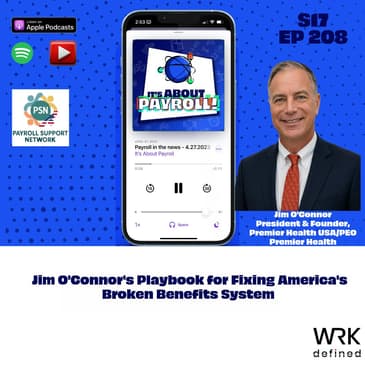
In this explosive episode of It's About Payroll, we sit down with Jim O'Connor, President & Founder of Premier Health USA, to expose the hidden truths behind America's healthcare benefits crisis — and what employers, employees, and payroll professionals can do RIGHT NOW to fight back. 💥 What you'll learn in this episode: ✅ Why America's benefits system gets a D (and what it would take to earn an A) ✅ The "Insurance Hamster Wheel" trapping employers with the Big Four carriers ✅ How level funded & partially self-insured plans can get your money BACK at the end of the year ✅ The #1 mistake employers make when selecting benefits (hint: they never ask their employees) ✅ Why the paycheck is the most powerful benefits communication tool you're not using ✅ How payroll and benefits teams can team up for a home run ✅ What employee benefits will look like by 2030 ✅ Jim's surprising take on what employees STILL want — same as they did 40 years ago 💡 Whether you're a payroll professional, HR leader, small business owner, or benefits consultant — this episode will change how you think about healthcare, compensation strategy, and the future of work. 🔗 Connect with Jim O'Connor & Premier Health USA: 🌐 Website: www.premierhealth-usa.com 📧 Email: joconnor@ph-usa.com 🌐LinkedIn: https://www.linkedin.com/in/joconnorpremierhealthusa/ 📲 Enjoyed this episode? Do us a favor: 👍 LIKE this video 🔔 SUBSCRIBE & hit the bell so you never miss an episode 📤 SHARE with a payroll pro, HR leader, or business owner who needs to hear this https://wrkdefined.com/podcast/its-about-payroll, itsaboutpayroll.io https://youtu.be/RkVPNtuyAbg 💬 Drop your thoughts in the COMMENTS — what grade would YOU give America's benefits system? 🎙️ It's About Payroll — the podcast where payroll professionals, business leaders, and HR innovators come together to make sense of the workforce landscape. Quote of the Day 💬 "Every meaningful breakthrough in life begins with a long season of unnoticed work." — Robin Sharma #employeebenefits #payroll #healthinsurance #hrstrategy #smallbusiness #LevelFundedPlans #healthcarecosts #payrollpodcast #BenefitsStrategy #humanresources #workplacebenefits #JimOConnor #PremierHealthUSA #ItsAboutPayroll #openenrollment #affordablecareact #employeeretention #hrleadership #businessgrowth #healthcarebenefits
Powered by the WRKdefined Podcast Network.
[00:00:01] Welcome back folks, this is another episode of It's About Payroll. Amazing guest with us today. Before we get into the guest, how you doing Walt? Excited, happy Friday to everybody. I'm just excited to talk to our esteemed, highly intelligent guest today. Looking forward to it, Brian, but how about you?
[00:00:24] Doing good. Before we get into it, I always want to share a little tidbit. This week, we want to share a little financial fitness tidbit for payroll folks that stood out to me. And this is a great way that payroll folks can help save money. We're not just a cost center. We can help. We can actually help the businesses save money.
[00:00:46] And one of those ways is on the new hire setup. And a lot of money is saved there because errors in the pay group, the tax location, the deductions, the salary, exemption status, or direct deposit can cause expensive corrections later. And the takeaway is the cheapest payroll ever is the one you prevent during employee setup. Let me say that again. The cheapest payroll error is the one you prevent during employee setup.
[00:01:16] Wolk, you want to introduce Jim for us today? Yes, absolutely. Today we're tackling a topic that impacts every employer, every employee, and frankly, every paycheck in America. Benefits, right? So as healthcare costs continue to rise, employers are struggling to balance affordability with attracting and retaining talent. Employees are demanding more value, more flexibility, and more transparency than ever before.
[00:01:46] Meanwhile, payroll professionals are often caught in the middle, helping administer benefits while answering the tough questions employees have about what they're paying for and what they're actually getting. To help us navigate this rapidly changing landscape, we're joined by a true expert and pioneer in employee benefits and healthcare solutions. Our guest today is Jim O'Connor, president and founder of Premier Health USA.
[00:02:13] Jim has spent decades helping employers and employees understand healthcare, benefit strategy, and alternative health plan solutions. He is also an expert on the Affordable Care Act and has dedicated his career to finding innovative ways to make benefits more affordable and accessible for businesses and employees alike. Welcome to the show, Jim O'Connor.
[00:02:42] Happy to be here. Great to be here, Walt, Brian. You know, great to be with you guys. I've enjoyed your show and your prior episodes and honored to be here. We appreciate that. We were talking about the Knicks before we started recording. You could see that Walt kind of thought he was at the garden introducing you as a player. I was like, oh, I got a little jump there, right? I felt like coming out to do some high fives. That's what I'm saying, yeah. I was like, oh, yeah, yeah, yeah. He gave his garden feels there. I love it. I love it. Jim, before we get it started, any questions?
[00:03:11] How did you get into this business? I was at a company in the shipping industry. Oh, wow. And enjoyed it. But circumstances were such that that company went chapter 11. And so we all got laid off. And I went to a headhunter and was looking at different opportunities. And getting into the group insurance business seemed to be an interesting industry for me.
[00:03:40] I was never one that was going to be oriented towards selling individual insurance products. It's a really important role for that in our country. And insurance products are very important. When I was more of a B2B person as opposed to a B2C person. And so, yeah, so I started as a group insurance rep at Prudential back when Prudential was in health insurance in the 80s.
[00:04:01] And any old timers listening to this podcast will know what I'm talking about, that Peru and Met and Travelers and all those old line insurance companies used to be in health insurance. But then the wave of managed care and HMOs pushed them out. But Brian, that's how I got in. And it was basically going to a headhunter and getting a new job back in 1987. Wow. All right. Awesome. Thank you for sharing your start. So I'm going to jump right into it, Jim.
[00:04:29] If you had to give every American employee benefits, a benefit system. Well, let me restate that. If you had to give a letter grade for America's current benefit system, what grade would you give and why? I'd probably give it a D. Oh gosh, a D. At least I'll probably give it a D. Holy moly. There are some students in the classroom that might deserve a C.
[00:04:57] But overall, I'd say that the class on a curve is running at a D in terms of the health benefits system. And put air quotes around that word system because there's very much not a system. Yeah. But the health benefits business in America today. Wow. So your next question is probably why? Why am I giving it such a low grade? Yes. Tell us why. Yeah. Yeah. So when you think about it, right? What is the function of a health benefit program?
[00:05:27] Well, it's to give people access to affordable health care where they're not going to go bankrupt. They're not going to be exposed to possibly losing their home. They're not making decisions between getting medication for their kids or putting food on the table. Right. They're not avoiding going to the doctor. They're not splitting pills in half or not getting refills. Right. And that is what happens in our country today.
[00:05:54] And so, while you made a comment about benefits for the purposes of helping attract and retain talent, right? And so what has happened is benefit plans today, we haven't solved the hyperinflation problem, right? Health insurance costs have been going up at double digits for my entire 40 year of career, right? And they still aren't, right?
[00:06:18] But back in the day, I was telling people, hey, a single rate is under $100 and a family rate's less than $300 for a comprehensive medical plan, right? But yet, back then, we were saying health insurance average trend is 12%, 14% increase. And it was good news if you got a 7% or 8% increase. Well, you know what? We're telling that same story today. Oh, my gosh.
[00:06:46] But insurance premiums are $800 for a single, $2,500 for a family. Yes. And so, like, the D is because costs have gone uncontrollably through the roof. And then what happens is employers that are making the buying decisions, the way for them to kind of keep their purchase in a budgetable range, they got to raise deductibles, cut benefits, take more out of people's paychecks.
[00:07:15] So it's an unaffordable, unsustainable rising cost. Yep. We're cutting benefits, and we're taking more out of people's paychecks. And so it's a D at best. It's a D at best. Wow. Thanks for sharing that. That makes a lot of sense. What's the biggest misconception employers have about employee benefits right now? What are the employers getting wrong about the benefits?
[00:07:42] I'd say that the biggest thing they're getting wrong is that they think their only options are the traditional health insurance carriers, right? When I started, you know, there was 15, 16, 20 different insurance carriers that were in the health insurance business. So you got a lot of choice. Now there's essentially four. You boil it down. There's United, there's Cigna, there's Aetna, and there's Blue Cross, right?
[00:08:10] And you got Kaiser in California and a few other markets, but fundamentally, you're down to four, right? So any time that you eliminate choice and put dominant market share in so few hands, right, you're going to lose innovation. You're going to lose opportunity to do things better.
[00:08:30] So the biggest mistake that employers are making is to sit on their hands and think that their only options are to stay on this insurance carrier hamster wheel, right? And just shop it like a commodity. Okay, I'm going to go from Blue Cross to Aetna, then I'm going to go from Aetna to Cigna, and then I'm going to repeat the same cycle with the same big four.
[00:08:52] So that's one of the biggest errors that employers are making is to think that they have only these few options when in fact there are other choices. Okay, that's what I was going to ask. So there are more choices than that. There are. There really are. So a couple different areas to come at that from. And we're talking mostly the SMB market, right? Like for large employers, they definitely have a lot more choices and options.
[00:09:21] But as you come down to employers with less than 500, less than 200, less than 100 employees, right, they tend to just always still been thinking about the traditional fully insured insurance carriers, right?
[00:09:34] Well, believe it or not, in the last decades and certainly within the last 10 years, the fastest growing type of health insurance plan in America are employers moving from traditional fully insured plan to what we'll call as hybrid self-insured plans or partially self-insured plans. You'll also hear them called level funded plans.
[00:09:56] And so what these are is they look and feel to an employer like a regular insurance plan and that every month they're going to pay a single rate, a husband and wife rate, a parent-child rate, a family rate. Difference is that they're technically self-insured. And at the end of the year, if claims run better than expected or better than the maximum liability, that employer is going to get that money back at the end of the year.
[00:10:27] The pace of change in the world of business is fast and that drives incredible complexity for the world of human resources. Welcome to the HR Data Labs podcast, a series of conversations with experts inside and outside the world of HR on how to innovate, measure and evolve our practices. Our goal is to help provide you with practical examples of how HR has to change to meet the complexity of the business environment. Every week, we'll talk to new and different voices on all aspects of HR.
[00:10:58] And at times, we'll get irreverent, silly even, and sometimes geek out on the data and technology that underlie the processes that drive the world of HR. But the conversations are always insightful and fun. So please, enjoy the HR Data Labs podcast. Yeah. So think about this, right?
[00:11:19] You're in a traditional insurance carrier plan or you're just paying premium and everybody gets told, hey, use generic drugs instead of brand drugs because it's less expensive. Go to the virgin carers. Don't go to the virgin carers. Yeah, exactly. Expensive. Right? Right? But none of that matters because the insurance carrier keeps all the money and they're just going to jack up your premiums, you know, at their whim.
[00:11:39] When you're in these partially self-insured or level funded plans, you now as the employer have the opportunity to get money back at the end of the year, your money. So now when you're teaching your employees, ladies and gentlemen, instead of going to get that elective MRI at the brick and mortar hospital where they're going to charge $6,000 to the health plan, go to the free standing facility, you know, in town for $800.
[00:12:09] Oh my goodness. Right? Now that matters. Place of service matters. But when you're in a traditionally insured plan with a carrier, you know, you have no skin in the game. Yep. Now when you're in these level funded plans, these partially self-insured plans, and as I'm coaching you as an employer, literally get your employees to understand, to be thoughtful about get generics instead of brand.
[00:12:35] Use telehealth instead of urgent care instead of ER for non-emergency things. Go to the free standing facility for an MRI or an X-ray instead of at the expense of hospital. Now all this matters because if we can get money back at the end of the year, unspent money, who wouldn't like to get money back? If I'm a safe driver and I don't have accidents or tickets, all state advertisers are going to give you money back. Right?
[00:13:02] If you have a workers comp plan where everybody's being safe in the workplace and you have no injuries, right? You can get money back. Well, let's apply that same type of thinking to health insurance. And now instead of employees just ignoring you at open enrollment and throughout the year when they get these emails and these feel-good messages about being thoughtful, now it can matter. Imagine this, Walt. Imagine this.
[00:13:28] Imagine a year from now, you're standing in front of a room of employees and you're saying, ladies and gentlemen, we got money back from our plan last year because we together were all thoughtful about where we got our care and where we were getting services rendered and how we were using the plan. So ladies and gentlemen, guess what? No payroll deduction for the next two months. Awesome. And that's what I was going to say.
[00:13:55] Like, if you can give it back to the employees, right? You incentivize them to do these things, then there's some winning there. That's awesome. So Brian, to bring it back to the question you asked me, right? What's the misconception? What are the mistake employers are making? Is they're not being open? They're keeping their mind closed to just the traditional big four health insurance companies, right?
[00:14:22] And they're not getting themselves open-minded to an alternative way to buy. Everybody's mad, but sometimes they don't turn that mad into positive action. They just stay mad and then it's just wash, rinse, repeat, and they throw their hands up and just give in. Stop giving in. Stop giving in.
[00:14:42] Your broker, your benefit advisor can show you these alternatives, such as what my company does and others in my space that can bring high-quality alternatives to the employer marketplace if they would keep their eyes open. Wow. You dropped a boatload of nuggets there. I have so many questions. Oh, my gosh. Okay. Okay. So I want to switch to the employee's perspective here. Yep. Yep. Right.
[00:15:08] So what are employees asking today that they weren't asking five years ago? Oh, that's a good one. You know, it is a good question, but I think my answer may surprise you. I don't think they're asking anything different today than they were five years ago. Wow. They're saying, hey, I want a health plan I can use that I can afford that's not crushing me out of my paycheck, right?
[00:15:38] Sure, I'd like a 401k. Sure, I'd like quality PTO. You know, sure, I'd like, you know, a good work environment. But as we're just kind of staying in the healthcare lane and some of the things related to the healthcare lane, right? It's the same desire today as it was 40 years ago. I want something my family can use that we can afford, right? That provides me for when I need it.
[00:16:06] And that's why we go back to today we're a D because we haven't solved this. And so it's the same. Right. I'm sure that there are other people that would answer this question with some very sophisticated answer about, you know, Gen X versus Gen Z, which is I don't even know what Gen we're in anymore. Right. But I'm a baby boomer. That's what I know. But you know what else? I will give you one thought, though, while I keep moving away from that core.
[00:16:31] You know what else is interesting is in the payroll space, we're seeing now the paycheck being kind of the center of the wheel of the opportunity for employees to buy additional services, whether it be insurance product or vacations or even regular products that we buy in our day-to-day life. I'll give you an example.
[00:16:54] I do business with an incredible company called Benefits Me, and they have an online store with over 70,000 people. I'm probably not supposed to talk about specific companies or just be a commercial, right? No, you're fine. You're good. You're fine. We're not exclusive to anybody. But this Benefits Me company is amazing in that people can buy, like, refrigerators, washers and dryers, tires, you know, products from Best Buy, Ashley Furniture, and they can do it on a payroll deduction basis, interest-free.
[00:17:25] So think about folks making $50,000, $60,000, $70,000, $80,000 a year. They might be doing this. They need a new refrigerator because it's broken. Their tires are bald, and they can't get to work. So what do they do? They got to go to a payday loan or high-interest credit card or maybe if it's furniture, they do rent to own. So this way they can buy it interest-free and spread out over 26 pays on a payroll deduction basis. Think about you as a payroll company bringing that to your customers, right?
[00:17:52] Think about that in your audience as they're thinking about as a payroll company. What other value can I be adding? What other value can I bring to my customers to help them attract and retain talent? You know, Brian opened up by saying it's almost like my thinking was the Knicks game, right? You don't want to see the referee. You know, like the best referee is the one you never hear about, right? The best payroll is one you never hear about. It's like everything works fine.
[00:18:16] So now what can we do to enhance that relationship with the employer and by extension their employees? So giving them access to purchasing programs like this can be a really valuable addition to a benefits plan. Love it. Wow. Love it. Brian. Yes, sir. So in line with that, are there any benefits that employees consistently undervalue until they actually need them? Great question, right?
[00:18:46] We kind of tell a joke in the health insurance business that people don't really know what health insurance costs until they leave their company and go on Cobra. Oh, yeah. You see the total cost. Yes. And they don't know what their benefit is until they're in the emergency room. That's right. And they need, they need. But so, so I think they appreciate the value of health benefits, but they don't spend enough time understanding kind of how to navigate it properly.
[00:19:08] I will tell you though, also Brian, the other thing that employees don't value well enough is things like when the employer provides some opportunities to buy disability insurance or life insurance. Yep. Right. Or some of these supplemental policies. You know, God bless AFLAC for all of their advertising. As much as people might think they, they can be annoying or a little bit too much.
[00:19:29] They, they are putting a spotlight on the fact that through the workplace, the ability to buy at a low cost, easy payment, payroll deduction basis, some of these other coverages that can be very important in your life. If you pass away and your family's got some final expenses that have to be paid or you get disabled, so you lose your paycheck, a disability policy can be there for you.
[00:19:55] So, so I think these other benefits are things that get undervalued, underappreciated by employees. And so, so the, the, the more thoughtful employers, and again, they're partners like payroll companies that have the face of the employee every twice a week when they're getting the paycheck, promoting, educating, letting people know about the value products that are out there. It can be very, very opportunistic. Yeah. That's the, that's great, Joe.
[00:20:22] So my next question for you is, I guess, from the business standpoint, what are, in your experience, what is, what are some of the biggest mistakes that businesses make when selecting their benefits? Hmm. Great question. So number one is they don't ask their employees what's important to them. Yeah. Yeah. So employers should spend more time, more lead time. Yep.
[00:20:52] You know, engage with their employees out. Just asking them, Hey, you know, what's important to you guys. Right. And you don't make it like a democracy and whatever we vote for, we get right. But what you are saying to your employees, Hey, you're part of this spend. We want to make sure we're spending the money the right way. So let's make sure we're getting your input. But so a mistake would be in a way to correct, it would be, you know, engage the input of your employees with a lot more lead time as you're doing your benefit planning. You're doing your strategizing.
[00:21:19] The other thing that would be a mistake I think that they, that they often do is they think benefits management is one time a year. It's the renewal and it's open enrollment and it's magic managing a negative. They just like, Oh, let me get through this. Let me put it to bed. Right. As opposed to throughout the year, right. Let's be educating, reminding our employees about the health benefit plan, different components of it and how to maximize its use. Right.
[00:21:47] About the 401k and the match that they're getting. Right. About these hidden benefits, like an EAP that they forgot they had. Right. So benefits, communication, education, engagement throughout the year is another mistake that employers make is they, they see purchasing benefits. Not everybody, right. The enlightened ones do this really well, but just as a general observation with businesses, right. They just see it as managing a negative.
[00:22:13] Let me put this thing to bed and not worry about it till next year. Right. And so it's really should be an annual engagement process. And that gets overlooked. Wow. Thank you, Jim. That definitely resonates with me. Yeah. And perfect segue because is. Everybody, Tim Sackett, host of HR Famous, a new podcast on the Work Defined Network. Am I famous? No, I'm HR famous.
[00:22:38] My wife says I'm a micro celebrity and 13 HR ladies around the world want their picture with me, which I think is funny. So, hey, what do we talk about on the pod? We talk about all the dumb stuff we do in HR in any given day, week, month, and we have fun with it and we have some great guests. Come check us out. We're not famous. We're HR famous.
[00:22:59] Is richer benefits still a competitive advantage for recruiting or just being a more strategic employer so you're saving money and you can give people more money? You know what I mean? Do benefits help in that recruiting still because it's so hard and so expensive? You know, it does, right?
[00:23:23] Benefits, health and welfare benefits, retirement benefits, the whole scheme of benefits programming is a big part of attracting and retaining a talent. But I correlate two pieces you just said there, Brian, about just saving money versus richer benefits. And really, depending upon the industry and the culture of the company, we'll impact the definition of rich benefits versus affordable benefits. One way to look at it is, Mr. Employer, right?
[00:23:52] How much is budgetable for you? And now let's spend that the right way. I'll give you an analogy. You go into a restaurant and you have no intention of spending over $50. Where are you going to spend $50 on one expensive steak entree and that's it? Nothing comes with it. Or might you get a fish or a chicken dish and then a green vegetable, a potato starch, maybe dessert, you know, a glass of wine, right?
[00:24:16] So for one person, just getting that steak and that steak alone is what they want for their company. But for the other person, they want the multiple pieces around that meal. So I don't know if this analogy is holding up, but my point is it's not just about how much you're going to spend. It's what you're spending it on.
[00:24:39] And by talking to your employees, understanding the culture of your company, understanding why you're attracting people or losing people and how benefits play a role in that can help guide you on how to spend the amount of money that you're budgeting to spend. And so richer, richer benefits, of course, everybody wants better, right? Everybody wants more. Everybody wants a bigger house, better car, you know, better clothes. But distill that down, distill that down and say, which really makes sense for this company?
[00:25:07] And that's where you can engage with the employer, the employees. And again, I come back to the payroll, right? The payroll is just like this ecosystem that the employees are always going to, right? I'm being communicated with twice a month about what my pay is. So can we use this as a communications channel, the payroll company as the conduit to getting information out to the employees? Because oftentimes the benefits are a lot richer than employees realize.
[00:25:38] So just don't chase the spend. Make sure everybody understands the value and what they already have. Wow. Jim, you're definitely giving me the goosebumps there, man. You're saying a lot. You know, it's funny. We're going to say payroll companies or really going to say like, you know, broader, you know, human capital technology companies, payroll of which is a component to it, right?
[00:26:01] And I think that the forward thinking payroll companies of America, you know, entrepreneurs and innovators and people that are really trying to, you know, move the dial. Processing payroll is just kind of the baseline, brushing your teeth, right? And like, let's get that right. Let's get that right every time. But there's so much more to it.
[00:26:21] If I'm that payroll company that can bring to my client and the employees, this whole environment of communication and access to benefits. Now, I'm quote unquote, so much more than just a payroll company, right? I am this entire like human capital management technology company to that client. Yes, Jim. That's a perfect segue for my next question for you.
[00:26:49] So what benefit trends should payroll leaders, charlotte leaders, business leaders in general be preparing for over the next three to five years? Yeah, I think that a key trend I'm seeing is one. We kind of touched on it earlier where we're the paycheck being that that center of the wheel. Right.
[00:27:13] And that if we can if the paycheck can be the conduit, you know, heck, you know, for like I said, buying tires, buying furniture, you know, maybe paying my mortgage directly on a payroll deduction basis, paying my student loan as it can happen now. Right. So so so so payroll leaders need to see what they have and also the data they have about their population and how to bring product into that population. That makes sense. And then their their technology ecosystem has to be able to administer that.
[00:27:42] The other thing that AI, of course, you can't have a conversation in any any business without talking about AI. Right. So so so so how do I apply AI going forward that that doesn't doesn't replace human support in some places as well? Right. In some places as well, we all have to be honest with with ourselves about about that. But how does AI make the the employee member experience better?
[00:28:12] How does AI help my staff in serving my clients more efficient and more effective? Right. So that's a big part of the forward looking thinking for all industries, but payroll certainly. So talking about payroll people, that age old question, how can payroll and benefit folks work together better? That's a great question. They need to understand they're they're serving the same client for the same purpose.
[00:28:42] We're serving the employer who has employees. And the entire purpose that we both serve is to help them attract and retain the employees that will make them have a successful company. The benefits person or team is coming at it from that perspective. Peer role HR technology is the administrative platform upon which it all runs.
[00:29:09] So if we really get together more in a hand in glove way, right? Quality product, quality plan design, quality fiscal management of the benefit plans combined with high quality administration and employee engagement. Then we've got a home run because when you think about it, when we all look at everything we do, right? I always look at things as we break it down into three things.
[00:29:34] When we serve our employers, are we helping them financially spend the money the right way? Administratively, are we making their lives easier and more efficient? And three, are we enhancing the employees experience? Right. Those are three things we do. Payroll company does it. Benefit companies like mine do it. So if we do it together, who could that be a powerful combination? Yes. That's real. Awesome. Awesome guidance and mentorship there, Jim. Thank you.
[00:30:04] No, you called me a pioneer earlier. That's a polite way of saying I'm an old guy. No, no, no. We were just saying it about ourselves. Just calling you out, brother. Right before you got on, we were just saying we're pioneers in payroll as well. So no, no, no. There's absolutely no slight in there at all. Trendsetter. Maybe that's a better word. Pioneer has an old connotation, but it's not that. I just love to be able to play with you. I just love to be able to play with you. Yeah.
[00:30:34] So Jim, if we were to have this conversation again in 2030, let's say, you know, about, you know, four or five years from now, what do you think will be dramatically different about employee benefits in America? I think that we're moving much more into a individual employee choice environment. So there'll be more customization, personalization at the employee level.
[00:31:02] I think that that is a direction that's definitely taking place. I believe that our conversation earlier about these partially self-insured plans and level funded plans where employers and employees can have a seat at the table and a positive impact on the health costs inside of that company. That's clearly a growing trend that's going to be accelerated in the next four or five years.
[00:31:28] I think technology is clearly going to play a huge impact on the benefits landscape, whether again, we've talked about AI earlier, more and more self-service. So I think five years from now, but I also think, Walt, with a little bit of pessimism that we're still going to be having the same conversation, that we haven't slayed the dragon in terms of rising healthcare costs. And I say this out of respect to those that serve our healthcare needs, the doctors and nurses
[00:31:57] and hospitals, but they also have a role to play, a responsibility in terms of what cost of care is for certain services. Why is an MRI $8,000 at a hospital versus $800 down the street at the freestand facility? Right. So health insurance premiums are a function of the cost of providing healthcare. Right. Right. And so from the provider side, the business side, the health insurance carrier side,
[00:32:25] legislative slide, we need a more cohesive approach to it. So five years from now, Walt, I think that we're going to see a lot of exciting things happening from an innovation perspective that we've talked about here on this call already. But I do think that we're still going to be, a D might've become a C or a C plus. How's that? Hey, we're trending up. We're trending in the right direction. Absolutely. Absolutely.
[00:32:48] So in terms of the future, to close it out, Gem, what gives you hope about benefits in America? Welcome to The Human Rule, your go-to podcast where HR and payroll collide with innovation. I'm your host, Tiana Neal, and every month I'm diving deep with industry experts and change makers, bringing you real talk insights, practical tips, and fresh takes you won't hear anywhere else.
[00:33:15] Whether you're a leader, practitioner, or just curious about the latest HR and payroll trends, I've got you covered. Ready to roll with the best? Tune in for fresh perspectives, actionable tips, and the knowledge you need to roll forward with confidence. Subscribe now and let's transform the way you work. The innovators. And I don't say this just to you guys as shallow praise, but stuff like you guys are doing, right?
[00:33:39] Running this podcast, putting a spotlight on maybe people and things that can improve the world, improve the future. So I see some young and not so young people with brilliant ideas, brilliant ideas making a difference. And my optimism for the future of this business is that those innovators, those disruptors, right? That's how we make improvement. That's how we make advances.
[00:34:08] And I just see a lot of it taking place in the benefits space. And so I'm really encouraged about the future of this business. I wish I was 20 years younger so I could be a part of it, but I do plan on spending the next 20, 25 years being a part of it, but, but to be a young person and part of the future of this business would be a great, it's a great industry to be in. I feel the same way. So I don't think that, I think that's just like the nature of it all. I'm like, wow, I was 20 years younger now.
[00:34:36] And you know, my goodness. Yeah. Jim, this is a great conversation. We, we, we definitely have to have you back on if you're open for that. Yeah, for sure. Always welcome. You know, definitely. I enjoy you guys very much. Likewise. Like I said, I enjoy watching and listening to you guys. And so I appreciate being on. It's been a great honor. Likewise. And I'm just very pleased to have the conversation with y'all. Likewise. So before we conclude, we do like to play a game with our guests. It's called This or That. And so we ask you six different questions.
[00:35:05] You can choose one or the other or neither or both. You know, and so we're going to start it off. I'm going to go with the first three and then Brian's going to finish it off. All right. So would you rather, I guess, watch basketball game or a baseball game? Basketball. Okay. Excel or Google Sheets? Excel. Bon Jovi or Guns N' Roses? Springsteen. Pop. Pop.
[00:35:35] I love it. Okay. That's right. Another Jersey native. I like that. I like that. All right, Brian. Apple pie or pumpkin pie? Oh, how about can I have a little slice of both? But if I had to take one, I'd have to go pumpkin, but I'd try to get both onto my plate. No doubt. That's all my wife can tell you. I'm all about the pies when it comes to the holidays and I want them all. Teaching or being taught? Oh, gosh.
[00:36:04] I would honestly like to say like both. You gave that as a choice because anything I do, I love being taught. Like I take golf lessons. I take tennis lessons. I take ski lessons. I like anything I want to be taught, be taught, be taught by somebody that knows what they're doing. But then I do get a lot of joy out of teaching and kind of taking some of my experiences and helping folks learn from them. So, yeah, both are important. Love it. Better movie, Goodfellas or The Departed?
[00:36:34] Oh, two good choices. You know, you got to go Goodfellas. Yeah, me too. My wife is a Departed fan. I like the Goodfellas one. Yeah, yeah. Jim, this has been great. We would love for you to tell our listeners where they can connect with you and find out more about Premier Health USA. Thank you, Walt.
[00:36:56] Yeah, so Jim O'Connor, the email is joconnor at ph-usa.com. You can also find us on our website at www.premierhealth-usa.com. So you can find me and my team on the website or at my email address. So I appreciate you allowing me to give that little plug, Walt and Ryan. Thank you. Yeah, absolutely. Absolutely.
[00:37:26] And before we go, folks, please like, share, follow, you know, click and share, do all the things. Subscribe, tell a friend and tell a friend. Thank you, sir. And Jim, it's been quite an honor. Thank you so much. And I mean, we really appreciate you. We can tell that you like teaching. I mean, you are so efficient about your answers and really, really helpful and great information for us bureau folks. And before we let you go, folks, give you a quick quote of the day.
[00:37:56] Every meaningful breakthrough in life begins with a long season of unnoticed work. Robin Sharma. So thank you, folks. We love you. Till the next time. Thank you, guys.
Sponsors
