
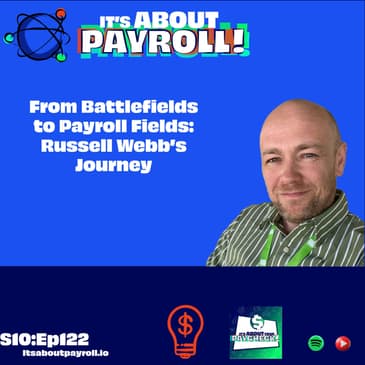
Payroll Insights with Russell Webb: Global Payroll, Career Paths, and Industry Trends
In this episode of our payroll podcast, hosts Brian Escobar and Walter William Duncan II sit down with Russell Webb, Payroll Business Development Manager at Phase Three Consulting. Webb shares his fascinating career journey from military service to payroll management and discusses various aspects of the payroll industry, including the differences between global and in-house payroll, the role of AI in payroll, and the ongoing debate about whether payroll belongs under finance or HR. The conversation also touches on the importance of being proactive in understanding company policies, the nuances of payroll systems across different regions, and practical advice for professionals navigating their careers. Webb's insights provide valuable knowledge for both payroll newcomers and seasoned veterans.
00:00 Introduction and Welcome
00:47 Casual Banter and Reflections
03:52 Payroll News and Updates
11:46 Interview with Russell Webb
24:37 Global Payroll Insights
26:37 Challenges of Global Payroll in France
27:24 Tailoring Payroll Solutions to Company Needs
28:22 Introduction to Phase Three Consulting
29:17 Managed Service Payroll at Phase Three
32:13 The Case for Outsourcing Payroll
35:54 Addressing Concerns About Outsourcing
40:17 The Role of AI in Payroll
44:41 Fun and Games: Getting to Know Russell
50:26 Final Thoughts and Farewell
Intro
Current Events and Pay News Updates
Walt https://www.forbes.com/advisor/business/best-international-payroll-services/
Brian https://lailluminator.com/2024/08/16/hundreds-of-lsu-employees-to-lose-state-benefits-after-transfer-to-staffing-agency/
Free Learning Call Out- Ask questions when the dynamics change at your company. This is a common topic at companies because it can save the company money.
SPONSORED ADS
Walt Summer is almost over, and with it, the perfect opportunity to plan your next vacation. Whether it's a long weekend or Christmas break, TimeTrakGO is here to ensure requesting and approving your time off is hassle-free.TimeTrakGO simplifies vacation planning for employees with its intuitive mobile app. Easily check available vacation time, submit requests, and manage everything on the go. For supervisors, approving requests is as easy as a single click upon notification.
BrianEveryone deserves a break, and TimeTrakGO streamlines the process for all. Start your stress-free vacation or PTO planning today with a free 14-day trial at timetrakgo.com. That's W W W - T-I-M-E-T-R-A-K - GO.com or you can call 8 8 8 3 2 1 9 9 2 2. Happy vacationing! Let’s Go!
https://www.timetrakgo.com/signmeup?utm_source=SMB24&utm_medium=IAP&utm_id=SBM24
Russell Webb
Joining us today is our guest Russell Webb who is a dynamic force in the payroll industry. Russell is the Payroll Business Development Manager at Phase 3, specializing in Managed Service Payroll. With 8 years of experience across the global payroll landscape, Russell has held pivotal roles from managing payroll teams to spearheading global account management and sales, ensuring clients get tailored solutions for their Payroll, Finance, and HR needs.
Before venturing into payroll, Russell led IT teams at DHL and served with distinction for 8 years in the Princess of Wales Royal Regiment as a machine gun commander and support weapon specialist.
When he’s not driving business forward, Russell is a dedicated father of two toddlers, a passionate football fan, and a true Star Trek aficionado. Get ready for an engaging conversation. Welcome Russell Webb to the show!
Questions for Russell Webb
What is your payroll origin story? How has your prior IT experience helped in your payroll career? Payroll – Is it a finance or a HR role?Global payroll – is it really global? Would you hand over your payroll to AI?
This or That
Capt. Picard and Capt. Kirk
Beer or Scotch
Excel or Google Sheets
Chelsea and Manchester United
Remote or Hybrid
Fish and Chips or Bangers and Mash
Safe Talk - Would you recommend processing Global payroll in house? Why or why not?
Powered by the WRKdefined Podcast Network.
[00:00:00] Sitting on Century Duty, watching out over the desert in Afghanistan. I certainly wasn't thinking I'd find myself on a podcast talking about payroll.
[00:00:12] Welcome to our podcast, Its About Payroll. We're your hosts, Brian Escobar and Walter William Duncan III. Whether you're new to the payroll game or a seasoned veteran, we have something for you.
[00:00:27] Welcome back folks. It's another episode. It's about payroll. It's about your paycheck. It's the remix. You know what I'm saying?
[00:00:37] We had episode 122. We got a great guest on today. His name is Russell Webb and we're just going to have a payroll conversation with him.
[00:00:46] But before we get into that, how you doing sir?
[00:00:49] I'm good man. I'm good. Man, has this year flown by or what?
[00:00:55] Half the year's gone.
[00:00:57] Gone bro. It's just, it's crazy. It feels like it was just a blur. Just so quick. But other than that.
[00:01:04] I'm sorry. Go ahead.
[00:01:06] No, I was going to say, when you get old and you're busy, the older you get and if you're busy on top of that, forget about it.
[00:01:12] Time is just...
[00:01:13] Let's put it a different way. You get wiser and you get busy.
[00:01:17] Instead of older.
[00:01:18] No doubt. I like that. Wise, yes. I hope I'm wise.
[00:01:22] Yeah, me too. Me too.
[00:01:23] Sometimes I don't feel as wise as I would like to be.
[00:01:26] What about you man?
[00:01:29] Good man. Just, gosh man. I don't know.
[00:01:32] Trying to be intentional. You know what I mean?
[00:01:34] Trying to just constantly refining.
[00:01:36] I had told Tiffany Gray, when we started chopping up with Tiffany Gray from PayCon, from the Payroll Congress.
[00:01:44] I forget, we were starting to chop it up on LinkedIn before we actually interviewed her.
[00:01:49] She's how's life, how's things? Great to talk to you guys.
[00:01:52] And I was like, it's not a midlife crisis.
[00:01:54] It's a mid... I don't think that's... I think people really, they over dramatize it, right?
[00:01:59] And get to this age.
[00:02:00] I think it's a midlife reevaluation.
[00:02:04] It's you've changed so much from...
[00:02:07] Because in my head, I'm still 25.
[00:02:09] But we've changed so much from that age that you have to really like just reevaluate.
[00:02:18] And some people don't do that and get messed up and get stuck on the past and don't get out of the past.
[00:02:25] And their life is stupid at 40, 50 years old.
[00:02:29] But some people get it and they're like, wait a minute, we need to readjust and can't do these things anymore.
[00:02:34] You call me what you want and whatever.
[00:02:36] And whether it's dietary things, whether it's whether you drink or bad habits and you cut away the people, the negativity, nonsense.
[00:02:46] So I think it's just a midlife reevaluation that I've been in for a little while now.
[00:02:51] Look, to me, it's like that.
[00:02:53] And I said, I think it's like that fork in the road point.
[00:02:56] Yes.
[00:02:57] It's one of those moments like that.
[00:02:58] Right?
[00:02:59] It's just, you come to this point, this place in life and you're like, okay, I can keep going on the road I've been or I could take this new road.
[00:03:07] And maybe if I take this new road and start doing things better, because this is the time to do it.
[00:03:12] Right?
[00:03:12] Like through our 20s and some of us in our 30s still, like we partied it up, lived life and stuff like that.
[00:03:19] And we really weren't thinking about the future and really didn't know about different things.
[00:03:24] So I think it's that fork in the road moment that you're, that's how I, that's how I think about it.
[00:03:29] No, I like that.
[00:03:29] I like that.
[00:03:30] You got to make a decision.
[00:03:31] You come to a point and you got to make a decision.
[00:03:34] And some people don't.
[00:03:35] There's people who I know who are 60 years old, still doing stupid stuff that never made that decision.
[00:03:43] That never made that change.
[00:03:44] Yeah.
[00:03:45] YOLO and all that.
[00:03:46] It's about it.
[00:03:47] Anywho, man, let's, let's keep it moving here.
[00:03:49] Thanks for, thanks folks for letting us chat.
[00:03:52] I hope you enjoy the banter.
[00:03:55] Um, but let's get onto some new, some pay news or which one do first.
[00:04:01] We want to intro Russ or we can pay news.
[00:04:04] Let's all let's, let's do the pay news and then we'll intro Russ after the commercial.
[00:04:09] Got it.
[00:04:10] Cool.
[00:04:10] All right.
[00:04:11] Get us started, man.
[00:04:12] All right.
[00:04:13] So I have an article from Forbes.com.
[00:04:17] It's a Forbes advisor and it's talking about the 10 best, uh, global payroll services for 2024.
[00:04:24] So this is based on Forbes.
[00:04:26] You might have your own opinion as a payroll pro.
[00:04:29] You may have your own opinion.
[00:04:30] You may like a lot of these.
[00:04:32] You may not.
[00:04:32] So this is.
[00:04:33] And not only that talking to the employee too, as an employee using these systems, what do you like?
[00:04:43] Do you like the system you use?
[00:04:45] Why do you like it?
[00:04:46] If you don't like the system use?
[00:04:48] Why don't you like it?
[00:04:49] Hit us up, send us messages.
[00:04:51] Let us know.
[00:04:52] Cause we can, we talk to these folks.
[00:04:54] We talk to these salespeople all the time.
[00:04:55] I love to tell them, Hey, I had a thousand users.
[00:04:58] Tell me they hate your system because of X, Y, Z.
[00:05:01] Yes.
[00:05:01] So love to hear back on that too.
[00:05:03] Are you going to share it with us or?
[00:05:05] Yeah.
[00:05:05] I'm going to tell you the 10 right now.
[00:05:07] So, and no specific order, but I'm going to give you the reason why they're listed by Forbes here.
[00:05:13] So deal is one on here for best as best for pay for global compliance.
[00:05:20] There's a system or payroll service called multiplier.
[00:05:24] They say that it's best for, it's best for international recruiting.
[00:05:29] Okay.
[00:05:29] Omnipresent.
[00:05:31] They said that it's best for integrations.
[00:05:33] Oh, okay.
[00:05:34] QuickBooks is best for large international teams.
[00:05:38] Really?
[00:05:40] Mm.
[00:05:40] That's what it says.
[00:05:41] Okay.
[00:05:42] It's best for EOR services.
[00:05:44] EOR.
[00:05:45] What is that employee on something employee?
[00:05:48] I don't know.
[00:05:49] I don't know what you are.
[00:05:50] I'll find out though.
[00:05:51] And then gusto is on here and it says that it is best for contractor run global companies.
[00:05:59] Rippling is best for ease of use.
[00:06:03] Paychex flex.
[00:06:05] It says it's best for internationally expanding companies.
[00:06:09] Trinet.
[00:06:10] It says it's best for companies that issue work visas.
[00:06:14] And then the last it has work day, which is says it is best for global yet centralized payroll reporting.
[00:06:24] I love it.
[00:06:25] I just started touching gusto too.
[00:06:27] And it's smooth, nice system, intuitive.
[00:06:30] I haven't processed out of it, but it looks good.
[00:06:33] EOR, by the way, is employee, employer of record.
[00:06:36] Okay.
[00:06:37] Okay.
[00:06:37] Employer of record.
[00:06:39] And that's interesting because my article is around something that has to do with that.
[00:06:44] So that's cool.
[00:06:45] Okay.
[00:06:46] So look, and then you, do you want to say what a EO, an employer of record is or what they do?
[00:06:52] Yeah.
[00:06:52] So employer of record just means basically who you work for.
[00:06:55] Right.
[00:06:55] And where it makes a, how can I say, meaning if you work for Google, do you get actually paid for Google?
[00:07:03] Or are you a temp agency working for who knows whatever staffing agency getting paid from them?
[00:07:10] Because you could be doing Google work, but working for a staffing agency, your EOR employer of record is that staffing agency, not Google.
[00:07:20] So, yeah.
[00:07:21] So there's a definition here and you said it, right?
[00:07:23] Oh, you got it.
[00:07:23] You're going to break it down.
[00:07:24] Okay.
[00:07:24] Yeah.
[00:07:25] So it says it's a third party company that manages payroll taxes and benefits for another company's employees.
[00:07:31] Like you said, to that point about the temp employee versus Google's those type of things.
[00:07:35] All right.
[00:07:35] What do you have, man?
[00:07:36] Let me get to mine.
[00:07:37] So my article is about LSU, the college, the sport juggernaut, right?
[00:07:45] One of the great sport juggernauts out there, basketball, football, Louisiana State University.
[00:07:50] Unfortunately, they had employee, they're changing their EOR, right?
[00:07:55] Right.
[00:07:56] And, but unfortunately, they, Louisiana State University was, the employees were initially state employees, Louisiana State employees.
[00:08:07] Now we know a lot of us employees know that when you work for a state or city, you traditionally get really good benefits.
[00:08:15] Yeah.
[00:08:16] Right.
[00:08:16] Everybody back in the day, it was, oh, get a state job, get a city job, get a government job, blah, blah, blah.
[00:08:21] May not be that way now.
[00:08:23] I don't know.
[00:08:23] I would love to understand more, but that traditionally was the call out.
[00:08:27] Hmm.
[00:08:28] Now, Louisiana State University is changing their employer of records for a group of employees.
[00:08:32] And for whatever reason it is, but unfortunately the full-time employees in this group are going to lose their state benefits because of this employer of record change.
[00:08:44] So what I wanted to call out because of this article to employees out there is be, if things like, one, pay attention to what's happening in your company.
[00:08:55] Right.
[00:08:56] Don't have those blinders on, like, I just need to do my job and get the day done.
[00:08:59] You can do that, but you may miss out on these things happening in the background and then all of a sudden you have no benefits.
[00:09:06] All of a sudden you have you losing things or policies change and you fired because you didn't acknowledge the handbook.
[00:09:13] What was that stat?
[00:09:15] 67% of employees actively avoiding reading the handbook.
[00:09:20] Come on.
[00:09:20] So I know it sounds like front of the class, teacher's pet nerdy type of thing, but as a good employee, be a steward of your own paycheck because that's what this show is about.
[00:09:31] We're trying to help you understand and be a good steward of your own paycheck.
[00:09:35] And this is the type of things you've got to pay attention to, right?
[00:09:38] Yeah.
[00:09:39] Because you want to ask questions and you could have a merger and acquisition.
[00:09:44] Like, things are, a company, like, high up in companies, things are always going on.
[00:09:50] And the company, for a lot of things, they're required to tell the employees, whether they tell you now or later, they're going to tell you that things have changed and this is what it is and you sign off.
[00:10:00] Right?
[00:10:01] And you go on your, so I love how it all ties together because when you log onto your system of record and you got a document there and it's nowadays, you could just click it.
[00:10:12] Yeah, I read it.
[00:10:13] Acknowledge.
[00:10:13] Click.
[00:10:13] I'm done.
[00:10:14] But in that document, it could have been explaining to you, you're being moved to a new employer of record.
[00:10:20] If you're a full-time employee, you're going to lose benefits and you need to go and do X, Y, Z.
[00:10:24] If you're clicking away and you're not understanding and paying attention to these things, you could really get hurt.
[00:10:30] And these things like this happen all the time in companies.
[00:10:34] And that's a common conversation that leaders are having.
[00:10:38] Should we change our employer of record?
[00:10:40] Because there's money savings in there for them, right?
[00:10:43] Yeah.
[00:10:43] There's management savings.
[00:10:44] There's, there's, there's gain, there's this money to be saved.
[00:10:47] So when you're talking about a company and you work for a company, guess what?
[00:10:50] Those leaders are always talking about how to save money.
[00:10:55] And they do have to tell you, right?
[00:10:58] You may not know immediately, but eventually if it has employee impact, they are going to share it with you.
[00:11:05] Yeah.
[00:11:05] And you're going to acknowledge on some document that you didn't read, then you're going to be impact, right?
[00:11:11] Yeah.
[00:11:12] So, so look, it's better.
[00:11:14] And let me know if this makes sense or resonates with what you're, what you're saying.
[00:11:18] I'm trying to articulate it in a way that makes sense for the employees that are listening.
[00:11:23] Oh, wow.
[00:11:23] So one of the things that you need to do, Hey Russell, one of the things that you need to do as an employee is make sure that you are more so proactive than reactive.
[00:11:35] Right.
[00:11:35] By, and that's by informing yourself, educating yourself, learning about what your company policies are, learning about those different things.
[00:11:41] So you can find out exactly how those things benefit you.
[00:11:46] Right.
[00:11:47] Hey Russell, we were just talking about, we went over our article here and just talking about some different things.
[00:11:52] Thanks for joining the show.
[00:11:54] Apologies.
[00:11:55] I'm a little bit early.
[00:11:56] I thought I'd jump in.
[00:11:57] No, you're good.
[00:11:58] Yeah.
[00:11:59] As long as you don't mind joining us for a few things.
[00:12:01] Absolutely.
[00:12:02] Oh, awesome.
[00:12:03] All right.
[00:12:04] Awesome.
[00:12:04] We do have some bills to pay.
[00:12:07] Walt, do you want to read our, start our, let's pay the bills.
[00:12:10] Yes.
[00:12:11] Summer is almost over and with it, the perfect opportunity to plan your next vacation, whether it's a long vacation or Christmas break.
[00:12:18] Time Track Go is here to ensure requesting and approving your time off is hassle free.
[00:12:24] Time Track Go simplifies vacation planning for employees with its intuitive mobile app, easily check available vacation time, submit requests and manage everything on the go.
[00:12:34] For supervisors, approving requests is as easy as a single click upon notification.
[00:12:39] Everyone deserves a break and Time Track Go streamlines the process for all.
[00:12:45] Start your stress free vacation or PTO planning today with the free 14 day trial at TimeTrackGo.com.
[00:12:54] That's W-T-I-M-E-T-R-A-K-Go.com.
[00:12:59] Or you can call them at 888-321-9922.
[00:13:05] Happy vacationing and let's go.
[00:13:07] Let's go.
[00:13:09] So joining us today, we have Russell Webb, who is a dynamic force in the payroll industry.
[00:13:16] He is the payroll business development manager at phase three, specializing in managed service payroll with eight years of experience across the global payroll landscape.
[00:13:26] Russell has had pivotal roles from managing payroll teams to spearheading global account management and sales, ensuring clients get tailored solutions for their payroll, finance and HR needs.
[00:13:40] And before venturing into payroll, Russell led IT teams at DHL.
[00:13:44] Oh, that's awesome.
[00:13:45] And served with the distinction for eight years in the Princess of Wales Royal Regiment as a machine gun commander and support weapons specialist.
[00:13:56] Thank you for your service.
[00:13:57] Yes.
[00:13:58] And when it's not driving business forward, Russell is a dedicated father of two toddlers.
[00:14:03] Oh, God bless you.
[00:14:04] And a passionate football fan and a true Star Trek aficionado.
[00:14:11] Get ready for an engaging conversation that we're going to have here with Russell Webb.
[00:14:15] Thank you, Russell.
[00:14:16] And welcome to the show.
[00:14:19] Thanks for having me.
[00:14:19] Yeah, that was a lovely intro.
[00:14:21] I really appreciate it.
[00:14:22] And a hundred percent accurate as well.
[00:14:24] Oh, awesome.
[00:14:26] Wow.
[00:14:26] Good.
[00:14:27] That's good to hear.
[00:14:28] Russell, it's great to have you on.
[00:14:30] We're excited for you to be here.
[00:14:32] I know we've been talking back and forth and so forgive me because I know I dropped the ball a little bit when you reached out.
[00:14:38] Thank you for being patient with us.
[00:14:39] And we're excited to have you here and really want to get this episode going with you.
[00:14:45] We have some topics that we want to discuss with you.
[00:14:48] And before we get to those questions and stuff, we would like to know how did you get into payroll?
[00:14:53] What is your payroll origin story?
[00:14:56] Yes.
[00:14:57] So it's interesting.
[00:14:58] Well, as you said, I joined the army straight from school.
[00:15:02] So I was 16 when I joined the military.
[00:15:04] Wow, 16.
[00:15:06] Yeah.
[00:15:07] I don't think you can do it anymore.
[00:15:09] But at that time you could join at 16.
[00:15:11] Wow.
[00:15:11] And I went all around the world with the military, Iraq, Afghanistan, various other places.
[00:15:16] And all through that, I didn't even know payroll was an industry.
[00:15:22] I didn't even know it was a job that people did.
[00:15:24] It was just, I'm sure many people around the world actually have this, the same thing.
[00:15:28] You get your paycheck, you get your pay slip, but you don't, unless it's wrong, you don't know what goes into doing it.
[00:15:34] I had no intention of going into payroll when I left the military, but I got the opportunity to, I was living in Prague in the Czech Republic for a little while.
[00:15:44] And I got the opportunity to manage, cause they were looking for a people manager.
[00:15:49] And I got the opportunity to manage a payroll team.
[00:15:51] Oh, wow.
[00:15:52] It was a great opportunity for me to learn, to develop people, which I've always been quite good at, to coach and to mentor people.
[00:15:58] But at the same time, I felt like I should know a little bit about payroll if I'm managing the payroll team.
[00:16:05] So I learned.
[00:16:06] Well, that's going to ask you, wait a minute, you just straight out of the military.
[00:16:08] They let you manage a team, a payroll team at that.
[00:16:12] Yeah.
[00:16:13] There was a few little, like you said before, I was at DHL for a little while when I started on the IT service desk, tried to turn it on and off again.
[00:16:22] Then within a few months I became the manager there.
[00:16:25] And then as I said, I moved over to a company that you guys might be quite familiar with.
[00:16:31] I was with three initials, ADP.
[00:16:33] Yeah.
[00:16:33] I work with them right now.
[00:16:35] And every, every payroll person that I, or company or that I speak to, everyone's got someone from ADP in their, in their organization.
[00:16:43] It's such a far reaching.
[00:16:45] Yeah, for sure.
[00:16:45] But yeah, so I joined the ADP, ADP team managing Swedish payroll, would you believe?
[00:16:50] Which has its own set of legislation and nuances and far beyond anything I dealt with before.
[00:16:57] But from there I moved into, I realized I like talking about payroll more than actually doing payroll.
[00:17:03] I moved into an account management position.
[00:17:05] And then from there to, to, to sales selling managed service payroll.
[00:17:09] Wow.
[00:17:10] That's so amazing.
[00:17:11] I love it.
[00:17:12] Again, thank you for your service.
[00:17:14] And I do have one more sub question.
[00:17:16] I don't know if I included it in the email with the topics, but could you say, or how has your IT experience helped in your payroll career at all?
[00:17:28] I wouldn't say very much at all.
[00:17:30] So at DHL, we were doing internal service desk, first level IT stuff.
[00:17:36] Okay.
[00:17:38] Obviously as companies have evolved and service desks have evolved, they have this system where they try to put more of the technical stuff on.
[00:17:46] Onto the first level teams.
[00:17:48] But I don't, I don't think it really affected what, what, what I've done in, in payroll at all, to be honest.
[00:17:55] I don't understand.
[00:17:56] Yeah.
[00:17:57] Okay.
[00:17:57] Make customer service though.
[00:17:59] If you go with people, definitely sharpen that skill.
[00:18:02] It all, it all, it all connects.
[00:18:04] It all connects.
[00:18:04] That's the beauty of payroll.
[00:18:06] Yeah.
[00:18:06] That's awesome.
[00:18:07] All right.
[00:18:08] But yeah, it's not quite a, it's not quite a Marvel origin story, but I still think it's more interesting than most.
[00:18:15] Wow.
[00:18:15] You're a great story, man.
[00:18:16] I think that's what I love about connecting with people and folks on the show is that everybody's story is different and it's unique.
[00:18:23] And like, everybody's like their own, to your point about Marvel, right?
[00:18:27] Everybody's their own payroll Avenger and everybody has their own super story.
[00:18:31] So it's cool.
[00:18:32] It's really cool.
[00:18:33] All right.
[00:18:34] One of the things I love is talking to, talking to friends.
[00:18:37] When people say that you tell people you're in the payroll industry or you do payroll, people more often than not, if they've not had any kind of direct experience with payroll teams, they're like, isn't it just clicking a button?
[00:18:48] Yeah.
[00:18:49] Oh my God.
[00:18:50] And I love explaining some of the, especially the differences between global and local payroll.
[00:18:55] When I first joined ADP, the thing that someone explained to me at a very kind of high level about payroll is that if you're a, if you're a multinational company that's got offices in every country in the world, either you outsource your payroll to someone for a cheaper price.
[00:19:11] Or you'd have to have a different payroll person in every single country that you've got.
[00:19:16] Yeah.
[00:19:16] So it's just cheaper to do it outsourcing, but then most companies in the world aren't multi-country.
[00:19:23] Most companies have their own geographical footprint in their own country.
[00:19:26] And it's even cheaper for them to do it in their own country, using an outsourcer, using a trusted company rather than trying to do it themselves.
[00:19:35] You bring up an interesting point there.
[00:19:37] If we can clarify, what's the difference between outsourcing and doing it themselves in your opinion?
[00:19:43] So for me, it's outhouse versus in-house.
[00:19:47] So in-house, you, you will use a payroll system.
[00:19:52] You have to outsource a payroll system unless you develop your own, which is obviously very expensive.
[00:19:55] Which is crazy.
[00:19:56] Right.
[00:19:57] Or unless you do it on Excel, which I still find companies doing something.
[00:20:01] Wow.
[00:20:02] Depending on your size.
[00:20:03] Yeah.
[00:20:03] I've seen that as well.
[00:20:04] Yep.
[00:20:04] But you're going to need, you're going to need a payroll system, but you're also going to need a payroll specialist who knows the local legislation, the local nuances, can support your employees, can run the payroll each month.
[00:20:16] Plus all of your different things like your pensions and everything else that you've got in line with the payroll side of things.
[00:20:23] And in-house, you're hiring someone to do it for you, but they also need backup as well.
[00:20:27] So you need someone else to be trained to in case of the worst.
[00:20:32] So in-house is doing it there.
[00:20:33] Whereas for me, outsourcing is using another organization to run your payroll and it can be fully managed, part managed, even just emergency support or a little bit of support here and there.
[00:20:47] And outsourcing can cover all manner of kind of support levels that you can have in your payroll, whether it's at the top end of the spectrum, fully managed or just a little bit of support here and there.
[00:20:58] Wow.
[00:20:59] Perfect.
[00:21:00] I love it.
[00:21:00] That's great.
[00:21:01] Because I think we as payroll folk, we kind of, we talk about, oh, in-house, out-house, like what does that mean?
[00:21:07] Yeah.
[00:21:07] Thanks for that.
[00:21:08] I appreciate that.
[00:21:10] Yeah.
[00:21:10] So the next question or the next topic we want to discuss with you, Russell, is payroll.
[00:21:17] In your opinion, is it a finance or is it a HR role?
[00:21:24] It's the, it's one of the age old questions that I don't think anyone has been able to significantly answer yet.
[00:21:30] I see arguments all the time on, on, on LinkedIn and places like that for either way.
[00:21:36] I also see a lot of people nowadays saying that payroll should be its own department, should have its own.
[00:21:42] It's as important as HR.
[00:21:44] It's as important as finance and it should have its own director.
[00:21:47] It should have its own level within the organization, but then people against that will say, then you're adding more people to C-suite level.
[00:21:56] You're adding more kind of decision makers there and more people to committees.
[00:22:01] So I think there is a definitive answer.
[00:22:04] I guess it depends on the size and shape of your organization.
[00:22:08] I think from personal experience in EMEA and Europe and the UK, especially it tends to usually fall under HR.
[00:22:18] Oh, okay.
[00:22:20] I know that's quite a little bit different to you guys.
[00:22:22] I know that in the States, it's a lot of under finance.
[00:22:25] It's about split in half in here.
[00:22:27] Based on the research we've done, it's 50-50.
[00:22:30] And even in our careers, we've experienced the same thing.
[00:22:34] I spent half my career reporting to finance, the other half reporting to HR.
[00:22:38] Some of jobs we've gone back and forth where we started off reporting to one department and have shifted and started and reported to another because of reorganization.
[00:22:47] So what you're saying, but on your side of the world, it's mainly majority is in HR or all, would you say?
[00:22:55] Yeah, mostly. I haven't seen many organizations where it's a finance role.
[00:23:01] Wow.
[00:23:02] It's usually an HR role, but then they still need finance approval to do anything really tangible.
[00:23:10] And we say on the show, we've called it the holy trinity of payroll where you have to, it doesn't matter who you report to, whether it stands alone or not, HR, payroll and finance have to be in lockstep, have to work together to produce the product.
[00:23:26] We call it the golden triangle.
[00:23:27] We work with the golden triangle.
[00:23:30] I love it.
[00:23:31] I love it.
[00:23:31] You mentioned we work with, I'm not going to promote them here, obviously, but we work with a few products that integrate so well.
[00:23:37] And obviously you guys know integration is what every company wants.
[00:23:40] Oh gosh.
[00:23:41] If you've got your, your finance system working in unison with your payroll system, which works with your HR system and they're all feeding to each other.
[00:23:50] That's the golden triangle.
[00:23:51] That's where you want to be.
[00:23:52] I love it.
[00:23:53] I love that.
[00:23:54] You mentioned the acronym that I don't, one, I don't know if I know all the letters and just for the listeners, what does EMEA mean?
[00:24:02] EMEA is a Europe, Middle East and Africa.
[00:24:05] Ah, okay.
[00:24:06] Quite often global corporations will split their geographical regions into North America, sometimes LATAM, Latin America.
[00:24:15] Sometimes they'll have EMEA, which is Europe, Middle East, Africa, and APAC, Asia Pacific will be, so at least the companies that I've worked with will split them.
[00:24:25] Yeah, no, I'm familiar with the acronyms, but I'm like, I directionally know what they're mean, but I never looked it up.
[00:24:31] And thanks for sharing that.
[00:24:32] That's a good call.
[00:24:33] That's a good definition for folks.
[00:24:35] I love it, man.
[00:24:36] What a great conversation.
[00:24:37] The next one is global payroll.
[00:24:40] And I love that the Walt did this and shout out to Walter.
[00:24:43] Walter curious the show and produces it and really helps us guide through what we talk about.
[00:24:48] And I love the things that he brings up.
[00:24:50] And so global payroll, is it really global?
[00:24:52] I recently wrote an article for it in the UK.
[00:24:56] We have something called CIPP Chartered Institute of Payroll Professionals.
[00:24:59] Yes, familiar.
[00:25:01] Like our payroll org.
[00:25:03] Yeah.
[00:25:03] Formerly known as APA.
[00:25:05] Yep.
[00:25:05] Yeah.
[00:25:06] Same, similar sort of thing.
[00:25:07] They're not necessarily a governing body, but they, they're very well respected and they train people and you get your qualifications in payroll through them.
[00:25:16] And I'm quite, quite friendly with them and I wrote, I've wrote an article in there monthly about the, about the different global and local and regional and whatnot payrolls.
[00:25:26] One of the things that I was thinking that I, and this is coming from ADP.
[00:25:29] So we used to have global payroll.
[00:25:31] So you're, if you're in, if you're in a company and you want your employee to have the same experience from onboarding to payslip from, for an employee in Columbia to an employee in Singapore, you want system that does everything.
[00:25:47] But then at the same time, it's very difficult to have one payroll or one HR system that can look at the nuances and the differences between European payrolls, Asian payrolls and US payrolls.
[00:26:00] Even in the US you've got 52 different effectively countries with different legislation sometimes.
[00:26:05] Yeah.
[00:26:05] Oh yeah.
[00:26:06] It's crazy.
[00:26:07] And so it's difficult to have one system that can do all that.
[00:26:11] In the old days, I say the old days, I'm talking about 20 years ago.
[00:26:15] Yeah.
[00:26:15] That's crazy.
[00:26:16] Yeah.
[00:26:17] You would have companies that offer global payroll would have a network of local providers in each country.
[00:26:23] And they were loosely strung together by perhaps one central system, but it wasn't doing the payroll.
[00:26:31] It was the local in-house countries that were doing the payroll.
[00:26:34] And that was good for a number of reasons in Europe.
[00:26:38] Obviously there's certain countries in Europe, I won't name any France, that don't like to have English as the business language.
[00:26:45] They like to have their support in French.
[00:26:48] They like to have, and their payroll is quite complex as well in terms of the nuances and the legislation.
[00:26:55] Having a global system or someone offshore to do their payroll in France is very challenging.
[00:27:01] Wow.
[00:27:02] And they would expect to log a ticket and have that back in an hour.
[00:27:06] So the best thing sometimes that companies can do is have the in-country provider providing the support there.
[00:27:12] They've got the language, they know the rules, they know how it works.
[00:27:17] But then you need to have that still connected so your outputs can still go to a central system, which can still go to the client.
[00:27:23] So I think my outcome, and this is perhaps a coward's outcome in my article was that there is no right answer.
[00:27:32] Yeah.
[00:27:32] No.
[00:27:32] Depending on the size and shape of your company depends on how you should set up your payroll, whether that's grouping countries together and having that done that way,
[00:27:41] whether that's having local providers who can provide the outputs of the GL files and everything else that you need into a certain format that goes into your central system.
[00:27:50] Or if you really want exactly the same user experience, but are willing to compromise slightly on perhaps the service time, a global system is true for you.
[00:28:01] So it really depends on the size and shape of your company.
[00:28:05] And that's why my job is speaking to clients and determining what the best fit for them is.
[00:28:13] Wow.
[00:28:14] Yeah.
[00:28:14] And perfect segue.
[00:28:16] What is your job?
[00:28:16] Tell us a little bit about your company, what you do, what your purpose is.
[00:28:22] Sure.
[00:28:22] So my company is Phase 3 Consulting.
[00:28:25] We are a company based in Manchester in the UK.
[00:28:29] Okay.
[00:28:29] Cool.
[00:28:30] We started off 20 years ago.
[00:28:33] We recently celebrated our 20th anniversary.
[00:28:35] That's all I know.
[00:28:36] Yeah, congratulations.
[00:28:38] We started off with one person, our founder, in his bedroom doing some HR consulting.
[00:28:42] Yeah.
[00:28:44] And we've over the years we've grown and now we're 120 people.
[00:28:47] Nice.
[00:28:48] Our business is split 50-50 roughly between our consulting side, our professional services, where we offer clients health checks on their systems, HR finance, payroll systems.
[00:29:00] We do health checks.
[00:29:02] We do system selection.
[00:29:03] So we'll go out to companies and we'll help them choose the best of breed kind of systems for them.
[00:29:10] And any kind of professional kind of consultancy on multiple different payroll systems that are used in the UK.
[00:29:17] And then the other side of our business, which represents the other 50%, is our managed service payroll side.
[00:29:22] This is where I come in.
[00:29:24] Okay.
[00:29:25] Okay.
[00:29:26] So we offer, we're a bureau, so we offer managed service payroll on, we offer payroll on about nine different payroll systems.
[00:29:35] So we have experts on all of those different kinds of things.
[00:29:38] Oh wow, so not just one?
[00:29:40] No, absolutely.
[00:29:41] All different kinds of payroll systems that we use.
[00:29:43] We have experts on, I think someone at last check, it was about 600 years of payroll experience in our payroll team.
[00:29:50] Dang.
[00:29:51] Wow.
[00:29:52] That's awesome.
[00:29:53] A company will come to us and say, we're having trouble with our payroll.
[00:29:56] We either our payroll manager left is usually one of the things, or the payroll system is not fit for purpose.
[00:30:03] If they like what they're using, generally we would say, we can offer you a short or long term managed service.
[00:30:09] So one of our experts can come in, operate the payroll on your software and run your payroll for you.
[00:30:15] Or if they're not happy with the software they're using, we have a system of choice that we can implement and run ourselves called Brain Payroll.
[00:30:23] Nice.
[00:30:24] At the moment, it only does UK and Ireland, but eventually we can expand.
[00:30:29] Brain, you called it?
[00:30:30] Brain Payroll?
[00:30:31] Brain Payroll, yes.
[00:30:32] As I said, we use multiple systems and I'm sure you guys will know some of them, not with the ADP Global View.
[00:30:39] And we use one that's quite popular in the UK called iTrent.
[00:30:43] There's one called Unit 4.
[00:30:44] There's various systems that we run managed services on, but all of our teams say that their favourite one is the one that we use called Brain Payroll.
[00:30:53] It's very simple.
[00:30:55] It's very linked into everything.
[00:30:57] You have one user journey that you go on the side.
[00:31:00] You can run everything that you need to run possibly from there.
[00:31:04] Reporting is, you have a report builder on there, so you can build the reports as you need them.
[00:31:09] And you have the connectivity, as I said before, into the finance and HR systems as well.
[00:31:13] So it's a really good system to use.
[00:31:15] Awesome.
[00:31:16] Wow, I love it.
[00:31:17] You said it's only in UK and Ireland?
[00:31:19] At the moment, yes.
[00:31:20] Hopefully expanding soon.
[00:31:22] So where are most of your clients in the UK?
[00:31:25] Correct, yeah.
[00:31:26] We have a partner network as well.
[00:31:28] So we have good relationships with some local providers in other countries.
[00:31:32] So if we have a client come to us and say, we've got Finland and Belgium as well, we can certainly do their payroll for them, but it will be via one of our partners.
[00:31:43] Got it.
[00:31:44] Got it.
[00:31:45] So what's your role there?
[00:31:46] Are you an account manager, a sales leader?
[00:31:49] What do you do for them?
[00:31:50] A business development manager, purely sales for managed service payroll.
[00:31:54] So all new managed payroll deals have to come through myself.
[00:31:57] And I'm also out there trying to attract them as well.
[00:32:01] That's what drew me to your amazing podcast.
[00:32:04] Yeah.
[00:32:05] Thank you.
[00:32:06] We love it, man.
[00:32:06] What an amazing guest you've been so far.
[00:32:08] I love it, man.
[00:32:10] That's awesome.
[00:32:11] So I have one more question for you.
[00:32:13] Would you recommend processing global payroll in-house?
[00:32:17] Why or why not?
[00:32:20] In-house, if you're a global company, in-house.
[00:32:23] See, to be honest, no, because just because of the expenditure, the expenses that you have on running payroll in-house, just to, especially if you're a big company and you need to, this is the thing that people don't think that you do the simple maths and you think, how much does it cost to hire one payroll person for a year?
[00:32:43] So you think in London, perhaps that's 50,000 pounds a year.
[00:32:48] And then all the taxes on top of that, okay, it's going to go up to 70,000 pounds a year.
[00:32:54] And then you've got to have them a desk.
[00:32:55] You've got to have them equipment.
[00:32:56] You've got to have everything else they need.
[00:32:59] Plus they've got to have the payroll system to use.
[00:33:02] And then you've got to have backup.
[00:33:03] I like the backup call out.
[00:33:05] Not many people think about that.
[00:33:06] They'll hire one payroll person standalone, but they won't think about, wait a minute, this person needs to go on vacation.
[00:33:11] Heaven forbid something happens.
[00:33:13] Where is their backup?
[00:33:14] Absolutely.
[00:33:15] And all these things do add up quite, you do some simple maths there and you're looking at a hundred grand.
[00:33:20] Easy.
[00:33:20] That's the number I, yep.
[00:33:21] That's the number I jumped in my head when you said it.
[00:33:23] And then you go to, you can go to a, an outsourcer who can do it for 30 grand maybe.
[00:33:29] Again, random numbers off, but at the same time, you're also getting there, the expertise that you don't need to keep up with legislation because your outsourcer is going to keep up with the legislation and they change frequently.
[00:33:41] And they're getting quicker in terms of their changing all the time now.
[00:33:44] Yeah.
[00:33:44] Oh my God.
[00:33:45] Yeah.
[00:33:45] The three things.
[00:33:46] The norm so often.
[00:33:47] And so yeah, you, you also get the reduction of risk.
[00:33:51] If you're a company and payroll goes wrong, it's, it's either human error or it's the system's fault.
[00:33:57] Right.
[00:33:58] And if it's the system's fault, then you can blame the system and you can blame the people who provide the system for you.
[00:34:02] But if it's your payroll person, you've got to have someone managing them and making sure, you know, you're reducing risk by using an outsourcer, a reputable outsourcer.
[00:34:13] Yeah.
[00:34:14] That has SLAs defined.
[00:34:16] And let's be honest, punishment, not punishment, but penalties.
[00:34:19] Sorry.
[00:34:19] I was looking for not punishment.
[00:34:20] Penalties if you don't meet your SLAs.
[00:34:22] Might as well be punishment.
[00:34:25] I was thinking of the army.
[00:34:26] I was thinking they had to do press ups.
[00:34:27] Yeah, I know.
[00:34:28] But no penalties, yes.
[00:34:30] And I think for a global company, it just makes a lot more sense to have an outsourcer do it.
[00:34:37] One of the problems that I've experienced is I know that speaking to, and obviously my counterparts in companies are usually directors of HR or directors of finance, sometimes depending on their setup.
[00:34:49] Sometimes they have been burned before by going with the company and not having a great experience, going with a payroll outsourcer and not having a great, great experience with them.
[00:35:00] Yeah.
[00:35:00] So that's one of the reasons why I try to be as upfront as possible is set the right expectations from day one.
[00:35:06] But if I'm talking to a client and they want integrations with this, that, this, that, we'll work for it one by one.
[00:35:11] But I'm not going to tell you that everything's going to integrate perfectly if I'm not confident it will.
[00:35:16] Well, and as great as I say that our payroll system of choice frame payroll is, it's, it can't do every single thing for every single country.
[00:35:25] There's no payroll system that can.
[00:35:26] None of them can.
[00:35:27] So I'm going to, I will always set the right expectations with clients.
[00:35:31] And I will always tell them from the start that this is what it does.
[00:35:34] Okay. You want this?
[00:35:35] Let's try and find a way to deliver this to you, but it's not going to be exactly this.
[00:35:41] It's about sitting right.
[00:35:42] So, yeah, as I said, a lot of, a lot of people that I've spoken to have used sometimes a couple of payroll providers in the past and been burned by them in terms of delivering what they wanted or being mis-sale or something.
[00:35:54] Let me ask you a question though, because the biggest argument that I see with leaders in the U.S. for outsourced payroll is lack of control.
[00:36:01] Do you run into that?
[00:36:04] All the time.
[00:36:05] Okay.
[00:36:06] How do you, how do you battle, combat that?
[00:36:09] How do you answer to that when a potential client says, I want to control it?
[00:36:14] Absolutely.
[00:36:14] So, no, I get that quite a lot where it would be half the price.
[00:36:19] We could do your payroll for you for half the price of you doing it in-house.
[00:36:23] Instead of you having your team of three running payroll in-house for a fortune, we do it for half the price.
[00:36:29] But end decision lies with the CFO.
[00:36:33] And they believe that they have more control over it if it's done in-house rather than outsourcing it.
[00:36:40] And do you know what, to some extent I get that.
[00:36:42] I like to have control.
[00:36:43] I like to see what I'm doing each month.
[00:36:44] So the way that I like to approach that is like, look, with our payroll system or with any of the payroll systems that we use,
[00:36:50] we make sure that you've got access, that you've got the login, that you can see on the dashboard where the payroll is each month,
[00:36:58] what we've processed, that you get the variance reports when you need them.
[00:37:03] And there's variance reports, I'm assuming you guys have this in the US, but it just shows you the difference between this month's payroll and last month and where those differences are.
[00:37:11] So we make, I try to explain to these people that you'll get all the reports, you'll see on a dashboard where we are each step of the way.
[00:37:19] And you have to approve the payroll before we can send it.
[00:37:23] So it's not like we're doing things behind your back.
[00:37:26] So you'll get everything the same as what you would have if it was in-house and you have the end control over the payroll.
[00:37:35] I love it.
[00:37:36] It doesn't always work.
[00:37:36] And I, no, let's see, I'm just thinking about it through, right?
[00:37:40] I would challenge those folks to say, what is it that you want to control?
[00:37:43] Because if you start peeling that onion back, what you find more often than not is, oh, they want to run a report really quick.
[00:37:51] So if they have access, they can, your finance, and it's usually finance that needs the report and or data, right?
[00:37:57] If you want people data nowadays, that's an easy report as well.
[00:38:02] You can deliver it in advance with real time.
[00:38:03] So there's probably a few reports that you could just give them the run and give them that data, right?
[00:38:09] I know.
[00:38:09] I'm quite, I'm very payroll orientated.
[00:38:12] So I don't work too much with HR systems.
[00:38:15] And I feel even in my experience with HR systems, they can be more global than payroll systems because I-
[00:38:24] Because it's not processing compliance and taxes.
[00:38:26] Exactly.
[00:38:27] Like your people in, and that's where I guess work day comes in.
[00:38:31] I haven't worked in a long time.
[00:38:32] I was just about to say work day.
[00:38:34] You can have your work day and you can use it how your company needs to use it.
[00:38:38] I've spoken to a lot of companies who use every single facet of work day.
[00:38:44] They're very, they buy all they see.
[00:38:45] But then I speak to some companies who only use tiny piece of work day because only the individual countries only utilize a certain amount of it.
[00:38:53] But then if you've got that as your global system of records, you can have your HR system such as work day as a really good global system of record where you're onboarding your employees.
[00:39:06] And you can have your countries, individual countries doing their own payroll.
[00:39:11] I think that to me, that's a good system that works.
[00:39:14] Yeah.
[00:39:14] Because you get a standout service in each country.
[00:39:17] Again, it goes back to as well, another thing called best of breed.
[00:39:20] So if you choose one company to do your HR, do your payroll and do your finance, you're going to get their system.
[00:39:28] And it might be great in HR, but it might not be that great in payroll or finance.
[00:39:31] So you're not going to get the best of breed.
[00:39:34] And nowadays with the connectivity we have with APIs and middleware and everything else, you really do get the connectivity that you need very quickly between those three systems.
[00:39:44] Yeah.
[00:39:45] Pretty much.
[00:39:46] Yeah.
[00:39:46] Thank you for that.
[00:39:48] Yeah, man.
[00:39:49] What a great conversation.
[00:39:50] I love it.
[00:39:51] And I love being surprised, right?
[00:39:52] Because I didn't, I don't, we've never met and we don't do any pre, how you say, like preparation calls for the.
[00:40:00] I don't like doing it.
[00:40:01] I like, love it.
[00:40:01] I love it being very fresh and right.
[00:40:04] I've seen what you got.
[00:40:06] I've watched your, you guys' podcasts before and I really like them.
[00:40:09] So that's one of the reasons.
[00:40:10] Thank you very much.
[00:40:10] We appreciate that.
[00:40:11] I was really eager to get on this one.
[00:40:12] Thank you very much.
[00:40:13] Yeah.
[00:40:14] One last one.
[00:40:15] And then we like a, we'll play a game with you here.
[00:40:17] AI is huge, right?
[00:40:22] What's the thoughts of AI?
[00:40:24] How do you feel about it?
[00:40:25] Is your company, what's, what are you guys talking about around AI?
[00:40:30] The problem is if I say what I really thought, I might be seen as a technophobe.
[00:40:34] Oh, I know.
[00:40:36] So I know a lot of big companies that have spent billions, I'm talking billions on AI.
[00:40:43] I bet.
[00:40:43] Yeah.
[00:40:43] And don't really have a great deal to show for it.
[00:40:47] Like when I was doing the service desk and I'm talking like 2013, so 10, 10 years ago
[00:40:53] now working for DHL, we started working with IBM on one of their huge robot things called
[00:41:00] Watson.
[00:41:01] Watson.
[00:41:02] Yeah.
[00:41:02] Yeah.
[00:41:03] And it was, it was already around for a while, but we were going to utilize that to do our
[00:41:08] chat answers to, if you need support, just use the chat instead.
[00:41:12] Yep.
[00:41:15] Even after a lot of testing and a lot of work, it just, it wasn't up to scratch.
[00:41:19] And I'm talking 10 years ago now.
[00:41:21] Wow.
[00:41:21] Just like chat.
[00:41:22] Yeah.
[00:41:23] And even now I still feel I wouldn't be comfortable with AI doing payroll.
[00:41:29] You're talking about payroll, people's salary end of the month.
[00:41:33] You're talking about, you guys know as much as I do.
[00:41:36] It's the one of the most important parts of the entire company because every company is
[00:41:42] its most important asset as is people.
[00:41:45] And you need to pay your people right and on time every time.
[00:41:48] Otherwise they're not going to do the business for you.
[00:41:52] And I feel like handing out, I'm all for automation.
[00:41:55] I'm all for reducing manual.
[00:41:58] We hate manual input, by the way.
[00:41:59] We don't like anyone cutting stuff from Excel into one Excel.
[00:42:04] No, but you can get run up by using imports or the APIs that move stuff, move data across.
[00:42:09] I still need a lot more convincing that the AI is going to give us tangible benefits anytime
[00:42:15] soon.
[00:42:16] I feel sometimes, I feel sometimes like these bigger companies are all investing in it and
[00:42:20] promoting it and pushing it.
[00:42:22] I feel because they think they need to, rather than to get any immediate tangible benefits.
[00:42:28] Yeah.
[00:42:29] What can it really do yet?
[00:42:30] Yeah.
[00:42:30] You're right.
[00:42:31] Because what's the business case for it?
[00:42:33] How does it solve something, like you said, in a really tangible way?
[00:42:38] Accurately.
[00:42:39] Let's not forget, right?
[00:42:40] We got one job, deliver accurate on time payroll.
[00:42:45] Absolutely.
[00:42:45] How does AI help you do that is a big question.
[00:42:48] What's up?
[00:42:48] And look, there's so much discovery that still has yet to be made in terms of AI, right?
[00:42:55] Yeah.
[00:42:55] And so we don't know, like when the internet came out, right?
[00:42:59] It was this glorious thing, but it also came with its different consequences, these different
[00:43:04] things that people use.
[00:43:06] Like just as we advance, there's also going to be those people who don't have good intentions,
[00:43:11] that want to hack into people's information.
[00:43:13] Oh, everything.
[00:43:14] Yeah.
[00:43:15] It's insane.
[00:43:16] I am always reminded when people start to say, oh, a couple of years, no one's going
[00:43:21] to be, no one's going to have any jobs because AI is going to do everything.
[00:43:24] No.
[00:43:24] I'm always reminded of that.
[00:43:26] Do you remember that movie about the female nationalists?
[00:43:29] They were doing the maths for the first launches.
[00:43:32] Yes.
[00:43:32] Yes.
[00:43:34] And they was all worried because the computers were coming in and they thought, yes, they're
[00:43:38] not going to need mathematicians anymore to do it.
[00:43:41] And how many more jobs did computers create than, than take away.
[00:43:46] Exactly.
[00:43:47] So I still think we need to understand that there's, there's, there's a lot to understand.
[00:43:52] It's not like Terminator.
[00:43:53] We're not getting Skynet coming and take over anytime soon.
[00:43:56] No.
[00:43:56] Yeah.
[00:43:56] I agree.
[00:43:58] I agree.
[00:43:59] So on my, on my LinkedIn, I create some payroll memes sometimes and I was running out
[00:44:05] payroll jokes.
[00:44:05] I'm going to be honest, it's tough.
[00:44:07] Yeah.
[00:44:09] So I asked T, give me five payroll jokes.
[00:44:12] Mm-hmm.
[00:44:13] And not one of them made any sense.
[00:44:15] Oh yeah, exactly.
[00:44:17] Exactly right.
[00:44:19] And I, I, that's, that's, it's funny you say that cause I think recently you put out one
[00:44:21] that I love.
[00:44:22] I don't remember what it was, but I was like, oh man, that's awesome.
[00:44:25] It was funny.
[00:44:25] And you're right.
[00:44:26] It's hard to, to, to bring humor to it, to make it funny.
[00:44:30] Normally it revolves around payroll teams not getting any thanks once they've done payroll
[00:44:34] correctly.
[00:44:35] That's more payroll.
[00:44:36] Isn't that just pushing a button kind of thing?
[00:44:38] Yes, that's exactly right.
[00:44:40] Exactly.
[00:44:41] Look, Russell, thank you so much, man.
[00:44:43] Before we let you go, we have a game that we play with everybody called this or that.
[00:44:47] And you could pick one or the other or both or neither.
[00:44:50] Just something fun to get to know you beyond payroll.
[00:44:53] And what you want to do the first three and I'll do the last.
[00:44:56] Yes.
[00:44:57] So I had to ask you this question.
[00:45:01] Captain Picard or Captain Kirk?
[00:45:05] Picard all day long.
[00:45:06] Kirk was a bit before my time.
[00:45:08] And yeah, I'm a big car fan.
[00:45:10] Okay.
[00:45:12] Beer or Scotch?
[00:45:15] I'd love to say Scotch because it's one of the things that I like the smell of, but I
[00:45:19] don't like the taste of, but yeah.
[00:45:21] Okay.
[00:45:21] And then my last one before I pass it to Brian, Excel or Google Sheets?
[00:45:29] I'm a little bit old school.
[00:45:30] So I'm going to say Excel.
[00:45:32] Okay.
[00:45:33] All right.
[00:45:35] Chelsea or Manchester United?
[00:45:38] I have Chelsea tattooed on my arm.
[00:45:40] Oh, so that's there.
[00:45:43] There you go.
[00:45:44] All right.
[00:45:45] Yeah.
[00:45:45] Remote or hybrid?
[00:45:51] So I'm remote full time.
[00:45:53] Okay.
[00:45:54] Our office is in, yeah.
[00:45:56] Our office is half the country away.
[00:45:58] So having remote workers allows you to have an expanded workforce.
[00:46:03] You know, you can have skills that people need.
[00:46:05] And nowadays without, with the connectivity that we've got to each other, it's, you don't
[00:46:09] need to have everyone sitting in the office unless you're in a factory, obviously, or something
[00:46:13] that you need to be there.
[00:46:15] I'm going to say, but again, it is nice to meet the team and go out for drinks afterwards.
[00:46:18] And so a mix of both.
[00:46:22] I like the remoteness.
[00:46:24] Okay.
[00:46:24] There you go.
[00:46:26] Last one.
[00:46:27] Fish and chips or bangers and mash?
[00:46:30] Oh, that's a good one.
[00:46:31] I'm not a big fish fan.
[00:46:32] So I'm going to say bangers and mash.
[00:46:34] Okay.
[00:46:35] Yeah.
[00:46:35] So, and you guys don't know this, but so we, in the UK, we have, where I'm from, especially
[00:46:39] as a local cuisine called pie and mash.
[00:46:42] I know.
[00:46:43] Yeah.
[00:46:44] So we have mashed potato, a small mincemeat and onion pie, but we'd have something called
[00:46:49] liquor on it.
[00:46:50] And my nan used to make it.
[00:46:51] I was still not sure what's in it, but it goes over it.
[00:46:55] It's like a gravy kind of thing.
[00:46:56] Okay.
[00:46:57] Oh, that sounds good.
[00:46:58] Man.
[00:46:58] Sounds good.
[00:46:59] Yeah.
[00:46:59] That sounds, and you live in Manchester.
[00:47:01] Is that right?
[00:47:02] No, I'm just south of London.
[00:47:04] Oh, okay.
[00:47:04] Where, what's the town if you don't mind us asking?
[00:47:07] It's called Chertsey.
[00:47:08] Chertsey?
[00:47:09] Chertsey.
[00:47:10] Yeah.
[00:47:10] We have UK's biggest theme park next to us called Thought Park.
[00:47:13] Oh, wow.
[00:47:13] One of the biggest.
[00:47:15] That's all we're famous for really.
[00:47:17] Wow.
[00:47:18] Okay.
[00:47:18] Very cool.
[00:47:19] I love it, man.
[00:47:20] Thank you so much, Russell.
[00:47:21] Where are you guys at?
[00:47:23] Where are you guys at?
[00:47:25] I'm in South Florida and was in Georgia.
[00:47:28] I'm in Georgia right now.
[00:47:30] Georgia.
[00:47:30] East coast.
[00:47:30] East coast of the US.
[00:47:31] Southeast.
[00:47:32] I can surprise you on one thing.
[00:47:34] So I'm quite, I'm quite good at geography and I do, before I have a big call or a big
[00:47:38] meeting with a new client, I do, I do the little brain warmups.
[00:47:42] Okay.
[00:47:42] One of the ones that I do is name all 50 states in five minutes.
[00:47:45] Oh, wow.
[00:47:47] And I always miss one of the Wyoming or Nebraska or something like that.
[00:47:52] Yeah.
[00:47:53] That's a tough one.
[00:47:54] I don't think I could even do that.
[00:47:56] I'm a good 47, 48.
[00:47:58] Wow.
[00:47:58] They're better than me.
[00:48:00] For real.
[00:48:01] That's a good one.
[00:48:03] I like that.
[00:48:04] That's a good tip.
[00:48:05] That's a good tip though.
[00:48:07] T Russell's a man of many tallies.
[00:48:08] All right.
[00:48:08] I like that.
[00:48:09] Yeah.
[00:48:10] I'm right.
[00:48:11] In the UK, we have counties.
[00:48:12] They're not the same as states, obviously.
[00:48:14] I can name about three of them and there's 70.
[00:48:17] Oh, wow.
[00:48:18] I'm pretty good with the, I'm pretty good with the US stuff.
[00:48:21] And honestly, well, back when I was in the military, we, we done some jungle training
[00:48:25] in South America, but we stopped over, I think it was bad weather.
[00:48:29] We stopped over in, in, in Maine, in Bangor.
[00:48:33] And so we went out, we were allowed to go out for the night out in our own uniforms,
[00:48:37] because this is what we had on us.
[00:48:38] I swear to the 70 of us, every single one of us were taken for a meal with a family.
[00:48:44] Oh my goodness.
[00:48:45] We were like drinks all night.
[00:48:46] We were treated like heroes.
[00:48:48] And I absolutely love that about the US, the way you treat your, your armed forces.
[00:48:52] It's really inspiring.
[00:48:53] Yeah.
[00:48:54] Heck yeah.
[00:48:55] We got, yep.
[00:48:55] Got to take care of those folks taking care of the countries.
[00:48:57] Right.
[00:48:58] You all, Walt is also, Walt's a veteran.
[00:49:02] It's a lot to put your life on the line like that.
[00:49:05] Even if it's for however many years it is, you literally, you're putting your life on the
[00:49:08] line for your country.
[00:49:09] And yeah, I'm glad that you got that hospitality.
[00:49:12] That's good to, I feel good about that.
[00:49:16] Sitting on century duty, watching out over the desert in Afghanistan.
[00:49:19] I certainly wasn't thinking I'd find myself on a podcast talking about payroll.
[00:49:24] That's what I was.
[00:49:25] That's what I was.
[00:49:25] Where the world brings you.
[00:49:26] Are you familiar with, Max from Paysar?
[00:49:30] Yes.
[00:49:31] Great guy.
[00:49:32] He has a podcast too, that you might try to jump on as well.
[00:49:36] And he's another one that said the same thing.
[00:49:38] He's I never thought payroll would take me around the world and what it did for him.
[00:49:42] And he had some great experiences.
[00:49:44] Walt did payroll in the Navy and on an aircraft carrier around the world.
[00:49:48] Like you just, you never know what, where your life is going to take you.
[00:49:52] Right.
[00:49:52] One of the things that you do.
[00:49:54] There's still, I still think it's, it is a niche industry.
[00:49:57] And it is, you tend to, as you go on, you can't burn bridges in payroll because you will meet
[00:50:02] people from your past experiences going forward, but there's still a lot to, to be developed.
[00:50:09] It's such an important industry that needs to be, it needs to, to function well and companies
[00:50:14] and clients need it.
[00:50:14] So there's a lot, it's just a very important industry.
[00:50:18] And I'm really happy to be part of this industry so that I can try to do, do a good thing and
[00:50:24] try to help it.
[00:50:25] Absolutely.
[00:50:26] Absolutely.
[00:50:27] Again, thank you for coming on the show with us today, man.
[00:50:29] It was a really pleasure, pleasure to have you and we'd love to have you on again, man.
[00:50:33] There's so much more we could talk about and let's keep in touch when we could do another
[00:50:38] date.
[00:50:39] And back to your first question, Brian.
[00:50:40] So you said Chelsea or Manchester United, Chelsea just kicked off seven minutes ago.
[00:50:44] So I'm going to go and get to the game.
[00:50:46] There you go.
[00:50:47] Thank you so much.
[00:50:48] It's really nice to meet you.
[00:50:49] And thank you.
[00:50:51] Thank you.
[00:50:52] Thank you.
[00:50:53] Bye bye.
[00:50:53] Bye bye.
[00:50:54] Before we sign off.
[00:50:55] Here are a couple of quick things.
[00:50:56] Don't forget to follow.
[00:50:58] It's about payroll on LinkedIn and it's about your paycheck on Facebook and tick tock.
[00:51:03] Thank you for being part of our payroll community.
[00:51:06] And thank you for being a part of this journey with us until the next time.
[00:51:11] Keep learning, keep growing.
[00:51:12] And most importantly, keep going.
Sponsors
