
Leadership is often measured by visibility, performance, and outcomes. Yet the leaders who create lasting impact understand something many organizations overlook:
Trust is the strategy.
As organizations navigate AI disruption, shifting workforce expectations, and increasingly fragmented attention, one capability continues to separate influential leaders from transactional operators—the ability to build meaningful relationships over time.
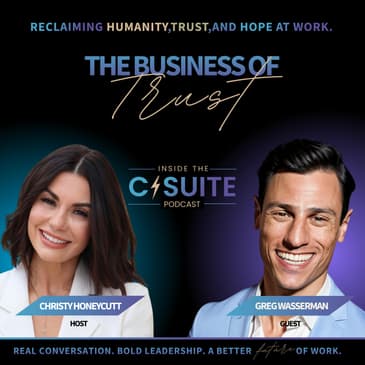
In this episode of Inside the C-Suite, Christy Honeycutt sits down with Greg Wasserman, a master relationship builder whose career spans media, advertising, business development, and podcasting. What begins as a conversation about podcasting quickly evolves into a deeper discussion about leadership, influence, communication, and why relationships remain one of the most valuable assets a leader can cultivate.
Greg challenges conventional thinking around growth, networking, and leadership effectiveness. Together, Christy and Greg explore why trust has become a competitive advantage, how vulnerability strengthens teams, and why the leaders who create the greatest impact focus less on extracting value and more on creating it.
This episode also doubles as a mini-masterclass in podcasting. Whether you're a host, a guest, a business leader considering a podcast, or simply curious about the medium, Greg shares practical insights, common mistakes, and hard-earned lessons that every podcaster should know. From measuring success beyond downloads to building genuine audience engagement, this conversation offers actionable advice that applies far beyond the microphone.
At its core, this episode reveals a simple but powerful truth: people rarely remember the transaction. They remember who listened, who showed up, who created value, and who invested in the relationship before expecting anything in return.
Strong leadership is often less about accelerating outcomes and more about building trust long enough for extraordinary outcomes to emerge.
What you’ll learn:
- Why relationship-building is a leadership advantage
- The difference between managing people and leading people
- How vulnerability strengthens trust within teams
- Why transactional leadership eventually limits growth
- The role podcasting can play in building executive influence
- How podcasts create long-term relationship equity
- Why downloads can become misleading success metrics
- The importance of audience engagement over audience size
- Podcasting dos and don'ts for both hosts and guests
- Practical tips for creating better conversations and stronger content
- How consistent communication builds organizational trust
- The hidden ROI of investing in people before opportunities emerge
If you're looking to become a better leader, communicator, networker, or podcast guest, this conversation delivers practical wisdom you can apply immediately.
| Connect with Us |
Follow Greg Wasserman:
LinkedIn – https://www.linkedin.com/in/gregwasserman/
Company Page – https://www.linkedin.com/company/rsscom/
Instagram – Greg Wasserman (@gwassermusc) • Instagram profile
Company Page - RSS.com (@rss_podcasting) • Instagram profile
Website – https://rss.com/
(Greg Wasserman, Head of Relationships at RSS, is a relationship-driven media and podcast industry professional whose career spans advertising sales, business development, and strategic partnerships. After spending over 15 years in media and advertising, he transitioned into the podcast ecosystem, where he focuses on building trust, fostering meaningful connections, and helping leaders rethink growth through long-term relationships rather than short-term transactions. His work centers on communication, partnerships, and the intersection of audience-building and authentic leadership.
Follow Inside the C-Suite:
LinkedIn – https://www.linkedin.com/in/christyhoneycutt/
Subscribe on Spotify – Inside the C-Suite
Subscribe on Apple – Inside the C-Suite
Want to be on the show or know someone who would be a great guest?
Contact Form – Inside the C-Suite Podcast
Powered by the WRKdefined Podcast Network.
[00:00:00] Podcasting is a long-term game, just like relationships are long-term. So if you are treating a podcast as a way to build relationships, Christy, I've got a podcast that talks about leadership and I love to bring you on and talk about leadership because I've listened to some of your stuff or whatever the pitch is that you want to go ahead and get. Most likely that person's now going to say yes. Now I've got the 30 minutes prep call, the 60 minutes of actually recording with them. That's 90 minutes with a person that
[00:00:29] never would have been able to get on the phone because they would have had a guard up saying, this person's just trying to sell to me. And now I'm not trying to sell to you. I'm actually trying to extract your knowledge to share with the world forever because that's the joys about this is unless I take down the video and the podcast, it's going to live up there so people can consume it.
[00:00:49] That is the way to do it. Hi, I'm Christy Honeycutt. I'm your host for Inside the C-Suite where execs get real about leadership, impact, and what truly drives high-stake decisions. Let me ask you a question. What if the most powerful growth strategy for leaders right
[00:01:15] now isn't a sales team, a marketing funnel, or even AI, but a conversation? Today, I sat down with someone who doesn't just believe in relationships, he engineers them. Greg Wasserman is the head of relationships for RSS.com and the CRO of Time and Relationships. Greg is known as the relationship generator. He's helping leaders rethink podcasting as one of the most underutilized growth levers in the business. If you're leading and you're not thinking
[00:01:43] about access, trust, and proximity, you're already behind. This is one episode you don't want to miss if you're teeter-tottering on should you be a guest on a podcast or should you host one? Join us, find out more. Let's dive into this mini masterclass from Greg and learn the do's and don'ts. Let's jump in, shall we? Greg, thank you so much for joining us on Inside the C-Suite. Can you tell us where you're joining from? Because I know my introduction did not do you justice. So tell us a little bit
[00:02:13] about where you're from and what you do. So born and raised in Chicago, based in LA. Shout out to always hometown will always be Chicago. Spent 15 years in the media industry doing ad sales before spending the last five years since 2021 in the podcast ecosystem. I've always considered myself a relationship-focused person, whether it was a kid up until now in my 40s. And so for me, it's always been be of service and how do you leverage relationships? I mean, I'll age this
[00:02:41] in the sense that we are recording right after Mother's Day. And I spent a good portion of yesterday sending texts to all the mothers in my phone that like, hey, here are my friends. And like once a year, that's all you have to do. So that's kind of way I operate. I love that. So you definitely are known as the relationship guy. I know you are my people because the first time we met, it was like, oh, how can I help you? Here's my people, right? We meet good
[00:03:05] people. You want to expand that circle. So I know that you're doing a lot of stuff in the podcasting space. And I know that it's also driven by relationship. So what is it? What's the first memory of relationships and why they're important to you? And I always love telling the story that when I was a kid, it was my brother. I will consider him the brains of the family. I was more of the athletic side, right? But at the same time,
[00:03:30] I was very much like my mother. You make friends with everyone. So I had friends in the sports groups. I had friends that were in the nerd sides. I had friends that were in the magic, the gathering, like whatever the group was, I had friends, but like, that's kind of just the way things go when you're younger, especially when you're figuring out identity. I was friends with most everyone. And you realize, hold on, just because we play soccer together and then you're off, I don't know, being an AP math student. And that's just definitely not my thing.
[00:03:58] Like, well, we're all connected here. Like, why can't we connect in other ways outside of just this one? And so it was always looking at how do we create those connections? My birthday was always the fun part where how do I bring all my different groups of friends together who never really met each other, even though they're all in some kind of circle together. And it's just ultimately been that. So that's how I've always lived. And then when you get into the sales world where most of my career was, it was the belief of, you know what? I know I'm
[00:04:25] trying to sell you this product, but I don't know where our relationships will take us because you learn really quickly. At least you shared. Most of us don't stay in one job for 40 years like our parents did. So if you start understanding, if I could connect with this person and I like this person, even though what I have to sell is not what they need right now and what they're buying is not what I'm selling right now, it doesn't mean that when our paths go into different places,
[00:04:50] we can't work in the future. Or as I always looked at, I may not have a solution for you, but I know friends that do. And so let me be the person that guides you into, hey, I'm going to save your email from a thousand people that are cold emailing you right now going, hey, here's three people that you just told me that you are probably going to want to talk to based on what you're trying to buy or what your solution that you need is. And let me help you that way. And then that creates the relationship right then and there. I love that your heart's
[00:05:17] so open because you do listen to the people you're talking to and you're able to identify a need and kind of connect the dots. And that is a very rare leadership skill. So I'm just curious because I know everybody has a defining moment and I'd asked yours. And now most of you, if you've come on my show or you're coming on my show, I send a very brief survey. It is not scripted, but I do ask this question and I'd like to know what, what was your defining moment? You mentioned
[00:05:41] bad bosses and a culture led by fear, which we know isn't leadership. Tell us a little bit about your defining moment and what that taught you. So my first job out of college was in retail management with Meyer and Frank, Robinson's May, Meyer and Frank, which quickly day one got acquired by Macy's. So 10 months later, we're all laid off. There goes that. And so the next job I had actually got me into Yahoo and got me into the advertising world. And I think what, in less than a year into it,
[00:06:09] I was promoted from sales rep to manager. So I look at that as a defining moment. It's like, hold on, I am young. I have no clue what I'm doing. No one's teaching me. The standard made it into management based on the fact that I was really good at selling and hitting numbers and they needed someone to, to come in there. So now I've got an existing team that's well bonded beyond me. And I'm just grinding away, head down, let's keep doing this. And now I'm like, hold on, I've got to actually
[00:06:38] manage these people. And so based on the directions that I was giving, that's how I was managing until a coworker of mine said, Hey, Greg, and she helped me understand, let's connect with the people. Let's understand them. Let's sit down. And that was a defining moment because from then on it wasn't, let's do one-on-one so I can understand your book and then crack a whip. It was more of, Hey, how do I understand your book? And how can I help you? Like, what is it that you need that's
[00:07:05] going to support you in this? As opposed to your numbers are terrible, go call more people or go sell more. It was more of like understanding what that person needed and who that person was. There were some people on the team. It was like, this is a job. I don't care to be a top salesperson and achieve X, Y, and Z. Like I'm content. Great. How do you understand what that person needs? Because they're good. They're actually a top performer, but they're not looking for anything beyond that.
[00:07:34] You're not going to get anything beyond that. And so you start understanding the needs and and the wants of each of your team members, but also how to coach them as opposed to what most sales managers and most managers I think would actually do is you're supposed to help me make me look good, which is true. But how do I make that happen for us both? So what I heard you say, which I love because I've had the same experience and anybody watching this probably has had the same thing is that you moved from managing to leading, right? So all I knew when
[00:08:04] I got thrust into leadership, same thing, which is I'm really good at this individual contributor thing that they want to replicate it. But all I had was bad examples of what I didn't want to be like, and some examples of what I aspired to be like, and I fell terribly short, but you learn and grow as you go. So it's so beautiful that you had a colleague pull you to the side and kind of help navigate that, which is probably where your career took a change. It sounds like.
[00:08:29] A hundred percent. I mean, it went from probably pissing everyone off on the team, right? To actually creating a team environment, to actually creating a cohesion that really allowed us to really, to understand this isn't why you are an individual contributor. There's a team level. And then it was also the, how do you provide clarity when clarity wasn't given, right? When management's telling you we're doing this and you go back to the teams, like we're doing this and
[00:08:57] everyone's going to ask like, why? And if your answer is because I was told to as a, as a child, no one enjoyed that when you were getting parented as that way, right? So how do you go ahead and build that trust and go, look, I know this is a terrible situation. This isn't my decision. This is coming from well above my pay grade, but we can at least understand I'm in this with you. I understand why the decision is being made. We may not like the decision, but how do we move forward? And you start,
[00:09:26] as you said, moving from management to leadership and understanding that whole component. No, that's such good guidance. And I know we've all felt it. So what, so obviously that unlocks, unlocked something special in you and how you lead. Were you able to identify exactly what that unlock was? It was really, it was being vulnerable with your team members, right? And, and it was years later when I follow what Brene Brown says is like, okay, there's a, there's a way to do it without telling
[00:09:54] them everything about you or everything that they need to know, but also still giving them what they need. And that really helped. I think if I looked at once I left Yahoo and then I stepped back from management, went back into the individual contributor side and like, okay, what are these bosses that I now have and realize they're not doing what I, what I thought I was doing so well as a manager and, and as a leader. So it gives you that perspective of like, okay, you guys are still just following
[00:10:22] the same playbook of crack a whip or if you sell more, you're going to make more money. And isn't that what you want to make? But no matter how many times I told them my motivation wasn't making more money, it was actually doing right by my client, because if you do right by your client, they're going to be happy, which means they're going to come back and not only spend with you again, but probably spend more because you were successful. Or even if the campaign didn't succeed, they'll still come back with you later on because you still have that trust. You weren't just
[00:10:49] trying to be transactional. And that became something I learned quickly. Once it became in leadership, it's like, Ooh, how do we get out of the transactional mindset and actually start thinking about things from a long-term relationship, but a long-term benefits of not only you, but the company itself. So, and this is what makes you the relationship king because you do get that part, right? And I'd like to talk a little bit about the transactional piece of it, because if we shift into
[00:11:18] your purpose and your drive and what you're known for today, besides being the relationship king, it's podcasting, right? You've got so much great knowledge on podcasting. I fell into podcasting. Absolutely love it. I love holding space for people and having smart conversations. I'm extremely curious, but I'm curious on this question because I went to a podcast conference with William Tenkopf and Ryan Larry on the Work Defined Network. And we learned that in the next three years, they're anticipating
[00:11:46] that every company will have their own podcast. Do you agree or disagree with that? I don't know if the next three years, but I agree that should be just like everyone should have a website. Everyone should have a podcast. It just depends on how you treat that podcast. But I'm a hundred percent on board with, with the three of you in that. So if we go to my next question is transactional, right? Versus authentic and the different things.
[00:12:12] If we challenge the noise that everybody should start a podcast, right? Or at minimum be a guest on a podcast. How do we move them from thinking of downloads and numbers and marketability to actual ROI? Because I think there's a lot of misconception that I'm going to start a podcast. I'm going to be famous. I'm going to get all of these clients. You'll be knocking at my door. And I think that there's two lanes, in my opinion. There are people that get into it for curiosity,
[00:12:40] love and want to drive some sort of a mission. And then there's some that get into it and think, I'm going to make some money off of it. It's not that easy. So I'm just curious from the podcast Relationship King, what's your point of view on that? I mean, I'll avoid the, the correction on that last piece, because I think there's more than just two lanes there, but let's focus on the third leg in. We're learning. I'm curious.
[00:13:04] So what makes my view on the, on the podcast ecosystem that I'm sitting in unique is I spent 15 years in advertising, right? So I was the person who was out there building the relationships with the brands and the agencies to ultimately sell whatever that campaign was. That was my dedicated job that I got paid handsomely for. Most people like yourself, that's not your dedicated job. So if you were to say, Hey, Greg, I need to go ahead and get a sponsor for my show.
[00:13:31] Think about how much time and energy that you're not putting into actually the way you make money, but now trying to go get a sponsor and know that you don't have the skill set, not saying that you're not skilled at the art of selling, but the skill set to go out there and start talking to brands and agencies and spend the time now instead of how do I go find new clients for coaching? Or if you're B2B, the SaaS you're selling, the enterprise million dollar deal, like imagine how much time you're
[00:13:59] taking away from that cold call, that relationship building to now go after brands and agencies, which is exactly what my dedicated job was. So you're, you're, you're taking yourself away from all of that. So you've got that lens where people aren't understanding that, that that is what can go into it. You've got a lot of people that just start podcasting without understanding of why, why am I doing this? And I always love asking like, why are you doing this? And a lot of them,
[00:14:26] the answer is, um, I love talking or I'm told them a good interviewer. I'm told I'm good at getting good conversations or I'm a good conversationalist, whatever avenue it is, but they don't understand, like, why am I doing this? Like, what am I getting out? Oh, I want to be able to tell good stories. Well, that's the same person who's then getting frustrated. Why aren't people listening to my stories? It's like, well, there's an art to it. There's a marketing to it. There is a, a lot more that goes into this. So there's, there's a lot of different paths that go into why you start a podcast.
[00:14:56] So that kind of gives you that. But like, if we get to the core of the question, like three years, why should everyone have a podcast no different than why everyone should have a website. But if we can move away from the transactional, no one likes the pitch slap. No one likes, Hey, Christie, uh, you should buy my product after this call kind of vibe. Cause then it just feels wrong. I've actually, I've been on a podcast where I didn't understand that the nature of it, you kind of understand that
[00:15:24] every conversation you're going to have, there's a sale, there's a relationship, but when does that sale actually come through right after the call, which means right after the recording should not be the time going, Hey, did you know that I sell this? That feels spammy. That doesn't feel authentic. That feels transactional. Podcasting is a long-term game, just like relationships are long-term. So if you are treating a podcast as a way to build relationships and know that as I like to coach
[00:15:52] people, if I could bring in 50 guests that I would love to do business with, love to connect with that, if I were to just call them and go, Hey, Christie, I'm trying to sell X, Y, and Z. You're never going to answer my call. You're never going to respond to my email, but Christie, I've got a podcast that talks about leadership and I love to bring you on and talk about leadership because I've listened to some of your stuff or whatever the pitches that you want to go ahead and get most likely that
[00:16:18] person's now going to say, yes. Now we've got the 30 minutes prep call, the 60 minutes of actually recording with them. That's 90 minutes with the person that never would have been able to get on the phone because they would have had a guard up saying, this person is just trying to sell to me. And now I'm not trying to sell to you. I'm actually trying to extract your knowledge to share with the world forever because that's the joys about this is unless I take down the video and the podcast,
[00:16:43] it's going to live up there so people can consume it. That is the way to do it. Now you get to build the relationships, not like buy my product today, buy my product for when the product and the timing makes sense. So let's keep this relationship going. Exactly. And I love what you said because it was in sales at one point multiple times. And for me, what's really, really hard. And it's the same thing with podcasting is it's your face. It's your voice. It's your message. It should
[00:17:10] be authentic. It should be heartfelt. And the second that you put ego and money over and you said you had mentioned an employer not getting your motivation right. But for me, the second that you put money and speed over what's right, you've already lost the battle. And people know that they know if you're authentic or not. And I too love building long term relationships. I've told people that I work with or for if you've worked with or for me, you have access to me because I always want people that I interact
[00:17:40] with to be successful. And I think that you attract your vibe attracts your tribe. I can say that. But I think it's I think it's a true thing. So I've interviewed a ton of people and I'm curious. I'm a curious person. I always want to learn. So that's why I love it. It makes me better at what I do. But I have come across some people that I anticipated would have presented better. You know, they're C-suite, they're strong, they're leading organizations, but they get on a podcast and they just kind of it's like deer in
[00:18:08] headlights. Right. Have you experienced that? A hundred percent. I mean, I think there's a couple of reasons, right? If it depends on what level of a company or how they hold themselves in some kind of regards where being on a podcast, the whole point of the podcast is to be authentic, to create that connection, to in a sense, be introduced to your audience. In this
[00:18:29] case, you're Christie's audience. If my vibe comes off very sterile, very corporate, and that's not truly who I am, regardless of the fact that I am corporate, people don't want to do business or maybe they're like, wow, this person's so well eloquent. And I think there is that you find your tribe. And so if that's the vibe that you're going to put out, then you're going to attract those kinds of people. But I don't think everyone understands what it takes to just go out there on a podcast and share. I mean, look at
[00:18:58] me. I've been doing this for years and I'm still not as eloquent as some. I've still got the likes, the arms and all the filler words. And, and, and that's just who I am. Right. And you get better. And I think that's another thing that everyone needs to remember is now that I've launched my own podcast, I'm very conscious of like, okay, asking questions versus here. When I go onto your podcast, it's so much easier. You ask the question and, and I don't
[00:19:24] feel in my head that I'm being, I'm saying anything that would, anyone would go like, who is this guy? This is stupid. But when you're in the hosting share and you're trying to extract that information or ask the questions that someone's going to be able to respond to, you get very self-conscious of, did I just ask a stupid question? Did my guests even understand what I was saying? Everyone's listening to this like, right. And I think that's part of the content hamster wheel that we get into. Sometimes we get into our own heads. And I think the value you have to
[00:19:53] remember is when you start recording, which is why everyone should have a podcast, it's going to make you a better communicator. A hundred percent. So if you become a better communicator with the 50 people that you would love to do business with, the love to have as testimonials, love to learn from, I mean, there's so many different ways you can use a podcast beyond just the downloads. And I know I skipped that part of the question, but we can go back into that. It will make you a far better communicator and your,
[00:20:20] in your shoes for as a host and my shoes as the guest, those will all allow me in the business world. So if I'm a leader to be, how do I communicate the answers to the questions that in this case, my host is asking me, well, that's going to make me a better communicator with the VCs that I'm presenting to the PEs, the investors, that whole group, my C-suite managers,
[00:20:44] the employees below me more than anyone out there besides that. I think podcasting as an art form makes us all better communicators. And that's another reason why I believe everyone should have a podcast because especially in the day and age where we're all relying on AI, human connection and the ability to communicate better authentically in human ways will be better for us.
[00:21:09] I love everything you said and I agree with it. I mean, I feel like podcasting builds trust, access, opportunity for relationships, ideation. There's so many wonderful things there, but I have experienced some people coming on the show that I anticipated were just going to be dynamite. They were dynamite on stage talking to thousands of people and they get on a podcast and it's just like deer in headlights. So if I asked you the three top tips for anybody going on a podcast,
[00:21:36] just being a guest, what would you give? What would Greg give as the three top tips for prepping for a podcast as a guest? Always make sure that you do an intro call. I know time is valuable. If we're talking to everyone here who's in a C-suite, I know time is valuable. You may be, I don't have the time for a 30 minute intro call. I only have the time for the 30 minute or 60 minute recording with this person. My time is
[00:22:01] valuable. You're not going to get the best recording. Even if you go in that recording with your canned answers, everyone's going to realize these are just canned answers and it's not going to feel good. And remember the whole point of going on the podcast is not to get introduced to your host audience. It's to make yourself look good. Your host's job is to make you so you look good to their audience. If you do that, it doesn't sound great. So that's why I always tell everyone to spend that
[00:22:27] 30 minutes and get to know who the host is. But also that's where you build part of a rapport that builds part of the backstory that makes the actual recording better. I mean, I couldn't imagine doing this with you without having had already talked to you and go like our vibe. You've already commented on the fact that like our vibe. And so anyone that's listening to this can understand like Greg and Christy had a vibe
[00:22:51] beforehand. We're just not creating this vibe real time for you. And so having that intro call is going to be a key piece. The next one I would say is do a little, do a little research before you get on the call. And in that regards, I would push your host to go, Hey, what are the questions? What is what is it that you're going for? If you want, you can listen to some of the recordings a couple minutes here and there of the host show, but you may not have the time for that. So if nothing else, look at their show notes. That's
[00:23:21] going to tell you a lot. Partly looking at their show notes will tell you, is this a show worth going on? Because they can't get their packaging right. That alone gives you a little like their packaging isn't right. Maybe their content's incredible, but I don't know what people are going to get out of this, even though I know what that, that something will be getting out of this. And that's usually what I do before we jumped on here. I'm like, all right, what do we got? Who's she's talked to? How she structured the conversations? What is her vibe and just her, her descriptions.
[00:23:50] And we all understand that descriptions are done with AI. However, there's a format that each host can go through. I put my stuff through AI, but there's a set format of like what I'm trying to tell as a story. And if I'm telling a story just in my description, then can imagine the storytelling that's going to be coming out of that recording when you actually sit down with your house. I say those would be three big things if I sum it up. Do your prequel, do a little research. The research is not only looking at what
[00:24:18] they've got from their content, but also getting questions back and come in with the perspective. I love that. I think that's so great. I always ask the question, what are the top three things that you're most interested in? Because I want to be able to trickle those in throughout the interview and capture that passion. But I think that's such great guidance. So let's make this usable. Let's say that we're in the C-suite or a founder and we're listening. What is the smartest way using
[00:24:46] podcasting as a relationship strategy and not just a marketing channel? What guidance would you give to those C-suite? So I believe podcasting is the greatest relationship engine that fuels your know, like and trust that drives a content flywheel. So if we take away that content flywheel at the end, we only focus on the relationship component here. Who do you want to talk to and why? And those 50
[00:25:10] people should be a combination of testimonials. So existing clients, bring them on and let's go ahead and have that conversation so that everyone can hear the great work you've been doing. And then the others. So choose whatever variation, say 50 because there's 52 weeks in a year and you should probably take a couple of weeks off. You purpose some of those weeks, you know, you do your end of year recap, whatever it may be in your beginning of the year. Hey, here's a new piece, but 50 recordings is
[00:25:39] good enough. 10 testimonials or five testimonials, because maybe you're new, maybe you're just starting out. Maybe you're, you're literally just in this realm that finding those con clients would be a little difficult, but do that. So you've got your half hour intro call, you've got your hour recording call, and then you're continuing that relationship thereafter. And what most people do is just like we do what we don't do in sales, we shouldn't be doing in podcasting. And when it's sales, we all know,
[00:26:08] once you've sold, the hard work actually happens. Now the customer's in there, you've got to either onboard them, get them up and going, continue that account management, give them a dedicated customer support team, like whatever realm your angle is, if it's enterprise, great, they're getting more hand on. If it's self-serve and mid-market, maybe not. Whatever your direction is, you're constantly staying in contact. Whether it's marketing emails, whether it's a touch points, a QBR once a quarter,
[00:26:38] same thing should be done with your podcast. Once a quarter, bring your guests together and say, hey, I'm bringing all my guests together once a quarter. So if we think about it and from zero to to Q1, that's 12 people. So if I say, hey, three people show up for my first quarter out of those 12 people. Well, hey, that's three people that you hadn't probably talked with during the course of those other 12 weeks that you get to introduce. But now you get to also be the catalyst of bringing
[00:27:06] those people together. Because I have to imagine if you're bringing these guests onto your show, there's a reason that these guests should probably also be talking to each other. Yeah. And you can be the now the catalyst of not only doing business for yourself, but also being the catalyst for helping others. And as I said earlier, it's a great feeling to help others solve their problems. Even if you aren't the solution that you're offering, you are the conduit for that. And they'll remember that and they'll go back to go, you know what? I joined this,
[00:27:36] this quarterly guest webinar or whatever you want to call it. I'll join again because I met some good people and I like the host and I want to, I want to keep learning. And that gives you another touch point. So that gives you the 30 minutes of recording, the 60 minutes, or sorry, 30 minutes, 60 minutes recording. And then once a quarter, so that's now four other touch points, once a four times a year that you get to connect with this person. And the whole point is now your emails aren't,
[00:28:03] Hey, Christy, I'm just checking up on you. Hey, did you know that this is my white paper? Hey, did you know that I'm selling X, Y, and Z? No one wants to buy like that. No one's selling like that. But now you've got those six touch points with this person where you're adding value. Because think about it, a podcast is adding value for that person. It is building their know, like, and trust to your audience. But if you are a good host, you're providing those assets to your guest. So they
[00:28:30] promote you to their audience and you have to remind them, Hey, I know you came on my show. You want access to my audience and your audience may already say this, or maybe you don't have an audience. You're new to social media. And you're like, I don't post them. I'm just testing this out. Start posting, start taking that content and letting your audience know that. And you can do this all with AI where you don't have to spend the time writing, but that's where it becomes so relationship
[00:28:55] driven. And, and I'm a partnership person at heart. So now you've created more partnerships where more business can get done, more deals can get done. You're know, like, and trust is being elevated. And I guarantee you that will all come back from an ROI standpoint, not in the transaction. Did I hit my Q1 goal, but more of, did I hit my yearly goal? And most likely if you can't close a couple of the deals from those 50 people that you brought on or their network,
[00:29:24] because once again, we're getting them to promote you to their network who now know, like, and trust you. And then we go back to the content flywheel. You've now got all this content that you're able to fuel out there promoting the conversations you've had. You should be able to get enough inbound leads on top of those quote unquote outbound conversations you're having from recording that fuel the business that you need knowing very well what your ROI has to be to hit your revenue metrics. Hey guys, if you've listened this far, this is exactly why I want to Greg on
[00:29:53] the show, because we're all trying to figure this out and it's, it's so authentic. Everything you said is so authentic and such great nuggets that you can take back. Have you, what are the top three mistakes that you see podcasts host make? And if I'm guilty, let me know, but what are the top three mistakes you see them make? That's really keeping them from elevating and reaching their goals. They're not consistently posting, right? So there's, you've got this content. What are you
[00:30:19] doing with it? The content you are posting is consistently, Hey, here's my new episode code listing, which you then are falling into the trap of why isn't anyone listening to my podcast? And then that discourages you because you're looking at your download numbers, realizing that this shouldn't be. And I know I'm not dancing around that topic, but we'll get back to download numbers and metrics. And then going back to the pitch slap, you are trying to create this as a, the generation that
[00:30:47] I need to close someone right now and put them into a funnel. I guess if I add the fourth, then on that funnel point is you put this person now into an email funnel. And so you just crushed your, uh, your relationship. You put this person from a relationship into your email funnel. And now other email is being flooded with by this, here's this, what we're doing from a product standpoint. And that person didn't come on for any of that. They don't want any of that. They want to keep
[00:31:17] talking to you and have value. So if you're putting them in any kind of funnel, that funnel has to be nothing but relationship. And if anything, I would not even look at him as a funnel. I would look at it as this is a personal relationship, just like anyone else that I'm connecting with. And I'm following up with, Hey, Chrissy, it was just mother's day. What did you guys do for mother's day? This is what I did with my mother and X, Y, and Z. I mean, that's how I build my relationships. It's how most of my
[00:31:44] emails are. It's pretty much the first three forces just, here's what's going on in life in the last week. And then at the bottom, you know, there's a little something that would be relevant from a business standpoint, if anything, but that's, that's what you're going to do to create the relationship as opposed to anything else is just transactional. We're getting, we're getting a masterclass in podcasting and relationships from you. I love it. It's just so great. So, um, I know we're going to start winding down. So I really want you to hit
[00:32:11] the download because for me, and this is not a popular opinion, I'm not so focused on the download as I am the people I'm holding space for. So I'm just curious what's your point of view on the download? Cause you've kind of danced around it for about 30 minutes. Yeah. So if you follow this framework, you don't care who listens. You don't care about a download metric. And the reason you start thinking about downloads is twofold. One,
[00:32:35] you're looking at how do we get a sponsor? And you then are now selling your audience as opposed to selling your host. And so you're trying to monetize the people that are listening to you by someone else's product as opposed to your own. And that's the joys of having the podcast is you're the brand. So ever you are selling should be the focus, whether it's yourself, it's your services, it's your SAS, your consulting, you name, whatever it is, you are the brand in the
[00:33:04] business. It's B2B. It's that as soon as you start going, well, how do I start making money to cover the cost of this production that I'm outsourcing? Or if I'm doing DIYing it to cover that time, you have switched the mentality of this is a podcast for building relationships and know, like, and trust to I need to build downloads. Anyone can buy downloads. Anyone can buy followers. So then you get into this mentality of are these actually the people that should be listening?
[00:33:33] If I look at it as a room, if I could fill the room with 100 people and they stayed until the end of my presentation, would I rather have that than a room of 1000 people, but 900 of them left in the first five minutes? And the ego goes, I filled the room with 1000 people. And the reality goes, I'd much rather have 100 people listen to everything I had to say, then people come into a room and leave
[00:33:59] and the embarrassment of knowing that they left. And so when you look at the podcast metrics, you can see how long are people listening to. So the download number gets you the ego going, yeah, I filled this room, I got 1000 people. But if the consumption of people are dropping off pretty quickly, that hurts. And most people aren't looking at that number, which is actually if we move away from downloads, that is the number that most of us should be looking at is a person staying
[00:34:24] with you long. And then the other side is, is you don't care about the downloads because it goes back to those 50 conversations, it goes back to the audience that you're building, not just on your podcast, but across all ecosystems. So if we look at 50 people I'm talking to, and the content flywheel that I'm able to get out of this conversation, then I can start aggregating. Well, how are my posts doing? That's an audience because I'm not going to convince everyone to listen to a 45 minute
[00:34:54] conversation. Remember, the point is the 45 minute conversation with your guest. That's the key. That is the goal. And when I record my show, I always ask people, I'm like, Look, do you have a hard stop? If they say no, I'm like, great, then I know we can go longer. And they finally cut me off, then great. But if I can, if I have an hour and a half conversation, knowing very well that most people aren't going to listen to this show, because I'm not paying attention to downloads. But I got an hour
[00:35:19] and a half with a prospect, I'd rather have that thing going, yeah, I got more downloads to people that I don't know anything about. But here I get the hour and a half of the person I actually do know, I get to build that relationship. That becomes the key piece. So if you're using it as for the audience, I get the email content, I get my social content, I get relationships and conversations, and now you're aggregating all those metrics. You're not just focused on a download, which
[00:35:46] ultimately becomes a vanity metric. Vanity metric. Boom. That is a soundbite right there. I just heard it. But, you know, you're so right, because I've had some pretty big players chase me to get on the show. And I'm like, Okay, yeah, you look great. I'd like what your message is. Let's let's have a conversation about it. And then they'll come back and go, What are your numbers? What is this? And I get into that. I'm like, No, no, no, no, no, no, I'm producing the show. I'm paying for the show.
[00:36:11] I'm giving you a platform. I'm not doing homework. So you feel good about it. You approached me by and I there's some pretty big, big people that I've done that to because I'm just like, No, we're not an eco based show here. There are eco based shows somewhere else, just not mine. But I love that you break it down like that. Because I love the people selfishly that are in this for the heart to grow each other. And to like bring insight to the table, which you've brought so much today.
[00:36:38] And I'm so grateful for your time, Greg. Before we drop, is there anything that we didn't share with the audience that you'd like to that I might have missed? I think I want to follow up on that last point is the the how many downloads do you have question, right? So if you are if you are looking at this, anyone that's listening going like, You know what, I'm not going to start a show right now, which once again, you should, because you control the conversation. But if you're like,
[00:37:03] I don't want to invest the time of production, I'm going to go into just guesting. And keep this in mind, even if you go into just the guesting side of it. First off, you still need that repurposing flywheel. So no matter what, you are still going to be doing the time and effort to create that content to help you. Because if all you're doing is going on this person's show, and then you're not doing anything afterwards, you just missed out on a huge opportunity. And you're only looking at their audience as opposed to how do I take the content from this
[00:37:32] conversation with them and fuel my audience and build my know, like and trust further. So you're still going to need to do work there. But you should be thinking about not the downloads, but the relationships in the conversation. So if someone reaches out, says, I want you on my show, your first question really shouldn't be how many downloads, it should be more of a value. Is this a show that I find value with? Is there is there value alignment? Is there an opportunity for us to
[00:37:58] connect that I don't know where this conversation will take me? And I think that should be a fuel and in a sense a soundbite. But that's what I believe life is about time relationships, you have no clue where one conversation is going to take you. So if you say no today, because they don't have the downloads, what are you actually saying no to is the future when that person does. And that's exactly what happened to me. I was a guest on someone's show never would have thought the show would have blown up. They're now doing millions of downloads. And because
[00:38:26] I've already been recorded when they first started on part of that back catalog, back catalogs get like 80% of downloads, depending on how they promote it. You are in that person's ecosystem, you are in a sense riding that person's coattail if you want to look at that way, because they spent the time and money to build their show to something larger than just what you and I are discussing here of like, forget the downloads, let's build the relationships. They're following a very different business model,
[00:38:54] props to them. But hey, you get to to enjoy that. So don't be focused so much on the downloads, whether you're a guest or host, focus on the relationships. Boom. I need sound effects for your episode. It's so fantastic. Well, Greg, again, thank you so much for holding space for myself and the audience. And from my heart to your heart. Thank you. Because there's so many people that need to hear this. And I just I do this show selfishly because I care
[00:39:18] about others. And I want everyone to succeed. So how can people get ahold of you? And and what would you like them to get ahold of you for? Is there anything that you'd like to ask the community for? I live on LinkedIn. So that's where you'll find me. So yeah, please go ahead, connect with me on LinkedIn, Greg Wasserman. You can't miss it. If you're listening, you don't get to see the face, but you get to see the tagline will be like relationships. You'll figure out exactly which
[00:39:46] Greg this is. But yes, please. I love when you reach out for a couple of reasons. One, I will talk to anyone. But the other reason is it gives Christy the feedback. And that is the greatest gift. If you reach out to a guest of Christy's or any show that you're on, we are currently talking into a void. Like I have no clue. Truly. I don't know how many downloads Christy has. I don't know who's going to listen to this episode. I don't even know. Christy doesn't even know who her users are that
[00:40:12] are listening to this unless you engage, unless you reach out, unless you comment. So by you saying, wow, I really loved what you have to say. I would love to talk or I got nothing to sell at the end of the day. I mean, Christy and I talked about this, but like I'm not offering any consulting. I just, my business is relationship generating. And so the more people I talk to, the more I'm like, oh, what's the solution you're trying to do? And how do I connect the dots for you? So in a sense,
[00:40:37] when you reach out to me, you're getting access to my network. And then I start thinking about how do I build this relationship with you to connect you with the relationships I already have to help solve your business needs. And that's where it all comes together. But it all starts with the conversation. So please reach out. Love that. Thank you. And I love what you said. Support your creators. We're in a creator economy. Support your creators. Like, follow, comment, reach out. It's so exciting when stuff resonates because then we know we're on the right track and we want to keep doing more things
[00:41:06] that you guys like. So really good tidbit there. I mean, I don't know about you, but anyone that's listening probably is in the same boat is someone you run into and they're like, oh, I loved your content, but they never liked it. They never engaged with it. And you're like, I didn't even know you were following. I mean, I know you follow, but I didn't know you actually read what I do. Please just engage comment. But getting this verbal comment from you out of the blue was, was great. So getting a DM
[00:41:31] or getting an email to Christy saying, hey, I really liked this episode, or this was a great guest or whatever it is that you want to provide. Or the flip side is, you know, this is bad. As a host, we all want, we want the feedback. We take it with a grain of salt, but if we're not getting feedback, there's no way for us to improve. And that's regardless of the fact that we're using our podcast for the relationship engine. It goes back to, we're using it to be a better communicator.
[00:41:57] So if you give me feedback, I can communicate better. I communicate more effectively, not only just to you as a listener, but also to anyone in the ecosystem of my life. Amen. All right, guys, if you've been with us, thank you so much for entertaining. And listening to the wonderful Greg, I'm going to butcher his last name, Wasserman. Did I do it right? There you go. Right. Connect with him. Follow him. He's doing some really interesting things. Hence how he ended up here. I actually saw one of your posts and hit you because we needed to
[00:42:27] chat. So tune in, subscribe, like, leave positive comments or DM me for the negative ones. Ciao.
Sponsors
