
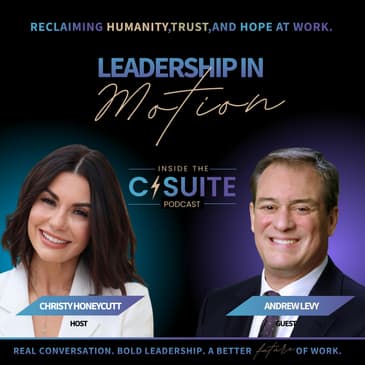
Avelo Airlines is entering a new chapter of growth—and North Texas is part of that story.
In this episode, Andrew Levy sits down with Christy Honeycutt and shares the leadership philosophy behind building Avelo: simplify travel, meet customers where they are, and rethink how air service connects everyday communities.
That vision is now showing up in real time with Avelo’s planned expansion into McKinney National Airport in North Texas—a move designed to shift travel away from congestion-heavy hubs like DFW and toward local convenience, speed, and accessibility.
For Collin County and surrounding communities, this isn’t just new service—it’s a structural shift in how people move. Shorter lines. Easier access. Point-to-point travel that prioritizes time as much as cost.
At its core, this expansion reflects something deeper we explore in the conversation: LEADERSHIP is not only about scaling a company—it’s about reshaping how people experience a system (inside and out).
This isn’t just another airline entering a market.
It’s a bet on a different behavior entirely—
that people will choose proximity over complexity, and simplicity over scale when given the option.
If it lands as intended, it doesn’t just add routes.
It redefines dependency—moving from large hub reliance to local convenience.
-
Leadership is shaped more by experience than theory
-
Complexity demands steadiness, not perfection
-
Communication gaps often become leadership gaps over time
-
Accountability is not about blame—it’s about ownership
-
Identity can shift when roles change unexpectedly
-
Failure is a requirement for meaningful leadership growth
-
Culture is not controlled—it is continuously shaped by behavior
-
The strongest teams are built on trust, clarity, and responsibility
-
Talent is less about pedigree and more about character and discipline
-
Staying grounded is a leadership practice, not a personality trait
00:00 – Introduction & Andrew Levy background
01:15 – What Avelo Airlines is building
04:10 – The strategy of convenience and everyday low fares
08:09 – Leadership under tragedy and operational complexity
13:37 – Career evolution and lessons from multiple airlines
18:30 – Identifing high-potential talent
22:01 – Why failure is essential to leadership growth
25:42 – Growth through termination
28:35 – Identity shift after leaving a long-term leadership role
32:30 – Building Intentional culture
35:21 – Defining values and hiring for alignment
38:17 – Perspective on travel, patience, and human behavior
40:49 – Closing reflections on leadership and Avelo’s future
🎙️ Watch the full episode here: Podcast — Christy Honeycutt
| Connect with Us |
Follow Andrew Levy:
LinkedIn – https://www.linkedin.com/in/andrew-levy-0b70931/
Company - https://www.linkedin.com/company/avelo-airlines/
Instagram - Avelo Airlines (@aveloair) • Instagram profile
Website - Homepage
Facebook - Avelo Airlines | Houston TX
(Andrew Levy is the Founder, Chairman, and CEO of Avelo Airlines, an ultra low-cost carrier he launched in 2021. With over three decades of experience in aviation, he has held senior leadership roles at major U.S. airlines, including serving as CFO of United Airlines and Co-Founder and President of Allegiant Air. Today, he leads Avelo Airlines with a focus on making air travel more accessible, efficient, and affordable by serving underserved markets and building a streamlined, customer-focused operation.)
Follow Inside the C-Suite:
LinkedIn – https://www.linkedin.com/in/christyhoneycutt/
Subscribe on Spotify – Inside the C-Suite
Subscribe on Apple – Inside the C-Suite
Want to be on the show or know someone who would be a great guest? Contact Form - Inside the C-Suite Podcast
Powered by the WRKdefined Podcast Network.
[00:00:00] Sometimes we have inflection moments that shake us a little bit. So that's why I was curious to how that hit your identity because there's been so many people without work or going through transitions and they're all trying to figure out what's next, right? And the path isn't always straightforward. How does that change how you now elevate leaders differently?
[00:00:17] Well, that's a really good question. You know, number one people and organizations is to really try to do my best to pick really good people, support them, empower them, guide, coach, mentor, but let them do their thing. Like I tell the many executives that I hire or have on my team, if I need to tell you what to do, then I got the wrong person. I want you to tell me what we should be doing, not the other way around. And so you need to have a great team.
[00:00:46] And my focus has always been, let me get out of the way. I'm very, very careful not to go around my leaders in a way that would cause their authority to be in any way viewed as being undermined because then...
[00:01:12] Hi, I'm Christy. Welcome to Inside the C-Suite where execs get real about leadership impact and what's truly driving high stake decisions. I'm honored to have on the show today, Andrew Levy. Andrew is the CEO of Avello Airlines, an industry veteran. He's seen both hyper growth and the kind of moments that redefine leadership forever. Hi, Andrew. How are you? I'm doing great. Thank you. How are you?
[00:01:38] I'm good. Thank you so much for holding space for the audience today. I'd love you to introduce yourself and briefly, you know, what you guys are doing at Avello. Sure. Well, I'm the CEO of Avello. I'm also the founder of the company. You know, some people would view us as an ultra low cost carrier. I don't like that moniker. I think we're just a high value new entrant on the scene. You know, we've been around five years now, but compared to American or Southwest or Delta or others, we're relatively new.
[00:02:05] But we offer everyday low fares, reliable transportation. We focus our efforts on going into secondary airports of large metro areas where we can offer something that's just far more convenient than the alternative of going into the big airport. Like in your case, DFW, for instance, will be in a place nearby in the outskirts that'll make it really easy for the people who can access that. So that's what we do.
[00:02:30] I love that. And for all of our Texas friends and family, do check this out because it's a beautiful airline that does service to underpopulated areas where they have to take a hop. I know most people have to take a hop into a major city and then to another location, but you're making that more available with direct flights. We offer everyday low fares. That's in today's high fuel price environment. As of the past few weeks, that's becoming a little less of a common theme that you see out there.
[00:02:57] But we're very, very budget oriented, I'd say, in terms of consumers, right? We'll save you money. But I think what makes us unique is the focus on also saving you time and making it easier. I've yet to meet anybody who'd rather fly out of a really large airport if they could do the same thing out of a smaller airport that's conveniently located to them. So in the Dallas Metroplex area, we're going to be serving McKinney up in the northeast quadrant of Dallas.
[00:03:24] And for the people who are reasonably close to McKinney, it's just going to be a terrific option for them because you're going to be able to park your car right in front of the terminal, get in a line, the short line at the counter, TSA. Next thing you know, you're on the airplane. It's going to be a piece of cake. And, you know, you can't do that at DFW. Love Field's certainly a lot easier than DFW, but this is a different level of ease and convenience. And that's really our calling card is we inspire travel. That's our purpose.
[00:03:52] And we do that by saving people not just money, but also time. When you guys had, what was it, 2.6 million passengers in 2025? That's significant. That's nothing to blink at. And where are the other hubs, like the major hubs that you have right now? Well, our largest one is up in New Haven, Connecticut. So we serve the entire southern Connecticut region out of there. That was an area where before we went in there, most people would go to LaGuardia, which is an hour and a half drive.
[00:04:21] There's a lot of people in southern Connecticut. And so that's taken off and done exceptionally well. So that's by far our biggest location. Our second largest location is we call it Philadelphia Wilmington. It's an airport in Wilmington, Delaware. It's just south of Philadelphia. And again, it's a nice, convenient, easy-to-use airport that is on the southern, I guess, outskirts of a massive area in terms of Philadelphia metro area. We also are in Charlotte Concord.
[00:04:51] Concord is just outside of Charlotte. It's right off the Ring Road and 85. It's right next to the Speedway, if anybody likes racing. And so we're very excited about that opportunity. You know, Charlotte's a dynamic, very fast-growing and already pretty good-sized metropolitan area. And then lastly, we have a presence in Lakelands, Florida, which we call Orlando Lakeland. Actually, maybe closer to Tampa, but it sits right in between Tampa and Orlando, just off the I-4.
[00:05:18] And the I-4 corridor, kind of like Texas, where we are, that is one of the fastest-growing areas in the United States, filling up with population in between both Orlando and Tampa. And we're situated really nicely in between the two, again, with a very nice, easy-to-use small airport. So those are our four bases. We're thrilled about McKinney. That'll be our fifth. We expect to open that in November as soon as the airport's ready to go. Well, you've already got a fan, so I'm super excited to try you guys out. We'll have to see how that goes.
[00:05:47] Well, this is a leadership podcast, and I know that you have led through so many different things. And most leaders are taught, you know, to be confident and to be decisive and to be even optimistic. And seeing, Andrea, I know you've led through tragedy, volatility. I mean, look at our environment today. I'm sure that that's brought a lot of challenges to you recently, everything from navigating the airport to safety and customer service, et cetera.
[00:06:14] So your philosophy is more of like a stay steady philosophy. Could you share a little bit about that? Yeah. And I'd say one other thing about that, the way I view things, is I believe in being very genuine and very authentic. I wasn't taught leadership. Maybe it just comes natural to me in some ways. I guess I could point to a lot of cases in my childhood where I suppose that's the case. But I've just always been very genuine, very authentic, and also honest and direct.
[00:06:44] And I think that those are really important attributes for any leader. At least it's certainly worked for me. As far as staying steady, I think that for me early in my career, I've had a very kind of eclectic career.
[00:06:55] It's been mostly in aviation, but I've touched a lot of really interesting elements and a lot of interesting things from startup airlines to being chief financial officer at United Airlines for a period of time, being an investor in early stage airlines, and then working with Frank Lorenzo, who's kind of an industry titan of the past. But working with him and doing things in international jurisdictions on aviation.
[00:07:22] So I've touched a lot of things in different sizes, shapes, and forms. And through that experience, I've had two perhaps that are, well, maybe there's three really. I mean, my first job was at Value Jet Airlines, which was an upstart airline back in the mid-90s. It was a phenomenal company. It was just doing things no one had ever done. It was kind of basically modeled after Southwest, and it was in Atlanta.
[00:07:47] And we were growing like crazy, doing exceptionally well financially, embraced by our customers all over the eastern United States. And then we suffered a terrible tragedy. We had an airplane that crashed. 110 people died. This is back in 1996. And that still leaves a mark. I'm getting chills as I talk about it.
[00:08:09] But, you know, when you see the highs of the high, the ultimate highs, and then you literally see the absolute ultimate low in terms of just seeing not just a complete change to the business, but more importantly, what it, you know, the human effect of 110 people losing their lives. And that is, you learn a lot from that.
[00:08:31] I think that that plus my next foray was in an operating business was in telecommunications, which similar trajectory, just right space, right time back in the dot-com era in the late 90s. This company's stock just took off like an absolute rocket ship. Made no sense. Looking back in time, at the time it felt like it made perfect sense. Actually, you know, months later, we're just getting ready to go file for Chapter 11.
[00:08:54] Seeing how high you can go and how fast things can really change has, you know, I think that's really allowed me to gain a lot of perspective at a really young age. Because the telecom company, I left there when I was, I think I was 31. So just in my 20s, I was able to see those two examples of just incredible highs and incredible lows.
[00:09:21] And I think that's, that's helped me as I've gone forward and in trying to maintain steady balance on not getting too excited, not panicking, always trying to stay in some kind of middle ground. Doesn't mean I don't get emotional because I do. I get upset. I get angry. I get happy. But, but I try to keep things in perspective. And I think when you have experiences like that, it helps you do that. I believe it rewires you as a leader. It has to, right? When you experience like high success and such low losses.
[00:09:49] And you said that, you know, you could feel it in your body now when you're talking about the 110 souls that were lost. What was that like to lead in that moment? And, and how did you keep your team together when they're looking for certainty when there might not be certainty? Well, at that time, I didn't have a lot of people reporting to me. In fact, I'm not even sure I had anybody. I was in a kind of a, I was in a leadership role as a director of contracts, but I was in a more of an individual contributor position, I suppose.
[00:10:16] But I touched all aspects of the business because of the nature of my job. And one of the areas that I had oversight was the underwriters, the insurance companies. And so for me, within hours of learning of the accident, I was down in Miami where I spent the next week, which was just a very emotional experience getting off the airplane at the airport and seeing TV cameras everywhere and just grief from friends or family of those who were lost.
[00:10:43] It's like nothing you've ever seen before to be in the middle of a mass tragedy and spending a week around the families that were there seeking information about their loved ones. Quite an experience. It's one I wouldn't wish on anybody. It certainly has helped me, I think, from a just pure airline executive perspective. It certainly made me forever more really, really wanting to emphasize how important safety is at all times. And there were a lot of causes to that accident, just like there always are in any accident.
[00:11:12] But yeah, that left a big mark and it helps put things in perspective in a big way. So maybe that's the biggest one. No, it's great. I have a friend who, you know, American Airlines lost a plane a couple of years ago and I checked in on this individual. He was a mechanic on the planes. I said, you know, how are you doing? And he said, you know, I'm really glad you asked that question because no one's asked that question. And he said, we're mourning. We're mourning. And, you know, we're going over everything.
[00:11:42] We're trying to figure out where it went wrong. But they were mourning the loss of those passengers and the fact that that was their job to keep those planes safe. Right. So they had a lot of survivor's guilt. And it's a big responsibility. And I know it's got to change you in the way that you lead more humanly, more authentically. I think there's no question. I mean, that had a huge effect on my career and my life and how I think about things. And I'm sure that translates very much so into how I lead. Well, from a leadership perspective, how would you take that?
[00:12:12] Not that that's a lesson. It's an experience. But how do you take that experience and maybe instill what you learned into your leaders that you have today? Well, I don't know if that one really forms me as much as maybe things that have happened since then. That was the first position in my career. So this was a long time ago. And so I've been through a lot of other interesting experiences along the way.
[00:12:36] I think that certainly the first operating companies, those first two examples taught me to kind of stay steady. But it also teaches you how quickly things can change. And things can change for the better or for the worse. So, I mean, it's not always bad change. Sometimes things can happen and very quickly things can happen that are much more favorable. And I certainly saw that at the place I spent the most time in my career was with Allegiant. I was a co-founder of Allegiant, which has now become a pretty large, well-known airline.
[00:13:06] Headquartered in Las Vegas. Maury Gallagher, the chairman and still largest shareholder there. He and I took the company out of bankruptcy back in 2001. And we worked together for 14 years. And we built something that's really, really special. Continues to this day. A lot of the leaders who are now the president and the CEO actually kind of came up under the ranks when I was there. And had a lot of, actually one of them I was very involved in hiring and mentoring.
[00:13:34] You know, there are a lot of experiences there along the way. A lot of lessons learned. Seeing a company go from one airplane when we took it out of bankruptcy to 70 when I left. And now I think it's, they have 150 or so. They're doing a big acquisition to get much bigger. And so I think that, you know, just as you get older and you have the ability to experience more things and lead in different positions. I was president of the company there for the last five years.
[00:13:59] And certainly elevating to that level, you learn a lot about how to lead. And it's very different than when you're at a more junior level and certainly when you're in a smaller enterprise. That certainly changed for me when I went to United, which was, you know, massively larger. And I had to kind of take my genuine authentic self, which I think actually in some cases that that company was viewed with a certain amount of confusion.
[00:14:26] Because I do think at larger companies, it's more typical perhaps for people to be maybe less authentic. But certainly to be effective in that environment, you know, 100,000 people that work for the organization and global spread. You had to do things a little differently. But what I took from that on maybe it's steroids, I guess, is how important it is as far as what you do, what you say, how you act, you know, even the way that you stand and walk.
[00:14:54] And I mean, everybody's watching and everybody is kind of seeing cues. And especially as a CFO and maybe a little more so as to like, OK, are we OK financially or are we not? But anyway, I think that every experience shapes you a little bit. And as long as you're, you know, a lifelong learner, which I am, I love learning new things. And but yeah, I mean, I'm obviously it's one of the benefits of experience. You get older, you do get gain a lot of experience. You get a lot of wisdom comes from it. We do.
[00:15:22] And, you know, we're living and working in a multigenerational workforce. And you and I were speaking earlier about the sandwich generation. I'm still taking care of kids and now leaning into my parents as they age. As you you're known for spotting top grade A talent. And I think talent looks different at different places. And you and I both obviously love authenticity and vulnerability. When you look at the talent that you've spotted, how is that different for you?
[00:15:50] Because I think you've got maybe a different viewpoint on how you can identify talent. How do you how do you seek out those hyper performers like you know something special? So, yeah, I would say that I do not care where somebody went to school. I'll start there. I literally could. I like it. In fact, I don't even care if somebody has graduated from university. That means nothing to me. Now, the facts are that usually the filters that are out there help you.
[00:16:20] You don't see that many people. However, one of the top performing people we had at Allegiant was a guy who never went to college. He is absolutely fantastic. I'd hire him in a heartbeat. He finished his role at Allegiant at a very, very senior executive level. He was outstanding. And I think that, you know, if you get focused on things that I think don't matter, which is what's on your resume when you come out of college, I think you tend to lose out on really, really great talent.
[00:16:49] So I put no weight on that whatsoever. I do put weight on things like if you did go to college, how'd you do? But more importantly, because I didn't do great. I did fine. But, you know, I was not a summa cum laude or anything like that. But I think that what I look for is there's a few common themes. I love athletes.
[00:17:08] If you played sports at a high level right there, that's a big plus for me, because in general, what that means is that you have been somebody who's committed yourself to excellence in athletics, which takes a lot of sacrifice and a lot of dedication, especially as you keep going at a higher level. And those people are typically competitive and very, they want to win. You know, they want to win. They want to improve. They want to get better.
[00:17:37] So those are traits that are they're not exclusive to people who have been athletes. But but but you do see that a lot with people who have been in athletics at a high level. So that's something that I look at. I also look at, you know, what kind of jobs have they had? And I'm not necessarily looking for blue chip jobs. I'm looking for, hey, were you waiting tables because you had to? Or were you out there just hustling, doing whatever you had to do?
[00:18:04] Right. I mean, because I think that those are kind of character traits or they at least point to certain character traits. You had a summer internship at IBM. Good for you. That's great. But what does that do for me? Right. Nothing. Doesn't tell me anything about you. Just, you know, I mean, and it could. I mean, I'm not saying that's bad, but it doesn't tell me as much. And so what I look for are people who when I interview, I really focus on the character of the person. You know, who are you? What makes you tick? Do you listen?
[00:18:33] Listen. That's one of the biggest, biggest things I actually focus on is do you listen well? You know, if if you're just thinking about what you're going to say next, then that just means you're not listening. And a lot of people do that. So I try to weed. I try to weed that out as well. But I always have enjoyed bringing on people that are younger. And it's probably a little bit of a bias because when I was young, I had those types of opportunities.
[00:18:59] When I was in my 20s, I was I was given enormous scope and responsibility. And I know how much I was able to learn from it. So I guess I've always maybe had a little bit of a bias to kind of maybe pay it forward, so to speak. But we did that at Allegiant. We hired an enormous number of incredibly talented people who are in their 20s. And most of them, if not two person, they didn't go to the top tier schools. And they are phenomenal.
[00:19:27] And they are in leading roles at executive levels at airlines all around the United States. So I think that we clearly spotted some great, great people, helped them grow by giving them a lot of responsibility, pushing them, making sure they had different experiences. And but most importantly, you know, you don't have to teach them to work hard. You have to teach them to care. You have to teach them to want to exceed. That has to be within you.
[00:19:54] And so finding people like that is, I think, the trick. And then, of course, supporting them and letting them do their thing. So I've had a lot of success with that. This is what I heard. Hopefully, I'm a good listener. You want disciplined, caring and curious individuals. I love that. I think that's great. That's right. And you alluded to mentorship. And a lot of these individuals are now in C-suite roles. Was there anything different with them that shined to be able to put them on the hypo track? I mean, we talked about their background with, you know, the drivers.
[00:20:24] But if you were to share that with someone else, what would they do differently? I think that implicit in this, and it hasn't been stated, but I'll state it, is you got to have. A certain level of intelligence. Okay. And I don't, I was going to say IQ, but it's just a way of measuring intelligence. But I'm not testing people for their IQ. But you got to be smart. I mean, you have to be smart. Right. And you got to be quick. You got to be, you know, so you got to have a certain speed up there that you either have or you don't. You know, I mean, just to be fair.
[00:20:55] Or else you're not going to be able to operate at that level. And at least not in a larger enterprise. Right. I mean, the larger companies are more difficult and more complicated in so many different ways. And it takes a certain amount of just, you know, just, just brain power. But, you know, I think that, I think it's really, maybe it's more than anything. It's a, it's a work ethic that you see. And maybe for me, it's an attention to detail.
[00:21:21] Because I think those in some ways go hand in hand. You know, when I get something that's produced by somebody and it's thoughtful, it's well reasoned, it doesn't have mistakes on it. You know, if I see an Excel mistake, immediately I'm just questioning, okay, what else is wrong here? Right. And if I see a spelling mistake, it's like, okay, this is just sloppy. Right. It just, it just immediately tells you something. And it's not, it's not a good thing. Right.
[00:21:50] So those are the kind of things that when you see that, you see the ability to listen, the ability to communicate a high speed of, of motor skills or intelligence and just skills, being able to be fast and quick. Being able to support a position with data and then having work that inspires confidence because you're not seeing mistakes or sloppiness.
[00:22:15] Those are the kind of things that I think point to people who generally are going to go far, you know? And some people can think very strategically. Some people are less capable of doing that. But in some ways, that just dictates where you're going to go and in what role and maybe how high you can go. I mean, even if you're not maybe the biggest strategist, that doesn't mean you can't be a CEO. You just need to pull it. You need to build a team that helps you with your areas that you're less smart or less capable in. Right. Nobody's perfect. Right.
[00:22:43] And we all, we need to build teams that, that not just help the individual leader, but, but also that can work together. And for the organization, not everybody needs to be able to be great at everything, but you got to make sure you have every piece there. But, but yeah, we've been able to just grow really high potential people and we didn't make them high potential. They were just built that way. And that's the trick is finding the character and the people that really want to succeed and, and have that sense of the drive to do something great. Whatever that may be.
[00:23:12] Doesn't need to be running a big company. It just means to be maybe just doing great work. And drive for excellence. That was a great, great answer. Well, and, and look, let's go to a place that I know most leadership avoids talking about failure. So can you share with me a time that you failed and what you learned from it? Sure. And by the way, it's interesting you mentioned that because I always try to make sure I ask that question when I interview executives.
[00:23:41] It's tell me about a time you failed. And I make, it's like, I don't care if it's personal business, doesn't matter to me. Tell me about a time you failed. And the ones that can't think of anything and say, okay, you're not the right person for me because everybody's failed. I mean, you can't succeed unless you've failed and you learn a lot from failure and a lot, actually a lot more from failure than success. It's kind of trite, but it's true.
[00:24:05] You know, for me, as I was thinking about that question, staying on a purely professional basis, I would say that, look, I got fired at Allegiant. I was there for 14 years and Maury and I had worked together for an entire time. It wasn't just me and him. There were others, of course, along the way. But the whole way there, it was me on, me and him on day one. And it was, you know, it was, I was the president when I left.
[00:24:31] And, you know, we got to a point where, you know, we just weren't working very well together. And I was already kind of starting to think about going elsewhere. But he made it not my option. And that was not, that was unexpected. It was not a good feeling. I wasn't that upset about it because it was time for me to go. It really was. And I just hadn't kind of come to grips with that, I guess. But it still, it was, it was a failure. It actually took me a while to even recognize it as a failure.
[00:25:01] I think I was just too proud, maybe. And I committed myself, well, I was leaving anyway, so who cares? But it took me a while to realize and look back and think, okay, yeah, you know what? I did deserve to get fired. I wasn't as all in as the role required. I was kind of coasting. I was complacent. I wasn't communicating effectively. I lost sight of the fact that, you know, he's still the CEO. And even if he had given me enormous rope, I didn't think I was the CEO or anything like that.
[00:25:31] But I kind of just, I don't know, I started maybe to marginalize him a little bit. And I learned a lot about that. I didn't know, you know, he and I have had these conversations since then that I failed to continue to really stay close and connected and communicate effectively. And it was that gap that was really my responsibility to do, not his. At the time, I felt like, okay, well, if he doesn't want to know, well, then okay, I don't need to tell him what's going on over here.
[00:26:00] I wasn't trying to hide anything. But it was my failure to keep really close and connected that I think it created a kind of a gap between us. And over time, you know, things got to a point where it just didn't work anymore. And, you know, I learned from that. You know, it's really important to, number one, don't take anybody for granted. And don't take what you're doing for granted. Know that you are, and I used to say this, and I knew it as well, but it hit home the idea that, hey, everybody is replaceable.
[00:26:29] Life will go on without you in that role. Whoever you are, whatever role that is, it doesn't matter. Everybody is replaceable. And that certainly hit home. And I think there's a lot of good lessons to be learned from that. But I think it's also a reminder, too, that, look, I'm not ashamed to say that I got fired. I didn't get fired because I did a bad job. But, I mean, I did a bad job in terms of communicating. The company was doing great. I had great teams.
[00:26:55] But, you know, I failed in staying close and connected. The leader who I supported and my partner, my business partner. Look, I learned from it. And that's what else can you do, right? Like I said, you know, you learn a lot from failure. So I feel like I've learned a lot from that experience. And, you know, I'm very comfortable talking about it. I love that you're so vulnerable, just ripping off the Band-Aid there. So going through that, I mean, I'm sure it had to feel a different way. Did your identity shift in that moment? Absolutely, it did.
[00:27:25] Yeah, that was actually a little bit of a disorienting experience because it was not just like, hey, it's time to go. But it's like it's time to go like right now. And it was like, I think I had a day or two to kind of just say my piece. And that was very disorienting because I was kind of, I think publicly I was the face of the company at that point. Certainly internally, I was viewed that way.
[00:27:48] Not to diminish more in any way at all, but just I was just responsible for so many areas of the business directly. And to go from that and something I've been doing for 14 years and we had a lot of success. We built a great company. And it was, yeah, it was very disorienting because immediately now I'm like, well, what do I do now in my day-to-day life? Like what do I do tomorrow? Right. And then it became, well, what do I do with my life?
[00:28:14] You know, like really ask a lot of questions about, okay, what do I want to do? And, you know, it was interesting because, you know, we had a lot of success and there was a lot of financial success that came with that. Which in some ways is even more disorienting because you can kind of do in some ways maybe whatever you want. And that's even harder in some ways.
[00:28:38] I mean, it's, don't get me wrong, I'm not complaining, but when the world is your oyster, so to speak, it's like, well, where do I go? What do I do? And for the first time, I had to think about like, well, what do I do? I could do all kinds of different things with my life. What do I do now? And when you retire, you think about it and you're leading up to it, you plan it, and then maybe, you know, you figure out what you want to do. Or if you know you're going to leave a position, you kind of start thinking about it well ahead of time.
[00:29:06] But when it happens that way, it's, yeah, it's very disorienting. And so, yeah, but, you know, it wasn't that bad. Don't get me wrong. And it was after a while, I was having a good time, enjoying life. Yeah, I was, I married the woman who is my wife and we were together at that time. So we were having a lot of fun. And ultimately, I decided to pursue what I'm doing now. But yeah, it was definitely a disorienting moment. And it was very much part of my persona.
[00:29:34] It was tied into the role that I had and had had for so many years. Well, and I think, you know, everything you've shared about your makeup, the fact that you seem very grounded and authentic and in touch. You know, sometimes we have inflection moments that shake us a little bit. So that's why I was curious to how that hit your identity, because there's been so many people without work or going through transitions. And they're all trying to figure out what's next, right? And the path isn't always straightforward.
[00:30:00] So with you going through that, Andrew, how does that change how you now elevate leaders differently? Just because you've been on the other side. Well, that's a really good question. You know, well, number one is that, you know, I'm kind of in his role now. I'm the boss. And, you know, and so that's a little bit of a, you know, it's very, it is lonely at the top. You know, even when you're president, you're still, it is lonely at the top there, too.
[00:30:27] But when you're the CEO and, you know, the person everybody's looking to, yeah, I mean, you don't have a lot of people to turn to. You know, it's just kind of you. But I think I've always had a view as to how I've managed people and organizations is to really try to do my best to pick really good people, support them, empower them, support them, guide, coach, mentor. But let them do their thing.
[00:30:52] You know, like I tell the many executives that I hire or have on my team, it's, you know, look, if I need to tell you what to do, then I got the wrong person. I want you to tell me what we should be doing, not the other way around. And I really believe that, right? Our company is a very complicated company. It's very small compared to some of the larger airlines, but we have about a thousand employees. So we're not small compared to most businesses, but it's a very complicated business.
[00:31:21] We're an e-commerce business. We're a logistics business. We are, our single biggest cost input is a commodity that we have absolutely zero control over the cost of. Competitive business in the world. I don't know what could possibly be more competitive than the airline business where you have these assets that can be picked up and moved in a moment's notice. And so you need to have a great team. And my focus has always been, let me get out of the way.
[00:31:50] Let me make sure I don't give mixed messages. Let me make sure that I don't undermine anybody. I will talk to the next level for sure if I have a question, but I'm very, very careful not to go around my leaders in a way that would cause their authority to be in any way viewed as being undermined. Because then I'm just not doing them a favor, which really comes back at the end of the day. It makes my life more difficult.
[00:32:16] So those are some things I've learned from maybe seeing others do things that I think could have been handled better without naming names. But those are things I've learned and wanted to try to make sure that I adapt and don't do those types of things. I love that you're giving responsibility and authority and you're protecting that relationship with the downline. That's really important. Very few leaders do that. Well, responsibility without authority is really a lousy place to be. And I've been in that position too.
[00:32:45] And I'll be honest with you. I won't name names, but I was at a company that is not Allegiant and I had a lot of responsibility, but I didn't feel like I had the authority. And at Allegiant, to some extent, same thing. And that's a tough place to be. That's a tough place to feel like you are responsible, but you don't have the authority you need to get the job done. And you kind of feel like you're in a no-win position there because you are.
[00:33:11] So, yeah, I try to not do that to others because I didn't like it when I was on the receiving end of it. And look, at the end of the day, you got to let people fail. I mean, you can't make huge mistakes. You can't make mistakes that can put the company at risk. But you got to let people fail because it's only then that you can really determine, do I have the right person? Or maybe they fail and they learn from it, which is great because it's about learning, right? I mean, nobody's perfect. Everybody makes mistakes.
[00:33:41] But how do you handle failure? And if you fail too often, well, then you're in the wrong – either you're the wrong person or you're in the wrong job, one of the two. But I think that you have to let that happen. You can't be the crutch that goes in there that does everybody's job for them. They got to be able to do it themselves, but you got to let them succeed or fail and give them all the tools they need in order to do one or the other, whatever they can do.
[00:34:03] So that brings me to the future of work because you've built Avello and it's going to continue to grow and it's got this powerhouse leadership team in place. What did you intentionally do differently when building the culture? And how are you keeping that culture intact in our current environment? Well, you know, I think that we tried to be very intentional about the kind of people that we hired from day one.
[00:34:28] And it really started – really the first thing we did after we were funded was we spent a lot of time – I mean, like a lot of time – on our purpose, values, and our vision. And we had – this took a couple weeks. It had multiple homework assignments, many, many, many hours. And it wasn't that we had to figure out, okay, what do we believe in? That wasn't it.
[00:34:48] It was how do you distill it in a way that makes sense, that can provide these guidelines for people that hopefully will help attract certain people that believe in our values or in our purpose or wherever we want to go, which is our vision. But if they're in the organization, they just kind of can always think, okay, you know, like as long as I do – as long as I go in this direction, I'm going to stay consistent with our values, right?
[00:35:15] So we put a lot of attention and a lot of energy into that. But I would say that, you know, what I can do is try to guide the culture. But at the end of the day, I can't – I don't control the culture of the company, you know. I kind of birth it, me and many others. But what the culture becomes, it's every individual at the company and their individual experiences and how that translates into what the culture is and becomes over time.
[00:35:43] And I'll certainly do what I can to keep it the way that I want it to be and the way that I think it still is. But I also recognize that there's only so much I can do. I can lead. I can guide. I can do everything I can. But people have to buy in. And if people buy in, then it's alive. It's not just words on a piece of paper. And I believe in our case, it really isn't just words on a piece of paper. And I've worked at places where it's words on a piece of paper.
[00:36:10] In our case, I believe that it's a living, breathing thing, our values, our purpose. But it's something that needs to be continuously emphasized and reiterated. But, yeah, I'm not a believer that I have the ability to control the culture. I have a big influence over it, but I don't have control over it. And I think it's beautiful that you've set it out and had the intention for it because, I mean, I'm midlife. I'm 51.
[00:36:36] And I remember back early in my career when everyone bought into the culture how fun it was, how you felt like you had camaraderie, how you felt like you had safety. And I feel like and I know that many people are not experiencing that. And it is words on a paper. So I love that you're trying to keep this. I think that it really comes down to what do you believe in? And I think that translates into who do you bring on board?
[00:37:04] Because you really want to make sure that you hire people who share your values. I mean, it starts there. You got to have people. First of all, you got to make sure it's understood. Here's what we care about. You know, in our case, we have four values. It's safety always. It's keep it simple. Do the right thing. And one crew. And those are four values. Right. Those are four values. That's the one that seems to be the most popular. And that's all about teamwork and the fact that we all own it.
[00:37:32] And we all we all own it in terms of delivering for the customer. Keep it simple is about just that. We're not everything to everybody. We don't want to be. And it's much easier to be excellent if you're trying to do fewer things than if you're trying to do a lot. And there's a lot more to each of these, of course. Doing the right thing is about, of course, some people think it's about integrity, which I don't think that's a value. I mean, of course, it's a value. But if I need to tell you you need to act with integrity, then we really hired the wrong person. Probably not the right person. No.
[00:38:01] So that's really more about transparency and being willing to be open and honest. And that one's so important because if you're not willing to own up to maybe mistakes made, which everybody makes mistakes, then you can't learn from them and neither can the organization. So we talk a lot about transparency. And nobody gets shot for making a mistake. We're all human.
[00:38:26] But if you're going to hide it or if you're not going to share it, that's a problem because those types of people are people we'd rather not have around us. And then safety always starts there. There's nothing more important than that for everything we do each and every day has to start with making sure that we are always safe in every single thing we do. So we talk a lot about that. We talk more about that one than anyone of the other values. Explain what they are, why they're important.
[00:38:53] And it's kind of a little bit of a filter too for people that want to come because that either, it's either a magnet for some and others, maybe it's a repellent. But I think what you need to do then is just make sure that even those people, because you're not going to be perfect. You're going to bring on some people maybe who don't know how to live by those values. Those are people that you just have to get out. You just got to get rid of them because that's what starts to chip away at your culture over time. Not kind of making sure that the people you do have really are bought in to what you're
[00:39:23] doing. And it doesn't mean you're a bad person, but no place is for everybody. We need people who are believers and are going to commit. And everyone is replaceable. That's fair. Everyone's replaceable. So I'm going to ask one last question, then we'll wrap up, but technically two. So if you could share some insight with people that travel, what would it be? I've been, I've traveled a ton globally and I see my, my fellow travelers and how they show up.
[00:39:50] And I'm just curious if you had one guidance to the just general population about travel and engaging with your employees and others, what would that be? Sure. I would say, I would say don't take it for granted. Like we move a billion people a year in the United States alone safely. Billion pastors, one billion. And it's amazing that we do that safely.
[00:40:14] But what's also amazing is that we do that in the face of this incredibly complicated business that we run, you know, where weather is always there. You have true constraints, whether it's ATC, you have, these are machines, they will break. These are people. They sometimes do get sick. And I think that even with all that, about almost 80% of the flights that are operated
[00:40:43] by commercial scheduled airlines, and we're number one or two in the last three years in terms of on-time performance, but almost close to 80%, high 70% of the time, you get to where you need to go, not just safely, but on time. And that's, that's incredible. And I think that there is an expectation that everything should always go perfectly. And when it doesn't, people get really angry. And even if they know it's snowing outside and they know why things aren't going perfectly, they're still angry.
[00:41:13] And, and I think that people need to maybe take a step back and have a little perspective and realize that, Hey, look, the vast majority of the time you're going to have a pretty good experience, but there are going to be days that are just going to be tough. Things are just not going to go your way. Well, you know what? That's life. And don't take it out on the people who are sitting right in front of you. They're doing their very best, but sometimes there are things that happen and it's just, that's just the way it goes. Life is not always easy and smooth.
[00:41:42] So that's what I would say is just give everybody a little bit of a break. Doesn't mean you shouldn't expect to get where you need to go safely on a clean airplane, be treated with some respect and kindness, but just kind of take a chill pill maybe is what I would say is just, just take a deep breath and know that it won't, it isn't always going to go your way and you got to be comfortable with that. And if, you know, go get in the car and drive, you'll still, you'll still have the same kind of issues along the way if you want to drive instead.
[00:42:11] But, you know, I think that that would be my advice is just kind of take a deep breath and know that sometimes you're going to have some challenges along the way and just got to roll with it. I love that answer so much. Well, it has been an immense honor to get to spend time with you and for you to share your knowledge with myself and those that are plugged into Inside the C-Suite. Before we end, Andrew, is there any nuggets you'd like to leave with the audience that we didn't cover?
[00:42:37] Well, I mean, I'm going to pitch my company for sure, which is, you know, Velo Airlines. And, you know, as I mentioned, I know I think some of your listeners, maybe quite a few are up in the Dallas area. And I hope folks that can get to McKinney give us a try. Or if you're in one of the other areas of the country where we serve, from those bases we operate in, we serve to, I don't know, 40, 50 other cities around the United States, mostly in the eastern part of the United States.
[00:43:04] We do expect to grow over the next many years. And hopefully you'll see us in an airport near you if we're not already there. So give us a try. I think you'll be very pleased with what we bring to you. We'll save you money. We'll save you time. And the vast majority of the time, we will get you there on time with your bags. You know, so AvellaWear.com. Awesome. Well, guys, it's definitely one crew. It has been a pleasure, Andrew. Thank you so much. And I cannot wait personally to hop on one of your planes in McKinney.
[00:43:34] So until next time, guys, tune in, like, subscribe, and go follow this guy and go book a flight on Avella. Cheers.
Sponsors
