
The best engineer for your next project might be in Romania. The best accountant might be in Mexico. For most companies, hiring them used to mean registering an entity, waiting eight months, and hoping the market worked out. So they didn't. Growth stayed capped at whoever they could find, and afford, at home.
That has flipped. When Charlie McGinn started selling employer of record in 2011, buyers asked how it was even legal. Now they ask why one provider over another, and the smartest companies use EOR as a growth strategy: a way to reach talent pools they can't find or can't afford in the US, and to test a market before they commit to an entity.
We're building Human Cloud so companies can find the partner who gives them access to that talent in minutes instead of months.
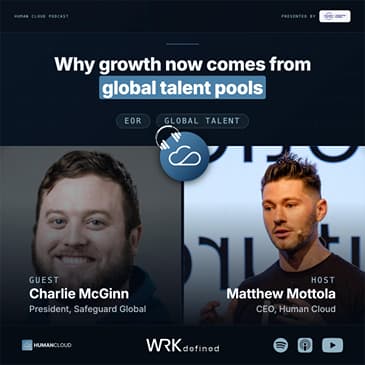
In this episode, Charlie McGinn shares:
- Why growth now comes from accessing global talent pools, and why "a pocket of very highly skilled individuals in Romania" beats competing for the same people at home
- PEO vs EOR vs staff leasing, in plain English: what each one solves, and why co-employment is illegal in some countries
- The real cost of the cheap EOR: a $100 to $200 monthly fee on the label, then FX, transfer, and termination fees on top
- If not EOR, then what: contractor misclassification, back taxes plus a 100% fine, and why an entity takes months to set up and just as long to unwind
- Talent access is the new EOR: how sourcing and EOR are merging so companies can hire globally without paying 15 to 30% placement fees, and why Human Cloud and Safeguard Global are building toward the same future
Charlie McGinn is President at Safeguard Global. He joined in 2011 as the first sales hire for its employer of record business, rose to SVP of Global Sales and Alliances, and now leads its recruiting and embedded services.
Listen now on Apple Podcasts, Spotify, or wherever you get your podcasts.
About Human Cloud: We help companies find and deploy the right flexible talent solutions in minutes instead of months. We automate discovery, compliance, and orchestration across 1,000+ workforce platforms — so business teams move fast, procurement teams stay in control, and rogue contractor spend turns into a strategic advantage.
Proudly presented by Safeguard Global. The employer of record that lets you hire, pay, and manage teams in 187 countries without the risk. Meet Safeguard Global on Human Cloud.
Powered by the WRKdefined Podcast Network.
[00:00:04] [SPEAKER_01] Real quick, before this episode gets started, I have a question for you. How do you scale both your local and your global talent? Do you take on the risk? Do you pay the taxes? Do you actually set up a local entity everywhere your talent is located?
[00:00:20] [SPEAKER_01] Well, I hope you don't, because today's episode is sponsored by Safeguard Global. Safeguard is one of the leading employers record since 2008. Now, there's a reason EORs are the fastest growing segment across Human Cloud, and that's because they are the have your cake and eat it too solution. What do I mean by that? Well, you get the flexibility of a flexible workforce with them owning the risk. Now, enjoy this episode and go reach out to Safeguard.
[00:00:48] [SPEAKER_01] All right, Charlie, thank you for hopping on, man. So you listeners, you got a really fun one because Charlie is not a PR contained sort of podcast. This is the first one you've ever done, Charlie?
[00:01:09] [SPEAKER_00] It is. Yeah.
[00:01:10] [SPEAKER_01] Oh my God, this is so awesome. This is the most honest you'll be, Charlie, ever, because on the second podcast, you'll sound a little more polished. And listeners will be like, I kind of missed that first one. Yeah.
[00:01:22] [SPEAKER_01] So context for all you listeners. So Charlie is leading, I would say, one of the most fascinating segments of this talent industry in that he's enabling the partnerships and integrations of EORs and sourcing solutions. He also comes from, I'm going to call it the outside, Charlie, but we'll get into your background.
[00:01:41] [SPEAKER_01] But so this is going to be a super fun episode in terms of, you know, what really is the talent industry from a first principle? Why do we even have this middle layer that's a full industry just getting in the way of people doing the work and people needing the work? So why do we even have this? Also hitting on one of the most fascinating developments, which is we're seeing EORs and sourcing solutions start to merge.
[00:02:04] [SPEAKER_01] And so we're seeing things like deal talent. We're seeing a lot of internal teams coming out of EORs. And then the third thing is Charlie comes from probably the, I'm going to say one of, but probably the most reputable employer of record that's been around since 2008.
[00:02:20] [SPEAKER_01] So also one of the big things is you all know, if you're looking at EORs, there's a lot of venture backing, there's a lot of sizzle, there's a lot of, I don't know, very fancy steak dinners, crazy experiences, sweets at football games and stuff, not things that are directly value driving to EORs. So we're going to hear from one of the originals and one of the most reputable. So those are three things, Charlie. What do you say? You ready to get going?
[00:02:46] [SPEAKER_01] I mean, I hope I can live up to the clout there. So I appreciate it. We just say dumb stuff on podcast, Charlie. That's what we're allowed. And then we have an editor that, no, I'm just kidding. Unfortunately, I cannot actually edit anything that we say. We've tried listeners. We've tried. I've tried to make myself sound smart. It's really tough. But Charlie, let's into, actually, where are you located? And then we'll get into it.
[00:03:11] [SPEAKER_00] I'm on the coast of North Carolina. So a very small town called Cape Carteret. So anyone that knows of it, I'd be very surprised and interested, but a beautiful spot.
[00:03:22] [SPEAKER_01] Can you explain the difference of Carolina and Texas barbecue to our listeners?
[00:03:28] [SPEAKER_00] I'm not originally from here. So I can't offend either of my friends on either side, but I would say North Carolina vinegar and their pulled pork. Amazing. You get to Texas. That's the brisket. That's your true barbecue. So they both exist. They're both wonderful. I won't say anything bad about either one of them.
[00:03:47] [SPEAKER_01] I was going to say, I'm going to force you. We're going to get you a little controversial. Are you sure you think they're equally like, come on, you got it. You got a preference.
[00:03:55] [SPEAKER_00] Then what depends? Do you like pork or do you like more brisket? It's more of your preference. So I like the brisket.
[00:04:04] [SPEAKER_01] I'm more of your brisket guy. But I will say whenever we're in Texas, what is that one? T Perry's or something?
[00:04:13] [SPEAKER_00] I'm going to be black. Yes. Yes. That place is good. That place is good. Very good.
[00:04:19] [SPEAKER_01] But okay. On the less fun stuff. So you're ready at Wicked Boring. So your background, Charlie, give us the full experience. How the hell did someone cool like you end up in a talent industry and with an EOR? What could have possibly gone so wrong, Charlie, that this is both of our lives?
[00:04:38] [SPEAKER_00] I mean, I would say dumb luck probably more or anything. So the long story, which is a fun story. And again, this dates back to my origins with Safeguard. I was actually renting cars at Enterprise Rent-A-Car in downtown Raleigh. It was a Saturday. We were closing up shop. We had one left sitting there. And I had two guys come knock on the door to say, hey, are you available? One left. It was all about utilization. Let him in and I heard the accent.
[00:05:06] [SPEAKER_00] So when you're renting cars, especially at Enterprise, when you hear the accent, you hear cha-ching. So you're like, I'm selling them every insurance under the sun. So they wanted to rent a car and just head to the beach for the weekend. And I'm like, you guys aren't from here because that's about a three-hour drive each way. So whatever. Let's rent the car. So, you know, it was two English guys, both Nick and John Giles, who at that point, Nick was the VP of global sales for the EOR, which was just starting out. It wasn't even called EOR at that point.
[00:05:34] [SPEAKER_00] And John Giles was the COO of Safeguard. So Safeguard, we're a couple of years in at this point, just starting out very much focused on the global payroll. But they just had this banter. We're having a good time. I'm like, if you guys are work colleagues, like, what do you do? So they explain what they do. And I'm like, well, like, are you hiring? This sounds cool because I'm renting cars. There's nothing wrong with renting cars, but they're like, hey, it's time for a change. And so, yeah, they're hiring sales. Can I sell? Have I ever been in sales? And that's one thing with enterprise, a lot of grids.
[00:06:03] [SPEAKER_00] I mean, you're selling insurance to people who don't, that are insurances paying for the rental car. You know, you can do something. So long story short, interview with Safeguard. The interview takes place at like 7 p.m. on St. Patrick's Day, because I had to close down the shop to get there. Interview goes, well, I start. So I started Safeguard in 2011, come from renting cars into, hey, at this point, we're calling it international PEO because we were selling into the other PEOs. Nobody else was doing it. It was a fresh new market.
[00:06:33] [SPEAKER_00] And it was kind of like just let's figure it out as we go type thing. So, again, no experience, just picking up the phone, dialing for dollars type things, working leads. And it turned out, it worked out, right? Like over the years. So graduated through Safeguard of, you know, just the first sales guy for GEO, EOR, international PEO, whatever we were calling it back then, and moved up through the sales side. So ended up taking over the U.S.
[00:07:00] [SPEAKER_00] Sales, ended up taking over the, essentially got to the SVP of Global Sales and Alliances. So on the GEO side, it's what we call EOR. And we were building it and emerging it. I grew it up to about 2021. And then I decided to kind of step away because I want to try something new, something different. And that's where I stumble into the world of global recruiting. So I did that for about a year as a consultant, looking at some of the global recruiting firms
[00:07:27] [SPEAKER_00] on how they can grow their book of business, how they can operate more efficiently. And then a year later, I get a call from Bjorn, the CEO of Safeguard, who, hey, we acquired a company that has a recruiting arm. I know you're doing a bit in the recruiting. Would you consider coming back and kind of looking over that? So I did, obviously. So said yes, came back in, started building that up. And that's where you can really, when you look at the world of recruiting, there hasn't been a lot
[00:07:53] [SPEAKER_00] of evolutions on the way companies operate because they're very hyper-focused on filling that wreck, which absolutely understood. But the joy about Safeguard is because it fits more in a human engagement versus just sourcing side. We started looking at saying, how can we adjust the way we approach the market on the talent acquisition side to fit in to other companies? Because obviously, we're looking at it into EOR, into opening new territories, so on and so forth.
[00:08:21] [SPEAKER_00] So did a lot of migrational change of that world. And that's where I got cut my teeth into and then eventually into what I'm brought. So I've still overseeing the recruiting, but we've launched or relaunched really what we refer to as our embedded services model, which is our reseller, our white-labeled offering, which is mirroring or merging the worlds of talent acquisition and contingent engagement, EOR, staff leasing, whatever you want to call it.
[00:08:47] [SPEAKER_01] I did not know that it was selling or renting cars.
[00:08:51] [SPEAKER_00] That's incredible, Charlie. Like I said, but it's done good over the years.
[00:08:57] [SPEAKER_01] So yeah, but like dumb, but, and this is something I actually think, um, this is a massive tangent that I'm going to make sure we don't go down. But one of my, one of my things with AI is I actually, I think it's people who've done like real stuff that are going to be best positioned and, you know, real stuff, meaning like, you know, when you were in high school, were you working at the ice cream shop? Were you, you know, selling rent-a-cars? Were you having to build a landscaping company?
[00:09:26] [SPEAKER_01] Like things where you're actually doing real stuff versus like MBA sitting in a classroom talking about theory at that, you know, and a bunch of buzzwords and stuff like that. Like, I don't, I don't know. I think I would take the guy having to sell like an enterprise rent-a-car and I know all of the crazy things you've had to deal with because I actually have had friends who've worked there and, um. I've got stories. Yes. I know you do. Oh, I know you do. Um, it, it puts things into perspective, but so, you know, one, one fun thing about
[00:09:56] [SPEAKER_01] this episode, um, and listeners, I want you to open up either granola or whatever note taker app you have. I want you to start recording because Charlie, one thing is, is I'm going to just, I'm going to act like an idiot here. I'm going to act like a legit 10 year old or grandma, whatever you want to call it. And I'm just going to ask you to like repeat some basic terms. And it's not because I totally don't know them, although I probably don't, but, um, it's mostly just because there's so many things that the business teams, the marketing teams, the product
[00:10:26] [SPEAKER_01] teams, the actual operation teams don't know, but also don't care about in staffing. And because they don't care, don't know, they can totally get worked over. Right. And it just turns into more costs. It turned into a longer process. And so I hope this episode also might be a bit of a bridge in terms of how to get actual product engineering, marketing, operating. I'm going to call them more the value drivers, which is a buzzword in itself, but so how to kind of get them into our world in a easier way.
[00:10:56] [SPEAKER_01] But so let's start with, you mentioned P-E-O-G-E-O-E-O-R. Okay. Yeah. Three acronyms. God, that sounds like a lot. But can you just define all three of them?
[00:11:07] [SPEAKER_00] Yes. Yeah. So P-E-O, or professional employer organization is a large, massive industry here in the U.S., which is very beneficial for small emerging, even to large companies, because essentially it's co-employment. So company still has their dedicated F-E-I-N entity, but do not want to handle, you know, the payroll, the H-R. But more importantly, the economies of scale of benefits, because when you're a smaller company, you know, that that's a backbreaker.
[00:11:34] [SPEAKER_00] So what the P-E-O's do come in is support all of that and then group all the worksite employees under big benefit plans. So it allows small to medium-sized businesses to benefit from the economies of a larger kind of enterprise-style benefit plan. So when we set out to kind of launch the next acronym, employer record, it was really based
[00:12:00] [SPEAKER_00] off of the basis of the P-E-O industry of that what existed when, you know, Safeguard moved into the U.S. market and started establishing partnerships with some of the big players in the P-E-O world of saying, wow, this is such a massive benefit to small to medium-sized businesses. But there's no really solve for the international side. And so that's essentially what we set out to do is how do you mirror something as close
[00:12:25] [SPEAKER_00] as possible as what already is a massive market, massive benefit in the U.S., but kind of supported into international. And that's where employer record really come from, which is EOR, employer record. We coined it global employment outsourcing in Safeguard, but essentially what that is is just a different term for employer record. So again, what we set out to do was to mirror the benefits of P-E-O, but apply it to international.
[00:12:52] [SPEAKER_00] The difference and the main difference there is the co-employment, which is P-E-O, doesn't exist internationally and in some countries is illegal. So the underlying structure had to change. And that's why it's full employer record versus co-employment. So EOR allows people to legally engage people in countries where they don't have an entity versus them having to register an entity in outsourced areas too.
[00:13:18] [SPEAKER_00] So again, the service model that we set out to do was to look and feel very close to the P-E-O, but that underlying structure is slightly different. And that's kind of how it started emerging. EOR staffing existed before Safeguard, but being able to kind of bring it as a global consolidated approach, I've used Safeguard was really the first to view it that way. One single vendor to help you expand anywhere versus having to reach out and deal with localized
[00:13:47] [SPEAKER_00] staffing firms, understand their language, their legality, so on and so forth. And that's why even today, I'm still learning. I just got off a call on Italy and staff leasing laws in Italy. And okay, I got to digest that for a second. And I'm a veteran, I would say, in the industry. So there are so many different factors that come in and changes that are happening that, again, keep it on its toes and it's continuing to evolve today.
[00:14:14] [SPEAKER_01] Did it make you more or less confident slash excited for Italy as an economy? Right.
[00:14:23] [SPEAKER_00] Opportunities like crazy. And that's where Italy is one of those countries that are very, very regulated on the way you need to operate. So understanding that and learning that only just strengthens me personally, you know, as a person that's intrigued by the industry, but also the position of the company to say, we've done the due diligence. We've spent the money to do the local leasing registrations and have this structure in place to ensure if an audit comes through, it's compliant because that's what it's coming down to.
[00:14:53] [SPEAKER_00] And as you mentioned, like you've seen the, the, just the influx into the world of EOR, the money that's come in, well, then has local registrations looking at it to say, let's make sure people are operating compliantly because there's our tax dollars potentially left on the table.
[00:15:09] [SPEAKER_01] So I was just going to say, those are our taxes, which is really interesting. Um, we have seen probably for, I wouldn't say definitely the past two years, Europe kind of opening up as a place that U S companies are interested in. Um, and it makes, I feel like we're playing this massive Delta slash arbitrage, which is like, Hey, you know, Americans are very expensive. There's no, there's no if, ands or buts around that.
[00:15:36] [SPEAKER_01] Um, we were talking with the founder yesterday and he was like, what I actually ended up doing was I bumped my American costs up by 40%. So he's way overpaying, you know, his, his peers, um, that are American. But with that said, he's only having less than 10% of his team that are American and the rest are sprinkled throughout Latam, Asia, and Europe. And Europe is one of those that we have noticed because their economies are so crazy regulated for a while, right?
[00:16:06] [SPEAKER_01] Like we're talking 50 plus years now. It has created this environment where like for the majority of hiring, it kind of sucks to hire in Europe. But when you find really good people, it's insanely advantageous. So like we've had, you know, contractors, fractional, whatever you want to call them, costing maybe like two to 5,000 a month. And they would cost up to $20,000 here in the States, same exact productivity, maybe if not more same exact expertise. And, and you wouldn't think, right?
[00:16:35] [SPEAKER_01] You wouldn't be like, oh, like I'm hiring someone in Italy because they're cheaper and better. You're like, wow, that doesn't really make sense. But it is, right? It's kind of true. So it's, it's funny you mentioned Italy. Um, when we talk about the PEO, GEO, EOR. So here's an, let me ask you an interesting question. Is it, if I were to make it really simple, could I just say, you know, if I'm thinking about PEO, it's to make sure that my workers all have benefits and EOR is to mostly go international
[00:17:04] [SPEAKER_01] and ensure that I'm not going to have a government trying to fleece me? Yes. Though, um, the reason I, here we go, hit me. And by the way, Charlie, for our listeners, what you're saying is like, is actually kind of exciting. Uh, just because most of us have never really heard this, uh, a while.
[00:17:21] [SPEAKER_00] So it's relevant then, you know, so. Yeah. It's not, man. Yeah. So I would say, I mean, you know, and essentially yes, but, but there's a different element to it, right? Because both of them are deeply ingrained in compliance, right? That's why you engage into an EOR or to a PEO is because you want to ensure you're operating compliantly. Because yes, the benefits, the cost, the feature benefit there is huge, but ensure a lot of these might be processing their own payroll in house on spreadsheets, whatever it might be.
[00:17:51] [SPEAKER_00] So ensuring all those elements are in place, you know, your various workers comp, what's required by state, so on and so forth. So they're definitely from the benefit side, but also from the compliance side, the exact same on the EOR, but EOR is evolving today. And I'll kind of explain to that a bit more, but the way EOR started out, like what you were solving for was always compliance. But the easiest sense that I say was the fear of the unknown, right?
[00:18:16] [SPEAKER_00] To your point, exactly like, hey, like in Germany, there's great engineers and I've got a project you're going over there. I want to expand or even I just need coverage and I'm struggling to find talent in my little world. Historically before EOR, how do you do it? When you got to go register a company in Germany, we got to go over to Germany. You got to speak German. You're dealing with everything that applies to that local market. So EOR opens it up for you, but with confidence because of that fear of the unknown, you know,
[00:18:46] [SPEAKER_00] we're providing a compliant employment solution. So it turns from a payroll standpoint for the client to an invoice. They fund an invoice with the comfort knowing that everything's being paid out. Where it's starting to shift, I will say, is as staff leasing and EOR start coming closer together. And by staff leasing, you know, you've had temp staffing for a long time, right? That people want to engage people under a contingent nature because of whether it's fixed term,
[00:19:14] [SPEAKER_00] project-based, whatever it might be, but they have an entity. And again, look at the U.S. How many companies that are U.S.-based that still use temp staffing agencies because A, it's access to talent. It's getting them on quickly. It's making sure, you know, from a product, a customer, whatever project standpoint, we stay on task without the, hey, I've got to do my full onboarding. I've got to expand them all over, so on and so forth. So you're seeing those starting to come together, which means EOR now is starting to become a lot more prevalent here in the U.S.
[00:19:43] [SPEAKER_00] because you've got Europe expanding over and the inverse, but you have companies that are used to an EOR that want something similar in the U.S. but want that talent layered in, so on and so forth. So it's a bit of a merging animal and you're seeing it with the evolution of AI. Like what is the support behind AI in order to keep evolving? Well, it's building up data centers. It's a specialized technicians. It's, you know, things like that. So, and then you get into your larger companies.
[00:20:11] [SPEAKER_00] Like they have a massive budget for contingent workforce and sometimes they don't care where it is. But again, it's separating that direct higher budget versus contingent. So what that eye view is, is EOR started out exactly what you said. I want to expand internationally. I just want to do it compliantly. I don't want to register an entity. I've got a few workers. That's all I want. EOR has evolved. People are looking at EOR as a growth strategy now to say, hey, I don't want 10 to 15 to
[00:20:37] [SPEAKER_00] 30 people in country, but they're wising up, right? It can't be just the lowest cost provider because the lowest cost provider, that's all well and good until a worker doesn't get paid. And who's hearing that? Dan Klein. But then also taking into consideration what your activity in country is doing, what the effect of that. And that turns into permanent establishment, corporation tax, so on and so forth. So again, it's all kind of coming together and evolving because the world of staff leasing
[00:21:07] [SPEAKER_00] solves for when you have that entity, right? That gives you that temporary outsource to be able to say, hey, I want to, you know, I got an influx coming in, so on and so forth. And EOR generally don't have the entity, right? And so I just want access in the country. But again, it can only last for so long because your activities are going to dictate what that local government views you doing. And if they view you as corporate tax, the only way to solve for that is to start registering your entity.
[00:21:33] [SPEAKER_00] So again, it's a moving beast and an animal that are all starting to come together, which is really interesting.
[00:21:41] [SPEAKER_01] So I want you to put yourself in the shoes of a leader that I'm not just going to pay everyone via Zelle, Venmo. I'm not that dumb, right? Like I've done this enough. I'm not going to do it that way. With that said, I'm used to just having another function do it for me. I'm used to not having to worry about this. So the fact that I now have to worry about hiring people and paying people compliantly and all that kind of stuff, it just freaks me out.
[00:22:11] [SPEAKER_01] It's new. And I really don't want to do this. So I want to start with the various business models. So when we talk about PEO, GEO, EOR, what are all the relevant business models? And then also how customized? So if we're talking about safeguard versus EOR, ABCDEFG, I mean, are you all going to give me the same business model?
[00:22:39] [SPEAKER_01] Are you going to give me some creative things? And actually, I kind of want to push on your rental car experience. Is it going to end up becoming like the rental car experience where Expedia tells me it's 50 bucks a night, but then all of a sudden I walk off the lot and it's actually 120 or sorry, a day. It's 120 a day. So let's get tactical on business models. And hopefully you listeners out there won't be as screwed after this segment than you were before.
[00:23:08] [SPEAKER_00] Yeah. I mean, to me, right? To me, in my home building, it depends on kind of what the goal or the objective you're trying to achieve, right? Because there's various different models of employment, right? Starting at independent contractors, right? Like when you talk about independent contractors in the world of EOR, that's a bad word because they're not compliant. But they can be, right? Independent contractors exist.
[00:23:35] [SPEAKER_00] The stigma that EOR is trying to educate and help companies overcome is like there's certain criterias that an individual must be within to justify or qualify to be a true compliant independent contractor. What it used to be back in the day, the stone age when I started selling it, it was like, I don't know another way. I'll just pay them as a contractor. And again, because there was no other option, we'll just pay them. Well, they don't understand the inherent risks that they're exposing.
[00:24:02] [SPEAKER_00] But what they also don't understand in a country like Italy and others where there's very socialized benefits, that's more of a burden to them because they have to register. They have to do their own tax filing. So some talent don't want it, right? Some will. Some will. But so that world exists, right? And so when companies are looking at, I've already engaged a worker. I've engaged John Smith in Egypt, whatever, just using an example. And I've been paying him as a...
[00:24:28] [SPEAKER_01] Charlie, what a hilarious John Smith in Egypt. He took the most British name and put him in Egypt.
[00:24:36] [SPEAKER_00] Very bad example. But we're going to roll with it anyway. Like, I've already known you. You know, okay, let's make this a bit more formal. Formal, we're going to put you under an EOR. Well, that company, because they're not using EOR as a growth strategy. There's no physical reason for them to have John Smith in Egypt. They just... It's a talent. It's an individual that I'm keeping with it. It's an individual that they've worked with. Well, they might go to the lowest cost provider because they just want to ensure it's paid, right?
[00:25:05] [SPEAKER_00] They're not using EOR as an agent of growth. They're using EOR to capture and ensure they're legally engaging a worker that they want on their books that they've known forever. So that's one business model. And that's where tech-only solution, very minimal support. But again, it's a cost-benefit. That's what you're paying.
[00:25:24] [SPEAKER_01] And what is the cost, Charlie? Is it, hey, I'm just going to pay $50 a month on this person? I'm going to pay 5% on this person? $1,000? What's the typical, like, if it's purely to not get sued?
[00:25:38] [SPEAKER_00] It's looking for the cheap. Yeah. It's all over the place, right? But then you start getting into the question of, okay, that's the rate on the tin, right? On the label. Yes. But then there is layered stuff that comes in. And so you can see it anywhere from $100, $150, $200, whatever it might be. But then there's transfer fees. They're charging on the FX. There's termination fees. There's things that are going to come up. So it's never what it seems, right? There's not that transparent sometimes.
[00:26:08] [SPEAKER_00] I'm not saying all, but sometimes. And that's what you see a lot on the real low cost because, yeah, they're giving you the access in. But then, you know, there's very, it's almost like an application, right? You add that. Okay, that's an extra $50. That's whatever it might be. And so, okay, right? Because they don't, there's no contract customization. There's no supplemental benefits coming in. It's just, it is what it is. And it keeps them engaged. Where you see that start shifting, right? And this is what I've noticed over the last five to 10 years.
[00:26:37] [SPEAKER_00] As you know, there's been a lot of influx of funding into the EOR, which has done great for the industry because it's now people understand it. Like taking a step back when I used to sell EOR out the gate, the question was, how are you doing this? And how is this legal? Like that was the, they just couldn't wrap their head around it. They didn't understand the service. And so like that was a, now the conversation is why you versus them.
[00:27:01] [SPEAKER_00] So the buyer now coming in is educated about EOR and they're trying to provide the supplier to match their needs, whether it is tech enabled, whether they want, you know, an account management team and human first type of approach on and so forth. So that's been the big adjustment. Then as you see that, you see clients now or companies now looking at EOR to say, that is my agent of growth. Like they've done their research.
[00:27:25] [SPEAKER_00] They know that they want to expand these regions because there might be a new market they want to tap into, or there's an amazing talent pool that they can bring in under their organization. So it's not just the engagement for John Smith in Egypt. I can't stop. John Smith in Egypt. It is, there is a pocket of very highly skilled individuals in Romania that I can't find here in the U.S. or I can't afford here in the U.S. because they're already employed by massive enterprise firms, right?
[00:27:54] [SPEAKER_00] That business model starts changing because now you're using it as an agent of growth. So you want that to be an extension of your HR, your payroll. And so your needs and your drivers start changing, right? You want that managed service. You want that, you know, amazing white glove experience. You want everything to be starting to integrate with various systems, so on and so forth. So A, your buyers change.
[00:28:19] [SPEAKER_00] Your fee structure is starting to change because if you're going and you're getting nickel and dimed on every random thing, okay, all of a sudden it gets expedited. But again, it's all about the worker experience. At the end of the day, EORs, PEOs, staffing, you deal with a volatile asset, which is people. So if the end user, your worker, is not receiving a good experience, well, then the client gets upset because there's a direct link. There's no, hey, they're going to reach out and talk to the line manager and tell them the experience.
[00:28:49] [SPEAKER_00] They're not getting paid on time. Their benefits are in line with what's staff story. They don't have the ability to level up because they are more senior. So that's where you're seeing that buyer market adjust because there are big companies now using EOR as an agent of growth. And whether that is, hey, I'm going to use EOR forever or I'm going to use EOR for the first 6 to 12 to 18 months until I understand what this market looks like for me and what type of entity I need then, whether it's a subsidiary or branch, so on and so forth.
[00:29:18] [SPEAKER_01] Because let me ask you a question. So if not EOR, then what? Is it A, is it one full-time HR person? Is it one full-time procurement person? Is it one full-time lawyer? If not EOR, what's my alternative option? So going down is independent contractor, right?
[00:29:39] [SPEAKER_00] But there is too many companies that just jump into that and just, oh, this would be easy. And it works really well, especially in Latin and South America, until you try to terminate or end the agreement with the contractor, right? Because then all of a sudden they're like, whoa, whoa, whoa. You were treating me as a contractor, but technically I should be employed, so I need my severance, my unpaid vacation.
[00:29:59] [SPEAKER_00] It can get costly very quickly, and then it can spiral quickly where local governments can, if something comes up, right, look at, hey, it's tax evasion. You haven't been paying tax. So not only do you owe back taxes from day one of engagement, here's a 100% fine on top of it or whatever it might be. It varies very much country by country. So you've got independent contractor. And again, there is a legal framework to work within.
[00:30:25] [SPEAKER_00] And you've got EOR, or let's call it contingent engagement or staffing, all of that, an outsourced employment model. The next step would be you have to register an entity there, which is not easy. It takes time. There's a lot of unknowns. There's a lot of money up front that goes into that. And what people don't understand is there's two different elements to be able to employ. So you've got to get entity ready. Then you've got to get employer ready. And a lot of companies just go, I'm entity ready. I'm going to take my U.S. employment contract.
[00:30:54] [SPEAKER_00] I'm going to convert it to whatever it might be. Or just have them sign it and we're good. They're not understanding what their liability is because there might just be a very small group of people. So they're not hiring HR teams. They're trying to support it from other geographic locations who might be engaged with a local attorney or an accountant. But again, it's hard to predict that cost. You're now being billed on an event per hour or something.
[00:31:20] [SPEAKER_00] So it's very hard to predict and control that cost in that scenario. And then you've got a lot of companies that I just need an entity where they don't actually have a taxable presence. So EOR would have been a very legal, but it took them eight months to set up an entity. It took them thousands of dollars to be held in escrow just to get the entity registered. Then they had to get a local payroll. They need to get local contracts.
[00:31:44] [SPEAKER_00] They need benefits, workers' comp equivalent, and everything that needs to go in place in order to truly be employer ready. So that's why when you take a step back, why your business model is a lot of companies leverage EOR to get to that because it doesn't warrant a day one expense. I can get someone on the ground working in two, three days, weeks, whatever it might be, knowing it's compliant because I'm contracted through. It gives back to that, back to the fear of the unknown, the peace of mind that still exists today.
[00:32:14] [SPEAKER_01] And so it would take, man, you would have to really hire this, meaning that you'd have to have one or a couple people full-time dedicated just on this, right? And the toughest part is, to your point of setting up a local entity, in Germany it might take six months for you to actually be incorporated. And ensuring you're doing it right. And ensuring you're doing it right. So you hire someone full-time, and then what? They just sit at a desk for six months? It takes them, what, five hours to fill out the paperwork?
[00:32:43] [SPEAKER_01] Then they just sit there for six months?
[00:32:45] [SPEAKER_00] And you're paying them? Yes. Well, and it's cross-functional from the corporate structure, right? So who's responsible for registering the entity? It starts with tax. Well, usually that rolls up to some sort of the finance function. So they're working through all that. Okay, well, then you got to think about what's a handbook need to look like? What benefits do we need to offer? What does the employment? Well, that's HR now. Okay, well, then now we've got to find the talent. That's a function of recruiting talent acquisition that might sit under HR. It might not.
[00:33:13] [SPEAKER_00] And then, okay, if in the expense and time that it takes to set it up, that's on the back end too. So let's say I said, yes, I'm steaming to Germany because my product or whatever, like, I believe I'm going to be very successful there. And it doesn't hit. And all of a sudden, that was a whoopsie because it happens. Okay, well, now I need to deregister because once that registration is up, I'm paying taxes on that. It doesn't matter if I'm employing or not. Well, then to deregister, how much time and effort did it take to set it up?
[00:33:41] [SPEAKER_00] Well, that's the same on the back end too. So again, when you're trying to renew an understanding, that's why EORs, it's such a value add to companies to say, okay, this is a way for me to dip my toe in the water without having to put brick and mortar up and understand how I can operate there. Or if I can attract the talent or did my research tell me the talent's going to cost me this, but I want to level up and oh my goodness, it's hard to find those. I got to pay at the top level, so on and so forth.
[00:34:09] [SPEAKER_01] It is literally just the obvious, you shouldn't do this yourself. And even if you can, yeah, you probably shouldn't, right? I'll go out. To me, actually, I think one angle to look at this is potentially because one thing we have to help companies a lot with is like shifting budgets. And we're talking like we're talking midsize companies. Honestly, anything more than 100 employees, right?
[00:34:36] [SPEAKER_01] And you're like, hey, we got to shift budgets to make this happen. And the question is never like yes and no. It's like, okay, who's going to pay for this? Where does it come from? And a lot of times it's literally just like, okay, you're spending a lot here. Well, guess what? You no longer need this. So one angle that I do think is very true is we used to spend a lot on things that you no longer need. So let's say right now you have like a 10-person accounting team. I'm willing to bet all you listeners out there, you probably only need one accountant or two accountants.
[00:35:06] [SPEAKER_01] Let's say you have a 50-person marketing team. Yeah, you probably only need like five right now because you with agents, you can do whatever it is. And then let's say you have a software development team of 15. Shrink that down to one person. Have that be a PM who is technically literate. But so long story short, there's lots of budget now that can get reallocated.
[00:35:27] [SPEAKER_01] And to your point, this is a growth strategy because let's say that there's a market in Asia or let's say there's a market in the U.S. You're way better served hiring boots on the ground where that opportunity is than keeping that software development team or keeping that bloated marketing team. So very, very, very, very just tangibly and visually for you listeners.
[00:35:51] [SPEAKER_01] I think the biggest key insight to me up until now, Charlie, is like just shift the budget, right? Like there is more growth opportunities outside of your current teams. And just go. Take some of the money. I hate to say the word layoff, but OK, reduce or maybe shift them over to contractors.
[00:36:11] [SPEAKER_00] Reallocation. Right.
[00:36:13] [SPEAKER_01] I know it sounds bad to say, but I don't got a PR muzzle. So I'm allowed to say, yes, you should reduce 40 percent of those teams. With that said, and then, you know, when I say reduce, I know that sounds bad, but, you know, maybe it means more contractors rather than them all being full time sitting in the same office. Right. So if you have 50 people all sitting in the same cubicle farm or in the same geographical region. Yeah, kind of dumb.
[00:36:39] [SPEAKER_01] Like maybe turn that into five and then have five in Europe, five in Asia, five in LATAM. But now I want to I want to head over, which is one of the most fastly moving or rapidly evolving areas. And that is this combination of sourcing plus EOR. Now, I'm just going to throw, you know, a crazy claim out there and watch you squirm. And that is I don't really get the point of staffing agencies.
[00:37:09] [SPEAKER_01] To me, there's there's thousands of them. They basically just take a job break. So the hard work was actually creating that job break, creating that project plan and identifying like the parameters of what you need. But staffing firms seem to just take that wreck and then just basically be salespeople finding candidates and hoping the client says yes. So they get their placement fee. So I'm going to throw that wild, lavish claim out there. I know it's not that simple, Charlie. I know it's not that simple.
[00:37:36] [SPEAKER_01] But that is me being the most like, I don't know, grandpa on the porch negative about it. With that said, the hardest thing right now is finding the right talent and filling those data centers and filling these specialized resources. So I say that, you know, rub on staffing just to say the biggest demand right now is actually finding the right people.
[00:38:00] [SPEAKER_01] And so and tying it all back together, it seems like with the EOR, you are more deeply embedded in the business itself, meaning you're tightly correlated to the actual business results, not just, you know, HR teams. But you're tightly correlated there. So you should be able to say, yes, we need people in these regions with these skill sets and we can help you also with that.
[00:38:28] [SPEAKER_01] But let me just throw it over you and say, kind of make sense of the dumb rambling grandpa on the porch move for me, because this is one of the most rapidly evolving segments of this industry.
[00:38:41] [SPEAKER_00] And I think it's understanding the markets they serve, right? Because they all have a purpose, right? But it's solving the need for that particular client, right? So EOR, a lot more growth, a lot more emerging, as you mentioned, that, you know, expanding into new countries. It's a bit more of a global expansion partner versus a vendor, right? You've got staffing, which I would disagree with you a bit on the staffing side, because, you know, what they're bringing is, hey, project-based work.
[00:39:10] [SPEAKER_00] Like all of a sudden, I landed in RFP. I need 100 engineers in role mating, whatever. Well, a staffing firm is going to have the talent pooled and then be able to engage, but then they still outsource. So it's kind of doing sourcing on top of EOR, right? So it sits next to it, but it's a bit of a different animal because you're serving large enterprise-style clients, right, that have that contingent budget versus the direct hire. And then once the project's over, they're out.
[00:39:37] [SPEAKER_00] And they might have their own operation there, but they don't want to entwine these people with it. Sitting on the other side of EOR, though, which I think is kind of what you were getting at, but is more agency recruiting, right? And that is, I'll just help you find the talent. I'll take a job order. I'm going to try to get it retained, but I'll also do a contingent. I'll work previously to do it and pray that you select them. But I'm also going to work alongside your internal TA, so on and so forth, which that is an area that I think you'll start seeing evolving.
[00:40:05] [SPEAKER_00] And that's an area that I'm very intrigued and interested in as well because we spoke to a number of our clients that want EOR, don't need staffing, but then still need support in engaging that talent. Because, again, there might be a reason that they're expanding into Mexico because they want to nearshow some operations, lower costs. The education market is really good there, so on and so forth. So they need a bit of a hybrid between EOR and staffing, right?
[00:40:31] [SPEAKER_00] So they have their own internal TA team, talent acquisition team. Sorry, don't want to use acronyms. And so they know a lot to completely outsource the recruiting. They can do it themselves. They have the team to do it, but they don't understand the culture. They don't understand where to look, so on and so forth. And so I've actually spoke to a few larger clients and tried, like, hell, excuse my language, to sell them recruiting because that's what I do. Not going to buy it, not going to buy it. So I kind of took a step back.
[00:41:01] [SPEAKER_00] I'm like, okay, well, what is it that I can help you with them? Because they were already an EOR client, so it's not like I'm, you know, so we're already supporting them. So what can I help you do? And what we kind of uncovered is providing access, right? Like, so they can't get on the local job boards. They can throw up a job post on LinkedIn recruiter, but not knowing is like, is there a localized job order? Is there a different way to do it? So on and so forth.
[00:41:26] [SPEAKER_00] So that's where I view that the element of sourcing is evolving because sourcing isn't agency recruiting, but it feeds everything else. So, you know, you are going to go to EOR. You want to run your own process, but you want access to the talent. And it could be as easy as local job postings that I shoot through. And then you got to weed it out. Well, that doesn't quite work either because, again, AI and what's coming through. Everyone's resume looks amazing. So, you know, that first interview comes through pretty important.
[00:41:55] [SPEAKER_00] So it is providing that sourcing support to say, hey, we have reached out and targeted or, you know, evaluated these individuals. Here are the individuals that, A, responded, match the skill, the, you know, the education that you require as part of it. So here's a real life person. Here you go. Run through your process. So I haven't put them through three interviews before you start your interviews because every corporation is going to have their process, whether one, two, three, four.
[00:42:25] [SPEAKER_00] I've seen up to seven interviews, which is very hard on the candidate. So it's, hey, here's quality talent that we have sourced. We have verified by making sure they're real and their credentials match. You run your process. And so that opens up to be able to work with internal talent acquisition teams, to be able to work with internal recruiters versus working against them. Right. But then it also opens up to merging EOR and staffing a bit because it isn't like, hey, I don't need a staffing slash BPO model where I need 10 accountants just to do it.
[00:42:54] [SPEAKER_00] I don't ever want to talk to them. No, I need a group down there. I want it to feel like an extension of my team. I want to interview them. I want to manage them. But I need your help all the way through the process. So that's where you're starting to see that merge together of like sourcing with EOR. I think you start seeing some bundling options. So you don't have to pay 15, 20, 30 percent up front on salary or full placements. It's rolling it together to be a hybrid approach of what the bigger staffing is, if that makes sense.
[00:43:23] [SPEAKER_01] So here's the here's the bow on the episode. And I think this will become the title of it, Charlie. So and I remind you, so if I were to if I were to flow the conversation, I would say that you you had to go from selling rental cars and insurance of rental cars, probably the worst thing ever to sell into a totally unknown but highly valuable industry, which was the PEO model.
[00:43:52] [SPEAKER_01] And the reason is so simple there. It's like, hey, like, are you going to have the level of scale that a Microsoft is going to have to provide good benefits? Of course not. So here's the solution that phenomenal, highly, highly valuable to then the OK, you're expanding beyond your borders. But are you going to set up that local entity and people asking you, is this even legal or not?
[00:44:15] [SPEAKER_01] But yes, this makes total sense to now this world where, all right, most people understand what an employer of record is like. This is a known thing, right? So now that's known. But with that said, AI and just the general, you know, environment of business right now, it's wicked fast. It's wicked adaptive. And hell, who knows what's going to happen tomorrow.
[00:44:38] [SPEAKER_01] But I might have to have a brand new team that's sprinkled throughout the world versus in one place, which now comes to putting it all together, which is, all right, this is a growth driver, meaning where the hell am I going to find growth? And talent is no longer that boring thing that HR or contingent procurement people talk about. It's something that's actually like really, really crucial for every executive team to know.
[00:45:03] [SPEAKER_01] And so the bridge that I'm going to put in this episode is going to be how growth can be driven through talent access models. And I'm going to stop at the talent access models, because I think what you nailed was that the ability to curate a pool of talent that you need to tap into when you need it is, it's like the new EOR, right? For the next 15 years, it's going to be the new EOR.
[00:45:31] [SPEAKER_01] It's going to end up becoming a standard in the next five to 10 years. But it's really hard right now. Most solutions haven't been built for it. Selfish plug, the solutions on human cloud are that way. Very, very selfish plug. But that is the way the world is going. And if you don't have your EOR infrastructure set up, then you won't even be ready for this.
[00:45:55] [SPEAKER_01] So basically, it's kind of saying like, hey, when we evolved into the internet, if you were still using desktops versus a laptop, you're kind of dumb, right? So if you don't have your EOR infrastructure, you can't even embrace cloud computing and all the great things that we live in now. So step one, go get your EOR infrastructure set up. And then step two, come talk with you or us about talent access. And that's literally going to be the language of business in 15 years.
[00:46:25] [SPEAKER_01] It'll be some stupid course in a Harvard MBA thing, Charlie. And you and I will be like, I don't know, man, remember when like no one knew what this was and people were like, oh, what?
[00:46:36] [SPEAKER_00] We should have took it and done some work.
[00:46:38] [SPEAKER_01] Right? Yeah. But listen, most important question for our audience, Charlie, is where can our listeners find you and Safeguard? And what's the first thing you want them to do right now?
[00:46:51] [SPEAKER_00] I mean, reach out to me, obviously. I'm available. But for Safeguard, I mean, check out the website. There's a lot of good content on the website, a lot of knowledge. So back to your point on getting your ducks in a row, the education's out there now. So there's a lot of self-service. I used to refer, and this is probably a legacy term, but like a lot of WebMD coming up to understand the problem or obstacles, but then reaching out to verify.
[00:47:17] [SPEAKER_00] Well, that access is there between AOI, between the EOR provider, but there's a ton of information, you know, within the Safeguard ecosystem. The one tool that we rolled out that I'm very excited to because it kind of touches all worlds is there's a lot of access on information, but not a lot of access of what to do from there. And so we've really evolved into that from the Safeguard, which is what we refer to as our intelligent workforce.
[00:47:39] [SPEAKER_00] So we type in a lot of key data to really understand, and it could be as, hey, this is what I'm paying for these roles in the U.S. Tell me where else I should be hunting for to be more cost effective, to be able to stretch my dollar further. That's what that tool does. We have a lot of inherent knowledge on what the employer's cost looks like, what, you know, benchmarking to give that guidance of, okay, this is where I should be looking. Right. And that's a bit of a self-service, well, not necessarily self-service, but an information tool to provide guidance based on data.
[00:48:09] [SPEAKER_00] But then the next step further. Now, how do I execute? And that's to your point of, okay, we're getting my ducks in a row, making sure that I've qualified an EOR. Because back, I'm not sure how often it happens today, but when I was selling it all the time, hey, I've already found the worker. Now I got to figure out how the hell to employ him. So, okay, how quickly did he just start a month ago? Well, you legally can't do that. You know, we'll do sign-on votes. So you get creative about it. So it's flipping that and saying, okay, we know we're explaining. Let's get in front of it.
[00:48:38] [SPEAKER_00] That way we're working in parallel to say, if I do have an internal team that's doing outreach and interviews, okay, well, let me figure out how to employ. Because at the end of the day, as I mentioned, we're dealing with people. So I would engage with you and say, hey, we're great. I'm going to end John Smith in Egypt, the bull and bat there. And, you know, have a really good conversation.
[00:48:58] [SPEAKER_01] I can't wait until I finally meet this John Smith in Egypt.
[00:49:01] [SPEAKER_00] He is real.
[00:49:03] [SPEAKER_01] He's a British guy.
[00:49:04] [SPEAKER_00] He needs you. So, but hey, we do everything. We go through the interviewing process. And this looks good. But then I can't get you out of diploma contract for two to three weeks, months, because I haven't solidified an EOR. Well, I just lost John Smith because other people are doing the same thing. So it is getting all that together and doing that work in parallel to make sure it isn't a hurry up and wait, hurry up and wait, hurry up and wait.
[00:49:28] [SPEAKER_00] Because then after I've spent all the money on my recruiting and my time and everything, then I'm evaluated and I've signed an EOR and everything. Then we start onboarding. Well, John Smith just accepted another job. You lost it. You're starting at day one. How much money and time and effort did you just put in there? So it is. It's working it together into tandem as a project, but really clearly define what the business objectives are.
[00:49:50] [SPEAKER_01] Listeners, do not lose John Smith in Egypt. And whoever finds John Smith in Egypt first. What, Charlie? One year free of EOR services from Safeguard. I know you probably can't say yes to that. But if someone can find John Smith in Egypt, is that offer available? Maybe for the next year?
[00:50:07] [SPEAKER_00] Absolutely. Yeah.
[00:50:08] [SPEAKER_01] All right. We'll make it a couch. We'll put it on couch. All right, Charlie.
[00:50:12] [SPEAKER_00] Thank you so much for hopping on, man. Great. Thank you for having me. This was a lot of fun and I hope that, you know, it was beneficial to everyone out there listening. First to many, man. Thanks, man. Yep.
Sponsors
