
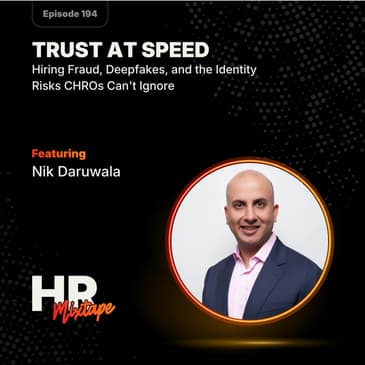
Most CHROs have a fraud problem they didn't sign up for. Deepfakes in video interviews. Synthetic IDs at the application stage. AI-generated credentials that pass every automated screen. Only 31% of CHROs say they're confident in their ability to prevent hiring fraud, and the technology making it easier gets more sophisticated every quarter.
Nik Daruwala, Vice President of Sales at Checkr, has spent 21 years in B2B technology sales, including thousands of direct conversations with HR leaders trying to protect their hiring funnels without losing speed. Checkr powers background verification for Uber, Lyft, DoorDash, and Instacart, and was the first API in the background check industry.
In this episode, he covers:
- Why hiring fraud appears at every stage of the funnel, from the initial application through post-hire monitoring, and what a continuous identity verification strategy actually looks like in practice
- How CHROs should be thinking about partnering with their CISO to address a risk that's moved from the cyber stack into the talent pipeline
- Why the speed-versus-safety trade-off in hiring is a false choice, and what good looks like when both coexist in the same program
https://thehrmixtape.com/episodes/trust-at-speed-hiring-fraud-deepfakes-and-the-identity-risks-chros-cant-ignore-with-nik-daruwala
Timestamps
[00:00:39] Context: this conversation was recorded live at the Checkr booth at SHRM 2026
[00:01:01] How enterprise hiring changed over 24 years: global sourcing, the normalization of remote hiring, and why the explosion of application volume made quality screening harder
[00:02:50] The CHRO anxiety most people aren't talking about: making sure candidates throughout the funnel are actually who they claim to be
[00:04:13] Only 31% of CHROs have confidence in their ability to prevent hiring fraud, and why the AI tools now available to candidates are changing that threat surface fast
[00:04:39] The three identity threats CHROs weren't trained for: deepfakes in interviews, synthetic IDs at the application stage, and AI-generated credentials that pass automated screens
[00:06:44] Why most organizations are reactive on hiring fraud, and the parallel to the early days of cybersecurity: you don't prioritize it until you have your first incident
[00:08:42] Where fraud actually shows up across the hiring funnel: application, interview, background check, and continuously post-hire
[00:09:41] The speed-versus-compliance trade-off is a false choice, and why the best hiring programs don't ask their teams to make it
[00:13:27] Nik on what it actually means for trust to be a competitive advantage, and why that should be the north star for every hiring program
[00:16:00] The two-to-three year horizon: AI automating talent sourcing and administrative tasks, continuous monitoring as table stakes, and why the hiring decision stays human
Brought to You by Paylocity
Paylocity is the fastest growing unified platform for HR, Finance, and IT. Paylocity brings your people, processes, and data together in one place so HR leaders can spend less time managing systems and more time doing the work that actually moves their organizations forward. Learn more at paylocity.com
Keywords: hiring fraud, background checks, identity verification, deepfakes, synthetic IDs, AI-generated credentials, CHRO priorities, talent pipeline security, hiring at scale, continuous monitoring, background screening, hiring compliance, HR technology, Checkr, credential fraud, HR risk management, fraud prevention, remote hiring risk, AI in hiring, talent operations
Powered by the WRKdefined Podcast Network.
[00:00:01] You're listening to the HR Mixtape, a podcast for leaders who want to understand people, strengthen culture, and navigate change with clarity. Today's conversation starts now.
[00:00:16] Joining me today is Nick Daruwala, Vice President of Sales at Checkr. He brings 21 years of business-to-business technology sales experience, including more than 14 years in senior leadership roles where he built and scaled people teams at Microsoft, Gartner, and SurveyMonkey.
[00:00:39] Nick, thank you so much for sitting down and talking to me on the podcast today. We are at the SHRM 2026 Annual Conference Expo inside the Checkr booth. So glad to have you on the podcast. Thanks for having me. I appreciate it. So I'm really excited about this topic, and we're going to start with this. How has the fundamental nature of enterprise hiring changed over your career? Nick Daruwala, Vice President of the United States
[00:01:01] Yeah, it's been interesting. I have been at this for a little bit, almost 24 years and counting in different roles, not only in technology sales, but I would say it depends and varies on the industry and type. Nick Daruwala, Vice President of the United States We are seeing, I think, a lot on global processes happening. So it started all local and hiring, but I think there are sometimes some competitive advantages to look at global opportunities to hire folks.
[00:01:25] I think there was always this demand previously that you had to meet the person in person. Now, I think, because the last couple years we got used to hiring remotely. So I think we're becoming more comfortable with that, although there are some implications of that, which we might bet to today. I think the volume of hiring has gone crazy. If you think about the platforms that exist out there, LinkedIn, Indeed, number of AI tools out there.
[00:01:49] So there's a huge amount of supply that are out too, and it's very easy to apply for a job. So I think we democratized hiring for the candidate. We made it much more easy to at least search and look for a job. And again, there's also some implication for that volume that come in to make sure we hire the Rack Chatsun at the candidates. I think there's some new emerging technologies as we will try and limit the amount of times we say AI on this.
[00:02:13] Oh, but we might need to talk about it a little bit. But how AI has, I think, changed a lot of the hiring values. I think there's pluses and minuses and advantages to that for both the candidate, as well as for the recruiting teams and talent operations teams that are out there. Yeah. So you talked about AI, which, again, I don't think we're going to try to limit as much as we can, but that's kind of like the topic on the floor.
[00:02:38] But I don't think it's the only thing that CHROs are anxious about right now. I think they have a lot on their plate. So when it comes to hiring, what are you seeing as kind of their top priorities or their top anxiety drivers? I think right now we've seen, at least in our business, a huge amount of inbound demand and interest to solve a problem around making sure that the cameras they're seeing throughout the hiring funnel are actually who they say they are.
[00:03:04] So I think there's some concern from CHROs. Are they hiring the wrong person downstream? And what's the business impact of that? Yeah. Sometimes we don't realize sometimes, especially if you're working, as an example, if your end customer or your place you're working with is in a vulnerable populations, that's a huge concern to get that hiring wrong. They're introducing risk into the business. And I think that keeps a lot of CHROs awake at night because that was a threat service they didn't need to worry about.
[00:03:32] It was mainly all cyber focus, but we're seeing more and more, I think, creative ways that Borgs just are trying to get into and attract companies, gather information, potentially do nefarious things. And it was not obvious, I think, to a lot of people that the CHROs might have to play an outsized role in partnering up with their IT counterparts, the technology counterparts to go and prevent that.
[00:03:58] And I think if you're a small business and you're a very small company, it's equally a problem because that they, you know, if you run a small business, you typically have, you wear multiple hats. So you need, you know, I think solutions or you rely a lot on the technology providers to help prevent someone with that risk that might get to your business. Yeah. You know, only 31% of CHROs have confidence in that ability to prevent hiring fraud.
[00:04:21] And I find that really fascinating, especially as we look at all of the tools that are available for the candidate now to help them ace interviews. I recently saw something that was like basically like an AI version of yourself is coming and doing the interview and answering the questions. That's got to be really scary for CHROs. It is. And I think it's just unfortunately just getting started.
[00:04:45] I think some industries are maybe lessening because you maybe do more in-person hiring, but equally, I think there's fraud that they might not realize that might already be in their company. But if you just take your question directly, I think there's a threat from deep fakes, the synthetic IDs that are being created. There's AI generated credentialing that's happening right now. And these are all new challenges. I don't think the CHRO had to worry about.
[00:05:11] We hear a lot from our customers and CHROs that there was a non-issue at the start of 2025, that as AI and the large language models have become more and more sophisticated, it has become the tooling and power to go and create fraud has become a lot harder to go and navigate in any. So a lot of fraud, it's a new challenge for CHROs.
[00:05:37] And it's, again, not an area I think they typically had to proactively think about worrying about. They're often very reactive to go and solve this issue, but I think smart CHROs are getting ahead of this. They're pibering up with their technology counterparts, the chief information security officers, if that role exists, or at least highlighting to the C-suite, if the role doesn't exist within an organization, especially if smaller, medium-sized companies, they have less resources on the technology side.
[00:06:02] And potentially then they need to rely a lot on the vendor to help guide them to come and prevent this risk that's entering their hiring funnels. Yeah. I recently just attended a conference and they talked about NCIDs, non-consensual intimate deepfakes. And I was like, wow. As an HR person, having to pay attention to something like that was not on the bingo card for the year.
[00:06:26] So how many executives or enterprise leaders are actually prepared to handle hiring fraud? So there's the awareness piece, right? We got that. But now that we, let's say we catch somebody, how prepared are they to handle that situation? I think I'll early read that most are not yet, but I think they're becoming more and more aware. And it's usually a reactive state. It's very similar to what we saw in the early days of cyber, where until there was a cyber incident,
[00:06:53] then people react and take action and go and look at a value of vendors in the market and find a solution to close the gap. And I think it's very similar for what we're seeing with some of these deepfakes and frauds. I think until you had your first one, you might not want to think this is a top priority. It maybe is like bottom of the list of all the to-dos that you're required to do as a senior HR leader. And suddenly when you have your first one or there's an impact to your business or revenue or your customers,
[00:07:21] and it was the result of someone that's entered the organization that is not who they say are or it's fraudion, that's usually when we see sort of the impetus to change. But I think sophisticated HR leaders, and I think it's becoming more and more of a topic. I mean, at the time of this recording, if you just see the power of some of these large language models, the U.S. government stopped one of the largest manufacturers of large language models, Anthropic, from releasing their latest model because it was so powerful.
[00:07:50] So the U.S. government stepped in to stop export control, one of the largest, most important technology providers that are out there in Antropic, from releasing their latest model just to show the power of these platforms. And they want to do some checks and balances the full day you're on releasing. So the power is being democratized. And I think if you have nefarious intent, it's really worrisome. But again, I think there are companies out there that can help. We're one of them.
[00:08:16] They're doing a lot of work and are deeply thinking up to Angus problem because we see it more and more from all adults. Where do you typically see the fraud or the deep fakes or the use of AI resumes inside of that pipeline, that talent pipeline? Is it right at the beginning, or is there people that are getting all the way to the point where they're starting and you're like, oh, wow, you don't have any of the skills you said you had? Yeah. We see it everywhere.
[00:08:44] So we see it at the application to just applying for the job. We see it at the interview level. So there's now deep fakes, as you mentioned, they're referenced earlier. You could have an avatar essentially of the human, but actually it's a bad actor or someone faking who they represent on a Zoom call. If you're doing a remote screen, when you actually get, let's say you actually get the job, we're seeing it in the background check process as well. And even post hire, we see an ability,
[00:09:12] if you don't continuously monitor the identity of the folks that are working for you, there's risk that you introduce to your organization. Yeah. What have you said to the person who's like, yeah, okay, I understand all of this, but have you seen the racks that I have to fill this week? And I'm being told I need to fill them in two weeks. So hurry up and get through. I can't worry about this. Yeah, no, it's totally fair. I mean, it's a fair demand. I think that the business places on the talent and recruiting leave.
[00:09:41] It's always do more with less. You know, if you look at all the funding of resources and where they're at in headcount, you know, the HR and TA teams are usually the last to ever get requisition cyber recruiters. And I think there are solutions out there like us where you don't need to make that trade-off. I think the best hiring programs give you the confidence to have that throughput and speed, but you don't need to compromise on compliance or safety.
[00:10:08] I mean, you should have technology automate a lot of that low value manual worth, but still maintain a high bar for accuracy and compliance with your hiring scan. And so I think there should be risk controls embedded into the process. And I think there's always, you know, we obsess over trying to help our customers remove friction from the hiring process. So we try and obsess over that last mile of the hiring process that sometimes
[00:10:36] and not the most fun part, which is, wait, I'm going to offer someone the job and then they've got to go through the background check as an example. And I think there's other technology providers out there as well that are trying to tackle the same sort of funnel channels right now. But we've, at least in our world, we don't see a need where you need to have a compromise and you get to have the cake anyway. You both get the speed as well as the safety and compliance.
[00:11:02] And I think all technology providers, any HR tech ecosystem should have that as an all-star goal. Yeah. As Checker being, you know, a premier background screening company, and I'm going to use that very smallly because that does not do justice in describing Checkr's totality. Yeah. You know, what is the thing that you are consistently solving as a pain point for businesses when you come in and you talk about the solutions and some of the things we've talked about already?
[00:11:33] So I think, you know, if I try and I'll try and be as unbiased as far as I can, but I think be, you know, I think share with your audience and your viewers and your listeners. We don't just do background checks. I think we think about just like, how can we be a data platform for safe and fair decisions? And that's a lot of things in life. What many people don't realize is that they actually interact with our product indirectly.
[00:11:59] So if you've ever taken an Uber or Lyft, or if you've ever had delivered from Godash or Instacart, that stranger that we just assume we trust, the many, many years we have been verified by check-ons. So we are actually the background check provider for many of these companies that we just trust and take for granted every day of the week. And we think that, you know, I think the specific pain point that we solve is a couple of things. There's the candid side.
[00:12:27] So we've spent lots and lots of time on looking at different worker types. And we understand as everyone that needs a mobile first experience or generationally, you know, the younger generations, if you're trying to staff someone for a front of house operations, you try and send a 16-year-old or a 17-year-old an email. They're like, what's that? But, you know, they can quickly, you know, do a background check on their mobile or their phone. And we meet them where they are. So there's that aspect of it.
[00:12:54] There's the candidate aspect, which we aim just to like our candidates and have a beautiful UI for them to enter. All the way through to the user management of actually using a platform. And we've spent a lot of time with HR leaders, talent operations folks, recruiting, correcting, like truly try and remove friction from their day. So everything that's manual in the day, we just try and automate. How technology, we're a technology first company. We were the first API in the background check industry 12 years ago. And we've continued to kind of innovate.
[00:13:24] And we're doing that with fraud as an example right now. And I think we fundamentally believe that trust should be a competitive advantage and that you should be able to have and develop that trust at speed. So we think about speed. We also think about making sure it's incredibly compliant. So we just don't want to give you the fastest background check. We want to make sure it's no underreporting, highly compliant. You mentioned speed. And it kind of leads me to my next question.
[00:13:50] When I think about hiring at scale, you know, you have organizations that have, you know, consistent maybe knowledge worker hiring, replacements, that kind of stuff. But you also have, you know, organizations that do mass seasonal hiring. And they got to really quickly do all the background checks. You know, how do they prioritize this process and what should be coming first and what shouldn't as they're trying to make sure that they're getting accurate information, but they're not slowing down the pipeline like we talked about earlier?
[00:14:19] Yeah, I think there's a couple of areas that you can do to kind of like prevent some of the like slowdown, maybe the hackings later in the funnel. So I think they should be checking identities. They should be like constantly scanning. And again, it's business dependent. There should be automation, workflow efficiency. It should be like a really simple, easy to use candidate experience. Because when you spend a lot of time with these, the folks that are applying for jobs,
[00:14:47] sometimes they just, you know, they're trying to make ends meet and they want the first job that's the easiest to start. They want to start today, working where they want, start earning income. They have sometimes have to work two and three jobs to support their families and they need to have that first job. So it's almost like a bit of advantage if you can have a frictionless hiring process from application through to onboarding and start and making sure like hiring teams kind of look at that and seeing are the micro improvements that we can make in that hiring floor.
[00:15:17] You know, take our piece of it, the last mile of it, the background check process, like how can we make that frictionless? And that's what we obsess over trying to ensure we make it as seamless and frictionless as possible. Yeah. All right. So looking forward, you know, let's go two to three years. I feel like asking the question about what's going to happen five years from now is probably pretty unrealistic. Yeah. Two, two years from now, you know, you talked a little bit about the younger generations
[00:15:43] and their modes of communication and, and thinking in my head, like there could be a world where you are applying and doing this entire process through an Instagram message. You know, how is Checker thinking about the next two years, three years, what's going to be different in the hiring space? Yeah. Yeah. We, we're constantly, I think thinking and looking ahead, you know, we have a wide range of customers. We have 140,000 customers.
[00:16:09] Now they'd use out for, from single, very small business owner all the way through to 14,500 and everything in between. And I think that's a lot of the, I think that's a lot of the, I think that's a lot of the, I think I think that's a lot of the, I think that's a lot of the, I think that's a lot of the administrative tasks, which I think for anyone in a TA role or a recruiting role or an HR leader, it's, it's some of the most non-obvious areas to go on order weight. We just do things and we expect things.
[00:16:36] And we talked to a lot of customers who in 2026 are still doing so much manual work. For example, like they're manually adjudicating every single, you know, record that gets flagged. And there's now ways, for example, like we have an ability to automate water that. And I think that is the ability, like it will never actually make the hiring decision. I don't believe that will happen. I still think humans should finally make the judgment call on that. But I think a lot of the administrative clocks of the role should be there because ultimately,
[00:17:07] you know, hiring's, you know, a highly compliant industry. It's a very, very important thing to get right. And if you can fully outsource that to AI. I think, I think one of the most painful parts of being a hiring manager, even for myself, hiring a lot of people is just sourcing really good talent. I think a lot of the talent's going to be sourced through AI. I think you'll be able to like personalize outreach to top talent that you want to proactively
[00:17:34] go and find, or if you want to build a bench of talent, you're going to be able to use AI to write very thoughtful messages to prospective people that you want to bring into your company that you go work for. And it's a very manual process right now. If you do it, you have to manually go look for that talent. You've got to find the criteria. You've got to, and if you use LinkedIn recruiter as an example, like you've got to go look through LinkedIn recruiter, settle your filters. I think a lot of that's going to be automated. And you're going to be able to ask, I say, I'm hiring for a role in Dallas.
[00:18:04] Please find me the top talent that meet my criteria. There's my criteria. Go find me the candidates, write the outreach, send them the various methods of communication you want to. And I think it's all going to be, are going to be ordinated. I also think that your verification and trust is going to be super important. As we think about just the increasing use of AI and the fraud that continues to take place,
[00:18:31] I think we will see an increasing need to have really good verification and trust signals that are happening. And I think at the end of the day, I think whether we like it or not, I think there'll be need to have a discontinuous monitoring that happens. It can feel a little bit big brotherish at times, but I think making sure that we adopt the right people in our organization who they say are constantly monitor them to make sure that
[00:18:57] their identities and their driving records, any other records that might be relevant to their chapter are still relevant to this. Nick, this was such a great conversation. And it's really cool hearing from somebody who's on kind of the sales side of HR tech in this space about what you're seeing, because you get to have all these kind of tough conversations with people as you go in and try to sell checker to them. So you have a really different perspective, I think, than I've heard from some other people.
[00:19:26] So I appreciate you sitting down and chatting with me. Thank you. Yeah, I hope it was helpful. Appreciate it done. Thanks for tuning in to the HR Mixtape. Like, share, review, and subscribe to support the show and help more people discover these conversations. Until next time, keep the conversation going.
Sponsors
