
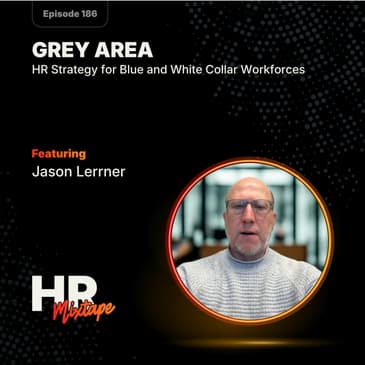
What does it really take to hire and retain people across a workforce that's part office, part shop floor? Jason Lerner, HR Director at Groundwater Treatment and Technology, has spent his career doing exactly that. He's grown his current company from fewer than 300 employees to more than 500 across six states, and he's cracked the code on attracting, developing, and keeping talent in grey industries, where blue-collar and white-collar work exist side by side.
In this episode, Jason and Dr. Shari Simpson dig into the skills gap hiding in plain sight, why Gen Z is more suited for grey-collar work than most people think, and how accountability is actually a retention tool, not a threat.
Key takeaways:
• Why candidates with non-traditional backgrounds may be your best hire, and how to screen for it in the interview.
• How to build clear career paths that satisfy Gen Z's need for growth without overpromising.
• Why holding people accountable is one of the best things you can do for your top performers.
Timestamps
[00:00:00] Intro from The HR Mixtape announcer
[00:00:41] Jason's non-traditional path: from sales to childcare to HR
[00:03:10] Defining grey industries and why they matter right now
[00:04:39] Skills transfer: helping candidates see their own potential
[00:05:09] Real example of a shop employee who moved into engineering
[00:08:35] Reformatting the interview process for non-traditional candidates
[00:09:41] Taking candidates on a PPE tour before making an offer
[00:11:23] Succession planning and why Gen Z fits into grey industries
[00:13:32] Setting expectations and using accountability as a retention tool
[00:17:00] Why credibility in the shop matters as much as HR expertise
Guest Bio
Motivating teams, building consensus, and creating a culture of honest and open communication are the tenets that have defined Jason Lerner's professional life. With a nuanced understanding of human behavior and a high degree of emotional intelligence, Jason leads by example and champions the performance and success of his team.
Adept at transforming ideas into actionable programs and breaking down complex concepts into understandable parts, Jason is known as an agent of change and an executive who gets things done. He currently leads the HR function for a privately held transportation and logistics company, overseeing its expansion from fewer than 300 to more than 500 employees across six states.
Committed to positioning HR as a strategic business partner, Jason collaborates with finance and executive leaders to advance the mission of the organization.
Brought to You by Paylocity
Paylocity is the fastest growing unified platform for HR, Finance, and IT. Paylocity brings your people, processes, and data together in one place so HR leaders can spend less time managing systems and more time doing the work that actually moves their organizations forward. Learn more at paylocity.com
Keywords: grey industries, blue-collar hiring, white-collar hiring, workforce development, Gen Z retention, skills transfer, non-traditional candidates, succession planning, accountability, HR strategy, career pathing, grey-collar work, employee retention, interview process
Powered by the WRKdefined Podcast Network.
[00:00:01] You're listening to the HR Mixtape, a podcast for leaders who want to understand people, strengthen culture and navigate change with clarity. Today's conversation starts now. Joining me today is Jason Lerner, Human Resources Director at Groundwater Treatment and Technology. Jason brings experience leading HR strategy in technical environments where skills, safety and retention are critical.
[00:00:34] Jason, thank you so much for jumping on the podcast with me today. Jason Lerner Good morning, Sherry. It's a pleasure to be here with you. So thank you. So I'd love to start with this question to just kind of T up our audience, maybe share a little bit about yourself and your background and how you got into the space that you're in right now. Jason Lerner Sure. So, um, I have a little bit of a non traditional background. I started out in sales at the beginning of my career and then pivoted into childcare for 20 years.
[00:01:01] I worked in the childcare space, actually owned five childcare centers of my own family owned. I ran that for a little over 20 years, then got into fully into the HR space. I did all the human resources there with the childcare centers, but I fully got into it doing a little bit of property management, physical therapy type of companies, things like that, helping develop HR departments from nothing and building the processes and all
[00:01:27] kind of stuff, and then got into trucking, engineering, and then now in wastewater remediation. So a little bit of a different path to get to here, but rising up and I enjoy building departments, taking it from the ground floor or taking it from a position where it's not effective and then being able to take it down and build it back up to where it is effective. You know, most HR people that I talk to don't have a traditional, hey, I went and did my
[00:01:55] undergrad in HR and then my master's and then got into this work. So I think you're untraditional is probably very traditional for the HR space. And having worked in childcare, that in itself has so many transferable skills with running the business and dealing with parents. And, you know, I think that probably set you up for a very successful career in HR. So thanks for sharing that. No, I agree with you. In the beginning, it was hard because people saw my background and they looked at me and they're like, you know, you worked for yourself for 20 years.
[00:02:24] How are you going to go work for somebody else? And I was like a lot harder. I had 450 bosses, you know, all the families we provided services for each of them was your boss, right? So it's a little easier when you're working for one. So it was a challenge there. But one of the biggest takeaways I had from owning my own business and then going to work was the ability to take HR and mix it with operations. So I understand, I have a good understanding of how does the company make money?
[00:02:52] How do you, how does the company, what's their goals? So I learned to align my HR, you know, the HR teams that I build with the goals of the company. So this way you're fitting in for operations and helping them to become more efficient and helping with retention in that space as well. So good. Well, I want to dive into our conversation and I love this topic. I think it's very relevant and it centers around this idea of gray industries.
[00:03:22] So for those who don't know what gray industries are, what that term means, let's start there and maybe you can help define that for our audience. Sure. So what I consider a gray industry is when you have your blue collar workers and your, who work with their hands in their shop or in the field for us. And then we have our white collar workers who are inside. So you put them together and you get kind of a gray industry. So you're doing a combination of blue collar work and white collar work together in the same environment.
[00:03:49] And I see it now being very relevant where people, there's a, you know, right now there's a high unemployment rate for some, for college graduates and they're struggling to get into the workforce. And they don't know that there's really good opportunities in non-traditional industries. They would, you know, no one really, I would think a lot of people wouldn't go to college thinking, I'm going to get my bachelor's degree in finance and then go work for a wastewater
[00:04:16] management company, or I'm going to go work in, you know, a manufacturing place or something like that. So I think there's education that can be done to reach out to students and graduating students and teach them that there's really good opportunities in these small to middle sized companies where you can actually make a difference pretty quickly and your career path can be accelerated because you're working in that type of environment.
[00:04:39] I think that one of the things that I see in, in that transition from either formal education or from having a different type of job and then moving into a gray industry or blue collar role is often there's that question of like, my skills don't transfer. And so as you've been working with people who have made those transitions, what are some of the things that you ask them to help them understand that they have a lot of possibilities? They just maybe don't realize that the skills transfer the way that they do.
[00:05:09] What they don't see is the opportunity to work with your hands a little bit, right? So people who have engineering degrees or some degree where they're, they have some background in, in a non-traditional environment, but they don't know that. They don't kind of understand that that's where they are. So they can work their way up. Like we have a person who works for us, who was in the shop, engineering student, and she was, is really good. They found that she was able to take her skills that she learned in this shop while she was working.
[00:05:38] And then now she's working in our engineering department, setting up remediation systems, filtration systems. She does the engineering work, the process engineering work to help us out in the field and get these understood. And you know, what, what people have to come to understand is, and we have three or four recent college graduates who we have working in our shop, but they're also going out in the field and they can take their, their, their experience with college, go in the field, learn
[00:06:06] our business from actually seeing how it operates. And then they move into the office and they're like, okay. So now they become much more effective because we have salespeople who sell these projects, but they need somebody who's like technical and understands it. So if you've already been out working in the fields and doing it, and then you come in the office. Now, when you go see a client, it's very easy for you to speak to the business. And it's, it's, it's, I see it as an education and a good way to do that is, and we're starting
[00:06:34] to move in this path is go down college, college fairs, things like that, where we can actually have the opportunity to talk to people maybe before they graduate or right after and explain to them kind of what we do and how we do it and what the career path is for them with their degree. The hands-on experience is so important. I think I've shared this on the podcast before. I worked for a company many, many, many years ago now called Peapod.
[00:07:02] They are a division of Ahold Grocers, which is out in the New Jersey area. And part of the requirement when I started at that company was it's a grocery delivery company. So think about like a competitor to like Instacart, but all the same company. And they had their own, you know, grocery warehouses and anybody who was salaried, doesn't matter what position you had in the organization, you had to start. Your first day, you would get on the truck and you would go deliver groceries for the whole day.
[00:07:31] And I thought it was such a, at that time, I had thought it was such a weird approach. But as I got into my role in that organization, which was in training and development, it gave me a completely different perspective on creating training opportunities for the employees because I really knew the complexities of the role that they had and what skills we could leverage and what types of things that would help them develop or move to the next level.
[00:07:56] So in thinking about that, it's interesting because I think that when we think about our hiring practices, that sometimes we can have questions or processes that weed people out that have these non-traditional backgrounds, that have some of this hands-on experience, but we don't translate it inside of our hiring processes to be something that we can see that can flex between a blue-collar job and potentially a white-collar job.
[00:08:23] So as you've worked to screen your own candidates and your organization, how have you helped kind of reformat that interview process to really help candidates who come from those non-traditional backgrounds? You know, I love that question because it's not normal. So I'm going to say this pretty quickly. It's not for everybody. There's a lot of people who don't maybe want to do this or won't fit into it the right way, right?
[00:08:52] One of the things you look at is what do people like to do when they're not working? Like a question I'll always ask is, what do you like to do? What do you love? What's your enjoyment? And when you hear people who enjoy fixing cars or doing do-it-yourself projects in their house or just fixing things or are always interested in trying to see how does something work, those type of people a lot of times can fit into these organizations because they have that background.
[00:09:21] They want to use their hands. They want to learn something different. They want to do something. You know, they want to, they don't want to sit at a desk all day. They want to have the opportunity to do different things. That's a huge trait that helps. And I'm not saying that that's, you know, what we use to make our decision. But when you're looking at a couple of candidates, sometimes it's, hey, does this person, do we think this person wants to do it? And as part of our interview process, when people come to, you know, visit our office, we put them into, you know, personal protective equipment. We give them a hard hat.
[00:09:51] We put on a vest and we take them on a tour of our yard and our shop. And we give them the opportunity to see the environment that they're working in. And with that, you know, I was saying, you know, we have a, our building is a 200 year old building and our office is inside of a working quarry. So it's, you know, it's a non-traditional workplace. But, you know, when people come in and it's not even that they, the hobbies help, but like you want to see what they, their face and how they react to being in that environment.
[00:10:18] And some people really enjoy it and, and have, and don't know that they have the opportunity to do that. And that's where I think that the disconnect is. There's a, um, we don't know how to necessarily find these candidates, but these candidates also don't know how to find us. Right. So it's, it's kind of a, you know, is it the chicken before the egg kind of thing, but we're, you know, that's why I said earlier, you know, we were looking at college fairs, things like that. But there's also people who were in transition who got laid off or lost their job. We're looking for something they wouldn't think to look in this industry or they're targeting
[00:10:48] bigger companies and they don't see the value in a small to midsize company and the ability to make a change and then move up there as well. So it's, it's not always just college students. It's also people in transition are just looking for something a little bit more active than what they're used to as well. That variance in what people are looking for leads me to ask you about Gen Z because I keep reading that that generation is more apt to look at the trades compared to looking at
[00:11:18] maybe knowledge worker opportunities. Have you seen that to be true? So yes. And what I've done is here is where we, I've been working on a succession plan and part of that succession plan is, is we have some people here who've been here. I mean, the average tenure at this company is almost 10 years. So there's a lot of institutional knowledge that's here and nobody's thought about how do you continue on that institutional knowledge?
[00:11:45] And this is where we're looking at Gen Z and trying to bring them in to understand it. One of the things, Gen Z gets a little bit of a rap. I have, I have two kids that are Gen Z, so I totally get it. But you know, you need to understand, they always want to learn something and they want to see very quickly where the growth is for them. They're not, they don't have the patience to kind of wait it out and see, they want to see how am I going to grow? Where am I going to grow? And how quickly does it happen?
[00:12:14] And in a small mid or mid-sized company like this, this is a perfect opportunity for them. They can come in, you work in the field, you learn what we do, and you very quickly can move up to an internal position because you already have the math skills or the other engineering skills that you need in order to be successful in those positions. You know, that's so interesting to me as you've thought about that, because it does sound like you have a very good defined path for them. And we hear that in other places too, that Gen Z definitely wants that clear path to promotion.
[00:12:44] And it's not, I haven't found that they come across that they are deserving of it. Like it should be automatic. It's more, I just wanted clarity and how I get more. So how have you coached your managers to make that transition between supporting blue-collar employees and supporting white-collar employees without creating the like us-them mentality, right? We can see that in blue-collar and white-collar. We can also see that in hybrid environments where you have fully remote and fully on-site
[00:13:14] employees. So how have you managed that? That's, I love it because I actually was on a call, a meeting this morning. We were doing exactly that. We're trying to get the sales department to talk more to the operations, right? Because they're out there selling the products and services and then operations has to catch up to them. And now what we're trying to do is we're working to align the sales department with the operations so that we can support them when they sell. It's the same type of thing here.
[00:13:40] I think to your point where Gen Z wants to understand where they're going to move up and what their career path is. As a company, the best thing you can do is set expectations. You don't want to come when they're interviewing with you. You don't want to just feed them a line and of you can do this, you can do that. Like set the expectation, be a little bit transparent and here's what you need to do. Here's what you can accomplish if you do these things and move up. And, you know, a lot of times if, you know, I feel something that's missing a lot of times
[00:14:10] in the workforce is accountability. People don't want to hold other people accountable. You know, to your point, keeping good workers is, people don't realize when you hold people accountable, your best workers stay, right? Because they see you with somebody who's not holding their weight and they have to constantly do more work. What happens? You don't lose the person who's not doing as much work. You lose the person who's your performer because they're actually doing more. So it's kind of in your interest to set the boundaries and let them know where their career growth is.
[00:14:37] I think it's a miss by a company if you don't do that up front. Well, and the research shows us that, you know, clarity is kindness, right? Clarity is being clear. Clarity is, it's a positive thing. And there is, there is a little bit with some of the younger generations. So I'm a Gen X and some of the younger generations kind of avoid that conflict because they don't want to create the tension. And I think in a way it's been good, right?
[00:15:05] As a Gen Xer, it's like, we don't have a problem with conflict, but sometimes we overflux to that area where we could use a little gentler parenting approach. But that being said, you can still hold people accountable in kindness. And I think that conversation we need to have more and more because it's about civility and it's about showing up. And it's, you know, most people, me included, want clear expectations on what good looks like in an organization so that I can work towards that.
[00:15:33] It's, it doesn't matter whether it's blue collar or white collar. That idea around clarity is very important. No, I'd agree with you. And I think you, um, the other part of that is, is sometimes people forget that you need to talk to people the way they want to be talked to, right? Instead of having one way to talk to everybody, you need to kind of understand how they want to be spoken to. And when you can, when you can master that skill, that, that helps you to relate and you can understand and you, and you get a feeling for where people are going and what they want.
[00:16:03] And then that helps not only in recruiting people, but also retaining them. And that all goes back to, you know, active listening, right? And, and don't look just to respond, but hear what they're saying, listen to what they're saying and, and, you know, have appreciation, even if you disagree or don't think that that's there. Either you try to find common ground with them, but at least you know where they're coming from and, you know, it's a, it's a hard task to, um, to get to that point where you're
[00:16:33] speaking to the language they want versus speaking the way you would want someone to speak to you. Um, it's a little bit of a different, I know it's a very small nuance, but it's a big difference. It is a huge difference. Um, I don't think that that necessarily means using all of Gen Z's slang when you're talking to them in case anybody thought that's what you meant. Um, that's pretty, yeah, that would come across probably not the way you want it. Exactly. That'll seem fake, quite honestly, if at least, you know, and I see it some, you know, I mean,
[00:17:02] I've done things where I've gone out in the warehouse. Um, people look at me as HR and when I was in trucking, we had a fleet safety and I took a forklift safety class, a forklift certification class. And one day one of the, someone was giving me a hard time and I said, you know, come off the forklift. And I literally got on the forklift and he's like, I got work to do. And I'm like, all right, what do you need? I literally took the forklift, unloaded 10 pallets off the truck and stacked them up against the wall. And you know what? After that, I never had another problem. But you know, they're like, HR has a forklift certification.
[00:17:32] I'm like, yeah, this, you know, this HR can get on a forklift and unload pallets for you. So it's, it's, that goes back to the whole understanding the environment that you're in and being able to speak that language. And it automatically gets you credibility too. Well, and it's such a good illustration of the concept we talk about all the time of HR can only be as successful in an organization if they know the business of the organization. And that business might be a knowledge business.
[00:18:00] It might be a very hands-on situation where you go in and you get the forklift certification. There's credibility there. There's understanding there that's different than if you just sit behind the desk and use your HR skills and don't ever kind of inundate yourself in the business, which makes me curious. Is there other maybe myths that you've heard around blue collar or gray collar work that you'd like the audience to retire using going forward?
[00:18:26] You know, it's, I think people look at blue collar industries a lot of time and feel like it's people who didn't go to college who go into those environments. And I'm seeing it here. Like it's, that's not necessarily the case. And I think when you have, you need a mix, you have some people who, who didn't go to school and then you have some people who have a, you know, a college education. I think that there's a, there's a sweet spot of having a mix of both types of workers.
[00:18:55] And I think the people who don't have a college education learn from the people who have college education, the people from college education get the other side of it from somebody who didn't necessarily go to college. So, you know, I think people need to open up their eyes a little bit and understand that you don't necessarily just because you went to college doesn't mean you can't work there. And, and I've, I've heard that before, you know, like when I, when I talk to friends of mine or people who I know that are looking for jobs and they give you a target list and
[00:19:22] then I'm like, well, what about like a blue collar industry? What about a smaller company? And you're talking about, you know, giant companies on your list. What about some small to midsize companies? There's a lot more opportunities there. There's a lot more of a place to make a difference. You might get hired at one job, but you're really going to have like two or three. And it's because there's, it's a more nimble type of environment and you can, you can change things pretty quickly. And I think that that's a, but you know, those are a couple of the big myths I see is that you can't blue collar and white collar don't really exist together.
[00:19:52] And, and I'd like to see people see, you know, there is that merging and it turns into a gray industry. Jason, what a great last thought for us to leave on. It's so much for us to take away and think about when it comes to really embracing the ideas around blue and gray industries and the work that, that you're doing and that HR practitioners in that space are doing. So thanks for sitting down and chatting with me for a few minutes about this. No, thank you, Shari, for the time. I appreciate it. This was a great experience. So thank you.
[00:20:27] Thanks for tuning in to the HR Mixtape. Like, share, review, and subscribe to support the show and help more people discover these conversations. Until next time, keep the conversation going.
Sponsors
