
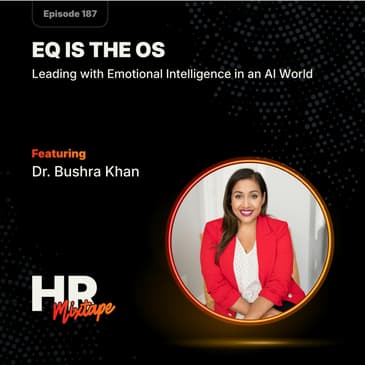
Most high performers don't get passed over because of what they know. They get passed over because of how they lead. In this episode, Dr. Bushra Khan makes the case that emotional intelligence isn't a soft skill, it's the strategic operating system every leader needs right now, especially as AI reshapes what work looks like.
In this conversation, she breaks down:
- Why 'be more strategic' on a performance review usually means something specific and fixable.
- How influence actually works in the brain, and why title alone won't get people to go above and beyond.
- A concrete KPI approach for measuring emotional intelligence that most organizations aren't tracking yet.
Timestamps
[00:00:42] Emotional intelligence as the operating system for the future of work
[00:02:30] Why 'soft skills' is out — and 'strategic skills' is in
[00:03:10] How technical experts plateau: the real meaning of 'not strategic enough'
[00:05:47] What 'be more strategic' is actually code for
[00:07:26] Micromanagement as a symptom of not knowing how to teach others
[00:09:09] The Peter Principle in action: when great individual contributors struggle to lead
[00:12:19] Why title doesn't equal influence — and what builds rapport instead
[00:16:55] Integrity in leadership: what it looks like when leaders actually walk the walk
[00:17:15] How to give feedback that makes people better, not defensive
[00:19:57] Measuring emotional intelligence: the KPI framework most orgs are missing
Guest Bio: Dr. Bushra Khan is a founder, educator, and leadership expert with over 15 years of experience in organizational development and adult learning. With a doctorate in Educational Leadership, deep research in emotional intelligence alongside global experts, and the creation of a top-rated executive leadership program (clients include Google, Government of Canada, and ERCOT), her impact is both measurable and deeply human.
Dr. Khan helps high-performing professionals strengthen their strategic capabilities, lead with integrity, turn their expertise into meaningful influence, and shape their leadership philosophy. She describes her work as a calm, compelling signal in the noise — a space where leaders come for clarity, rising professionals see possibility, and organizations recognize that emotional intelligence isn't a nice-to-have: it's the operating system for the future of work.
Brought to You by Paylocity
Paylocity is the fastest growing unified platform for HR, Finance, and IT. Paylocity brings your people, processes, and data together in one place so HR leaders can spend less time managing systems and more time doing the work that actually moves their organizations forward. Learn more at paylocity.com
Keywords: emotional intelligence, EQ, leadership, strategic skills, soft skills, HR leadership, performance management, people management, coaching, micromanagement, influence, integrity, feedback, AI and leadership, KPIs, organizational culture, future of work, Dr. Bushra Khan, HR Mixtape, Paylocity
Powered by the WRKdefined Podcast Network.
[00:00:01] You're listening to the HR Mixtape, a podcast for leaders who want to understand people, strengthen culture and navigate change with clarity. Today's conversation starts now. Joining me today is Dr. Bushra Khan, leadership and emotional intelligence expert at Leading with BK. Bushra helps leaders strengthen self-awareness, communication and trust to improve performance and culture.
[00:00:35] Dr. Khan, thank you so much for jumping on the podcast with me today. Dr. Shari Simpson, so nice to be here. Dr. Shari Simpson, so you have talked about emotional intelligence as kind of the operating system for the future of work. I'd love to hear more like what got you to believe that that is the next thing that we really need to focus on. Dr. Shari Simpson, Ph.D.: Yeah, so my whole motto has pivoted. So I'm a strong believer, researcher, practitioner,
[00:01:02] facilitator of emotional intelligence, behavioral leadership, strategic thinking, change management. And now what I'm seeing more than ever with rapid AI evolution, with rapid tech evolution, that the robots aren't taking over, the technology is not taking over. Dr. Shari Simpson, Ph.D.: Oh my gosh, what's going to happen to my job? Dr. Shari Simpson, Ph.D.: AI is going to ruin it. Dr. Shari Simpson, Ph.D.: It's people who know how to use AI.
[00:01:31] Dr. Shari Simpson, Ph.D.: The people who are emotionally intelligent and are strong with, you know, have a really strong sense of understanding how the tech is evolving. Dr. Shari Simpson, Ph.D.: They are going to take over. Dr. Shari Simpson, Ph.D.: So it's, that's kind of like, this is me on my soapbox. Dr. Shari Simpson, Ph.D.: This is me on top of the mountain. Dr. Shari Simpson, Ph.D.: It's really important to recognize that what sets us apart is how we actually influence.
[00:01:55] Dr. Shari Simpson, Ph.D.: I just got off a three day training with some of the best leaders at Google and their GHQR, their global hardware quality and reliability team. Dr. Shari Simpson, Ph.D.: Right? Some of the best in the world. And we're just talking about like how a simple nonverbal Q should shift, should make you pivot and influence the way you influence others. Dr. Shari Simpson, Ph.D.: And they were just like blown away because that's not something AI can do.
[00:02:22] Dr. Shari Simpson, Ph.D.: So that has been kind of, that's what I'm promoting. Dr. Shari Simpson, Ph.D.: That's what I'm teaching. Dr. Shari Simpson, Ph.D.: That's what I'm screaming from the mountaintop. Dr. Shari Simpson, Ph.D.: Well, and so often emotional intelligence is kind of bucketed in this softness. Dr. Shari Simpson, Ph.D.: Soft skills, right? Which I'm kind of done with that word. Dr. Shari Simpson, Ph.D.: Yeah, absolutely. No more. No more soft skills. Dr. Shari Simpson, Ph.D.: Yeah. So what's your, what's your definition in the practicality actually of emotional intelligence?
[00:02:48] Dr. Shari Simpson, Ph.D.: Yeah. There's nothing soft about emotional intelligence, about influence, about empathy, about camaraderie. There's nothing soft about this. Dr. Shari Simpson, Ph.D.: They are being relabeled. This is not a Bushra thing. This is a worldwide relabel of, they are no longer soft. It's called strategic skills.
[00:03:10] Dr. Shari Simpson, Ph.D.: You are extremely strategic. Like we are seeing some of our, the smartest leaders, some folks who are so innovative and they stop after a point in their career. Dr. Shari Simpson, Ph.D.: Why? They get the feedback. They get their performance improvement plan. They get laid off. You are not strategic enough. You are not visionary enough. You don't know how to inspire others.
[00:03:34] Dr. Shari Simpson, Ph.D.: But what? I'm the one who wrote the code of this or I'm the one who created the process to, you know, for this $3 million, $3 billion project. But you're not strategic. You're still doing it yourself.
[00:03:48] Dr. Shari Simpson, Ph.D.: Well, if I don't do it, no one else knows how to do it. No, that right there, it's because you don't lead with emotional intelligence. You don't know how to coach and mentor. So out with the soft skills, in with strategic skills. And it's really, really important that while you're buckling down on your technical skills, and by no means am I saying that technical skills are not important. They're absolutely important. But what we're seeing is, and this is like, you know, 40, 50 years of research done.
[00:04:18] Dr. Shari Simpson, Ph.D.: Harvard University, Harvard University, led by Dr. Daniel Goldman, and like a lot of us other researchers are kind of piggybacking off of that and contributing to this longitudinal study is IQ and technical skills. Absolutely important. What sets you apart for better leadership? What gets you more yeses, more money, more buy in, more stakeholder appreciation is emotional intelligence. IQ and technical skills.
[00:04:48] Dr. Shari Simpson, Ph.D.: Really important. Emotional intelligence is twice as important as IQ and technical skills for superior performance. So out with the soft skills, in with the strategic skills.
[00:04:59] Dr. Shari Simpson, Ph.D.: So for those who have gotten on their performance review, and I will admit, I am one of these people very early in my career. And I will say it's a terrible thing to write on a performance review because it's not specific, but it is the, you need to be more strategic. Like, what does that mean? But in the context of what you're talking about, how do they begin to learn those skills, right? They sit in this area where it's communication, it's confidence.
[00:05:29] Conflict resolution, it's, it's, it's, it's, it's, it's, it's, it's, it's, it's, it's, it's, it's, it's, it's all those things. If they're not used to doing that work, where do they begin to start pushing themselves? Because you can read all the books you want. This is a very, you've got to practice it. You've got to feel it.
[00:05:46] Dr. Shari Simpson, Ph.D.: Yeah. So strategic is code for not always, but often, you don't know how to clearly provide instructions to others. So it means often, not always, if you're lacking strategic skills, it means you don't know how to delegate, coach and follow through. That's what it's often code for.
[00:06:13] Dr. Shari Simpson, Ph.D.: So I, I, I'm going to come back to the how, but let's go back to the why. It's, and I'm not going to say inner child work, but I want you to take a second and think about every time I have a 10 year old and I have a five year old.
[00:06:28] Dr. Shari Simpson, Ph.D.: And I, and I see it in them. It's that they are praised for being leaders, yet there's still always the teacher at front, right? So at home, you've got parents at the front. They're the leaders. Then you've got teachers, you know, throughout elementary and high school and throughout university, you've got the teachers and professors at front. Then you get into a job, you put your head down, you've got a manager or supervisor, tech lead at front.
[00:06:56] Dr. Shari Simpson, Ph.D.: So we are constantly taking directions from others. We have not built. And I will say, you know, as the generations go by, I'm a millennial. I will say Gen Z's are quite good at this. We all need to be better across the board is how do you take turns in coaching others?
[00:07:18] Dr. Shari Simpson, Ph.D.: So don't just wait for your teachers and your managers and your community leaders and your little league coach to tell you what to do. What are, how are you inspiring others? And that is such an important skill set.
[00:07:30] Dr. Shari Simpson, Ph.D.: So coming back to the performance improvement plan is you need to be more strategic, Bushra. Okay, what does that mean? It means do you know how to coach and mentor others? Which actually leads to a myth, a management myth that micromanaging is a result of poor management. No, micromanagement is a result of the person doesn't know how to teach and inspire others.
[00:07:55] Dr. Shari Simpson, Ph.D.: So if I don't know, for example, if I ask you to complete the fiscal budget in X, Y, Z, I'd be like, you did it wrong, do it better. That's not really giving me much guidance. If I say, hey, this is how you need to do it better. This is step one, two, three, four. Well, I don't have time to teach Bushra, teach Sherry. It's just faster if I do it anyway. Yeah, you're right. It is faster if you do it yourself.
[00:08:24] Dr. Shari Simpson, Ph.D.: The first time. Maybe it's faster if you do it yourself the second time. But then by the third, fourth, fifth time, now you are no longer being strategic. You are putting out the fires yourself. You are not seen as a leader. You are seen as a doer. And there's nothing wrong with that.
[00:08:39] Dr. Shari Simpson, Ph.D.: But recognize if you want that promotion, if you want to be recognized as the leader, you got to step up and learn how to motivate and teach others. Give them smart goals. Be specific, measurable, actionable, realistic with a time bound. Give them opportunities to mess up. Give them, you know, have a coffee chat with them and be like, hey, you're probably not going to get it right for the first two, three times. And I'm going to coach you through it. Because in the long run, you are going to be seen as a strategic leader.
[00:09:08] Dr. Shari Simpson, Ph.D.: Well, and I think about all of those things when it comes to our high performers. Because you really kind of honed in on it. You have somebody, you know, the Peter principle. You have somebody who's really, really good in their job. And then they get promoted. And you're like, oh, what happened? They're no longer good at their job. Well, it's a totally different job.
[00:09:28] Dr. Shari Simpson, Ph.D.: And so it really does change how we should be thinking about high performers when we see them struggling to lead. So when you've worked with those groups of people who innately have this high passion to deliver, this probably can be a very emotionally scary thing to go through to try to flex because they've been so good in every other area of their job.
[00:09:53] Dr. Shari Simpson, Ph.D.: I could not agree with you more. And it's also true for anytime you're quite good. So like I mentioned, I have two kids. The first kid, I'm like, oh, I can do a second one. This is... And then we had our second one. I'm like, what just happened? Right? Two different kids, you know, being parent of one. There's my husband and I versus one kid. Now it's my husband and I.
[00:10:23] Dr. Shari Simpson, Ph.D.: Versus the two of them. And they like, you know, knock on wood, they have a really great relationship. And I'm like, how are you ganging up on us? Like, I am twice your size. Same idea in the workplace. You've been so good at the technical aspect of your role or the where your subject matter expertise is what you're being rated on, is what you're being evaluated on. You're an accountant. You're very good at accounting. You're an engineer. You're very good at the engineering aspect.
[00:10:53] You are a teacher. You're very good at teaching and making lessons plan. And then you get promoted because you're so good at that specific topic. You've been promoted a few times. Now there's 10, 15, 20 people under you. And you're like, wait, what? Can I go back? Why don't I actually have time to do the quote unquote my actual job? Nobody. Your actual job, the job description has changed.
[00:11:18] You are now ensuring, if you were a great engineer, you are now ensuring that 15, 20 people who report to you, they are great engineers. If you're an accountant and now you're the head of, you know, the accounting department, now you're in charge of making sure the rest of the accountants are good at their job. You are no longer, and should you no longer be expected to do the actual technical aspect of your job. It is your job to be strategic, inspire others, coach others, and follow through.
[00:11:47] What do you say to that person who steps into that role, has a fundamental understanding of that, but draws on this fallacy that title equals respect equals influence.
[00:12:02] That's just not true. But sometimes I see people fall into that and it's, well, I've got the title, you should dot, dot, dot, whatever I have to say. How do we help them understand that influence isn't equal to your title?
[00:12:18] Yeah. Yes. And I'm not going to say that's an old school way of thinking. I see that. I hear that. And oftentimes it's because you've worked so hard for your title as probably as an individual contributor, maybe as a team contributor. But again, when you're at the top, the game has changed.
[00:12:46] And so one worldview that I have is that the more things you have in common with others, what happens to your psychological safety. So the more you have in common. So you are now the VP of innovation, AI and innovation.
[00:13:04] Okay. And you have been an excellent individual contributor. You've grown, you've grown, you've grown, you've now had a 10 people team, a 20 people team, and now you're at the top and now you have maybe 100, 200 people under you.
[00:13:19] You have worked so hard to be there. But how you lead through influence is through rapport. And what happens to our brain, the more we have the fields of experience overlap. So the more things we have in common, what happens to others is our amygdala. That's our threat center. It calms down. It's totally calm.
[00:13:43] And our prefrontal cortex is online. And we are more willing to hear what you have to say. And if we are more willing to hear what you have to say, then it kind of translates back to our hippocampus, which is right here.
[00:13:56] So then it becomes learned knowledge. So we kind of operate from our prefrontal cortex, we do our executive functioning, we do our perspective taking, our planning from up here. Then once we have bought in, if I like you, it really comes back to playground rules.
[00:14:16] If I like you as a kid, you know, and it's like, every day, I used to come home with like 10 new best friends. If I like you, I am going to listen to you. That is plain and simple. Now, you can flex, I got the VP role, I've got the director role, do as I say, okay, but no one's going to go above and beyond for you. That's where burnout comes in. That's where, you know, lack of well being comes in. That's where reduced psychological safety comes in.
[00:14:45] People like you, you know, I always get this like Bushra, not only do I need to lead a team, but now I need to be their team therapist. Yeah, yeah, you do. Absolutely. So if you have the title, and you don't know how to influence, you got to pause. And you got to think, what are you doing to build rapport?
[00:15:05] Rapport is so important. And I think about all of the, you know, all the leadership books that are out there that people are told to read to get prepared, right? You've got the Dare to Lead by Brene Brown, right? Very emotionally intelligent type of work.
[00:15:21] And then you have on the other side, the 48 laws of power, right? That's teaching you about like how to play the game, right? Somewhere in the middle of all of that is this idea around integrity and how to be a leader that has a brand that, that people know, hey, you know, that person has really high integrity.
[00:15:42] What are some of the habits that you're seeing coming out of those leaders who that is the word that gets used often for them? Because it's not a word I typically hear when leaders are described.
[00:15:54] Yeah. So how I have heard it being operationalized, how I have heard it being described is, you know, they don't just talk the talk, but they walk the walk. When they see shit has hit the roof, when they see there are fires, that they are not afraid to roll up their sleeves and get to work.
[00:16:17] It's less of a, I'm sitting at my glass tower and, you know, screaming from the top, like, oh, you're doing this wrong and you're doing that wrong. And let's be very clear, Sherry, no one thinks they're doing that. Everyone thinks they have influence, right? And this is where feedback comes in.
[00:16:39] So I, so one of my frameworks is if you have strong rapport, meaning, and not that you need to be friends with everyone. Empathy and rapport doesn't mean you're friends with everyone or empathy doesn't mean you're just being nice. It really means, do you understand the other person? You may not agree with them, but do you understand them? So how do you build rapport? There's one. And the other one is feedback.
[00:17:06] And in my Venn diagram, where there's an overlap, that's where influence happens. So we've talked about rapport. Let's talk about feedback. Folks who are with strong integrity, what I see in my research, what I see in my work, when I work with these huge global leaders over and over again is they ask for feedback and they give good feedback.
[00:17:29] Feedback. And feedback isn't, Sherry, hey, you did that presentation well, but it went too long. Do better next time. It's, Sherry, you did well because you engaged everyone and you asked, you answered some really hard-hitting questions. Next time, instead of having 20 slide decks because you were reading off of them, maybe cut it back down to one or two because you have such strong command of the knowledge.
[00:17:54] We want to hear Sherry and less the slides, right? Being really specific. And then opening it up like, hey, what can I do better? And as a leader, that's actually putting you in a vulnerable spot. But understanding, you do have the title to protect you. So oftentimes what happens is that leaders are, we claim that we are self-aware, but you can't really be self-aware if you're not getting data.
[00:18:22] And you need to get that data points. Do not wait for the annual or biannual appraisals and the, you know, the anonymous peer reviews. Ask people for feedback. And if you are as good as you are in your job and you are, that feedback only makes you better. And tell folks like, hey, I want to know what I've done well and I want to know where I can improve with a suggested solution.
[00:18:46] And that's where the magic happens is don't just say, I need to be better, provide suggested solutions and share that. I will hear all of it. I may not apply all of it. And that's okay. But people are not feel comfortable to speak to you. That's where integrity comes in is when someone tells you, hey, Sherry, hey, Bushra, have you considered doing this a little bit differently? And then you see your leader do it differently. Holy moly, guacamole. That's integrity.
[00:19:16] Not are they only inviting you to ask, asking you for feedback, but they're actually walking the walk. So leaders, integrity means ask people the uncomfortable questions. And if they tell you the answers, follow through it. It makes you look good. I love that. That makes you look good. Love that. You know, as we wrap up our conversation, you know, I'm curious, how have you helped leaders think about the metrics behind emotional intelligence?
[00:19:46] Because we know we all get asked that. What's the ROI? How do I measure this? How do I know that, you know, implementing programs to help my leaders be more emotionally intelligent is actually having an impact on my business? Yeah. So if your KPIs are not already, if your key performance indicators are not already measuring this, you should. And a lot of organizations are doing this.
[00:20:09] The organizations who are stuck, this is the message for them is, number one, have a KPI where you can measure the number of times folks have reached out to team members and team members have said yes. Now, I don't mean burnout. I don't mean they're taking on more work, but this is true collaboration.
[00:20:35] So you should have a KPI to show that this is the number of times, you know, Bushra is the project leader, but Bushra needs support or needs expertise or needs collaboration. And Bushra now has asked Johnny to support. There should be a place in your system where that is tracked. Number one. Number two is once that is tracked, how quickly was that project completed?
[00:21:02] Did it hit the deadline? Because often we only measure when things did not hit the deadline. We should also measure that it did hit the deadline. We did hit our, you know, our success metrics. But the how, how did it happen? Did Bushra have to pull three all-nighters? No way. You are failing as a team. Or did Bushra reach out to Johnny and Sherry to get it done?
[00:21:26] So you need to capture that information. And when that is praised, when that is applauded, that Bushra has reached out to others and Bushra gets that shout out during a meeting, you better believe Sherry's going to do that next time. You better believe Johnny's going to do that next time. So for those who are not already measuring the, and I don't just mean shout outs, like it's not enough to praise folks informally.
[00:21:53] It needs to be measured formally. It needs to be tracked that. And that's also really good information when you're assigning the next project that like, okay, again, the VP, the director, the senior leaders are thinking, how hard can this job be? Right? Like I could probably do it over like in a week. And then a week has gone by, a month has gone by.
[00:22:15] Hmm. Why hasn't it been getting done? Right? Whereas if it does get done, wow, see, I told you, I told you could get done. Like, you know, I can never be wrong, but they're not kind of pulling back the curtains and seeing what's going on backstage.
[00:22:30] So please folks, if you are all about the KPIs, if you're all about the success metrics, measure how often people are asking each other for help, for collaboration, for subject matter expertise, and reward that formally. I love that. That's the first time I think I've ever heard anybody give that example for a metric. So what a great takeaway. This has been a wonderful conversation. Emotional intelligence is so important. So I'm glad that we got to sit down and talk about it for a few minutes.
[00:22:59] I'm so glad. Thank you so much for having me. Thanks for tuning in to the HR Mixtape. Like, share, review, and subscribe to support the show and help more people discover these conversations. Until next time, keep the conversation going.
Sponsors
