
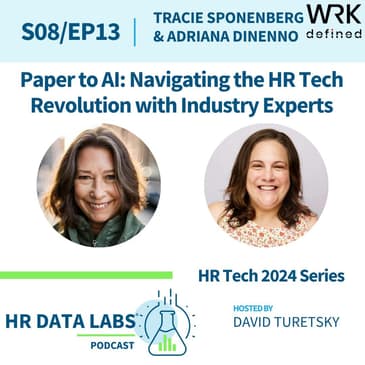
This episode features two conversations that took place at the HR Tech 2024 conference in Las Vegas.
Tracie Sponenberg is a Fractional Chief People Officer and Consultant for the distribution industry. In part one of this episode, she talks about why some organizations are slower to adopt new HR tech than others; the importance of adopting new technology with strong ethics and data governance; and how compensation has been affected by the latest developments in AI.
Adriana DiNenno is the Senior Product Manager at Health eCareers. In part two of this episode, she talks about how emerging HR technology can help both job seekers and recruiters save lots of time; how pay transparency regulations will affect recruitment; and how AI-based recruitment systems won’t create an emotional connection with job seekers.
[0:00] Introduction
- Welcome, Tracie and Adriana!
- Today’s Topic: From Paper to AI: Navigating the HR Tech Revolution
[1:20] Part One: Evolution of HR Tech with Tracie Sponenberg
- [3:11] Despite massive leaps in HR technology, many organizations are still using pen and paper systems
- [8:08] Why AI tools should always be approached with ethics and data governance in mind
- [13:36] How emerging HR tech affects compensation and why training will be so important
- [18:09] What role with AI play in HR once the hype dies down?
[25:33] Part Two: Evolution of Recruitment Technology with Adriana DiNenno
- [27:38] How HR tech can help convert more job postings and avoid candidates “ghosting” interviews
- [36:45] How pay transparency will affect recruitment
- [40:05] How AI’s lack of emotional connection might affect recruitment
Quick Quote
“I found, in healthcare, within my own data set . . . that [job] seekers are more likely to view [job postings] and apply when the compensation and salary are listed.” -Adriana DiNenno
Resources:
Tracie's website
Contact:
Tracie's LinkedIn
Adriana's LinkedIn
David's LinkedIn
Dwight's LinkedIn
Podcast Manager: Karissa Harris
Email us!
Production by Affogato Media
To schedule a meeting with us: https://salary.com/hrdlconsulting
For more HR Data Labs®, enjoy the HR Data Labs Brown Bag Lunch Hours every Friday at 2:00PM-2:30PM EST. Check it out here: https://hrdatalabs.com/brown-bag-lunch/
Produced by Affogato Media
Powered by the WRKdefined Podcast Network.
[00:00:00] The world of business is more complex than ever. The world of human resources and compensation is also getting more complex. Welcome to the HR Data Labs podcast, your direct source for the latest trends from experts inside and outside the world of human resources. Listen as we explore the impact that compensation strategy, data, and people analytics can have on your organization. This podcast is sponsored by Salary.com, your source for data, technology, and data.
[00:00:30] and consulting for compensation and beyond. Now, here are your hosts, David Turetsky and Dwight Brown.
[00:00:38] Hello and welcome to the HR Data Labs podcast. I'm your host, David Turetsky. We have two exciting episodes for you in one coming to you live from the 2024 HR Technology Conference in Las Vegas, Nevada.
[00:00:51] We have two very special guests, Tracy Sponenberg, a fractional CPO and a good friend, and Adriana DiNenno, a very good friend of the podcast. And she's from Healthy Careers. These are two complimentary podcasts. So hopefully you'll enjoy them. Please listen and let us know.
[00:01:20] Hello and welcome to the HR Data Labs podcast. I'm your host, David Turetsky, and we're here live at the 2024 HR Technology Conference in the beautiful Mandalay Bay Exposition Center in Las Vegas, Nevada. And I'm here with Tracy Sponenberg. Tracy, how are you?
[00:01:35] I'm good, David. It's good to meet you. I don't think we've never met in person, right?
[00:01:39] No, no. This is really cool. Well, I saw you from afar yesterday. Oh, actually, I was pretty up close.
[00:01:43] Oh, you said that. You messaged that. Yeah, yeah.
[00:01:44] But you were surrounded by people and you were interacting and it's really rude to go, oh, but it's David Turetsky from the HR Data Labs.
[00:01:51] No, you totally should have. You totally should have.
[00:01:53] No, I don't. My ego's not that big.
[00:01:56] I would have recognized you.
[00:01:59] Well, yeah, I don't have as much hair as I used to.
[00:02:01] Well, you know, none of us do.
[00:02:03] Yours looked better than mine.
[00:02:05] Well, it's been a rough night. It was a rough, not a rough night.
[00:02:09] Wow.
[00:02:09] No, no, no. I came in with my hair all done.
[00:02:11] What story is that?
[00:02:12] No, I got up at four in the morning, had my hair done the day before.
[00:02:16] Today, I was like decided to just redo it and like now I'm having a hair crisis, but that's all right.
[00:02:21] Thankfully, we're not recording video.
[00:02:22] No, her hair looks wonderful just to let you know.
[00:02:24] Well, we're going to take a selfie later.
[00:02:26] Okay.
[00:02:27] There you go.
[00:02:27] We'll do that.
[00:02:35] Yeah.
[00:02:35] One fun thing that no one knows about me.
[00:02:38] Oh, well, I guess it's fine.
[00:02:40] I used to be a chair leader and I'm not, when I was younger, I'm not very coordinated,
[00:02:45] athletic in any way, shape or form.
[00:02:47] And that's, I guess, surprising.
[00:02:51] Nobody really knows that now.
[00:02:53] Okay.
[00:02:53] I would have said the tattoos, but now everybody knows I have a bunch of tattoos.
[00:02:57] Well, I see the one on your arm.
[00:02:58] I see at least two on your arm.
[00:02:59] Okay.
[00:02:59] And then I have one.
[00:03:00] Okay.
[00:03:00] Another one you can't see.
[00:03:01] Okay.
[00:03:01] I'm not going there.
[00:03:02] No.
[00:03:03] No, this is an HR podcast.
[00:03:04] Nope.
[00:03:04] Okay.
[00:03:05] Nope.
[00:03:05] So we're here at HR technology and we're going to actually talk HR technology.
[00:03:10] Yeah.
[00:03:11] So the first question is, how has HR tech evolved and transformed?
[00:03:17] So I've been doing this for a long time.
[00:03:21] So it was 30 years, right?
[00:03:23] And so when I first...
[00:03:24] So in grade school you were...
[00:03:25] I was like four when I started in the business.
[00:03:29] Yeah.
[00:03:29] I was four.
[00:03:30] And I was just a prodigy.
[00:03:32] And I started with a large global company.
[00:03:37] And I remember it really wasn't HR tech to speak of.
[00:03:40] Somehow we paid people.
[00:03:42] That wasn't really my area.
[00:03:43] It was a big...
[00:03:44] I was in talent acquisition mostly.
[00:03:46] Okay.
[00:03:46] But I remember like just even getting email.
[00:03:49] I mean, that's how long it was.
[00:03:50] Yeah.
[00:03:50] Like just the very beginnings and then the bones of HR tech and then going to the first
[00:03:56] job where I was leading it.
[00:03:58] And we actually had a system.
[00:04:00] We had a system that I thought was just amazing.
[00:04:04] And looking back on with 2024 eyes, I'm sure I would look and go, what the heck is that?
[00:04:11] And, you know, I've been doing this long enough where I followed the evolution of the capabilities
[00:04:16] of what HR tech can do from just...
[00:04:19] Really when I started, it was like pay people.
[00:04:21] Yeah.
[00:04:21] Like just get people paid, right?
[00:04:23] And then it became so, so much more.
[00:04:26] And now with AI, there's really nothing HR tech can't do.
[00:04:31] It's such an incredible tool for all organizations, all teams.
[00:04:36] So a sense of what you're saying is it's gone from being very administrative and it's kind
[00:04:40] of transformed to kind of say your HR team can be what it needs to be and can evolve by
[00:04:49] leveraging the technologies available to it.
[00:04:52] Much more eloquently said.
[00:04:53] That's exactly what I'm trying to say.
[00:04:55] Not enough coffee this morning.
[00:04:57] Well, my job is interpretation and translation.
[00:05:00] So, yeah.
[00:05:01] Well, but I think I've seen this happen.
[00:05:03] I've seen this happen in the world of compensation.
[00:05:05] I've seen it happen in HR IT.
[00:05:08] The tools around us have changed.
[00:05:09] Like when I first started, there were HR organizations sharing one computer in the center
[00:05:15] of the room, right?
[00:05:17] And everything was still done on paper.
[00:05:19] When I got my first compensation practitioner job at Morgan Stanley, we did everything by
[00:05:25] inter-office envelope.
[00:05:27] And you know, those personal action change forms that we used to send through those very secure
[00:05:36] manila envelopes with the red threads.
[00:05:38] Yeah.
[00:05:38] So, you know, even, but I'm, well, we all know that that form has just transitioned onto
[00:05:46] technology, but we're still kind of doing the same thing.
[00:05:49] We're just not using the inter-office envelopes anymore.
[00:05:51] Well, some places are, which is part of the work that I do is, is help them not do that
[00:05:57] anymore.
[00:05:58] My last company that was doing that, right?
[00:06:00] They were still, we're still doing that and all completely paper-based.
[00:06:05] And I think when like you and I talk or we talk to people we know who play in this space,
[00:06:10] it's surprising to a lot of people, but particularly I work mainly in distribution.
[00:06:15] And that's, it's not surprising to me when I see entirely paper-based people.
[00:06:21] I tell you in 2024, I am shocked when I hear, well, yeah, we have an HRIS and we do shared
[00:06:29] services and a lot of the work that we do is entering change forms into our HRIS.
[00:06:36] It's not shocking to me.
[00:06:38] It's like, I immediately go, oh, I can help you.
[00:06:40] Like, right.
[00:06:40] They, you just don't know you, they maybe don't know.
[00:06:43] And that's what I've encountered a lot.
[00:06:45] Like, you don't know if you're in that and you've been in that role for 30 years and you
[00:06:50] don't come to things like this.
[00:06:51] You don't know what's available to you.
[00:06:54] But then that means that the organization hasn't evolved to see the benefit that HR can provide
[00:07:00] in other areas and they see HR as being administrative.
[00:07:03] Correct.
[00:07:03] And that's also what I'm trying to change in the whole industry and beyond, because it's
[00:07:08] still very much, that's that, that perception is still very much present.
[00:07:12] Not everywhere, but in a lot of places.
[00:07:14] I mean, God bless you.
[00:07:16] And if there are, if there are organizations that are listening and saying, well, we do
[00:07:20] a lot on paper too.
[00:07:21] I'm not decrying you and I'm not telling you you're behind what, and I think what Tracy
[00:07:26] is saying is, is that you're not alone.
[00:07:27] Yeah.
[00:07:28] Right.
[00:07:28] Totally not alone.
[00:07:29] There's no shame.
[00:07:30] I think that that's the, the big thing.
[00:07:32] Like if you are there, that's where you are.
[00:07:35] And everybody was at some point and there's no shame.
[00:07:37] And if you want or need to move forward, there's lots of great ways that will help not only you
[00:07:44] and your HR team, but the company.
[00:07:47] And most importantly, the people of the company.
[00:07:49] Right.
[00:07:49] And the vision of what HR can become should be something that you start thinking about as
[00:07:56] being a, how do you evolve your practices and your policies and your technologies should help
[00:08:01] you along the way with that.
[00:08:03] Yep.
[00:08:03] They're tools, tools.
[00:08:05] It's not the end all be all, but they're excellent tools to help.
[00:08:08] And so let's go on to the next question, which is really one of the more fascinating ones,
[00:08:13] which is, what do you think of as the latest trend in HR technology that's really helping
[00:08:17] drive some of these changes?
[00:08:20] And, you know, what should people be on the lookout for in 2025?
[00:08:23] It's a good question.
[00:08:24] I'm going to give like the most boring answer, probably.
[00:08:27] That's probably not true about the most boring.
[00:08:31] It might be.
[00:08:31] So, and I don't love the word trends, but like, I think, you know, AI is, it was just
[00:08:39] having this conversation with Teresa Fessenstein, who runs a, basically a training company for
[00:08:45] HR professionals on AI.
[00:08:47] And still a lot of HR professionals don't understand it and what it can do.
[00:08:53] So I think, you know, yes, everybody talks about that being a trend, but it's more than
[00:08:59] that.
[00:08:59] If you walk around to all the booths here, it's going to be hard to find, at least in
[00:09:04] the large companies that aren't, I mean, AI has been around for decades, but that aren't
[00:09:08] using it in some majorly transformative way.
[00:09:11] And I think we need to keep talking about it in the HR space, particularly in the spaces
[00:09:16] where people aren't listening because you're going to get left behind.
[00:09:20] But the problem I think with AI, especially the terminology, is that it means so many different
[00:09:27] things.
[00:09:27] It's a catch-all phrase to mean natural language process.
[00:09:30] Right, right, right, right.
[00:09:32] Generative AI.
[00:09:32] I do that too.
[00:09:33] Like, I tend to do that too, but specifically generative AI.
[00:09:37] Yeah.
[00:09:37] And for those of you who, you know, there's Gemini, there's Copilot, there's, you know,
[00:09:46] ChatGPT 4.0, there's a lot of others.
[00:09:49] Perplexity is my favorite.
[00:09:50] I love that.
[00:09:51] It's a great research tool.
[00:09:53] A lot of, easy to play and free to start.
[00:09:56] Easy to play around.
[00:09:57] Well, and one of the fascinating things that I've been talking to people about is that
[00:10:01] that's a consumer-facing.
[00:10:03] Yeah.
[00:10:03] That a lot of people are using as their work resources.
[00:10:07] Right.
[00:10:07] Scary as heck.
[00:10:09] Yeah.
[00:10:09] Or AF, if you will.
[00:10:11] Yeah.
[00:10:11] Because every time you type something into those prompts, that's actually being held onto by
[00:10:18] the AI learning about it.
[00:10:20] Yeah.
[00:10:20] And learning, and they know your IP address.
[00:10:23] Yep.
[00:10:23] They know the company you work for.
[00:10:25] Yep.
[00:10:25] But you're basically telling the world what you're researching.
[00:10:29] Yeah.
[00:10:30] Yep.
[00:10:31] Warning, warning Will Robinson.
[00:10:33] Go hand in hand, right?
[00:10:34] We should have said that first.
[00:10:35] Ethics and AI go hand in hand.
[00:10:36] And governance and AI, that goes hand in hand.
[00:10:39] And it's, you know, it can be dangerous, but it can be wonderful.
[00:10:42] And it also doesn't do everything.
[00:10:44] And it's also kind of stupid still in subgenerative AI specifically.
[00:10:48] Like, it's not everything, you know.
[00:10:51] But I think if I'm an, I think, I know, if I'm an IT person and I'm the leader of IT
[00:10:57] in my organization, I should be probably thinking about how scared I am about these AI bots
[00:11:05] running among, not the bots.
[00:11:06] No, totally.
[00:11:07] But the generative AI running amok in my organization that I don't know about.
[00:11:12] And I may not ever know because of the BYOB.
[00:11:15] Yeah.
[00:11:15] Yep.
[00:11:16] Or BYOD.
[00:11:18] Not bring your own beer, bring your own device.
[00:11:19] Bring your own device.
[00:11:21] My last company, a lot of companies, at least early on, did, you know, their solution was
[00:11:25] just like, block it, block it.
[00:11:26] Nobody's going to use it.
[00:11:27] That's not the solution, you know, because it can be used for some really good, helpful
[00:11:33] things.
[00:11:33] And you want people to learn, right?
[00:11:35] And then I had a client that was really early and deep on an AI policy.
[00:11:40] And that was really...
[00:11:42] That's great.
[00:11:42] I think really putting guardrails around what you can and can't do.
[00:11:46] And even just creating the policy creates an awareness of, oh crap, you shouldn't be doing
[00:11:51] these things if you are.
[00:11:52] Right.
[00:11:53] And if you are, tell your boss about it or tell IT about it or whatever the policy is going
[00:11:58] to be.
[00:11:59] But to your other point, you're not going to be able to clamp down and have people not use
[00:12:03] it.
[00:12:03] Yep.
[00:12:04] But if you embrace it, and you mentioned the word training before.
[00:12:08] Brilliant.
[00:12:09] You know, if you can get training for your organization to be able to know how to embrace
[00:12:14] and what to embrace and lead them in a direction, I promise you're going to get much more desirable
[00:12:20] results if that's the terminology.
[00:12:21] Right.
[00:12:22] Right.
[00:12:22] Not just, here you go, figure it out.
[00:12:24] Right.
[00:12:24] Which people are doing on their own.
[00:12:26] I mean, we've been living in a world of AI because Siri and Hey Google and Alexa has
[00:12:32] been around since like 2013.
[00:12:34] Yeah.
[00:12:35] We've been getting trained.
[00:12:37] I mean, even like Grammarly or the spell checker in your iPhone or Android, they've been
[00:12:42] around forever.
[00:12:43] Right.
[00:12:43] Right.
[00:12:44] It wasn't until chat GPT that everybody goes, oh, what's this?
[00:12:48] And it's so accessible.
[00:12:51] Generative AI is so accessible.
[00:12:53] And I think that that was the huge difference.
[00:12:56] And it's, there's no going back, really.
[00:12:59] No.
[00:13:00] I wish we were further along.
[00:13:01] I want it to be like, I want a real, like, do this for me.
[00:13:04] And yeah, it kind of does it, but sometimes it's just really awful.
[00:13:08] So we're not quite there with everything.
[00:13:11] I wanted to do a little bit more of my thinking.
[00:13:15] Well, reading your mind, if you're not.
[00:13:18] Not that far.
[00:13:19] Not that much.
[00:13:19] If you have that chip implanted by Elon.
[00:13:21] I know, I don't want to do that.
[00:13:23] I will not be doing that.
[00:13:24] Yeah.
[00:13:24] Me neither.
[00:13:25] Me neither.
[00:13:26] Too far.
[00:13:26] Too far.
[00:13:36] So the third question we wanted to talk about was how important is compensation in
[00:13:41] kind of the general scheme of where HR technology is and where it will be?
[00:13:44] You know, I think, well, very important, right?
[00:13:48] And I think there's been so much.
[00:13:53] Let me take a step back.
[00:13:54] When I've been working in companies and with clients, one of the biggest headaches is compensation,
[00:14:00] right?
[00:14:00] One of the biggest headaches.
[00:14:02] It's if you have the budget to hire a comp specialist, they're very hard to find.
[00:14:07] Right?
[00:14:08] And expensive.
[00:14:08] And expensive.
[00:14:11] Or even simply doing a, you know, a salary survey.
[00:14:14] You do it.
[00:14:15] Very expensive.
[00:14:16] And then you do it again the next year.
[00:14:18] And you do it again.
[00:14:18] And there are tools, you know, like, you know, salary.com has one because I researched
[00:14:22] it for a client, right?
[00:14:23] Thank you for the shameless plug.
[00:14:24] There are tools that, what?
[00:14:25] Thank you for the shameless plug.
[00:14:26] No, no, no.
[00:14:27] Seriously.
[00:14:27] I was doing a project for a client and doing some research.
[00:14:32] And there were others, but we won't mention them.
[00:14:33] But there are tools that are really, really helpful because it is so complicated, confusing.
[00:14:43] And if you care about nothing else in an organization, you should care about pay.
[00:14:48] Absolutely.
[00:14:49] And you should care about pay equity.
[00:14:50] And we now have the technology to help us monitor, to help us, you know, pay people what
[00:14:58] they should be paid, to help us figure that out, where we should be now, where we should
[00:15:03] be going.
[00:15:04] And so I think this is huge.
[00:15:06] It's probably what I should have said instead of AI.
[00:15:08] It would have been kind of more fun.
[00:15:09] And it's also something like, it's a growth area for me too.
[00:15:13] So I was never a comp specialist.
[00:15:14] I was a leading HR.
[00:15:16] I was doing generalist work and that was part of it.
[00:15:20] And so it never for me got the time and attention it deserved.
[00:15:23] And now me working in the capacity I am with clients, like being able to have tools, it's
[00:15:29] terrific.
[00:15:30] Yeah.
[00:15:31] Well, and, you know, I'm deep in it.
[00:15:34] So sometimes I don't see the forest for the trees.
[00:15:36] And I've been doing comps since I graduated college.
[00:15:41] And I've always used technology as a differentiator for myself to do more, to do better.
[00:15:47] And I never really got how people just didn't use technology.
[00:15:51] I mean, even Excel is kind of a very popular technology platform for compensation.
[00:15:59] And I guess where I wanted to go is, is that with the regulations that are coming out with
[00:16:03] FLSA change, the minimum for exempt status or pay transparency or other things, comp is
[00:16:11] going to have to start working more across and pay equity, obviously, is going to have
[00:16:15] to start working across the world of HR and beyond to make sure that the ramifications of
[00:16:21] these policies and these changes really are a business context instead of just being an
[00:16:25] HR or compensation focus.
[00:16:27] Totally.
[00:16:28] And HR is business.
[00:16:29] And I've been saying this for years, right?
[00:16:31] Like your people are your business.
[00:16:33] HR is a business function.
[00:16:36] And this matters.
[00:16:37] And this is before I left corporate.
[00:16:38] We were talking about the, you know, the pay equity laws coming and, you know, in the states
[00:16:44] that we're in.
[00:16:44] And so it's not just that and nailing that, making sure that you're doing the right thing
[00:16:49] by people and making sure that you're not violating the law.
[00:16:52] But then it's educating everybody.
[00:16:54] And when you have, you know, 10, 20, 30, 40, 50, 70 different locations, if you're, you
[00:17:00] know, national, if you're global, how are you going to do that?
[00:17:03] If you don't have a system that helps you with that, I don't know how, how you can.
[00:17:08] Well, it becomes really complex and it becomes really difficult and a lot of companies fail
[00:17:13] at it.
[00:17:13] Yeah.
[00:17:14] And what scares me is, especially in the realm of pay transparency, because it's so invasive
[00:17:19] to everything we've been doing in the past, we now need to start opening up and translating
[00:17:25] all that comp speak or the HR speak into like, what's a midpoint progression and who cares?
[00:17:30] What's a range spread?
[00:17:32] What's comp ratio?
[00:17:34] We can go on about that for hours.
[00:17:35] Educate people, not just managers, but your team.
[00:17:39] And if they know it, if they understand it, it's going to be better for everybody.
[00:17:45] But, you know, it's like anything, right?
[00:17:47] Something was, oh, people don't need to know this.
[00:17:49] Yes, they do.
[00:17:50] Don't you want them to be right when they're talking about things and have the correct
[00:17:54] information?
[00:17:55] Well, and the problem now with getting the wrong information isn't just someone leaving
[00:18:00] because these things are transparent.
[00:18:05] It's a public relations nightmare.
[00:18:07] Yeah.
[00:18:07] Yeah.
[00:18:08] Totally.
[00:18:09] So let me try and ask a bonus question.
[00:18:12] Okay.
[00:18:13] Because this is one of my favorites that we're talking about here at the show.
[00:18:16] Beyond the hype cycle, where does AI land in the HR stack?
[00:18:21] Where is its best home?
[00:18:23] Where is its most effective place in the HR stack?
[00:18:26] So.
[00:18:28] Again, beyond the hype cycle.
[00:18:30] Beyond the hype.
[00:18:31] So I like to think of it, generative AI as a, like a co-pilot, if you will, right?
[00:18:39] Like, like as a partner.
[00:18:41] And I think we're seeing that with all kinds of companies here.
[00:18:45] I'm here with a company called Harriet, which is like the help desk of the future for HR,
[00:18:51] right?
[00:18:51] And so I work in the distribution space.
[00:18:53] I work in the frontline space.
[00:18:55] And, you know, if your people can text and answer to a question and interact with somebody
[00:19:01] like it's interacting with a human.
[00:19:03] And if the company like Harriet has done the work of stripping out all of the hallucinations
[00:19:08] or trying to, right?
[00:19:09] Yeah.
[00:19:10] That's, that's, we were talking yesterday.
[00:19:12] That's funny actually.
[00:19:12] That's spent tons of time kind of working on the hallucinations.
[00:19:15] So you're not getting wrong information.
[00:19:18] Right.
[00:19:18] And so think of that, think of the implications of that.
[00:19:22] And there are other companies that have that integrated, but they work in a smaller
[00:19:25] space like I do.
[00:19:26] Like think of the implications of like your people having everything they need.
[00:19:31] Like what was my paycheck amount last week?
[00:19:33] What was this?
[00:19:34] What was, can you send me a, um, you know, uh, uh, not a time slip, but can you send me
[00:19:41] a pay stub?
[00:19:42] I've been out of it.
[00:19:42] See, I've been out of it for nine months.
[00:19:43] I forgot the pay stub, right?
[00:19:45] Can you send me a pay stub?
[00:19:46] Can you do this?
[00:19:46] Like what's the, how much vacation time do I have?
[00:19:48] All of those little questions that can eat up.
[00:19:51] And that seems like a really simple thing, but that is super transformative.
[00:19:55] So I think, you know, beyond that hype, just as like, this is here, it's going to be with
[00:19:59] all of our people in some way, shape or form.
[00:20:02] And that little thing is going to be really, really transformative.
[00:20:06] So one of the things that bothers me though, about what you just said, not what you said
[00:20:11] was the data underlying the HR system needs to be in such pristine shape.
[00:20:20] And we know that up.
[00:20:21] It's not, that's the, and that's, we were just, I was having this conversation.
[00:20:25] Like 20 minutes ago.
[00:20:27] And, you know, the good systems like that one help you figure that out, right?
[00:20:32] You use AI to help you clean up that data and you have to have, the data has to be right
[00:20:38] or everything's meaningless.
[00:20:40] And that goes with anything.
[00:20:41] Is that conversational or is it interview based or how does someone go through it?
[00:20:45] Cause there's so many touch points and there's so much about a person.
[00:20:49] It's not like it's just a page of form that has everything about a person on it and they
[00:20:54] can update the page.
[00:20:56] When it's an interview, when it's a chat, it's a, oh, so I understand you have two kids.
[00:21:01] Have your dependents changed?
[00:21:03] Yep.
[00:21:03] Have you, are you still married to your spouse or are you still living with your domestic
[00:21:07] partner?
[00:21:09] Have you moved?
[00:21:10] I mean, you know, basis of where you live is such an important thing for taxation and
[00:21:16] regulations.
[00:21:17] So all of those things are so intertwined.
[00:21:19] Yep.
[00:21:20] Yep.
[00:21:21] How do you do it?
[00:21:21] Where does it start?
[00:21:22] I mean, I don't know.
[00:21:25] I mean, no, I mean, yes.
[00:21:27] Yeah.
[00:21:27] You have to look at bias and you have to figure, that's a great question.
[00:21:31] Like, where are you housing that information on?
[00:21:34] I have two kids, right?
[00:21:36] Like, particularly at the pre-employment stage.
[00:21:40] Within the employment, that's, I'm more comfortable with that.
[00:21:44] But like, if you're talking about from a interview standpoint, like if something comes up, right?
[00:21:49] Like, where are you housing that information?
[00:21:51] Where does it go?
[00:21:52] A lot of work, I think, still to be done there.
[00:21:55] But what do you do with that and how do you make decisions based on that?
[00:21:59] And where does that data go?
[00:22:01] So that's, I'm still learning.
[00:22:04] Let me give you an example of where this really comes into play.
[00:22:07] And I had this happen to me twice.
[00:22:08] One, which is I just got divorced for the second time.
[00:22:13] Yeah.
[00:22:13] Don't come to me for relationship advice.
[00:22:15] We talked about this.
[00:22:16] Yeah, we had a pre-call on this one.
[00:22:18] But seriously though, my deductions were wrong and I had to update my beneficiaries and all that stuff.
[00:22:26] And I totally, I was so excited about being free that I forgot about all that stuff.
[00:22:31] Well, that has implications on your benefits.
[00:22:34] It has implications on your taxation.
[00:22:35] But then I haven't updated my W-4 in for freaking ever.
[00:22:39] No.
[00:22:40] There was a tax change during the Trump administration.
[00:22:43] Yes.
[00:22:44] Which required us to do that.
[00:22:45] So confusing.
[00:22:47] Right.
[00:22:47] Yeah.
[00:22:48] And then the federal reform is updated.
[00:22:50] Right.
[00:22:50] So, you know, those are the type of things though that drive people crazy because when it gets to April when those things matter then.
[00:22:58] Or even November when we're doing our benefits elections.
[00:23:01] They're wrong and we blame HR.
[00:23:03] But it's not HR's fault.
[00:23:05] It's not.
[00:23:05] And I think, you know, that's where some tools can come in or the education can come in in terms of like, okay, let's, you know, hey, you have questions about this.
[00:23:16] Here's what it means.
[00:23:17] And here's a one minute video on that.
[00:23:19] And here's this and here's that.
[00:23:20] And so, you know, my former team did some, you know, education, not advising, but like, here's where you go if you need to know this.
[00:23:29] Because that, yes, HR gets blamed.
[00:23:31] You know, you do everything you can.
[00:23:33] If the data is wrong, HR will always get blamed.
[00:23:34] Right.
[00:23:35] But education, education, training, education, learning, all of that is.
[00:23:40] I think you're saying education is the key.
[00:23:41] I am.
[00:23:42] Yeah.
[00:23:43] But I had a podcast a long time ago now with a couple of brilliant people who were actually using artificial intelligence to find patterns of incorrect data in HR data.
[00:23:55] And I was like, couldn't we create agents that go do that?
[00:23:59] That search and destroy.
[00:24:01] Yeah.
[00:24:02] Probably.
[00:24:03] And they're probably here somewhere.
[00:24:04] I mean, if you're not here, you've got an HR tech company and you're not here.
[00:24:09] It's surprising.
[00:24:10] I don't know who isn't here.
[00:24:12] It's everybody.
[00:24:13] Oh, this is one of the floor.
[00:24:15] This is one of the largest floors I've seen.
[00:24:17] And I've been coming to this show for 20 years.
[00:24:19] Yeah.
[00:24:19] This is one of the largest I've ever seen.
[00:24:20] I haven't been that long, but I've been for the past seven or eight years and definitely the largest I've seen.
[00:24:26] But, and they're all, most of the time, they're doing different pieces or they're taking on different, you know, tax on, you know, one thing.
[00:24:38] Like, they're benefit providers here.
[00:24:40] But then there's other companies that do not just health and welfare, but they do perquisites.
[00:24:44] And then there's others that do rewards and others that do incentives and whatever.
[00:24:49] It's such a crazy time to be in the HR technology space.
[00:24:53] It is.
[00:24:53] It's fun, though.
[00:24:54] It's fun.
[00:24:55] It certainly is.
[00:24:56] It's really fun.
[00:24:57] Tracy, is there another conversation?
[00:24:59] There's another question you want to take?
[00:25:01] I think I'm good.
[00:25:02] I mean, you can keep firing at me.
[00:25:03] No, I think I know I could talk to you.
[00:25:06] You know, I could talk to you for a long time.
[00:25:08] Me too.
[00:25:09] So why don't we do this?
[00:25:10] Why don't we end today?
[00:25:11] And then we're going to ask you back on the podcast later on.
[00:25:14] All right.
[00:25:15] We'll do that.
[00:25:15] Thank you.
[00:25:16] Thank you so much.
[00:25:16] Thank you for having me.
[00:25:18] And enjoy the rest of the show.
[00:25:19] Thanks.
[00:25:19] You too.
[00:25:20] Take care and stay safe.
[00:25:22] Like what you hear so far?
[00:25:24] Make sure you never miss a show by clicking subscribe.
[00:25:27] This podcast is made possible by salary.com.
[00:25:30] Now back to the show.
[00:25:33] Hello and welcome to the HR Data Labs podcast.
[00:25:35] I'm your host, David Turetsky.
[00:25:36] And we are live from the HR Technology Show 2024 at the Mandalay Bay Exhibition Center in Las Vegas.
[00:25:44] Beautiful Las Vegas, Nevada.
[00:25:46] And I'm here with one of my besties, Adriana DiNeno.
[00:25:51] You will remember her from some of the best podcast episodes HR Data Labs has ever done.
[00:25:57] Thank you very much.
[00:26:00] Hey, Adriana.
[00:26:01] How you doing?
[00:26:02] Good.
[00:26:02] Thanks.
[00:26:02] Having fun.
[00:26:03] I know.
[00:26:04] Well, there's a lot of fun to be had here because there's a lot of really cool stuff going on.
[00:26:07] Agreed.
[00:26:08] And we're going to get into some of that in a minute.
[00:26:10] But first, what's one fun thing that no one knows about Adriana DiNeno?
[00:26:17] Because we've uncovered a lot of things about you in the past.
[00:26:20] We have covered a lot.
[00:26:24] But you put me on the spot.
[00:26:25] Can we do it at the end?
[00:26:27] No, you cannot transition to the topics until you come to this point.
[00:26:33] Okay.
[00:26:34] All right.
[00:26:35] So...
[00:26:35] By the way, you're not the only person that's ever been stumped with the one fun thing.
[00:26:39] Yeah.
[00:26:39] But usually someone dredges something up out of the bowels of their mind.
[00:26:44] Okay.
[00:26:44] So it's funny how your mind goes blank.
[00:26:47] Totally.
[00:26:48] When you have to answer this question.
[00:26:51] I wrote a book.
[00:26:53] We know that.
[00:26:54] No, I don't know that everyone knows that.
[00:26:56] Well, they do on the podcast because we've talked about it and I've highlighted your book.
[00:27:00] Fine.
[00:27:00] But I'm proud of it.
[00:27:02] Yeah.
[00:27:02] We're all proud of it too.
[00:27:03] But that's not one fun thing that no one knows.
[00:27:05] Okay.
[00:27:05] Fine.
[00:27:07] I ran track.
[00:27:09] No one would know it because I can't run anymore.
[00:27:13] Oh, okay.
[00:27:14] I have arthritis in my knees.
[00:27:16] Oh, my goodness.
[00:27:16] So no one would know I actually ran.
[00:27:18] Okay.
[00:27:18] All right.
[00:27:18] And I was very good.
[00:27:19] I missed districts by two seconds.
[00:27:21] Two seconds.
[00:27:22] Two seconds.
[00:27:23] Two very long seconds.
[00:27:24] Yes.
[00:27:25] So it's actually a good one because no one would know I'm a runner.
[00:27:28] All right.
[00:27:28] Well, I'm a runner now.
[00:27:29] I started running in my 50s.
[00:27:31] So...
[00:27:32] Yeah.
[00:27:32] There you go.
[00:27:33] I don't run.
[00:27:33] I walk.
[00:27:35] That's okay.
[00:27:36] So that's my one thing.
[00:27:37] All right.
[00:27:38] So now let's talk a little bit about our topics for today.
[00:27:41] Okay.
[00:27:42] So we're going to be touching on recruiting and recruiting technology.
[00:27:44] And the first question, which is near and dear to your heart and a lot of people who are hearts that we're going to talk to is how has recruiting, the recruiting practice and recruiting technology evolved?
[00:27:54] And especially lately.
[00:27:56] Sure.
[00:27:57] So you're going to not be surprised by my response.
[00:28:01] Wait, wait, wait.
[00:28:01] Is it a two-letter acronym?
[00:28:03] Yeah.
[00:28:03] I'm not talking about that.
[00:28:05] Oh, okay.
[00:28:06] Good.
[00:28:06] I was going to tell you I am not talking about AI.
[00:28:10] Oh, okay.
[00:28:11] Like I will not talk about it.
[00:28:13] Well, you just did.
[00:28:13] Yeah.
[00:28:14] We don't talk about Bruno.
[00:28:16] Exactly.
[00:28:16] So anyways, I will not talk about that.
[00:28:19] I will talk about technology in general.
[00:28:21] Okay.
[00:28:22] And yes, AI is playing a part in that.
[00:28:24] Of course.
[00:28:24] But we tend to forget that the rest of technology exists too.
[00:28:29] Absolutely.
[00:28:30] Sure does.
[00:28:30] So I will talk about that and I'll talk about how technology itself has really changed how fast the recruiters can get through the recruitment funnel and get the seekers quicker.
[00:28:45] And it's actually changed the expectation of the seeker because they actually expect things faster.
[00:28:52] So I don't know if you know this, but according to Forbes, 46% of seekers don't show up for their first interview.
[00:29:03] And I think what's happening is when you're playing games with a seeker and you're making them go through five to nine interviews, they don't want any part of it.
[00:29:13] So technology is making the expectation higher among the seekers.
[00:29:18] And it's really forcing the recruiter to up their game.
[00:29:23] So when you say 46%, is that the first interview or is that later interviews?
[00:29:28] The first interview.
[00:29:28] Wow.
[00:29:29] That seems like a lot.
[00:29:30] Yes.
[00:29:30] Especially given the fact that if you get to that stage, it's a miracle these days.
[00:29:34] Yes.
[00:29:34] But if you get to that stage, you'd probably want to carry on with it, no?
[00:29:38] Yeah.
[00:29:38] You would think.
[00:29:39] Yeah.
[00:29:40] Yeah.
[00:29:40] I read a whole article from Forbes about seekers ghosting employers, not the other way around.
[00:29:48] Do you think that that might be because they're using it as a check on their current careers and just seeing if they can get the interview is satisfaction enough?
[00:29:57] I think it's a combination of that.
[00:29:59] But I also think it's high expectations among the seeker and feeling like they deserve more.
[00:30:07] And if the recruiting process doesn't go as they wish, they pull themselves quicker out of it.
[00:30:13] And when you talk about the recruiting process, you're not just talking about the technology piece of the recruiting process.
[00:30:18] I'm talking about a combination.
[00:30:21] Yeah.
[00:30:21] So it's really about how the recruiters as well as the recruiting technology treats that candidate throughout that entire experience from the application or probably from the posting part all the way through.
[00:30:34] Yeah, exactly.
[00:30:36] We're going to touch on some of the things that have kind of changed the entirety of the requisition as well as the posting.
[00:30:46] Because obviously with pay transparency, that kind of impacts it.
[00:30:51] It also impacts who self-selects in or out of roles based on their expectations of pay.
[00:30:58] Yep.
[00:30:59] But we're going to get to that.
[00:31:01] Let's touch on that.
[00:31:02] Well, actually, why don't we touch on it now?
[00:31:04] What's the relationship between recruiting and comp and how is that changing?
[00:31:08] Because in the old days, when recruiting called us in compensation, we were like, oh, recruiters are calling us again.
[00:31:15] They want to know what the current rate is on pay for a job.
[00:31:19] Yeah, it was awful.
[00:31:20] I remember that.
[00:31:21] And there was tribal knowledge there where the comp people were like, I'm not giving this to them.
[00:31:26] They don't deserve it.
[00:31:27] Yep.
[00:31:27] We now live in the world of pay transparencies.
[00:31:30] How does this really evolve?
[00:31:31] Yeah.
[00:31:31] So I actually, this is a very timely subject for me.
[00:31:35] I just did research on this and I found in healthcare within my own data set that 30% conversion rate when the seeker or when the job posting has the salary.
[00:31:50] Yeah.
[00:31:50] Which is a pretty high conversion rate.
[00:31:53] And that means that the seeker is more likely to view the posting and apply with the compensation and the salary listed on the job posting.
[00:32:04] What's fascinating about that is that, and I guess the question to you is, is that based on the states that are requiring posting or is that regardless of state requiring posting?
[00:32:16] Yeah.
[00:32:16] So what's happening is the states and the cities, in some cases, the cities, we're seeing the legal requirements change around this.
[00:32:26] And organizations are being hamstringed into including the salary on the posting.
[00:32:34] And what you're seeing...
[00:32:36] I like to think of it as encouraged, not hamstring.
[00:32:38] Yes.
[00:32:38] And what you're seeing is that if an organization doesn't want to include the salary on the posting, they're being forced to in those certain use cases.
[00:32:50] But what's happening is the seeker is coming to expect the salary on the posting.
[00:32:57] And so it's actually...
[00:33:00] I actually had a client who wasn't getting buy-in from the top to put the salary on the posting, except for the use cases where you have to with legal.
[00:33:12] Right.
[00:33:12] And their seeker funnel was way less than the rest of the physicians that they were chatting with.
[00:33:18] Sure, of course.
[00:33:18] So it really puts them in a situation where it lowers their pool of candidates.
[00:33:24] I was talking...
[00:33:25] I had a presentation last week to a bunch of people in Massachusetts.
[00:33:29] And obviously, Massachusetts now passed a state law requiring transparency.
[00:33:34] But beyond that, what we're talking about is companies that have multiple state locations, that they choose what we like to call either the highest common denominator or based on your perspective, the lowest common denominator.
[00:33:48] What's the state that requires the most rigor or the body that requires...
[00:33:53] As you said, municipalities have rules and as well as the EU has rules.
[00:33:57] And so if you operate in multiple jurisdictions, find the one that has the most stringent policy, follow that and you're okay.
[00:34:07] But to your other point, candidates are now expecting this information.
[00:34:13] They are.
[00:34:13] They see it on other posts and they're like, well, wait a minute.
[00:34:16] Why would I work for you if I know what the range is going to be for them?
[00:34:21] Correct.
[00:34:22] I'm going to go apply to that one.
[00:34:23] And that's going to put you behind, you know, a really serious competitive disadvantage.
[00:34:29] Correct.
[00:34:30] Exactly.
[00:34:31] So is that your advice then to people?
[00:34:33] Just post?
[00:34:34] Just post the damn range?
[00:34:36] Yeah.
[00:34:36] Post the range.
[00:34:37] Okay.
[00:34:38] That's my advice.
[00:34:38] So you heard it here first, people.
[00:34:40] Adriana Doneno from Healthy Careers says, post the damn range.
[00:34:46] Stop messing around.
[00:34:47] The statistics prove that your conversion rate will be higher.
[00:34:50] Well, and transparency is not going away.
[00:34:53] It's the law in many different jurisdictions.
[00:34:56] And make sure you follow the laws or you will be fine.
[00:34:59] Yeah.
[00:34:59] We're not giving you legal advice.
[00:35:01] We're just telling you that the lowest common denominator now is just to freaking post the range.
[00:35:05] Yes, I agree.
[00:35:06] Yes.
[00:35:07] What else from a compensation perspective do you think, or what else do you think is happening between compensation and recruiting to keep that relationship?
[00:35:16] Do you think that comp is educating the recruiting group, or do you think that recruiting is giving comp some education on what they're seeing in the market?
[00:35:24] Where is this relationship going?
[00:35:27] Adriana, where is this relationship going?
[00:35:28] Well, I think it's actually hard on the organization to keep up with all this because it's hard to keep up with the laws,
[00:35:36] and it's hard to get buy-in from the top to post the compensation.
[00:35:41] So we're acting like it's easy, but it's actually kind of complicated.
[00:35:47] Oh, yeah.
[00:35:47] You know, there's this tribal, again, tribal knowledge.
[00:35:50] Executives don't want to give lower-level staff access to this data.
[00:35:55] They think they can't handle it.
[00:35:57] But it requires education.
[00:35:58] It requires people to be trained.
[00:36:01] This is what it means.
[00:36:03] This is what a salary structure is.
[00:36:04] Yes.
[00:36:05] This is what a salary range is.
[00:36:06] This is why we post these ranges.
[00:36:08] Yes.
[00:36:09] This is our policy on compensation.
[00:36:11] And this is why we have technology to show you labor market data.
[00:36:15] And this is why we have a compensation system that, you know, integrates in with HR systems.
[00:36:22] Exactly.
[00:36:22] This is why all the tools exist for you.
[00:36:25] Right, right.
[00:36:25] Well, and using them all together, you paint the picture and you tell a story and you train the people that need to know,
[00:36:34] the stakeholders that need to know, why are we doing what we do?
[00:36:38] Exactly.
[00:36:38] You're treating people like adults making business decisions.
[00:36:41] Yep.
[00:36:42] Agreed.
[00:36:43] Okay.
[00:36:44] Well, that's good.
[00:36:45] So let's go to the third one.
[00:36:46] This is a fun one, too.
[00:36:48] And we covered off in this already.
[00:36:50] How does pay transparency change recruiting?
[00:36:53] Well, I actually have answers to that.
[00:36:55] Yeah.
[00:36:55] Let's talk about it.
[00:36:56] Yeah.
[00:36:56] I think we went back to the candidate expectations.
[00:36:59] I think ever since COVID and I think in general, for some reason, there's been a shift in the seeker mindset.
[00:37:08] And pay transparency is really making the seekers more, I think, confident and we're no longer scared.
[00:37:19] You were talking about, like, when, like, back in the day when, like, I know when I had one of my first interviews, like, 20 years ago, like, no one wanted to talk about Bruno.
[00:37:32] No, you don't talk about Bruno.
[00:37:33] It was like, they didn't want to talk.
[00:37:34] If you brought it up, you were like, oh, my gosh, should I have brought that up?
[00:37:37] Well, and you might be disqualified by bringing it up too early.
[00:37:40] Like, why are you talking about paying you?
[00:37:42] We don't know if we want you yet.
[00:37:44] Exactly.
[00:37:44] And now, it's like, honestly, it's like one of the first questions that often you talk about.
[00:37:52] Yeah.
[00:37:53] Because seekers no longer want their time wasted.
[00:37:58] Now, the part that's really hard in recruiting that I want to talk about is some of the higher paying jobs.
[00:38:04] Like, let's just say you make $200,000 a year and you post the salary for a $200,000 job a year.
[00:38:12] Right.
[00:38:12] It's high paying.
[00:38:14] It's great.
[00:38:16] Like, honestly, you're probably going to get some seekers eventually.
[00:38:19] And it's not as bad as if you're posting, like, a lower paying job.
[00:38:25] And so, what's happening is recruiters are having to sell jobs that are lower paying with other perks.
[00:38:33] So, it's like, oh, this may only pay $30,000, but here's these other benefits of the job.
[00:38:40] So, it's forcing – I know I have a friend in recruiting and, you know, it's a lower paying job that she sometimes recruits for.
[00:38:49] And she's having to get really creative when the posting includes the salary to kind of showcase some of the other things that can't be monetarily, you know, a perk.
[00:39:01] Absolutely.
[00:39:01] So, I think that is changing with recruiting.
[00:39:06] Well, so what you're saying is that they need to sell beyond the comp or sell beyond the salary, which might include benefits.
[00:39:14] It might include perquisites.
[00:39:16] It might include culture.
[00:39:17] Yes.
[00:39:17] It might include purpose.
[00:39:19] Yes.
[00:39:19] So, there's a lot of other things.
[00:39:20] And people want that.
[00:39:21] Oh, of course they do.
[00:39:22] Especially ever since COVID.
[00:39:23] Purpose. Yeah, they want purpose.
[00:39:25] They want to know that they're not working for an evil person.
[00:39:28] Yes.
[00:39:28] Which we've heard.
[00:39:31] No one wants to.
[00:39:32] No, nobody wants to.
[00:39:33] So, yeah.
[00:39:34] So, I think that's –
[00:39:34] Dr. Evil.
[00:39:35] I think that's how it's changing recruiting.
[00:39:40] Hey, are you listening to this and thinking to yourself, man, I wish I could talk to David about this?
[00:39:45] Well, you're in luck.
[00:39:46] We have a special offer for listeners of the HR Data Labs podcast.
[00:39:50] A free half-hour call with me about any of the topics we cover on the podcast or whatever is on your mind.
[00:39:56] Go to salary.com forward slash HRDLConsulting to schedule your free 30-minute call today.
[00:40:06] So, I guess the next question is – and this is a question that we've been asking a lot because we're going to ask it – AI in the world of recruiting.
[00:40:16] Can we escape it?
[00:40:17] Can we not use it?
[00:40:19] Or is it now part of the process and it's never going to go back?
[00:40:23] I mean, yeah, but I've actually heard people say something's AI that's not AI.
[00:40:30] And as someone that works in product development, we know the difference when something's built with AI versus technology.
[00:40:39] And I feel like there's a huge misunderstanding of, oh, that's AI.
[00:40:43] And it's like, actually, it's really not.
[00:40:45] It's just technology.
[00:40:46] But I do feel like AI is – I mean, we use AI too.
[00:40:51] And I do feel like it is a game changer.
[00:40:55] But I personally don't think it's everything that it's going to have to be.
[00:41:00] Well, I mean, there are different use cases.
[00:41:02] There are different pieces.
[00:41:03] There are different methodologies.
[00:41:05] There's different technologies.
[00:41:07] And so just saying AI, I mean, we could be talking about generative AI.
[00:41:10] We could be talking about machine learning.
[00:41:12] We could be talking about natural language processing.
[00:41:15] There's a ton of different things.
[00:41:16] So, yeah, no, I totally get it.
[00:41:19] And you're absolutely right.
[00:41:19] I think the point is that when you get into the recruiting process and think about the world of the candidate experience,
[00:41:28] usually the first experience that we have is somebody going up on the website, seeing a job description, and then posting for that job.
[00:41:37] And in that process, an AI gets back to them like literally seconds later and says,
[00:41:43] Hey, we got your experience.
[00:41:45] We think you're really experienced.
[00:41:47] But we have other candidates that are better experienced than you.
[00:41:51] And therefore, we're going to move on with them and you're out of the process.
[00:41:55] You mean three seconds later after I hit the submit button?
[00:41:58] You already know that?
[00:41:59] Yeah.
[00:42:00] Well, we know that that's the AI going through the person's resume, using the decision trees that they have, and making a decision.
[00:42:07] We're no longer going to keep this person in the process.
[00:42:09] And you're going to put a pressure on the seeker to make sure that their resume is like state of the art.
[00:42:14] Right.
[00:42:15] With all the hidden fields.
[00:42:17] I mean, as a writer here, externalism major, like you need to have many people review your resume.
[00:42:24] It can't be just a you process in order to get through that screening process.
[00:42:28] Well, there are professionals who write resumes, too.
[00:42:31] Yes.
[00:42:32] And I've actually had professionals rewrite my resume.
[00:42:35] Now, you can't paint a turd and make it look less like a turd.
[00:42:42] So there's that for me.
[00:42:45] So, you know.
[00:42:46] That's so funny.
[00:42:47] I'm like, sorry, but, you know, sorry for the illusion that everybody's now getting in their head about me.
[00:42:51] But, you know, you can't polish a turd.
[00:42:53] And that's the problem I have is that, you know, if I even if I have a professional resume writer, look at my resume.
[00:43:00] They're like, yeah, I can't help you.
[00:43:01] You're done.
[00:43:02] Yeah.
[00:43:03] Just go.
[00:43:04] You know, just go.
[00:43:05] I love your analogy.
[00:43:07] But seriously, though, we have a lot of and I know there's a lot of people out there who are listening or like, yeah, I've had this experience, too, where you wrote a book on something like this.
[00:43:16] That's where it's really hard to get a freaking job.
[00:43:18] It's even harder to get that first interview.
[00:43:21] When you do, you know, you have to really be ready for it.
[00:43:25] So now somebody's got let's assume somebody got past the first stage and they're in the interview process.
[00:43:30] And now the scheduled interview is with an AI bot.
[00:43:34] Yeah.
[00:43:34] A chat bot or it's with an AI avatar.
[00:43:37] I know.
[00:43:38] So I just saw a platform that is a video interviewing and it takes all your words using AI, makes a transcript and basically analyzes your entire video and all the responses.
[00:43:55] Yeah.
[00:43:55] And tells the recruiter like a synopsis of whether they're going to knock you out or not based on your video.
[00:44:04] Right.
[00:44:04] They say this person's a serial killer.
[00:44:05] Get rid of them.
[00:44:06] Yeah.
[00:44:06] So it's not just the recruiter watching the video anymore and seeing Adriana's smiling face.
[00:44:12] And like what I'm, you know, my you're missing that.
[00:44:16] Like you're just seeing a transcript now.
[00:44:17] So your answer has got to be rock on.
[00:44:21] Right.
[00:44:21] But, but so it's actually doing an analysis of your sentiment, of your verbal language, language skills.
[00:44:29] It's doing a temperament and emotional experience.
[00:44:33] It's matching what you say to the job description if you use the right buzzwords.
[00:44:38] Right.
[00:44:38] Right.
[00:44:39] But, but in some ways that's wonderful because it gives you transcript and scoring and all that stuff.
[00:44:44] But what it doesn't do is it doesn't have any emotion.
[00:44:47] It doesn't have any.
[00:44:49] No emotional connection there.
[00:44:52] Yeah.
[00:44:52] No.
[00:44:53] That's, that's it.
[00:44:55] Well, so.
[00:44:55] And that's.
[00:44:56] So that's that step.
[00:44:58] Right.
[00:44:58] So let's say the AI says, oh, this person seems like they're a good candidate.
[00:45:03] Here's the probability that that candidate will be successful in your organization.
[00:45:07] So then they go on to the next level.
[00:45:09] If you still have the candidate.
[00:45:11] Because.
[00:45:12] Right.
[00:45:12] I've read research, lots of it.
[00:45:14] When I did a disrupt HR presentation.
[00:45:17] And candidates don't want more than two to three interviews.
[00:45:21] So if you're doing too much software and putting them through all these things, they will drop off in the funnel.
[00:45:30] Do you include in that the assessments, the technical assessments?
[00:45:33] Yes.
[00:45:34] You do include in that.
[00:45:35] Yeah.
[00:45:36] So you're, you're including in that then all the steps and you're basically saying, get it done quickly with as few steps as possible.
[00:45:47] That means don't send them a nine interview rounds.
[00:45:50] Yep.
[00:45:50] If you can't make up your freaking mind after two or three interviews with maybe with a hiring manager too, then don't do it.
[00:45:58] Yeah.
[00:45:59] Because you're going to lose the candidate.
[00:46:00] I mean, from my personal experience, this job I'm at now, I did like two interviews and that was it.
[00:46:06] And that's part of the reason I took the job.
[00:46:09] I actually backed myself out of some jobs when they wanted like five, six interviews because I, I thought they were kind of playing games.
[00:46:18] So, I mean, you're better off to do an interview panel like all in a row versus doing like, oh, now you meet with this person this day.
[00:46:28] And then five days later, this person.
[00:46:30] When you say a panel, you mean all at the same time or do you mean?
[00:46:32] Um, even not at the same time if they're back to back, like, like every, like 15 minutes, this person.
[00:46:38] Okay.
[00:46:39] But, but let me tell you the nightmare that that is.
[00:46:41] What?
[00:46:41] There's no such thing as a 15 minute interview because you're starting to get to know somebody in 15 minutes.
[00:46:46] Yeah, that's true.
[00:46:47] And then, then that person goes to 30 and then you have two that are backed up because of that.
[00:46:52] Yeah.
[00:46:53] Well, I don't think that you can have the seeker interview with seven people in the organization then.
[00:46:58] And, but at the same time, when I took my first job, I interviewed with 10 people at once.
[00:47:04] And I was right out of college.
[00:47:07] Oh my gosh.
[00:47:08] You should have seen me like this little new college grad came into a room, 10 people.
[00:47:13] Yeah.
[00:47:13] And they all fired questions at me.
[00:47:15] And I was like, so scared.
[00:47:17] But I got the job.
[00:47:19] Well, there you go.
[00:47:19] And then, and then you realize you didn't want it.
[00:47:22] But, but.
[00:47:22] 13 years later.
[00:47:24] Yeah, exactly.
[00:47:25] Exactly.
[00:47:25] But, but where I was going with that is that the candidate really needs to have a good feel for the.
[00:47:34] Organization.
[00:47:35] Organization, the culture, the trust.
[00:47:37] So if you start to do ones that are 15 minutes back to back to back, you're already setting them up for disaster because you're basically telling them, look, we want a lot of people to give input on you.
[00:47:48] And we, we don't want it to be just one person.
[00:47:51] We're going to do this as a committee.
[00:47:53] Great.
[00:47:53] But guess what?
[00:47:55] Well, no, we're so disorganized and, you know, we know that, that things are going to get off the rails.
[00:48:00] That's okay.
[00:48:01] Yeah.
[00:48:02] I mean, and so this is why technology and AI are only so good.
[00:48:06] That comes down to your recruitment process.
[00:48:09] You could be using the best, I mean, interview scheduling tool mixed with AI.
[00:48:14] You could be doing the best assessments.
[00:48:16] And if you're not doing it right, then you're, you're going to kiss the good candidates goodbye.
[00:48:22] And, and, and the negative.
[00:48:24] And that's not good in the hard to fill possession.
[00:48:26] Oh, and the negative feedback.
[00:48:26] And I can understand.
[00:48:28] I think I, I, I think I can understand it if it's a very senior hire.
[00:48:33] Yeah.
[00:48:33] And they have a global impact and they have, you know, lots of direct reports and you want
[00:48:38] to get a lot of people's feedback on that.
[00:48:39] No, I get that.
[00:48:40] Yeah.
[00:48:40] Um, but, and especially if it's a C level, but if you're, if you're interviewing a first
[00:48:46] level professional or even a non-exempt role, an individual contributor.
[00:48:51] Yeah, exactly.
[00:48:52] You know, get the senior manager, maybe get a supervisor, maybe get a, um, a practitioner
[00:48:57] who's doing the job right now.
[00:48:59] That's what I loved here.
[00:49:00] I had like the senior managers and that, that was it.
[00:49:03] So, so our advice is be pithy.
[00:49:06] Yes.
[00:49:07] Be quick.
[00:49:07] Use the technology right in your process.
[00:49:11] So, and the process shouldn't be driven by the technology, the, your culture, what works
[00:49:18] for you should, but you have to work within whatever the technology is giving you.
[00:49:22] Exactly.
[00:49:23] Yeah.
[00:49:23] Yeah.
[00:49:24] I agree with that.
[00:49:25] Adriana, it's always a pleasure to talk to you.
[00:49:27] I know you're making me nervous.
[00:49:28] I'm starting to sweat.
[00:49:30] Why?
[00:49:31] Just kidding.
[00:49:31] It's just really hot.
[00:49:32] It was really hot.
[00:49:33] I'm wearing a sports jacket and I am dying in here.
[00:49:36] I don't know how you're doing that.
[00:49:38] Cause I'm sweating.
[00:49:38] Cause I'm so hot.
[00:49:39] I just feel, it feels like they just turned the air on.
[00:49:42] Cause I just got a, some wind come in.
[00:49:44] Maybe there was no water early.
[00:49:46] No, no.
[00:49:46] Don't worry everyone.
[00:49:47] It's really fun.
[00:49:48] Just no water.
[00:49:49] Yeah.
[00:49:50] Yeah.
[00:49:50] We're in a desert.
[00:49:50] It's hot in here and there's no water.
[00:49:52] I found a booth with water and I was like sitting there.
[00:49:55] Yeah.
[00:49:56] Well, if you go outside, they charge you like $8 for a small bottle of water.
[00:49:59] So there you go.
[00:50:02] But Adriana, it's always a pleasure to meet with you.
[00:50:04] Always a pleasure to sit down again.
[00:50:06] Adriana DeNino has one of the top downloaded episodes because it's on mental health.
[00:50:12] It's very important.
[00:50:12] And because this is suicide awareness month, go listen to it.
[00:50:16] It's still relevant.
[00:50:17] It's still a beautiful story.
[00:50:18] Still a huge advocate for mental health myself.
[00:50:21] I cannot even emphasize.
[00:50:24] So yeah, go listen to it and, you know, keep going.
[00:50:29] Yep.
[00:50:29] Again, thank you.
[00:50:31] Take care.
[00:50:31] Thank you.
[00:50:32] And stay safe.
[00:50:34] That was the HR Data Labs podcast.
[00:50:37] If you liked the episode, please subscribe.
[00:50:39] And if you know anyone that might like to hear it, please send it their way.
[00:50:43] Thank you for joining us this week and stay tuned for our next episode.
[00:50:47] Stay safe.
Sponsors
