
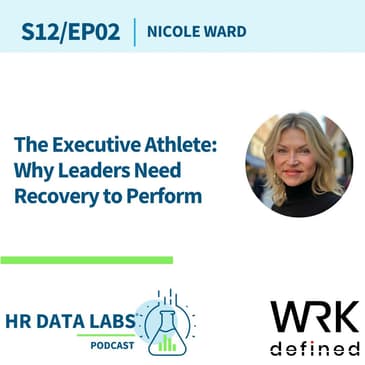
David Turetsky talks with Nicole Ward of Aon about her concept of the executive athlete and why leadership performance is built on physiology, recovery, and sustainable habits. They explore how burnout shows up in executives and sales teams, and why HR can play a major role in reframing wellness as a business performance issue.Nicole shares her own wake-up call, the accident that pushed her to rethink health, and practical ways leaders can build better energy, focus, and resilience without “boiling the ocean.”
Key topics
Nicole Ward’s background at Aon - Senior vice president of sales with a career rooted in professional services, public accounting, and now commercial insurance.
The origin of the executive athlete idea - Nicole’s near-fatal rollover accident became the catalyst for a long-term shift toward health and wellness.
Physiology as leadership infrastructure - Her central idea is that energy is the currency of performance, and leaders who are under-slept, under-nourished, and constantly “on” are not operating at full capacity.
Why burnout matters organizationally - Burnout, dysregulation, and chronic stress in senior leaders have downstream effects on teams, culture, and decision-making.
Culture rewards overwork - The conversation pushes back on the idea that always being available is a badge of honor, especially in executive roles.
Recovery improves performance - Nicole argues that slowing down and recovering is not weakness but a competitive advantage supported by real data.
Small changes beat all-or-nothing thinking - She recommends “exercise snacks,” breathing breaks, short movement intervals, and better sleep habits rather than unrealistic total overhauls.
Data can drive behavior change - She shares an example of a sales team using wearable devices over six months to track sleep, stress, and activity, leading to better performance and better well-being.
HR’s role in changing the conversation - HR professionals can bring wellness into strategic planning sessions and ask leadership how health is being prioritized.
Bio-individual wellness at work - Nicole emphasizes that companies should offer flexible options because different people need different supports, from meditation space to gym access to better snacks.
Timestamps
00:00 - Welcome to HR Data Labs and introduction to Nicole Ward
01:12 - Nicole’s role as senior vice president of sales at Aon
02:15 - The accident that sparked the executive athlete journey
03:14 - Why executives need physiology, not just willpower
06:54 - How boardroom experience shaped the platform
07:24 - A team member’s comment that changed everything
08:21 - Why the book is aimed first at sales athletes and then all executives
09:30 - Recovery as a competitive advantage, not weakness
10:43 - The cost of working until collapse
11:20 - The “toxic capacity” bucket and signs of overload
12:19 - Why leaders struggle to fully disconnect
13:26 - Tying recovery to revenue and metrics
14:41 - Burnout in sales and other high-pressure roles
15:31 - Alternatives to always being “on”
16:25 - Why all-or-nothing thinking fails
17:26 - Using micro-habits for sleep, breathing, and movement
19:37 - A six-month wearable experiment with a sales team
21:33 - Salespeople as athletes and why preparation matters
22:48 - Why companies should treat wellness as a real priority
23:45 - The biology of organizations and employee energy
24:48 - How HR can start the conversation with leadership
26:14 - Bringing health and wellness into strategic planning
27:10 - Example of no meeting Fridays
28:46 - Why a bio-individual approach is better than one-size-fits-all
29:15 - Personalized wellness options for different employees
30:11 - The reality of obesity, inflammation, and dysregulation
31:11 - Incremental progress in the face of broader stress
32:01 - Closing thoughts and final thanks
Notable quotes
- “Physiology is the infrastructure of leadership and energy is the currency of performance.”
- “When we decelerate, when we allow ourselves to recover, we adapt.”
- “My best tomorrow starts tonight.”
Powered by the WRKdefined Podcast Network.
[00:00:09] Welcome to the HR Data Labs Podcast, now part of the WRKdefined Podcast Network. Join us as we explore the vital role of compensation, strategy, data, and people analytics in navigating today's complex business world. With the resources of Work Defined, we're now bringing you deeper insights and actionable ideas from top experts. Now, here is your host, David Turetsky. Hello and welcome to the HR Data Labs Podcast. I am your host, David Turetsky.
[00:00:36] And like always we try and find people inside and outside the world of HR to tell us the latest as to what's going on in this crazy freaking world, this complex world that we live in. Today we have with us Nicole Ward of Aon. Nicole, how are you? I am well, David. Thanks so much for having me. I'm super looking forward to the conversation today. Me too. I had worked at Aon a while ago and, you know, it's always good to talk to someone from the mothership. Absolutely.
[00:01:06] So, tell us about Nicole Ward and also about what you do at Aon. Thank you for the question. Yes. So, yeah, Nicole Ward. I am the Senior Vice President of Sales for Aon. And I've been with the firm just literally about a year and a half almost to the date. And, you know, it's been a long journey to get here.
[00:01:27] My career is really, I've spent it as a Chief Sales Officer or Head of Sales in some capacity, most of the time in professional services and public accounting. So, Aon was a bit of a deviation for me moving into the space of commercial insurance, but equally as interesting. But, yes, so here I am. Well, it sounds like you're having fun there because there's a lot to sell at Aon. There's a lot of stuff going on, a lot of shiny objects that we can bring to the market, right? Definitely.
[00:01:58] Yes. And if you're like me and you hear the word squirrel, you know, it's kind of like there's something new to sell, too. How cool is that? Absolutely. Talk to us a little bit about what is the Executive Athlete. Yeah, so my journey to the Executive Athlete actually started about 20 years ago. It started by me burning a candle at all the ends. And literally, I was about 60 pounds overweight.
[00:02:25] I had the blood lab work of really a 65-year-old woman at 35. My resume had never looked better. My bank account had never looked better. Of course. I had all the toys, all the objects, the houses, the cars, the travel, all the things. But inside, it was absolutely doing damage to myself. And I rolled my Land Rover, which was my wake-up call. Oh, my gosh. Yeah. And it actually was a nearly fatal accident. Sorry. And thankfully, no one was killed in that.
[00:02:53] And it set me on this path of health and wellness. And so one of the things, you know, that the Executive Athlete is really about is, I believe that physiology is the infrastructure of leadership and energy is the currency of performance. And if you look at athletes, premier elite athletes out in the world, how many of them would ever go into a big game undernourished, underslept, under-resourced, under self-cared for? Right. None of them. No.
[00:03:23] But we treat executives in this world like they are, you know, it's just like, like, you know, not sleeping and being always available as a badge of honor. Right now. As opposed to recognizing that executives and all of the downstream effects of executives and their decisions and their dysregulation and inflamed situation affects everyone underneath them. Absolutely. That's a little top line on the Executive Athlete. And we're going to spend a lot of time talking about that today.
[00:03:51] But before we do, what's one fun thing that no one knows about Nicole Ward? You know, I would say very few people know that I'm actually almost an expert water skier. I'm a really good water skier. I started when I was very, very little. My dad taught me he actually had tournament skied way, way, way back. Yes. And he taught me from the time I was like six years old, I was on water skis. So that's something that not many people know that is very near and dear to my heart.
[00:04:20] And you know, water skiing is one of those things you think it looks, first of all, you think it looks simple. It is not simple. No. And it's also pretty dangerous, isn't it? It can be. Absolutely. If you're not smart about it and you're not thoughtful about how you approach it and making sure you've got somebody that's watching you with a flag. Right. And it's looking out for other boats and all the things, but it's super fun. All the things in the water too. Yes, for sure. For sure. Yes. Well, and you don't want to do it around any sharks, I imagine.
[00:04:50] No, no, no. Most of mine has been actually in freshwater. I have ocean open water skiing, but most of it is in freshwater. So. Yeah. I can't think of a good idea to do. I mean, maybe if you're in the Bahamas and it's, you know, beautiful, but yeah, still. Yeah. No, they look at me and go, hey, what is that walrus doing up on skis? And how can I get him? He looks really juicy. So yeah, we're not going to go there. I love it. But, but today we're going to have a fun conversation because as you had mentioned talking about
[00:05:20] senior leaders, they are really the nervous system of an organization. And when we talk about how dysregulated and we talk about how burned out and inflamed they are, and we, you talked about it as well. There's really downstream ramifications of that. And so we're going to talk about the context of how do we make sure that we're taking care of that person and making sure that we're setting them up for success. We'll do that right after this.
[00:06:18] Technology. So Nicole, let's get back into it and talk about your origin story. And, you know, let's talk about this platform and where it came from. And, and obviously we talked a little bit about this in the preamble, but how did you kind of make that connection that this would be something that you could help other people think about that executive athlete?
[00:06:47] You know, it's interesting. It was cumulative, but there was a switch that flipped and I can tell you exactly what it was. I had sat, you know, in so many board meetings, whether it was my, you know, my own, you know, board roles, whether it was across from other executives, you know, you know, strategizing and trying to do all the things that we do when we're, you know, worried about metrics and revenue and KPIs and, and shareholders. Right.
[00:07:14] And, and those, all of those moments accumulated, and it was one of my team actually, and we were talking about how he gained weight and he was running a big team, right? Right. For me. And he was at a big job. And he said, you know, Nicole, he goes, gosh, I'm gaining weight. You know, he goes, I had to be out four nights this week, networking. I'm not sleeping well. He goes, I need to, I, you know, I need to do some of what you're doing.
[00:07:43] And that was the moment when I was like, what am I doing? Like, how am I leading? You're the role model. And yeah. And, and being this sort of example to my team of longevity and healthy choices and wellness. But how have I not shared this story more broadly and invested myself in the health of my team? And if it's not cascading down, and if I'm not supporting others, then what am I doing with it? And so it was at that moment, I was like, I got a book in me.
[00:08:12] There's a book here. There is an audience. And granted, although the book is titled Biohacking for the Sales Athlete, you know, they say you have to write what you know. So I wrote to my tribe first as a chief sales officer. But ultimately, really the platform is for all executives and recognizing how unhealthy we are. And that that road to health is not only beneficial to us, but our, our husbands, our wives, our colleagues, our staff, our teams, all the things.
[00:08:41] But if you look at the way our culture celebrates success and the way our, our culture celebrates burning the candle, as you mentioned before, and just leaving it all out on the field, they say. And you know, what, what kind of messages do we send to young kids about how they need to act when they look at us and go, hey, dad, I don't ever remember a time when you were sitting on the couch. You didn't have your laptop or your phone in your hand.
[00:09:08] What kind of message do we send to everybody when we celebrate the culture of being always busy and always unavailable? It is, it's, it's, A, it's very Americana, right? As I've done podcasts about the book over the last couple of months, everyone's like, well, how do we get it to stop?
[00:09:27] And it, it is cultural, but it, but it's so important that we get the irony that when we decelerate, when we allow ourselves to recover, we adapt. If you want a greater competitive advantage, if you want to exceed your own expectations and performance, the most important thing you can do is allow yourself to recover and to slow down. But it feels, it feels the opposite. Total antithetical.
[00:09:56] Right, it feels absolutely antithetical because to slow down in our culture is weakness. Yes. And so to your question, you know, I'm not sure how to evangelize this more broadly other than really through human resources, which plays a huge role and contributing factor into messaging this broadly and bringing this to executive leadership teams that health and physiology is critically important.
[00:10:22] That just saying I'm always available is not a win. But actually what's that costing you? Yeah. Right? Right. We always see this happen, Nicole. The CEO leaves their, her or his role and then they die a couple months later and people go, well, they missed their work. And the answer really isn't that they missed their work. It's really that they killed themselves because they worked too freaking hard while they were around.
[00:10:51] They lost the opportunity to enjoy the fruits of their labors because they didn't live. So what you're saying realistically is live instead of living to work, work to live. Yeah, absolutely. And everyone will hit a wall eventually. Mine was rolling my Land Rover. Yeah. In a very serious accident. Someone else, it'll be a divorce.
[00:11:16] Someone else, it'll be some physical ailment that will show up. So that wall is there for everyone, right? You know, there's a saying in health and wellness that, you know, we're each born with a bucket of toxic capacity. And none of us really know how big that bucket is. Right. But you know when it starts to spill over, when you get the skin rashes, the joint pain, the brain fog, you know, and that's why it's so important to be drilling a hole in the bottom of that bucket with detoxification.
[00:11:45] And not to go too far down the rabbit hole, but for the sake of the illustration of this, what are we all doing on the daily to drill a hole in the bottom of that bucket to make sure that we're creating space and capacity to be our best selves? You know, it's funny. I have friends who go on vacation all the time and they send me pictures of, you know, Europe or I was speaking to a friend today and they said they're going to Fiji. And I said, oh, that's great.
[00:12:16] And they said, yeah, we're going to disconnect a little bit. We're not going to bring our phones. We're going to put them away. We're going to put them in the hotel safe when we get there and we're not going to check anything. And I can't tell you, Nicole, the last time I was ever able to fully disconnect in the roles that I've been in, I couldn't fully disconnect enough to be able to rest and relax and recharge that battery. Absolutely.
[00:12:43] We've not created the space to afford ourselves that in this culture. And until we get really that it ties back to better performance, better revenue, right? Better metrics. That is what drives our culture in the United States. And we've got to, it can't be, I feel better because no one, let's face it, the board, public company boards don't care if you feel better.
[00:13:07] But if we can tie it to real data and real science, which exists, which I reference in my book, there's real data out there that substantiates that when we actually create space to recover, which is adaptation, that we actually will come back and exceed expectations and exceed performance metrics. Now, that's a good point, though. Let's talk about the ROI.
[00:13:30] And I don't know if you mentioned this in your book, but is there an ROI analysis that we can give to the board or the executive team that says, yeah, we need to let people relax. We need to let people live. And when they do, there is a marked difference in their return on our investment for them. Yes, and I reference that data in my book. Excellent. And I think it's out there.
[00:13:56] There is a lot of really compelling evidence, and we see this in other cultures too, other countries outside of the United States. You wouldn't be surprised to notice or to know that in the United States, we don't tout it, right? Well, it's antithetical to our culture, so. Exactly. Exactly right. And, you know, if you look at burnout and the stats that I talk about around burnout, it's nuts.
[00:14:23] And certain roles are more burnout, you know, excuse me, burnout. It's more common for burnout than others, right? Sure, sure, sure. So sales, obviously, is a huge one, right? Oh, my God, yeah. I mean, the burnout factor there, just the running that you have to do, the pushing that you have to do. But that's what I spent my time in the book talking about are the alternatives.
[00:14:46] There's so many tactics and things that you can do to work around the culture because I personally can't solve it all. I can't solve all for our culture. But what I can do is try to infiltrate into the minds of executives and board members that there is another way of being into these meetings. There's another way of prioritizing health metrics that will yield the better result.
[00:15:13] And so I spent a lot of time talking about what are the ways, different ways that you can approach, whether it's networking, sleep, travel is a huge one, right? How can we think differently about time and how we spend time and where we put our focus and energy? And so a lot of it is in there because I feel like we, sometimes we need examples of like, okay, that's a thing I didn't know existed. Let me try that on.
[00:15:40] And so it's a way that I've sort of approached it by taking little different bites of the pie. And I call them like, for example, exercise snacks, right? Or, you know, ways that people can approach, you know, like I said, travel. So I think there's also this pervasive, which will not surprise you, pervasive vibe that everything we have to do, it's all or nothing. That we have to boil the ocean. If we don't boil the ocean, we don't do it all, then we might as well forget about it and not do anything.
[00:16:08] And I really push hard on this because that is just never going to work. That boulder is never going up the hill. Well, we always say that you're leaving something on the field. You know, you always say don't leave anything on the field. Right. You know, give it your best. Give it your all. Right. You haven't given it your all. And we hear this a lot in performance evaluations as well, Nicole, and it's just bull crap. You know, what about giving back to that person and saying, hey, listen, take the rest of the day off. Go chill.
[00:16:37] You did a great job this last week. Do you have examples of that from the book where you've kind of challenged the notion that you have to be at level 11 all the time and that, you know, people can't ratchet back? Or how about taking a nap during the day? Or are there any examples like that? Yeah. So this whole concept of snacking that I use for meditation, breath, movement, and exercise.
[00:17:05] So for example, you know, if someone's got a really, like a very important meeting, you know, early in the morning, you know, the next day, I always say that my best tomorrow starts tonight. And so it's like, okay, so what's one thing I can do to get better sleep tonight so that I'm better prepared going into that meeting?
[00:17:25] And then setting really tactically, you know, setting alarms on our phone, you know, ending calls at the 55 or the 25, you know, minute mark. So that gives us five minutes to sit. Not the 05 afterwards. Right. Exactly. But like cutting it off. So you've got one or two minutes that you've scheduled on your phone where you can sit and go, okay, I'm going to feel my feet on the ground. And I'm going to remember I have feet. And then I'm going to, you know, I'm going to feel them on the ground.
[00:17:54] And I'm just going to put your hand on your heart or just notice your breath for two minutes. All of us can do that. And then by the end of the day, you know, you look back and you go, gosh, I had 20 minutes of breathing time. Or, you know, I took the stairs for five minutes in between two meetings. And I, you know, and then I did a wall sit, you know, for, you know, two minutes. And then I did, you know, I did some air squats.
[00:18:20] And I got to add 15 more minutes of movement today than I, you know, I, you know, I put some bands in my office. And while I was on calls, I just turned the camera off and I just sat and I did bands for a couple of minutes. Before you know it, you've taken little bites out of what arguably seems to be this big thing. Oh, meditation. Oh, I've got to go to the gym for an hour and a half. Or, oh, I've got to, you know, I've got to move my body, yada, yada. But bite sizing it down. So there's some examples.
[00:18:47] And those incremental improvements add up over time so that if you looked at your Apple Watch or you looked at your Oura Ring or whatever you use to track your progress in being able to be around or, you know, not sitting at your desk staring at the screen all day. Exactly. It does add up. Yeah, it absolutely does. And I'll give you another real world example, which was when there was a really cool, she's a chief business development officer that I know.
[00:19:13] And we were in this peer circle and she said, you know what, Nicole, I'm going to challenge my team. I'm going to buy them Oura Rings. And she says, I want to track it for six months. And she said, I want folks to pick their, you know, pick whatever one or two things they felt was important to track. Maybe for some it was their heart rate variability, which meant less stress during the day, taking more breathing snacks. For others, it was sleep.
[00:19:40] And it was like, okay, I'm going to turn my device off an hour before I go to bed. Whatever it was, she divided this large team of almost 30 sales reps into different groups. And they competed with one another. And then they tracked all the things they usually track. Pipeline. They tracked meeting volume. They tracked wins and losses. And it was so amazing the data that came back from that six-month experiment.
[00:20:06] Because sure enough, there were people that had chosen to kind of fall off, not take it seriously. But the groups that really embraced it, and again, there's a lot of data behind this, but the groups that really embraced it absolutely had more meetings, closed more deals, felt better, and put in more time. And not in an hourly, but actually put in more time to their health. Sure.
[00:20:31] And as opposed to just slamming hours at selling, they actually put more time into their health and then got better results. So that's another example of real ways that we can use devices to give us those tightness data loops so that we know where we are. Again, not boiling the ocean, but helping us make small incremental changes that make a huge difference. And by the way, those aren't HIPAA violations when they're... Voluntary. Voluntary, right.
[00:21:01] Yes. And by the way, you also mentioned something that's really amazing, which is that salespeople, by their very nature, are athletes. They are competitive. Whether or not they're athletes and go out and play golf or tennis or whatever, they are athletes when it comes to trying to close business. And just like you mentioned at the beginning, you know, you can't send an athlete on the pitch, you know, if we're talking about football or soccer. You can't send them on the ice if you're talking about hockey. You can't send them on the diamond if you're talking about baseball. And they've had no sleep.
[00:21:31] They've had no preparation time. They have had no rest. And, you know, even when a baseball game has a doubleheader during an afternoon, they space it out by an hour to be able to decompress and relax and get their, you know, recharge themselves before they go out on the diamond again. And it's almost always not exactly the same team that goes one to the other.
[00:21:54] And so this concept of the executive athlete, and I think you mean more of like even just broader, the employee athlete, we really need to make sure that we are taking care of them as much as they're taking care of us. Couldn't agree with you more.
[00:22:11] And nothing sends a better message to people that are working really hard for your company than your wellness, your health and your wellness matter to us, right? And I think it's allowing the space for the conversation, right? It's encouraging people to talk about health and wellness.
[00:22:35] And, you know, we, there's, I just wrote a post on this yesterday, but really companies, organizations, they're organisms, right? There's, there's a biology to it, right? We think about, you know, employees are like the mitochondria, the, you know, the energetic charge of companies, right?
[00:22:56] And really appreciating how closely, you know, we really need to look when we're asking people to do the things that we ask them to do and how hard we ask them to prioritize, you know, the company, etc. It's, it's, it's a lot. And giving back to them with health and wellness and opportunities and options around all of that is super important. So we talked about a lot of ideas. And they've been super amazing.
[00:23:21] If I'm an HR person listening to this, what would be the first step that they'd want to take in order to be able to say, well, I like what Nicole's saying. I'm going to go buy her book, obviously, from Amazon, The Executive Athlete. And we'll put a copy of the URL in the show notes. But what would be the first steps beyond buying your book would they have to do in order to start thinking about how they're going to start selling this to their board?
[00:23:50] I mean, it's obviously an easy sell, we would hope. But how do they sell it to their board to be able to take mindfulness and these intermediate steps into account for their people? What I would choose to encourage is what I chose to do. And it was effective. It was not easy, but it was effective. And ultimately, it worked.
[00:24:11] I would go to whatever the annual strategic planning session is, or maybe it's quarterly strategic planning session, where you've got the executive leadership team in a room together. And you've got the floor as an HR executive or professional. It would be to bring, and again, they don't need to bring my book. Probably a good idea. They certainly could. And it's a little bit of a sticker shock, right?
[00:24:40] Seeing biohacking for the executive athlete, right? Some people are like, oh, biohacking. What's that thing I've heard a lot about? You can remove the biohacking fear from the audience there. And instead, talk about how athletes train. And starting there from, like, how do we, as a team, as an executive leadership team, asking the questions, how do we prioritize our health and our wellness?
[00:25:07] And how are we exemplifying that for the greater population of this company? And so, for me, it would start with curiosity, with asking health, wellness-minded questions, and getting a sense of what the executive leadership team thinks about it as a priority. And I say that you do it at one of these annual or quarterly retreats because that's where the big thinking is, right?
[00:25:35] When you start thinking about what initiatives are we going to focus on, what levers are we going to pull as a company to drive performance, to exceed expectations, to hit our revenue goals? Being as disruptive as saying, I think our greatest competitive advantage and our way to actually exceed our revenue objectives is by actually slowing down and investing in our health and our wellness. And here's what I mean by that.
[00:26:03] So, I think it's inviting the conversation. It's asking, do we prioritize, as a company, do we prioritize health? You know, how important is it? What are the things that we have in place? You know, one company I worked for, they had no meeting Fridays. You know, and that was really effective at giving people. They did not have to be on screen. We had to work, but we weren't on screen. We did not have internal meetings. That was one measure that we took, you know? And there have been many other, you know, examples that I could give.
[00:26:33] But I would say that the HR professional's job is to stay curious, not accusatory, but ask the questions to start. Because especially if you work for a company that's like, health and wellness, really? All you have to do is chat GPT and the data and the science and the numbers are there. So, it's reframing their thinking around the prioritization and the impact that a healthier population of humans that work for your company can have.
[00:27:03] You've seen headlines that have captivated, especially HR's attention about return to work and return to the office. And how some companies like Chase, JP Morgan Chase, have taken a very hard line in the, you're coming back to the office or else. And some others have as well.
[00:27:25] Do you think that this would be looked at as another example of one of those things that boards might necessarily go, yeah, we tried to give them a little bit of room and, you know, we started seeing things like remote work take over. Do you think this is going to fall into that category as well? It's an interesting thought. I'll tell you why I don't.
[00:27:54] And it's because, frankly, I mean, health, first of all, if we take somewhat of a bio-individual approach to this, everyone is a little bit different. So, if we decide as a company that we're going to prioritize health and wellness in a new way, it doesn't have to look the same for everybody, right? You don't have to institutionalize. It can be as much as if you had a list of 10 things,
[00:28:20] and you can pick one or two things that you got to implement on a weekly basis that you feel would really contribute to your health and wellness. Maybe for one person, it's a free gym membership. Or another person, it's a meditation or a room, a conference room that they know one hour a week they can go meditate in. For someone else, it's better snacks in the cafe. Even being able to go to the cafe just to get away from your desk. Exactly.
[00:28:49] So, if everyone got to pick sort of what their one or two things are, I don't think it does fall in that bucket. Because, again, it's not necessarily, and you could institutionalize things. Like the example that I gave earlier, we institutionalized Fridays were no meaning Fridays. But you could do that, but I feel like taking a more bio-individual approach, which is what my book is all about, which is getting, we are not all the same. You know, one person struggles with sleep, another one, it's weight loss.
[00:29:20] For someone else, it's just, you know, getting sunlight and getting, you know, air, you know, fresh air. So, everyone's a little bit different, right? For other people, maybe it's a couple of hours to leave early off of work one day a week. So, I think you have to really fine-tune what it is for folks. So, I don't think that it does. And I think obesity is a massive problem in this country. We are not healthy. We are inflamed. We are dysregulated.
[00:29:46] I don't think that falls in the same bucket as I want to work from home all the time. I think we have a serious health epidemic in this country. And there's no hiding it anymore. And I think these are actual tools to begin addressing it. And what's fascinating is it's compounding the stress that we have from the economy and politics, relationships, and everything else.
[00:30:09] And those things, when we bring our authentic self to work, we bring ourselves to work, all those things compile to make our lives at work more difficult. And if we were able to do that just one thing, we're making incremental progress, right? Absolutely. Again, not boiling the ocean, figuring out the little tweaks that we can do. I mean, a company can't solve for a person's entire health issues, you know, the spectrum of their health issues. But can we prioritize that we care about it? Yes, we can.
[00:30:40] You know, are there things that we can do and certain levers that we can pull that support our folks in being better, healthier humans? Absolutely. And I think that's a great place to start. So, for you HR folks, go buy the book. And we're going to have the book in the show notes. Nicole, thank you so much. This has been fascinating. Thank you so much for having me. A pleasure. Absolutely. Just been wonderful.
[00:31:08] Now, I'm kind of trying to think about my one thing right now, too. And I'll let you know what it is. Love it. Please do. All right. Take care. Thank you, everybody. Take care and stay safe. Thank you for listening to the HR Data Labs podcast. Don't forget to hit subscribe and share it with your network. You can also check out the recordings on Spotify or the HR channel, now on Roku and Fire TV. Thank you. Take care and stay safe.
[00:31:43] Great job.
Sponsors
