
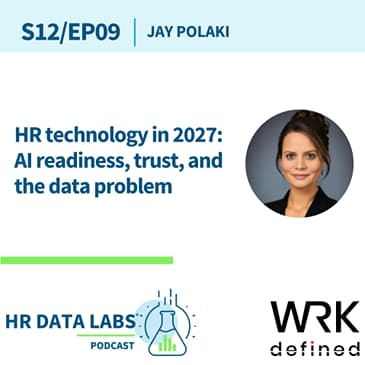
This episode looks at where HR technology is today and where it may be heading by 2027, with a focus on AI’s real impact on HR teams. David Turetsky is joined by Jay Polaki, CEO of HR Geckos, to unpack why so many organizations have access to AI tools but still lack the data, governance, and skills to use them well.We discuss the growing gap between AI enthusiasm and operational readiness, why HR is still unclear on its role in AI strategy, and why the conversation needs to shift from hype to use cases, trust, and measurable outcomes.
Key topics
Jay Polaki, CEO of HR Geckos, explains that HR Geckos is a people-centric co-pilot for HR operations, built by HR for HR.
The episode opens with a lighter note about Jay’s unexpected appearance on MTV during a Russell Peters event clip.
The central theme is that AI access is no longer the main problem — scaffolding is.
Jay shares findings from HR Geckos’ “AI Ready or Not” roadshow, based on conversations with about 55 HR and business leaders across multiple sessions.
Many organizations have AI tools, but data quality, governance, ownership, and funding remain unclear or incomplete.
David raises concerns about security risks, especially employees using consumer AI tools with sensitive HR and PII data.
The discussion highlights a split in AI maturity:
Some HR teams have no access and no training.
Others are forced to use AI with little or no education.
ROI is a major sticking point, with both speakers arguing that most organizations are measuring the wrong things or measuring too early.
Jay says the best way to deploy AI in HR is by starting with a specific use case, not a broad enterprise rollout.
HR service delivery and the HR service desk are identified as one of the most likely near-term AI investment areas.
The conversation repeatedly returns to trust, especially around governance, role clarity, and employee anxiety about job loss.
David and Jay agree that AI is more likely to augment workers than replace them, and that people who know how to use AI will outpace those who do not.
Jay argues that HR should stay central to reskilling, learning and development, recruiting, and re-engineering processes.
The episode ends with a strong warning against using AI for sensitive compliance work without human oversight.
Timestamps
(00:00) Opening the HR technology conversation with Jay Polaki
(01:12) Jay introduces HR Geckos as a people-centric HR ops co-pilot
(02:17) Jay’s unexpected MTV cameo and the Russell Peters story
(04:42) Why 2026 feels chaotic for HR technology and AI
(05:23) Roadshow findings from 55 HR and business leaders
(06:21) AI access is widespread, but scaffolding is missing
(07:47) Why data, ownership, and governance are still unresolved
(09:18) Security concerns around employees using consumer AI tools
(10:29) Two extremes of AI readiness in HR teams
(11:26) Large organizations vs. smaller firms in AI adoption
(12:23) Trust is the biggest barrier to AI deployment
(13:14) Why AI desktop tools raise privacy and control concerns
(14:11) Why AI was often used as a cost-cutting tool before HR was ready
(15:22) Why ROI is hard to define for AI in HR
(16:46) The real friction is data readiness and skills readiness
(18:09) Why the best AI deployments start with a single use case
(18:34) Why the HR service desk is a likely next AI investment
(20:30) Start with why, then move to how
(21:57) Why AI should be deployed in baby steps
(22:56) Centralizing siloed HR data before scaling AI
(24:21) Why leaders are unsure about HR’s role in AI strategy
(26:08) Mixed views on HR’s AI future: curious, transformational, undefined
(27:29) Where HR can lead: skills, learning, recruiting, and re-engineering
(28:32) AI in talent management and the future of interviewing
(29:30) Governance gaps, risk levels, and access controls
(30:28) HR’s role in managing worker anxiety about AI
(31:47) Trust and governance as urgent CEO, CHRO, and CTO issues
(33:27) AI as a tool, not a replacement for people
(34:04) Why the doomsday narrative is overstated
(35:12) Why AI is still “pretty dumb” without human training
(36:04) Augmented intelligence and human judgment in tandem
(38:12) Why AI still cannot handle HR compliance on its own
(39:12) Government scrutiny and accountability risks
(39:50) Wrap-up and HR Tech conference frustrations for service providers
Notable quotes
- “Technology should elevate people, not replace them.”
- “We’ve solved the AI access issue — ownership, funding, data, governance, all of that is still in flux.”
- “People who know how to use AI will replace people who don’t know how to use AI.”
Powered by the WRKdefined Podcast Network.
Sponsors
