
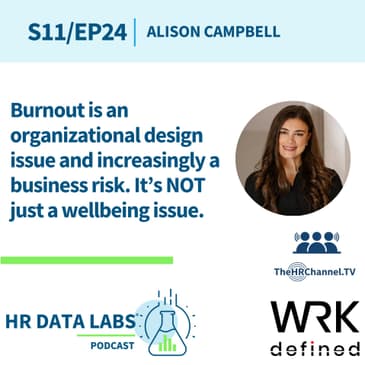
In this episode, we explore the complex issue of burnout within organizations, its predictors, and how HR leaders can proactively address systemic risks that impact employee well-being and productivity. Alison Campbell, founder of Unburnt, shares her extensive research and practical strategies to recognize and mitigate burnout at every level of the organization.
Key Topics Covered:
Alison Campbell’s background and the founding story of Unburnt, highlighting her transition from corporate roles to addressing burnout
The relationship between burnout, innovation, and systemic organizational blockers
Research findings on how systemic factors like ambiguity, lack of transparency, and uncertain role definition predict burnout
The surprising discovery that highly active or visible burnt-out employees often exhibit reduced capacity for long-term strategic thinking
The impact of external stressors, demographic factors, and generational differences on burnout dynamics
Practical steps HR leaders can take: diagnostics, leadership development, board discussions, and transparent communication
The importance of viewing burnout as an organizational risk rather than solely an individual problem
How to foster a culture of open dialogue and early detection through diagnostics and ongoing conversations
Timestamps:
00:00 - Introduction to Alison Campbell and the importance of addressing burnout
02:27 - The moment that led Alison to focus on burnout and her personal journey
04:01 - Alison’s creative side and her graphic novel "HR Datadoodles"
06:16 - The research partnership with Bentley University on burnout predictors
07:44 - The link between systemic organizational risk factors and burnout
08:49 - How high burnout employees can still appear visibly active in their roles
09:39 - The significance of capacity to think strategically and translate plans into value
10:40 - The disconnect between perceived stress and actual burnout risks
12:02 - External vs internal stressors and the inability to compartmentalize life and work
13:09 - Leadership’s role in recognizing and mitigating burnout risks
14:47 - Organizational challenges in managing AI transformation and burnout
16:26 - The importance of leadership development and systemic change over siloed HR initiatives
17:50 - Lessons from early computer adoption and AI integration in the workplace
19:21 - The necessity of strategic, outcome-driven AI implementation and avoiding wasteful spending
20:31 - The role of diagnostics and ongoing measurement in early burnout detection
22:09 - The importance of communication from leadership and the board level
23:55 - Addressing the aging workforce and demographic considerations in burnout
26:49 - The impact of caregiving, obligation stressors, and generational differences
28:20 - Practical advice for HR leaders: assessing current tools, engaging with the C-suite and board
30:46 - The significance of transparent, frequent communication around organizational goals
33:55 - Final thoughts on the complexity of burnout and the need for comprehensive solutions
Resources & Links:
Connect with Alison Campbell:
Powered by the WRKdefined Podcast Network.
[00:00:03] Welcome to the HR Data Labs Podcast, now part of the WRKdefined Podcast Network. Join us as we explore the vital role of compensation, strategy, data, and people analytics in navigating today's complex business world. With the resources of WRKdefined, we're now bringing you deeper insights and actionable ideas from top experts. Now, here is your host, David Turetsky.
[00:00:27] It's always funny that I'm introducing myself, but yes, I am David Turetsky. Hello and welcome to the HR Data Labs Podcast. And as always, we try and find the best and the brightest people inside and outside the world of HR to talk about what's going on. And today we have the best and brightest. Alison Campbell from UnBird. Alison, how are you? I'm doing good. How are you? I'm okay. I'm tired, but we're going to talk about that later. Yes, we'll save that. But I'm thrilled to be here.
[00:00:57] Yes, we're going to save that. It's very topical. Our conversation is very topical for me. But Alison, why don't you give a little bit of background on yourself and as well about UnBird. Yeah, again, thrilled to be here. Thank you so much, David. So I'm the founder of UnBird. I am new on this entrepreneurial journey. So UnBird was born about two years ago out of very real lived experience.
[00:01:18] So prior to UnBird, I spent nearly 20 years in corporate, variety of operating roles from finance to e-commerce. I was at Wayfair pre and post IPO. And then in my last gig, I was at an HR tech company first for the e-commerce side of the business. And then I moved into a chief of staff role. And through that role, I was helping to shape culture of our management team, you know, lead strategy and analytics for this billion dollar plus company.
[00:01:46] And I loved it. I loved collaborating with teams. I loved building new initiatives from the ground up. And at the same time, you know, going through a global pandemic, homeschooling two little kids at the time. Wow. And then unfortunately, experiencing a health scare. You know, I was not only burning out, really overwhelmed, really stressed, but I was ignoring my own personal well-being, my own health.
[00:02:09] And so that all culminated in having to have surgery in 2023 and really was the catalyst that kind of opened my eyes to this is completely unsustainable. That existential crisis moment of what am I doing? I've been ignoring these warning signals. And, you know, it just feels like something is so far out of alignment, but I need to take time to really figure that out. So that's the quick version.
[00:02:33] Wow. Well, that's a heck of a very quick version. We're going to talk about that much more later. But first, Alison, what's one fun thing that no one knows about Alison Campbell? Yeah, so I was reflecting on this question. I love it. It's a good one. I think probably a handful of people in my family do remember this. But when I was little, I used to walk around with a sketch pad and I wanted to be a cartoonist for Disney.
[00:02:59] So I would draw. I was very creative. I always took lots of art classes and I would walk around and draw things. And I used to tell everyone, oh, I'm going to I'm going to be an animator, a cartoonist for Disney. Wow. Well, that's very funny because my oldest son just graduated from the School of Visual Arts in cartooning. So cool. Oh, my goodness. My nephew just graduated from Syracuse University in cartooning.
[00:03:28] Wow. Well, so this is why I love this question, because we would have never known that. And also, I don't know if you've seen it, but here is my HR graphic novel called HR Data Doodles, where it's literally an HR graphic novel. That's the sixth season. We have the seventh season in production right now where we literally draw out the issues that HR is dealing with every day. So, Alison, you're right at the heart of the world right here, right now.
[00:03:56] I love it. I love it. It's funny, when I was young, I wanted to be an architect until I went to college and realized I was really terrible at it. But I found economics and became, you know, an econometrician and that thus led me into comp. So we find our way in life, Alison. We do. Absolutely. And some of those passions, you know, they don't necessarily have to go away either.
[00:04:20] Well, and we kind of channel those energies into other things, and that makes us who we are today. So we're going to find that cartoonist in you. I promise. Okay. Here we go. Well, today, what we're going to talk about, and you kind of mentioned it a lot in your conversation about who you are and where you've gotten to and who Unburnt is. We're going to talk about something that's very real for a lot of us and may actually get emotional because I think a lot of us are actually dealing with this right now.
[00:04:50] And it's okay. It's okay to feel this. In fact, a long time ago, I had my friend on the podcast, and she and I were talking about it's okay not to be okay. We were talking about mental well-being. Mental well-being. Mental well-being. I'm not there yet either. But now it was an organizational issue, and it's a critical business risk for a lot of organizations who rely on intellectual property of their very senior people.
[00:05:16] And it's not just a senior issue or an issue for senior leaders. It's an issue for all of us. It's also not just a well-being issue, but we're going to get into that right after this.
[00:05:45] So Allison, Unvolt did a study on burnout, obviously, and it found that many employees who are actually looking really productive are probably most at risk. How did you recover this, and what really surprised you most about this research? Yeah, so I partnered with Bentley University Center for Health and Business because I was really interested to look at the modern drivers.
[00:06:14] So the right now current drivers of workplace friction, of stress, including hybrid work post-COVID, including AI transformation, right? It's creating lots of opportunity. And at the same time, we're so early in the change curve that it's also creating a lot of chaos inside of organizations. So I was really interested to look at burnout through the lens of what's happening today in modern workplaces.
[00:06:40] Is it, can we predict burnout by looking at system risk factors, conditions inside of teams? And then how is that impacting innovation? How is that impacting resilience, empathy, psychological safety? So we looked at a number of dimensions across a variety of validated subscales to really understand, is there a relationship? Can we predict it? And then what's the impact? And what we found, you know, you hit the headline.
[00:07:08] Not only was burnout predictive, so there were a number of risk factors that correlated extremely highly with an increase in burnout. Things like uncertainty in my role, uncertainty with respect to the role of AI in my work. No surprise there. Well, I wasn't surprised, you know, in doing this work. Things like ambiguity, right? So changing direction in the company goals without transparency communication, right?
[00:07:37] So things that we sort of know at large create a little bit of fear for employees came out as the top risk factors for burnout. It was predictive, statistically predictive. But what we found was that the employees that were at risk, so this population of employees that were also experiencing high burnout, at the same time still ranked very high on what's called the innovative work behavior scale.
[00:08:05] Which asks questions like, are you generating creative ideas? Right? And so in that scale, what we found, people were still displaying visible signs of activity, right? So they had both visible signs of being creative, innovative, and high burnout. But what we found in that group was that they were the most likely to be at risk for lower innovation capacity.
[00:08:31] So these were questions around whether there was the ability to translate complex problems into plans. You know, do I have bandwidth at the end of the workday to think? You know, like, so we really wanted to get at this capacity question that has really been underserved in the burnout research. So not just am I showing up, am I coming to the meetings, am I responding in Slack? But do I have the capacity to translate these plans into durable, long-term company value?
[00:09:00] And the answer was, in that group that was both highly burnt out and still highly active, they had the lowest capacity scores of the entire sample. I think a lot of us tend to translate what you're talking about into, do you want to have time to get shit done? Absolutely. Like, just frankly, I work so hard all day, every day. I've got back-to-back readings on my calendar.
[00:09:28] I literally have no room to recover and to just literally get shit done. So is it a question of work style? Is it a question of, you know, blocking time on your calendar? Everybody always says that. We're not always just blocked time on your calendar. How many women's actually blocked time on our calendar to get stuff done? We don't. Because that actually is more stressful anyways, right? Yeah.
[00:09:53] And I think what we found in this research is that actually the systemic blockers are what are creating burnout and then the downstream impacts that I just discussed. We also looked at perceived stress. And actually in that same group with high burnout, the correlation between the perceived stress, can I handle the stressors in my life? There was no relationship. There was really no correlation there. And so it's not a personal stressor issue.
[00:10:21] And this is where sometimes this conversation gets very conflated. As you mentioned at the top of the hour, burnout is a workplace syndrome, right? And so, yes, we all have stressors, obligations, demands outside of work as well. We wanted to really look at these as two separate constructs. And so what we're talking about here is workplace burnout. And what we found was this relationship to systemic organizational blockers.
[00:10:48] And so just to answer your question, no, even if you are blocking time on your calendar, what we're finding is that that cognitive capacity, right? The ability to think. So to get shit done. And then to, you know, have the headspace. Is what I'm working on even what matters, right? Am I translating our company goals into plans that make sense? Like that's what's really eroding.
[00:11:13] You mentioned two other things, though, which are fascinating, which is you're trying to separate the external from the internal, extrinsic from intrinsic. Well, let's just say external from internal, which is I come to work and I put my life on a shelf. We're not automatons. We're not robots. We're not AI. We can't do that.
[00:11:33] So if there is stresses, like our kids sick at home and we can't take the day off or we can't work from home because of the new rules in the workplace, that's really incredibly stressful for us. There's nothing that we can do about that. It just is what it is. So having our ability to be our true selves and actually be at work, there's just no way to do that. We had a fight with our spouse.
[00:12:00] If we had issues going on with money and whatnot, we can't separate those things, right? I mean, it's just not possible. We can't separate them. I think in the workplace, though, we over-index on this idea that first, as you mentioned, we can put all of that other stuff on a shelf. But also it's you, the individual, that has to figure it out, right? Block your calendar, be more productive, have better time management skills.
[00:12:27] And we're not looking at the broader system. We're not looking at, is leadership trained to identify when there are risk factors? What are those risk factors in the context of our business? Are we clearly communicating the plans? Do we have kind of a top-down strategy with respect to AI or are we just telling everyone, go figure out AI, right?
[00:12:50] So these are the things that came out in the research that were leading to workplace burnout and ultimately impacting the ability for those employees to be innovative for the long haul. I'm sure it also doesn't help that there was a lot of talk and a lot of actual communication from other companies saying, we're cutting 4,000 employees. We're cutting 8,000 employees. The U.S. federal government just went through a gigantic shakeout of a ton of people. And a lot of people are struggling to find a job.
[00:13:20] And so this sort of Damocles hanging over everybody's head going, when am I going to be affected by this? And if organizations aren't communicating and they're not being communicative about not just their financial condition, but also how do we leverage those things you were talking about and how are we getting stuff done today?
[00:13:40] That must cause a tremendous amount of impact because the black hole of information that's surrounding all those things are really critical for people to operate it efficiently. Absolutely. And we know, you know, there's so much research on the impact of chronic stress, right? And so we're talking about workplace burnout as the driver.
[00:14:04] But as human beings, when we are stressed, it impacts our cognitive capacity for decision making and rational thinking, even empathy, our ability to collaborate well with other colleagues, right? So this is all impacted. And unfortunately, that then translates into impacting business results, right? So this really is sort of a workplace organizational challenge to solve for.
[00:14:30] But again, we kind of fall back on, well, just be better with your time. And then back to our second question, which is then it becomes a realm of HR, right? Now that it's a workplace productivity issue and it's people taking care of people, then it becomes HR's realm. And how does HR really deal with this beyond just being a wellness issue and saying, hey, what do you need? We have an EAP for you to deal with all this stress.
[00:15:00] Yeah. So I think increasingly, I mean, what this research is pointing to, you know, and the work, the conversations, just really the sentiment, you know, like talking to HR leaders and really kind of getting a temperature on how everyone's feeling. I think framing this through the lens of operational risk, right? This is not just HR's problem to solve. And yes, it is absolutely a people challenge. Yeah. This is an organizational risk.
[00:15:28] And so therefore, how are we mitigating? Actually, let me take a step back. We're talking so much about AI transformation, right? We're talking about this huge technological shift, which is inherently very human, right? We need humans to implement and to translate and to, you know, figure out how we're going to work alongside this new technology agents and how the work is changing so rapidly. And so it's not just a tech stack investment.
[00:15:56] It's got to also be a people investment, but it can't just be siloed and relegated to this one sort of department. So I'm sure you saw it. It's hysterical to me. But there were a couple of companies that implemented these plans, which said that if you don't use artificial intelligence for percentage of your job and you don't use your credits, you are at risk of being let go.
[00:16:18] So what people did was they started throwing garbage into AI, basically throwing the kitchen sink into AI to kind of say, okay, that's what you want. Great. I'm going to put everything in that basket and totally overwhelm the AI from a garbage perspective and wasted tons of money. Because we all know AI is not free. Credits cost a lot of money. And so this kind of business strategy of let's use AI for everything, but it doesn't solve customer problems.
[00:16:48] But that wasn't what was asked. What was asked was if you're not using artificial intelligence, you're on the leaderboard, quote unquote, then you're not doing your job. Yes, I did see that. I think is a classic example of not designing with the outcome in mind, right? What are we actually trying to solve for? And so it's unfortunate because what a waste of money, what a waste of creative resources. What a great lesson though, Allison. Yeah, absolutely. What a great lesson.
[00:17:18] And you're probably not old enough. I'm not going to cast aspersions. But when I was very young in the working world, there wasn't a computer on every desk. And one of the concerns that people had, especially in the HR world is, well, how is this thing, this computer sitting on my desk going to make me more effective? And the answer is, we found lots of ways of making it more effective. And some of us who are computer people, I've been a computer person since I was 13. No, no geek jokes there, necessary.
[00:17:47] I am a geek, it's okay. But one of the fascinating things about it is that we figured it out. With artificial intelligence and the tools available to us, it's not as easy to figure it out. Because yes, we've been working in a gloomy world forever. But in some ways, that's made, going back to the topic of conversation, it's burnt us out even more. Because there are a lot of things we just don't know. And if we have to Google everything all the time, and we're going to use AI all the time,
[00:18:16] what will we begin, what does the work begin and end with us? And I think a lot of people are worried that artificial intelligence, if we start putting all of the will in which we work into AI, AI will figure out and do it for us. And the answer is, that's just not true right now. We can use it as tools. And it's not really helping on the burnout side, because we're spending a lot of cycles on it. Anyways, I'm totally off topic now, so I apologize profusely.
[00:18:43] How does HR figure this out other than to develop these terrible programs, which are, hey, you can derive everything, and then find out that we just wasted a ton of money? Yeah. So I think what's interesting, certainly that sort of came out in the data and the research, but again, is sort of reinforced through conversations I'm having every day, it's about leadership. It's about employees feeling supported. It's about culture.
[00:19:11] So some of this, you know, I paused there for a minute because I don't want to gloss over it like it's easy. This is certainly not easy stuff, but it is a moment to think about how are we going back to basics? How are we really focusing on developing our leaders, thinking about how, because sometimes I'm talking to groups and they're like, wait, but before we talk about my team and my employees, like I'm burnt out too, right? And so the leaders, the leaders are overwhelmed.
[00:19:38] And so I think it's about leadership development, arming them with the skills required today, right, in this kind of changing landscape. But building in this notion of personal capacity, operational capacity in the flow of work, acknowledging that there are systemic barriers. It's very contextual, depending on the business, the stage you're in, you know, number of employees. Are you global? Are you all sitting in one office together? Right.
[00:20:04] But based on all those conditions for your unique organization, measuring, you know, what are those blockers? What are those signals that are potentially predicting burnout, right? Let's not wait for the exit interviews. Let's not wait till we see performance starting to slide. How are we baking in the right diagnostics? How are we really developing our leaders and having ongoing conversations?
[00:20:28] From the top down, so the board, the C-level, are we super clear, right, and consistently providing transparency around what the goals are? You know, none of us have a crystal ball, so we can't say remove uncertainty. Right. But there is a case to be made for early and often communicating, hey, we don't know what next quarter is going to look like with respect to ABC variable. Here's what we're doing about it. Here's what we do know.
[00:20:56] So, sorry to interrupt, but Allison, you start at the board level then? Because ostensibly what you're saying is that leaders are also caught up in this. They have this infection, which is burnout. Yes. Listen, I might be best off if I went as the HR, as the leader in the HR world, to go to the board and go, hey, listen, we've seen that there have been some health issues with, especially with our leadership team.
[00:21:23] And throughout the organization, we know that people are working ridiculous hours and putting in a lot of work. We have a solution, which is we need to start uncovering this. Wouldn't it be best to go to the board and talk about it from an operational risk perspective, as you said before? Yes. Rather than just being an HR perspective. And yes, it's HR carrying that mantle.
[00:21:46] But they really have to, because unless you have a best friend in the COO's office, who's going to uncover it? Yeah, absolutely. I think these are conversations that need to be happening in the boardroom. I think you nailed it. Well, I mean, that's kind of depressing because, you know, knowing that you have this problem means that you're ready to work on it. It's kind of an awareness issue.
[00:22:12] And it would be great if you could go to your CDO and say, I think we have a burnout problem with them not going looking back at you going, well, we pay them fairly. You know, they have opportunity to use our health and welfare. We pay for a lot for health and welfare. They should be using that. I feel like that is a blocker in this that, you know, leadership would kind of just all of a sudden go, you know, this is a well-being issue.
[00:22:40] You know, I think, again, very contextual based on the business. But, you know, looking at utilization, right, is our EAP being used? Are, you know, the resources we're providing, you know, is it providing benefit? And are we seeing over, you know, a period of time the risks decreasing or, you know, the sentiment getting better? And if the answer is no, then what you have in place perhaps isn't it, isn't doing it. Right. And so I think there is a little bit of a look back.
[00:23:09] You know, I think that unfortunately burnout, overwhelm, stress and work is still highly stigmatized. So one of the challenges here is that it's really, really tough for managers, leaders all the way sort of up the org to get the real perspective. Even, you know, sometimes in employee engagement surveys, people are kind of, you know, there's this fear. Can I really provide the real detail here?
[00:23:37] Will they be able to pinpoint it was me? Exactly. Can I open up? I mean, certainly managers can't come into a touch base and say like, so you burnt out today. It's just not happening. You've got bags in your eyes, David. So if we're not getting the feedback in anonymous surveys, if we aren't having the conversations and increasingly we're in this climate where it's really risky. You know, we're worried. You mentioned it. Job security. We're worried about is my role going to change, go away?
[00:24:07] And so unfortunately, it means that sometimes leadership, even at the board level, isn't seeing the full picture. And so that's why some of these hidden signals, right, having diagnostics that start to get at, okay, how can we, what are the things that are predictive, right? And what are some of the new things we need to be looking for measuring that is not, well, they're still coming, they're smiling, they're generating ideas, right?
[00:24:32] Like that's not having this kind of old finger on the pulse, walking around the office, they're showing up seats, you know, seats are filled. That's not what we need to be looking at anymore. Well, we also have an aging workforce and that aging workforce, like I'm a, I'm 59 years old. I'm not getting any younger and I still have at least 10, 15 years so that I have to work in the, you know, the most productive I can be. But I'm certainly not as productive.
[00:24:58] Well, in some cases I'm a hell of a lot more productive than I have been. But I will argue that, you know, as we get older, our bodies just start telling us these signals and saying, you need to work differently. Mm-hmm. Yeah.
[00:25:53] care composition. You know, I think that's something that we need to pay attention to, because the point you made earlier around obligations, stressors outside of work are very real. Yeah, my best friend down in Florida had to take care of her mom until her mom passed away. And it was an incredible stress on her, you know, having caregivers come in and out of the house and someone having to get fired and whatnot. And I moved back to New York because my mom was
[00:26:17] getting older. And so, you know, you're right. I am definitely and me and my friends are definitely in that sandwich generation of we've got stresses not only at work, but we also have to take care of our families above and below us. Exactly. And that's a very real demand on time. It's an emotional, you know, sort of burden, you know, one we all want to bear. But it is, it is, you know, something that when you're in your 20s, and you just kind of like hustling through and working, it's all about you.
[00:26:46] Those aren't things that you have to consider. So I think just even before we talk about the personal capacity, your personal productivity, as you as we age individually, there are additional, you know, demands on our times. I think absolutely. So we're interested in the research to dig into that, to look at and really segment what's happening generationally, because there's even different philosophies and approaches with how each of the generations are kind of showing up and what their
[00:27:14] expectations are with respect to work, their employers and culture. We're gonna have to ask you back once that research is done, because I am, I'm looking at the answer for what I'm supposed to do. Well, stay tuned. Exactly. Well, I certainly will. But if you're an HR person, let's get to the third question. If you're an HR person, and you're sitting there and you're saying, okay, where do I start? You know,
[00:27:40] what is, what do I do? Where do I go? What do they do? What does an HR leader do now that they've heard about this? You know, how do they move forward? Yeah. So I think, you know, it's, we touched on it a little bit, but I think there's a first piece around taking SOC, right? What do I have in place? What's my current diagnostic toolkit look like? How are we measuring? You know, do we have surveys sort of out there? Are they annual? Are they
[00:28:11] quarterly pulse checks? But, you know, again, really taking stock, like what data do I have? How programs are in place? And then kind of doing a look back. Are these things working? Are we seeing trends where, you know, there was sentiment about burnout post layoff two years ago, but now it's sort of, it's been alleviated. So there is a first piece, I think, around awareness and a general acknowledgement of where are we. But again, I would say that even if you have certain things in place,
[00:28:40] and even if you've got some diagnostic tools that you think are measuring listening, there might be an opportunity to take a look and see, are there different types of questions we need to be asking? Are there different measurements? So I would offer free resource, you know, our paper, right? We have a number of different risk conditions that are sort of explained in how we uncovered this predictive
[00:29:06] relationship between, and they clustered around three things, environment, culture, and the operations, right? So three different kind of constructs. Do we think we have a good pulse on, if any, you know, are these risk factors in place for our organization? And so I think it's, you know, it's beginning to look at the shifting tides here, you know, within the organization and just ask the question, you know, do we have the right measurement tools in place?
[00:29:33] And I will definitely put a link to your research in the show notes. So I think you actually provided that already. But I think one of the other things that we would suggest you do is probably have honest conversations with the C-suite. You know, you're the head of HR. Yes. You're the senior leader in HR. Have conversations with your C-suite about stress and ask them, is this something we should, well, I would not ask. I would tell them, we should be talking to the board about this.
[00:30:00] Yeah. We should be talking about how we work and what we do to support our organization because this is a stressful time. You know, this is an economic, there's economic pressures, there's a war going on, there's political infighting, there's social unrest. There's a lot of things that every single person is going through who work for us. We can't lose sight of the
[00:30:26] fact that they're people. And so we should be talking to the board about how do we support our employees, not from just from a compensation and HR perspective, but from this operational risk perspective, right? I mean, they've got to be thinking that, yeah, we can do diagnostics, but we'll also have to go to the board and say, hey, let's not even need to do stuff. But first, we need to do more research on this. Absolutely. Absolutely. I think these are board level conversations. These are conversations that, you know, senior HR leaders need to be having with
[00:30:56] their peers, right? Getting that anecdotal feedback. So yeah, gathering the intel, if you will, is absolutely step one. I think that's to have an informed conversation, like what are we doing today? What new things might we want to look at? But absolutely, this is a board level, you know, C-level future durability of our company conversation that needs to be had.
[00:31:20] You also mentioned a few times about communication and the proactive communications that are probably necessary to ensure that employees understand the goals of the company and understanding where we are and how healthy we are and things like that. Do you tend to see, especially from senior HR leaders, that there's, with higher burnout, there are less conversations and less communication going on?
[00:31:47] Yes. Yes. This vacuum of communication with respect to the goals, progress relative to those goals, you know, when there are lots and lots of pivots happening, right? So we thought we were working on one thing. It's okay to change, right? We need to be agile, but without rationale or reasoning behind these constant pivots. Yes. It's typically that vacuum of information where there's a lot of uncertainty,
[00:32:14] fear. There's sort of a questioning, or do we, do senior leaders even sort of understand where we're going strategically? And that absolutely is correlated very highly with burnout. Well, HR has got a lot of work to do, and we're definitely not going to sort of solve world peace on this conversation. But I think what we might need to do, Alison, is bring you back again to talk about your new research and talk about what you find from not only the current research, but also the
[00:32:42] added to research on demographics so that we can, you know, give them a little bit more basis for, you know, gosh, this is how to deal with burnout in this really crazy society. Yeah, absolutely. And I think there is not one solve. I think that this is something that, you know, collectively, so many of us are trying to figure out. So I would love to come back. I would love to illuminate more of what we find in this next wave of research. But these aren't easy, easy problems to solve.
[00:33:12] No, they're not. But thanks to you for getting the light of day. So we really appreciate that. Thank you. Thank you for being here. And thank you all for being here. Take care and stay safe. Thank you for listening to the HR Data Labs podcast. Don't forget to hit subscribe and share it with your network. You can also check out the recordings on Spotify or the HR channel, now on Roku and Fire TV. Thank you. Take care and stay safe.
Sponsors
