
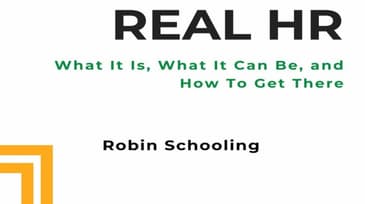
In this episode of DriveThruHR, Michael turns the mic on his longtime co-host, Robin Schooling, about her brand-new book, Real HR: What It Is, What It Can Be, and How to Get There. What unfolds is part interview, part therapy session, and part HR real-talk manifesto.
Robin shares the behind-the-scenes journey of writing a book that doesn’t sugarcoat the realities of the HR trenches. From the lonely moments to the WTF ones, Real HR is about cutting through the corporate noise and saying the quiet parts out loud. Michael and Robin talk about why empathy matters (like, actually matters), how storytelling makes us better HR humans, and why HR pros must stop waiting for permission to lead with their values.
Oh, and they also talk about burnout. (Because, duh, it’s HR.)
TL;DL (Too Long; Didn’t Listen) Takeaways:
- Real HR is messy, human, and long overdue.
- Writing a book is like doing HR: it’s hard, personal, and not for the faint of heart.
- Storytelling isn’t fluff - it’s how people learn and connect.
- Tech is a tool, not a substitute for empathy.
- Burnout is rampant; community and reflection are survival gear.
- Robin’s not done writing. Stay tuned.
Grab your coffee, your sense of humor, and maybe a stress ball - this one’s for anyone who’s ever been “voluntold” to fix the unfixable
Powered by the WRKdefined Podcast Network.
[00:00:21] Hello everyone, this is Michael Vandervoort. Welcome back to Drive Thru HR. We're the only podcast where HR isn't just human. We hope it's hilariously human, especially today. We normally discuss ideas, trends and activities impacting HR talent, HR technology in the workplace, but today we're going to talk about HR real.
[00:00:39] Our guest today, she's HR royalty, a woman so people-centered, she practically bleeds empathy, so tech literate she could probably onboard chat GPT and so into the workplace that she once led a compliance training in heels during a thunderstorm. I don't know if that's true or not, but it sounds good. It sounds fabulous. She's a speaker, a system nudger, whatever that means, and a workplace truth teller and now cue the confetti. She's about to become a published author.
[00:01:08] And that is my very own lovely co-host Robin Schooling. Robin, welcome to your own podcast. I know this is fun. It's like I'm sitting on the other side of the desk, even though not really because we're in our exact same desks we always sit on. Exactly. And we have the same blurry images. Anyway, seriously, congratulations. Robin has a new book coming out called Real HR, What It Is, What It Can Be and How to Get There. And it drops on May 15th. And it's probably not your grandma's HR book. It's Robin. It's going to be a little different.
[00:01:37] So I haven't read a word. And so we're not doing a typical book talk type thing. We're going to go and have some fun with how Robin got the idea to write this book and how she got there. And so if you're cool, I want to jump right into the questions because I've already heard a little preview of this, but about the birth of the book. But I love talking to people about their personal creative process. And for you, this was some time in the making.
[00:02:04] So talk to us about why you wrote the book and how was your creative process? Was it more like birthing a baby or pulling teeth? It was birthing a baby after a super, super long gestational period, I think. Far more than nine months, right? Far more than nine months. It's, you know, I think you probably had the same thought I did when we look back, you know, from the days of old, because you were a very well-known and very prolific HR blogger back in the day as well.
[00:02:32] The human racehorse is still one of the best names ever that you had. But, you know, we've we both started writing pre-2010. We were we were blogging. And so I think always in the back of my mind, I had the I'm a writer. I'm a writer. Am I really maybe not unless I write a book.
[00:02:49] And so I've always had that in my head. And, you know, we we have lots of friends in our HR space that have done just that. And I'm so excited when I see they have a book coming out. And I thought, I want to do that. And so I actually did the first outline started the first iteration of this probably about 10 years ago.
[00:03:08] Mm hmm. And had this files and the outline and some drafts of chapters in a folder in my Google Drive for 10 years. Nothing ever came of it. Five years ago, around the pandemic, you know, when we were all looking for things to fill our time and what can I do and, you know, whatever. I pulled it out and took a look at it. This is the time, right? People are learning to play piano and bake sourdough bread. I'm going to write a book, write this book finally. So I made some changes. No, I'm going to put I want to talk about this now. And here's these chapters.
[00:03:38] And came up with another very high level draft slash iteration of it five years ago, put it aside, never got back to it. This past fall, I had, as you know, as some folks may know, because I've written about it on my blog, I had a cardi, I went into cardiac arrest, theoretically, almost died, literally, truly almost died, thankfully did not. And I think that that kind of spurred me on to get some stuff done that I always wanted to get done.
[00:04:16] Mm hmm. And had gone through sort of these mental machinations of, you know, what does life mean? Why am I here? What have I not done that I want to get done? All of that kind of stuff. You know, there were some, you know, little things that I've kind of taken care of in the intervening time. But one was, I'm going to get this book done. And I didn't tell anybody just, I said, I'm going to get it.
[00:04:41] Yeah, you didn't tell me and it's not like we're, it's not like we, uh, all our secrets every week or anything. But yeah, I was, I was, I was pleasantly surprised when I heard it. Or did I have any idea it had been on the shelf for so long?
[00:04:53] Yeah, I didn't, I didn't tell anybody until maybe about a month ago. So early part of April, mid April, when I was done, basically, other than the formatting and getting it set and ready for publication. But I was, I was done. And then, you know, so I pulled it together pretty quickly, couple of months, and I kind of got it. Here we go.
[00:05:13] And when I, when I was done, that was when I told, um, I told John, John, my John, John Baldino, and he were Riso. I told him, and he was the first person I told. And then I just said, I need to put it out into the world and pick a date and say, here we go. And that's what I did.
[00:05:31] So very, very cool. Well, congrats. I mean, seriously, congratulations. I told you the other day that I have been playing with the notion of it. I helped fill his book, which we did a show for it. You did a show interviewing Phil a few weeks ago, which we appreciate it is fascinating process to go through. We won't, we won't bore all of all of our HR listeners with, with book launch strategies. It's a fascinating process to go through. It is.
[00:05:55] Your self-publishing, which Phil has done in several books in the past that way. He, he went a little tear up this time and has a publisher through Fast Company. It's a way more elaborate process and there's a lot of behind the scenes stuff. It's amazing. And I'm sure we only scratched the surface because this wasn't, you know, but anyway, so I didn't include a very essential questions in the, in the front. So let's set the stage and then we'll get into the rest of my goofy interview questions.
[00:06:20] Since, since I haven't read the book, I don't even know what it's about except HR and that intro that I wrote. Seriously, tell us about the book and what, what it, what it covers and kind of how you, why you wrote it. And I wrote the, wrote the book before I had a title for it. The title sort of came after the book was pretty much finished.
[00:06:41] And that's the real HR moniker, the real HR part of the title, because what I've always wanted to do is put things into writing that are real for a better word. What is it really like working to use, remember Charlie Judy's old phrase, trench HR, which I still love that phrase. What's it really like out in the trenches? Because you can go to school for HR specifically, you can land in HR, you could be doing HR for 20, 30 years.
[00:07:10] And nobody talks about the day to day in a, in, in, in a human way that really lets HR professionals understand what the work is going to be like. We talk to each other, we go to a sure meeting, we go to a, uh, out for cocktails with our HR lady friends. And we, we instinctively know what each other is going through because we live it and you've had to have lived it to really understand it.
[00:07:40] But then you go to, you know, an HR conference or you, you know, read blog posts or whatever it might be. And stuff is so freaking sanitized and so buzzwordy and so rah, rah. Um, I'm going to pick on our friends at SHRM, right.
[00:07:59] But you go to the SHRM bookstore and everything is, I love HR and there's tchotchkes and there's, you know, app sometimes about, um, the messy, challenging, difficult, crazy, ultimately really rewarding work that we do. Yeah. I actually, I actually like to flatter us. You know, we, we don't talk like raw, varnished HR here every, every minute of every show or anything, but I kind of like to think that we've talked real HR. Yeah. Yeah.
[00:08:28] I mean, we do, we do a wide variety of shows, but I think we talk about like, like, think about this stuff. Yeah. Because sometimes following the book and reading the manual, it's not, that's not HR. It's not, that's part of it. Anyway. And I, yeah. And I think, I guess if I had to say what, you know, what's the gist of the book, it's not to romanticize. I don't romanticize HR, but I respect it. And I, I love it.
[00:08:54] I wouldn't have worked in this field for 30 plus years if I didn't love it. Yeah. Um, and, and part of loving it is challenging it and challenging the way we do things and getting us the collective us right. To think differently. And so often, especially those HR professionals in small or mid-sized businesses feel so isolated and so alone. And it's hard for them to talk to somebody and say, am I where I should be?
[00:09:24] Is this really where I want to keep working? Why am I so exhausted or frustrated or angry? And that's a common, common thread. It's so common. There seems to be more burnout and more stress. And we're challenged with, you know, ever growing. Anyway, this isn't supposed to be a depressing show. It's supposed to be a fun, funny show about your book. But no, but seriously, congratulations on getting the book out. Look forward to reading it.
[00:09:49] I want to kind of walk through some silly stuff, but also use it to, use it to, you know, kind of make some points and help people understand what the book's about. But one of the things that if people have listened to Drive Thru that they will know is Robin is just a great, fabulous storyteller. She makes up a lot of characters. She's got some HR ladies and stuff. And I forget the names. The one that I think of most often that you come up with is Sally Sue. Good old Sally Sue. And there's like, there might be like Peggy Jean or I don't know.
[00:10:16] Anyway, but you've, you've, you've, you've told you, you, you deliver analogies and tell stories with, you know, with people who kind of who are archetypal HR people. They don't exist, but they're all of us in some ways. How did, is that, is it just part of your style? Or do you actually, how do you come up with that? I guess is the question. I think it is just part of my style. And part of it, I think, is the need for us in HR to learn from each other is often through storytelling, right?
[00:10:46] We talk about things that we've experienced or the crazy situations we've found ourselves in. And we often can't go in and say, well, that was, you know, Cecilia Boudreau who did that, right? So we make up names. Cecilia Boudreau, truly not a made up name. I actually know several of them. So, yes, Sally Sue has been one of my go-to names. Trixie, Trixie, Trixie's another favorite of mine. Pam from Payroll, she's another one I like.
[00:11:12] And so, really, I think all of those folks, certainly their names, make an appearance in the book. I don't know, I just latch onto these names. They evoke to me a character. But I think, I think the talent of having that, having those people that I think that, or maybe it's, maybe it's the gift is, they literally are people you know. Yeah. You kind of tell a story without insulting anyone or mostly not insulting anyone.
[00:11:38] You know, like you use them to tell, like you're saying, the stories that we can't tell with by calling people out by their name or whatever. But you bring the story to life through the fictional Sally Sue or something. I love that. Another goofy question, Robin. Real HR sounds like the HR version of a reality show. I mean, it's like the seven housewives of HR or whatever. So, if your book was a series, what would, what would a season finale cliffhanger look like? Well, before I tell that, let me, let me point this out.
[00:12:06] Cause I just about fell out of my chair the other week. Part of this, let me, let me get back into the groove of writing, which has been so incredibly invigorating. Mm-hmm. But I still get readers, not like the old days, but I get good web traffic.
[00:12:29] But I wrote a blog post the other week about my favorite reality show, Below Deck, which I've watched every season, every iteration, you know, hours upon hours upon hours upon hours. And it is my only reality show I watch. I wrote a blog post about it. It's a hot mess of a show, but the people are actually working. It is probably the realest reality show. Mm-hmm.
[00:12:53] And a guy that works for the show and has been an editor and a producer for the show reached out to me cause he wrote my blog post and he said, you get it. I was, we had a conversation. It was fabulous. But anyway. You should get him on the podcast. You should. But anyway, I would say season finale, man, I don't know that they'll, season finale is maybe that the, you know, the CHRO finally confronts the CEO about like toxic leadership. The organization.
[00:13:23] And then the CEO offers the CHRO, the COO job. There's your, there's your cliffhanger, right? And you wonder is she going to take it or not? Versus professional. Yeah. Cliffhanger. That's right. I thought it might be like the CEO from whatever company that I just saw that got fired for. Kohl's. Kohl's. Yeah, that's right. Just like, anyway. So that's, that's a pretty good setup. When you sell the TV and film rights, remember that. That's right. Yeah.
[00:13:51] It can be, it can be the end of season one. I'm going to make this question somewhat serious and somewhat funny or try to be funny. Anyway, you described HR as a force, not a function, which led me to go. It was just may the fourth, may the force be with you last week. And it made me go to, okay. So that's a Jedi level, bold call out. Are you a Yoda? Are you a Mace window or a more slightly burned out Obi-Wan? First of all. Well, other than Yoda, I have no idea who any of those others.
[00:14:20] Samuel L. Jackson was Mace. Sure, sure. And Obi-Wan was Alec Guinness and or the other younger version of him. Go with Yoda. Just don't talk as fun. All right. I'm not a Star Wars person. I've never seen a single one of them. However, talk about the force versus function thing. Because that seems like an important point.
[00:14:41] What I want, and again, through the, I guess the arc of the book, right, is here's this stuff that's kind of messed up or that aggravates us or that we question or that we wonder about our own identity as HR professionals. It's kind of like, here's this stuff that we have to figure out. But at the end of the book, the arc of the book is, but we can do it. You can do it, right? You have the power to do this.
[00:15:06] And every chapter, no matter what the issue is, kind of the high-level issue within that chapter that we're talking about, is that HR, whether that be an HR department, an HR team, an HR, an individual practitioner, individual professional, that individual is and can be a force for good, a force for change, a catalyst to make their workplace better. And by extension, other workplaces better.
[00:15:31] We have this opportunity, I think, and I like to think about it this way, right? That it's, and I'm stealing other people's, you know, thought when I use this term, but be the ripple. Remember we had the, Chris on, that was the be the ripple guy, right? But we can be this ripple, this force for good by changing things in our individual departments, our individual teams, in our individual workplaces, and then letting that carry out.
[00:16:00] That's being a force, and a force for good, and a force for change. And, yeah, and the function to me, again, without having read what you've written, the function part to me is, like, how we view our profession, and when we're that regimented by the book kind of HR, which I guess is the opposite of your real HR, right? It's being empathetic with people and trying to work with them, not just make sure the rules are followed and the policies are applied with, because that's super important.
[00:16:29] We say this all the time, super important, but it's not the be-all and end-all, and it's really, really the people. I'm skipping the question about throwing the laptop, because we've already talked about it. You talk about, I guess, and I don't know if you said it exactly this way, but staying human in a somewhat, a system that can be inhuman sometimes, which, you know, like, we are, we can be regimented, and we are expected to be the compliance police at some level, although that doesn't have to be the main role you play.
[00:16:55] So what's the most human thing you've ever done on the job, and did it totally backfire, or did it go well? Here's a story. I'm thinking, I don't know that I've ever told this story. I've told it to people, like, over cocktails and things, but I don't know. Breaking news. A new rabbit. I don't think I ever wrote about it or anything. My very first HR job, so I was young, in-house HR job. I started in an agency, and then my first in-house HR job was a bank, and I was there for probably about four years, and I was a recruiter at this bank.
[00:17:25] Bunch of branches. You know, I had a lot of requisitions, about 400 employees. I knew I was leaving. I was looking. I'd been there about four years. I wanted to have a generalist role. I'd been interviewing. I was pretty sure I was going to get this job offer that I did get. So I was kind of like, you know what? I'm just going to have fun while I'm still here.
[00:17:45] And I went to, we did an annual sales banquet that all our branches went to, all our branch employees, and they, you know, got, you know, sales awards and this sort of thing. And HR, the HR team got to go to this, to this banquet. So I went, and then afterwards, it's open bar. These were the days when you had open bars and stuff. Afterwards, I went with the employees from branch number four. I'll never forget this. Branch number four.
[00:18:11] I went with them after the banquet to a local watering hole before we all went home. So it was the branch manager and the assistant branch manager, the mortgage officer, you know, a bunch of the tellers. You know, it's like about eight of us. And next thing you know, and I was cocktailing quite a bit. Next thing you know, I was making out with one of the employees at the bar and we kind of peeled ourselves off of each other.
[00:18:35] And I looked around and we were literally in the middle of a circle with the branch managers standing there, the loan officer. And they were, it was like a movie. I mean, I can still see this, right? They were like, their mouths were hanging open because I'm making out with, you know, this employee. I'm the HR lady making out with the employee. And so we kind of like, nobody said anything. We just, we like stopped.
[00:18:58] And a couple of days later, following week, I don't know, I had to go to this branch because somebody was, I think I had to go to an exit interview or something. I can't remember. But I went to this branch and I, it was middle of the afternoon. I walked in the door and there were no customers in there. There were customers at the drive-thru, but nobody was in the branch. I came in the like three, four tellers behind the counter came out from behind the counter. The loan officer stood up. The branch manager came out of her office. The personal banker like hung up her phone call.
[00:19:25] They all stood up and started clapping when I walked in. And I was just like so mortified. So, but not really. It's Robin, the kissing HR lady. So, I mean, you can't get much more human than that. That, that's, that, that story is revolting. That's a great story. Sorry. It's like, I got to put on my HR hat. Anyway. And then like about a week later, I like gave my notice because I did get this job. Yeah. So you're out of there.
[00:19:55] So yeah, I have never made out with any, any employee at any place I ever worked. So you have to be, I don't promote it. I did go on a date one time with somebody that I worked with and that was weird enough that I didn't do it again. She was fine. It just, the whole idea of dating someone that you worked with kind of freaked me out for the, for the, for the HR reasons. But anyway, so thanks for sharing that, that breaking news story. Those, that's always great. What? So like HR is complicated, right?
[00:20:25] It gets contradictory. Like we're, we're, we're, we're the employee's representative, but we're not, we're the company's representative, but we also have to be on the side of the employees. Sometimes we're bad actors. You know, there's, and there's many, many more circumstances like that, right? It's complicated. It's, it's chaotic at times. And we were talking about how people have been stressed out. So what's your favorite trick for now? I know you're in a little bit different role these days as am I than the old trench days that we had, but what was, or is your secret for kind of staying sane in a crazy
[00:20:55] profession? I think it comes down to this very, very personal awareness, which, which comes out of introspection and comes out of knowing yourself. And that is being very clear on your boundaries and the values that guide you. It's knowing the lines that you won't cross. What are the values that guide you as a human being? What are the values that guide you as an HR professional? Because that then becomes the, what will you put up with? What will you not?
[00:21:23] And I think this is, that's hard for people to think that they can own that, especially very early in their career, because you, what it will, I'm, you know, I'm learning, I'm learning, and this could be true of any job, but I think it's so true of HR, right? I'm learning, I'm learning this job. I'm new to the profession. I don't really, I can't really bring my quote, personal agenda into this. It's, I'm here for, to your point, I'm here for the company. I'm here, you know, to support the employees, whatever.
[00:21:51] But I think what makes, makes you a good HR professional is knowing that you can't leave your values and your way of treating people, what you'll put up with in society or at work or whatever. You can't leave that stuff at the door. You have to know that about yourself because being strong, to get, strong enough to get through the complexity, to get through the chaos, to get through the tough times is understanding those things about yourself.
[00:22:21] So one of the scenarios that I lay out in the book, it's actually part of chapter one, where I talk about HR's identity crisis and go off into several different directions with that. But I talk about me very personally when I had, gosh, about 10 years ago or so, when I started to write the book the first time, but I had this like existential breaking point. I was, I'd hit that wall and I had a great job at the time. I loved where I worked.
[00:22:46] I loved what I was doing, but I was just exhausted and, and I, I was burned out and I had a great job and I was still burned out. And so what did I need to do was I needed to think about those sorts of things. Why am I here? Why do I keep working in HR? What, what guides me? What do I feel strongly about? What do I want to keep fighting for? What are the non-negotiables in how I approach HR, how I'll practice HR?
[00:23:12] And I, and I went through this exercise first time, probably this was about 10 years ago and I've subsequently kept it updated, but I wrote down, I created and wrote my HR manifesto. So my like professional manifesto. And, and in the book, I take people through kind of how I, how I did that. What were the steps that, that, that I did. But one of that was a big part of that was what are my, what are my core truths?
[00:23:40] What are my core beliefs? And, and what are the ways that I will use those to make an impact in HR? It's those three things. And so a lot of that was, you know, what are the values that are important to me? And then out of that comes for me, what, what keeps me in HR. So things that things like what I will vow to always do. I will always vow to eliminate discrimination.
[00:24:06] I will always vow to advocate relentlessly for social justice. I can't remove that from my humanity just because I work in HR. I will always vow to improve the workplaces by, by improving HR, right? There's a sphere that I'm working in. I will always vow to empower employees and give them agency for themselves as much as I can. So again, it comes back to really sort of having that, that's time for self-reflection
[00:24:36] and, and becoming aware of, again, I think it's values and what you'll put up with and, and, and what you'll do. You know, we, we don't have to be martyrs. We tend to think we're kind of martyrs in HR. That's one of our issues, I think sometimes. So we have to consciously manage our energy around these things. And that comes as well from kind of knowing yourself. That's, that's very well said. And I'm not going to add much. We have a few minutes left and we're not going to get through all the questions, but I want to hit a couple in particular.
[00:25:06] Mm-hmm. The small stuff, right? What is it? What is it? So I'm sure you spend a lot of time thinking about a lot of different things, but what is one thing that really just raises your blood pressure right away about HR or at work? At work. Forced fun and forced trivality. Mm-hmm. Hate it. All-consuming passion. The culture clubs, the fun bunches. Gotta have a Christmas party and you gotta smile and gotta act like celebrating every, all this stuff, even though that person's a jerk, that kind of stuff. Yep. Yep.
[00:25:36] Or, you know, the number of places where I've worked, where we had, uh, the fun bunch, the culture club, the employee activity committee, what all designed to put a bandaid on some core issues by, you know, again, this forced frivolity. Let's force everybody to go out and do the local, you know, walk for pick a disease. Cause that'll be fun. No, it's not. Go, go walk six miles. Yeah.
[00:26:04] Uh, like on my Saturday off. No. Okay. But sometimes you have to. Yeah. Right. So if somebody reads, hasn't read your book like me or nobody at this point, I don't know, I guess you had to have somebody read it to get a beta, beta readers, I think they're called. But if somebody reads your book for you, if they had just one thing to take away, like a sticky note embedded to their brain, what would it be from real HR? It is. And I feel like, I feel like this has almost become a cliche, but I'm going to say it anyway.
[00:26:33] I want people to remember to show up human in a, in systems that are often not human. And so it takes us back to know yourself, know your values, what, know who you are as a, as a human being. Um, and then show up that way in these often in human systems. You can't fix everything, but you can fix some things. And sometimes you just need to start. And I'm going to go off script here. Two different things. And then we'll wrap up.
[00:27:01] They're related, but they're so AI. It, how do we like, that's not human, but it, and it's affecting a lot of human jobs. Right. So there's that. And then there's sort of just like our societal polarization where we, we're become, I mean, we're bad, we're bad at communicating and we're kind of reveling in being worse right now. Not, not everyone, but many of us are. And so, and so like, did you, did you get into any of that?
[00:27:31] And again, spoiler free, haven't read the book. So I'm, I don't know. Did you get into any of that kind of stuff in the book or is that not really part of where you. I did to some degree. And in, in that I, I do have a chapter, um, where I talk about, um, the chapter's called human connection in a digital world. And so we don't go down the path of, you know, I'm not a, I'm not a Ben Eubanks, you know, who wrote like a great HR book on AI. It is not that.
[00:27:58] But it, it, it does sort of talk high level about, um, you know, this is, this is the world we live in. Right. And I, you know, everybody says that, but you know, it's true. And technology is not the, not the enemy. It is not going to replace our empathy. It's not going to replace the skills and attributes that we bring as human beings to work with other human beings. It is not. But we need to then not do what we tend to do often in HR, which is put our head in
[00:28:24] the sand and pretend it's not coming and, you know, just deal with it when it gets here. So it, it comes back to, um, how, how do we prepare ourselves for that? And it's, it's being curious. It's learning as much as you can. It's playing around with the stuff. You are the poster child for this, Michael, when I think about it, right? Right. When, when Chan GPT came out, I mean, what is this? So it looks like two years ago now, right? Yeah. Two, two, two and a half, almost two and a half years ago.
[00:28:54] It actually did not before that. That's when it became widely, easily. Widely known. Right. Right. And you, you are just the perfect example of how you threw yourself. You were one of the first people, uh, you know, that I interact with, interacted with regularly at the time. You threw yourself into, I'm going in and I'm going to test all this stuff and I'm going to learn this and I'm going to learn that. I'm going to try this crazy thing. Right. And that's what we need to do, right? The collectively in HR, we need to not be afraid of this stuff.
[00:29:22] So I think that's probably one of my biggest, you know, words of advice, if you will, to the folks reading this book is talking about there's a, yes, there's some peril, but there's a lot more promise. So what does that look like? And I give some examples of, of things, you know, that, that I experienced at work and we used to chat about one time and kind of, you know, how that, how that came to be. And then some tweaks that we made to it. And then we talk about human centered design and again, keeping the people in front of,
[00:29:50] again, I'm not going down this, I'm a tech designer. Here's what we're designing our user experience to be like. It's not that it's much more the, we should be doing this anyway, whether it's tech, whether it's a policy, whether it's a, how we, you know, park in the parking lot at work, whatever it might be. Keep the people front and center. I forget which job you were in. And I remember a few years ago, our mutual, I don't know, with acquaintance versus maybe friend, depending on who you're talking about, Jonathan Duarte, you used a chat bot. Yeah. Yeah. Yep. Several years ago, right?
[00:30:19] Before chat bots were kind of like warm because you were trying to do a- 17, I think. You were doing autonomy training or something. Like, I forget, you needed help to get, like multiply your, because it was a shop of one, right? A shop of two. Yeah. Two. A shop of few. Yeah. Yeah. So you, in 2017, were playing with one of the first online chat bots, which I can't even imagine how atrocious that must've been back in the day, given what we have now, and they're still not great. Yeah.
[00:30:47] But that's a, like you talk about being a poster child, Robin, that's seven, eight years ago almost. Yeah. Yeah. And you're doing it in a shop with two people, you know, and not afraid to try it because if it works, it might, it might make us better. Right? Yep. And that, and I know HR people are good hearted, but that, that's the, that's the lens I hope people look at, at technology through. That's what I try to do. How can it, I mean, I want to know how it could hurt us too, but I want to know how it could better. So anyway, great.
[00:31:15] Last, last question. Well, I guess it's a two-parter. So number one, where can people find the book when they want it? Cause I'm sure there'll be one or two of us that are going to go out and order it anyway. I would hope so. Yeah. Yeah. Yeah. No, I mean, and, and you're going to be doing some other, some other promotions here in the, in the coming days, but we wanted to get this one in the can and get it out. So, but where can people order the book? So it comes out on next Thursday. So May 15th, you know, you can't.
[00:31:43] Do this without the beast that is Amazon, right? So that is who it's published through. So it's findable on Amazon. I have an author page and everything now. The ebook is available for pre-order right now. The paperback will go on sale on the 15th. Gotcha. That it will also be ideally, um, I have a plan to have an ebook version, a couple other sites as well. But you know, there's realhrbook.com is kind of the landing page for the book. And then robinschooling.com.
[00:32:13] And I have a page on, on my website is on my blog as well. So people can always get to it and find it. And now, now that you're about to break, break in the big time, and I'm probably, you'll, you'll probably be retiring as a co-host on drive through and onto a big book career. Do you have a sequel in the works? No, but you know what's funny is it's like getting, it's like getting tattoos. Like when I had my first tattoo, the ink was barely dry and I was ready for my second.
[00:32:41] And I'm like already thinking this one, this book hasn't even come out yet. And I'm already thinking, oh, what can my second one be about? It's hysterical. It's sort of that same, I got, you know, and so I, you know, after that first tattoo, I now have 13, I think. So, you know, watch out. But I might have a full series of books. Just so people know, apparently it's infectious because I just literally, I told Robin last week, I'd been toying with writing a book and, but I just, I had such a hard time writing a blog. How could I write a book?
[00:33:10] But I actually drafted a 17 word chapter about some, some crazy workplace stuff around grievances in the workplace. That was kind of my working prototype. So I actually have a chapter. I don't know if that'll ever go any further. I don't know if I have 10 years, but we're going to try. I'm going to wrap up with this just completely unrelated note. The founder of DriveThruHR, Brian Wimpen, is also a published author.
[00:33:35] He's written nonfiction books, but he's now turned his hand to writing fiction books and has a mystery novel series, I think set in New Mexico or something, Montana or some damn thing. So writing is running rampant in the world these days, apparently, as it relates to DriveThruHR personnel anyway. I want to be the first to wish you like happy bestseller status. Thank you. And then we're going to go ahead and wrap up.
[00:34:01] So I, you know, everyone knows you're the co-host, but you said robinschooling.com and realhr.com, right? Is that the right? Yep. Realhr. Realhrbook.com. But they can also find you on the Twitters and other, well, maybe not on Twitter anymore, but. I'm still on Twitter, LinkedIn. They can find you there as well. Our website, our DriveThruHR website. Our DriveThruHR is on DriveThruHR online. Yeah. You can go there as well. So thanks for doing the show.
[00:34:31] I'll get it edited and posted hopefully by tomorrow and it'll be live next week going into the, before the launch. So good luck. Thank you. And we will tell everybody thanks for listening and we'll be back with another guest actually next week because we're back on a regular cadence. So we'll be looking forward to chatting with Rebecca Trotsky from HRQD the day after Robin's book comes out. Thanks. Bye everybody.
Sponsors
