
Thanks to HRBench for powering this episode. To find out more about the company building the future of people intelligence, reach out to book a demo at hrbench.com/directionallycorrect !
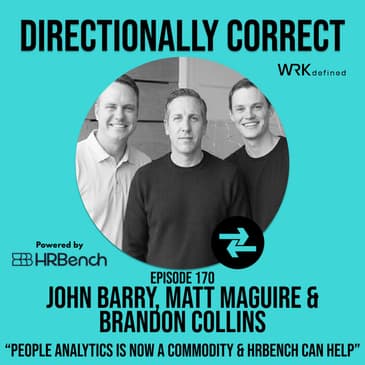
Check out this episode of the #1 people analytics podcast with special guests, John Barry, Co-CEO at HRBench, Matt Maguire, CRO at HRBench and Brandon Collins, CTO at HRBench!
In this wide-ranging and highly practical conversation, host Cole Napper sits down with the leadership team behind HRBench to explore how decades of shared experience in HR tech have shaped their vision for the future of people intelligence. What stands out immediately is the deep working history among the trio—relationships built over years at companies like Salary.com and PayFactors—which has translated into a strong foundation of trust, alignment, and execution speed as they build HRBench.
At the core of the discussion is a simple but powerful idea: data should be the foundation of every HR decision. The team reflects on how their early work in compensation analytics revealed a broader gap across HR—organizations lacked a unified way to bring together workforce data, understand it, and act on it strategically. HRBench was built to solve exactly that, consolidating disparate HR data into a single system that enables faster insights, benchmarking, and decision-making without months of manual reporting work.
A recurring theme throughout the episode is the rapid commoditization of traditional people analytics capabilities. Dashboards, reporting, and even predictive analytics are becoming easier and cheaper to build, largely due to advances in AI. But rather than diminishing the field, the guests argue this shift raises the bar. The real value is no longer in producing reports—it’s in driving action, enabling better decisions, and embedding intelligence directly into business workflows.
The conversation also dives into how AI is transforming both product development and organizational productivity. Brandon shares how engineering workflows have fundamentally changed, with AI agents now writing and reviewing code, dramatically compressing development timelines. At the same time, Matt highlights how customers are using tools like HRBench alongside AI to achieve output levels that previously required much larger teams, signaling a major shift in how HR functions scale.
Despite the excitement around AI, the group is clear-eyed about its limitations. Data quality, security, and business context remain critical challenges. “Garbage in, garbage out” still applies, and organizations must be thoughtful about how they manage sensitive employee data. Trust—both in the data and in the people interpreting it—continues to be essential, especially when insights inform high-stakes decisions.
Looking ahead, the discussion turns to the future of people analytics as part of a broader intelligence layer within organizations. Rather than siloed functions like workforce planning, talent analytics, and behavioral science, the field is converging into a unified capability focused on generating and applying insight. The team envisions a future where organizations can model themselves as digital twins, simulating workforce decisions and understanding their impact across the business in real time.
They also touch on emerging areas like qualitative data analysis, workforce transformation, and the evolving definition of work in an AI-driven world. Across all of it, one idea remains consistent: organizations that can combine high-quality data with actionable intelligence—quickly and affordably—will have a significant competitive advantage.
Blending strategic insight with candid moments and humor, this episode offers a clear window into how experienced builders in HR tech are thinking about the next chapter of the industry and why the shift from people analytics to people intelligence is already underway.
If you like this episode, you’d also love exploring prior episodes—visit colenapper.com for the full archive and show links.
Powered by the WRKdefined Podcast Network.
[00:00:02] When did you guys start working together? It's been a little while. I think when you get to work with really great people, you want to continue working with them. So I think that's how it's sort of happened. I think Matt, I think you and I met in 2006, I think back at Salary.com. And Brandon, you and I met I think in 2010, I think. 2010 or 2011.
[00:00:30] Yeah, really. It really is, you know, hey, we see data as a critical foundation, right, for HR and making decisions. And so we've, so Matt, Brandon and I have all worked together in HR Tech, you know, as we talked about for many years, a lot of those years have been in the compensation space. And so we've learned how to make a really big impact there.
[00:00:52] And really at HR Bench, we saw the opportunity to sort of expand and look at all HR data, bring it in all together. And in a single place where we can help our customers really understand what's going on from an HR perspective and make strategic decisions. I think when we were at PayFactors too, we started to get more questions. So I worked on the customer side of things. I wasn't always in sales.
[00:01:16] And hence the name, you know, the traditional answer to that question, Matt is benchmarking, right? So you just benchmark against other, the size of HR teams and other organizations or in other industries or what have you. And HR Bench is the name. I actually had it confused. I thought it was like HR Bench, like HR succession planning when I first met you guys. But it's short for HR benchmark. I don't know. Did you have anything though you want to add there, Brandon?
[00:01:45] No, just, I mean, it's been a great opportunity to, yeah, build some of the things that we wanted to build at HR Bench that we wanted to build at PayFactors.
[00:01:55] Welcome to Directionally Correct, a people analytics podcast with your host, Cole Knapper and today's guest, John Barry, the CEO of HR Bench, Matt McGuire, the CRO of HR Bench, and Brandon Collins, the CTO of HR Bench.
[00:02:27] Hey, Directionally Correct fans. This podcast is dedicated to you to help democratize people intelligence for the world of work. If you're looking to support the podcast, please make sure to listen weekly, subscribe to the Directionally Correct Substack newsletter, sign up for the Data Driven HR Academy at datadrivenhracademy.com, purchase Cole's book, People Analytics, or check out everything else at colnapper.com.
[00:02:55] Before we get into it, a quick word about HR Bench, the company powering this podcast. You know, when we all started in people analytics, we wanted to do strategic work, building predictive models, workforce planning, advising the C-suite, and most of all, quantifying the impact for the business. Instead, we spend months building dashboards and reports that should already exist. HR Bench eliminates that entire phase.
[00:03:21] Your HRIS connects, your metrics calculate, your benchmarks populate. This is not novel. This is day one, not quarter two. That means skipping straight to prescriptive analysis, storytelling, and taking action for the business. Want to learn more? Book a demo at hrbench.com slash directionally correct. Find out more about the company powering this podcast and building the future of people intelligence.
[00:03:48] As always, all opinions are our own, and thanks for being a listener. So when people ask me about joining HR Bench, one of the things that they're always surprised by is that you guys have worked together forever. As far as far as I can tell. So, you know, here with me, I've got, you know, John, you're the co-CEO.
[00:04:11] You've been on the podcast before, but we've also joined this time by Brandon Collins, the CTO, and Matt McGuire, the CRO of HR Bench. When did you guys start working together? It's been a little while. I think, you know, when you get to work with really great people, you know, you want to continue working with them. So I think that's kind of how it's sort of happened. I think, Matt, I think you and I met in 2006, I think back at salary.com.
[00:04:41] And Brandon, you and I met, I think, in 2010, I think. 2010 or 2011. And then we all continue to work together. We all work together back at Pay Factors and now here at HR Bench. So it's great. It's great to work with a great group of people who you trust. And, yeah, it's been good. You know when to avoid people, like when they're going to be happiest, what makes them tick.
[00:05:09] We've learned these things over this, the course of a few decades, I guess. Yeah, I'm just surprised you guys let me in. And I like the new entrant. I'll have to be here for 20 years before I'll be one of the regulars. It's a tall bar that we set. But we're glad to have you on board, Cole. Yeah. I know we covered this a little bit last time with you, John.
[00:05:34] But, you know, there's a little bit of a lineage in terms of, you know, this isn't your first go at an HR tech company. And you have a lot of learnings. You've had, you know, even some exits as a part of that process, which is a strong in the win column for you guys. But, you know, what was kind of the lineage that led to HR bench? Yeah, really.
[00:05:56] It really is, you know, hey, we see data as a critical foundation, right, for HR and making decisions. And so we've so Matt, Brandon and I have all worked together in HR tech, you know, as we talked about for many years. A lot of those years have been in the compensation space. And so we've learned how to make a really big impact there. And really at HR bench, we saw the opportunity to sort of expand and look at all HR data, bring it in all together.
[00:06:26] And in a single place where we can help our customers really understand what's going on from an HR perspective and make strategic decisions. I think when we were at pay factors, too, we started to get more questions. So I worked on the customer side of things. I wasn't always in sales. Just came over to the dark side within the last few years. But I was working with our customers and around, I think it was around COVID time, we started to get questions about just movement on like turnover and hiring and stuff like that.
[00:06:56] And we didn't, frankly, we didn't have the answers for that. I remember like one question that I got that it's a really good one that I feel like I never know the answer to either is it was from an HR team, large organization. They were wondering how big should their HR team be in relation to the overall size of the org. And I think that's relatable for any department you work in.
[00:07:18] At what point should you start expanding to be able to, you know, satiate the needs of your key stakeholders internally? And it was something I certainly struggled with on like the customer service side of things. You don't want to hire too much too early, but you don't want to be, you know, strapped for people, too. So it was those sort of questions that we started to get that started getting us thinking about this stuff.
[00:07:43] And hence the name, you know, the traditional answer to that question, Matt, is benchmarking, right? So you just benchmark against other, the size of HR teams and other organizations or in other industries or what have you. And HR bench is the name. I actually had it confused. I thought it was like HR bench, like HR succession planning when I first met you guys. But it's short for HR benchmark. I don't know. Did you have anything though you want to add there, Brandon?
[00:08:11] No, just I mean, it's been a great opportunity to, yeah, build some of the things that we wanted to build at HR bench that we wanted to build at pay factors. I think we started sketching some of this stuff out on whiteboards at one point where, you know, we wanted to build, you know, metrics around turnover, things that compensation, you know, affected at pay factors, you know, even workforce planning, stuff like that. So, yeah, it's really exciting to have the opportunity to work on this stuff now.
[00:08:42] Well, what gets you excited right now? Like, what are some of the things that you've built recently or are building that get you jazzed up about the space? Yeah. Yeah. The org charting features that we have in the system and the scenario planning stuff is really exciting because I think we do a pretty good job of it visually. You know, that's one of my passions is user experience. So, yeah, that's probably where I'm most excited right now in terms of what we're building in the application.
[00:09:10] I think we have a good opportunity to build something that's more approachable around the scenario planning features, as well as the org charting features and just all the data that we have access to and we can bring into the system and display on those org charts. So, yeah, that's probably where I'm most excited right now in terms of what we're building in the application.
[00:09:36] I get excited about the org charting and workforce planning for a couple of reasons. One, because we've been asked about it for 20 years, org charts, and we've never had a solution for it. So it's exciting to be able to finally answer that request in a really good way, branded a team and put together. It's really amazing. The other thing, too, that we've been talking about internally is I think with the world today and the changing landscape of job markets and org structures,
[00:10:06] that tools like this are going to be so important to an organization as they figure out how they want to scale, how they're hiring, whether they're backfilling, how they're introducing AI tools into the process and having good technology for that, I think is going to be really important. Yeah. And now that HR is more critical now than ever and really having a seat at the table in a lot of cases,
[00:10:34] HR needs the data, needs to understand what's going on. They're getting the tough questions right from the executive team. And so having that readily available is really critical. And so that's what we're really able to bring to the table. When part of that criticality is, I know this is somewhat of a controversial thesis, but I'm a very strong believer in more to come. Actually, probably by the time this podcast comes out, there'll be more to come in this space.
[00:11:01] But, John, do you think people analytics is becoming a commodity? Yeah. You know, look, I was waiting to see who was going to say AI first. And I thought it was going to be you, Cole, but I guess it's me. So, you know, obviously now, you know, the world is changing very fast and there's lots of tools that are coming onto the market. AI is enabling that in ways that we've never seen before.
[00:11:27] Everything from, you know, folks being able to do some of this work themselves, but also other, you know, people who have been in the tech space who, you know, maybe just didn't have the resources and the development resources to build out these kinds of tools are now starting to do some of that. So it's a really interesting time. I think it's definitely being commoditized.
[00:11:52] I think what, you know, folks need to really start to watch out for is how they're handling all this data, right? I mean, there's a whole host of things here that we could certainly dig into. But I mean, one of the big things, right, is when you're dealing with data, you've got to make sure that, you know, the data is secure. Number one, you're dealing with confidential data.
[00:12:16] So you don't want to just send your, you know, spreadsheets with social security numbers out to the cloud, which I don't want to do that. Unfortunately, I've seen done too many times. And you certainly don't want, you know, to be making decisions off of data that's really it's incomplete or it's missing or it's garbage in garbage out.
[00:12:42] Right. So having that data really be cleansed and there's there's it's a it's a difficult process that not many people know about. So when you're using tools like HR bench, all that all that's built in, we're helping our customers really look at that data, understand what's what's what's missing, what's needed if they're looking for certain pieces of information and storing it in a secure way.
[00:13:09] So that's that's that's that's sort of the one of the foundations here that, you know, you're you're it's still a challenge with AI. I think, you know, we'll see how that how that expands. But certainly this is all being commoditized. But, you know, not everybody has the time and and and wants to go explore doing these things.
[00:13:33] And and so, you know, there's there's still a, you know, a need for for folks like HR bench when when we're building out things like, you know, Brandon's talking about here scenario planning and whatnot, as you know, and then on top of that, we're able to build more features. Right. So it is enabling us to do more things for our customers as well. Well, that's what I want to build on that. Like, it's not just the commoditization of reports and dashboards.
[00:13:59] You know, it's cutting across things like the development of MCP, you know, predictive analytics and prescriptive analytics. You know, the chat interfaces, the AI workforce transformation, the workforce planning, the org charting. All of those things are becoming commoditized. And so the value add comes on from organizations taking action and really bringing value to their businesses because they can do so at a low cost point.
[00:14:27] Matt, how are you seeing this kind of manifest for the ICP? So the ideal customer profile of HR bench and why is this kind of a compelling value proposition? Yeah. So on the ICP side of things to just, you know, to give the audience a good idea of that, we work with organizations of all shapes and sizes. But we certainly have a high concentration in the 500 to 5,000 range.
[00:14:50] And what I've seen, at least in the last six to 12 months, is that these teams are leveraging more tools like us, but also AI tools that allow them maybe to like equal the output of organizations that have 20, 30, 40 person HR teams, people analytics teams. So they're able to do more with a lot less without having to hire.
[00:15:15] And that's what, you know, I hear from a lot of the customers using HR bench today is like we've been able to, you know, using tools like ours or other ones, they're able to get the output of like adding another headcount on top of the team, having someone work on reporting. They're able to do much more in their current role. And I know personally, it's like the same thing for me. I think each one of us could say this. I know Brandon for sure. And like what his day job is, he's able to increase his output tenfold. And I'm able to do that as well.
[00:15:43] So, you know, just creating more efficient team members, I think. Brandon, so is it all just hype? Is AI all hype or is the SaaSpocalypse real? Like, is it making you more productive? What is that like? It is certainly making us more productive.
[00:16:02] There was an inflection point probably back in December of 25 where with the release of models like Opus 4.5 and now 4.6 really kind of changed the game in terms of how we develop. I haven't written a line of code since probably December of last year.
[00:16:27] So, I am orchestrating code being developed by these agents. Multiple agents at a time, usually orchestrating different features. You know, we might be working on something that's tech debt. Might be working on something that's related to dashboarding. Might be looking, you know, working on something that's related to workforce planning. But there's multiple things going on in parallel at once.
[00:16:51] So, it is probably condensed what we originally had planned for 2026 in our development roadmap down, you know, in half, I would say. You know, what we were planning for the entire 12 months is probably condensed down and, you know, is going to be delivered in the first six months here at HR Bench. So, it's certainly not all hype. I mean, certain parts can be a little hyped up. You know, we certainly still need engineers to run the agents.
[00:17:19] We are reviewing a lot more code than we did in the past. You know, we're reviewing the code that the agents come up with. We're reviewing the code of other engineers and what their agents come up with. We have agents reviewing agents and their code. So, it's been a very, you know, interesting past six months since that inflection point in terms of how the engineering of SaaS products happens now.
[00:17:48] But, you know, I think it's mostly all for the better. You know, we're churning out a lot of great features. And I'm excited, you know, as we learn more about how these agents work and how we can better coordinate them and conduct them that, you know, we'll be able to push out even more here into the later part of this year. I mean, the cycle times is just really impressive. You know, I tell people why I join.
[00:18:14] You know, I talk to all the different firms out there that are doing analytics and I've seen all their products. And it's like HR Bench just ships things. You're right. And it seems like that acceleration is just increasing. But even within that, you know, people just delay vibe coding users can build their own tools. Like what's a differentiating factor for an HR Bench versus somebody who just wants to do it themselves? Like why are customers just building this stuff out for themselves?
[00:18:44] And is that even a threat to the business model? Yeah, I mean, I think there's different, you know, folks who are more comfortable with data, I think, are experimenting with it, you know, and trying different things. I think, you know, we talked about some of the challenges and issues with that. Obviously, you know, another big one here is AI.
[00:19:11] AI doesn't know your business, you know. I mean, I may know it a little bit, but it doesn't know the nuances of the business. You really still need, you know, to, you need to know what you're doing.
[00:19:28] And, you know, trusting that AI is going to, you know, make all the right decisions for you is, I think, is not really, it's not the end-all be-all solving all the problems, right? I think, you know, working with an HR Bench, you've got, you know, industry best practice all built in. You don't have to be a data expert. You don't have to be an engineer. You don't have to be a data scientist.
[00:19:55] You can really quickly, easily get access to insights, you know, that can help you make strategic decisions. And so that's kind of the focus here.
[00:20:07] You know, Cole, our friend, Martha Curiani, she, you know, I was talking to her recently, and she had an interesting perspective, right, which is, you know, there's this level of trust that you're building with an organization, right, with your executive team. And you can't remove the human element of it.
[00:20:30] It's, it's, people trust you, people trust that you're, you know, as a, as a professional, that you're going in and you're looking at all the different possible aspects of things and that you've done all your due diligence on it. It's, it's, it's very difficult to have, you know, AI back that up. But when you're doing it with tools, you know, that are all built best practice, you know, a lot of that's built in. So, yeah. Yeah. Yeah.
[00:21:00] You know, one of the things that, you know, we've been talking about since I, since I've been there is, you know, just building the thing that you worried about getting disrupted by. Right. So it's, it's still at this moment in 2026, who knows, maybe AI super intelligence is just around the corner. But for this moment, it still requires a human to use AI to build something with AI. Right. And insofar is humans cost money. Right. Right.
[00:21:26] And if a tool like HR bench comes in and it's just way cheaper than it is to hire out a whole team of analysts or, you know, AI experts to go do something for you. You're just building out the commoditized products to create something at a lower cost structure, which makes it easier for organizations to get value from it. But I know that, you know, thinking about those concepts like trust, Matt, I know that's like super important to the customers that we talk to. But, you know, how do you see the future looking?
[00:21:56] Yeah, I think like just because you can build it doesn't mean you're going to go and build it. Like AI has certainly leveled the playing field for people who lack any sort of coding skills like me in comparison to Brandon and John who have those skills and are fantastic at it. But, you know, I could go and I could build on the sales side of things in AISDR today. It's going to take me a lot of work to be able to get that thing humming.
[00:22:24] And I just don't think that a, you know, people have that kind of time to go and build out all these things. But you take that and then you combine it with, you know, when you mentioned trust, I think security and I think data. The data that we deal with, PII data is, I mean, so important. It has to be so secure. We go through InfoSec questionnaires with every new customer that comes on. It's not exhausting at all. No, no.
[00:22:50] And so like, man, I look at all the questions that a team goes through, an InfoSec team goes through to make sure that a vendor is vetted and data can actually go in there. And I think it's fantastic, even though it takes, you know, a lot of time on our end. But it makes sense. Taking data from there and then just pushing it into an AI tool, like I don't think teams are going to go for that. With this sort of data, the exposure is too big for them for like any sort of breach that happens there. So we have this security there.
[00:23:19] I think the other thing that comes into it that I hear from our customers is a couple other things that we do and that other organizations do too is data. Data is king here. External data I'm talking about too. You mentioned our name, HR Bench, the benchmark data. You're not going to get the type of benchmarks that tools like us and other surveys that are out there. That's not commercially available or publicly available. It's commercially available. You can go and purchase it.
[00:23:46] But that's a great piece of the puzzle to be able to compare any sort of analysis that you're doing in HR Bench with external data. And then also it's things like surveys too. Like we do engagement surveys within HR Bench. I don't think those are being replaced anytime soon by AI to have exposure of a survey going out to a 5,000 person company.
[00:24:09] Like I don't think companies like Qualtrics or CultureAmp are too concerned about their surveys, you know, being obsolete because of AI anytime soon. Yeah. I don't know. Do you have any thoughts, Brandon? Like where do you, we always talk about, you know, you got to skate where the puck is going. And you're a pretty early adopter in this space. Where do you see things going? Yeah. I'd like to touch first on the data aspect.
[00:24:36] You know, data is a lot of what we do here at HR Bench. Like we have our application. We have great features within the application across all of the data. But what you don't see is, you know, it's kind of like that picture of the iceberg where you see all the things that are happening below is kind of the lifting that we're doing on behalf of our clients and with our clients on data.
[00:25:03] We have a great implementation team and customer service team that is working with us on the engineering side and the clients to work through their data just to get it into, you know, the required format so that we can build these metrics from the data. You know, one of the things you need to build out a metric such as turnover is you need a timeline of an employee, you know, across their tenure at a company.
[00:25:32] Often that that employee will be hired, rehired, terminated, might be rehired again. And, you know, it becomes difficult for a lot of these organizations to to get that data and get it into a format that could be, you know, formulated into a metric. So we invest a lot of time and a lot of energy into the data side of things. So.
[00:25:56] In terms of where I see things going, I don't know if that has necessarily been commoditized yet is the orchestration of data from disparate sources and if the orchestration or the transformation of that data, you know, if that's been commoditized. So that's that's what we focus on a lot here at HR bench. Absolutely.
[00:26:25] And like some of the things I think about, you know, you talked about the implementation. Like how long does it take, Matt, for a new customer to be brought on board with HR bench and what is that experience like? Yeah, so it's anywhere from, I'd say, four to eight weeks could be faster. Sometimes takes longer. Depends on the size of the organization, the systems that they're working with, the type of metrics that they want. Replication of any existing dashboards that they're using in Power BI or pivot tables that they're using in Excel.
[00:26:55] You know, we want consistency and uniformity and what their, you know, the teams we're working with, their stakeholders expect from them. And so while their process, HR, the people analytics team, maybe their tools that they're using have changed, like they come over to us. From a user experience, end user experience, like on your ELT team in a board meeting, they want things to look and feel exactly the same in the same calculations and all that sort of stuff. So we invest a lot of time in that.
[00:27:22] So that's part of like the process for the implementation speaks to sort of what our team is doing there. But we match folks up with, you know, a couple people on our end that are experts to be able to share best practices, to get their data implemented, to deal with that problem of garbage in, garbage out. So it's not garbage out. I don't know. Gold out? What is it? I don't have a good answer for that. We'll think about that. We'll come back to it at the end of the podcast. Come back with a better punchline for that. Yeah, exactly. There you go.
[00:27:51] I didn't plan that one. But really having good data in there to then build out all their dashboards and then it's training and all of that sort of stuff. So when you look at that in comparison to building this out on your own, even if you are using AI tools, I don't know, you're probably looking at six months, maybe more. I know you know that better than I do, Cole, having done this before and built out, you know, like a people analytics program and a process and data and all that sort of stuff. Yeah. Yeah. It's a big undertaking.
[00:28:19] And, you know, like I always think about like, like, let's rewind the clock for a second. Let's say it's 2017 and I had something like HR bench. What would I do differently? I think it would be wildly different. Right. Because you were almost at the time you were forced to build like the tools were so immature. The data processes were so, you know, defunct and siloed.
[00:28:43] And then the ability, like the ability to get people with the skills to do things like predictive analytics was just so nuanced and fragmented out in the marketplace. Like it was really hard to throw together a good team back then. And so I think there's a lot more skilled people out there now, but they're a lot more expensive too. And the tools themselves have matured quite a bit. And I think this kind of lends back to that, the commoditization point.
[00:29:09] But John, from your perspective, like what makes this moment attractive for somebody who's going to market, who's looking and saying, you know, maybe, maybe I would have considered building in the past, but now I, I might not be what, like, what makes it attractive to do it right now? I mean, it's, it's, it's, it's, it's everything we've been talking about, but you know, it's, it's, and, and, and time, right. Time and money. Right.
[00:29:31] You know, bringing in a tool like HR bench, you know, we can get you up and running very quickly and access to that information, giving you more time to do other things. And as we've talked about, typically less than, you know, for, for most companies, you don't need a full-time hire to do anything like this. So, I mean, a lot of the companies we talked to still today haven't done anything themselves because they just didn't have the time or did the resources internally, you know?
[00:30:01] So, well, in a lot of cases, we're bringing this to organizations that never had anything and, and didn't, didn't, couldn't even build their own thing. So, so we're enabling companies to, to have access to this. And it's, and it's, it's, it's, it just, it just, it makes them more efficient, helps them right with, with making strategic decisions. And so it's really, it's really an interesting time to see where this is all going. I'm curious, Cole, I wanted to ask you, where, where do you see this going?
[00:30:30] I was just going to ask the same question. I was going to say, can we ask questions now? Yeah. If you want to ask questions. Where's the puck going? The scanning where the puck is going. And I think this is kind of a part of something that I'm writing up right now. One of the most popular things that I wrote, which was featured prominently in my chapter three of my book, it's this concept of the tree of value. Right?
[00:30:53] So it's people analytics, it's workforce planning, it's talent, intelligence, and behavioral science, all of which had different origin stories. So having worked internally many times, they, they, a lot of times there was like infighting amongst those functions. I never really understood why, because it seemed like, you know, that there were fellow travelers on the same journey. But just because of those different origin stories that they're all like, they say, oh, I have the one true way of knowing how to solve organizational problems through data.
[00:31:20] And so the tree was saying that they're all branches of the same tree. And that the roots of the tree are the value of human capital labor data. What I see is happening right now is the really what the value that that data in HR produces is collapsing into two different layers. There is a data layer, which Brandon has talked about how challenging that comes and is an issue for organizations. And we're trying to fix that. And then there's an intelligence layer.
[00:31:49] And that is all of those branches are collapsing to be a single, you know, trunk of a tree, if we're going to extend that metaphor. And that's the intelligence. And so you kind of have to move from the bottom of the stack, which is just the raw data and getting it, you know, to be the right definitions, the right metadata, like all the things that are necessary. But as you move up, you're getting into value creation mechanisms. And that comes through pure intelligence. And so that starts with what I always call a shared set of facts.
[00:32:18] So these are the things, the common metrics, the common dashboards, the common pieces of data that everyone needs. But you can go beyond metrics and you get into things like, you know, being able to predict the future, being able to generate insights by bringing together disparate sources of data to create a new kind of thing that no one actually knew before. And then it's driving decisions.
[00:32:41] And then it's quantifying the value of those decisions being driven in organizations to prove the worth of a function like analytics, like workforce planning. That's where I see the puck is going. And frankly, it's got to be cheap, too, to be able to do that effectively. Organizations are not going to be willing to have a hundred person people analytics team and pay a hundred million dollars worth of salaries and plus technology, plus fringe benefits and all of that. To get the value that they want to see.
[00:33:11] They want to see it and they want to see it tomorrow, right? Or today. And all of those things have to happen all at once. And so that was one of the reasons why I joined. Honestly, there were two reasons. It was like HR Bench is on a, like, just on a rocket ship. It's on a trajectory that is super, super exciting. But the second is, you guys are just nice people. Like, I really indexed to this probably way too heavily. Last time John came on the podcast, one of the first things I did, and this was completely unscripted.
[00:33:40] I made fun of him for being a co-CEO. I was like, oh, maybe one day you'll get promoted to be CEO someday. He was just such a good sport about it. He didn't take any offense to it. I was like, these are just humble, chill, nice people. They work together forever. And like, John, you threw and threw off the podcast. And this goes for Matt and Brandon, too. But I feel like I know you a little bit better now. And like, just the nicest people. And I was like, these are my people. Like, I just want to be a part of this. So super exciting.
[00:34:08] I will make fun of John again here for a second. In prepping for this, we were trying to talk about some idiosyncratic things or interesting things about you. And he's like, my hobbies are building businesses. And I'm like, God, you're such a nerd, John. You know, look, it's, you know, I really enjoy making an impact. I think I may have mentioned this last time. I mean, this is what gets me up in the morning. And it's exciting. And I like working with great people.
[00:34:35] And it's, you know, together, you know, we can solve big problems. And so I think, you know, as you know, and by the way, many, most of many of the folks at HR Bench, right, we've all worked together. So this isn't our first rodeo at all. And we've seen the value of really having good people and working with good people and the things that we can do to really improve and change an industry. And we saw that back in compensation.
[00:35:03] And I think, you know, we want to continue that here. And so I think the shift, right, and Cole, you know, I've talked about this, is how do we move this industry forward, right, and into the intelligence and leaning into the intelligence, shifting it from people analytics to people intelligence. So, and that's why we're super excited to have, Cole, you on board. And I think you're fitting well, right in with the whole team.
[00:35:28] I think, I don't know, pickleball or something like that adds to the hobbies. Give yourself some work on that. We'll work on that. Well, Matt, I mean, you, I think you fought in a boxing match or something at one point. Yeah, John, you don't need to do that. You may want to after Cole just called you a nerd, but. I mean, we'll get some boxing matches in the next offsite.
[00:35:58] John can punch me in the face. That's right. You know, you can really get your aggression out, you know. And instead of sitting in, you know, in a meeting, right, or in a Zoom, just get together in a boxing ring. Yeah. And then have the meeting. Yes. So I did. I did a couple years ago. I did this. There's this local charity in the Boston area called Haymakers for Hope that raises money for cancer research. It's a fantastic charity there nationwide.
[00:36:25] Now they do events in New York, Denver, Miami, a few other places. But essentially what it is, is amateurs come in and they train for, I don't know, it was maybe four to six months of training for like a sanctioned boxing match at the House of Blues in Boston. Three rounds. And, I mean, you're wearing headgear, but it was full go. So it was an amazing experience.
[00:36:51] How many times did you watch the Rocky montage when you were training? Plenty. I love those movies. I skipped the first one, though, because Rocky loses. And I saw myself as Rocky in this situation, so I didn't need that. How did you do in the match? I won. I won. Second round TKO. Oh, wow. Yeah. It's impressive. You watch out. I noticed I haven't made fun of Matt on the episode at all.
[00:37:20] I'm a lover, not a fighter. That's the only place that I would do it. You can find the fight somewhere on YouTube, though, I'm sure. Absolutely. Like, I know, Brandon, for you, you're a big cyclist, right? I've gotten into cycling over the past probably four years. My father-in-law is very big into cycling and mountain biking.
[00:37:45] And then my father used to be part of a team called Road Warriors, which did the Pan Mass Challenge every year. So I followed in his footsteps and did the Pan Mass Challenge last year for the first time, which is a charity ride from Sturbridge, Massachusetts, which is about halfway in the middle of Massachusetts, all the way to Provincetown, which is at the end of Cape Cod. So I'm going to be doing that again this year.
[00:38:15] This year, though, I'm going to try to do the unsanctioned, they call it Day Zero, where you start in New York. So you actually go the full Pan Mass. So I'll show up for the start of the Pan Mass on Saturday after I've already ridden from the New York border. My goodness, unsanctioned. Unsanctioned, yeah. We have room for one more because I think John's trying to pick up a new hobby.
[00:38:42] And I can build a business around it. I'll be there. He's going to make it sanctioned. This is going to happen. All right, guys, you want to join me in Cole's Corner? Let's go. Welcome to Cole's Corner. All right. We'll be quick. We'll start out with the order, John, Matt, Brandon, for these rapid fire questions.
[00:39:10] But if you weren't working at HR bench and doing kind of HR technology, what would you have done with your career? Physics teacher. Whoa, why? It's just a subject I always really enjoyed. And then, you know, I just think, you know, helping others learn new things and seeing them excited about things is really cool. What about you, Matt? Surf camp instructor.
[00:39:39] Instructor. That's what I'd like to do after I retire for kids to run like a program. Like the Paul Rudd character in Forgetting Sarah Marshall. Yes, exactly. Exactly. Pop, pop. What about you, Brandon? I think I would have started a taco truck. I've gotten into, over COVID, I got into making tacos, homemade tacos, you know, making the tortillas and making the meat and everything.
[00:40:10] So I think I would have started a taco truck. Do you have a taco list, too, of places? I feel like you have that, too. Yeah, I started a taco list pretty much every time I go to a Mexican restaurant. I rate them on three things. They're margaritas, they're tacos, and the ambiance. Brandon. The next barstool sports there. Yeah, except for tacos, yeah. I was like, Brandon, you're going high up the list in my book really fast. This is awesome.
[00:40:39] I didn't know this about you. You've got to get them. What is the best type of taco? That's a great question. It's probably carnitas, or at least that's the one I like to make the most is carnitas. Al Pastor is really good as well.
[00:41:00] I'll be trying to make a new steak type taco this summer that I saw a recipe for, but I have about four tacos that I've nailed down in terms of I can repeatedly make. So, yeah. I'm saying carnitas. Carnitas. I am so excited to try these out sometime. This is awesome. We're going to go change up the batting order.
[00:41:23] We're going to go Brandon, Matt, John for this one, but what's the place you've never been to that you'd most like to go and why? That's a good one. Probably Japan, I'd say. I think mostly for the food scene. Big fan of sushi. I think they're, I don't know, just be a really cool place to visit.
[00:41:52] They also, I do like another hobby is skiing of mine. So, it'd be pretty cool to ski in Japan. I've heard they've got some great skiing over there. So, probably Japan, yeah. Nice. What about you, Matt? This is a tough, this is like one of my toughest questions that I've gotten so far because I think about this a lot. The list is long. I like to travel. The one that I would pick, though, is an island called Tavarua. It's in Fiji. You can only get there by boat.
[00:42:21] It's like this small, I think it's like 20 acres wide. And it has like world-class surfing, snorkeling, kayaking. There's like one restaurant, a bar on there, and it looks amazing. What about you, John? So, we're going to have to open up offices in Japan and Tavarua. All right, Tavarua. Tavarua. Just say Fiji. Fiji's easier.
[00:42:50] Actually, Hawaii for me, I think, and I know, Matt, you've been there a bunch. Actually, one of the things, Matt's actually a good surfer. So, I think. Fiji's debatable. Debatable? I want to learn how to surf a little bit there. So, I'm going to hopefully get to Hawaii sometime. He is going to be Paul Ryan. This is awesome. Well, Matt, why don't you go first with, or no, John, did you? Oh, yeah, you said Hawaii. Okay.
[00:43:19] Why don't you go first with this one, Matt? If you were a character in any book, TV show, or movie, who would you be and why? Well, I kind of have to go with Paul Rudd now. Chuck, I think his name is, but he goes by Pono or something like that, which means Chuck in Hawaiian. There you go. All right, there you go. What about you, John? Can it be in TV? Yeah, it's a TV show or a movie. MacGyver. Yeah.
[00:43:50] Old school, but can do everything. What about you, Brandon? This one should be topical. I don't know if you guys have seen Hail Mary yet, the movie. Not yet, I want to, though. But I'd be, I think his name is Ryland Grace, who Ryan Gosling plays. He was a science teacher, John, who got sent to, on a one-way mission in space.
[00:44:18] I just, his character in the book is really cool in terms of problem solving. You know, solving a lot of science problems, which I really like. I also am Ryan Gosling. I think I drive with that. We all have dreams, right? In another life. What were you saying, John? In another life. So I got one big question for you guys.
[00:44:47] Any of you can feel free to go first, but where do you see the people analytics technology market being in five years? And what role do you see HR Bench playing in shaping that market? It's a tough one. I know. That's why I leave it for the end. I don't know. No, it's so hard to predict at this point because I feel like every day is different and
[00:45:15] things are just changing so drastically with AI and other technology. I think there's going to be a lot more people analytics organizations, vendors. I think we're seeing that today. New ones are popping up. AI driven people analytics tools, dashboard tools, ones that do everything. Ones that focus on, you know, core HCM that are adding on other analytics packages, which is, I think, great. You know, obviously it's competition for us, but I think competition is great. For the industry.
[00:45:43] I think it's going to put HR and people analytics leaders, you know, that much more at the forefront. The, you know, your people at an organization are, you know, the most important thing I'd say. And they're certainly the highest number on the accounting statement to payroll, of course. So anything that vendors can be doing to help with those, you know, with your employees and trends and analytics and stuff like that, I think is going to be important.
[00:46:14] Where it's going, I don't know, on the tech side of things. I would defer to my fellow nerds here, Brandon and John, to see where we're going. But as it relates to people analytics, my guess or thought here is within five years, it becomes an expectation almost that all HR departments have some sort of technology that can help them with these decisions.
[00:46:44] So it becomes a lot more ubiquitous is people analytics software is my guess. Yeah. I think I agree with both Matt and Brandon on everything. I also think that, you know, as we as there's there's more and more data and people want to look at not just HR data. Right. But look at your financial data, look at your operations data.
[00:47:11] You really start to create what we call and we've we've talked about a little bit, Cole, right? Something called the digital twin. And so basically a model of your organization in the digital world. And and so you can you can and it knows everything about your organization. It has all access to all the data to help you understand, you know, OK, well, what if we do make these organizational changes? Right.
[00:47:37] Not only what's the impact from an HR perspective and people and whatnot, but how does this how is this impacting the rest of the the output of the company? Right. As a whole. And how does it and you know, what is the and it's not just the direct impact of financials, but just just there's all kinds of impacts. And so what is that? What does that all look like?
[00:48:02] I think I think that's going to be where this all starts to head here in the next couple of years. But there's a lot there's a lot that has to happen. And again, these these great great now we've sort of you know, we've been really just we're focused on HR and helping HR be more strategic and solving the problems within the HR realm. Right. But it's just it starts to become, you know, what is the impact of the overall company and how do we look at the whole company as well?
[00:48:32] I think one thing I missed in mind, too, that if I'm listening to our customers today, because they're the ones that are going to guide us to where we should be going and where the puck is going. They've led us to workforce planning and stuff like that. Predictive analytics. It's finding better methods to put this data in other people's hands throughout the organization.
[00:48:53] So it's equipping people leaders with data about their people, how to better manage them, how to better have conversations with your employees of different generations and different roles, giving them insight into, you know, hiring, recruiting, engagement, succession planning opportunities, promotion opportunities for their employees. So hopefully creating better managers throughout an organization. I'm seeing that movement happen now.
[00:49:22] And I know organizations are doing this, some of them. But I feel a lot like a lot of organizations have tried with tools like Power BI and Tableau and have struggled for a number of reasons. And I think there is the more companies like us that are out there. It's going to be possible. Sure.
[00:49:42] The thing I think about is like the cost and the time it takes unit of intelligence is collapsing to zero. So in a recent article I wrote with Zach Williams, we talked about how what used to take six months in people analytics, then advances in technology happening. It took six weeks and then it took six days and then it took six hours.
[00:50:08] And now it's like where we are with AI, it's getting closer to like six minutes. We're not necessarily there yet. But how long until it's six seconds? Right. Because we're on that exponential trend or that logarithmic trend. And I think you kind of seeing the same with the cost of like tokenomics is what some people call it now is like the cost of a token and how that's just collapsing before our eyes, even though the demand for tokens is increasing exponentially at the same time.
[00:50:38] The other interesting part, though, is like the countervailing force, just because it's quicker, just because it's cheaper, doesn't mean it's ever going to completely zero out. And the countervailing force largely is just bureaucracy, inertia, organizational politics, security requirements, like organizations like the technology exists today to create a complete like surveillance state. That's like a hellscape that no one wants to live in.
[00:51:05] But we don't necessarily live in that because there's countervailing forces that make that happen. The same thing is going to exist. And so I think it's that intelligence layer that really is going to be key for where people analytics technology goes in the next five years. But I think it's a pretty exciting time. And I think we're going to be a part of leading the way there. So I'm glad to be a part of this. Welcome to The Human Rule, your go to podcast where HR and payroll collide with innovation.
[00:51:32] I'm your host, Tiana Neal, and every month I'm diving deep with industry experts and change makers, bringing you real talk insights, practical tips and fresh takes you won't hear anywhere else. Whether you're a leader, practitioner or just curious about the latest HR and payroll trends, I've got you covered. Ready to roll with the best? Tune in for fresh perspectives, actionable tips and the knowledge you need to roll forward with confidence. Subscribe now and let's transform the way you work.
[00:52:01] But let's do some what am I reading? This is fun for me because I know I brought like three articles in that you guys probably know nothing about. Correct. And so it's just like, all right, well, let's see what they think about this. So this first one is a recent article that was published by Herman Aguinness. And then he wrote up a LinkedIn post about it, about defining, assessing and reporting saturation and qualitative research.
[00:52:29] And I'm sure you guys are like, I understand some of those words. But essentially qualitative research is like quantitative research is using data like ones and zeros in a spreadsheet or something like that. Qualitative research is usually going out and doing things like interviews to ask people questions about what they're doing and how do you really gain insight there?
[00:52:51] And so in Herman's post, he talks about this concept of saturation and how it matters for trustworthy research if you're going to do qualitative research in a scientific way. And so he said it has to have five core indicators. There has to be transparency in how it's done, credibility, confirmability. So like plausibility and transferability. I won't go into what all of those mean.
[00:53:14] And one of the things that having done some qualitative research myself in the past, and this is what I want you guys to react to, when he talks about, you know, that there's this concept of saturation. Essentially what that means is you've done 40 interviews now. You've heard everything you're going to hear and you've heard it for the 39th time. You're like, I don't need to hear it anymore. That's what saturation means.
[00:53:41] It means that you've gotten the complete breadth of what you need through this research. I'm curious from you guys' perspective, do we have any thoughts on what role things like qualitative research play in people analytics in the future? And how do you gain insights from things that aren't necessarily data-oriented in nature? A lot of this, I think, goes into the survey capability, right, that we have built in, right?
[00:54:09] And so, and I do think one of the benefits of having AI is being able to sift through and read all that qualitative feedback and make sense of it. So, yeah, no, I think that's extremely important. I mean, it's not all just ones and zeros out there.
[00:54:31] It's looking at, it's analyzing data coming from all different places and could be from interviews, could be from, you know, exit interviews, stay surveys. All that's really important. And how do you make sense of it? So, yeah, I think that's, it's critical to incorporate that. Yeah, I think that's almost table stakes at this point for some of this qualitative data that people have.
[00:54:56] Like, my analogy that I've always used is Amazon reviews, you know, how they put at the top, they have like the green checks or the negatives about the product. And, you know, nobody these days, I don't think, is reading through hundreds of reviews on items. They're looking for a top level summary.
[00:55:17] And this is something that AI does very well, is sentiment analysis and summarizing large swaths of qualitative data. So, that is what we do incorporate into HR Bench already as part of our pulse feature. But, yeah, I think that's kind of table stakes now. Yeah. You know, going back to the last thing we talked about, I was like, what is it going to look like in five years?
[00:55:42] I would be very surprised if we didn't have some kind of like video interviewing capability that AI scored. Yeah. Because, like you said, like surveys will still exist. I think they're just going to look different. And, you know, one of the things about doing qualitative research, having done it in the past, is I'm a human being. I get tired. You know, on the 20th interview, I, you know, I might zone out a little bit because I feel like I've heard it all before. You know, it never gets tired. You know, an AI scored video interview.
[00:56:13] Right. And so, those are things of new ways of assessing capabilities and things that are out in the marketplace. But, Matt, did you have any thoughts on this one? All right. What those two guys said. I love it. I love it. All right. Let's move on to the next one. I'll try to make these a little quicker. So, this was a recent article that was on Archive about the whole person education of AI engineers. And so, I'm just going to distill it down a little bit because there's a post by Tammy McKenzie on LinkedIn.
[00:56:42] She talks about it. A lot of people, and I actually want to get, Brandon, your thoughts on this because you're probably the closest to it. But, John, I'm sure you have some thoughts as well as you, Matt. What does it take to train a good AI? Like, not just a person who's out there using AI in the wild, like just in their life or doing some bi-coving or what have you. But, like actually an AI engineer.
[00:57:08] Do you, like the ongoing debate, you know, I talked about it recently with Stacia and Danny from Red Thread. I've probably covered it with six or seven guests over the last year. People think you need a liberal arts education because you need to understand kind of the theory of mind of like, what does it mean to use an AI in the world and to communicate effectively.
[00:57:29] Some people think that you need the traditional, you know, technical background or maybe like a physics or a mathematics or like logic-based reasoning in terms or maybe even philosophy that goes into that to use these effectively. And some are just like, you know what, all bets are off. AI is going to teach us everything. We're not going to have teachers anymore. And maybe everybody's going to be, it's like going to be this great equalizer where everybody will be equivalently good at using AI. I don't know.
[00:57:56] What do you guys think in this space about the whole person education of AI engineers? Yeah, I'm still recommending to people to, you know, on the engineering side of things to still learn the core concepts of engineering. These systems, at least right now, I don't know what it's going to be like again tomorrow or, you know, two weeks from now. Right now, they still make a lot of mistakes.
[00:58:25] You know, a lot of my time is still spent kind of correcting mistakes or course correcting the AI. So I still strongly believe that, at least right now, it's still extremely beneficial to learn the core concepts of systems engineering, software engineering, just so you can be a better steward of the AI in how it builds software for you.
[00:58:53] Yeah, and the AI only, you know, knows what it knows, right? And so I think, you know, certainly, you know, having understanding, just understanding people, understanding interacting with people, understanding how businesses work, understanding all this stuff. And it's different, and it could be politics, right, within a certain organization.
[00:59:20] Like, all these nuances are really, I think, needed and required, right, to execute. And so it's more than just, hey, I need these set of requirements. You know, it's the whole person. I think you're still going to need the experts to be able to build the agents, like to Brandon's point, and to give him props there. He's an expert in what he does.
[00:59:49] And so I would trust him to build an AI agent that's going to be, I'll use it again, it's a different example, a digital twin of Brandon to build that out there. And if it was someone with lesser skill experience, then I think you're going to get what you put into it, too. And so you're probably going to get something not as good when you're building out an AI agent.
[01:00:15] It made me think what you were just saying, like, in the past, like, when globalization was entering the workforce, what would happen is, you know, people would, like, lose their job. But before they lost their job, they had to train somebody, like, that was operating at a lower cost structure to do their job for them and, like, how, like, karmically harmful that is. And then, like, now it's like, well, now we just have to train our digital twin to do the job for us. It's like, when do I just get to do the job? I just want to do the job, guys. No, I don't know.
[01:00:44] That was funny to me. But let me hit you guys with the last one. Another one along the lines of fit and what's going on. So this was a recent Journal of Applied Psychology article by a few authors. Zihan Liu is the primary author, but previous guest on the podcast, Fred Oswald, is on here. And it's called Toward a Whole Person Fit Assessment.
[01:01:08] Interest, values, skills, knowledge, and personality using O-Net, which is a tool out there that kind of categorizes different occupations. And so in the psychology literature, there's, you know, a common thing that people talk about is things like PJ fit. So it's person-job fit. Like, so do you fit for your particular job at your organization? Or PO fit, which is person-organization fit. So you do fit with kind of the cultures and values of a different organization.
[01:01:37] But this is person-occupation fit. And, like, so do you fit? Do you have the interests, the values, the skills, and the knowledge and the personality? One of the things that I think is interesting in this space is how much this can relate to things like workforce planning.
[01:01:52] And how we fit people to, not only to their job or to their particular organization, but how do they fit to the changing nature of occupations as AI is kind of coming through the workforce? And how do we kind of redeploy talent and keep the value of human beings that is ultimately there in the workplace? But do you guys have any thoughts about this one? This is an interesting one.
[01:02:21] I think there's, you know, a lot of organizations are struggling with it right now. I think it's something that we at HR Ventures are sort of thinking about and trying to figure out how do we, how can we help organizations with it? But it's not just looking at skills and what skills can be sort of automated, right? It really is understanding occupationally how are, how are, how's, how's work changing? How, how's, how, how does, how does AI fit into this?
[01:02:49] And, and, and, and, and I agree too, also with culture and stuff. It, it, it, it's, it's, it's, it's more than just a, a set of a couple skills, right? And so I, I think, and well, and interesting with ONAD, I mean, that's, that, that's been around for, for a while. Yeah. You know, it, it's, it's a challenge that I just, I just don't think there's a great solution to right now.
[01:03:18] And, and, and, and it is something that we're, we're actively thinking about here at HR Ventures. So more, more to come on that. More to come. Brandon, Matt, you're like, please don't call me. I'm almost hit to the side. I was, I, I'm not sure. What do you think, Cole? What I think is interesting about this is, and, and I mentioned this on a recent episode with Neil Morelli at Salesforce.
[01:03:46] I don't think we have the right lexicon, like the, the words and terms to talk about how the world of work is changing before our eyes. We're, we're going back to old words like skills and ONAD and task and just the concept of work or like occupations. And it's like, if you fast forward 15 years into the future, does an occupation exist? Like, does the concept of that exist? And it might, but let's say for the sake of argument, it doesn't.
[01:04:16] We need to have a different set of words to understand that. And then from like, again, being a data person, then we need to have the corresponding data that helps our organizations understand how this is impacting their workforce from the human component and the technology slash AI component. And we need to have equivalent data sources. So if we have really good data on our humans, we need to have equivalent data sources on the AI agents who are engaging in the work.
[01:04:45] And if we have the, you know, AI agents engaging in the work, we need the equivalent data sources for humans to be able to do apples to apples comparisons to make these understanding under like understanding from a workforce planning standpoint, just say, how is AI transforming our workforce? I think the organizations that figure this out the earliest are going to be the early winners. And so I think there's a huge incentive to try to figure out this equation, but I don't know. I don't think we're necessarily there yet.
[01:05:15] Completely agree. But I think the ones who can really help solve it are going to really add a ton of value. So yeah, absolutely. Hopefully we're there leading the charge. I know you guys just gritted your teeth through that. So I appreciate you being good sports, but kind of going along with the podcast format. But this has been so fun. I just like you guys are clearly good sports. You've clearly just got awesome rapport.
[01:05:44] I love being a part of this. But if people want to learn more about HR Bench or just reach out to any of you individually, where can they find out more? They can go to hrbench.com. Really simple website for you right there. There's plenty of info on there about us, our background, what we do, how we're partnering with different organizations across different verticals and stuff like that. There's product videos, a whole bunch of stuff on there. So check that out. Or on LinkedIn. I would love to connect with people there. You can find any of us on there.
[01:06:14] We're fairly active on LinkedIn. It's where we first probably connected with Cole besides then seeing them at conferences. So LinkedIn is, I mean, it's got some good and it's got some bad in there. It is what it is. I'd say we're part of the good, right? Yeah. I mean, you're giving back to the community. You're giving resources and insight. I feel like if there is a good part of LinkedIn, that's it. So yeah. Excellent. Well, we're excited to have you as part of the team, Cole.
[01:06:43] This was a lot better than I expected it was going to be. I was scared. I'll be honest. Oh, Mike. I don't even want to ask what your expectations were now. Not you. Not you. It's just me being on a podcast. I don't know if that's ever a good idea, but we'll see. We'll see in the reviews. But I'll say this. I want to say a big thank you to HR Bench for being kind of the permanent sponsor of the podcast now.
[01:07:09] And in the show notes of every episode now, we have HRBench.com slash Directionally Correct if you want to learn more as well. But you've been listening to Directionally Correct, a People Analytics podcast with your host, Cole Knapper. And today's guests, John Barry, Matt McGuire, and Brandon Collins. Thanks for joining me, gentlemen. Thanks, Cole. Thank you.
Sponsors
