
Thanks to HRBench for powering this episode. To find out more about the company building the future of people intelligence, reach out to book a demo at hrbench.com/directionallycorrect!
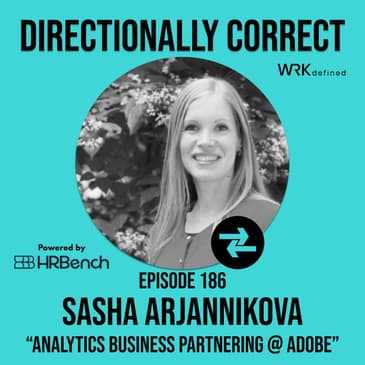
Check out this episode of the #1 people analytics podcast with special guest, Sasha Arjannikova, Director of Analytics Business Partnering at Adobe!
In this rich conversation with host Cole Napper on Directionally Correct, Sasha shares how to build a people analytics function that genuinely partners with the business, bringing insights back to leaders in ways that drive real decisions while earning trust as a data subject matter expert. She unpacks the delicate balance of deep analytical sophistication with business fluency, audience analysis, empathy, and change management so that complex findings land and spark action rather than gathering dust. Listeners hear how Sasha navigates living in both worlds—translating the unspoken needs and hypotheses of HR business partners and executives into clear asks for data science and research teams, then distilling rigorous outputs into the language the business already uses. The discussion explores her role at Adobe after the team restructured around domains of expertise, the energy of operating at the speed of the business, co-creating with savvy HR partners, and ensuring employee survey insights move from understanding to visible action in a data-focused, people-centered culture. Sasha reflects on her unconventional path from childhood cow herding (paid in the best fresh milk) and modeling that taught confidence yet revealed the gap between glamorous exteriors and daily reality, to studying communication as the flip side of I-O psychology and now writing a practical book that equips leaders with research-backed principles for evaluating and partnering with AI. She and Cole dig into the HR Strategy Forum’s AI collaboratory work with practitioners and academics like Alexis Fink and Alec Levenson, the urgent need for people-centered AI implementation so HR leads rather than lags, and the risks of over-automating junior roles that erode internal pipelines, institutional knowledge, and long-term organizational health. They examine the pendulum swings between pyramidal and diamond-shaped organizations, the existential challenge of data quality and ground truth across every field, evolving mental models for performance cycles and hierarchies in agile work, and the identity shifts facing the people analytics profession itself. Looking three years ahead, Sasha anticipates roles merging, faster answers through AI-native tools, and the critical importance of automating tasks that drain joy rather than those that energize, preserving human judgment, connection, and satisfaction. The episode also covers three thought-provoking articles: the surprising tolerance of attractiveness bias because people fail to notice it (with stark implications for AI image generation and coding of confidence or success), research showing a spouse’s conscientiousness predicts a partner’s job satisfaction, income, and promotions via practical support and reduced cognitive load, and provocative ideas from the Work Design Lab on how finance teams at Anthropic already use AI skills for forward-looking work while HR still largely remains stuck in backward-looking analysis—complete with caveats around data quality, testing, deterministic versus probabilistic outcomes, and architectural readiness. Throughout, the pair emphasize communication as a two-way street, slowing down with intention amid rapid change, measuring the real impact of analytics, and building credibility before offering predictions. Sasha invites practitioners to join upcoming HR Strategy Forum sessions and connects on LinkedIn under her distinctive name. This episode delivers practical wisdom for anyone seeking to make people analytics truly influence strategy, culture, and the future of work while staying grounded in the human element that technology amplifies but never replaces.
If you like this episode, you’d also love exploring prior episodes—visit colenapper.com for the full archive and show links.
Powered by the WRKdefined Podcast Network.
Sponsors
