
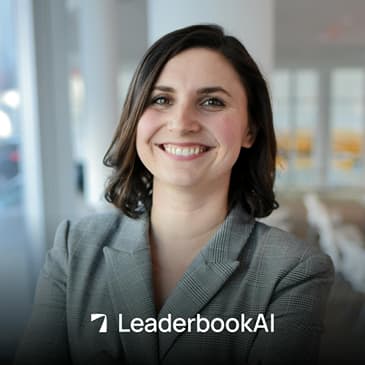
Backlight CEO Kathleen Barrett explains why customers can love your products while your business still struggles to scale. She shares how she focused an acquired portfolio, rebuilt sales quotas and financial visibility, and why leaders need to fix their operating foundations before layering on AI.
IN THIS CONVERSATION
- Why customer love isn’t the same as a scalable growth engine
- How to focus go-to-market investment across an acquired portfolio
- How to build trust when some products receive more investment than others
- Why leadership hiring requires both trust and a bias check
- The hidden cost of misaligned sales quotas
- Why AI-ready media workflows begin with organized content and trusted metadata
ABOUT THE GUEST
Kathleen Barrett is CEO of Backlight, a media technology company building products for media creation, management, distribution, and monetization.
Connect with Kathleen Barrett on LinkedIn
Explore more episodes: https://leaderbook.ai/podcast
Learn more about LeaderbookAI: https://leaderbook.ai/
Learn more about Backlight: https://www.backlight.co/
Powered by the WRKdefined Podcast Network.
[00:00:00] How do you sell into a market that's panic buying? How do you prove that AI wasn't a tack-on capability for Backlight? I think there was a panic buying phase we talked about previously, right, where first people were questioning if it was a thing and then it was, I have to buy AI tools. And that phase is actually clarifying once you cut through the noise because eventually the buyer does have to show an ROI.
[00:00:26] And when they do, that's really when they realize they bought an AI badge that maybe doesn't actually work. I'm Felicia Shakiba and this is Leaderbook AI, where we solve a business challenge in every episode. Fortune 100 customers run three-day off-sites about Backlight's products.
[00:00:50] The customer love was real. The go-to-market motion to scale it was not. Kathleen Barrett, CEO of Backlight, a PSG company, walks through the rebuild that turned five products in five countries with five tech stacks into a focused, scalable business, while AI rewrote her customers' industry around her. Kathleen, thank you so much for joining us today.
[00:01:18] Thank you for having me. Pleasure to be here. And just for context, what does Backlight do and what are the five businesses that you acquired? So Backlight is a global media technology company and we're focused on eliminating the friction in media workflows with simple AI powered products. And we have an integrated suite of solutions and that includes the five products we acquired. So we have Iconic, our media asset management solution.
[00:01:46] Wild Mocha, which is focused on live streaming and content clipping. Celtics is our screenwriting tool. F-Track is our media rich project management tool. And Zype, which offers video APIs, fast channels and monetization. And our mission is really we want to help every organization access, understand and activate their their media, unlocking its full value at scale. Wow. So, you know all about film. I assume so.
[00:02:15] I know about a lot of different types of media types. Yes, lots of video, film, commercials, marketing. These days, everybody is using media, I think, to communicate. So it really spans the gamut. It's really fun, actually. I think it's a really fun industry because I was working with WPP and had all sorts of advertising mediums. And it's just a fun, fun place to be. So exciting work that you're doing. Yeah, exciting work, exciting customers. It's really fun. Yeah.
[00:02:44] And so you inherited five products, five countries, five tech stacks. Walk me through the first 30 days. What were the questions that you asked? Who did you speak to? And what did you hear? So I joined about two years after the formation of Backlight when all those assets were acquired. So I had the benefit of folks that had been around for a little while after bringing everything together.
[00:03:12] So really, the first thing I did was listen. And we had media companies, like you mentioned, running three day strategy sessions, just talking about how they were using our product and how other teams could use it more deeply. And so that really told me the product had real value and we didn't have a product challenge at hand. And what I heard internally was a little bit different. You know, people were working very hard, but without clarity. Five products, five countries, five different tech stacks and really no shared understanding of what we were actually trying to win.
[00:03:42] We didn't have goals and quotas tied to specific products. Marketing wasn't really perfectly coordinated across the portfolio. And our finance team didn't have the visibility they needed to make good investment decisions either. The company had been built through acquisition, but the integration work, that kind of unglamorous connective tissue of building one business just hadn't happened yet. My first questions were really simple. Who's our customer? What do they buy from us? Why do they buy it? Where do they come from? Where's the growth coming from?
[00:04:11] And what does it take to do more of that? So taking the time over the first 30 to 60 days to get the answers to those questions right really shaped everything that came after that. Got it. One of the things that you obviously did really well and most people know is that you learn before you do coming in and that really sets you up for success. I think a lot of times I've seen executives not do that.
[00:04:37] They come in and they feel like they know what they need to do and they know what needs to be done and they come from a great background of, you know, working with so and so. I think that can be a recipe for failure. But the fact that you had those questions before you acted, I think is really important. And I want to get more into that. You have Fortune 100 customers running three day off sites just to talk about your product. Yeah, I love it. Yeah, I know. I know. Right.
[00:05:07] That is good. That's a good thing. How do you have that level of customer love and still not have a working go to market motion? How do you how do you navigate that? And I really think of it as like a scaled go to market motion. Right. I think it's quite a common failure in software businesses that are built through acquisition. You buy like really great products. They have genuine fans.
[00:05:34] But the go to market infrastructure that lets you scale them, which are, you know, sales playbooks, enablement, demand generation and even forecasting. That doesn't often come along with the acquisition of products at the scale. So you inherit the love, but not an engine that is quite scalable. And so in our case, we had every product had its own sales team when it was acquired, its own pitch, its own go to market motion. And there wasn't a unified backlight story.
[00:06:01] So our sales reps were trying to sell things they didn't really fully understand to buyers who were asking for a coherent platform narrative and wanted to know that the products that they had loved prior to were going to be safe in this new world. So when you can't tell that coherent story, I think you really only win the deals where customers already know what they want. And that's fine. And it does work for a while, but it's just not true scale. So the customer love was real and it was hard one.
[00:06:27] These sophisticated buyers, they don't just stay loyal out of habit and the love doesn't scale itself. So at some point you have to build the motion that lets more customers find you, understand what you're offering and buys from you simply without heroic effort on anyone's part. So that was really the work we focused on honing in on in my first couple of years here. Yeah, I've seen that time and time again where unification of multiple entities is really the key to both efficiency, the story, the customer experience.
[00:06:57] Right. And so so let's talk about that because you narrowed focus from five products down to I think it was two. Walk me through how you decided which ones got pulled, which ones got merged or became the front runner. Yeah, so we still have all five products, but really the work was around just the thinking about where we invest, how we invest and how we drive our growth. Wasn't quite as clean as, you know, pulled out a front runner.
[00:07:26] There's a lot of decisions to be made across the board and it was really a portfolio discipline exercise. So the first question was, where's the growth actually coming from? And when you looked at the data, Iconic was growing at over 50 percent year over year, even though it had started as one of the smallest businesses in the portfolio. So that was a really strong answer right there. And we decided to build around what was working and had the biggest market opportunity.
[00:07:51] Iconic also serves brands and media teams as effectively and so really has a very large addressable market. Then we looked at that user and that workflow and Wild Mocha was a very natural complement. It solves both the live side of the media workflow, but also the activation layer while Iconic manages kind of archive and an intelligence layer. So together they tell a complete story from ingest through publish. The customers we were meeting with were really asking for that friction to be solved.
[00:08:21] So there was a really nice kind of overlap between our views and the customer ask. So that became our two product go to market focus. And when I say focus, it's really where our sales team leads, where we prioritize, where we market and really how we talk about Backlight as a whole. We had other products that are still part of the portfolio. An example is F-Track. It's a profitable product. It's a devoted user base, but it serves a very focused market.
[00:08:48] So for the time being, we just opted not to try to expand beyond that focused market and have it focused on the bread and butter. And then for Celtics and Zype, we saw more value in focused leadership and independent operating models to keep Backlight's focus steady on that long-term vision around Iconic as the heart of that strategy. I think the hardest part was not, you know, the strategic logic, but there's also a human reality piece to that. So every product team has, every product has a team that believes in it, behind it.
[00:09:18] And telling people that we might not make that the top priority for the year or the next two years while still asking them to show up every day requires you to be super direct about why and honest about what it means for them. So we're very transparent about how and why we make those decisions and what we expect from each product for growth and profitability. And then what that means for how and how much we invest in each of those products and directions. Got it. Okay. So I heard multiple data points you had.
[00:09:47] Speaking to the customer, the qualitative data, you had future opportunity, like where is the market growing? You had previous growth and growth history, you know, year over year growth. And then the human aspect of it was kind of a factor in how you perform that. Can you tell me more about maybe like what were some of those challenges that you bumped into? I think you want everyone bought into the company strategy as a whole.
[00:10:15] And that means understanding both what it means for them day to day, but also where you're trying to go across the organization. I think another interesting challenge, especially when you're bringing this many products together, is if we want to go really hard after a specific market, we need a lot of our team focused in that direction. But they came from different backgrounds. So how do you enable them all to be equally as successful in the focused direction?
[00:10:38] So there was a lot of investment in training and clarity and really solidifying a focused mission and making sure our team had the tools to put themselves in a position to be successful in this new reality that maybe wasn't what they originally signed up for, right? They may have been really passionate about a different part of the market or a different customer.
[00:11:00] So I think being clear about where you're trying to go and what we're trying to accomplish and then honest about what we need to provide as leaders for the teams to make sure that they're in a position to be successful in that new focused world. So give me an example. I can imagine some of our listeners are like, well, we know that we need to do it, but how do we do that, right? How do we get people on board with the new story of what we're trying to accomplish? And then what do we do?
[00:11:28] Cross our fingers and hope that they learn the new path. You know, how does that get done operationally? I mean, I think for us operationally, that means bringing the team together in many forms. So we bring our whole organization together and we tell them exactly what happened last year. How do we perform financially? What customers are coming to us? What customers are staying?
[00:11:52] So kind of walking them through that decision-making path that we went on and then sharing that with them so that they have the same level of context. Then we do a really amazing job, I think, at bringing our go-to-market teams together every year and clarifying where we're going, what we're saying, and how we're going to enable them as well. And making it clear that that's what's going to drive us hating our financial plans too.
[00:12:17] So they can have a deep understanding of the why and then they can be on board for, great, this is exciting because this is how we're going to drive our growth. I think it takes time and a lot of repetition as well. Lots of sales enablement sessions. Some are formal and some are informal. We even have teams that are deep experts and iconic that just host an hourly, weekly where anybody can come with questions.
[00:12:42] And then at the same time, we have super structured training for our salespeople to be the best at sales and also to be enabled in how we position our products and where we're focused on positioning our products. So I think there's formal, there's informal, but really it's a lot of trust gained by doing what you say you're going to do, being clear about why we're doing what we're doing, and then coming back and reporting on how that went and how that informs future decisions.
[00:13:08] And showing people that there is some, you know, there's a team here supporting them and investing in them and listening to them. Ultimately, over time, buys a lot of trust. But without trust, I think it's really difficult. Yeah, I think you hit it absolutely on the target, which is the transparency that you provide. The ability to say here is how we got to that decision is really what's going to breed that trust. And I think that that was just the key that unlocked the future.
[00:13:37] So bravo, kudos to you to getting that done and understanding that that was needed to be done. Because I think that's a step that a lot of leaders will miss sometimes. It's like, here's what our operating company has asked us to do. This is what we're doing. This is what we have to do. And go do it. But skipping the step of like, hey, everyone, let's come together. Let's truly understand the why behind it, how we made the decision was, I think, just super key.
[00:14:03] Which leads me to the next question, because you brought in your former CRO from a previous business. Instead of running a search, why was that existing trust more valuable than the optionally of a fresh hire? I think at the time that I brought in Josh, who's my partner there, I didn't need optionality. I really needed speed.
[00:14:28] And when you're rebuilding a go-to-market motion, which was our top priority, the first six months of that matter enormously. A search takes, you know, three to four months. Onboarding takes another three. And so by the time a new hire is operating at full capacity, you're already at almost a year. And so for us, someone I'd worked with before knows how I think as well, right? And they know how I escalate, how I make trade-offs, where I'm going to push, where I might give ground.
[00:14:53] And that's not a small thing when you're trying to move really, really quickly and the stakes are high and there's a lot of complexity. So we didn't need to spend months calibrating to each other. We could just get right to the work, which was a huge advantage for us. But at the same time, I do always run a search process in parallel to challenge my own bias. But after 12 months in the business, I knew exactly what the role required. And if I had gone fully to market, I would have been looking for someone with Josh's profile anyway.
[00:15:23] Someone that knew how to build an operational engine, but also understood a complex kind of high-touch sales motion as well, which is pretty unique. And I think the other thing people underestimate is the cultural signal of that. So I had brought a couple of other folks in that I vouched for that had proven to be incredible fits and incredibly valuable. And so when I brought someone in, I trusted and vouched for it. It told the team something about the standards I was setting and that I was serious about bringing this person in.
[00:15:52] So it was me betting on a track record and I had direct evidence for that. So that also helped with kind of the team buy-in on that front. You know, it's so interesting is that I had a couple of guys on the show. They were, I want to say they were co-CEOs, but don't quote me. They were serial entrepreneurs. They were on like their third company. And we talked about one of their, you know, reasons for multiple successes,
[00:16:20] which is basically around bringing on team members that surrounded them with the same culture, the same know-how people that they knew, that they liked working with, the network that they had, that they literally brought from one company to the next. And I, and it's something obviously that I am thinking about because it's something you did. And I just wonder how big of a factor does that contribute to the success of a business, right?
[00:16:47] I mean, not that a new CEO or new leader can't bring in fresh people, but I, yeah, go ahead. Go ahead. I know you want to say. I think I have lots of views on this. When I first became a CEO, actually at a different organization, the person that put me in charge said the only question he had for me is who am I going to bring in, right? And it's because at a certain leadership level, I think your understanding of talent, your ability to recruit and your bench are very, very powerful. That being said, I also think there are people in my network that are not a good fit for this
[00:17:17] organization. And so just because we do have a track record or they're talented doesn't mean this is the right place for them. And so it does have to be approached with that lens. But I think having people that have been in the trenches with you and have gone through the really hard stuff, it buys you a lot of kind of runway to navigate a lot more together. And so I think it's very powerful. I think it also, you have to be quite thoughtful about it.
[00:17:42] I think there are lots of mistakes people make just bringing in their network or bringing, like you were saying, somebody in with a playbook. And you have to be very, very intentional about bringing people in that will fit that environment and that problem set. And hopefully you have people in your network that do that and also bring the skills you need. And that can be a really powerful combination. Yeah. So you came in, you assess the situation, you tell people how you make those decisions,
[00:18:11] you bring in your team to support. And now you're walking into the board and said that you wanted to rebuild your go-to-market from scratch. What did you have to prove to them first? Was it quick wins? Did you go straight to showcasing what was broken? Like, how did you convince them that this was the plan? I didn't really walk in with quick wins at first, right? I walked in with a diagnosis.
[00:18:37] So the board had been seeing the symptoms for a while, which looked like missed forecasts or pipeline that didn't convert or weak attainment numbers that were all over the place. But what they hadn't seen was a really clean-eyed picture of why those things were happening. So my first job was to show them I understood the actual problem, not just the output metrics, and deeply understood what was working and what was not working.
[00:19:00] So we rebuilt our financial model from the ground up, really kind of inputs-based model, based in reality, zero-based budgeting, and product-level P&Ls. So we had clear visibility into where our growth was coming from and where it was leaking and opportunities for us to either double down or fix things that were broken. So that's not as glamorous as coming in with a really shiny plan, but it really was the foundation for everything else.
[00:19:29] And once the board trusted those numbers, they trusted the plan. So we did a lot of deep dives into why we understood what was happening and shared that with them. And then the quick wins really came later, and those really mattered as well, right, for track records. So we were able to improve our forecasting accuracy to 95% for three consecutive quarters, right? And suddenly, with that sort of track record, the board is listening to you and they really trust you.
[00:19:56] We were able to take attainment from, I think it was less than 40% to over 80% for most of our reps. But those things were proof not how we persuaded. The persuasion really came from that clarity of analysis and the diagnosis. And then we've continued to just kind of show up with a track record of, this was the plan. This is what we're measuring. This is how it went. And again, that transparency and clarity, I think, continues to serve us well.
[00:20:22] I love the diagnosis piece that you come in and you say, here's not just what is broken, but here's why it's broken. That, I think, is the absolute place to start. A lot of times you see leaders, like I said before, where they come in and they say, oh, we know what the problem is. And this is the plan. We've done this before. But having a true deep dive, having the evidence to share, here's why.
[00:20:51] We do that a lot at Leaderbook AI. And sometimes it's shocking. The reaction in the room. Very surprised, right? It's easy to say, oh, it's the people. Change all the people or something like that. And you can find some really interesting things to dig into. And it unveils, I think, opportunities that you might have missed just running a playbook, for sure. What was something that the board, was the board surprised about anything that you brought into the room? It's a great question.
[00:21:20] I think they were just really excited that we were able to get to the level of clarity, which is, which can be hard too. So I think they had been asking a lot of questions for a long time. And there was just excitement around having some answers and having some perspective. So I think they were surprised to finally see some deep dives and cuts that they had maybe been previously told were too difficult to attain, which goes back to, you know, kind of the steps on the operational side of things to make sure you have the foundation you need to be able to get that clarity and then make those decisions and operate.
[00:21:50] How long do you estimate it took for you to get the full diagnosis? Oh, I mean, you're always learning new things. We're still learning things, right? I think there was some high-level opportunities. One was really just like building that operational engine, which was new for most of the organization. And then that clarity, those things were very obvious up front. But building that takes longer, obviously. Yeah.
[00:22:18] But to this day, we're still running, you know, analysis around which industries are behaving in a certain way in a certain MCV group. And so I think you can do endless analysis. The most important thing is... Maybe I asked the question wrong. How long did it take to get to an initial evidential diagnosis? I presented within 90 days. So I had given a very clear path for how I was going to run my first 90 days and came
[00:22:46] with a perspective and then refined it every quarter, obviously. But I think initial direction to get people moving within 90 days. Yeah. As you should be iterating, right? I mean, totally fair. Before you arrived, you said quotas weren't tied to specific products. What was the actual cost of that misalignment? Or how might you calculate it, like in theory? Yeah.
[00:23:12] So I think there's like quotas and then there's how you believe you're going to hit your financial goals. And those were very tied and were not specific enough for me to be comfortable operating. And so that's a lot of the work we did. I think some of the costs, you know, the most direct cost is definitely deal quality. So when a rep can sell anything to hit their quota, they will sell whatever closes fastest. And that usually means smaller deals or the easier deal or whatever problem or product the customer already knows.
[00:23:41] And so that keeps attainment numbers alive in the short term. But the company can kind of go adrift while that's happening. And the strategic products might not get the sales attention they need in that scenario. The second is forecasting. So if you don't know where you think your dollars are going to come from, and if you don't know where a rep is focused, whether that's a specific product or a new or an expansion dollar, you really can't model your pipeline by product.
[00:24:07] And that means you can't make good investment decisions about where to hire or where to market. You're really lying quite blind. And I think the third is the rep themselves. You know, when everything is in play, nothing's a priority. And reps who aren't clear on what they're supposed to sell will spend their energy on what feels comfortable and not necessarily on what the company needs to do. Needs them to do or on too many things, right? Which we all know distraction can be really expensive.
[00:24:35] So that's a management fail, not a sales failure, but the reps end up bearing the consequence of that. So when we were clear about how we were going to hit our numbers and how our teams would be incentivized and providing that specific enablement, our attainment improved almost immediately. And not just because we hired different people. It was because we gave the people we had a very clear job to do. And that focus is just incredibly valuable. Yeah. Yeah.
[00:25:03] I couldn't agree with you more because I feel like sometimes a lot of people, they throw money at problems. They throw tools at problems. They throw AI at problems. Yes. When really, when really clarity, like it's so much noise. It's so much noise everywhere. Right. And it's not fair. It's not fair to ask people to kind of wade through that noise alone. I think it's a misconception that everybody should be able to do that effectively.
[00:25:33] But I also think, and I want to challenge this thought, so keep me honest here. But I think because we have AI, the question is, do we spend or initiate that the job of the individual is to now figure out what should be priority? Right. Because we can, like as an individual, let's say I'm working for so-and-so and then they're asking me to do a hundred things.
[00:26:03] Like I have AI, I have tools, I have resources to say, hey, this is everything that my boss wants me to do. These are my goals. Like, how should I prioritize? And then be able to like push back and say, this is where I think that I should be. Like, does that get flipped? That would be amazing if AI was right about where everyone should focus all the time. I think, look, I think it's a great tool for, and a thought partner. I still would want, and I'm always open to my team coming back and saying they should
[00:26:32] focus somewhere else and bringing evidence around why that's true and why we should believe that. So if AI can help them think creatively and come up with an idea I didn't, that's like, I'm all ears. Hallelujah. Right? Yes. I don't, I think, you know, the interesting thing about AI is something we think about solving too, is like the context really matters. So it is true. If we can provide a lot of context across the organization and the context of the job and the context of the market, AI can be a very valuable thought partner.
[00:27:02] But I think that the human element is still incredibly critical. Yeah. Same. Same. I agree. One other thought that I had, which is, I think, really relevant to where we're at with AI, which is how do you sell into a market that's panic buying? How do you prove that AI was an attack on capability for Backlight? Yeah. Yeah. It's a huge question in our market for sure. I think there was a panic buying phase we talked about previously, right?
[00:27:32] Where everyone, first people were questioning if it was a thing and then it was, I have to buy AI tools. And that's, that phase is actually clarifying once you cut through the noise because eventually the buyer does have to show an ROI. And when they do, that's really when they realize they bought an AI badge that maybe doesn't actually work because from our perspective, often it was layered on top of disconnected, messy media infrastructure.
[00:27:59] And like we were just talking about AI needs organized content and trusted metadata and connected workflows, at least in our world. And that's exactly where we solve problems, right? That's what our media management system, Iconic, does with the guidance of a dedicated team. So we really focused on that foundation and believed that without that foundation, AI creates noise instead of value. So our point of view has been that. And we've been very intentional about how we leverage AI. And AI really works when humans and your media work together.
[00:28:28] And so we, you know, it was tricky to not have that feel defensive. It's not a defensive statement, but it's the most important thing we can tell our buyers is don't layer AI on top of chaos and build the foundation first. So we're fortunate to be providing that sort of solution. But then we really focused on customer outcomes, right? So when a pro sports team can migrate years of their archival footage into tiered storage and a podcast studio can consolidate three tools into one, or a broadcast team can clip,
[00:28:57] reformat, and publish a live sports moment across hundreds of channels in minutes instead of hours, that impact and those real business use cases, we let those stories do the work. And we really focused on only putting AI to work and in the product when it could really support those outcomes as opposed to, you know, throwing the button in, which I think a lot of folks were focused on in the beginning. Yeah, 100%.
[00:29:21] Okay, so two years in, what's the metric that tells you that the transformation worked? For our business? Yes. Yeah. For us, it is, we have continued to be able to forecast a growth rate that we have operationalized and then we hit on an ongoing basis. So we're very forecast focused, not because it's like a nice vanity metric, but because if you know where the growth is going to come from, you can make very intentional investments
[00:29:50] and then you can see the outcome of that growth. And so by signing up for a certain growth rate and putting a plan in place and seeing ourselves at least come really close there, I think that that speaks volumes for where we were and where we are now. Yeah, I love that. I love those metrics that you've shared and I think for sure you're the one to tell us. So thank you so, so much. This was really great, Kathleen. Thank you.
[00:30:18] Visit us at leaderbook.ai. Your support as a subscriber means the world to us. So thank you for tuning in. I'm Felicia Shakiba. Let's connect on LinkedIn.
Sponsors
