
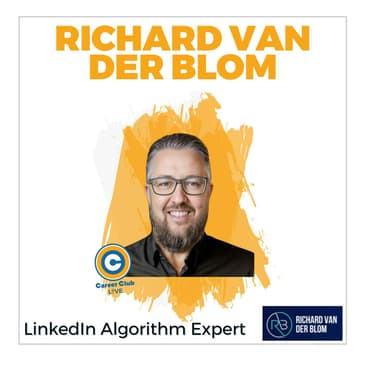
Unlocking LinkedIn's Secrets: A Deep Dive with Richard van der Blom
In this enlightening episode of the Career Club Podcast, host Bob Goodwin welcomes Richard van der Blom, the renowned LinkedIn algorithm guru, for a conversation that promises to transform your LinkedIn strategy. Whether you're actively job hunting or seeking to elevate your professional brand, Richard demystifies the often perplexing world of LinkedIn's algorithm, offering actionable insights and data-driven advice.
Discover the intricacies of LinkedIn's content distribution mechanisms, learn how to boost your visibility, and understand what truly engages your network. Richard's expertise, derived from years of meticulous research and analysis, equips job seekers with the tools they need to navigate LinkedIn's digital landscape effectively. Tune in to bridge the gap between you and your next career opportunity by leveraging the full potential of LinkedIn.
Powered by the WRKdefined Podcast Network.
[00:00:00] I know you're gonna find it, you gotta keep on at it
[00:00:11] Welcome everybody to another episode of Career Club Live. I'm Bob Goodwin your host and the president of Career Club
[00:00:17] Thank you so much for taking a few minutes out of your day to either watch us on YouTube or on your favorite podcast platform
[00:00:23] Before we get started I want to let folks know about a couple of free resources for you
[00:00:28] If you are a job seeker we are now offering free coaching every Thursday at 1 o'clock Eastern time
[00:00:35] There's no fee, there's no selling, it's just the opportunity for you to get some high quality career coaching
[00:00:41] and ask your questions in a Q&A format so go to Career.club and you'll see the banner to register for that
[00:00:48] If you are an HR professional and in particular in talent acquisition
[00:00:52] We are now offering free resources for you to incorporate into your rejection or disposition letters
[00:00:58] So a great way to improve the candidate experience while also building your employer brand
[00:01:04] So again Career.club and just go to the resources for employers under candidate experience
[00:01:11] With that I'm ready to get the episode started
[00:01:14] Before I bring him on screen I want to introduce our guest today
[00:01:17] You may already know him from LinkedIn his name is Richard Vanderblom
[00:01:21] and I'm just going to read this because he's got a very impressive background
[00:01:25] So we're going to dive into insights on LinkedIn today Richard is just an acknowledged LinkedIn expert
[00:01:31] He is the person behind the algorithm report, the LinkedIn algorithm report
[00:01:36] We all know that feels like a crazy black box and he's going to shed some light on what really drives it
[00:01:41] His expertise has transformed the way professionals and companies leverage LinkedIn
[00:01:46] Offering strategies that significantly enhance online presence and engagement
[00:01:50] With the foundation in social selling and digital branding his approach transcends basic profile optimization
[00:01:57] So I really want you guys to hear this
[00:01:59] Focusing instead on impactful storytelling and strategic networking
[00:02:04] As the mind behind just connecting he's educated over 250,000 professionals
[00:02:09] And served more than 850 companies globally making them a pivotal figure for anyone looking to unlock the potential of LinkedIn
[00:02:16] So with that let me welcome Richard
[00:02:20] Richard how are you doing today my friend
[00:02:22] Well after such an introduction I'm doing very well
[00:02:25] Absolutely and I'm only telling the truth here so it's awesome to have you thank you so much
[00:02:31] It's really a privilege to have you
[00:02:33] You're welcome I'm looking forward to it
[00:02:36] Awesome where do we find you today
[00:02:38] Where are you
[00:02:40] I'm based in Valencia in the beautiful Spain so I don't have a Spanish surname
[00:02:47] I'm Dutch but I decided to change the grey rainy skies of Holland back in 2018
[00:02:54] For the sunny blue skies of Valencia at the Mediterranean coast
[00:02:59] Awesome how's your Castilian Lisp coming along
[00:03:02] Valencia
[00:03:03] No my Castilian Lisp is very bad but I'm getting pretty good in the Valencian local language
[00:03:12] Ah okay do you have a favorite slang word you've picked up that's repeatable in public
[00:03:22] Macca and Neil but that's not a very nice thing to say
[00:03:24] That's if something goes wrong then that's how people say like
[00:03:29] Enough said I get it
[00:03:32] Very quick do you mind just painting a little bit of a picture of your career Richard and kind of how you got here
[00:03:40] I think that'd be helpful to kind of set the table for your background
[00:03:44] Of course yeah of course so
[00:03:48] After when it came to the point in Holland you have you're around 17, 16, 17 you need to choose which university you're going to follow
[00:03:59] I had no idea okay so and I had a few friends there I played football with them on the same team and they went to study economics
[00:04:07] So basically that was where I was going I'm going to study economics
[00:04:11] And then the first year of my study economics I know I'm not really a number guy I don't like a lot of bookkeeping
[00:04:20] So I went for commercial economics okay so people always see me as a smooth talker
[00:04:25] So I went okay let's go for sales so I studied commercial economics
[00:04:29] I started to work at a Deco a well-known staffing company I think they're globally active
[00:04:35] I worked there for six years when I was actually actively had hunted by another staffing company Ransstat
[00:04:44] Also one of the biggest names in the world
[00:04:48] I moved there for two years and then I decided that I wanted to leave the staffing industry
[00:04:53] And at that moment I applied for a job with a Dutch training institute
[00:05:01] And they didn't had a sales department yet so they had about 200 trainers but each trainer was themselves responsible for bringing in leads
[00:05:11] And it wasn't working that way so they invited me to set up a sales and later on a marketing team
[00:05:17] So that's what I did for about two years and while being active in a training company
[00:05:24] I thought wow I don't want to be the guy that sells the training I want to be the guy that does the training
[00:05:29] Okay so that's where I started I'm now in 2009 I started thinking okay how can I combine my knowledge for sales
[00:05:38] How to position yourselves how to get like at the table of your potential client or maybe even your potential employer
[00:05:46] Because that's what I'm good at how can I transfer that knowledge
[00:05:50] And then just at that moment LinkedIn started to rise at least in Holland 2009 2010
[00:05:56] And I saw the potential of LinkedIn being that vehicle that brings you via your profile to the table or where you actually want to be
[00:06:05] So I started December 2009 with my first LinkedIn training and I was actually
[00:06:13] When we registered a company we were the third company in Europe that was 100% focused on LinkedIn
[00:06:20] So that was already like end of 2009
[00:06:23] Wow
[00:06:24] And actually that's from that moment on it's been a journey of entrepreneurship
[00:06:29] It's been a journey with heavy bumps going through some economical recessions
[00:06:35] But it has also been a journey that has brought me to meet a lot of wonderful amazing people
[00:06:42] I mean I traveled the world to be on stage talking about actually my well almost my hobby you know my expertise
[00:06:51] So ever since 2009 I have been active in delivering training coaching consultancy when it comes to LinkedIn
[00:06:59] That's awesome so that's what we're going to talk about today
[00:07:02] I think so you and I met via Sarah Johnston who is a LinkedIn top voice here in the US
[00:07:12] Like me she works a lot with people in job transition
[00:07:17] And in fact I just spoke with her this morning and gave her props for introducing us
[00:07:23] But you know there's a lot of emphasis
[00:07:30] I really kind of want to go in two directions with this
[00:07:33] One is the effective use of LinkedIn
[00:07:36] And again just being very transparent with listeners I engage you to help me with my LinkedIn profile
[00:07:42] I think I know a little bit about LinkedIn and I don't know everything
[00:07:46] So I went to the guy that knows about it Sarah introduced me via your algorithm your annual algorithm report
[00:07:52] Do you mind just explaining that because that drives a lot of what we're going to talk about
[00:07:55] So people understand we have a common understanding
[00:07:58] What is the algorithm report you guys have produced
[00:08:02] So basically a lot of people all LinkedIn actually on every social network
[00:08:09] But also a lot of companies put a lot of effort in creating content
[00:08:13] They want to be heard they want to put their voice out they want to share their expertise
[00:08:18] But many of them struggle in getting a substantial reach or even reaching their target audience with their content
[00:08:26] And sometimes it's the quality of the content that is not good
[00:08:31] But we've also seen a lot of well written content that would not drive a lot of traffic
[00:08:39] Because the algorithm would not pick up on it or the algorithm would push it away
[00:08:45] So we got more and more questions actually from our clients about how does this work
[00:08:50] How does this black bog of the algorithm work
[00:08:52] What do we need to do to increase visibility? What are the dos and don'ts?
[00:08:57] And why do some posts fly and other ones like really don't take off like literally no reach
[00:09:05] And we always answer those questions based on intuition or own experience
[00:09:11] But a lot of people they wanted to have like more the evidence-based background stats facts
[00:09:18] And that's actually back in 2018 when we started to do research into the algorithm for the first time
[00:09:25] Basically to answer the question that we got from our network
[00:09:29] And so what do you guys just I don't get super deep in the methodology
[00:09:33] But just so people understand you guys look at tens of thousands of posts
[00:09:37] And try and understand what's driving
[00:09:39] Well it has evolved
[00:09:43] So the first report we have published this February for the fifth consecutive year
[00:09:49] But the first report was a nine page report where we did I think 3,000 posts which we analyzed manually
[00:09:56] Just by simply taking print screens every 15 seconds and looking at the numbers
[00:10:03] And this year we managed to collaborate with Autoredop which is a LinkedIn creator tool
[00:10:12] They have literally 10,000 of users and they partner with us
[00:10:18] Which means we could literally had the data of 1.5 million posts
[00:10:22] And since all these posts are published via their platform
[00:10:26] It's very easy to make an analysis for example of how many hashtags, how many tags
[00:10:32] What is the best type of content? Is it a video post? Is it a text post?
[00:10:37] So this year was really I mean last year we had 43, 44 pages and this year we have a 123 page
[00:10:46] It's almost like a book about the LinkedIn algorithm
[00:10:48] Oh my gosh
[00:10:49] Wow
[00:10:50] Yeah, yeah one
[00:10:51] And you know what's driving the algorithm is dynamic
[00:10:57] It said what the answer was in 2021 or 2022 would not be what the answer is in 2024 right?
[00:11:03] No definitely no no it's changing and I also dare to say that it is changing more rapidly than ever
[00:11:12] Also because LinkedIn is currently like bringing a lot of new features to the platform
[00:11:16] And every new feature to the platform impacts the algorithm
[00:11:19] Impacts how we consume content, how we publish content, how we create content
[00:11:24] And let me be very clear about how people should look at the algorithm report
[00:11:32] I mean it's not a Bible, it's not something that tells you what to do, what not to do
[00:11:36] It gives you an insight so you may have a better understanding why some of your efforts fail
[00:11:44] And why some of your efforts fly so it's more or less to find confirmation or find the reasons
[00:11:52] And to optimize your strategy for example I get so many questions lately from even big content creator
[00:12:00] Say hey Richard my reach is down, it's like really down like 50%, 60% is it me?
[00:12:06] Well if you look at the algorithm report no it's not you because 95% of all people have a 40% like downfall and reach
[00:12:13] It's not you and that type of confirmation and insight that's actually the goal behind the algorithm report
[00:12:19] And again it's really, I come from syndicated data so having norms and benchmarks and some diagnostics
[00:12:28] Like you say it's not a Bible but it's a well researched quantitative data set to look at to say to your exact point
[00:12:38] Oh it's not me, this is the category is going down not just my brand as an example
[00:12:46] So I think it's super cool I'm just very grateful that I found you
[00:12:51] First thing I'll just ask listeners to do and we'll put this in the show notes and even at the end of the YouTube video
[00:12:58] Is a link to get the algorithm report
[00:13:01] The second thing that I've encouraged people to do immediately is follow you
[00:13:07] You're putting out a tremendous amount of rich, rich content that if you did a compendium of just every post Richard did in the past year
[00:13:16] Would be a LinkedIn how to book so again just something that people can do right now
[00:13:23] I want to kind of go at this from sort of two angles Richard and you guide me here a little bit
[00:13:28] But I'm thinking about as you know Career Club we work a lot with job seekers
[00:13:34] They're not experts in LinkedIn at all right and the second thing they tend to not be experts in is personal branding
[00:13:43] And then the third thing they tend to not be experts in is networking and yet LinkedIn is all these things
[00:13:50] Right and so this is not a you know how-to webinar you know with a bunch of slides and stuff
[00:13:56] But just you know if you can kind of start leading the conversation a little bit about
[00:14:01] Yeah, I will
[00:14:02] I will help people how people can most effectively be using LinkedIn you know in most use case of a job search but I'll let you I'll let you run with that
[00:14:12] So
[00:14:14] I think the maybe the most important takeaway
[00:14:19] From this whole episode is going to be
[00:14:22] Never stop doing LinkedIn once you land your new job because that's basically what people do
[00:14:29] Like I think 96% of all the people they start to use LinkedIn more intensively if they need a new job
[00:14:36] Okay, they're going to optimize their profile. They're going to be more active
[00:14:40] Once they land a new job they go back like in rest mode like okay, I have a new job like job done
[00:14:45] What you see again fact-based is that people who have a consistent way of being active on LinkedIn
[00:14:54] I mean updating your profile putting out valuable content actively networking people who do that have
[00:15:02] 16 times more chance to be found by recruiters or people who are looking for new talent because basically
[00:15:12] LinkedIn rewards your efforts. Okay, they see that you spend time on their platform in return
[00:15:20] They make your profile more easy to find and topping like the search ranks getting a higher place. Okay, so
[00:15:27] And I ceiling then I'm going to be very honest. I mean I have Facebook
[00:15:32] I have 200 friends people that I know I I used to I used to use acts
[00:15:38] I don't have Instagram. I don't have dick talk or whatever. I'm really LinkedIn guy
[00:15:44] But for me, LinkedIn is not a social network. It's your digital identity in what I call the grown-up world
[00:15:50] Okay, BDW world or at least but it is I mean
[00:15:54] If you apply probably people are going to Google you like resumes people are going to Google you
[00:16:01] What can we find on the internet? Okay, and the first link in 96% of all cases is LinkedIn
[00:16:06] So to think for example that you can pimp your career your resume and you can make it all shiny and all like address to the vacancy
[00:16:16] But your LinkedIn profile is like ghost town. It's a mealy turn off. It's like really like it's I
[00:16:23] Sometimes use the metaphor for better on tinder like you have this shiny great picture of yourself
[00:16:29] And then you have your first date and you know, you are like unshaved you don't anything like the picture
[00:16:34] But that but that's really what happens between resumes and LinkedIn profiles in a lot of cases
[00:16:41] So be aware that your LinkedIn profile. It's out at 24 seven. It needs to be update
[00:16:47] It needs to breathe your expertise your knowledge and it needs to be active. That's that's the most important point
[00:16:54] Okay
[00:16:56] And then I also think that
[00:16:59] I mean we really live in a network society and you mentioned that a lot of people are not good at networking
[00:17:05] But I think that has to do
[00:17:07] Because they think networking is like almost like rocket science. Okay, like I need to go to this arranged events
[00:17:15] I need to have the certain strength. It's not I mean I network
[00:17:19] When I go to my football club because I have the chitchats with my teammates
[00:17:23] Okay, what are you working on which project? Interesting. I know a guy that does with bomb I network even when I'm on
[00:17:30] Birthday parties I network when I'm go out. I mean every day there are so many opportunities
[00:17:37] Even if you're online to pay your groceries, it's a network opportunity just by chatting to people
[00:17:42] And I think that's something that people need to get across that it's very easy to just start composition also LinkedIn
[00:17:49] I'm gonna marry two ideas at the risk of interrupting for half of a second is
[00:17:54] The point that you made about people basically abandoning their LinkedIn profile once they've landed their new role guess what else they stop doing
[00:18:02] networking and
[00:18:03] Yeah, yeah, right. Well, I don't need you anymore because I got what I was looking for and I'm done
[00:18:09] The other thing like you said like you're networking all the time and I know for a lot of my less sales oriented friends out there
[00:18:18] That sounds gross like, you know networking because there's this misperception that networking is manipulative
[00:18:26] Like I'm trying to use you and I wish we could just rebrand networking as relationship building friend building
[00:18:33] That's all you know like if you're at your football club or you're at the birthday party or whatever like you're just being
[00:18:41] A human being building relationships that well, what are you working on? That's interesting, you know and you hey maybe I could help you
[00:18:48] Richard, what are you working on working on this? Hey, I know somebody that might be
[00:18:52] That's called a relationship and they think it's just over scientific or it's just some other category of conversation
[00:19:00] When you're just sharing information and being genuinely curious about another person
[00:19:06] Well, we all know, you know the basics of networking or relationship building is sometimes you are in a stage
[00:19:14] Where you need to ask more than you can give and sometimes you're in a stage where you have simply more to give
[00:19:20] So if you just landed your new job as I don't know a sales director
[00:19:24] You have a lot to give you can share your experience. Maybe you have some jobs that you know
[00:19:28] And the more people you are willing to help with like very simple gestures, okay? Like to give them a name to give them a tip
[00:19:37] To give them feedback on what they're doing but the more people you are willing to help in a stage where you have more to give
[00:19:44] Once you need those people when you have more to ask they will return the favor. That's something that people really need to understand
[00:19:51] Like so to go back on some things that you mentioned you said like follow Richard because the guy is giving away a lot and funny enough
[00:20:01] I had a few months ago a company asked for like a proposal for trainings. So I made a proposal and then the CEO came back to me
[00:20:12] And said like Richard I have a look at your profile your content and he said like if I have my intern
[00:20:19] Copying all your latest post from the last year and we like editing them and bill them a structure
[00:20:27] I have the same knowledge that you can give me in a training and I said well yeah basically yes because I'm sharing 99%
[00:20:35] But you're not paying me for my knowledge you're paying me for a smooth implementation of this knowledge into your company. Okay, that's that's my service
[00:20:45] So my service is something that I only can give to you and it's not something that you can Google and I think that's also something that people need to understand
[00:20:54] Each professional has so much to give the things you have learned the expertise and the more you give the more eventually will come back to you
[00:21:03] That's that's for me the basis of relationship building
[00:21:06] Yeah, and I call that sewing and reaping and that's why it's not manipulative when you sew into other people and you you're giving
[00:21:14] You're planting seeds and the natural fruit that comes from being generous is you receive generosity in return. It's just the way that it works
[00:21:25] That's a law of nature and networking is just a again another manifestation of that
[00:21:33] And I just like people are missing out when they view it as more transactional
[00:21:37] You know, well then you're gonna have transactional relationships because that's what you've sewn
[00:21:42] Right exactly exactly exactly
[00:21:45] So let's talk about you know
[00:21:49] John the job seeker
[00:21:52] And again, I'm not trying to turn this into a webinar exactly but what are two or three things that John can do to clean up his profile first
[00:22:04] That's always one question and then the second thing is Bob. I have no idea what I would post about like I hear you say that I should post stuff
[00:22:13] I have no idea what to do
[00:22:16] Okay, let me give you three examples because it's it's actually a mechanism on and then so it's it's branding its content and as you already said it's networking
[00:22:26] Okay, so let me give you a tip for John for each one of them. So
[00:22:31] One of the most important things when you build your brand is and I know this is this is like almost an empty box with his authenticity
[00:22:38] Okay, don't try to be the guy that gets hired or try to be the best version of yourself and if you get hired
[00:22:46] It means it's the best match because they want you they don't want somebody pretending to be the best candidate
[00:22:50] So if you build
[00:22:53] Your profile
[00:22:55] Be authentic if you never wear like
[00:23:01] A suit
[00:23:02] Don't go all in the end with a picture in suit because that's not you if you have a hobby for example, you like to do
[00:23:11] Chasing polar bears in Canada bad example
[00:23:13] But have a background have a background of the Canadian mountains, you know because that's where you have a story to tell
[00:23:22] I mean make it authentic. Okay, so try to stand out by being authentic and
[00:23:27] And it helps if you understand how recruiters are using LinkedIn
[00:23:32] So what are the sections that they really filter on so it's about your skills which you can list
[00:23:38] It's about having a word description where you don't only mention your task and responsibilities
[00:23:45] But also your achievements because like tossing responsibilities and many companies are exactly the same if you are a sales director
[00:23:53] I can go to 10 companies and more or less the job description is exactly the same
[00:23:57] I'm gonna build on that super quick. I'm interrupting you is yeah people get fired for not doing their job description
[00:24:03] Just because you had that job doesn't mean you're any good at it. It just means you had that job
[00:24:06] Right exactly so go ahead so listening love it. No, no, no so listing tossing responsibilities is like it doesn't add anything
[00:24:15] I want to see what did you achieve or what did you achieve achieve with your team?
[00:24:19] And then the about section the about section should be your generic motivation letter like who am I
[00:24:28] How did I build my expertise and knowledge over the past years?
[00:24:30] What is my added value for my future employer and where can you get to learn more of me?
[00:24:37] That's basically what you need to have in your about section. Okay, so that that's about branding if you go to posting
[00:24:45] Let's have an example of a CFO or financial expert. Okay
[00:24:51] If you want to be
[00:24:54] Found based on your expertise it makes sense that you're going to publish content that is aligned with your expertise. Okay, so that is aligned with
[00:25:04] Financial things financial articles and if you're not a good writer because I think that's really that lot of like the bottleneck
[00:25:12] A lot of people that they don't feel comfortable in writing things
[00:25:15] Make sure to follow in the direction of your own
[00:25:19] To follow influential people in the finance that are publishing content
[00:25:25] Follow hashtags that are financially related that you can follow join groups where financials meet and whenever you see a piece of content
[00:25:35] That you go like hey, this is an interesting article comment from your own next perspective adding
[00:25:41] An additional insight being relevant for your target audience
[00:25:46] Starting conversations by asking questions. I mean
[00:25:49] Only seven point four percent of all the members we have a billion members on LinkedIn, but only seven point four percent are publishing content
[00:25:59] So if you're not publishing content, I mean you're the majority
[00:26:02] But at least try to become active and leaving comments because that means that you're dropping literally your profile in relevant discussions
[00:26:09] Okay, so I'm gonna build on that. Thank you. So I really want to build on this and is
[00:26:16] Okay, I don't know how to write a great post will chat GPT can probably help you a little bit with that
[00:26:21] But yep, but the point that you made because we I was just talking with clients about this the other day which is
[00:26:28] You know what do you want to be known for?
[00:26:31] Follow people who are known for that also who are influential
[00:26:35] Like follow them ring the bell next to their name so you get pushed
[00:26:41] It's a Google news alert that hey Richard just published another thing. So I don't have to go fishing for it
[00:26:47] It's just coming naturally into my feed and then
[00:26:50] You know, I promise you it's one of that seven point whatever percent of content creators
[00:26:55] I know who follows me. I know who comments on my stuff
[00:27:00] I know who reposts my stuff
[00:27:02] And so when somebody I've never met potentially never even had a conversation with is
[00:27:09] You know, hey Bob really appreciate your post on you know taking a rest from the job search
[00:27:14] I found that in my own experience too and it made all the difference in the world blah blah blah
[00:27:20] So it wasn't just like great posts love it but like a real human comment
[00:27:25] That matters and then if that person was to reach out to me now
[00:27:30] I'm in the networking for real. I know her name. That's the lady that has dropped three really
[00:27:37] Interesting comments on my post. I'm very likely to take that call
[00:27:43] But that's that's the added value of getting into the comment section or relevant discussions that people see your name
[00:27:52] People get to know you people are going to check out your profile
[00:27:55] People might see that you're available for your job and this is where the ball starts to start running and and
[00:28:03] In addition to that
[00:28:06] I really need to say to all your listeners of yours like get rid of that imposter syndrome
[00:28:13] That you think that everything you put on and then needs to be perfect because that's not how it works
[00:28:18] We're not perfect
[00:28:20] And so instead of thinking but what if the people don't like my content? Okay?
[00:28:28] Ask yourself the question. What does it say about me that I'm willing to jump into this that I'm willing to position myself on and then being vulnerable
[00:28:36] Whatever it takes I think that's by far how you can really like
[00:28:41] Distinguish yourself from the like the huge crowd on and then that stays at the sideline because they're worried
[00:28:47] What their network might think I mean we're all human we're all my mistakes and the more mistakes you make also on and then I've seen it by myself
[00:28:56] The quicker you will become successful
[00:28:59] The point that you're making about you know not being afraid and you know what if nobody likes my content this is again why I really want to encourage people
[00:29:08] Get your algorithm insights report. There's a condensed version of it. It's free and
[00:29:13] People will have a huge head start on knowing what works instead of as I like to say doing the best
[00:29:21] I don't know how like there's a manual here that will help you again. It's not the Bible
[00:29:26] It's not you know a recipe to do steps one through ten and it's guaranteed
[00:29:30] But it will give you a huge head start on creating content
[00:29:34] The other point Richard that I just so appreciate that you said and again this is really in the imposter syndrome element to is authenticity
[00:29:43] People can feel the authenticity and they can feel the not authenticity
[00:29:50] And I'm gonna course correct myself a little bit
[00:29:55] Chats
[00:29:57] It's a good way to get started
[00:29:58] It's a good way for to maybe get your thoughts collected
[00:30:02] Maybe create a little bit of structure of how you want to say something do not outsource your posting to chat GPT
[00:30:08] Everybody knows what chat GPT sounds like now. Do you agree?
[00:30:13] Yeah, definitely so so you mentioned in the beginning of this session that chat GPT might help people to start
[00:30:20] Creating content which I 100% agree
[00:30:23] I 100% agree. I mean it's a great tool to brainstorm to say hey, I'm a finance professional
[00:30:29] I have been working in the staffing industry
[00:30:32] This is my interest
[00:30:35] What give me 10 topics that I could share with my network to position myself as an authority and chat GPT comes a
[00:30:42] And you choose the one that resonates with you and you might even ask chat GPT
[00:30:48] Can you give me a brief outline now how an article might look and then you start writing, you know
[00:30:51] I for example, I'm not native English. So all my content that I write myself
[00:30:56] I put it to chat GPT say correct for grammar. Okay, that's for example also how I use chat GPT
[00:31:01] But
[00:31:03] People copying literally the output from chat GPT into what they're going to publish that's that's don't underestimate your network
[00:31:10] We all know how you sound and we know how chat GPT sounds and the same goes for commenting
[00:31:16] Because I really see a huge increase in AI commenting tools being used on LinkedIn because people are aware
[00:31:25] That the more you put your name out on relevant discussions
[00:31:29] The better it is for your branding, but they cannot manually or they do not want to spend that much time manually in
[00:31:37] Searching all these posts commenting themselves. So what they do they use tooling where they say follow these 300 people and if they publish
[00:31:45] They write an AI comment. So I've literally seen people publishing 800 comments a day by using a tool and they're all sound generic
[00:31:54] And not an authentic tone of voice and people see through it and they will really like like if I see it happening on my feet
[00:32:04] I would go like hey Bob
[00:32:07] Nice to hear what your AI is thinking but what is your own opinion? I call you out because I don't like people to send a robot to my
[00:32:15] No, no, I mean
[00:32:20] No, no, but I mean you engage because it's a topic that you like because you want here we go again
[00:32:26] You want to network with me. You want me to respond
[00:32:29] But you don't send your robot to give me a generic a comment just to put your name in my feet
[00:32:33] I mean it's I think in ways of LinkedIn etiquette. I could even call it rude to do that. I
[00:32:41] Would well, it's the opposite of authentic. I'll say that much
[00:32:47] You know it's it the the a is
[00:32:50] Artificial the a is not authentic
[00:32:53] So like I'm not a fan of that approach at all and you know I get these these LinkedIn invitations
[00:32:58] Hey Bob, I looked at your profile looks really interesting would love to connect. It's like oh my gosh
[00:33:04] Seriously, like what are you trying to sell me because I'm not interested in whatever it is
[00:33:10] And the fun part is the fun the fun part is if you respond and say what exactly stood out on my profile
[00:33:17] You will not get a response. You'll never get a response because they're not supposed that like they are going for the
[00:33:24] Connections they're not going for the discussion. That's not what I want. So well, it's a is the ways of everybody's time
[00:33:32] Yeah
[00:33:39] They have one and I could be right or could be wrong this might be a myth but myths about
[00:33:45] LinkedIn for example
[00:33:46] I have read that when I do a post to help drive the algorithm
[00:33:52] I should be on LinkedIn for a few minutes before
[00:33:55] Competing liking some stuff to basically kind of warm up LinkedIn that hey, I'm here and then post
[00:34:02] And then stay on LinkedIn for a little while longer
[00:34:05] Maybe engage on a couple other posts just to kind of fully bake my post instead of just putting it out there cold
[00:34:13] Is that true or not true?
[00:34:15] True true LinkedIn does not like us to what they call
[00:34:20] Posting ghost you post your post
[00:34:24] Or or drop and run whatever you call it, you know, but I like posting girls
[00:34:28] Yeah, yeah me too. So it's true and I can see it myself because those things I test myself
[00:34:34] Every now and then you know for example, I always publish between eight and nine in the morning
[00:34:38] That that's my slot eight and nine in the morning
[00:34:40] But imagine that I need to be boarding a plane at 8 30
[00:34:44] Okay, so what I can do I can still pose at eight
[00:34:48] But then I go on a plane
[00:34:49] So I have no
[00:34:51] There is no way how I can interact directly on my post or other people's posts and if I have that
[00:34:57] Or I have an appointment or I'm in a training if I do not engage prior and directly after
[00:35:03] I publish I get around 30 35% less reach in total
[00:35:08] Compared to when I do this. So it's it's definitely true
[00:35:11] If I'm back to John the job seeker and let's just say I've got 1500 2000 connections
[00:35:19] And I do a post and it will show me the number of impressions
[00:35:26] These are vanity metrics and again, maybe this is just all myth, but that's the only proxy
[00:35:30] I know for reach if I get a thousand impressions should I be happy if I get 5000 impressions
[00:35:36] Should I be happy like what's good?
[00:35:38] That's totally depending on the content. For example
[00:35:42] If you still if you share a really personal story with people, if you share something from the heart at resonates
[00:35:50] You can see a number of impressions that is a tenfold of your connection. So if you have a thousand connections
[00:35:55] You can get 10,000 20,000 impressions because it resonates and the more people engage
[00:36:00] The more networks are open to your post. Okay, so really gross beyond
[00:36:05] The borders of your first and second connections
[00:36:08] If you do a more in depth niche post about your expertise
[00:36:14] You can be very happy if you get 50% of reach of your connection
[00:36:18] So if you have a thousand connections, you get 500 views job well done because that's not the type of post
[00:36:24] That people are going to massively engage with so it's not a pose that is being boosted by the engagement
[00:36:29] So it's really difficult to on the internet
[00:36:33] Really difficult to answer if people say me what is a good percentage of reach?
[00:36:39] It's totally depending on the type of post when you post it how you post it where you're able to nurture it
[00:36:45] What is the topic all these elements influence that metric?
[00:36:50] Got it and then
[00:36:53] What did you teach me about the you know, hey, I only got 10 likes but there's this whole silent majority and advocates
[00:37:01] Right, they're not taking the time to like it, but they are seeing it. They are reading it. Yeah are getting exposed
[00:37:08] Can you explain that phenomenon that was new to me?
[00:37:11] Yeah, so we call it the silent community
[00:37:13] So there is a huge it's more than 50% of all LinkedIn members who are
[00:37:19] They are active users, but they don't publish content themselves and they don't hit the like comment or repost button
[00:37:27] But they are like that's why we call them silent. They read your post
[00:37:32] They click on the link to go to your article. They watch your video
[00:37:35] They just will not engage because they don't like to put themselves in front of your eyes by by showing their profile
[00:37:43] So whenever people get frustrated or disappointed by the low reach of views or likes
[00:37:50] And they want to stop posting on LinkedIn. Okay, I always say don't stop be consistent for several months
[00:37:59] Because if you are sure that you're putting out the right insightful content
[00:38:04] It will take you a few months until suddenly people start to send you invites
[00:38:09] That's sound like this. Hey Bob, I've been following your career advice now for four months
[00:38:14] I really liked your recent post. Can we have a chat on how you can help me to learn my dream job?
[00:38:20] And then suddenly someone who has been silent for four months
[00:38:24] He's not connected. You've never seen his name pop up underneath your post is now convinced that he needs you
[00:38:31] That's typical behavior of the silent community. They wait they consume you build trust
[00:38:36] They you become top of mind until they are convinced that they need your services or your expertise and then they reach out to you often
[00:38:45] Outsight LinkedIn like an email or a phone number that they found
[00:38:49] Typical silent community. So you're not only writing for the people who actively engage your writing for over 50% that belongs to the silent community
[00:38:58] So I want to just build on a point
[00:39:02] This takes a while. There are no shortcuts, right? I mean you're oh here's the silver bullet just do this and like you'll be a rock star on LinkedIn
[00:39:11] It doesn't work that way and anybody who's looking for a quick fix is going to be really disappointed
[00:39:17] No, so I you know I created a lot of content the hook you will never find
[00:39:22] On any of my contents is do this follow this method and in three days from now you will have result X I said
[00:39:29] Because like you said I don't believe in shortcuts. I've been on LinkedIn since 2005. I it really took me years
[00:39:37] To understand the platform to use the platform in a successful way like I'm and now sharing that knowledge
[00:39:42] And I does it it doesn't mean that it will take you years for everyone
[00:39:47] But if somebody says to you buy my book buy my course follow my method and in three days from now
[00:39:54] You will land your dream job. You will get new clients. It's simply not true
[00:40:00] Okay, I don't know what's going on with my camera. So let's go figure that out real quick
[00:40:13] There we go back
[00:40:18] Cool
[00:40:19] Yeah, another myth maybe I'll ask two in one question because I think you'll get to them pretty quickly
[00:40:25] One is I've read or heard that if I do a post and within an hour or whatever
[00:40:32] I edited I found a typo. I want to say it differently
[00:40:36] That kills the algorithm and the other thing is on external links within my post
[00:40:42] Okay, also our order
[00:40:45] Okay first one
[00:40:48] Was true until one and a half year ago is not true anymore. So if you find it tight if you want to edit your post
[00:40:55] You can do it without risking a penalty and reach the only thing is don't change more than approximately 15% of your posts
[00:41:03] Okay, that's a risk because for example
[00:41:07] If I'm going to write a post where I explained to you Bob. I'm really a
[00:41:13] Big fan of the color red red is my favorite color. Do you agree?
[00:41:19] And I get 100 likes and 80 people commenting. Yes, I agree and then I go back to my post
[00:41:25] I added that I said I'm a really big lover of the color blue. The comments are still the same
[00:41:32] So that means that if you're substantially going to change your post LinkedIn will then almost make your post invisible because they don't know
[00:41:40] If what you have changed is still alive with the comments you earlier got okay makes sense to me
[00:41:45] Yeah, the second one
[00:41:48] Was about external links. Yes
[00:41:50] Yes external link posts perform less and there are two main reasons one confirmed by LinkedIn the other one never confirmed and they will never confirm it
[00:42:00] So the official reason also the reason that LinkedIn tells us and it's true is that people only in they don't have a high intent
[00:42:11] To leave the platform
[00:42:13] To leave the platform
[00:42:15] So if you share a blog that is on your website and we are scrolling
[00:42:20] As soon as we see a link we just go to the next post in the fee because we don't want to go to your website
[00:42:26] We don't want to go to your YouTube channel, you know, because I'm actually looking for updates what my network is doing on LinkedIn
[00:42:32] So opposite to if people are already on YouTube then they are looking for videos
[00:42:36] So then it's good that if they see your video they can open it but online then people have a very low intent to click on links
[00:42:44] Okay, so that's the first thing which means that people skip your post which is not good for the reach
[00:42:48] The second reason not confirmed by LinkedIn but stated with almost every independent research
[00:42:55] I know including ours is that it's not in the interest of LinkedIn if you drive away people from their platform
[00:43:01] If you say hey, I've written this really cool post check out my website everybody who clicks
[00:43:08] Leaves the platform that's not on the interest of LinkedIn because that means that they cannot show us anymore ads or advertisement
[00:43:14] Or whatever they want to show us. Okay, so I do believe that platform gives you a hard time when you use too many external links
[00:43:22] But it's also your audience's behavior
[00:43:25] So a couple of examples that have bit me I think one is hey, I'm doing a free webinar on Thursday
[00:43:36] You know here's the link to register right which would seem like a very appropriate thing to put in a post like that
[00:43:44] I've learned you tell me this is not right Bob to put it in the comment section so it's not in the post
[00:43:51] It's a comment. No that doesn't work either
[00:43:53] No, no
[00:43:56] No, no, no definitely not because I always tell people if
[00:44:01] Your main conversion your main goal of the post is to have people to sign up for your webinar
[00:44:08] You don't need to give them a hard time by looking in which comment the link is you need to have your link in the original post
[00:44:15] And you need just to be accepted you get lower reach
[00:44:18] That you get lower reach
[00:44:21] But you get lower reach but you still get a lot of people signing up because you make it very easy
[00:44:25] And the second reason why I was very quickly to say no is that LinkedIn has seen that a lot of people jump to the comment
[00:44:33] Because you get bigger reach so now since November if you leave a link in the comment that comment is almost invisible for your audience
[00:44:43] If you get multiple comments LinkedIn moves the comment with a link to the bottom which means people need three additional clicks to find a link
[00:44:52] Which basically reduces a lot of traffic a lot of audience for your link so if your main goal is to have conversion just put the link in the original
[00:45:01] Your goal is not reach it's at the end people need to click the link and sign up
[00:45:05] If your main goal has nothing to do with the article or the link the only reason you need to ask yourself is do I really need a link
[00:45:14] Do I really refer to the post or can I just make my own and like I don't need next on a link that's basically how I do it at the moment
[00:45:22] So sometimes job seekers want to show expertise in value so they might like site a Harvard Business Review article or Wall Street Journal article or whatever
[00:45:32] In that instance would you encourage them to just ignore the link and just say comments or would you say no deal with the dilution of reach and put the link in there
[00:45:51] It's a good example and I think there is no good or bad way so again if you think I need the article because that's the compensation start I need to refer
[00:46:00] You put in the link and you just settle for less reach you can also make like a print screen of the article ok so a print screen of the article
[00:46:10] Now you have an image and just stack Harvard Business Magazine in the in the post so you tag the author so job done and instead of the link you have an image
[00:46:23] Ok that's also good
[00:46:24] Beautiful and I think what's also great about that I've done that is you also get sort of the visual beauty in your post of all the artwork they worked on for that article
[00:46:36] And you just get to borrow that drop it in and say that's an interesting visually appealing post let me see what this is about
[00:46:43] We're coming up on time so I want to be very respectful just on the topic is there anything that we haven't talked about
[00:46:55] They like or if you want to summarize and like here are the three things just to kind of repeat that if you're a job seeker and you're really trying to maximize LinkedIn ABC
[00:47:07] I have a big a capital a ok and that is pro activity that's a very important one pro activity so when I I have been invited in the past by
[00:47:23] career agencies to provide training to their candidates and one of the one of the exercise I always did I said ok I want you to make a list of 10 potential but realistic companies you would like to work for
[00:47:43] Ok so realistic so if somebody said I want to work at Walt Disney Florida and you live in Holland I mean that's not realistic well maybe who am I to say but I mean
[00:47:53] I know what you mean
[00:47:57] Then you go with that list to LinkedIn
[00:47:59] Next thing you do is you're going to check if you know people this can do by the free search you know free searching then current company you take the first companies on your list
[00:48:11] You click on connections and you see if you have anyone in your connection and it doesn't matter if he's working at HR or IT or maybe he's the governor it doesn't matter but if somebody works at a company he can give you insights
[00:48:24] Ok that's the first thing what happens is that a lot of the times people get no hits and they say yeah I wanted to work at this company but I have no connections there ok now move the name from current connection or from current company to past company
[00:48:40] So now you're going to ask LinkedIn am I connected with anyone who in the past has worked for the company on average 5 to 6 times more results because people move
[00:48:50] And now you get people you are already connected with that hey look at this he left that company back in 2022 but probably he can still tell me who's the most important person to connect
[00:49:02] Hey are you still do you still have friends inside that company can you still like introduce me and that exercise like not to wait if your favorite company is going to have like a job offering
[00:49:13] But to put yourself proactively on the radar of the decision makers the high end process with a list of 10 20 maybe 30 companies that really makes a difference
[00:49:24] Ok one more question open to work should I have that thing on my profile
[00:49:30] Yeah that's a very good question and I'm not personally I'm not going to give you the most popular answer because I say no ok because especially in a labor market where a lot of companies struggle to find
[00:49:48] Because we say like basically all the good people have jobs already you know you need to head hunt them on a position that they currently have
[00:49:57] I know and it's not only me but I speak with a lot of recruiters I mean we work with a lot of HR departments and recruiters and I know that a lot of recruiters are not necessarily triggered by that ring
[00:50:08] Because they give you like it's almost like they brand you how come that if you're real expert that you haven't got a job in this dense market where like people are scarce
[00:50:19] So I personally would say no make your profile appealing without having that green ring there are other experts on LinkedIn that say definitely yes because now your network knows that you're looking and they can look with you and they can support you on your journey which is also true
[00:50:34] But for me it's like a reverse status symbol
[00:50:38] Yep because what I thought I'd read is that it's actually you know I can in my privacy settings you know open to work visible only to recruiters and then you can go this next step with the green ring as you said
[00:50:52] Open to recruiters is what I advise because now it means that you're not perfectly branded as a job seeker but the people who are paying LinkedIn to get that information they can directly see that you're like almost directly available for a new job
[00:51:08] So that's a good thing but I'm talking about the publicly visible open to work green ring I'm not a big fan of that one
[00:51:13] Awesome well I just want to go back to your capital a on being proactive and that really you know resonates with me and our philosophy that we put forward to our job candidates is there is so much that you do have control over
[00:51:32] I don't have control over world events the economy the company that laid me off whatever's happened is what's going on I have no control over that and that can be overwhelming and I start to feel like I don't have autonomy over my own career
[00:51:47] And so I just applaud you for saying be proactive that's something that you can control this you know and there are there are things that you can be doing as a job seeker that you know will drive your visibility and desire ability on the platform
[00:52:07] And that looks like hope to a lot of people because yeah I mean what's to be real LinkedIn is the marketplace for talent and so if we can do things that make us again more visible and more desirable in that talent marketplace that's a good thing
[00:52:26] So Richard I'm going to make sure that in the liner notes and in the video portion of this we would encourage people to connect with you on LinkedIn we would encourage people to get the free version of the algorithm insights for 2024 report.
[00:52:41] And then lastly you actually have a special community there's a way of engaging with you more or intimate leave I can say that way.
[00:52:53] Do you mind describing just sort of the tribe.
[00:52:56] So with our agency we focus more on midsize and enterprise companies with our trainings and I got especially the last three years I get so many requests from entrepreneurs like like job seekers individuals actually who want to leverage LinkedIn for their own individual business goals or career goals and I could never help them.
[00:53:19] So in August 22 I started a community it's $90 a month we currently have 160 members and what we do literally you get three live sessions each month covering different topics how to build your profile how to put yourself on the radar for HR department how to have a unique voice when it comes to content stress.
[00:53:44] So all different topics related to LinkedIn we cover also with external experts if you can join live.
[00:53:51] You will get a copy of the recordings you will get a copy of the slides so your guaranteed have three knowledge sessions a month.
[00:53:57] We have a community on LinkedIn LinkedIn group we have a Slack community.
[00:54:01] You can ask your questions 24 7 to other members and to me and all with the goal to grow individually but also to grow together as a community and it's a very nice place it's very collaborative.
[00:54:13] And again 90 bucks a month you're in and I'll guarantee you something that I really need to emphasize if you get it now.
[00:54:23] You directly have access to all the workshops we had since the start so if you get it now you directly have over 60 hours of materials that you can look like OK what is my biggest challenge my biggest challenge is how to position myself and you can find a three master classes that we have done about personal branding.
[00:54:44] You get the slides you can watch the recording so this massive value for like each member.
[00:54:53] Awesome so I'm really glad that you shared that because you know I want to personally endorse the work that you do and you've you've got the insights you've got the experience you've got the track record.
[00:55:04] And again LinkedIn is so important as you say kind of as the digital representation of your professional self your adult self and ignorance isn't an excuse you can know what to do better.
[00:55:19] It's just a matter of accessing the right resources.
[00:55:22] So Richard amazing thank you so much for spending a few minutes I really do appreciate it for people that watched listen thank you so much at the risk of staying the obvious ratings and reviews to help.
[00:55:33] And lastly again if you're a job seeker please get some free resources from us at career dot club.
[00:55:39] If you are an HR person we would love to help you with your candidate experience as well.
[00:55:44] So without Richard thank you so much and enjoy the rest of your week.
[00:55:47] Thank you Bob thank you thanks everyone.
Sponsors
