
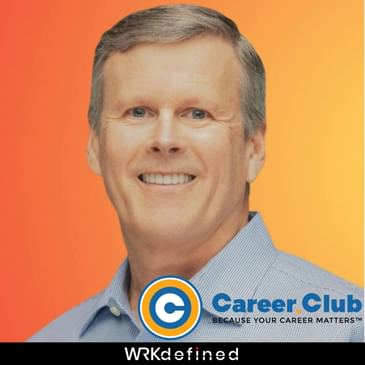
In this episode of Career Club Live, host Bob Goodwin sits down with Betty Larson, EVP & CHRO at Merck, to discuss the evolving role of HR as a strategic business driver. Betty shares her career journey, insights on balancing business priorities with people development, and how HR leaders can build credibility by delivering real business impact. She also dives into the power of purpose, agility, and trust in shaping a world-class organizational culture.
Tune in for a candid conversation on leadership, talent strategy, and the future of HR — plus some great takeaways for professionals looking to elevate their careers.
Powered by the WRKdefined Podcast Network.
[00:00:10] Hey everybody, this is Bob Goodwin and welcome to another very special episode of Career Club Live. Today I'm very pleased to be joined by the Executive Vice President and Chief Human Resources Officer at Merck, Betty Larson. Betty, welcome to Career Club Live. Hi Bob, thanks for having me. I'm excited to be here. Well, I'm very appreciative of you being able to carve out a few minutes and I know that our audience is going to benefit greatly.
[00:00:39] So thank you. As we are want to do, if you don't mind if I just ask you a couple of icebreaker questions so we can kind of get to know the real Betty. So very quickly, where were you born and raised? So I was born and raised in a suburb of Chicago. So it's funny we were talking about Katie George because I had enjoyed that series. Not too far from Katie. I can attest to the fact that Chicagoland Pizza is superior.
[00:01:05] But I was born in a suburb of Chicago called Mal Prospect, Illinois and did most of my schooling there. Yeah. Yeah, go ahead. And is that where you said you went to school? Where did you go to school? So I went to the University of Illinois for my bachelor's in psychology and then I got a master's in HR there and I went to Kellogg at Northwestern for an MBA.
[00:01:29] Very good. We've had one of your former colleagues, I guess, from Northwestern came on about a year and a half ago, helped us with communications, which actually helped us do how we do our thing here. So I'm a huge, huge fan of the Kellogg School. You've had an amazing career and you're obviously at a very senior level at a very big company. Do you mind just painting a little bit of a picture of, you know, leaving Northwestern, you've got your MBA and how your career's progressed?
[00:01:59] Sure. So most people who are in HR, by the way, tell you these tremendous stories about how they wound up there on accident. Yes, that's true. That's the acutous route. I'm the opposite. I've chosen HR and stayed in HR because I love what we do. So I think I started, I did meander a little bit in college. I started as an early childhood education major at the University of Illinois, but took an industrial organizational psychology class,
[00:02:28] fell in love with the idea that we could have a role in business that's all about helping unlock the potential of others. Yes. Stayed there, got my master's, started working for a company called Baxter Healthcare in an HR rotational program. They're also headquartered here, there in Illinois.
[00:02:48] And I went to Northwestern part-time, toyed with the idea of maybe going into a different function after getting my MBA in marketing and organizational behavior. But honestly, continued to stay in HR because I just love what we do. That's cool. And so how did you, what's a little bit of path from there to Mark? Yeah, you know, it's funny. I have to sit down at one point and draw this all out.
[00:03:14] I think I've had many more sideways or lateral moves than moves up, which is something I'm pretty passionate about in terms of coaching others. So I stayed at Baxter for about 16 years and moved around the three different businesses there in different HR roles, whether they be central organizations like learning and behavior or HR business partner roles.
[00:03:37] And after Baxter, I got my first CHRO opportunity with a company called CR Bard, which is what brought me to New Jersey. So I moved with my family to New Jersey, was with Bard for a couple of years when we got acquired by another medical technology company called Beckton Dickinson. After the acquisition, I became the CHRO of the new combined company and so was there for in total about eight or so years.
[00:04:06] Went for a brief period of time to help spin GE Healthcare as they were spinning out of the GE organization and then got a call to join this incredible organization. I think when you spend almost three decades in healthcare, it's hard not to have an appreciation for Merck. And so it was a little bit of a job of a lifetime. And so I joined here about, oh, 11 months ago or so. That's awesome. And you're based in New Jersey now? That's right.
[00:04:34] Yeah. We lived in Morristown or as I should say, Morristown for five years. New Jersey is beautiful. Like it's such a very, very pretty area. And then what do we find? Go ahead. I was going to say I live in an area called New Providence, Berkeley Heights area. Another area. Rolling Hills, lots of great places to hike, incredibly friendly people. Yeah, yeah, yeah. No, I love that part of New Jersey. So what do we find you doing when you're not at Merck and getting into all the things that we're getting ready to talk about?
[00:05:05] Yeah. You know, it's funny. You actually suddenly realize where you spend all your time when you have a weekend alone and nothing to do. So I think I've come to the sad realization that with a 16 year old son and a 14 year old daughter who play competitive sports, most of my time outside of the office is either walking a dog or driving somewhere or to something to watch either my son play hockey or soccer or my daughter play soccer.
[00:05:34] That's pretty glamorous. Come on. Yeah, no, no, no. But I mean, you know, that's great. I mean, you have a really, really big job. And yet, you know, and this is sort of the human based quality that sometimes we skip past is, you know, you've got two teenagers, which somebody's had four kids. That is a handful. And, you know, I mean, everybody's got their real life going on, not just their work. So that's that's nice that you're able to go and be with them at their events.
[00:06:02] Yeah. There's nothing more than having teenagers because it doesn't matter what your title is or what you did that day. They do not care. That's funny. Humbling is a good word. So let's get into it because I've really been looking forward as I've tried to learn more about you, your style and your team has been phenomenal, by the way, with helping in all of that.
[00:06:28] Yeah. I wanted to get you to start talking a little bit about the evolving role of HR in their role in business and kind of what your philosophy is in that and how you direct your teams accordingly. Yeah. So I've been very fortunate to spend the entirety of my career in health care. I think health care is a very human capital intensive industry.
[00:06:54] And so for me, it hasn't been hard to see the link between human capabilities and human performance and business performance. And so that's just never been a line that's that hard to draw for us. But, you know, we do often talk about this 80 20 rule, if you will. And so when we when we're setting up our objectives for the year, we talk about the fact that 80 percent of the work that we do in HR has to be in the business.
[00:07:22] We're actually in the business helping to execute strategies and plans, make sure that the organization has the capabilities that they need today and tomorrow. And then the other 20 percent is really working on the business. And so we, like every other function, own a set of business processes on behalf of the company where the talent lends for the company. And we have to make sure that those processes are fit for purpose.
[00:07:47] So in addition to running the business and executing for the business, we have to make sure that our performance management process, as an example, is designed in a way that is either reinforcing the culture we're trying to cultivate or delivering the expectations that we need, the feedback we need around performance. Same thing with incentives. And so we often talk about the balance between executing for the business and designing our processes and making sure we're we're fit for purpose for the future.
[00:08:17] If I'm a, you know, people leader, HR leader, you know, not something that's a what, 16 billion dollar company ish. You know, it seems like, and I know in our coaching practice and stuff like that, people are just like 99% and 1%. How do you create the bandwidth and the ability to actually go execute on that kind of an 80-20 and find the 20?
[00:08:45] Well, I think the important thing is that you have to make sure that the, I would say the central organizations, so that we call them COEs. Everybody's got a different moniker. That they recognize that what the majority of what they do every day is executing routine processes for the business, too.
[00:09:06] I think sometimes we get enamored with the improvement projects or the initiatives instead of saying, hey, look, first and foremost, we have to make sure we're executing our processes flawlessly. So, you know, maybe the breakdown, Bob, isn't really 80-20. Maybe it's more 90-10. But it's really, it's focusing people on the responsibility that we have to execute for the business and execute our processes.
[00:09:28] And then making sure that where we do carve out time for the 10% or the 20% of project work or improvement work, that we're asking ourselves the why behind every one of those, I guess, improvement projects. So, you know, my team probably gets sick of hearing me always ask, what's the business problem we're trying to solve? So if we're going to be redesigning how we collect feedback, why? What are we trying to do differently this time?
[00:09:57] What outcomes are we trying to accomplish? And so I think that it's executing on the business, then making sure when you're in that 20% zone, you're still staying very business focused in the work that you take on. Do you see, and maybe you've actually architected this, but how do you see that connectedness to the business? I love what you say. What's the why behind this? Like, how is this going to impact the business? You know, growth, strategic, profitability, something, you know, a differentiated capability, whatever it might be.
[00:10:26] Have you seen the expectations changing over time that HR should be taking, you know, more of that business first kind of a mentality? I think so. I mean, it's certainly been part of my experience that there's no free pass. I mean, again, maybe it comes from the industry that I've been in and that it's so human capital focused, but we talk all the time around what's the return on time investment.
[00:10:52] So even when you're actually engineering an HR process, you're often taking a manager away from their team. You're taking someone off the production line. You're taking them out of an R&D space to complete a survey or do a 360 evaluation or complete a performance review. We talk often about, okay, if the company was actually spending the dollarized equivalent of that person's time in this process, what outcomes would we expect?
[00:11:21] So I do think there's always been a high bar for when you're taking people's time away from the organization. Yes. What are the outcomes you're getting? How are you driving the business forward? Yeah. And it does seem to be in the kind of current zeitgeist, if you will, that like being really laser focused on the business outcomes will be a competitive advantage for the organization.
[00:11:44] But I think functionally for HR leaders and their teams, right, to really be able to draw a short, straight, fat line between what we're doing, why we're doing it, how it positively impacts the business. Yeah. I definitely think, you know, it's interesting because your question makes me reflect a bit. I probably, I've always been fortunate enough to be in organizations where HR had credibility. And so we didn't necessarily have to fight for the right for relevancy.
[00:12:13] And so that's a refreshing place to be. But when I went to CRBARD, so my first CHRO job was a very decentralized HR organization. And that's an interesting experience to go through because whenever you're going to do an HR initiative or ask for investment in a system like Workday, you actually have to convince business leaders of the return on that investment. It's not like you're going to one centralized organization and getting a blank check.
[00:12:43] And so maybe that was instrumental in shaping my focus. Because the CEO of that company was the CHRO previously, and he grew up in HR at Abbott. So maybe he didn't want to be known as the HR guy. So he was harder on HR in terms of making the business case. But that really helped us sharpen our tools, if you will, when we were trying to explain the importance of either the processes we were accountable for or the interventions we were advocating for.
[00:13:13] That's funny. It's always hardest to be the coach's kid. But it's true, too. Like you had, you know, multiple air quotes selling, you know, opportunities, right, with it being decentralized. And it's like, go make the case. You know, we're not, you can't just have this one monolithic policy. But it does also speak to, I think, the change from being more compliance oriented to impact oriented.
[00:13:40] And there is, you know, still a bit of a legacy on compliance, which is, I mean, even kind of your 80, 20, like, let's be good at our job first, right? And compliance is part of that. It's just not all of that. Yeah, I do think, by the way, that we either harm our credibility or hurt our credibility by being able to demonstrate that we're sensitive to the business conditions. So what do I mean by that?
[00:14:05] I think that all too often, HR organizations get really cute with what they're designing. So you're redesigning performance management. And maybe you're going to what is current best practice or you're advocating for the latest and greatest technology. And sometimes what the company needs is a stripped down, simplified process. And so when you challenge yourself to say, what does the business really need? And you go back to the business with something that demonstrates this is the outcome we're trying to drive towards.
[00:14:34] And here's the most efficient, effective, simplest process possible to get us there. You earn a lot of credibility. I think when you go there and you say, well, we're going to, you know, we're going to add into the performance management process, career development planning. And since you're having the conversation, you might as well solicit feedback. And while in all of a sudden the process becomes super bloated. So sometimes we're our own worst enemies. No, you're right. There's a bit of an Occam's razor principle in there. Like, can we just simplify?
[00:15:02] Like that's usually the more elegant solution. I think Steve Jobs would say that's always the hardest solution, right? To see if you can make it simple or not. So again, thinking about, you know, people that might be listening to this podcast, you're building a world-class, highly connected HR team that is connected to the business, right? And maybe the way I'm phrasing this is going to sound, you can disagree with the framing of the question,
[00:15:27] but like this very integrated HR function that is driving business results. And at the same time, you know, is very sensitive to employees and the nuanced needs that employees have. Yeah. And so we always talk about the, I guess the framework we use or the way we think about it is our role is to advance the business and the business outcome. So what can we do to accelerate or unlock business growth?
[00:15:57] But we also have a responsibility to unlock human potential. And so, you know, within that, there's that balance of, hey, do people understand what's being asked of them? Do they connect to the purpose? Do they feel a sense of belonging here? Can they be as productive as possible? And so we view our role probably equally. How do we advance the business and how do we make sure that the human capital within the organization can be as successful as possible?
[00:16:24] And as long as you're looking at life through the lens of optimizing success for the organization and the individual, I think the work becomes pretty clear. Yeah. And so one of the things I know that you like to talk about is delivering the right capabilities at the right time. Are there principles or strategies that you would share that you have found to be particularly effective in that regard? Yeah, it's funny because I probably it'll show you the industries I come out of have been more med tech or cost conscious.
[00:16:53] It's always deliver the right capabilities at the right time and the right cost, because I think anyone can go to the open market and pay far too much for talent when you need them if you're doing on demand hiring. And so what we try to do is get out ahead of it. Yes. And think what are the capabilities that the company is going to need a few years from now? So we try to really focus on or capability planning to ask ourselves those questions.
[00:17:20] And then you have if you ask those questions early enough in advance, then you have many more options available to you. Is this something we can develop within our workforce today? So in our world, if there's a therapeutic area that we're going into and the basic scientific principles or the way medication works in the body is not that different than another therapeutic area, maybe we're going to be more successful taking Merck people and training them around the go to market in a different therapeutic area.
[00:17:48] How people engage with the health care system and leverage the understanding of the fundamental science. They're in Merck. They know how to be successful. So maybe then that's a training and development play. If we find we're going into a space that's completely different and we have enough time, who are we going to hire from? And at what point do we help ramp that workforce up? And so I think that for us, it's more about predicting and planning so that then we can sit back and say, what are the solutions we need to employ? Is it training?
[00:18:19] Is it development? Is it talent mobility, moving people around? Is it hiring? And then employees lifespan, are you going to hire them out of college and train them or advanced hires? And so I think it's more about that planning, Bob. And then thinking about the totality of solutions that you can employ to make sure you have the right people. They're set up for success. Your incentives are driving the right behavior. And you're able to give them feedback, communicate and align their priorities.
[00:18:48] And so it really is an integrated approach. So, I mean, it feels a little bit like a home truth. Speaking to someone, you know, at your level with the level of complexity scale, you know, that is just your day to day life. And but it really is a point worth reinforcing, which is you're talking about planning, being proactive, trying to anticipate.
[00:19:10] But that's what makes you a true business partner, right, to the rest of the organization is you are there to support them and make sure they've got the capabilities. Human capital in your case to be what they need to be when they need to be there.
[00:19:27] And again, you know, as a bit of encouragement to others who are listening to this, you know, that the executives at your company, your CEO, your board, they want you to be that way and to take a leadership role and not be reactive and be kind of show up with order pad in hand. Yeah. Right. How would you talk to somebody just a bit more about that?
[00:19:49] Because I think it's a really a crucial point that you've been able to not just in your own career, but with the part of the organization that you steer, get to that higher ground and just thinking about people that might be struggling with that. Yeah, I think it's a good point. And look, I'd be remiss if it sounded like at Merck we have all the answers.
[00:20:09] I think that the profession, Bob, in the last probably decade or so has maybe responded more to meeting the demands that are articulated by the business versus helping the business architect or understand what they're going to need. And so it can be a bit intimidating. And we talk about this amongst our own HR community as we're doing more and more of this board planning is to say, look, nobody has the answers and you don't actually have to have the answers. You just have to have the courage to ask the questions.
[00:20:39] And so I think if you're in there asking the questions at the right time, the business appreciates it. If they're asking you to fill a job and that's when you're asking all the questions, you're going to lose their patience. But if you're in there early enough to say, hey, what are the implications of this acquisition? What kind of talent are we going to need? Why does that talent want to work here?
[00:21:01] If they're used to working at a small biotech, how is life going to feel different at a large pharmaceutical company or life sciences company? So I think it's about when you're asking the questions, having the courage to ask the questions. And then what do you do with it? I think the other point is if you ask them a whole bunch of questions and then you don't do anything with that. Well, then, you know, they lose patience with you as well. So it's about asking questions at the right time. And I think it's about leveraging each other. Nobody's done this really well.
[00:21:31] You can't go to a consultant out there and they pull an off-the-shelf great tool for organizational capability planning. So it really is just being a bit uncomfortable and getting in there and consulting with you. Well, I love that word courage. I think that that's going to be definitely a soundbite that comes out of this is having the courage to ask the questions. Right. And there's a great book. I don't know if it would have necessarily crossed your path, but it's called The Challenger Sale.
[00:22:00] And it's a corporate executive board work from a few years ago. And going from being kind of order pad in hand, this is as a salesperson, you know, Betty, help me understand your needs, blah, blah, blah. Versus going that next step of being a commercial teacher in some ways. Right. And actually, you know, we're the experts in this. And let me share with you some of the learning that we have. Right.
[00:22:27] And then now you're really kind of in peer-to-peer territory. Right. And it's a powerful model to do this commercial teaching to challenge. Because one of the things that they will say is that even if you just made me think about it in a different way, you've already brought value. Yeah. Right. I may have to agree with what you're saying or do what you're recommending.
[00:22:53] The fact that you're just making me think about this in a way that I hadn't thought before brings tremendous value. Yeah. And, you know, it's interesting because it makes me think about the power we have today with access to more human capital data than we've had in the past. And so if you're in there and you're asking questions and with their answers, you can go back and bring them insights. You know, hey, when we've hired from this company before, we tend to see people are successful only 50% of the time.
[00:23:22] Or, you know, if we're looking at an M&A of this size when we integrate the company, we typically see retention is only about a year and a half to three years. So can we help you design a different solution? I think that's when you really demonstrate the value that you bring as the talent lens of the organization versus what they're bringing, maybe as the business development lead or understanding the market, whatever it may be. No, that's great.
[00:23:51] Well, let's keep this train running. I was at an executive office a couple of weeks ago and the CEO was like 2024 was really, really hard on a lot of people. It was not an easy year. And thankfully, we get to turn the page and we've got something called 2025 now. But there's obviously tremendous value and lessons learned. How was 2024 for you? And what are some of the lessons you take forward in 2025?
[00:24:18] Yeah, I think like many, many companies out there, 2024 for us brought with it some unexpected challenges and probably not challenges we didn't envision we would face. But maybe the timing was a little earlier than we thought that we would encounter them. And so I think this notion of be prepared for anything, focus on agility. And so for us, what does that mean or what advice would I give someone in HR?
[00:24:45] Be intentional about the outcomes that you're trying to get to and be okay that the actions you take to get there may change given the environment. So if we know we're trying to get to X, maybe it's a feeling or advancing the culture in a particular way. And you get thrown a curveball. Part of the business isn't performing as well. You can't spend on a program what you thought you were going to spend. You can take a step back and say, well, how else can we get there?
[00:25:13] There's many ways to, I guess, many paths you can take to get to an outcome. And so as long as you're focused on intentionally where we try to go and you stay focused on those outcomes, I think you can find a new path or you can shift the activities you had planned. That's probably our greatest outcome is making sure that agility comes in the form of reacting to the environment but staying true to the intended outcome we're trying to get. I love that. I love that.
[00:25:39] We, gosh, this is maybe three years ago, two years anyway, had a three-star general on Ben Hodges. And it's this mission orientation, right? We're taking that hill. That's kind of what we're doing. Supply truck didn't make it. We're still taking that hill. We're going to have to get there in a different way. And, you know, that kind of mission orientation and it sort of dials out excuses.
[00:26:05] It also dials up innovation and created sort of the, right, necessities, mother invention kind of a thing. But, okay, that didn't go exactly how we thought it was going to go. Doesn't change the need. Might change the method of how we get there, but it doesn't change the need. You brought up the word agility, which is really interesting. You work at a life science company. You've been around very human capital intensive things. People don't like change and they definitely don't like surprises.
[00:26:34] How do you build a culture that not only can sort of absorb it but even thrive in a much more unpredictable environment? Yeah, you know, it's interesting because I do think in many ways life sciences companies are dealing with experimentation all the time.
[00:26:54] And so, you know, you're always responding and reacting to either data that goes the way you think it would be or maybe an intended project actually finds life with a completely different therapeutic outcome. So I do think there's a certain level of change agility built in there. But I think that I think as long as you can establish within your organization a learning agility, a growth mindset, it helps tremendously.
[00:27:21] So the ability to actually admit, hey, you know what, maybe the plans we put in place ultimately ended up not being the right plan. But where do we want to go from here and what can we learn from there? So this notion of we can always learn, we can always get better, I think that helps create agility in an organization because people aren't necessarily fixated on the grade or achieving the perfect outcome. We talk a lot about progress over perfection.
[00:27:50] So what's the process you can get there and are we making continual progress? One of the other things that, you know, is a unique asset that a company like Mark has is also purpose. Right. And so when I can get aligned around the purpose, we are making people's lives better.
[00:28:11] These therapeutic, you know, innovations that you guys bring to market literally are making people have life and have life better. Sure. The marketing people can use that. But it is important, like when we can get focused on what is the greater good that's going on here, it kind of turns those mountains into speed bumps and not just, you know, folding like a house of cards. You know, it's interesting.
[00:28:41] So two things I probably either read or listened to a lot over the past several years. I think COVID taught us this. I love the work of Angela Duckworth. I love the work she's done on resilience and grit. Right. And she would say having a long-term goal and having kind of, so that's your purpose. That's your long-term goal. And then keeping things in perspective so that you can get up again, try again the next day really drives resilience.
[00:29:08] The other piece was, I think it was Deloitte did some work that showed that companies that thrived during the pandemic, not just survived, had three Ps. And I love these three Ps because I think HR plays an absolutely instrumental role in an organization around these three Ps. And it was purpose, potential, and perspective. So those organizations that had a purpose that people could focus on to say, you know what, this is difficult, but we'll get through it.
[00:29:38] And that for us, this is an incredibly purpose-driven company. So as we're working through almost any challenge, people know there are patients at the end of everything that we do. You know, I work in this company and I have a father who battled prostate cancer for 17 years before he passed away. My mother survived breast cancer. She's now living with Alzheimer's. We have programs that have the potential to change the experience in all of those diseases.
[00:30:08] They already are. So when you come to work every day, knowing your colleagues are making a difference in that regard, you can get through anything. So purpose is an unbelievable motivator for us. Potential, this gets to the capabilities piece. When you know what you have the potential to do and overcome, those companies are that much more successful because they can take on challenges. And then perspective. And I think HR plays a key role here. Helping the organization put things in perspective so that you can show you're making progress.
[00:30:38] I think that that's key to getting through almost anything. Wow. We could dive into that for another 45 minutes. One of the things that you shared is around functional excellence. Could you define that for people and then how you bring that concept to life? Yeah. So I think functional excellence applies to whatever function you're in. It's really the ability to consistently deliver with some level of efficiency and effectiveness.
[00:31:07] So, you know, I believe that in any function. So let's take HR. We are business people first and foremost. We just happen to own the talent lens for the company. Just like finance is managing capital for the company. Manufacturing is managing production for the company. We're the human capital or the talent lens. And so there's a subset of processes, business processes that we own on behalf of the company. And functional excellence is making sure that we execute those processes, that they're fit for purpose.
[00:31:37] They're delivering the intended outcomes. And we're doing so with a high level of quality. We're doing so as efficiently and effectively as possible. And we're getting better. So for me, functional excellence is what processes are we responsible for? Do they deliver as expected? And are we continuously growing, developing, and improving their service delivery? Well, it's great to hear because for me, that just underscores the 80-20. Like you have to do your job and you have to do it well, right?
[00:32:06] Because that is what allows you to continue, whether you're talking about an individual and a career or functionally, as you say, whatever functional area you're aligned with. But you've got to do your job and you've got to do it well. And what do you say with efficiency and effectiveness, right? So it's got to be done smartly, right? So I think that that's such a great takeaway for everybody is am I really, really delivering?
[00:32:35] Because that is what gives you the platform to bring forward if you've got ideas that you would like to improve, to change, right? If you're not even doing your job that well, you probably don't have much of a platform to get the executive's ear to drive real change. Yeah. And I think the nuance I would add there, Bob, is it's the what are we delivering? All too often, we stop at we executed the process. We didn't have any errors. The system worked as it should.
[00:33:05] Instead of saying, you know, this is a process by which we're making sure that we're differentiating rewards or this is a process through which we're making sure we're hiring the best talent. Well, we don't often go back and say, well, how would we measure that? So how many people are three years later successfully performing in their role? What's the turnover look like? And so I do think we have to hold ourselves accountable to say for the processes that we own, what are the outcomes we should be measuring?
[00:33:35] Not just execution of the process. Well, I thank you for that nuance, which is you're being kind to me. It's more than a nuance. It's a really, really important point. And I was speaking with another CHRO. We can talk about this offline. But, you know, I asked her what KPIs do you look to right in the business to see how you guys are doing? You know, is it time to hire, cost to hire, engagement, whatever, whatever?
[00:34:02] She's like, no, it's none of those things. It's looking at year, two years, three years. Is that person possibly impacting the business? And I'm like, ah, but, you know, I was hearing Angel sing when she said that because that really is, it isn't about, those are nice little intermediate metrics for some things, but it's not the big picture. And so I really appreciate your nuance in air quotes because it's really, really important.
[00:34:28] Yeah, I haven't figured out how to measure it yet, but a couple years ago, I stood in front of an HR team I was responsible for, and we talked about if someone measured us on the return on human capital or the return on the assets that we're responsible for bringing to the organization, like you might a broker. Let's look at the portfolio of investments you've made and what's the overall return. You know, we should think about our role that way.
[00:34:54] Every time we bring a talent to the organization and it's the wrong fit, we should feel that. Every time we bring a talent to the organization and they go on to take on three or four bigger roles, we should be rewarded for that. But we haven't figured out how to measure that yet. And our work can be somewhat distributed across different HR teams. And so it's harder to measure, but I think with AI, we'll eventually get there. Well, on another day, that is somewhere near and dear my holy grail is if people, one, or oftentimes
[00:35:24] the biggest expense between comp and benefits, and they are, air quote, our most important asset. All right. How do we tie that to business performance? I mean, to me, it's an imperative, but I don't want to go off on too much of a rabbit hole on that. Can we move very quickly? Because I want to be respectful of your time. And this was initially kind of what made me reach out to you, Betty, was really more around culture, inclusion, things like that.
[00:35:52] But for you, what are the pillars that you have at Merck or what you would like to continue to build into what makes for a great culture? Yeah. So first of all, I do think that what we have at Merck, a tremendous advantage, and for any company that has a great culture is a strong purpose that people feel connected to and that people feel they can connect their work to.
[00:36:18] And so I think making sure that people feel that purpose is job number one. I'm a big believer. I love the work of Francis Fry and Ann Morris. And so maybe a shameless plug for their books. But this notion of an organization that, or a manager, a leader, that has high, high standards and at the same time demonstrates deep, deep devotion. So I think what makes for a great culture is that you have high standards, high expectations of each other.
[00:36:48] You expect the best of each other and for each other. But you also care greatly about one another so that you'll help each other get there. Right? So they have this two by two because, of course, they're Harvard professors and consultants. And the idea is don't relax your standards, but make sure people know you authentically care about them because you will help them get to those high, high standards. So I think a company needs to have high standards, needs to have a caring culture, needs to have
[00:37:16] a purpose that everyone gets excited about. And then, you know, I'm a big believer in authenticity and transparency. So I think that an organization that has consistency between their words and their actions, regardless of what you aspire your culture to be, and somewhere where people feel like you're treating them like human beings and adults, you're giving them information, you're being transparent. Those are pretty important pillars as well. Yeah. Because I think of that.
[00:37:46] That's really, really good. I think of trust. Well, transparency as an ingredient that helps build trust. I think respect is part of that. The point that you made, and this is like, I just have to repeat what you said, because I think it's so fundamental. When you can demonstrate to people that you care about them more as a human being than as a work-producing unit, genuinely, you can't fake that. People will pick up on it.
[00:38:14] But when you are that kind of a leader, it's like, I genuinely care about you first. We'll get to the work part in a minute. Like, people will go through walls for those kinds of leaders because I know she cares about me. And I think, too, particularly in a change environment, when I don't understand or maybe don't even agree with why we're doing what we're doing. But I trust Betty. And I know that Betty's got my best interest at heart.
[00:38:44] And so I'm going to lean very heavily on that equity. Hi, this is Stacey Harris. And this is Terry Zipper. And we're the hosts of the two podcasts under the HR Huddle. On Spilling the Tea on HR Tech, we uncover the latest trends, truths, and challenges from Sapien Insight Group's groundbreaking research and our analyst insights, serving up everything you need to know about HR tech with no sugarcoating. And on HR, we have a problem.
[00:39:14] We tackle the toughest workplace challenges head on, offering you expert advice and actionable solutions to help HR leaders thrive in today's fast-changing world. Whether you want the scoop on tech or tools to solve people problems, we've got you covered. Take a listen and subscribe. If you want to become part of our community, we'd love to see you. That's an unbeatable culture. How would you build on that?
[00:39:42] Yeah, I think, look, I think that the important ingredient there, you talked about inclusiveness and a feeling of being, I'm going to expand upon it and say it's really a feeling about being seen. So if I work for Betty and I believe that, hey, I might not necessarily agree with all the decisions that she makes, but I know in my heart she understands what's important to me and she at least considered it because she knows me. She knows about me. She values the whole me.
[00:40:11] I think it's much easier for people to get behind the decisions a leader makes, the additional asks a leader might have if they actually feel like I respect them as individuals and I see them, to your point, more so than just the work that they're doing or the tasks that they're completing. And so taking the time to demonstrate authentically that you are interested and understand and you care about the whole person, I think is an absolutely essential ingredient.
[00:40:43] One of the things that people talk about, because if I bring my whole self to work or you're encouraging me to challenge or whatever, I need to know that that's a safe place and I can do that. I'm not going to get fired for doing that or somehow in whatever currency the company trades in be punished or penalized for that. How do companies really do that? Yeah, you know, it's interesting. I think that there's lots of people that talk about psychological safety.
[00:41:11] I think essentially you're getting at psychological safety and creating a learning environment, a safe space. Yes. Look, I think the company has to earn that over time by demonstrating that people can make mistakes and that people can learn and grow. And so to some extent, if people feel like they can't make mistakes or try new things, you're going to get a very, very narrow range of performance, right? And people aren't going to be willing to give discretionary effort.
[00:41:41] I think as leaders, what you have to do is break down barriers. I'm a big believer in power distance. I read some stuff on power distance, I think when I was getting my master's in HR back way, way back when at the University of Illinois. And I always like this example, Bob, because if we weren't on video and I stood up, you'd see I'm not a particularly tall person. And, you know, when you read about power distance, they talk about, you know, at the most basic
[00:42:10] level, when a kindergarten teacher or an elementary school teacher wants to build rapport or have a real serious conversation with a small child, what do they do? They bend down. You look eye to eye. So people know that, you know what, we're on equal footing here. We're on equal ground. We forget that in organizations, especially 75,000 person organizations, 60,000 people, plus billion in revenue like ours.
[00:42:35] You know, there's quite a power distance between a certain level in the organization and members of your team, your organization. And so how do you do the managerial equivalent of leaning down or getting it? You actually have to show people that you're human. And so I think to a great extent, it's incumbent upon organizations that we tap into humanity, that leaders demonstrate a human quality. They're not just a box on an org chart.
[00:43:05] So for me, that's always meant, you know, I like to go do skip levels or round tables. You know, it's funny. I probably learned this lesson in COVID. Like many people, we were doing a town hall. I was at Beckton Dickinson at the time. And we were doing a town hall from a living room because everybody was working remote. And instead of a jacket, I was in a sweater. And I'm answering questions.
[00:43:31] And I think I mentioned somewhere in the town hall that I was going to have to go because my dad was calling me from the other room because my elderly parents moved in. And I'm suddenly now responsible for all his medications and his meals. I got flooded with emails from people that day who just were commenting on the fact that you're human too. You know what? My parents moved in or guess what? Like I have to call my dad to remind him of his medicine.
[00:43:57] And I think when you remind people that you're human, that you're not just an exalted leader in the organization or that the organization cares genuinely about people, not just executing their processes, I think it goes a long way to creating that environment of trust. Yeah. I really appreciate that story that you said. I think one of the words you're using is like vulnerable would be another kind of in vogue word for that. But, you know, you're right.
[00:44:24] COVID was a very interesting time that you got to see people in their homes and the cat walking by and the four-year-old and, you know, whatever. But it also reminds me of, you know, we talk about bringing your whole self to work. And what that really, really means is my aging parents and my kid who's off the rails and I'm having trouble in my marriage right now. And we've got a health issue going on. Like that's, people haven't gotten to work yet.
[00:44:52] And this is like what all is on their plate, in their head, in their heart. And when you can meet people really where they are and show, hey, I didn't get a pass on this either. You know, my dad shouldn't be driving right now. We're in a big argument about taking the skis or whatever. Right. It's like, you too? Oh, wow. Right. And to your point, you're not this, you know, exalted executive. But like, you have a real life too. This is so nice to hear. Yeah.
[00:45:22] You know, it's amazing. Maybe there's no position more lonely than being the parent of a teenager because suddenly the group you actually used to compare notes with or share problems, you can't anymore because you're outing your kids if they have a problem. Right. So you're, and you find all of a sudden you have this tremendous community at work because somewhere somebody's dealt with the same problem. And so I do think that when leaders crack that door open and show some vulnerability, you're
[00:45:50] inviting people to bring more of themselves in or share more of themselves. I mean, even at high levels, I think, I think I went through my very first 360 when I was a fairly young VP and I was trying to make sure I was formal and, you know, I was presenting like a VP and the 360 coach was walking on the beach with his wife and he was saying, gosh, I, I know how busy Betty is. I can't believe it.
[00:46:18] She's so diligent that she's so busy and she had to give me like my responses to my self-assessment, whatever it might've been. He's like, and she sent it to me. It was in a PowerPoint. It was really nicely done. I know she probably stayed up late doing it. And his wife said, well, maybe that's part of the problem. And it was this aha moment where it's like, you know, it's okay to actually even demonstrate to your peers. I didn't get it all done or you know what? I haven't gotten to it yet. Right. Just have it handwritten here. I didn't take it perfectly.
[00:46:48] I'm not suggesting you decrease your work a little bit. Any less professional, but it's okay to let people know you struggle with assignments too. Hmm. Well, and, and would like to get your take on this. Oftentimes the best way to do that is to admit it first. Right. Like, like I didn't get it done. I, again, not trying to lower the standards here. I just want you to know, I had a bad night last night for whatever reason.
[00:47:16] And I'm not all the way to bright on this just yet. And, you know, apologies to the team, but let's move forward. Okay. Like, wow, Bob doesn't always have it perfectly together either. Again, the fine line is not degrading standards, as you said. Right. So super quick, because I want to be mindful of time. You said AI once, but I'm kind of curious, just sort of broadly, it's not an AI question
[00:47:46] per se, but it could be. What are some of the trends that either you see or you hope to see continue to shape HR over the next, I don't know, three, five years? Yeah. I mean, so I look at, I think probably two things come to mind, Bob. One you hit on. I think that in HR, if we can evolve the metrics or standards that we use to measure performance
[00:48:10] to be more holistic than just individual discrete outcomes, I think that would be tremendous. Right. So there's this notion of how do you actually measure kind of worker productivity, not just task completion, the overall contribution somebody can make through the experience that they bring, the work they do, the way that they coach and counsel each other, I think would be great. I think that the pressure, external pressure on companies to think about workforce sustainability
[00:48:40] is a trend I can really get behind. It's been far too easy in, you know, around the world, but let's say in our country the last couple of years, that if you need to shift your workforce, you just do a big restructuring and you go hire new people. I think that, you know, we all are trying to hold ourselves to a higher standard of what are we going to need two, three, four, five years from now? And can we actually invest in our workforce and retrain our workforce to get there?
[00:49:06] And so you see lots of companies doing that through digital upskilling, through recredentialing of roles, et cetera. So that's exciting. And then I think there's a ton in AI that could really level the playing field. I think that tools around hiring that will help individuals, let's say, to engage differently in the interview process, maybe neurodiverse individuals, tools that help remove bias from
[00:49:32] applicant tracking systems or resume reviews, I think are tremendously beneficial. I think tools that will help managers integrate information faster in order to give someone a more robust performance management review or performance review. All of these things are pretty exciting. It's the chat GPT applications, I guess, if you will. I think I'm pretty excited about those. How do you get to even better insights faster so that leaders can actually get to the coaching
[00:50:02] and not necessarily the aggregating of information? Yeah, that's well said. That last bit really resonates. I kind of want to end on this because you've been leading teams and leading people for a long time. If I was a brand new people leader coming into your office and like, Betty, give me like two or three pearls that I should just get completely grounded in as I move forward in my career as a people leader, what would you tell me?
[00:50:32] That's a good question. You know, I think that maybe the most important thing a people leader can realize is that they're not there because they're supposed to have all the answers or they're actually the smartest person in the room. They're there because they're the best at assembling a team and making sure that they have the expertise they need on the team so that they collectively get to the right answer. So making sure people leaders understand it's not about individual smartness or expertise.
[00:51:00] It's about how do you get this dynamic to work together, I think is incredibly important because I think people still have this view of I'm the manager. So that means I must be the most proficient compensation experts or I must be the smartest accountant. That's why they made me the leader of the group. And then maybe the second thing, Bob, is a long time ago, someone reminded me that there's a difference between intent and impact.
[00:51:27] And so if people don't understand your intent, they only experience the impact that your actions or your words have on them. So if they don't know why you're and this is important for me as I onboard to a new company like Merck, I ask a ton of questions. I love what we do in HR. If I don't actually remind people, I'm not second guessing your work. I really I need to defend your work. I need to advocate for you. So help me understand why did you design it this way or what's the intent here?
[00:51:56] What problem are we trying to solve? I have to make sure people understand why I'm asking the questions I ask. Otherwise, they'll just experience it as the new boss is here and she's asking me a million questions about why we do the things we do. And so this idea of remember, people don't actually understand or they make an assumption about your intent until they really know you. So that's why vulnerability is important. That's why telling stories is important. It's all of that.
[00:52:23] I was just telling one of my kids last night, you would die on 90% of the drama out of your life if you would just assume good intent. Absolutely. A hundred percent. What did they say that there's only two facts? What you directly see and what you directly hear? Everything else is a story somebody's made up. Okay. There's another soundbite for this. Betty, thank you so much. This has been awesome. We should probably just have you come back on because there's still like a ton of things I would love to ask you.
[00:52:53] But this has been phenomenal. I appreciate your time. I know you're very, very busy. But the insights that you shared are really great. And I know that our listeners are going to enjoy them. So thank you. This has been fun, Bob. So I'll come back anytime. I really appreciate it. No, thank you. And for everybody who's listening or watching, thank you so much. And we look forward to seeing you on the next episode of Career Club Lives. Thank you.
Sponsors
