
As organizations face growing complexity and rapid change, the need for simple, integrated HR solutions is more urgent than ever—especially in industries where high attrition and operational efficiency collide.
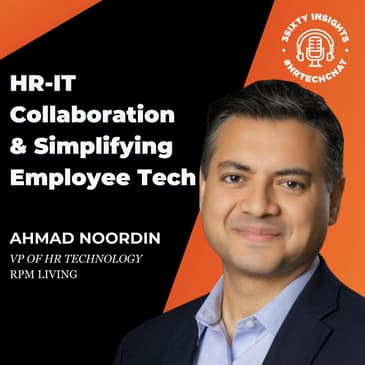
In this episode of #HRTechChat, 3Sixty Insights’ Dylan Teggart sits down with Ahmad Noordin, VP of HR Technology at a leading U.S. property management company, to explore how HR and IT can partner to drive better employee experiences without overcomplicating processes.
Ahmad shares how his background in both technology and HR uniquely positions him to bridge the gap between functional needs and technical capabilities. Together, they discuss the growing shift toward simplification in HR tech, the role of no-code and low-code platforms, and why ease of use has become a competitive advantage in workforce technology.
From selecting practical solutions and balancing vendor partnerships to embracing AI as a wrapper for fragmented systems, Ahmad unpacks how organizations can reduce friction, improve usability, and deliver faster outcomes for managers and employees alike.
How can HR and IT avoid working in silos? Why is simplification the new sophistication? And where does AI fit into the evolving digital employee experience?
Tune in as Ahmad offers clear, actionable insights on uniting people and technology in pursuit of seamless, human-centered HR.
Powered by the WRKdefined Podcast Network.
[00:00:00] Hey everyone, it's Dylan Taggart here with another episode of 360 Insights HR Tech Chat Podcast. I'm here today with Ahmad Noordin. Ahmad is an HR professional with 25 years of experience. He's currently the VP of HR Technology at a large property management company in the U.S. with around 5,000 employees. He's worked for a couple of big names in industries such as Alta Beauty, HelloFresh and has previously worked in the property management industry.
[00:00:29] Ahmad, thank you so much for joining me. Ahmad Noordin Thanks Dylan. I look forward to having this chat today and yeah, I think the topic today is going to be very interesting for me because I feel like we're at this crossroads where the people side and technology side are, there's an inflection point where the industry is going in. It's going to be fun to see where all of this goes. Ahmad Right on.
[00:00:55] And before we get into that, is there anything else I missed in your bio that you'd want to let the people know what you're up to right now or what you've been up to in the past? Ahmad Yeah, you know, I see myself as a business and HR practitioner. Ahmad I spend most of my time with our customers. Now, I go out of my way to, you know, spend more time with the associates, for example, the employees and managers, because really the focus for me is people experience. Ahmad It's obviously using technology as one of the drivers for you.
[00:01:25] Ahmad But having a very solid technical background. Ahmad I have my bachelor's and master's in technology, but also have all of the, you know, your HR certifications kind of gives me, you know, kind of what the HR and the employee experience should look like as well as what the, you know, what technology is required to make it a seamless experience.
[00:01:52] Yeah, and that's one of the main things I want to get into with you today is, you know, you have that deep depth of technology and years of experience with it. And oftentimes, HR tech teams need to either report to HR, not to HR, but to IT function, or have to work very closely with IT to find maybe a new solution or just in general. So how would you feel is the best way to develop a relationship between a tech team and an HR team?
[00:02:22] Yeah, it's a great question. And it's one of those questions that companies are often grappling with or experimenting with. Now, I've spent, you know, I've been on both sides of it. Currently, I'm reporting into the IT function, but still spending majority of my time with my customers, HR as well as other stakeholders across the organization.
[00:02:44] So obviously, when you're on the HR team, you could be more formally embedded into the HR function. You're very close to the action in terms of what their needs are and so on. But some of the drawbacks could be that you might be too vested into, you know, the customer.
[00:03:05] And in some cases, the customer's voice, you know, you may end up mimicking what the customer is really wanting to do versus looking at it from a more agnostic and non-biased standpoint. So, you know, being in IT kind of gives you that lens of you're still an insider, but you're outside coming in.
[00:03:26] And in some cases, especially in my current role, the HR function and some of the stakeholders I work with, they appreciate the fact that they see us as experts and consultants. They're still we're still partners, but we, you know, we may or may not agree with everything. And that's fine, too. Also, you know, in most companies, IT has a strategy and each function usually has their own strategy.
[00:03:52] And the goal always is how do we not continue to work in silos and try to have an overarching strategy as an organization? And so, you know, the fun part for me is regardless of which side of the aisle I'm on, how do we make sure that we're working towards that overall enterprise goals? And, you know, we have more cohesion between the department goals.
[00:04:17] And so kind of being in a role where you're in IT, you can look at what all of the departments are doing, what all of their goals are, and start connecting the dots in terms of where you see overlapping technology and where you might be able to do a better job of investing in those tools.
[00:04:34] And also, when you see an overlap in terms of where the systems that employees have to use, it gives you a much better point of view and you can call some of those overlaps and gaps in a more, you know, I would say comprehensive way.
[00:04:56] Interesting. And I know in your, you know, in your current role, you were kind of brought on because, you know, the company wanted someone with your specific set of skills who could bridge the gap between HR and IT. That was a big priority for them.
[00:05:12] How would you recommend to someone who maybe is not as tech literate as you, but is looking to become more tech literate or looking to enhance their skills in terms of technology knowledge so they can have a better relationship with IT or tech? What would you say is a good starting point and where do you think people can kind of further deepen their knowledge? Yeah, that's another great question.
[00:05:39] Now, when I started in the, you know, 25 years ago, you had to, you know, go to school, get your degrees and, you know, that technological skill set only was only offered to few, you know, a few folks. Now, obviously, it's been democratized. So a lot more, everyone has access to getting those technical skills.
[00:06:04] Not only that, but these applications that used to be much more technical in nature where you had to learn how to do programming and coding and so on. More and more of the industry is coming to a point where you should not have to do coding. So then the no code, the low code applications is where, you know, things have been going.
[00:06:26] So it makes it easier for someone who is on the business operation side or on the practitioner side to say, hey, it's no longer, I don't see this big hurdle where I have to go get a degree in computer science like I did, for example. Or go and go and go and learn programming languages to try to crack the nut and how to how to make things more efficient and seamless for the users.
[00:06:52] There are many applications out there now where you're able to, you know, the cliche of dragging and dropping and, you know, you know, obviously the education side of it, being able to go on YouTube and LinkedIn and learn all of these things that in the past, again, only a few folks knew how to get get to that information. So I would say, you know, the world is your oyster. There's a lot of great education material there, you know, some formal and some informal.
[00:07:21] And I think the best way to do it is try to figure out how it can practically make an impact either at your organization or at a more personal level. I think a lot of times when people are trying to learn a new topic, let's say artificial intelligence, you know, just that word itself, you know, folks either are cringing or getting confused or there's an aura to it. But there's also a lot of ambiguity.
[00:07:50] And, you know, the best way to kind of go about those is try to figure out what you're thinking about solving for and then see, OK, now how do I approach learning about this topic and how it can solve for what I'm trying to do?
[00:08:04] And we can just be working with different vendors, especially more recently, I can tell that they're trying to get in the heads of those customers as well in terms of how is the customer thinking about the business problem and then how can we present our solutions so it's not as obscure and it's more practical and more tangible.
[00:08:23] So if you're trying to learn because you want to apply to a tangible problem or opportunity, that's going to really get you much further than just trying to go and read a bunch of articles and kind of connect the dots and make sense of it. Interesting. So communication with vendors, you think, is a big part of it as well? It is.
[00:08:46] And I know that there are tons of vendors out there and you can talk about any part of technology, especially even in the HR technology ecosystem. But the more you're out there, the more you see how the industry is evolving and how the vendors are pivoting, not just, you know, all of the new players, the startups, but especially how the larger ones where they're investing and where they're putting their bets in terms of where the industry is going.
[00:09:13] Because, you know, when you're a startup, you can just pick a niche field and say, OK, we're going to go after improving onboarding experience. They can go all in on that. But if you're, you know, a much larger vendor, it's more unwieldy for you to just turn on a dime.
[00:09:30] And so for them, they have to look at their long term roadmap, look at where their investments are, look at the large teams they have sales and support and product teams, and then try to determine where they want to put their bets for the next quarter, for the next year.
[00:09:46] So it's good to get an idea from kind of your startup and smaller organizations that are focused on kind of those niche processes, but then also the larger ones, because they're the ones who are having to put a lot of money where their mouth is in terms of where they think the industry is going. And, you know, just going back a tiny bit, you mentioned more and more of the industry is not relying on coding, which is making it easier for practitioners.
[00:10:16] Why do you think that is? And, you know, it sounds like you know how to code a little bit, but why do you think it's kind of being phased out? Yeah, I think one, you know, example I can give you is if you think of people analytics, when you, you know, I remember, and this is still happening in most companies, right? You're spending, you know, the technical team is spending a ton of time with the business in trying to create this perfect dashboard.
[00:10:46] You know, let's say this operations, HR operations dashboard, that's going to give you turnover, headcount, your diversity numbers, and maybe some compliance related things and so on and so forth. A lot of work gets put into kind of building this dashboard.
[00:11:03] And, you know, with the metrics and these fancy graphs, maybe you're using a visualization tool and you spend so much time on it, you get, you ship it out the way the customer wants it. And the business need changes, you know, the very quickly, even the head of HR might need to pivot and say, okay, you know, yesterday I asked you for this because our priority was we're going to go after improving turnover.
[00:11:31] Today, looking at where we need to go as a business, we need to focus on how we need to, you know, improve compliance. And all of a sudden, you know, the things that you spend so much time building, custom building, creating, you know, having a lot of code and programming behind gets, is not as relevant.
[00:11:53] And so, because the need of, I guess, need for speed for what the business needs is so fast, if the, or, you know, departments like HR are not able to quickly, you know, pivot and respond to business needs, then they're the ones who are going to be left behind and not have that seat at the table.
[00:12:15] So, how can, if I'm an HR practitioner or if I'm an HR executive, how can I quickly make sure that I stay on top of what the business priorities and needs are as they're changing all the time? I need tools that are able to quickly get me what I need. And if we decide to go a different way, I don't have to go and, you know, get a bunch of people to do a custom development or go get another vendor because that system is no longer relevant.
[00:12:42] So, just that the business need and the speed of how things are changing has forced HR practitioners, has forced IT, and has forced the vendors to try to figure out how to just get things shipped out faster. Have you ever been to a webinar where the topic was great, but there wasn't enough time to ask questions or have a dialogue to learn more? Well, welcome to HR and Payroll 2.0, the podcast where those post-webinar questions become episodes.
[00:13:10] We feature HR practitioners, leaders, and founders of HR, payroll, and workplace innovation and transformation sharing their insights and lessons learned from the trenches. We dig in to share the knowledge and tips that can help modern HR and payroll leaders navigate the challenges and opportunities ahead. So, join us. Gotcha. Interesting. And so, you know, getting into solutions and kind of picking one that's right for you.
[00:13:35] I know you kind of emphasized in the past, you know, choosing a practical solution that's practical for your business. So, how, you know, but it's easier said than done. So, what are kind of the borders or the framework you put up when doing that? What's the lens you're looking at? Yeah. That's true. Yeah.
[00:13:59] Well, first of all, I would say that when I engage with vendors, I like to be very transparent up front in terms of what we're trying to achieve. In some cases, we're approaching vendors and telling them we're just, this is an education exercise. We're trying to understand an industry. We're trying to understand, you know, a technology. And by no means are we expecting to, you know, sign something and buy a product.
[00:14:27] This is just, you know, an exercise to get more educated. And, you know, when I do that, the vendors obviously, you know, they still hope and pray you end up, you know, buying their product. But their mindset is now focused on making sure that they align the right resources to make sure you're educated. You know, they'll bring folks in who can help you understand the technology and real use cases and so on and so forth.
[00:14:55] And you're going to get a little bit less of the salesy part of it, which obviously is there as well. But they'll just be, you know, you're going to spend more time with folks on the vendor side who are going to be educating you because that's really what you're trying to do. And from a vendor standpoint, that gets them in the door. You know, it's a, you know, allows them to come in and say, as we're educating you on this, we can, you know, obviously get into more of how we can solve for some of your business problems.
[00:15:24] So just being very transparent with the vendor in terms of what you're trying to achieve, because often, you know, if you don't and you just get on a call, the expectation is you're going to be, you have a business need. They're going to ask how, you know, how soon are you looking at, you know, buying the technology? And they're already, you know, light speed, light years ahead of you in terms of getting a contract signed. And you're still in the, I don't even know what your technology does.
[00:15:53] And I don't even know if I have a need for it. So just being very clear and transparent is one thing. The other thing is that depending on the vendor itself, you know, I approach them very differently. So if it's kind of your large, you're going after a large, you know, HRIS system, then, you know, you want to have a more robust RFP process and supplier selection process.
[00:16:17] And, you know, you pick those vendors, you, you know, whittle down that list and you send them your requirements in advance and see, you know, how they're going to respond to it. You make sure they orchestrate their demos to meet your needs. And they're trying to show you how they're going to solve for things you're looking for so things are not canned. So I put in a lot of time to make sure the vendors are successful and were successful.
[00:16:45] Are the customers, the stakeholders who are looking at these technology solutions and reviewing the RFP responses and so on? Are, you know, it's very custom to what our business needs are. And the real reason is because, you know, when you're a large vendor and you have these large, you know, portfolio products, you're not going to change that technology for us. You're going to, you know, it is what it is, right?
[00:17:12] Obviously, you can go on their community board and put an idea in there and wait for the next release. But there's no way I can make any of them change where they're going with their technology. Now, if you're a smaller vendor where you're a startup, you're still trying to get some customers. You're still trying to even build your product.
[00:17:30] That I enjoy that part even more because many of them are open to creating, you know, proof of concepts, trying to understand your business workflows and working alongside you, almost co-developing with you. Because they're trying to create, improve and create their product so that it's more marketable. And they're getting free advice. They're getting free, you know, consulting from customers who are sharing their business problems.
[00:18:00] And they have access to some of your data and they're able to play around with it and try to solve for it and then take it, you know, to a larger scale with more customers. So with them, I spend more time in making sure that, you know, they're ready to be that partner. That it's not a canned solution and they're going to just try to sell us the licenses.
[00:18:23] And if they are open to spending time with us, doing proof of concepts, talking about our business problems and even telling us where their product is going and is not going and how it may or may not suit our needs. Those are the qualities that I look for vendors. But if I realize it's more, it's not a partnership, it's more of a, this is kind of what this product is. And really just trying to get you to buy that product. Then, you know, I kind of shy away from that.
[00:18:55] Yeah, Chip. Yeah, I feel like also a part, a factor of all this is that I've been noticing at least is that the industry seems to be experiencing kind of consolidation across the solutions. And with budgets maybe tightening a bit because of the uncertainty of the economy, full suites appear to be making a bit of a comeback.
[00:19:20] So, and I know for you, you know, you work in an industry that has a bit of a high attrition and you've made an interesting point in the past. When you have that high attrition, you want a solution that's kind of not overly sophisticated and that you can kind of get on, get into it really quickly. You know, does it, do you feel like a full suite solution makes that a lot easier?
[00:19:43] Well, oftentimes when picking a full suite solution that is not overly sophisticated, you know, for the average employee, how does that change your process at all? It does. And I think, yeah, it is making a comeback.
[00:20:01] And I'll even tell you that from my perspective, the full suite with bells and whistles, I think customers are starting to get tired of that because they're realizing they, you know, they don't need all those bells and whistles, not just because they're paying for things they're not using. But it's just, it's overcomplicating the experience that the users are having. And so to your point, right now from my purview, what I can see is simplification is the game.
[00:20:31] No one is going into a system and trying to see how sophisticated it is. They're trying to go and see how simple it is, how quickly they can get stuff done. And obviously you can compare it to your, you know, how your apps on your phone and those types of things. That's really what they're looking for because they're also consumers who are, you know, they're not just employees. They're consumers.
[00:20:53] They have access to all of these other non-HR applications that, you know, in one click with, they can, you know, face ID into something and, you know, do something with their bank. And, you know, 10 seconds, they can, they can get something done. And they're expecting that similar experience with, you know, employee systems or people platforms. Now, obviously they understand that it's not going to be the same.
[00:21:19] You know, we're not going to be, these systems are not going to turn into Netflix or Apple and so on. But they're not even looking for it to be slick. They're looking for it to just be simple. If I am, you know, an employee or a manager, I have very little time to figure out how to create a job description up, you know, up post direct, go through the approval process.
[00:21:43] And then actually have the job get posted and then go through the interview process and electronically do the video interviews or Zoom interviews or on-site interviews and take all of the responses from that and collaborate with others and try to get to a point and then go through the offer letter stage.
[00:22:04] Just that one part of an employee life cycle or, you know, what a manager has to go through can be so overwhelming for them, especially if they're not hiring all the time. You know, managers, you know, hopefully, knock on wood, they're focused on, you know, reducing attrition. And so if you're not hiring every day, if you're not hiring every week or maybe every month, you shouldn't have to remember how to hire someone, onboard someone.
[00:22:33] You should be focused on how to get more customers, keep your customers happy, sell the products and so on. And so what is the quickest way for them to go in there and hire someone, onboard someone and do it in just a very seamless and simple manner? And same thing for the employees. You know, the more sophisticated these systems get, employees just get stuck.
[00:22:57] They get stuck somewhere in that process and then HR or someone has to come and unstuck them and try to nudge them through into that next workflow. And it would be so I think that's where the industry is going to not just consolidation, but simplification. Yeah, that makes a lot of sense. So in terms of where you see the industry is going, just with the last couple of minutes we have, what are some future trends you're seeing out there and you're keeping an eye on?
[00:23:27] Sure. And I remember, you know, a couple of years ago and it's still a big trend, obviously people analytics. But I think people are now moving towards looking at artificial intelligence and looking at it more broadly, how artificial intelligence can take, you know, the portfolio of systems we already have.
[00:23:46] In most companies, you will have that, you know, consolidated full suite that's probably taking care of, you know, 60, 70 percent of your employee processes. And then you still have 30 percent of things that are happening in, you know, six, seven other systems, you know, whether it's hiring or doing employee engagements surveys or reporting tools and offboarding and compliance systems and benefit tools and so on.
[00:24:14] And so, you know, I think we've gotten to that point where we're like, we know that's going to be it's here to stay. There's no way a full suite can take care of 100 percent of the employee and manager or even HR's needs. You're always going to have a bunch of ancillary systems. So now the question is, how do you find that wrapper?
[00:24:34] How do you find a platform that can connect to all of these different systems and offer one experience for the associate and for the manager? So if I'm a manager, instead of me logging into, you know, a background check system to see where that person is in the drug and background process or in the I-9 system for the I-9 process, just to kind of get them moving along in the onboarding process, hiring and pre-hiring and onboarding process.
[00:25:04] Imagine if I just had one platform where there's a search button and I'm just asking, you know, where is this associate? And then, you know, if there's a task I need to do as a manager, I can just in that same box, I can say I approve. And, you know, now I think the term that's being used is agentic. You know, so these agents, you know, can automate these workflows.
[00:25:30] They can go and do these tasks on managers or employees or HR's behalf. I can see very practical uses for it. And, again, it goes back into if I'm a manager and I have to do 20 tasks, is there a way I can just do 10 and someone else can do the 10 for me if certain criterias are met and they're no brainers?
[00:25:51] So, you know, if there was a way to do that, and that's the promise that, you know, AI offers, which is that perhaps there is an agnostic system, a wrapper that's sitting, you know, on top of all of these systems.
[00:26:05] It's able to pull data from different systems and give me the analytics that I need versus me having to create a, again, create dashboards and reports in different visualization tools and have integrations with different databases and hard integrations. You know, wouldn't it be nice if these, you know, I can just go somewhere and just like you're using ChatGPT or Google Gemini,
[00:26:30] it goes to whatever systems it needs to go to to tell you how much PTO you have and how to, you know, take some time off without having to go into those systems. And as long as those guardrails are in place and that the data is secure, and I know a lot of these vendors are focused on making sure data is secure and there's the right security access is there.
[00:26:53] And you have, and these are based off of company policies, not just, you know, something that people can just go ahead and do. So I just see kind of artificial intelligence as this general wrapper that can, that will continue to help us improve how to get to that data, get to the insights, the actionable insights to help us automate a lot of the workflows, because we know we're never going to have just one system.
[00:27:24] And just overall trying to streamline that employee experience so they don't have to figure out where to go to ask a certain question or get a task done. They just go to one place and then that box or that portal helps them with whatever their needs are. So I just see that big push and I've been meeting with multiple vendors and I see they're trying to figure out how to go from just your, you know,
[00:27:51] HR chat bots that do one or two things or go look up certain things in a document to now go and you can create custom agents. And, you know, it can go do multiple things for you, multiple workflows even. Yeah, I think that ease of use is really what people are looking for in, you know, simplifying and maybe removing those mundane tasks just with a couple clicks of a button.
[00:28:18] I think everyone's looking, everyone's kind of seeing the fruits of all that coming in now. And it's exciting to see how much more robust it gets because I think everyone, everyone's itching for that to happen in their life. Just to get rid of a couple tasks they can't stand doing anymore. Yeah. And Dylan, I'll just add the challenge will continue to be with for these vendors. How how can the customer show the ROI? Because productivity. Yeah, there is a productivity gain.
[00:28:47] There is an employee experience gain. But how can you turn that into hard dollars so that you could make a business case for these types of tools? And that's where I think that partnership between the vendor and the company, the customer makes a whole lot of difference. Because if it's a platonic relationship, that's not going to happen. They both need to be kind of all in and saying we're going to make this marriage work.
[00:29:12] We're going to really try to figure out what the benefits are and try to find not just the intangible, but the tangible benefits. So that the executive team and finance and, you know, so on, they actually see those returns coming in. And it's not just more smiley faces because people are people are more happy using less tools. There has to be a more tangible ROI. And I know vendors are focused on that as our customers.
[00:29:42] Awesome. Well, Ahmad, thank you so much for joining me. And it's been a really insightful discussion. If anyone has any questions for you, is there a good place for them to reach out to you? Yeah, I think LinkedIn is probably you can just type my name in and, you know, I should pop up on LinkedIn. So that would be great. Awesome. Well, thank you everyone for tuning in. And Ahmad, thanks again. Thank you very much. Appreciate it.
Sponsors
