
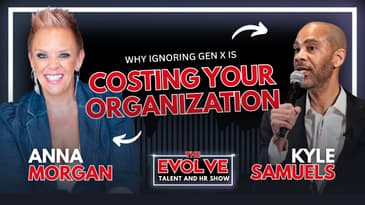
In this episode of the EVOLVE Talent and HR Show, Rhona Pierce sits down with executive recruiter Kyle Samuels live from EVOLVE 2026 in Atlanta to discuss an overlooked workforce advantage: Gen X leaders. While organizations focus heavily on attracting Gen Z and Millennials, Kyle argues that companies are missing a powerful opportunity by overlooking the generation currently running teams, bridging cultures, and delivering stability inside organizations. From hiring bias to candidate experience and leadership maturity, this conversation explores why Gen X professionals bring a unique combination of work ethic, technological fluency, and organizational loyalty that many companies underestimate. If you're a recruiter, HR leader, or hiring manager, this episode challenges you to rethink how generational dynamics shape your talent strategy. In this episode, you’ll learn: - Why Gen X may be the most undervalued leadership generation - How hiring processes unintentionally filter out experienced candidates - Why Gen X leaders offer stability and loyalty organizations often overlook - The role generational bias plays in recruiting decisions - What Gen X can teach younger generations about leadership and execution - What Gen Z can teach Gen X about boundaries and work-life balance - How recruiters and HR leaders can make hiring processes more inclusive across generations - A simple way to audit your hiring process for generational bias Key Moments / Timestamps 00:00 – Welcome to the EVOLVE Talent & HR Show 02:17 – Kyle Samuels’ journey into executive search 03:20 – Why Gen X is the workforce’s secret weapon 05:13 – How Gen X candidates experience modern hiring processes 07:42 – Hidden signals in job descriptions that discourage experienced candidates 08:48 – Why companies overlook Gen X talent 09:51 – The loyalty advantage Gen X brings to organizations 11:04 – What Gen X can learn from Gen Z about work-life boundaries 12:58 – How HR leaders can reduce generational bias in hiring 13:41 – Where to connect with Kyle Samuels Kyle Samuels is the founder of Creative Talent Endeavors, an executive search and career advisory firm specializing in leadership placements and outplacement services. With experience placing senior leaders across industries, Kyle helps organizations identify top executive talent while also guiding professionals through career transitions. He is a frequent speaker on leadership hiring trends, generational workforce dynamics, and candidate experience. | Follow Us | Follow Kyle Samuels Website | https://www.hirecte.com LinkedIn | https://www.linkedin.com/in/kylesamuels Follow Rhona Pierce Website | https://www.rhonapierce.com/ LinkedIn | https://www.linkedin.com/in/rhonapierce Instagram | https://www.instagram.com/rhonabpierce/ Follow Anna Morgan Website | https://yourcareerbff.com/ LinkedIn | https://www.linkedin.com/company/evolve-conference-careerbff/posts/?feedView=all Instagram | https://www.instagram.com/annamorgancareerbff/ Facebook | https://web.facebook.com/anna.morgan.351104 Join the EVOLVE Shine 2027 waitlist: https://yourcareerbff.com/evolve-2027 Interested in collaborating or sponsoring EVOLVE experiences? Book an EVOLVE partnership call: https://calendly.com/annamorgan/evolve-partnership If this episode resonated, subscribe, share it with a fellow HR or Talent leader, and leave a review to help more people-first leaders discover the show.
Powered by the WRKdefined Podcast Network.
[00:00:00] Welcome to the Evolve Talent and HR Show. I'm Anna Morgan, your career BFF known as the Rescuer of Dogs and Careers, but now the creator of the Evolve Talent and HR Experience. My career has been one big series of unexpected plot twists that now have landed me in the world of events for the recruitment and HR industry.
[00:00:23] Evolve was born from a desire to build heart-centered spaces for leaders to show up boldly and learn together. This show is for the modern day employee, a people first leader, individual contributors, managers, executives, practitioners, entrepreneurs, and fractional leaders who care deeply about humans and are not afraid to do work differently.
[00:00:48] If you influence how people are hired, developed, led, and supported, you belong here. On this show, you're going to hear conversations with talent acquisition leaders, HR business partners, event organizers, sponsors, speakers, and attendees who are passionate about building human-centered, connected, and creative workplaces.
[00:01:10] So if you're ready for something a little bit different, community, fresh energy, and practical inspiration that you can use right away, you're in the right place. This is the Evolve Talent and HR Show. Let's dive in.
[00:01:27] I can guarantee you your company does not care about you as much as you think they do, because unfortunately with all the layoffs that have happened over the last few years, there are people who are shell-shocked. They've given their blood, sweat, and tears to organizations for 20 years. They're now out here trying to figure things out. The company doesn't care about your 20 years.
[00:01:43] Everyone's talking about how to attract Gen Z. Meanwhile, there's a generation running your teams, bridging your workforce, staying loyal, and no one's fighting to keep them. Gen X built this house, and ignoring them is costing you.
[00:01:59] Kyle Samuels is the founder of Creative Talent Endeavors and an executive recruiter who spent years placing leadership talent. And today, he's joining me live at Evolve 2026 in Atlanta to chat about why Gen X is your biggest competitive advantage. Kyle, welcome to the show. Thank you for having me.
[00:02:18] Oh, and if we haven't met yet, I'm Rona Pierce, host of the Workfluencer podcast. But today, I'm taking over the Your Career BFF podcast live at Evolve 2026 in Atlanta. All right. So, for those who haven't met you yet, what's the Kyle Samuels story in 30 seconds?
[00:02:35] Ooh. Let's see. Introverted single or introverted only child. Grew up in Cleveland, Ohio. Went to college. Worked in entertainment for a little bit. Realized he was too introverted for that. Got into recruiting. Loved it. Went to business school. Worked at GE Aviation and Yum Brands. Started his own company nine years ago. And now he does executive search and outplacement.
[00:03:00] Amazing. So, you just spoke about candidate experience and employer brand. And the thing that stood out to me about is how much of the conversation ignores an entire generation. What does Gen X bring to leadership that younger generations haven't developed yet? Reps. Reps. So, Gen X is the secret weapon. I am Gen X, right? So, I'm biased. But I'm going to tell you why.
[00:03:27] We are old enough to remember there is no such thing as participation trophies. If you want to get the gold medal, you have to come in first. If you want to get promoted, you do the work first. You don't get to a job for six months and say, hey, when can I get promoted, right? So, we have a work ethic. We know we have to execute to get the rewards that we want.
[00:03:46] At the same time, we are young enough to understand technology. We can vibe code with the best of them. We understand digital marketing. We understand social media. So, I think a lot of employers are missing out when they avoid Gen X because you get the complaints. Oh, these kids, they want to get promoted without doing the work. Gen X has you. And if you go to the other part, oh, these old heads don't understand how technology works. Gen X has you.
[00:04:15] I love that. What happens to a Gen X candidate when they go through the hiring process that wasn't designed for someone like them? That was basically designed for someone 20 years younger than them. So, they'll usually pick this up in the questioning, right? So, like, oh, you have kids, right? That's something people start to think about when they're talking about how they do their time, right?
[00:04:45] Or the interview is more transactional, more tech-focused. And when I say tech-focused, I don't mean the job. I mean, you're doing mostly things through AI and forms versus actual conversations. Because if you're looking for someone who's typically more junior, you're going to spend less time. It's one of those things you spend on the executive meetings, right? So, they don't necessarily get the same holistic experience that they were used to getting in years prior.
[00:05:13] That's unfortunate. Why do you think we've skipped over Gen X? So, first off, before us, we had the boomers, right? Then after us, we had millennials. Gen X is just, first off, even the name isn't as fly as like being a boomer millennial. So, we have bad branding. That's part of it. Number two, we're a shorter generation. I don't know the gaps, but like we're maybe 15, 20 years versus some of these are wider, right?
[00:05:41] So, I think that's it. And the other part is we're a culture that loves youth, right? Like that's what we want. That's what we desire. We think the youngest is the best typically. And so, they start to get biased when it comes to looking for a job, especially if you're unfortunate enough to be in your late 40s, early 50s looking for a job.
[00:06:01] That can be very tough because companies are thinking about, oh, are they going to have the runway? We want someone who could give us 20 years. They're only going to want to hang out here for a little bit. Are they going to be up to speed, etc.? Right? So, there are myriad issues that happen when it comes to being Gen X in the workplace. Unfortunately, all of those issues are just bias, are just generalizations that aren't necessarily true for every single individual because the same thing could be said about any other generation.
[00:06:31] Just because you're young, just because you're Gen Z doesn't mean you want to be in the workforce for 20 years. Maybe you just want to do it for a few years while you build what you want to do for 20 years. Absolutely. I like that. So, I know you spoke about how Gen X can tell during interviews through the questioning that the process wasn't really designed for them. Is there a way that they can tell from the employer branding in general?
[00:06:57] Yeah. I mean, so, let's say you're looking for, we'll say a middle manager role, right? Because, you know, executives tend to be older and more experienced, right? So, middle manager role. One of the things I would say is years of experience. So, if you're 45, say you graduated at 22, you got 23 years of experience. The job might be asking for 12, right?
[00:07:19] Now, could be that they didn't want to eliminate people with more years of experience who could be a fit or they're doing that because, again, if you assume someone who graduates undergrad is 22, you want a 34-year-old, right? So, I tell people, pay attention to the years of experience required because that's kind of telling about where they're looking to hire, right? For that role. So, that's one of the first things I would tell someone. That's a, I had never thought about reverse engineering it that way.
[00:07:47] Obviously, I'm usually on the other side, on the hiring side, writing these things. And by the way, I'm team, don't write years of experience. Like, what does that even mean? But that's a whole other conversation. But I had never thought that it could be used as a signal to candidates about, like, who are they really trying to hire age-wise? That's a good one. And I will shoot a little bail on employers. It's also comp-wise, right?
[00:08:14] So, like, if you've got 13 years of experience, you shouldn't typically expect the same comp as someone with 22 years of experience. Yeah. True. True. But again, generalizations, because not necessarily true, but most likely, yes. Everyone's obsessed with attracting talent. But Gen X doesn't job hop like other generations.
[00:08:40] What do companies miss when they focus only on attracting younger generations? Loyalty, right? And part of that loyalty is not necessarily that some company is going to, or you're going to give your firstborn kid to a company. But what I mean by loyalty is this. You've got more going on when you're typically in your 40s and in your 20s, 30s, right? Probably got a family, maybe a kid or two, right? So, you want stability. You want consistency.
[00:09:10] It's not feasible to move across the country every couple of years for that shiny new job because you have a kid and a partner, etc., right? And so, companies are always worried about hiring someone who's a job hopper. But the best predictor of future behavior is past behavior. So, if you have someone who typically stays five plus years, they're probably going to do the same thing. Whereas you look at resumes of younger people, they jump around more. And that's not a bad thing. You're still learning. You're trying to figure out what do I like? What am I good at?
[00:09:40] But when you're Gen X, you've kind of figured that out and you've kind of said, listen, I'm 47. It's too late for law school. We're going to keep thugging this HR thing out because that's what I know, right? So, you get a little bit more stability and consistency. I love it. Is there anything that you think is important for listeners to know that I haven't asked you? There's not a question. It's just more of like it's a hidden value. It's a – what do you call it in stock? It's like a sleeper stock that is undervalued, right?
[00:10:10] Because – all right. I'm not going to say that because I don't want to put some of the stuff out there. But there's someone I know who is Gen X in my company. So, I keep it vague. And they are phenomenal. They are the king of how can I help? How can I do more? Hey, I checked – no, you didn't ask me to do this, but I checked this out. Here's what we're doing, right?
[00:10:34] And that is very different from what you might find from someone with less experience, right? And a part of it is because they haven't been around and had as many reps. But the other part could be they just don't have that type of internal motivation because they don't come from the era of you only get the championship by winning. You don't get the medal just for showing up, right? And so, I really think again and again, companies are missing out on some great, great hires. Yeah.
[00:11:32] People have watches. People have pensions. It's a dub for all that. That's over, right? And so, the younger generation realizes that their life is more than their occupation. And so, they have outside interests. They want to do different things. They might want to do different jobs within the same organization. Now, again, they're youthful, so they have more leeway, right? But I think that older people can learn to – I don't like the term work-life balance,
[00:11:59] but I can guarantee you your company does not care about you as much as you think they do. And so, you have to make sure you're performing at work, absolutely, but don't make it your whole identity because unfortunately, with all the layoffs that have happened over the last few years, there are people who are shell-shocked. They've given their blood, sweat, and tears to organizations for 20 years. They haven't – last time they interviewed, LinkedIn didn't exist. And so, they're now out here trying to figure things out. Company doesn't care about your 20 years.
[00:12:28] Oh, we made a shareholder value, right? So, I think that not tying your whole worth into your organization, unless it's your company, I guess, is something to think about because they definitely don't. I love that. Let's say you're a recruiter, you're a leader at a company, you're in HR. What's something they can do this week to start ensuring that their hiring process isn't repelling Gen X?
[00:12:58] Honestly, and this might be scary for some people, I'd ask candidates. I'd survey candidates and I'd say, what's your perception? Now, maybe you want to do it with the people that you actually hire just because there might be more amenable than someone you said, no, you can't work here, right? But I'd do a survey and see like, all right, you joined us. What were your thoughts? What was your experience through the process? How did we come across? Did we feel like culturally a good fit?
[00:13:26] Did you feel like we were aimed at you, et cetera? But I'd ask them, right? Because if you hear people say, no, but I joined anyway because of blah, blah, blah, blah, blah, then you want to figure that out. I love that. How can viewers connect with you? Oh, let's see. You can go to www.hirecte.com and you can learn all about our executive search practice as well as our outplacement. We provide outplacement services.
[00:13:53] We work with corporations as well as counseling for individuals who are looking for a role. And that could be whether you're currently employed or you're unemployed. Or you can find me on LinkedIn. And we'll add all of that in the show notes. But before we wrap, I have a quick and I think fun rapid fire segment. Let's do it. Just fill in the blanks, whatever comes to mind first. All right, let's go. Normalize. Safety. Stop rewarding.
[00:14:24] Basicness. Hmm. We need less blank and more blank. We need less technology and more human. Success doesn't come from. Hope. Culture isn't blank. It's blank. Isn't static. It's dynamic. Amazing. Thank you so much for joining me on the show. Thank you. Thank you for joining me today on the Evolved Talent and HR Show.
[00:14:52] I'm Anna Morgan, always your career BFF. And my intention here is simple. To create brave, fun, and high-trust spaces for people-first leaders so that they can connect, learn, and also remember that they are not alone in this work. So if today's episode gave you a moment of relief, made you laugh, or gave you that spark to just keep going, then we are doing our job.
[00:15:18] Until next time, please keep showing up boldly, keep caring about humans, and always keep evolving. Bye!
Sponsors
