
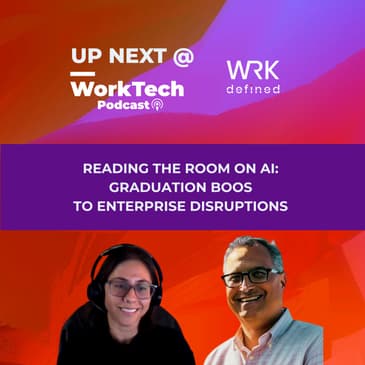
Welcome to a packed episode of Up Next @ WorkTech, the premier crossover podcast featuring George LaRocque (founder of WorkTech) and Kate Achille (host of The Devon Group’s Up Next at Work podcast).
In this edition, George and Kate break down the rapidly shifting intersections of AI, employer leverage, and the major technological shakeups redefining the modern workplace.
-
The Gen Z Dilemma: The hosts dissect a viral UCF commencement speech where graduates booed a corporate narrative praising AI and billionaires. With Gallup showing young Americans losing confidence in the labor market, George explains how entry-level hiring is fracturing: companies are increasingly bypassing foundational roles by equipping seasoned workers with AI.
-
Forced Tech Adaptations: AI is reshaping academia. Princeton University has phased out its 133-year-old unproctored honor code to combat AI cheating, while a massive Instructure Canvas outage recently derailed finals week at Rutgers and LA schools.
-
The Benefits Scale-Back: Major employers like Zoom and Deloitte are cutting 401(k) matches and parental leave. The hosts warn that leveraging current employer market power to slash benefits is short-sighted and risks major cultural backlash when the talent market swings back.
-
The Solopreneur Illusion: Reviewing the new Workday, Anthropic, and LISC accelerator, Kate and George argue that giving 15 solopreneurs just $10,000 and limited Claude AI credits is more of a corporate goodwill exercise than a structural business accelerator.
-
Big Tech Infiltrates HCM: Intuit is making an aggressive move into the SMB payroll and HCM space with QuickBooks Workforce, posing a direct threat to legacy players like ADP and Paylocity. Meanwhile, AWS is entering high-volume recruiting with an agentic platform, though George warns they may underestimate the complex 12-to-18-month enterprise sales cycle.
-
Voice AI & Funding Wins: Following a key acquisition by Greenhouse and an acquihire by Ashby, asynchronous Voice AI is overcoming historical candidate pushback to become a core recruiting interface. Finally, the hosts celebrate Kashable’s $60 million Series C round as a massive win for employee financial wellness.
On this episode Kate and George discuss Artificial Intelligence (AI), AI layoffs, job market pessimism, Gen Z employment, QuickBooks Workforce, Amazon Web Services (AWS) hiring platform, Voice AI recruiting, employee benefits scaling back, tech-driven workplace shift, Human Capital Management (HCM).
Learn more about your ad choices. Visit megaphone.fm/adchoices
Powered by the WRKdefined Podcast Network.
[00:00:00] Two of our favorite podcasts are crossing over every two weeks. Kate Achille of Up Next at Work and George LaRocque of WorkTech look at the tech, business, and people that impact our HR and work tech industry. It's a crosstalk with a unique strategic lens on what's happening in our world. Enjoy! Hey, Kate. Hey, George. How you doing? I'm doing well. It's slowly turning into spring and, you know, going up and down with
[00:00:27] the weather, but ready. I'm ready. How are you? I'm doing all right. Here we are. It's, yeah, it's the middle, about the middle of May, which means it's, you know, it's college graduation season. Yep. And for anyone listening, there's been a lot of news about what's happening, obviously, with college graduations and early career entrants. And this week, there was a viral commencement speech that maybe some of our listeners have seen. And if not, I think we're going to talk
[00:00:56] about it here for a second. And it came out of the University of Central Florida's College of Arts and Humanities. So I do want to stress that it was the College of Arts and Humanities before we get into this. So the speaker was, her name was Gloria Caulfield, I believe. And she's a real estate executive. All of these things are very interesting because they seem a little bit disparate given her speech, which focused heavily on the fact that AI is the fourth industrial revolution. Yeah.
[00:01:25] And the audience was not really a fan of that comment at all. And I think she thought that was going to land. She did. And yeah, she really thought, she really thought they were going to be excited about that. It was surprising. It like how upset they got. They were really, they boot her. The clip that I saw, they boot her twice. They boot her when she said
[00:01:53] the fourth industrial revolution and she was flustered. And then when she started up again, they boot her again when she talked about the amount of change that was going to happen. Well, I guess, so I read a bunch of coverage of this and you know, I think most of the clips online are of that moment that you just talked about. Okay. But apparently earlier in the speech, she was praising some notable billionaires. So I don't
[00:02:20] think she had started off necessarily on the right foot with this crowd of arts and humanities graduates. Well, didn't read the room. She did not read the room. Oh, she didn't read the room because you know, I mean, anyone who's an English major is not going to ever be a billionaire probably. Right. So, you know, talking about people like Jeff Bezos, this is not your crowd, especially, you know, like the Met Gala was a couple of weeks ago that also didn't get great, uh,
[00:02:47] great PR in light of what's, you know, the Bezos, Lauren Sanchez and Jeff Bezos' involvement this year, especially considering the theme had to do with art this year. So again, I think this particular commencement speaker really, yeah, failed to read the room. I don't think she was able to pivot either, given that, you know, I don't think she's a professional speaker, but yeah, talking about AI to a bunch of new people who are entering
[00:03:12] a not great job market about AI and telling them you're in the middle of an industrial revolution. And Hey, think about all these great billionaires that you could be like, and aren't they inspirational? Yeah. Yeah. Yeah. Not the right. There's also been a lot happening in like the general university systems lately that I think maybe is factoring into some of this too. Uh, you know, there was a big, I guess before, before we talk about what young people, uh,
[00:03:42] are thinking about the job market, I think there's, there's two things that have happened recently that I want to cover the first being Princeton, which is notoriously one of the least flexible universities in the country. And also one of the oldest, they just decided that they need to make some changes because of AI. They have like, they have an honor code that has existed since 1893. This honor code is that when they take their exams, the teachers actually leave the room.
[00:04:08] Like they are unproctored exams and they all have to sign a little pledge that says like, we will not cheat, but because of AI, they're going to have to move to a proctored model. So that's, that's, that's, that's interesting to me. That's big. It's big for Princeton. Cause again, anybody who knows, you know, the Ivy league, especially they're not fond of change, especially forced change. And then the other big thing is, and this, this affected like the entire country was a structures hack last week. Yeah. Yeah. The canvas system.
[00:04:38] Yeah. Yeah. The whole canvas system went down and George, I think you said your son was set. Well, not as impacted, but somewhat. Well, so he's at Rutgers, Rutgers uses canvas. And so everybody at Rutgers, it was, you know, finals. It's that time of year. And yeah, he did have some finals rescheduled. It didn't impact his schedule. Like it did some, some, uh, students were going to have to take their final on Sunday,
[00:05:07] which was mother's day. And, but it went on all week. So as a, as a parent and subscribing to whatever messaging system I subscribed to that I can't remember, but, but I was getting notifications about the canvas outage all week long. And it went from, you know, it's down, we're aware of it. We're looking into it. It's down, it's down everywhere. And, and then it ended up being this hack.
[00:05:32] It, it, yeah, it wasn't a good week for technology with the, with the young people. No, no. And I mean, to take out an entire, I mean, the week of finals. Yeah. I mean, and my, my sister-in-law is studying out in LA and same thing. She wasn't able to submit things. So yeah, nationwide outage the week of finals. So yes, I do think this speech, we have, we have a lot of factors here happening all at once. Yeah.
[00:06:00] So I don't think the university of central Florida speech was necessarily the most inspirational topic to go in with. I, um, I'm trying to remember my own college graduation speech. I do know that my commencement speaker at Rutgers, I believe he had been a contestant on the apprentice. Oh boy. I honestly could not tell you what he said to us though, but I think it was like the generic, like go forth and do great things sort of message. Sure.
[00:06:26] Um, and you know, I graduated like right before the great recession. So kind of similar job market, but you know, That's a good segue to the pessimism. Yeah, exactly. And that's like, so, you know what it's like to sit there feeling that that's the other backdrop to this is the layoffs caused by AI or, or, you know, AI among other factors. And, but AI is in every conversation about layoffs these days.
[00:06:55] And this is happening at a time when the job market, the pessimism about the job market has never been, I don't think it's ever been higher for young people. Yeah, it's, it's really bad. Yeah. Gallup released a study that says in no other country does young Americans confidence in the job market lag behind older adults by such a wide margin. So young Americans really do not think that the U S is doing a good job in terms of helping
[00:07:23] them find jobs or get ahead in any way. Young Americans are no longer more positive about job prospects and older Americans. So it's, um, and it's fallen sharply since 2024 and 2025. It's, uh, and that's, you know, about the time that we've really seen this acceleration of AI and AI layoffs. So, and it's, it's a weird, it's such a, it's such a drastic turnabout on the way things have
[00:07:49] always worked when you, when you're getting out of school, you're a hardworking, high energy, young, less expensive source of work. So companies could invest in turning you into giving you the skills, turning it into an expert, bringing you along. And now the theory is that AI is going to do all of that work that they would have had to
[00:08:13] invest in training you on the, you know, on top of while the more seasoned worker has the expertise to actually leverage the AI to be more effective. So it's a, it's not a very good long-term strategy because the older workers are the ones who age out. So your, your, it's really is a, um, I just don't see this ending well for anyone if this
[00:08:41] is the path that we're actually going to be on. So they have a right to be pessimistic. Oh, a hundred percent. A hundred percent. You know, the interesting thing is in the Gallup research though, it does say towards the end, young Americans were actually more pessimistic than they are now back during the great recession. Oh, okay. So in, it says in the early 2010s. So that's kind of, you know, mid to tail end of the great recession.
[00:09:06] So, you know, you now have those of us at middle age included in this, but we, I guess, are more positive now about job market process, the job market. Okay. So maybe we need to help our, our younger, our younger peers. Um, maybe, maybe that's, you know, maybe this is sort of that middle, middle manager on our way up is, uh, is how we help. I don't know. Well, yeah.
[00:09:31] I mean that, if you think about it shortly after that 2010 timeframe, it's, you know, growth, growth, growth. We've had an extended period of growth. So it, it, you know, these, we've all been benefiting from that. Yeah. Yeah. And now that doesn't exist for this group. I, I try not to go to any extremes. Like I'm, I'm not, uh, I'm not a, I'm not on the hype cycle bandwagon that everything's going to be fine.
[00:10:00] And AI is just going to fix everything. But I'm also not on the doom loop that we're just in for a completely dystopian future. But the middle doesn't seem to look that great. Yeah. So I, you know, I don't think anybody. There's a messy middle that we need to figure out. Yeah. And it's just the, the speed here, the, the pace at which this change is happening is what's different than any other of these cycles we've ever been through before. Or, um, and that's impacting everybody and, and, and, you know, at, at all levels, but
[00:10:29] it's, I think it's especially hurting the younger generations. I think the speed and also the lack of guardrails, there are no guardrails in sight and there don't seem to like the track isn't, the track is completely unmanned is sort of like, I just, you know, you mentioned doom loop. So like, I'm thinking about a roller coaster and it just like, as the track is being built, there are no, there's no safeties anywhere. Yeah. This isn't like the, you know, this isn't like at Six Flags, this is like the bad carnival in town that gets set up for a weekend.
[00:10:58] This is that ride that you don't want to be on, you know, um, that's being manned by like some teenager who's smoking a cigarette and not, not paying attention at all. Not to say that, you know, at least at Six Flags, they've done the background check. You know, they, they know who they've hired, you know, I could really keep going with this analogy, but, but we have other things to cover. This is true. This is true. This is true. Speaking of folks already in the workforce, we did simultaneously with all this great news. There were multiple reports.
[00:11:27] The one I focused on was Zoom and Deloitte scaling back employee benefits that could signal a broader workplace shift. And when you Google employers scaling back benefits, I had, I could have picked from about 10 different stories about, um, the, uh, about K's, how they're being frozen, matchings being frozen about benefits just being scaled back in general.
[00:11:57] This is, for me, this falls under just because they can doesn't mean they should. I think it's again, short-sighted benefits in this article. When they talk to these employers, they talk about the fact that employees don't have the leverage that they used to have. And that's, I don't think they remember how painful it was when the market turned to the employee side. And I think this is really, really short-sighted because I think we will get through this and
[00:12:25] the job market will change and, and, and we'll adjust and people will adjust and then they'll get their day. They'll get their day. A hundred percent. I mean, the market always changes and we always go from, you know, employer driven to candidate driven, like it always ping pongs. I mean, this time it might be a longer cycle of employer driven because of all this, you know, technological advancement or innovation, however we want to spend it. Um, but you know, what concerns me about the reduction of benefits also is we keep cutting
[00:12:55] them and we keep cutting them and we keep cutting them. And, you know, when I are both old enough to remember times when there were a lot more benefits and like, at what point do employees have no benefits left? Basically. Like, I'm not saying that we all need weekly happy hours and ping pong tables and things like that. I mean, so many of us are remote and hybrid at this point anyways, however, you know, gone are the days of expense accounts and gone are the days, you know, the workforce used
[00:13:25] to have a lot more in terms of benefits. Employers used to take, look after their employees in a way that they don't anymore. And, you know, how much can we cut, especially given the cost of living and the cost, like the rapid rise of inflation. I mean, I think, what was it? 3.8% last month inflation. Yeah, that's right. The inflation rate was or something like that. Like, you know, cutting benefits does have a correlation to things like that. You know, people are hurting right now.
[00:13:53] So cutting benefits is going to impact these people and their families. Like, it's not just the employee. It's the entire ecosystem that they're supporting. Yeah. Yeah. And they're cutting things like parental leave. And, you know, it's it's that's the type of benefit that where you have to make a financial decision about how much time you can afford to take off. Right. And and most benefits decisions are like that.
[00:14:19] But but that but it's it's it's just we don't have much to begin with, is my you know what I mean? Like, we're already so far behind other world industrialized nations in terms of leave. Yeah. And yeah, it's and like we already have to argue our way and fight our way to make leave requests and justify our existence in a lot of situations. And I just I you know, I said this to you in an email the other day, like with all of
[00:14:47] this talk about AI, I really feel like we're all starting to lose our humanity at the same time. And I think these companies are putting, you know, the fact that they can save a little money above above humanity. And yeah, when the market shifts, that's not going to shift in their favor. And, you know, we are seeing examples of how you can still have humanity and save money. And I think, you know, balance budgets and save, you know, I mean,
[00:15:11] I won't get too political, but yeah, but I but you surfaced another article. And if it all gets to be too much and you decide to break out on your own and you've got a great idea. Yeah. Yeah. Oh, that's my segue to you for for the others. Except it's not going to get you anywhere is the real at the end of the day, because the figure involved in this again in today's money. I don't know.
[00:15:41] I listen to that podcast, My Favorite Murder, and they always do the conversion between like, you know, they'll tell a story from, you know, 1910. And they'll be like, and it was $2,500. What do you think that equates to in today's money? Workday and Anthropic and Local Initiatives Support Corporation launch AI focused solopreneurship accelerator program. Okay.
[00:16:05] It's a pilot program that will use the power of AI to unlock economic opportunity for new solopreneurs in the US. Sounds lovely, right? It sounds like a lovely idea to help some some people with new ideas, you know, help launch their small businesses. These are massive companies with tons of money. And they are going to be giving 15 aspiring solopreneurs $10,000 each.
[00:16:34] Now, once you pay the taxes on that, I mean, I'm assuming you have to pay taxes on that grant, depending on where you live and what the structure is. It's buying you. Yeah. And it's a grant, right? It's a grant, it says. I think it's a grant to cover business expenses. And again, I don't know what the language in it is going to say. I don't know if there's stipulations for what you can and cannot use it for. But like some grants are very specific in terms of, you know, you can only use this for. It does say that you will have access to a limited number of Claude AI credits free of
[00:17:04] charge. Limited number. I just, you know, I mean, again, nice idea in theory. It's a press release. It's a press release. It launches, I guess the program launches this summer. For anyone who is interested, the initial cohort will begin in July. Yeah. Well, I think, especially, you know, with Anthropic being behind it and Workday, but,
[00:17:28] you know, it's a goodwill press release to say where we're trying to help people, you know, and one of the big theories is that, you know, you can be more productive and the shape of the economy is going to change. There will be a lot more solopreneurs and smaller businesses generating a lot more money. But this is no one's a full-time employee. No one has benefits anymore. Right. That's why. Yeah. And that, you know, anybody with a spouse like that doesn't, that wouldn't, that doesn't
[00:17:57] cover a year of, of benefits like 10 K's is not, it doesn't. It doesn't cover a year of pencils at this point. Right. Right. Right. Yeah. Again, I just, it maybe, you know, in my mind, again, interesting idea. Maybe if it were just three solopreneurs, like 50,000 each. Right. Or 25,000. I feel like maybe that would go a little further in today's dollars. Yeah.
[00:18:28] AI again, also, you know, costs are rising also because of, you know, things you and I were talking about before in terms of usage and data centers and grids and supply chain. And AI is not going to be free or cheap or any of that forever. Tokens, you know, we were talking about. Yeah. Even, even this limited number of clawed credits, they're not giving you free, free reign because there's costs. Yeah.
[00:18:53] It's, it is, it is a very, like I see a lot of accelerate, like they're, they're, they're positioning this grant as an accelerator program. But unless I missed something, there's nothing in this that's really an accelerator. Like it's, it's a $10,000 check and they get to, I'm sure they'll, they'll have another press release where they're announcing the 15 entrepreneurs. When the big checks are printed. Right.
[00:19:18] But in an accelerator program, yeah, but like an accelerator program, which would be tech oriented, these may not just be tech companies, but you get access to advisors, you get access to technology, you get access to sometimes in credit, like the, for tech companies, AWS hosting credits. So this, the thing about this is it feels like a pretty thin commitment on their part.
[00:19:44] And I think it, it's definitely probably one of many little drops in the bucket that, that they'll have to put a positive spin on, on their place in the world. I mean, Anthropic is viewed as the more, the, the less evil. AI for good. Yeah. And just to be clear, like a lot of these stories are about the impact of AI, the downside. I'm an AI enthusiast. I just, and I'm, I use it every day and I am excited about what it can do.
[00:20:14] I just also believe to your point earlier that we can have regulations. We can innovate and drive this kind of innovation without leaving everybody behind. We can, if we're, if we need to do it this quickly, you know, we certainly can fund programs so that people that are impacted are less impacted. I just think we have to look at the previous industrial revolutions. You know what I mean?
[00:20:43] Like we developed the car, we built roads, we put lines on them. We developed laws. We made people get licenses. You know what I mean? Like we didn't just let everybody start driving. Right. You know, there have to be systems to support the technologies beyond just letting it happen. Yeah. There are too many people in the world.
[00:21:07] I, you know, you know, inside my little tiny inner baby teenage anarchist wishes that we could just be a bit more nihilistic and let things roll. But there are just too many people in the world and there are too many people with bad intent. Yeah. Yeah. So I am with you that I'm not anti-AI. I just think that as we put the wheels on the bus, we need to make sure there is someone driving it in the right direction. Yeah. Yeah. It's at so many levels.
[00:21:36] There's a, I just saw a story about a town in New Jersey. I'm trying to think it's down on the shore. They're building a data center. And in this town, it all happened quietly. And so, and suddenly these massive poles went up that for power lines and the people all around where they're going to build this thing realized what was happening. And now they're freaking out in their town meetings. Oh, it's way far south. I know what you're talking about. Yeah. And, uh, and it's, but the impact is huge.
[00:22:06] The town has 5,000 people in it. Mm-hmm. This data center will use the energy, the equivalent of a town with 200,000 people. And they're trying to say, oh, there won't be any impact on the grid. Yet they're installing these, like, I've never seen anything like it. They're not telephone poles. They're not. They're like the big metal. Yeah. Yeah. They're massive. They're massive. And they're going around talking to folks in the town and they were like, we had, we had no idea this was happening.
[00:22:34] They're sneaking things past people. Yeah. Again, listen, systems have to adapt to what happens in the, in your area. It's to everything. It's not just to AI. Yeah. You know, I used, I used the driving analogy before I got a text message earlier today. They just dropped the speed limit in my town, which I'm so excited about. I have lived here for 14 years. The speed limit has been 35 miles an hour the whole time I've lived here. I've always thought that was ridiculous. It's a residential neighborhood.
[00:23:02] Finding a great career has always been a challenge. But today, with the massive changes underway in just about every sector of the economy, in just about every country in the world, finding a great new career is even more challenging.
[00:23:20] And if you're a student, recent graduate, or someone else early in their career, it's even harder for you because you just don't have the experience that those who might be 10, 20, 30 years older than you have.
[00:23:35] The answer, the podcast from dorms to desks, a podcast by college recruiter job search site, where every week we take a deep dive into a topic specifically of interest to candidates who are early in their careers and looking for a great part-time, seasonal internship or other entry-level job.
[00:24:04] We've had a massive influx population-wise, finally. And there's a playground up the street from me. And while I've lived here, cars have hit houses four times. Oh, wow. You know how ridiculous that is that people drive so fast that houses have been hit by cars? In fact, the same house got hit twice. Wow. In a month. So they finally dropped the speed limit. Again, you have to adjust sometimes. It's just the nature of how the world works. So AI is one of those things where we are going to have to adjust in order to accommodate it and to make it work for us, not against us.
[00:24:34] Yeah. So on that note, we do have some industry news, I believe. We do. Speaking of, you know. Yeah. Working for us. Yeah. So in industry news, there was a what I'm surprised I haven't seen anybody talking about this one. It's the kind of news that I've been waiting to see this headline for a long time. And it finally happened. And it's like, wait a minute. How come I'm the only one excited? So Intuit unveiled QuickBooks Workforce.
[00:25:02] And this is, I'm reading their press release. So this is how they're positioning it. Radically transforming human capital management for small and mid-market businesses. So the market leader, the system that most businesses use to run their finances and that most businesses have integrated into some other payroll or HR system, has now put together the complete offering.
[00:25:29] They've been on their way there for a while, but now they're putting a stake in the ground. They're coming for this market. So all the pays, you know, the paychecks, the paylocity, all of those, the ADPs, the day forces. Dayforce has a big SMB component. There's a big chunk of the HCM space that is now going to start competing with Intuit. They didn't compete with them last month.
[00:25:58] So this is, I think this is big. It's big also because they have the consumer recognition. Yeah. They already have the consumer recognition because in addition to the QuickBooks name, they have TurboTax. They have MailChimp. Like these are already their brands and those are now all bundled together in this QuickBooks workforce platform. Yeah.
[00:26:21] So, I mean, again, they have consumer recognition, brand recognition that a paylocity doesn't have. Yep. So that's, they're kind of already starting a little bit ahead in some regard for a lot of, in a lot of places. In a lot of homes, I should say, I guess. Yeah. This is what we would call an adjacent move, right? And they're, they're, and they're even, they're, they're about as close as you can get being adjacent and not being in our market.
[00:26:49] Because pay and payroll and the other systems they provide, they've been right there. They've had their toes on the line and now they just took a step in. We had another announcement of someone who I would not have put in an adjacent category at all moving into our space. And what was into it, I can see that immediately being wildly successful. This is a wildly successful company that I'm not sure this is going to go the way they, they've, I'm trying not to be totally pessimistic.
[00:27:19] But Amazon, in fact, the AWS division of Amazon is, they've announced a couple of new products, but they're, they're releasing a, an agentic platform for hiring. And it's particularly in the frontline and high volume hiring space, which is a lot of the hiring that they do. And it's based on their processes and their whole playbook of hiring. And they're going to sell it to enterprises.
[00:27:50] I think it, I said this to you earlier, I think it smells like Google hire. I, you know, when Google came out and Lance Hahn had a great piece on LinkedIn. You should look him up and read his piece. Yeah. He references, yeah, he, he referenced Google hire and it was the right analogy, the right comparison. I mean, when Google came in, so many of us thought, okay, this is going to be disruptive. But what Google learned and what Amazon is about to learn is hiring is more complex than people from the outside.
[00:28:20] You know, you may have hired someone, you may have interviewed and got a job. But when you really try to start to solve some of the systemic problems around hiring, there's complexity there. Also, enterprise hiring systems. It takes 12 to 18 months to sell one. I don't know if Amazon understands that yet. So we'll see. Most of the time, these players like this, they come into our space and they make, after about six months, they decide.
[00:28:49] The old saying is the juice isn't worth the squeeze. It's not worth the effort. They've got bigger fish to fry. There's a level of expertise that's required that goes beyond like your data set that you have. Yeah. Well, and Amazon and AWS in general, you know, they tend to launch a lot of things. And like, you know, they like to throw spaghetti at the wall and see what sticks. This is true.
[00:29:15] You know, I think I and I might be making this up, but I believe they're already like they had launched like a little agentic shopping, you know, agent. And I think they're already changing that or sunsetting it or, you know, I saw something earlier. So, I mean, that, you know, it's the Amazon way and the AWS way to experiment publicly. Yeah. Because when you've got, you know, you got the team and you got the time and the money, why not? Right. Right. Okay. What else is happening in the industry?
[00:29:44] Um, we, there were a couple of acquisitions in the same category. One was a traditional acquisition, Greenhouse acquired Ezra AI Labs. And the following week, Ashby came out and announced that they were acquiring Talent Llama. Yep. Which was an acqui-hire. Both of those transactions are voice AI. Greenhouse's announcement, which I went deep on it with them, did an interview.
[00:30:13] They're, they're, you know, in the world, in our landscape, everybody's moving quickly, but they're being thoughtful because they're looking at this as not an AI interviewing. Although there will be interviews done with voice. They're looking at voice, how to leverage voice across the platform. So thinking when you think big picture, the interfaces, we're interacting more with voice. Candidates will interact more with voice. They're looking to get this right.
[00:30:40] And recruiters and talent acquisition leaders will interact with systems more with voice. That's their take. Like, I did not speak to Ashby, but their announcement was 100% focused on interviewing. So they're all about the screening and pulling data out of that. So it's, it's not a category that has been like wildly accepted by candidates.
[00:31:03] So the, this, the, the voice interviewing and greenhouse has research and there are several reasons why candidates don't like it. But the, I believe that it's sort of like video interviewing. Like when that first came out, when higher view first came out, nobody liked that either. And look at us now. And so it's. I don't know that candidates like it now any better than they did then. They just had to accept it. Right. Right. Right. So they'll be beaten into submission with this one as well, but. Right.
[00:31:30] Well, but I, and I, I think the companies that do it right, giving, you know, employers as well as the vendors, I guess, picking vendors who can support options. So there are reasons why this makes good sense. Like you're, you're somebody who, you know, works odd hours and I don't want to use a chat bot, but I would do a voice interview or an async video interview. Or something. Yeah.
[00:31:58] Or the person who has to, they're an engineer. They're not, you know, there's a lot of times we think about frontline hiring for this, but you're at your desk and you're going to go to your car on your lunch break to do this interview. And there, you know, it's the type of thing where you need to be a little flexible with the timing. The AI is always there for you. So there are a lot of reasons why this could be a good option, but yeah, I'm with you.
[00:32:23] I do think about Kevin McAllister though, and home alone with the talk boy, like, you know, disguising as cool. You know, again, I just think about like the deep fake conversation and like how much struggle there is right now around that. And, you know, I had mentioned, I saw Daniel from greenhouse recently talking about that. And so I do just think about, you know, voice and that little device that I desperately wanted as a child and how that could play into, play into this issue. You know, that larger issue. Yeah.
[00:32:52] That was pretty cool. But you know, it didn't work. It was an actual toy. Like it was an actual thing. You know, it didn't work as well. Oh, yeah. Yeah. I'm going to go on eBay though and try to find one right after this. And what's the, it's like, is it Merry Christmas? You filthy animals. Filthy animals. Yeah. Yeah. Christmas you filthy animals. Yeah. Yeah. All right. For moving along on the capital front with industry news. We did.
[00:33:19] We had one really good sign so far this past month. Cashable with a K. Yep. They raised a 60 million Series C. Cashable is, yep, they're a financial wellness company. They provide access to credit. I did an interview with their co-founder, co-CEO, Inot. Inot Stacklove. Inot Stacklove. Yeah. So you can learn all about them, but they, it's a good thing that they provide.
[00:33:48] And her founder story is that she tells in the interview, she was an immigrant, came to the U.S., you know, was employed, but had no credit history. So she couldn't get a credit card. So this helps, it's low cost loans to employees. It helps them establish credit and it gives them access and loan approvals where they might not find them out in the market.
[00:34:10] The reason, along with it being technology and a benefit for good, that it, the reason, another reason it excites me is it was a Series C. And last quarter, we didn't have any of those. So the middle of the market, that's sort of, you know, B, C, it was really thin. The market has looked like a lot of early, really early stage and a lot of late stage. So it's good to see a solution like this be the Series C that I had to talk about. Yeah.
[00:34:40] A nice, healthy Series C. Yeah. And then I know, I know the Cashflow folks announced a collaboration as well, a partnership with another corporate sponsored emergency financial relief program called E for E Relief. And so they're also teaming up with other like-minded sort of benefit providers. So that's kind of cool that they're doing things of that nature.
[00:35:04] So a few other, the same, and the funding side of things, there were a number of other funding so far. But one thing that jumped out at me, there is one of the categories in our space that's being like really disrupted right now would be the job board category. So with all the data that's available, do candidates really need a destination other than your biggest brands to go and look for jobs? Like the AI is finding a lot for you as a candidate these days.
[00:35:33] So I've been talking for years about a shift to more of a value-based marketplace. And we had, there were a number of early stage preceding seed rounds. One is your future. You are future out of the UK. This is a candidate focused marketplace. So it's about finding, you know, putting your profile in and then I have not talked to them.
[00:35:57] I don't know a lot about it, but I can see that it's about, you know, finding great jobs from the candidate's viewpoint, leveraging their AI. Another one that was really interesting to me was Employ, I-N-P-L-O-I, also out of the UK. And, oh, no, I'm sorry. I'm sorry. Giver, G-Y-V-E-R. Employ is interesting, but it's just career sites. It's an agent.
[00:36:22] Giver, G-Y-V-E-R, out of Italy, which is doing a marketplace for skilled trades. They're starting with electricians and they are all about providing value to the candidate and to the employers. Like right now, you can't find skilled tradespeople. And so having a pool of talent there is obviously a great value to the employer. But to the candidates, it's assessing their skills. It's helping them present themselves.
[00:36:50] It's sort of career management for a segment of the workforce that hasn't had a lot of this available. And they provide learning and training and certification as well. And we had a couple other deals like this in healthcare where there's a lot of credentialing going on as well so far this quarter. The tradesmen are using this site. I know. Just because they're not usually like the most, they're not usually online. Right, right.
[00:37:15] That's the, I was just saying this to someone else the other day, not about this deal, but just in general, that human behavior. And like, you know, depending on the market segment, the demographics of it, the, you know, to your point, are those tradespeople going to leverage something like this? I have old friends that are tradespeople and I can't even text them. Like, like, I can't, I, I, like, I have other friends who do other things.
[00:37:45] I, I can text them. I can send them a message in Instagram. Yep. Not, not these guys. Like, those guys are like, you know, I've got to call them. So, um, but that's, I'm not throwing, I'm old. I'm not throwing a blanket over. No, no, no. I just, yeah. It really depends on like your industry and yeah, what you do for a living in terms of kind of where you fall on like the technology spectrum and your, your usage. Right. Every, yeah. Everyone's different. So. Yeah.
[00:38:14] Um, anything, any, any other updates or deals or have we reached? That's it. Or Rosenthorne. There's, there are others coming, but until next time on that. All right. All right. So Rosenthorne, what do you got? What do I got? My, I've got two sides of, uh, the same coin. First off, we've, we talked a lot about the schools and I found out this week that our school district for my youngest, she'll go into middle school next year. They're going back to pen and paper.
[00:38:43] So they've had, you know, we're in a great school district. So all the kids have had, they've had iPads and everything's on the iPad and Google classroom and all of this. And there will be iPads, but they stay in the classroom in a charging dock and they will, it's going to be a huge shift back to submitting your homework and stuff via paper. So the dog ate your homework is going to be an excuse again.
[00:39:10] And then the other side, right. The other side of this, the, the, I have two thorns. One is I saw an article that some schools are pushing back, which there's so much data now on. And it's just better for the kids to be offline and to use a pen and paper and they, they learn much more. So that, that's a thorn. But my second thorn related thorn is she's going into middle school. That's tough. That's, that's tough years. Yeah.
[00:39:40] For me, for me, I'm talking about for me. Oh, for you. I was going to say, those are tough years in general though, especially as a girl. Yeah. Yeah. But just, it just, you know, the last one is in middle school. So, so how about you? Rose and thorn. Rose and thorn. I would say my rose is that my garden is actually taking off, which is sort of surprising considering the weather we've been having. Good. You know, again, cause we've had some really, this has been an exceptionally strange spring here in New Jersey.
[00:40:09] I know for a fact that we're not going to have a peach crop this year, which is very sad. Jersey is known for its peaches as well as its tomatoes. Better not impact the tomatoes. I will be really pissed if that. I had TBD on the tomatoes, but I can tell you, yeah, apparently we're not going to have peaches. And if we have any at all, they're going to be wildly expensive. The farmers are devastated. So, and then my thorn is, I mentioned the last time we recorded that I'm competing and the competition is pretty much here now. I leave on Sunday. So it's, that's a rose and a thorn at the same time.
[00:40:36] So I compete next Wednesday, which is May 20th when we're recording this. So I compete at what will be 9am Eastern, 10am Central. All right. So, you know, it's the culmination of a lot of work and effort. A very interesting last month of my life, lots of highs and lows. So we'll see, we'll see what I can do. It's a, it's probably the last time I'm going to compete at the national level. So, uh. Wow. Okay. Yeah. I don't know that I'm going to continue to do this to myself. So, you know, it's a lot of work. All right. So I'll, I'll continue competing.
[00:41:05] I'm not going to, I'm not going to retire from that, but. So if this were a performance, I would say break a leg, but I feel like that's not appropriate for somebody. No, no, no, no. I don't want to do that. Yeah. Good luck is fine. Good luck is fine. All right. Light weights. Light weights is what we like to say. Okay. You want, you want the, you want all of the weights to feel as light as possible. Okay. Light weights. I like that. I like that. All right. Well, I can't wait to hear how it goes. And. We'll keep it. I'm so, it's so impressive. The whole thing. You compete at the national level. You've been on the national team.
[00:41:35] That's just like, I am. It's just so impressive. Yeah. Yeah. This is it for me at the national level. I've done a lot of cool stuff. Yeah. It's fun. But yeah. So I will, I will keep you posted on that and we'll, we'll be back in a few weeks. All right. All right. Light weights. The light weights. Talk soon. Bye. Take care. Thanks for listening to or watching up next at work tech brought to you by the work defined podcast network, the Devon group and work tech.
Sponsors
