
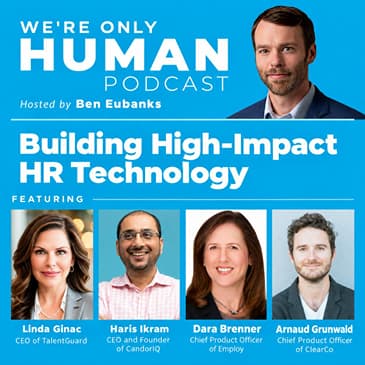
What does it take to build HR technology that delivers real business results?
Four HR tech product leaders explain how they turn customer ideas into product features, use AI to shorten feedback cycles from months to days, and apply AI in talent processes such as job architecture, skills data, and reporting. Guests are @Haris Ikram (CandorIQ), @Dara Brenner (Employ), @Linda Ginac (TalentGuard), and @Arnaud Grunwald (ClearCo).
They also cover the risks of HR teams vibe coding their own tools, how MCP and headless HR tech change who needs to learn the software, and where the industry is heading: AI-native services, shared data across customers, and governance for AI agents.
Key Takeaways
- HR technology only works when the data going in is clean. Bad data multiplies when you add AI.
- Good product teams solve the underlying business problem. They don’t just build the feature a customer asks for.
- AI can pull themes out of sales and customer success calls, which gives product teams feedback that customers never send directly.
- Building prototypes with AI lets customers co-develop features and see changes within days.
- AI can build job architectures, keep skills data current, and generate board decks automatically.
- With MCP and headless HR tech, hiring managers, interviewers and finance partners can do their part of a workflow in tools they already use.
- Vibe coding is fine for personal tools. Shared tools bring risks to data security, compliance and ownership.
- Code built inside a company is company property. It should live in the cloud, not on someone’s laptop or personal account.
- Don’t shut down employee excitement about AI. Point it at fixing internal processes, and leave the high-risk builds to vendors.
- As companies deploy more AI agents, they will need rules for who builds them, how governance works, and who approves them.
Timestamps
00:01 What makes HR technology work
00:05 Turning customer ideas into product features
00:07 How AI shrinks the product feedback cycle
00:09 How employers can become product partners
00:12 AI use cases in talent processes
00:15 MCP and headless HR technology
00:19 The risks of vibe coding HR tools
00:26 Compliance, sensitive data, and build vs. buy
00:32 AI-native services and shared data across customers
00:38 Why AI agents need governance
Keywords
HR technology, AI in HR, HR tech product development, vibe coding risks, MCP, headless HR tech, AI agents, HR data quality, change management, AI governance
Connect with the guests from this episode:
Powered by the WRKdefined Podcast Network.
[00:00:00] When you VibeCode, you're actually creating work for others as well, right? And so you need to be careful. It's an incredible technology that we have at our fingertips, but it's worth thinking, how are we going to do this? How are we going to manage it? What are the gates that we are going to put along the way to be sure that you're actually building something that's sustainable, right? Don't conduct your analysis in isolation because data is so incredibly powerful.
[00:00:30] Not defending just the tribe, but defending the organization. Those creative people that you really want to keep empowered, keep excited, keep motivated, keep thinking. A good experience pays dividends down the line. Here is a time to break down on proximity. Welcome to We're Only Human, a podcast about human resources, business, technology, and the workplace. My name is Ben Eubanks, your host, and I'm so glad you're here.
[00:00:59] Hey, everyone. Welcome to We're Only Human. I am Ben Eubanks, your host. I'm so glad you're here with us today. Today, we have an incredible conversation. As you all know, I've been doing more of these discussions this fall. We're recording with different groups of people, so I can see different perspectives. I've done a lot of single episodes or single interview podcasts over the years and, goodness, over a decade. And I've been doing more of these conversations because I want to get other perspectives in the mix.
[00:01:22] And today is going to be a blast. So in this conversation, I have not one, not two, four incredible panelists. And I was looking at this as I was prepping for it. So three of these people are founders. All of them have served as a CEO at some point. But most importantly for today's conversation, each of these four have a role leading and directing the products that we're building in the HR technology space. And so for the conversation today, I have Harris Ikrom. He is the CEO and co-founder of Candor IQ.
[00:01:53] Arno Grunwald, he is the chief product officer at Clear Company. Dara Brenner, she is the chief product officer at Employee. And then last but not least, Linda Janak. She is the account guard founder and CEO. So four incredible leaders, all of us all here. And we're going to start off actually with a fine question that I have no idea what that's going to become of this. So, Harris, I'm gonna start with you. I'd like you to fill in the blank on this one as we go. So HR technology works when blank. What would you fill in there?
[00:02:23] That's fine. HR technology works when the data, the inputs are clean. Garbage in, garbage out is even more exacerbated in the world of AI. Oh, I love that answer. Okay. Again, you're speaking to my language, which is data. I'm a data nerd as well. So love that. All right, Linda, I'm gonna come to you next. Awesome. Definitely agree with Harris and we've been through the ringer once or twice, making sure that we get the right data.
[00:02:47] But also, I think you have to align the change management process because when you're dealing with that data and there is some cleanup work to do, you're having to pull certain data, you have to have a cadence with the HR team where it does not feel overwhelming. And it's set on the top priorities first. That could be the leadership team or certain division. So you're having to do that. So you're having to do that.
[00:03:14] And then you're having to do that. So it's going to be the right to do that. and it's developed module-wise. It is distributed and sold module-wise,
[00:03:43] implemented module-wise and contracted module-wise. And at the end of the day, it's the employee's journey. It's the employee's life. It's just what should work as one. So that's something that I think a lot about these days. Yeah, some alignment there. A very fragmented market. Yes, that's one of everybody's favorite headlines to talk about, I think. And I like that one. Okay, Dara, what's your answer on this one? Now the pressure's on because everybody else answered and you said you like them, so I better come up with something smart.
[00:04:10] No pressure, but a whole print that is riding on this. So HR technology works when it connects people or talent decisions directly with the business outcomes. I'm over the just automating tasks or tracking data. It's really about giving the folks that are using the application or even those that are ancillary to the application itself actionable insights that can help them move their business forward. Oh my goodness. I love that. Again, each of these is its own separate conversation we could talk about and go deep into.
[00:04:39] I know that I told y'all before we started recording, like I want to dive into every conversation as deep as I can because we have some good stuff here. So we have data from Harris. We have the change management, like people side of that from Linda. Arno Grunwald talked about, they actually have to work together, connected. It can't be this like patchwork thing that people are fumbling through because that's the experience we're creating for them. And then Dara wrapping it up with, and by the way, if it doesn't impact something in the business, then great job. It doesn't really matter. It doesn't really have the impact we're hoping for. So today's conversation,
[00:05:09] the intent is high. And what does it take to build high impact HR technology? And that's the theme title of today's episode. And so we're going to go deeper into this. Thank y'all for letting me do that. I've been doing more of this, like fill in the blank stuff. And it's fine to hear everybody come up from a different perspective. So Dara, I'm going to start with you on our big conversation and everyone's welcome to chime in after Dara does, but how do you bring client IDs into the product so that it continues to evolve, usually meet their needs because there's a lot of customers and it must be an interesting challenge to try to make sure
[00:05:39] that you're meeting your needs on a regular basis. Talk about the process for that. Yeah. So I think about it in four different ways. The first thing is that you got to make sure that the ideas are focused on solving a real business problem rather than like, I like to talk about taking orders. So understanding the difference between what the customer is asking for and the problem that they're actually trying to solve. So I think that's really important. It kind of ties back to that business outcomes I talked about earlier. The second thing is that
[00:06:07] these multi-channel approaches, so think about them as cabs or direct feedback channels, are great for gathering direct feedback, but technology now gives us a way to gather indirect feedback. And so one of the things that we've done really well is that we've tapped into the customer success and sales teams interactions with customers, their calls, for example, and then we interrogate those to pull out the themes and then diagnose those overarching themes so that we can put them into action.
[00:06:36] And so that's the indirect side of it. The next piece is once you've done all of that, involving the customers. So involve them in design reviews, involve them in beta programs, maybe early prototype testing, because that really helps validate your approach with real-world workflows. And then the last one, and probably the most important thing, is making sure that all decisions, and this goes back to what Harris said, are informed and prioritized based on date. Balancing customer requests along with platform scalability,
[00:07:06] along with market trends, and long-term vision is really critical to ensuring that the product solves the problems for the broader user base and not just the loudest voice. Footnote for the audience, a cab, customer advisory board, CAB. So anyone that heard of that, it's like, why is Dara taking a cab? I don't know. There we go. Anyone in there, if you wanted to double down on one or add anything extra to one of those key points? I'll go. I'm pretty fascinated today by the shrinking
[00:07:35] of the feedback cycle with customers, especially with AI and agentic software development. We literally have three customers right now that are fairly different in their size, in their industry, in how they are structured, but they are good feedback givers and they wanted to be part of the development of a new module. They are meeting with us several times a week
[00:08:04] and they're just part of the team and they are giving us feedback on Tuesday and on Thursday they can see the new feature or the enhancement happening and they can give us feedback on it. That's not quite how I was seeing it. Instead of waiting a month or two and then sending the design in Figma just to use a design tool name, now we can just show the product that it's evolved in the past two days and that's really fascinating. Yeah. I love that idea.
[00:08:34] We're seeing the same thing too and as a matter of fact as we're building off of also what Dara said is we're building these prototypes and sharing the prototypes on the fly using AI completely and they're suggesting changes. We are literally putting the changes into the request so they can see it, look at the interaction, see if that interaction works for them and we're tweaking it on the fly and we have the same numbers you have three customers that are very heavy users and are super feedback driven
[00:09:02] and they are literally developing the product with us. It's not even in a cab anymore. It's interactive, AI driven, completely changing the product on the fly as we go and then it goes back to the product managers later to then make sure we've got all the right PBIs and how are we going to prioritize one, two, three, and four from where we are to where we're going and it's phenomenal with how fast we can go and to be honest with less resources. The AI is doing
[00:09:32] a lot of the heavy lifting. Harris, can I ask you to connect, sorry, I'm connected to all those sorts of things. I'm imagining that someone may be listening to this episode as an employer and thinking, how do I do that? How do I be the partner? How do I make sure my voice is heard? If they're of a sufficient size or they're spending a lot with a certain company, how do they approach someone like you, right, you're running product, CEO, your team, how would they do that? What sort of approach should they take? Should they be asking more questions?
[00:10:01] Should they be sending ideas? Talk about that process a little bit, how someone gets started because it's easy to picture the handful of them that are like excited and sitting in these meetings, talking to Arno, talking to Linda about this, but how does someone start that process? Any suggestions? Yeah, I think usually we ask customers to talk about what are their business KPIs? Some of the things that Linda mentioned earlier, what is the problem they're trying to solve? because it's not just about what's that, it's like the faster or worse because you could do that with AI too, right? It could be that
[00:10:31] incremental improvement or there might be an opportunity where we could completely do this in a very different way. It could be AI native and automate a lot of the human work. And so we want to be able to really think about the solution space more creatively for lack of a better word. But you really have to understand what is the customer KPIs? What is the problem they want to solve? So step one is usually that. Once we understand that and that could be a conversation, it could be a document, it could be a plot process flow diagram. It could be us interviewing different personas.
[00:11:01] Our product is multiplayer. We have HR finance, recruiting managers involved and you need to be able to ingest information from different lenses. And so there's multiple ways to get that input, synthesize it and then really iterate from there. So all of those are ways to connect with us on that. In my head, I was making it harder. I think that it actually is. If someone's got some ideas, got some suggestions, it's not just complaints, right? But it's here's some ideas that would make this faster for us because I hear time and time again when I'm talking to leaders like all of you, oh yeah,
[00:11:30] we had this really great idea from a client. We found a way to productize it. We put it in and then now we have 20 clients using that same thing that just one of them raised their hand and suggested to us. And so that's one of the things I was thinking about through this lens of high impact HR technology that's not just about help us meet our needs but we're going to get the benefit of other companies that are using the tools, using the software, that are also suggesting new evolutions, new changes and new ways to bring value into the product to solve those business problems. I love you all coming back to that again and again as the core theme
[00:12:00] because that's the very rarely does someone wake up saying I need a blank solution. No, it's I need a problem a way to solve this problem. We have a problem with hiring. We have a problem with internal ability. We have a problem with compensation. We have a problem with being able to manage performance for our people, whatever that sort of thing is and being able to connect those dots. Linda, I'm going to come to you next. There's this new thing that y'all probably haven't heard of yet called AI but it's this brand new thing. Everyone's talking about it right now. In all seriousness, each of you is doing
[00:12:30] some different things. I've had conversations with each of you about some of the creative stuff you're doing. We heard about some of that a minute ago on product development but let's talk about some use cases. Y'all keep coming back to the business value. It needs to add value in talent processes. So Linda, once you start us off, what are some of the best ways that you're seeing AI add value into the talent process and things like that? I can answer that I think a couple different ways. The first way is being a platform. We've been out there for a while. We weren't AI native but we've introduced
[00:12:59] AI native products if you will and it really is upstream and I think here it started with this. The data has been the hardest part is getting good data, making sure the data is clean, making sure it's not duplicated, not putting bad data in because it multiplies at scale. So we used AI to build out the job architecture, to structure the data, to build good skills, to publish it, to manage the whole governance and the SME review process and that has been hugely important for our customers
[00:13:29] because it saves them a lot of time and a lot of money and it's up to date and it's dynamic and it doesn't die because I think what Dara said earlier is that data is really important but how fresh is the data? How often is it being renewed? So when I'm making a decision on succession, am I making it on data that's two years old, a year old, 30 days, whatever that is and I think that builds trust. I think that's one part of how we help amplify the onboarding process using AI
[00:13:58] specifically focused on data construction but the second part when we were talking to our customers was and I think it goes to what Aaron was saying about business processes and we've been really trying to focus on business processes because we built very modular technology and have been evolving it over time but one of the biggest headaches that the customer said was, oh my gosh, I love all the data that I can get out of Talent Guard, I can get it in the dashlets and in the API but then I still have to take that data structure and put it in a PowerPoint. So what we did is we said, okay,
[00:14:28] during this process when you're done your talent review, you're going to click a button, it's going to build the board deck and it's going to all be generated by AI. Now the customers, oh, we want our own brand in there. So now the way we're going to use AI is you're going to design the template, you're going to give it to us, we program it on the background, they click the button and everything is there. So now, after all of these monthly or quarterly board meetings, they no longer have to spend, I'm talking oodles of hours building a PowerPoint to cut and paste or to make it look pretty to build the board decks,
[00:14:58] we are using AI to do that process as well. And then the third way is we are in certain parts of the software and now beginning to introduce the chat through MCP. We've already introduced the MCP to build the job roles through Claude, but now we've connected the API to our, we connected the MCP to our API for the data, but now what we're trying to do is figure out how do you now introduce a tool that can access the API for that instance,
[00:15:28] but you've got to be careful about how you pull and ask that data because of the PII and all the data privacy and the cybersecurity. So we're there now where we want the customer to be able to ask the chat about any of its data or any of its processes and be intelligent and easy on the fly for whatever they need, similar to I think what Apollo.io does and I think they have the best integrated AI chat ever, we want to move in that direction as well. So we're really testing that in a very
[00:15:57] responsible way to see what's possible, where the guardrails are so that it's easier for the customer to get what they want. So those would be three examples on an external basis where we're trying to apply and are applying AI so that it helps the customer complete whatever they need faster. And I'll jump in there. I love those examples, Linda. And you also opened the door to the next acronym that we're going to have to deal with and I'm sure we're all going to see it at HR Tech. Years ago, it was cloud, then it was BI
[00:16:26] and analytics and now it's AI and this year it'll probably be MCP. And so I think one of the best use cases in my mind for AI is definitely making things easier for people, getting the administrative and manual work off of them so they can focus on the most important thing for them. And in the talent acquisition space, it's obviously connecting with the candidate. But I think what I love the most if I were to take the combination of AI and MCP and put those together is where employee
[00:16:55] views MCP is not about necessarily only helping the recruiter or the talent acquisition person. It's about allowing people to use a system that they were never hired to use, that they are forced to use because they have to be part of the workflow. And so I'm talking about the interviewers, I'm talking about the hiring managers, I'm talking about the finance partners. They all have a part of recruiting workflow but they've never been, they're not paid to learn how to use the ATS. And so the recruiting staff then becomes not only the recruiting
[00:17:25] staff but also the IT staff for those third parties or those stakeholders. And so any more than I should have to learn NetSuite to be able to approve things for my finance partners, I don't believe that those other folks, the interviewers, the hiring managers, the finance partners need to learn the ATS. And so I think leveraging both AI in conjunction with MCP allows us to truly get headless and get the folks that shouldn't have to learn the actual HR technology out of there
[00:17:54] so they can stay doing their normal business and leverage what they need to do as part of the workflow in Claude or Gemini or ChatGPT or Slack or whatever their business solution of choices. So to me, that is a huge compelling use case. Accessibility, right? Turn it a boil down, like making it accessible and easy to use that. I love your example. They're not paid to do this. You're not trained to do this and yet here you go. Great, thanks. Ask it a question. And you do it once a year
[00:18:24] or twice a year, right? It's like, how much do people hate going through benefits enrollment because they're only in the system once a year and then they got to go and do it again. They got to reset their password and learn how to use it. So find a way so that they don't have to learn those things when they're not in it all the time nor are they paid to be. Okay. So we heard some, I'm loving the buzzwords. I should have expected that maybe for more of the technology audience here than our normal guests. So this has been so much fun for me because the audience knows,
[00:18:54] but our team talks to two or 300 different providers a year that are in the HR tech space, including the four here and many others. And so I get to hear all the nerdy tech stuff all the time and occasionally I have to translate that back to lawyers, right? The buyer, listen, they said this thing and here's what that actually means for you. But y'all have done a great job so far today of really making it tie back to the business problem, make sure you have clean data. Some of the key things here I think are like fundamentals to help someone do this well. Right. Arno, I'm coming to you next. So you and I had a conversation recently.
[00:19:24] We had so much fun talking about AI agents, like all the cool nerdy stuff there. And one of the things I'm curious about is I'm hearing from employers that are being challenged to vibe code a lot of things. I've talked to the head of HR technology products for an employer recently. I can't call it out, but their leader told me I'm being told by people in IT and finance and other parts of the business that I should be building applications for our recruiting team or HR team.
[00:19:54] And she said, I'm hesitant to do that and I need to know what to tell them. And so I gave her some ideas and suggestions there, but I'd love to hear from you. You have spent your career building technology. What are some of the risks of these teams building these tools themselves and just DIYing their HR tech? Sounds like you've talked to my team. I take this very personally. I don't know which philosopher would say about everything is the best thing in the world and the worst thing in the world
[00:20:23] and vibe coding. Exactly that. Personally, I'll speak to my personal experience first. I have rarely felt so much pride and I have rarely learned so fast and I have rarely been so relevant to my team. being able to develop tools in days or weeks that really meet a very particular, very custom need that would be very hard to find an off-the-shelf solution for.
[00:20:51] So that's been amazing for me and also for my team bringing them along this new passion of mine. And I think it's fine as long as you build something for yourself, right? It's a tool for you to go faster, for you to do better, for the moment you get to a tool that's going to be used by your team or let alone the entire company, right? You're bearing some kind of risk.
[00:21:20] You're creating some kind of risk and some kind of risk of non-compliance. You're starting to play with data and vibe coders typically are not the engineers, right? They're like either managers, senior managers like me or people working in different departments. And they're playing, I think, with data security, data compliance, data confidentiality in a way that they don't truly understand. And so where are you going to host that data?
[00:21:50] Where are you going to deploy that code? Where are you going to host that code as well? Because the moment you write code, it is company property. So is there a process around that? Who has the right in the company to vibe code? And who's going to manage that process? Who holds the guardrails, right? Is there an AI vibe coding committee or sort of AI guides that can tell you what is kosher, what is not?
[00:22:19] And so what I have learned the hard way myself and its lessons learned is that when you vibe code, you're actually creating work for others as well, right? For IT, for compliance, for finance. And so you need to be careful. I think it's something, it's an incredible technology that we have at our fingertips. But it's worth thinking, how are we going to do this? How are we going to manage it? How are we, what are the gates
[00:22:48] that we are going to put along the way to be sure that you're actually building something that's sustainable, right? that is not held on your code repo, repository, and deployed on something on which you're putting your personal credit card and that is linked to your personal email address, right? And I've seen that again and again. So that's something that I would stress. But the last thing I would say, maybe not the last thing, from a personal perspective,
[00:23:18] I would caution people to spend their nights and weekends in vibe coding because it's decently addictive. And you need to remember that you need to have a good work-life balance. Now, that being said, and to wrap up my answer, I'm telling you all this being the chief product officer of a software company. So now you consider your wholesale bakery company vibe coding
[00:23:45] a finance modeling tool. They barely have an IT team. They don't know where to host that code. They don't know where to host that data. They have highly sensitive customer data. Where are they going to put it? I think it's creating a lot of liability and you need to be very careful if you're not a software company to engage in vibe coding. Go ahead, Leida. I love what you said and I've experienced that and feel the same way. One of the things that I would add to that
[00:24:15] is when you have these employees who are very excited and they want to make an impact, whether it's a workflow or a new product or a new idea, whatever it may be, automating the knowledge base article updates, the thing to be aware of is to make sure that when your team are making these contributions, it's not on their local host, it's in the cloud because if it's in their local host, there's really a way to get access to that information should they leave because it's not into a GitHub,
[00:24:45] it's not posted so someone else can't download it. So that is a really important mechanism that any organization needs to ensure is happening and you can't allow everybody to post to a GitHub but you need to think about who are going to be the major AI contributors in our company and make sure that those specific people are hooked up in the right ways because even at our own company when I see, oh, somebody created something and I'm like, oh, I want to share that. They couldn't share it. I'm like, put it in the cloud host. Let me go look at it. Let me interact with it
[00:25:15] and you don't want to be left if you're launching these big products as an organization and say the CTO created and now the CTO is gone and it was running off a lot of local machine or it wasn't introduced the right way that could be a big problem for an organization who then wants to move forward with that. So just make sure that you have internal mechanisms to have infrastructure that is supporting something that is so new that we're all learning how to put the right roadblocks and the right guardrails in to make sure
[00:25:44] that we're doing the right kind of work where it's not exposing cybersecurity risks and access to data that certain employees aren't supposed to touch and so forth. I was going to say on one hand, I felt like I was crushing Arno's dreams a little bit to have him tell us that it can be risky, it can be dangerous but the other side, it's both, right? It's both incredible and fun and look at this really cool thing and oh my gosh, I didn't even realize that there's now some sort of cybersecurity risk or something, some sort of data privacy risk because I'm not an expert
[00:26:14] in those things, right? And building those things and so that's the problem is you have this citizen programmer that doesn't have all that background that when you start talking about where's the code lid and everything else that would keep this blanks there because they don't know the answer to that and so that's where all that risk comes from some of the challenges things like that that if you're going to do it for some low risk like process do it for yourself I know as you mentioned but when you start doing it that other people are going to touch you have to be really careful about that sort of thing because it creates some challenges and some issues. Harris, when Arno said that a minute ago
[00:26:43] he said like data privacy, compliance, confidentiality have like sensitive data and they're you're over there like nodding vigorously if you said that what were you thinking of? Or is like and especially even for us like we're in the world of compensation and headcount plan there's so much sensitive data here and a lot of our like HR partners and maybe for some of the audience their like CEO or board is going to be push them HR team you need to be building more with AI but the thing that don't necessarily think about is
[00:27:12] once you build it then who owns it who maintains that code base like who's HR builds something and then you roll it out that creates massive compliance risk actually some of our largest customers are while they use MCP and they use AI pretty extensively they will do like a thorough review of what do we want to take on from a compliance and risk perspective because if you get employee pay information leaks or data flows across the impact of that is really severe and so yeah we have a lot
[00:27:42] of these debates and conversations with our customers and helping kind of our HR teams go back and also explain this to their leadership yeah when to build when to buy when to partner and like thinking through some of those decisions I didn't think about this until you just said that but I was actually in a conversation last week with the head of people analytics and HR technology for Databricks and one of the things he was telling me we have this data now he said we can do almost anything we want to do with it but the big question we are baiting as a leadership team is what should we do
[00:28:12] because we can do some things that are pretty wild some things that would probably blow people's minds but some of those things involve very sensitive data and if employees found out what we were using that how we were doing it things like that there would be probably some backlash so we're taking a lot more time being deliberate about these decisions because we don't want to jump in because we're excited and I feel like a parallel just by coding piece like we're excited it seems easy and I've told people when I speak on AI I'm like listen AI seems so easy people do dumb stuff with it so you've got to be
[00:28:44] takeaways about some challenges some concerns some things to think about before someone goes down that path and I'll make one more quick comment on that Ben and from personal experience with my own team you've got to be careful not to squash people's excitement and innovation too right bring all that to the forefront so they understand the risk but so with my team as an example in product management and design they started out doing a bunch of biocoding and showing it to engineers and engineers were like have you thought about all these things that we've been talking about
[00:29:14] so far right and they didn't and so they were like but we want to do something we're so excited and so what we did is we actually focused them less on building a solution and more on fixing processes within our own organization specifically doing skills and so we built over 17 different skills within product management that solves our existing processes and so don't squash people's excitement redirect them and say let the technology vendors
[00:29:43] take on all the risk that we just talked about because we know what we're doing and we're doing it for decades but let's let your folks focus on those areas those process improvements internally that can be fixed and addressed with skills that could actually help you be more productive be more optimized be better and that way you get the best of both worlds that feels like there's a natural parallel almost to the first question we talked about those customers that are raising their
[00:30:13] hands sharing ideas let's not squash their ideas we can't not do that we also have to temper that with listen we can't do all 17 things you told me today we're going to take some time we'll prioritize but same sort of thing redirecting the energy to say okay how can we best make this the most useful product for you what's the first thing we can do that would be guarantee your renewal like those human angle there I would say also closing the loop with what Linda said earlier
[00:30:42] about change management right in a different context but when you write code when you create new tools when you let people innovate and have put their ideas to work and then to reality eventually it takes so much change management to roll out these tools and to drive adoption and if you don't take it as a regular project with a plan an adoption plan and a change management process and guardrails and
[00:31:12] philosophy and charter etc then you're going to end up with half-baked tools everywhere in the company and this is going to be worse than having nothing because it's going to suck the energy from every team people are going to have to maintain things that are half adopted and that's not constructive for the company I'm picturing this shot shared on social media everyone saw the Google graveyard of all the products they built and we have this stuff littered around or no
[00:31:41] it was really great when we built it everything else kicks off from there and that's a perspective you have that someone like me wouldn't because I've not
[00:32:11] been the builder in the past although I do like to play with it I'm creating dragon based games for my nine year old flash card medical stuff for one of my older kids who's doing medical stuff wants to be a doctor oh my goodness fun stuff Paris we talked about some of the things where the market has been where it's going so our last big part of the conversation today is as we've already talked about there's so much change so many things are happening there's a lot of excitement
[00:32:41] here and at the same time I'd love to get a picture from you as someone who is leading a company building a technology start us off where do you see the industry going from a tech perspective what's next yeah I think we touched on some of where the market
[00:33:19] workflows where it's really about AI native services can you do the work of a recruiter agent can you do the work of an HR business partner people ops person etc financial analyst do you need lots of third party external people to do all the bits and pieces or can you do a lot of that work in house end to end and maybe it's 70% there or 80% there the loop
[00:33:49] some decision making and human judgment intelligence that's required so I think AI native services is a different way of thinking about it right so instead of being 20% faster can you really transform how things were done and reimagine re-envision them that's one thing the other thing I'll throw in more technology thing
[00:34:19] can train and get smarter over time but as if they're where we can build use cases where we have data across customers you can unlock so much more insight and a lot of our customers ask us on the work I see Dara nodding her head too what does the span of control look like in the world of how should we shape our workforce and we actually have data across hundreds of customers on how are startups
[00:34:49] larger graphs and the memory so you're not just indexing Reddit for recommendations with the AI I think allots a lot of value and it requires a different level of comfort and collaboration with your customers too because they're okay with them sharing some of their data with you as a vendor in an aggregate anonymized fashion for greater value so if we were not friends I would go back and clip that out
[00:35:20] and out of contact so yes I did notice Dara over there was like oh yeah she didn't do the fist pump but it was almost there so something stuck out to you what was that now I think everything that I agree with everything that he said I will circle back to headless for a minute because I I do think we may be at a pivotal
[00:35:50] moment in time and I know we've talked about this for decades but I think we may be at that pivotal moment where the experience won't matter because the experience is going to be the experience of the tools that customers their users use every single day right so it truly is going to be these tools that people are using for vibe coding or these tools that people are using for their analytics or these tools that they're using for their chatting with the rest of the organization and so it's an interesting dynamic because I
[00:36:19] cast my thoughts into the future HR tech of 2027 or 2028 or 2029 and what are vendors in the expo showing right because I don't know that they're really showing the technology they have been for so long because everybody at that point knows how to use those third party applications so I think there's something really interesting with where we are right now and what that means to the future of HR technology Arno we talked about MCP headless all that stuff came up in a previous
[00:36:49] conversation where do you think the technology is going what's your thoughts I was reflecting on what Dara said I totally agree good that makes the news etc of the world and I feel the same frustration that things are getting lost in the thread of a conversation just like they are in Slack Slack is
[00:37:33] see my screen split into two halves I want one half that is my AI agent helpers and they come to me at the right time with the right data with the right context they submit ideas to me we make decisions together but at the same time on the other side I still want a candidate profile and a form to fill out my feedback and
[00:38:03] tech works when it's connected I see one platform or at least less platforms much broader platforms that coalesce a lot of the modules or functionalities that we've been developing in modules in the past and come together into under that one umbrella where I have both my AI agents my colleagues my real life colleagues and a point and click interface that's a lofty goal but that's where I'm seeing
[00:38:33] the industry go up I picture that it's the text thread where you're like three texts in this is way too complicated I've got to call them on the phone and sort this out that's where you some things are really hard to handle in just a back and forth chat no matter how smart the other person is that's still going to be a limit or context or take longer that way so that's my picture I got there Linda what are your thoughts so what's next you're thinking about this and products yeah I
[00:39:21] that back in the 70s when sales people they weren't assigned accounts we were all getting the same emails but we fixed that with CRMs but now I'm seeing that again where my emails and this isn't one company this is multiple companies being attacked in the same way so there is no licensing or provisioning or
[00:39:51] from somewhere whether it's your CRM or some homegrown system or LinkedIn or wherever it is so I think it's messy right now and it's going to take some time to figure that out and that's going to come with infrastructure to manage the agents check in check out who's doing what and there's going to have to be some type of approval process because I'm already seeing that happening and
[00:40:22] maybe it's like the old systems management vendors like the Tivoli's out there or the BMC's that become new agents change but they have a way to manage all I think
[00:40:52] that's where our was going when I have a SaaS application I know exactly where to go to get the data that I need to have it but then I
[00:41:50] we're LinkedIn or dara.brenner at employee inc dot com and then Linda Linda Janak on LinkedIn Linda Janak at talentguard dot com all of you each of you are incredible would have made a fantastic conversation separately but I'm so grateful you all said yes came together for this conversation as you are building these tools I appreciate you taking some time to talk to the people who are the companies using these things
[00:42:20] and helping them see some of the thinking behind that because they are trying to serve their people their candidates their employees their learners like whatever context right there make sure they pay their employees I can talk about all the personas and context but they're trying to do those things and you're helping to build the tools to make that possible for them so I'm grateful for all for doing that for everyone out
[00:42:54] technology matters absolutely but also some things like data and governance and change management and those things that are the core pieces
[00:43:26] of all ships to see show notes sponsor information in our full show archives visit only humanshow dot com
Sponsors
