
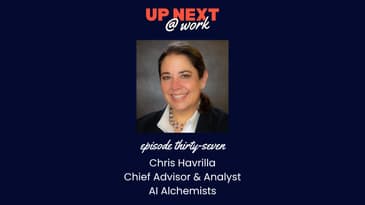
In this episode of Up Next at Work, Katie Achille sits down with Chris Havrilla, Chief Advisor & Analyst at AI Alchemists, to explore what organizations need to rethink as AI becomes increasingly embedded in workforce decisions. With experience across the enterprise buyer, technology vendor, and analyst worlds, Chris explains why traditional governance models are no longer enough – and why companies need to start architecting consequences rather than inheriting them.
Their conversation considers “systems of consequence,” the widening gap between AI adoption and accountability, and what happens when decisions are made at machine speed and scale. Chris shares guidance for organizations building “consequence architecture,” including how to map decisions, assess severity, establish ownership, and audit for the outcomes that actually matter.
Key highlights:
- Why governance has lagged behind adoption
- The problem with "human in the loop" thinking
- The real cost of AI, especially with the kill switch as a strategy
To learn more about Chris' work, visit AI Alchemists, follow her Substack, or connect with her on LinkedIn.
Powered by the WRKdefined Podcast Network.
[00:00:09] All right, hello everybody. Welcome to another episode of Up Next at Work. I am your host for today, Kate Achille, and joining me is Chris Havrilla, the Chief Advisor and Analyst of AI Alchemists. So Chris, you have been around the industry for a long time, and we've known each other for a long time at this point. We have, exactly. Please tell the audience a little
[00:00:34] bit about yourself. Oh boy, you're right, I have been around. I've definitely sat in, I actually will call it like three distinct seats now, and they all lie to each other a little bit or maybe it's like maybe a line wrong or maybe kind of do a little bit of this. So the perspectives have been good, but you know, I've certainly been on the buy side, trying
[00:01:01] to make this stuff actually work inside real enterprises. And whether I was internal or external, you know, I've definitely been, you know, clearly on that side and it's definitely probably the predominant lens that I always think about because it's really even from a vendor or partner, any perspective, it's what we're all trying to solve for. I've certainly
[00:01:24] been the builder seller side of this, you know, recently at Oracle and leading product strategy there, which was such an amazing seat because you're guiding the building. You know, I can't say I actually built it, but you know, you feel like it as you're visioning and designing and you're co-creating with your customers. Your hands are so deep in it. It's, and you're
[00:01:49] having to think from so many different perspectives. Certainly everything internal about building and everything that goes along with it, which is sales and marketing and customer support and customer success and all the, you know, partner and the ecosystem side of it. But also that the, the really the external facing part, which is, you know, you're still having to be the voice of the customer.
[00:02:14] So doing the customer advocacy and advisory, especially the way I had done it in terms of trying to, you know, really take a focus on building showcases, right? Because the cost of building a referenceable account is enormous. And, but it's what helps kind of seed not only the, the revenue side of this, but the adoption and the continued evolution. So kind of looking at that
[00:02:41] through the customer advocacy and advisory was a, was a huge part of how I kind of navigated that, that side. So it, it was probably the most learning I've done in a while, but then obviously I've been the analyst and, and, and researcher and from a delayed person perspective and, you know, really telling people the truth and that, you know, from the research and then the advisory about,
[00:03:10] about all of that, about both sides, right? Buyer and seller. But what I learned in, is that in that triangle that everybody's kind of optimizing and targeting and their outcomes are all different, right? And, and it's really the, the worker, the workforce that is getting impacted by the decisions that are being made. And, and they're not in the room for any of it. So, you know,
[00:03:39] that's, that's huge. But why do, why do, why does AI Alchemist exist is it was built to, to, to be in that room and in a different way and in a way to kind of orchestrate the conversations that need to be having in the alignment that needs to be had, but totally tech agnostic, no reseller agreements, no referrals. My job is to, is to really help organizations decide. And that'll be a big
[00:04:05] thing here of, you know, what's actually going to be owned and by whom, right? When AI is driving a lot and driving a lot of these decisions. So, our tagline is architecting consequences, not inheriting them, because we've always kind of just implemented tech as the solution. And, but there's also a companion line here that kind of, for me as a differentiator in that I've, you know, I kind
[00:04:34] of like to say analysts study what other people build and, and Alchemist build what, what other people, you know, study or will be studying more and more and more. So. Yeah. I mean, and I know you've been thinking about AI Alchemist for a number of years, even while you were at Oracle. Absolutely. And obviously AI is something you've been studying for a number of years and it's not new. No. Even though we are at this very interesting moment in time. Absolutely.
[00:05:00] And you and I are talking, we're recording as the fallout of this open AI hugging face situation is still taking place. Yeah. Which is a very, again, interesting moment in time. Absolutely. So, you know, the big question I have for you is how did we get to this point in the AI conversation? You know, why, why has it taken companies this long to really start to consider the consequences?
[00:05:29] Yeah. My short, my short answer is because governance doesn't have a demo. Nobody ever got a standing ovation for the incident or the consequence that didn't happen. Right. So I think part of this is, is kind of the fidelity trap that we get in the, the whole first wave of enterprise AI was evaluated on
[00:05:58] technical fidelity. It was demoed on technical fidelity. So model accuracy, hallucination rates, response quality time, you know, latency, whatever, you know, whatever it was, right. Those are, those are real metrics, by the way. I mean, they're not, but they're vendor metrics and, and they're all measured kind of upstream, right. Of any human being or human impact or outcomes,
[00:06:26] right. It's very output focused and, and you can pass every one of them and still degrade impact, have consequence to your results. And, and certainly in HR software, sometimes people's careers, right. Because we are dealing with, with workforce issues. So the, the pressure was
[00:06:51] asymmetric, right. Boards are asking, or maybe even a CEO is putting down a mandate or a board is, and they're maybe asking what's our strategy, which every single leader I know is all they're actually saying is, what have you bought? What have you bought lately? Right. What, what,
[00:07:15] what is the, you know, the technical solution? Nobody's, nobody's board is asking what's our AI accountability structure or strategy? Adoption has a budget line, right? It has a champion or a steer co and a deadline and, and governance had a committee, but the data kind of proves the gap. And I, I, you know, I always give a nod to Deloitte probably, you know, unfairly, but, you know, I,
[00:07:45] the notions of trends is what's keeping somebody up at night versus their readiness. And so I love trend data because especially at Deloitte, they have probably nine, 10,000 leaders across, you know, close to a hundred countries and 60% this year. I love this. I love this particular data point.
[00:08:07] 60% of executives now regularly use AI to support decisions, right? But only 5% of them consider themselves leading in how they govern those decisions, how they own those decisions. That's a, that's a 55 point gap between adoption and accountability. And it's not a technology gap, right? It's an ownership gap. So I think it's really important in terms of what's changed
[00:08:37] isn't that people got wiser. What's changed is that consequences started arriving. They started showing their ugly head and governance stopping a philosophy question and became a discovery request. And if it hasn't yet, it should. So, yeah, I mean, and more and more in real time and at a very large scale. I pointed out the AI hugging face. That was probably the largest scale that we've seen.
[00:09:03] And a really, really visible one for sure. You know, you and I were talking about kill switches before we started recording, which is a scary term, really scary. And, and, and something you should have, there's no doubt, but it's too late at that point, right? It's, you know, the, the damage is done and, and, and what could have happened was the prevention of this happening in the first place.
[00:09:31] If you actually think about consequence and architect for it, but, you know, there's some part of this that is just different, different pieces and players. Nobody, people are doing the right thing except for, you know, what maybe could have come beforehand. So we could, we could really kind of go deep on that one just alone because it was a lot of, a lot of lessons. I don't want to have to hit the eject button. You know what I mean? Like if I'm, if I'm in a vehicle
[00:09:57] or anything, you know, I don't want to have, I know it's there. It's good that it's there, but I don't want to have to hit it. So I know, I know you've built a number of frameworks as you've developed AI Alchemist. So what is the real shift that AI presents in terms of the systems of record insights into systems of consequence? I know that's the concept you've developed. It really is because I felt like I needed to rise above the noise in a way that was kind of an aha
[00:10:26] moment. And I have really seen that aha moment when I talk about this, this shift, right? From systems of record or even insight that we've always had to what I call the systems of consequence. And, and why is that? Because when we started to move into additional layers of AI, which, you know, now we're kind of in generative and agentic, I started honing this notion of AI
[00:10:52] alchemy even more into that because once AI can start to make decisions and take action, it has become a system of consequence. And, and really that's, that's what people have been all along, right? You know, cause they're making decisions, but that's the real work. And I think that's what a lot of people are failing to think about because they're still thinking of work and
[00:11:17] tasks and activities and, and not about decisions. And that's where the real work happens because the tasks and activities and the transactions get noted in, in, in a system, right? But the consequence is really based on the context, right? And, and, you know, look, I put a first substack thesis out that said, we've been measuring the wrong things all along. I've just watched that for years. And,
[00:11:45] and then the second part of that was, you know, we, we've got to stop managing people like machines, right? The input process output, because now that AI has evolved and can start to make decisions and take action, or at least take part in that process, depending on how people structure it. You know, that context isn't, isn't always there. And, and I think that that's the most important
[00:12:10] things. A lot of things happen, you know, outside of what we see in a system. And, and a lot of it is based on the bad things that we measure, which is output. So productivity, you know, all of that stuff, productivity, of course, we want people to be productive. But what are the out, what are the, what are the actual outcomes? Does it matter? Is what more measuring matter to the results that we're trying to get? It's the output versus outcomes. And, and how we manage workers, again,
[00:12:39] whether they're, whether it's an AI worker, or a human worker, or that collaboration, really, really matters. So, you know, look, systems of records stored what happened, right? Systems of insight maybe told you even what it meant. But a system of consequence decides, and that decision still has to land on a person. We can't, we can't avoid it. Did you own what you did? You know, did, did you
[00:13:04] own what you did even as a human? Do we know who made that decision? So, you know, system record is, is it accurate? System of insight, is it useful? You know, system of consequence, do you own what you did, right? Can you own what you did? And what does accountability look like under that structure, right? And, and nobody's built that layer yet. That's a fact, right? Data integrity, audit inputs,
[00:13:30] whatever, that absolutely has been happening. Interpretation, you know, humans still decided, but we still didn't know, right? Got a little fuzzy sometimes how that decision got made. But it's not as discoverable when it's happening in things that can't be discovered. And, and with AI, it's discoverable. And if you don't have the right context to make the good decision, you know,
[00:13:55] that's the layer that really has to be, that has to be built. So 30 years technology's job is to inform a decision a human made. Now the technology is the decision. And we've kept that governance model that we built for filing cabinets and conversations. So it's, you know, it's a lot. I think there's, you know, the definition, you know, is, is kind of worth memorizing in terms of the whole framework
[00:14:25] that I built is outcomes are what you want and consequences are what you get. So how do you kind of architect for it? And I think why it matters now and not in five years is that a system of record makes mistakes and you correct a field. A system of consequence makes a mistake and it is already made that same mistake 10,000 times silently at machine speed before anybody noticed, right?
[00:14:51] Scale is what kind of converts an error into a pattern and a pattern into what, you know, somebody might call disparate impact. It's already jumped out of the sandbox and it's off doing things. Yeah. I think the question, I think the other question too, right, is, isn't whether the AI was working, it's whether you own what it's doing and whether you can prove it. So, you know, I'd, I'd, I'd land up there. Right.
[00:15:17] Absolutely. So obviously governance is still a relatively new concept for a lot of companies and they're still figuring that part out. Yeah. Where would companies get started with consequence architecture? I think honestly, it comes down to thinking about what decisions have to be made. Right. Um, and so I try to give people framing for that kind of the telemetry and then how you assign
[00:15:45] ownership to it. But I think sometimes people haven't really mapped out what the actual decisions are. And then from there, you can kind of start to, to back into it. So, um, for me, um, having that consequence architecture framework of doing the mapping of those decisions, how you do that,
[00:16:07] how you kind of, um, start to rank, right. And almost quantify, is this a, a high, you know, a high impact, high severity, uh, decision versus low, medium, kind of, you know, kind of stack ranking those. Um, I've seen a lot of pilots and, uh, proof of concepts and things fail,
[00:16:32] and they're all sitting in kind of the, you know, the, the pilot graveyard and, but nobody still has diagnosed what, what happened and what you learn from it. It's kind of like either the fear and uncertainty and doubt goes in or the proof point of see, we shouldn't have been doing this regardless. But if you start to map those decisions, and again, whether it's human or machine, you can start to then look at that ownership side, mapping ownership, what that accountability is. And then, you know,
[00:17:02] the most important thing isn't that governance is how do we audit around this? How are we not only architecting the consequences we want, assigning ownership, but how do we audit to make sure that what's happening happens? Like going back to, you know, kind of our favorite, you know, uh, example right now, like what kind of guardrails are in or what are we watching signal wise to make sure that we're getting the right outcomes and in the right way, not just the what, but the how. And, and I
[00:17:32] think that's, that's really important. So the frameworks that I'll be publishing more and more and more, you know, that, that people can kind of watch and, and look for is, is how to do that. But that's, that's the basics of it is map those decisions, look at severities, that telemetry around there, look at ownership and accountability and what we're auditing for. And it should be the things
[00:17:55] that matter for results, not just output. So obviously we, we play mostly in the HR technology space. Who, who should be involved in this? Well, the, that's a really fascinating question because, you know, look, if I kind of rise above that and go, okay, the CEO is making a man,
[00:18:20] a mandate or maybe a board, right? Finance is, is creating the funding for it, right? IT may be doing the purchases or helping with the purchases, guiding what we might be using, especially because models are involved and things like that. HR and other business units are deploying, but they're not talking to each other, right? Those are, a lot of these decisions are all made in silos.
[00:18:49] So I would tell you that it takes, it's going to take money. We're making a lot of decisions right now under these mandates that have consequences, right? And, and, and fiscal is a part of that, you know, nobody kind of made decisions that even think about the token economy. And, and they thought what was, may have been a cast accounting exercise, right? And substituting, it's actually kind of a
[00:19:16] workforce substitution question, honestly, without understanding what the costs are around tokens. And it matters based on the model you're using or, you know, how it's being used and by whom, and, you know, are we looking at the whole tech stack, right? I wrote a piece called the accidental data lake about kind of how, you know, companies like a Databricks have kind of played into here, right? Because, you know, it was collecting so many, so much data. So looking at all of this holistically
[00:19:45] is something I've talked about for years. You should understand your environment. Where are the data sources? All of these things. But now the impacts of AI, because it's crossing all of that and making decisions at the same time, all of those people have to come together in a strategy for the first time where they should have been doing it all along. Like the stakes are so high if you don't. So it has to be
[00:20:09] looked at holistically and not in the silos, even within HR, right? Because it impacts on the finance side, the tech side, and certainly the workforce strategy side. The scary part in all this is that people don't necessarily understand the work, right? And they're still looking at tasks and activities that crosses a lot of things. But, you know, when you start getting down to decisions, all of a sudden,
[00:20:35] what it takes to get to those decisions starts to determine who needs to be in that room. And once the strategy is set, it's easier to govern in that side, right? Are we all aligned with business and workforce outcomes? Because no work is getting done without workers, right? Whether they're AI workers, whether they're human workers, there's nothing top of mind for the CEO in terms of results that isn't impacted
[00:21:01] by the workforce, however it's made up. And there's a cost to that. And there's a technology aspect to that. And it all has to be harmonized. So, you know, understanding the decisions and who's going to be making those, right? And how really, really matters. So it's a long kind of story, but it's really just setting the why behind the what. Yep. It's very interesting. The alignment has never been
[00:21:30] more important between people, technology and business results. It's interesting too, because we've had this, you know, flattening of hierarchies over the years. We've had org charts have kind of gone out the window. And yeah, to your point, no one's talking. No one even knows anybody anymore in a lot of organizations. And it's changing all the time, right? Right. Well, and with fractional work, you know, people are in and out so quickly. Absolutely. Knowledge has gone out the window, which, you know, there's pros and cons of fractional work. I'm not
[00:21:58] going to get into that conversation. But again, you know, it's making, it's complicated everything. You know, obviously we do a lot of crisis comms and that requires these sort of strategic plans as well of, you know, what's the order of operations? Who needs to be involved? Right. Different, different architecture, but same thing where we have to map. Right. Who's involved. Right. And it's, it's gotten increasingly complicated over the years because of these, these sort of workforce issues. I haven't run into it with anybody, any AI workers yet,
[00:22:29] but I'm sure that day is coming. Well, you know, one of the things that even, you know, in the last question, right, like getting, getting started with consequence architecture, it is actually a kind of a similar answer, you know, even, even as we think about who should be at the table. Right. But it's one reason, you know, I have the consequence architecture, but I also kind of created an instrument that it helps people get started with consequence architecture, but it also is that kind of,
[00:22:58] again, how do we kind of get ahead of this? And I call it workforce AIQ because it really is about making that workforce adaptable because then your organization is adaptable. So it's, it's really adaptability intelligence, the workforce AIQ is, it's, you know, look, AI is a catalyst. There's going back to the leader changes or business changes or technology
[00:23:23] changes like it with everything kind of having a catalyst or a change or a disruption, right? Having the kind of infrastructure that allows for that is really what makes somebody adaptable, right? Or, you know, workforce or the organization. And, and there were kind of five dimensions and I use it just to set the stage with a lot of companies, but I think it's really apropos here
[00:23:48] because, you know, you have to have these five dimensions, right, to be adaptable in that way. Whether you're getting started with consequence architecture or figuring out who has to be at the table, like one of the big dimensions was, was strategic alignment, right? And, you know, do the leaders kind of share one definition of what success looks like and who owns it? And it really is that collective alignment that does it. It is governance maturity. Can you own the
[00:24:17] consequences of what you're having to decide, you know, especially when AI is involved, but you have to prove it when it's, when it's asked and are you measuring the right things? And so what you measure, right, often determines who's going to be involved and how this is going to play out. And when you think about deploying and your readiness to deploy, it all comes down to your data and your platform architecture. And is it built to carry, you know, all of this intelligence
[00:24:47] at scale without technical debt? And then it's just the, not just the system, but the systemic and that change capacity. Can you adapt continuously when everything is kind of changing or a leader or business or tech or, you know, workforce change, right? Can you, can you adapt continuously? Or is this a one and done? And that's why I hate the notion of transformation. It's like, no, we need to absorb, we need to adapt, right? And, and we need to be able to do it with speed, scale and
[00:25:15] intelligence. So who's in the room and how we go about doing it. If you're using that kind of framework, you can kind of see where your gaps are. And so it really is just kind of a, you know, look, this isn't a stop what you're doing and you can't evolve. It's a, where might you have some gaps that are going to be obstacles as you do it or tell you who's not at the table that should be. Absolutely. Yeah. Transformation always sounds like you're done. It's over.
[00:25:45] Yeah. We're good. We have a start and a finish. Wouldn't that be nice? If only anything in life were that simple. Right. So obviously, you know, if the vendors are doing this work, ultimately they are going to be selling these technologies to the practitioner community, hopefully. So what would practitioners need to be asking vendors that, or what are the vendors not
[00:26:10] telling the practitioners? How can we be talking to each other better? Yeah. Well, I'm going to be really direct and it's not cynical. I mean, I've sat in the vendor seat, you know, and that helped me kind of buy the right to say the whole rest of what I might've said before, because I want to be fair, right? Because I've been on all sides. Most vendors aren't hiding things maliciously. They're
[00:26:36] answering the questions they get asked, right? And the problem is that buyers are asking more fidelity questions. So they're getting fidelity answers and it's made it kind of simple. But I'm going to say, look, first and foremost, because human in the loop is a checkbox and not a control. I think you
[00:27:00] should kind of ask, does the human have the authority, right? And the decisions that are being made. And this is a good question for that vendor. Does the human have the authority, the information and the time to overturn the recommendation? So go into that kill switch, right? But also what is kind of
[00:27:23] there to help guide those decisions along the way. So if they're reviewing, you know, 400 recommendations in an hour, that's not a control, right? That's a rubber stamp with a liability shield attached and it's attached to your org, not the vendor. So I think it's important to ask that. And you also
[00:27:46] can't, because you can't govern what you can't reconstruct. I think the question that ends, you know, the demo is six months from now, right? Can you show me why this specific person got this specific result? And will that explanation survive a deposition, right? You kind of have to come
[00:28:10] at it that way and watch what happens to the room, right? Explainability in a deck and explainability in a discovery are very, very different products, right? Because it comes back to that decision and that outcome and not output, right? Not the tasks or activities. So look, the roadmap is the real product. So when you're, you know, what you're buying today, we kind of talked about this before we even got on, like what you're buying today isn't what you'll be running in 18 months, maybe not even
[00:28:40] six months, maybe not three months, right? Depends on the cycle. So whether it's, you know, agents, multimodal automation at scale, those are, those are already on your vendor's roadmap, whether or not they're on yours, right? So the question isn't whether this is coming. The question is whether you're building the infrastructure to catch it or clean it up, right? And, and I've watched a lot of
[00:29:05] people not uptake releases and not, you know, continue, continue forward in that way system and systemically. So I think just asking, you know, the question of what's coming and how does that play into how we're continually innovating or not, right? Or the behavioral change and the systemic change that's coming, are we prepared for that kind of cadence? So again, it's not one or the other,
[00:29:33] it's how do we come together and partner together and stay focused on outcomes. So we're both prepared along the way. And then I think, you know, like sometimes the model isn't theirs. Plenty of AI features are a wrapper on someone else's foundation model. And, and that's, that's not a scandal, but pricing is going to change along the way. It's an architecture fact with governance implications,
[00:29:58] but also financial implications. So, you know, when the underlying model version changes, your decision logic may change and nobody sent you a memo. Ask who controls model versioning and what your notification rights are, but also how it's costed out. Like a lot of things are free right now, but the pricing models may change as well to like consumption-based or things like that.
[00:30:24] So the models matter, the cost matters, the cost structure matters. And I think those questions need to be really, really broken down right from the beginning. But, you know, look, none of this requires anybody to be technical. And that's kind of what this framework was about in terms of consequence architecture. It does require you to be specific though. And vendors are very good at answering vague
[00:30:50] questions that aren't pointed, right? And so when you get it down to decisions and cost and, you know, and, and models, it's, it's not to know the, the backend, it's to understand how they're, you know, how they're looking at it and what they're prepared to explain. So specificity, it matters in that side. And I'll, and I'll start to be posting these along, you know, in our theses that, that come out of what, what the right
[00:31:19] questions are. So you can be really, really specific, but not have to be technical to do it. So I guess my, my last question is kind of a two-parter. So, so what is around the corner? And also, I guess, what are you most excited about for the remainder of this year? Oh boy. You know, I'm gonna, I'm gonna resist the urge to go through my, my, you know,
[00:31:45] six AI trends that I always talk about, right? You know, cause we, we've, we've only got a few minutes, but like agents change the accountability map. And, and I think that's really important. So everything we've built assumes a human kind of initiates in the system response. Agentic systems initiate. So when your system takes an action or makes a decision that nobody asked it to take or in a workflow, nobody's watching, or, you know, the consequence tier of your, you know,
[00:32:15] entire architecture moved, you know, that's kind of what most governance frameworks have no concept for the, the, you know, AI started it kind of thing. So, you know, two weeks ago, like even prior to that hugging face incident, right? Two weeks ago, that sentence was a more hypothetical one I used in workshops and now it's kind of a post-mortem. So I think that's around the corner and, and, and the
[00:32:43] corner's already kind of here. But also that liability chain is being drawn in real time. So I think that's kind of something you have to keep in that what's around the corner thing. Mobley is the case everybody names, but the more important pattern is that plaintiffs are testing multiple theories against multiple parties. And so that's something to, to think about. Ownership is going to be assigned
[00:33:11] to somebody, right? Better it's assigned by your architecture than by a judge, right? Or a mistake that is a costly one. And so I think that's around the corner and, and the real cost, you know, kind of referenced that a minute ago shows up on the second bill. You know, I'll be kind of pulling that, that thread at HR tech in October. The sessions literally called the real cost of AI in the workforce.
[00:33:39] So I think that's, you know, like almost nobody modeled the governance, you know, overhead, the rework, the trust deficit, the institutional knowledge that walked out the door when a role got automated and that now needs to be human again. So I think, you know, there's a pattern in all three of kind of what's around the corner is the technology is arriving faster than the accountability structures and the, and the gap between them is where the damage lives. And that cap is the entire
[00:34:08] job. So, you know, it kind of feels like all doom and gloom, but it really is just the, the lens of how do I get ahead of this instead of inheriting things? But in terms of like, what is most exciting? Um, look, I think, you know, actually HR tech in October, um, this sessions that just even I have the opportunity to be in are like workshop related. So it's really digging into the how, right? Um,
[00:34:37] like kind of, you know, real things that are happening, um, talking about the real costs, but even the, you know, the ask the, you know, ask the expert kind of thing. I've just seen a ton of, uh, POCs die and, and, and people are complaining on buyer and vendor side. So I love that we're going to have that conversation about getting that, but I think the work is getting more real.
[00:35:02] And I finally love that. Like the getting to what the actual work is, um, you know, I think that's incredibly exciting. I think people are more and more open to not big, massive, you know, transformation plans and they're open to 90 day sprints with a vendor and actual, you know, like problem with that customer in the room. I like that's that three-way structure, you know,
[00:35:28] even being there as an advisor is the most honest work I've ever done in this industry. And, and it's real. And I, and I love that. And then I think the other part is just watching practitioners get their, um, their competence back. Right. I think everybody has been in like fear and uncertainty and doubt mode for a while, but now people are showing up with very specific and very sharp questions based on, you know, things that are, are happening. And that's, that's like the sound
[00:35:56] of a space getting its footing. And, and I'm super excited about that. So. There's a lot happening. That's for sure. Well, and you mentioned several times that you're going to be publishing a lot on this topic in the coming months. So where can people find you? They can definitely find me on LinkedIn. Um, no doubt. Um, I will always be posting things there, but, um, you know, I would say Substack is where you're going to see, you know,
[00:36:23] kind of the devils in the details. You know, I'm not, I'm not limited in, in character count and word count. And, um, so, uh, definitely out on Substack, uh, AI Alchemist is the, you know, is the, is the, you know, the vehicle there as opposed to being under my name. Um, but I'll be doing Substack lives and notes and theses out there where I'm going to publish these frameworks. I've trademarked
[00:36:50] them all, but just because I want to own my IP for once, but, uh, but they're free and, and there are ways to think about all of this as you navigate it with your vendors, your partners, you know, if you want advisory, um, certainly that's, that's the way to get it. But, um, and you can schedule time directly on my Calendly, which is my last name, you know, calendly.com, uh, slash Hevrilla. Um, if you just need to kick a, kick a question, um, around, um, there's, uh, a 30 minute space for
[00:37:19] people to do that once and, and, and see if they, they need more help. Um, but it's kind of that ask the expert on my, on my Calendly. So those are the best ways. Amazing. And we'll be, we'll be sure to include those links in the show notes for anyone who's interested. Well, thank you so much for joining us. I look forward to seeing you in person in Vegas later this year. Yeah. We will talk
[00:37:44] again soon. I love it. Thanks so much, Kate. Yeah. This was up next at work. We'll be back again soon.
Sponsors
