
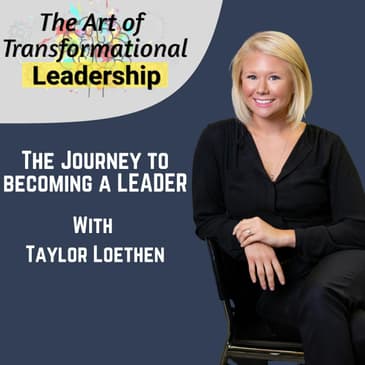
Welcome to the Art of Transformational Leadership podcast with Taylor Loethen.
Taylor is the Director of Operations for Digital Lead Performance and join us through her journey of becoming the leader she is now
You'll be sure to pick up a few tips on how to lead with confidence.
Elevate your recruiting game with WootRecruit 📈
➡️ https://wootrecruit.com/
Stream on Spotify now:
➡️ https://open.spotify.com/show/42nQV6HEAFByk4dPjDlIZl?si=e7a8cbf52e5b4dd8
Let's connect! 👋
➡️ Instagram: https://www.instagram.com/libbydelucien/
➡️ Facebook: https://web.facebook.com/LibbyDeLucien
➡️ Twitter: https://twitter.com/libbydelucien
Follow Taylor Loethen on:
➡️ LinkedIn: https://www.linkedin.com/in/taylor-loethen-cep-7a11664a/
Powered by the WRKdefined Podcast Network.
[00:00:00] Welcome to the art of transformational leadership.
[00:00:02] This is a podcast where we talk to leaders from all walks of life.
[00:00:06] From entrepreneurs to educators, we discuss their journeys and the strategies they use to become successful.
[00:00:12] Stay tuned to learn more on how to lead with confidence.
[00:00:17] I'm your host Libby and our guest today is Taylor Layton.
[00:00:22] I hope I've seen her. She's so hard to miss with that beautiful blonde hair. I've seen Florida back in 2014 and that's when my husband and I had gotten married and decided to live in Florida rather than Georgia and
[00:03:02] at the time I was a director for a
[00:04:05] comes out. And that was kind of that moment that I was like, wow, these are real people, right? And
[00:04:12] I've been now in the power sports industry for 10 years. But with that interaction being on the outside, working for the nonprofit and, you know, working with this group, I knew very quickly,
[00:04:19] I was going to work for this company, right? The way they behaved, the culture that they had,
[00:04:24] you know, the environment that they fostered. And I knew that I wanted to be just like Scott Fisher. I wanted to leave like him. I wanted to hire like him. I wanted to have a culture like him and I, it gave me a very clear kind of mentor, like perfect fit mentor, right? Of who you want to become. And that's really where that organizational health spark is having come from,
[00:05:42] you know, the petroleum industry and then doing a short stint there in a non-profit.
[00:06:43] of being what you want all everyone else to be. And so if you want great leaders,
[00:06:45] you have to be a great leader.
[00:06:46] You have to lead by example, right?
[00:06:48] We've always heard that.
[00:06:49] And so it sounds like Scott Fisher is the epitome
[00:06:52] of that great leader that shows us how it's supposed
[00:06:57] to be done because we wanna be just like him.
[00:07:00] Like I love that.
[00:07:01] Yes.
[00:07:02] Thank you for sharing that super, I have some news for you, but I need you to sign this NDA. And I was like, oh gosh, right? You know, I had never experienced this before. I didn't know what to expect. And so I thought, well, I hope I'm not giving away my kids because I actually really like them and at the same time that I was managing Scott's brand and supporting him in that regard, the other team member Aaron, who we referenced earlier, had this great idea of, well, what if we had a digital lead management service? So Aaron had managed the digital leads for our seven dealerships of the industry, which is how you and I met Libby, is through SAS Academy. So that gives you just a really high line evolution of the last 10 years. Awesome. And so can you tell us exactly what is your role inside of digitally performance?
[00:11:00] Because here I have that you're the director of operations.
[00:11:04] So what exactly do you take care of from a day to day?
[00:11:06] And how many people are most important right now? That could be for the quarter, that could be for the year. What are the things that we need to complete? Then I help our team achieve that. My hands are in every single department in our organization, but my primary drive is on the marketing and
[00:12:20] home academy side while we're in this bootstrap model.
[00:12:23] Awesome. We're going to get off track from the questions a little bit That is something that we never want to have to have that conversation. It's just a difficult conversation. And I'd love to hear, you know, Taylor, how did you one deal with your feelings about this? Right? Because at the end of the day, we like people and, you know, it's got to hurt or you have
[00:13:40] to feel bad.
[00:13:42] Because I've been there.
[00:13:44] We've all been there where we need to let somebody go, but we don't want to because
[00:13:47] we like them. industry as a whole to move to be an Assas provider. And with that, we knew that we couldn't take all 65 people and that hurt us to the core. Because because we focus so much on organizational health, you heard me talk a little bit about that earlier, we really have this family mentality. So it was the hardest decision that we had to make. And what
[00:15:01] made it even harder was, these are the
[00:15:03] key members that we know we're keeping.
[00:15:06] Here's everybody else're going to do. We did it in a full company mentality. Like, think about it as an all-staff. So for us, we have people working all over the country. We are a remote employer. And so we had to do it over Zoom, which is not the industry, stay in a similar role or go beyond. So it was written in a way. And then of course, if someone had questions or wanted to talk to that individual, my contact information was at the bottom. But during that time, Libby, 90% of our staff who were being let go said, Hey, listen, I'd
[00:17:43] love the opportunity to do these interviews.
[00:17:46] And 90% of those people were placed. always be fans of your company. And when it comes time to hopefully us being able to serve those dealers, they're going to be the advocate that says, here's what they did for me. Awesome. So I love that story. I almost wanted to cry that you personally took it upon yourself to coach them, to guide them, to almost mentor them through the process because
[00:20:03] you know, a recession that supposedly they say is coming,
[00:20:05] we may be faced with some of these things. We may be faced with what Taylor had to go through on a smaller scale.
[00:20:10] And so listening and learning to how she did that so that you can
[00:20:14] sleep at night so that you can feel like, yes, I did what I could.
[00:20:20] It's it's the fact that a situation changed is why I had why this is happening.
[00:20:26] And then you don't feel like such a bad person. ability to play staff, but the ability to be able to serve the industry in a way that we never knew that we would do. We didn't even know possible. Yes. And you mentioned something. Imagine what the dealers then thought of you by doing so much to help and care for your current staff. It probably elevated you guys
[00:21:43] even more and showed even more respect. So I see definitely you have a passion for culture, right? And building it and retaining it.
[00:23:01] What would be three tips that you could give us?
[00:23:05] Either three culture tips, what we're going to do, then you better do it. If you tell somebody that this is how I'm going to support you or here's what we're going to do, we have to make sure that that happens. Building trust is the number one thing and we all can reference Patrick Lencioni's five dysfunctions of a team, right? And it's very important that we understand that the foundation of anything is trust and if we can't build trust, we're allows us to leverage our experience. It allows us to leverage data to really understand what is best for our organization. And through mastering that conflict and through that healthy conflict, you have the ability to agree and move forward or disagree, but move forward, right?
[00:25:40] And that's the beauty of mastering conflict.
[00:25:43] And then the last thing that I would say is accountability.
[00:25:45] You can only hold people accountable. And then the last part I'll add to that communication is career huge love him. Do you know what the opposite of trust is? Lack of no it's fear. Oh sure it's fear. So I. I love what it is. One of the things I learned really early from, um, and again, Scott Fisher, I'll probably reference often is he taught us how to probe for it,
[00:29:41] how to challenge, even if you agree, challenge it anyway,
[00:30:51] Absolutely. And then lastly, just real fast, you know, your communication for leadership or for building culture, I'm sorry, communication. And at the ELS conference, like they were talking about, you know, you're always leaking.
[00:30:56] You're always leaking something.
[00:30:59] And the way they addressed it, it was really interesting because you said, you know're not going to understand, you know, why we were leaking those little things.
[00:32:20] And if we address it though, right, that communication, then they understand, oh, she's just having a bad day.
[00:32:26] It's not me. And too often as leaders, we attempt to elevate ourselves, right? We tend to, you know, want to move ourselves up here, but forget that what they really want is a human. They want a human that leads them because as humans, we want to be led, right? That is human nature. We want to be led by someone. And with that, we have to still be human.
[00:33:41] If we're a machine, humans don't want to follow machines.
[00:33:45] They want to follow other humans. to lead an easy life, right? We are not guaranteed that everything is gonna be perfect, that all of our strategies are gonna come to fruition, that everything that we declare is gonna happen, right? And we have to remember that we have the ability to stand up or we have the ability to succumb. And we should always choose to stand up, right?
[00:35:00] It doesn't matter how many times you get knocked down,
[00:35:02] you have to be, you know, able to stand back up.
[00:35:06] But I think one of the love that I like to carry through with my leadership style. And the other is grace. We all make mistakes. Again, we are not machines. We are human people with hearts and souls and minds, right? We have feelings. We have emotions. We have things that impact our decisions or impact, you know, the way we react or act.
[00:36:23] And it's important that we lead with grace in the sense of, hey, we're going to make sure that then we do it together because then you'll learn because if I do it for you or for them every time they're never going to learn and the company will never progress, right? We think about success was never built on perfection. Success is built on failure. Now how many failures? That's to every individual in every business, right? It could be one, two,
[00:37:42] three. It could be millions, right? And that your message gets heard or gets across the team? And then my next question is, is, you know, how do you know or when do you feel like you know you're making an impact or they're being, you're being heard? Great question.
[00:39:02] So let's start with internally first. consistency is what sets leaders apart. Everybody can do something once, but it's the people that do it over and over that sets them apart. And then, when we think about externally, when we think about coaching and training, you can do those in so many different degrees. Right now, I tend to do this in middle-mid-sized groups.
[00:40:20] So I do a lot of training in the 30-person group.
[00:40:25] And it's usually topical on a specific topic. Yes. But investing in it is key because you're bringing in people, mentors, coaches who have either been there, done that, had the failure to learn from it. And I think that when we try to figure it out ourselves is when we tend to get stuck.
[00:41:40] I read Libby the other day on LinkedIn for a company, I'm going to look at this differently now because it makes you want to say what environment were they in
[00:43:00] that they said, I'm not going to be a part of this.
[00:43:02] I want something better. career and couldn't get a job because he was too specialized. So it was, you know, those gaps are true because when you know how many businesses are out there, but then you know how many not great business owners there are or not great managers and whether it's just that lack of education
[00:44:21] or bad day or remember a title and I kid you not, I actually say before we have an interview, I want to know what do you do outside of work? And it shocks them every time, but then they open up, oh, I love to kayak. I love to fish.
[00:45:40] I love to hang out with my family.
[00:45:42] I love it just gives you a different level of understanding of who that individual is. And I believe that, you know, as leaders, it's our job to give back to the community that has given to us. You know, we have to identify what are we most passionate about and serve those in need. Sometimes we have to be the voice for those that can't speak. Sometimes we have to do the action for those that can't, right? And it's really important We're very big into volunteering in the community and especially for our children. So you brought up kids and so I want to kind of go to a different direction and you know for the working parents right not even necessarily
[00:48:21] moms but for the working parents like to have a level of work-life balance no nothing, right? You know, our family, we go to church on Sundays and then we usually go hiking after and we go do something because you may know Libby, we recently relocated to Southwest Utah. I do go to Florida every month, but we recently relocated. So we hike all the time and then
[00:51:03] usually Sunday evenings, we have a family go outside. If we teach them to volunteer, if we teach them to work hard,
[00:52:20] if we teach them to spend time with family, that's what they're going to do.
[00:52:23] And so it's important that this me, it's not all on Chris, my husband. But we get it wrong often. Every once a month we say,
[00:53:42] oh, we need to sit down and look at our schedules again,
[00:53:44] because something's not working.
[00:53:46] And then we tweak it and itches and work travel and money. They care about managing their time, having a little money in the bank, but developing a great life and family. Yes. And I think that COVID is the, is I am one that gives and serves, so I want to give to others all the time. I want to serve all the time, but I forget myself a lot. And I think that's almost like a raw, like, hot point, because I'm not very good at that. Yeah. I've gotten better. It takes, it takes planning and attention.
[00:56:24] Sometimes I fall off the wagon, but then I have life? How do we see challenges? You know, how do we see family? You know,
[00:57:45] what is our outlook? I do believe that we love? Like my team, right? Kit for our industry. You know, in that fire, a lot of it comes from within, right? A lot of it is just the the God of Wanna, right? I genuinely want to do this and I'm gonna do whatever it these great people who are just so sharp, but also willing to talk to people like me, who haven't been there yet, and to pour into me and show me, or say, this is the failure that I had, but here's what I learned from it. So it's important to understand that fire can come from different places.
[01:00:20] It comes from within, it comes from your outlook,
[01:00:22] it comes from your mentors,
[01:00:23] the people you surround yourself with,
[01:00:25] but also your friends, Considering what we talked about today is really two things. The first one is that nobody achieves the top of the ladder by themselves, right? Nobody gets to theirs that, and I'm not gonna say this properly. I can't remember if it was a proverb or whatever it was, but actually it wouldn't have been a proverb.
[01:01:40] But the turtle doesn't get to the top of the fence post by itself,
[01:01:44] right? And I may not be saying that properly.
[01:01:46] It had to have help, right? as I should have. So that's a big focus for me. So find me on LinkedIn. I'm sure Libby and the team will link that in the chat or in the in the copy following this podcast. But would love to connect, would love to continue to build my network and learn from everybody. I want to learn from every person, all walks of life and would love to connect.
Sponsors
