
Disclaimer: The views, thoughts, and opinions expressed in this post belong solely to Alex Gri. They do not represent, reflect, or relate to the official policy, position, or opinions of Google or any of its affiliates.
Artificial intelligence is advancing at an incredible pace. But does smarter technology automatically mean smarter work?
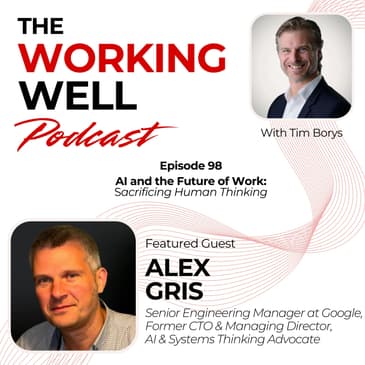
In this episode of the Working Well Podcast, Tim Borys sits down with Alex Gris, a senior engineering leader at Google and former CTO with more than 20 years of experience in technology and leadership.
They explore one of the biggest tensions in modern work: AI is becoming more powerful every week, yet organizations still struggle with focus, deep thinking, and meaningful learning.
From real engineering workflows to leadership decisions, Alex shares what actually happens when AI tools enter real teams and real organizations.
In this conversation you’ll learn:
• Why AI capability doesn’t automatically improve thinking
• How leaders can protect focus and learning in AI-driven environments
• The role of human judgment in an automated world
• What it takes to build a future of work that remains thoughtful and human
If you care about leadership, technology, and the future of work, this conversation offers a grounded perspective on how to navigate the AI era.
Powered by the WRKdefined Podcast Network.
[00:00:04] Today's conversation is about one of the biggest tensions in modern work, AI. And AI is getting smarter, faster, and more capable by the week. But that doesn't automatically mean our work is getting better, our thinking is getting sharper, or our organizations are becoming healthier. My guest today is Alex Gris.
[00:00:26] He's a senior engineering leader at Google and a former CTO with more than 20 years of experience across technology, systems, and leadership. He brings a rare perspective, not just on what AI can do, but on what actually happens when these tools hit real teams, real workflows, and real human beings. In this conversation, we explore what people and leaders may not be seeing yet.
[00:00:53] What still makes work human, and what makes it valuable. How to protect focus and learning in an age of overload, and what it will take to build a future of work that's not just more efficient, but more thoughtful, and more human. Let's get into it. Alex, it's so awesome to have you on the show.
[00:01:18] I've been excited about this conversation for a while, and I just want to say thank you so much for being here, and I can't wait to jump in. Thank you for having me. Thank you. Hi, thank you. Awesome. Well, you've had what I call a rare vantage point. You've been a CTO at a previous company, and now you're a senior manager at Google. What are you seeing about AI and the future of work that I think many companies probably still may not be seeing?
[00:01:47] I think it's going to – I'm going to say the obvious, which is that AI is here to stay. So I think that we kind of need to get used to it. And I think the question – the main question is how do we actually preserve our humanity while using and embracing AI with its strengths and weaknesses, and we don't lose track of ourselves? I think that's a different conversation than discussing whether AI is here to stay. Is it good, bad, whatever?
[00:02:15] I think it's more about, okay, how do we progress together?
[00:02:47] Yeah, and I love that. I love that. I love that. I love that. I love that. I love that.
[00:03:15] And so when you're feeling it, it's like, okay, I love that I love that you're here to stay. And I think this is happening across the industry right now. We see kind of everywhere that AI companies, companies that embrace AI do include people into the conversation and how to drive the future first. I think it is something that it is happening. And at the same time, we should not forget to request it.
[00:03:42] And you bring up a good point too, like being at Google, I would hazard a guess to say Google is further and all the other major tech companies that are developing AIs are further along the path than the average company that's out there in an insurance industry or healthcare and things like that.
[00:04:03] So from your vantage point down the road, what are you seeing about some of the challenges and how people are adapting to it that you can use for advice to companies that are maybe getting there soon? I think it's a very good question. I think one of the main problems is what I observe also by myself reading news and browsing on LinkedIn or social media, Twitter.
[00:04:32] I think that the conversation is a bit polarized. There are people that are worried about AI. I've discussed a lot about AI safety, which is an important topic, right? There is a lot of conversation about that. There is a certain rejection of technology and say, no, this is bad. It's not okay. It's going to take our jobs and all these things. On the other hand, there are strong promoters, also loud voices, saying that AI is here for good. It's going to improve everything.
[00:05:02] Everything is going to be better. I think a much – I mean, my opinion is that technologies are neutral. They can be used for good or for bad. And I think that how we decide to use it, and I think that this decision is an individual one, it's going to drive – I mean, it is a broader decision, but also an individual one, on a one-by-one.
[00:05:29] And I think that how we decide to use it, whether we use it for a good thing or a bad thing, is how it's going to drive the future of humanity. I think it is a powerful tool, of course. But at the same time, I still see it as a tool. I don't think that AI right now, it's going to completely revolutionize – I mean, it's going to revolutionize our world, but it's not going to change it or pose as much risks as some people try to describe it.
[00:05:54] I think it is just a technology, and we should be all the time aware of its strengths and limitations. That's my view. Yeah, and I like that. You know, as you said, you know, about lots of different technology, but AI as well, it's a tool. And you can use a tool in lots of different ways. There are going to be bad actors out there that are trying to use AI to hack into things, which is already happening all the time.
[00:06:23] But on the flip side, people are using AI to invent new medicines and cure cancer. Exactly. And I think there's always both sides of the coin. And as an individual, how we use it makes a huge difference. What do you feel is most misunderstood right now about how AI is actually changing work compared to what you hear and see in the media?
[00:06:50] AI is changing work, and I think that most of the people are using AI. And this is actually something that, you know, it's not always recognized, but I've seen articles about it. Many people are using AIs on their own, but they are not so upfront about using it at work. And that is because, you know, it happens. You put a document that you maybe shouldn't put in a public AI that the company, in order to get your work done,
[00:07:16] a lot of people are afraid to recognize that they are using on a day-by-day basis, thinking that their managers are going to replace them or something. And a lot of things happen. And I've read multiple articles about this happening. I think that the most powerful use of AI in the workspace is, it's twofold. One of them to try to optimize the processes that cut across organizational boundaries.
[00:07:46] Because usually those are the places where there is most of the friction. So, for instance, if I need to hand over my work to somebody else, this creates a delay. Is there any way in which this exchange can be negotiated or simplified through AI? And I think by deploying AI on entire workflows instead of deploying it on very narrow use cases here and there,
[00:08:16] is actually what's going to drive the benefits of AI. Because a lot of the work that happens at the boundary, it's not just about boundaries between organizations, departments, exchanges. It's not just generating delays. But in many cases, it's also frustrating because of alignment and so on. And I think that by employing AI on those particular boundaries, we're actually going to be a heavier workforce
[00:08:45] and focus on really extracting most of the boundaries. We've discussed a lot about communication being the main problem of people in the workspace. A lot of people say that, okay, we have a problem. It's a communication problem. And I agree. I think AI can be really, really good at translating communication between different parties.
[00:09:09] And I think that there can help and solve this communication issues on relatively large scale. What practical examples have you seen of that in the work you're doing? Just for example, a very simple example from my work for today. I had to review some code, right, for some of my engineers. And I also had the design doc.
[00:09:34] And you can easily, for instance, use AI, the design doc, and look at the code and see, do these things match together? Are we talking about the same thing in this too? Another piece of thing that I was trying to earlier, also like days ago, we are also having a couple of designs, some systems design, and we wanted to make sure that they match the legislation.
[00:09:59] A good starting point is to ask AI, please find in this design some potential pitfalls that would cause us problem with the legislation, with this particular legislation. Putting them together already saves a lot of time because it will bring to the table things that are difficult for humans to see. You know, we are not so good actually at connecting a lot, a lot of dots between a lot, a lot of things.
[00:10:28] And this is a good starting point. Now, this also comes immediately with the pitfalls. Because if we take directly for granted what the AI say, without trying to actually check ourselves that this is true, or even without trying to do the extra work on finding new other problems, you know, because it will not be exhaustive and it may misunderstand, then we open ourselves to blind spots.
[00:10:58] Yeah. And then the risk is on us. We cannot blame the AI. It's still the risk is on us. We're still carrying up the responsibility. So as long as we use it as a starting point, as a tool, I think it's very useful and very, very powerful. But we should not outsource the final judgment to the AI. Yeah. I'm glad you brought that up. It brings up another very big point is that, and I've seen multiple different stats on this,
[00:11:25] but it's like above 70%, closer to 80% of people take the first response from like an LLM and just like copy and paste it and say, oh, it must be right. And I'm just like, oh. And especially when the prompt isn't good, you're probably not getting a very good output.
[00:11:46] So that's a really concerning aspect that I think speaks to a bigger issue is as AI, you know, starts to do more and more of the work. What do you think humans really need to show up as human in that moment? And what are we going to be best at? I mean, Just a small question for you.
[00:12:15] First, you know, I think it's a great question. It actually loops back to the first thing that we were discussing earlier. And we are the client for the AI. The AI doesn't have a purpose. So the main value of the human is actually create tasks for the AI. And I think this is really important. I do think, for instance, for myself, the AI agents, it's like somebody who is working for me.
[00:12:45] And I do the same. I verify the work. I give tasks. If the task is not good, I try to fix it. And so on and so on. It is an assistant. It really helps me get my stuff done. And at the same time, I am the client. So I have the final say. And the main value is not to forget that we are the clients.
[00:13:08] And by having this approach, I think a lot of the problems will be solved. Yeah. Yeah. I've had a conversation with numerous people over the past few months, too, is around the things that are uniquely human and the skills that are more important as humans deal with AI. And one of them is leadership.
[00:13:37] And so as a leader yourself, you know the nuances of working with team members and performance management and things like that. But as more AI agents come out and even just not even agentic AI, just performance managing the responses of your AI involves leadership skills.
[00:14:01] So at some point, every single human will need to have strong leadership skills to make sure they're getting the most out of the AI. What are your thoughts on that? Yeah. I don't think that the idea, the good thing is to try to get more of the AI. Because I think that the main thing that we should ask ourselves is how do we bring value and to whom we bring value. Again, returning back, the AI is a tool.
[00:14:29] And of course, we want to use the tool to its maximum extent possible. But at the same time, we should not forget that what is important is the outcome. And that is where we deliver value. For whom we deliver value? For people. What do we need in order to maximum deliver value for people? It's human skills.
[00:14:53] It is trying to understand the demand, trying to understand the customer, trying to understand the person with whom we are interacting and for whom we are actually making the service and so on. So I think that one of the main benefits for AI is that while we can automate stuff, at the same time, we can dedicate more time to the actual interaction that is important.
[00:15:18] And which actually where the value is, trying to discover what people want, how do they feel about your services and so on. And I think that the leadership comes from understanding that right now, what do I do with my time? I double down on the human things because a lot of the things that are automatable can be delegated to technology. And I don't need to care so much about them.
[00:15:47] I can decrease the amount of time I spend on automatable things. So I can spend more time into building connection, building relationship, trying to get the human part. That's my taste. Yeah, I think that's great.
[00:16:02] And I agree is that some of it's communication, some of it's delegation, if you want to call it that, and the ability to make strategic decisions about where you spend your time. Yeah, judge the output because the AI will give you an output, but it doesn't have the context, the full context, right? In many cases, you know, it looks perfect, right?
[00:16:32] It looks very convincing. But I think this is exactly where it comes. You receive a very convincing argument coming from the AI. How do you actually validate it? In many cases, right? Especially when it comes, when that outcome refers to an interaction or an advice about a strategic direction or an advice about, you know, some relationship with a client.
[00:16:56] You need to actually look much deeper into yourself and say, what does my gut feeling say about this? Is this really true? Or is just a perfectly solved argument to me that I would be very tempted to use it without critical thinking? So I think spending more time on trying to actually, you know, connect to yourself is actually a time well spent.
[00:17:24] Well, I am 1000% agree. The thing I see happening is, especially with higher workloads and stress levels, a lot of people aren't taking that time to assess effectively and to critically analyze the result.
[00:17:47] You know, I've talked to a lot of leaders in tech like yourself and they're like, yeah, we're getting more work done because of AI. But now the expectations, the bar has just been raised. So, you know, we're putting out 300% of what we used to. And that's just the expectation now. And so people are like one thing after the other and the workload gets higher.
[00:18:15] So how, at what point do we need to step back and assess what path we're going down with using AI and what a better path might be? I think it's about creating corrective loops and systems of control. The more we can create systems of controls, the more we can free ourselves to go in higher level work.
[00:18:45] What do I mean by that? If, for instance, I know that I can count on AI 100% for a specific operation, maybe I should not think about it. So I can fully delegate. So that is an amount of work that can be offloaded. So now, what do I do right now? Where does the focus shift?
[00:19:11] The focus shifts from actually doing the work to thinking how can we best control the work that is getting done. Right? And I think that the more we are able to create these mechanisms of control, actually, the more we are free to do other things. Now, the problem that comes is that the work is increasing, but we don't have the right mechanism of control.
[00:19:38] So there is more demand because AI can automate, but we don't really trust it for good reasons. We shouldn't trust it until we have mechanism of control. So we are in that phase, which is the phase in the middle where everything is on the table. We neither fully trust it, and we shouldn't because, as I said, we don't have mechanism of control. We should not. But still the demand is there to try to optimize.
[00:20:03] So I think that a lot of the overload and the burnout comes from this being in the process of change. I do hope, and I'm pretty sure that I'm okay. I'm a techno-optimist by default, so take me with a grain of salt. But I do think that these things will – we will get more better and better control systems,
[00:20:28] so we will be able to focus more on what makes us more like value as humans, which is like being the customers of AI. And I really hope – I think we'll get there. I hear this question a lot is that if AI is taking over lots of the work, what are the skills that humans need to develop to make sure we're progressing effectively? And I heard discernment was one of them and strategic analysis.
[00:20:58] What other ones come up for you? Yeah, I think critical thinking is absolutely – I think it's very important. And doubting everything. It's an important topic. And asking questions. I mean, they come kind of together, right? Asking questions is a manifestation of critical thinking.
[00:21:21] I think these are important things to develop because right now AI can give us a lot of answers, but the answers depend very much on the question that we're asking. Absolutely. And it's not just the questions that we are asking because, as we know, it has a confirmatory bias. It will be very happy to tell you that you're doing absolutely amazing, even if not.
[00:21:51] But actually challenging yourself to think differently so that you can at the same time challenge the AI to think differently. So it will do the research for you, but you need to be very specific. What do you expect that research to be? So I think that structure, clarity, clear thinking, and critical thinking are very, very important. And be very – again, they all come together.
[00:22:21] Also, be very aware of the assumptions that you make because when you make an assumption in a conversation, the AI will very happily, at least at this moment, feed it back to you as a certainty. And I think that – these are things that – I do think that we are evolving together, right? We have a partner. So the partner is pushing us. We are pushing it. We are evolving.
[00:22:47] It's a common – we are evolving together with the technology. Absolutely. And as a coach, it makes me smile too about – basically you're saying we have to learn how to ask better questions of the AI and to dig deeper below the answers and responses. From a coaching standpoint, that's awesome. People need better coaching skills. It's prompting the AI. Yes, yes, yes. Yeah, yeah, yeah. I do think so. Yes, yes, exactly.
[00:23:17] So as a leader, how have you worked with your team to help them better utilize these tools? I'm unhappy. I'm a happy person because my team loves AI. So by nature also, the job and so on, it kind of – we are kind of all technology enthusiasts. So we are embracing it.
[00:23:44] So that is one – there's not a lot of work that I need to do to convince people to use AI. Right. And I think that a lot of the things that I learned myself, I learned from them. Okay. Because, you know, we have a team that actually faces problems and then they come back to you and say, Alex, look, all this thing happened and then you learn a bit. So this is an accelerated – this is working. It's also an accelerated process for me. Well, and your team – I do think –
[00:24:14] Yeah, I was going to say your team, because you're in the tech industry, you're lots of smart tech enthusiasts all working together. If you think back to the journey you've been on using AI, even with earlier models and things like that, what are some of the lessons you've learned as a leader to help maybe set those guardrails and expectations around that, that other leaders in other industries might just starting to be facing now?
[00:24:43] I think that one of my – the best lessons that I received is from one of my colleagues. And she came to me with two documents. Say, Alex, did you ask my other colleagues to create these documents? They are complete AI slope. Have you thought about this before? And how are you going to resolve this kind of problem?
[00:25:11] Because I don't want to read other AI slope again. And I think that is a really, really, really important lesson. Because if you are not deep and skin in the game, and if you are not exercising critical thinking, the output of the AI can seem very nice and really convincing. The moment you start actually looking into the things and try to critically analyze,
[00:25:35] you realize that there is a risk of overloading your best people with sloppy work coming from people that don't have the same depth or desire to go as deep into the process. And then we finally – and there is a real risk for the most responsible persons in the team to be overloaded with work verifying sloppy work.
[00:26:04] Because if before, even sloppy work took time, because you still need to do it yourself. So it's sloppy, but at least it takes some time to do it. You cannot produce a lot of it. Now you can produce a lot of it. And then suddenly your main points of control are overloaded, which are actually the people that you want the most in your organization to thrive. Because they are the most engaged and really care about your product.
[00:26:33] I think this is a really, really – it was a cold shower for me because I was highly – how it's called – highly enthusiastic before. Oh my God, we can do so many things. But then I say, okay, we need this mechanism to control put in place. I've heard that from a lot of leaders recently is that we've always had information overload over the past few years.
[00:26:57] But as AI-generated content comes out, it's so easy to just copy and paste a 30-page document and throw it in. And then, yeah, as you said, someone has to review that and it pulls bandwidth away from things that maybe shouldn't need to be done, or at least at that level. No, I don't know if you saw it. It just came out this week.
[00:27:21] But Gallup released their 2026 State of the Workplace report. And they've done a bunch of research around it. I've just started diving into it, but one of the key things that came up was that engagement has fallen globally, particularly among managers. Okay. And that AI is part of a factor in this.
[00:27:51] But with AI, they're saying that workloads are increasing, engagement's falling a bit with managers, but that most companies aren't seeing the ROI on AI yet. And people are saying, you had mentioned it earlier, I'm more efficient individually, but I'm not seeing the company generate new. And actually, I'm feeling overworked because of it.
[00:28:20] What trends are you seeing around that? I think I can totally understand why this is happening. And I think that – and I'm not surprised. I was having the same intuition. And I think the issue was exactly the one – the issue is exactly the one that I mentioned earlier. The AI is many times deployed on things that are easily to automate, right?
[00:28:49] But in most of the cases, that easy to automate is not the bottleneck of a process. So let's assume like this. I'm producing – let's say code. I'm just giving an example right now. But it can be anything. No, I'm producing paper. This is my job. Right? And you need to check the quality of my paper. I need to give it – no, you need to ship it further. Right? And I use AI to create 100 times more paper.
[00:29:18] But you can only receive the same amount of paper that I produced before. It's not going to give more value. If anything, it's actually going to subtract value because there is a lot of inventory and a lot of waste in between us. And even more, I'm going to be stressed. You're going to be stressed because of this – all this inventory that sits between us.
[00:29:43] Now, if we want to use AI in this case, we should try to sit together to see how can the process between us be optimized. And once the throughput of the whole process is optimized across all the workstations, because probably also you cannot ship at a certain speed because there is a certain guy who needs to call with a truck and so on and so on. Right? There is a chain of work changing hands.
[00:30:12] So, until we actually look at the whole process and try to optimize it with AI to be as integrated as possible, so a transversal application of the AI across the whole process, I think the benefits are not going to be there. So, that's why I think that what we – but again, this is my opinion.
[00:30:34] I think that the companies should actually look into embracing more AI across their entire work streams than try to just narrow it, silo it in a small place and then realize that, oh my God, it doesn't provide enough value because we are not making money out of it. Yeah, because this is a silo, of course. Mm-hmm. And then –
[00:30:59] So, I think that actually the embrace should be higher, but at the same time through a design process. It shouldn't be more like, oh God, let's use AI. It should be more okay. Let's map our processes. Let's see where are the problems. Let's see where the bottlenecks are. Can we work on the bottleneck first? Mm-hmm.
[00:31:23] Yeah, and from what I've seen, it actually was mentioned in the Gallup's thing as well, is that the bottleneck is not the AI. It's not the model. It's the humans in the system. And there's that resistance to change and not seeing the bigger picture.
[00:31:44] So, when you think about optimizing AI for that entire system, how do you bring the people along in the best way? Just solve that one. Like, tap your fingers and solve it. Why I'm smiling is all the time it's the same problem, but now it's an AI. It's not AI. It's a change management. Absolutely. It's the same tools.
[00:32:14] When we're talking about bringing AI to a system is similar to changing the process, right? Sending how that process works. That is a change management process. A good help for this is reading a change management book or looking at it not as AI transformation, but rather process transformation.
[00:32:39] And then you apply, shrink the change, gain stakeholders, whatever model for change you want to apply in your experience. There's a lot of literature about that. This is AI. Yes, AI is the buzzword these days, and it's creating change faster, which is creating more stress for people, especially when change management best practices aren't followed.
[00:33:06] And we're seeing that everywhere right now. And I think... Yes, I remember. Sorry, I remember what you had. The other thing except change management, this is the implementation. The other one is, okay, where do we implement it? This is really theory of constraints. You have a workflow. It doesn't matter.
[00:33:28] It doesn't bring value if you increase the capacity of unconstrained resources, because your constraints doesn't change. It will still have the same throughput. So it's constraints theory in 1980s. It's not something really, really new. It's not... Now we are calling it AI, but it's not. Systems have systemic properties. We're looking at them through the systemic lenses.
[00:33:54] I think we can actually decouple hype from what we are dealing with in reality. That's why I'm also optimist that it's kind of the same technical change applied in new clothes. Yes, new technology. Sure. But we've been through that. We've heard from the textile revolution in the 19th century or before, and then all the technical revolution. We've been through that.
[00:34:23] So I don't think that is fundamentally new in terms of change. Maybe it's accelerated because it has a much faster adoption. But humanity has been through these type of changes before and more or less succeeded. We could go down a whole other... Change management side is a whole other conversation.
[00:34:47] And I like how you brought the systems thinking into it because in many of the large companies, we're seeing that at the high level, but it's taking time to happen. What's your suggestion for small companies to start to capitalize on this in their organization? I believe that...
[00:35:16] My opinion is that the AI especially helps smaller organizations because smaller organizations come with shorter processes. The steps are shorter. You have much more control over everything. And generally, you have less integration problems within your company, at least. Because you don't have a lot of departments to talk to, a lot of people to talk to, and align, and so on. So you have much more control.
[00:35:43] So I think that smaller companies should really go AI as much as they can and try to prototype. I was speaking with somebody from a different company earlier last week, a friend. He was telling me that in their HR department, the HR is vibe coding some application for managing candidates' profiles
[00:36:12] and connecting them, verifying them against the internet. You know, like a simple, something that before was done by hand. It's an amazing use of AI. And such as, you know, it's the HR found the solution. They are not technical people. All right. But because they are small and because they could do this, they went in and this saves a lot of time for them. Yeah. Yeah. And we're seeing so much of that these days.
[00:36:41] And again, that's probably another conversation on the, what's the quality of the code and what are the vulnerabilities of doing that? If that type of code is put into a larger code base. But yeah, there's definitely concerns about that for sure. Yeah.
[00:37:06] But it does provide those tools to solve problems in a different way. And I agree with you on the small companies having a massive advantage compared to large organizations because they can iterate faster. Yeah. I'm pretty sure there is a lot of entrepreneurs out there who are thinking, I would like to hire a software company to do this automation for me, but this is so expensive.
[00:37:33] I'm pretty sure this is a very common quality. Now they can do the automation by themselves. And I think this is a great enabler. Yeah. And as, as we, you know, it changes by the week, how much better the models get. And I think we're getting to that point soon where it'll be a lot easier.
[00:37:56] One thing that I wanted to make sure we covered was there's a lot of talk right now about with AI being able to take over so many more of these tasks. How do you preserve the human ability to focus and learn? And what are your thoughts on that? Take notes. No, no, no, no.
[00:38:23] Leaving joke aside, you know, I, I, I really think that, I mean, yeah, exactly. Exactly. So one of the problem of AI, at least what I've noticed is that it gives you so fast the answer that you don't have really time to process it. And you, it seems that you understand it. It makes sense, but it doesn't go into your long-term memory. It just sticks into your, you know, for an hour in your brain and then it's, then it's gone.
[00:38:54] And the problem is that the human brain actually works based on the things that, you know, you can make connections based on your long-term memory, what you have stored there. So you still need to know a lot of things in order to be able to use the AI and have correct mental models. If you're not paying attention, AI may feed you information so fast, you think you understand, but you, but you forget immediately. And that, that creates a problem.
[00:39:22] And the problem is that you don't do it by your hand. So at least what I do is to add a point of friction between me and AI. I use AI for learning, but at the same time, I try to take notes as I'm discussing and so on. By taking notes, it bridges a bit.
[00:39:43] This, you know, it actually increases a bit the time between the answer and me processing it, allowing my brain to actually go through the problem by, by myself and ask lateral questions. And I actually think that the learning takes time and we should acknowledge that. And I really think that if we, if we are interested in a topic and I think we should still continue to be interested in topic.
[00:40:11] I mean, that's a longer discussion, but being interesting in topic, that's something that I think life makes life worth living. But, um, I really think that if we actually are interested in on the things that we are interested in, we should actually slow down.
[00:40:31] And, you know, we accelerate with AI things we don't care so much about, but the things that we personally care about, we should slow down and do the hard work of learning through them. Yeah. And I agree with that. And I see that in myself. I also am very aware of human nature to find the easiest path, the least resistance.
[00:40:55] So anytime you, anytime you say to people, oh, just put a little bit of friction in the mix to, to learn it better. They're like, I don't have time for that. I just want to, I just want to do it, do it easier. And I think that brings up the, you mentioned AI slot before.
[00:41:13] How, how do you help people navigate the balance between, you know, putting out a bunch of fast, mediocre work versus using AI to help you create something truly outstanding? I think that, that is a difficult question overall.
[00:41:37] And I think that the, it's, it's actually the same thing as the answer for learning. It's, it's more, it goes into the same direction. I think that you actually need to be interested into something like for the intrinsic motivation of doing something, right? And humans are very good at intrinsic motivation. I mean, if you're thinking about it, kids play, you know, in many, they engage in like play.
[00:42:07] We are adults play games. We read books. We do a lot of intellectual things, which are hard on the brain, but we're doing it for our own fun. And we really like to learn. We are learners, right? How do we do exceptional work is, I believe, you know, diving and reconnected to our desire for learning. Because exceptional work needs to be above the average.
[00:42:35] The AI will generally give you an average work, which is, by the way, a very hard bar, a very high bar. And it continues to rise. If we want to be above the average in a specific, in a domain, we cannot be above the average on everything, right? This is for sure. But there should be something that each of us has its own specific, you know, interest where we are deeply interested and we are above the average.
[00:43:03] And there is where I think that the biggest gains are. Let's not forget that AI is actually trained on this exceptional work, right? And it's actually trained on a – but this is where we are actually ahead of the AI, where the people that are exceptional in one domain and they are very interested are the ones who are pushing the domain forward.
[00:43:26] And, of course, they need to use AI because they need to free themselves time to actually excel in that one, two, three things that they are really, really good at. So how do you use AI to help you accelerate that? I mean, automate as much as you can right around your life. The things will be very – I think it's important to really take a decision at every time.
[00:43:56] Is this the thing that I'm really good at or is this the thing that I'm not interested in being good at? And then I can do the AI for the things I'm not really interested in. I just don't want it to be a negative impact on me as much as I can. Try to push – to try to really think more and more about the things where you really want to do good at.
[00:44:22] Now, AI, it can be an amazing idea-sparing partner as long as you're executing through this. And here comes the learning loop where you actually ask questions to AI and then you slow down to actually think through the learnings in order to actually level up your skill.
[00:44:45] Well, I think another aspect of it, as you mentioned, the automation, as we are able to take more off our plate in terms of automation of tasks that should be automated, it ideally gives us the bandwidth to step back and take the time to dive deeper and get better at those things.
[00:45:14] What we're seeing right now, and Gallup mentioned this in their report as well, is that right now that extra bandwidth is just getting filled with more work. And companies are taking advantage of that to get more productivity or workload out of people.
[00:45:38] But it's not – people aren't able to step back and actually build their excellence in an area. I think it's a – I really think it's a problem. I don't think we have – I don't think there are global solutions. But I do – I see it because we impair – by being constantly stressed, being constantly under demand, impairs our ability to learn. So if you're stressed, you cannot learn. You're just going to react, right? You cannot just think creatively. Yeah.
[00:46:08] We see that with kids in the school system right now. Yeah. Stress, overwhelm. Yeah, it's not going well for that education aspect. But yeah, it's – same applies to adults.
[00:46:29] Now, what do you – if you fast forward and, you know, looking at where – what you've seen over the past couple years, where do you see – where do you see things going in the next year to two years as far as humans and AI connection? Yeah. And this is a mix of – there is a bit of wishful thinking in what I'm saying. Sure. The crystal baller. You can – Yeah, yeah, yeah, yeah.
[00:46:58] I really think – I really hope that we will be able to find an equilibrium and actually that AI is going to help us, you know, be even more humans and excel at the things that we are, being the client of AI. And really use it for improving our day-to-day lives. And I think there is a very high probability that this will be – this will happen.
[00:47:24] Because if we are thinking, you know, just purely from an economic point of view, if we are not making – if let's say that AI takes all our job and we're not going to have any kind of jobs, who is going to pay for AI? So, if you're going to the other extreme, there is – you know, there's – you need clients in order to make money, in order to have a success. So, you need this economic loop. So, you need happy people to be able to spend.
[00:47:53] And, you know, so – so, I think that systemically we will end there. I think that there is still a period of transitions, like from any technical, you know, challenge. Not everyone is going to be a winner. And this is a very sad fact. You know, from the beginning of the technical – industrial revolutions and so on.
[00:48:19] Not everyone won from the technology. This is a societal problem. We will need to find a solution how to deal with that. Sometimes transitions can be long and very painful. It can last generations until, you know, your progress is not linear. Sometimes we do get back. We do fall.
[00:48:46] We can take generations to go back. So, we need to acknowledge this and have a broader societal discussion how to handle. Because I think the society has the resources to actually, you know, make sure that everyone lands in a good position. So, I think we have all the tools. It's really up to us to see what we can – how we can make it better. Yeah.
[00:49:15] As good as the elements of any tool, how you use it. But I think that the force is going to the right direction. That's my opinion. I think that we are leaning towards the right direction. And we see that mostly the dialogue is the right one. Yeah. And as you had alluded to before, humans have gone through many different transformations over the centuries.
[00:49:44] And the challenge with this one is just how fast it's happening. And, you know, when you look back to 2021, really it's been, you know, when did the first RGB decode or whatever? Yeah. 22 or something. 22, yeah. Yeah. And, you know, that's such a nanosecond compared to human history.
[00:50:10] 23, and the changes when it's happening that rapid, yeah, it's going to be painful in a lot of areas. I tend – I'm a passionate optimist. I think the, you know, well, yes, there's going to be pain. It's also going to create – have a net positive effect. And as with any of the changes we've gone through. Yeah.
[00:50:37] When you look forward, I guess if we think about leaders right now, most of the people listening to this are leaders. Thinking to the drop in engagement and the stress they're probably feeling, for someone – what's your suggestion for someone who wants to stay relevant on AI without becoming overwhelmed? What would you have them focus on first?
[00:51:05] I think it's just like general management advice in a way, right? If you're a leader, if you're leading somebody, so probably you're surrounded by people that work with you. And in most of the cases, the work is done through other people, right? I think it's important to take care of those people, to continue doing taking care of those people.
[00:51:30] Because in many cases, it's the individual contributors that feel the biggest change in the way they work. Because it's their job that changes. And I think really navigating the AI transformations as a change and taking into account all the emotions of your staff that are engaged with that change and being – and understanding that speed brings additional worry, additional stress.
[00:52:01] I think this is – I think this is still fundamental, which is actually fundamental, I believe, to great, good management overall. So I think that is. Obviously, staying relevant in the AI of AI, like trying to understand the technology, really understand – it is important. Because it's hard to lead something you don't understand. So, of course, you should still read.
[00:52:29] But this is kind of in the same bucket as, you know, knowing the business in which you are, right? If you're in the sales, kind of know sales. Otherwise, it doesn't really work if you're leading a sales team, right? So there's a – I think it is about that. And I'm hopeful. I think, you know, like in every change, you know, we need to deal with stress and learn how to detach and handle it and just move forward. I mean, it's easier to say.
[00:52:57] I'm sometimes pulling my hair myself. In theory. I love that you brought that up because I think – I've seen that leadership often underestimates the impact that they have on their team. And they were in the organization.
[00:53:17] And, you know, I see this a lot in technical roles as well is that a lot of technical leaders, and that's whether it's in IT or engineering or legal, medical, a lot of technical subject matter experts that are leaders start to focus on the work and not the humans doing the work.
[00:53:42] When we start to care for the humans doing the work and ensure they have what they need and you're helping them learn, grow, and improve and educating them, educating yourself so you can educate them, then the work improves. But focusing on the work directly doesn't necessarily improve it overall because if the humans are struggling, then the output struggles. That was not eloquently said, but –
[00:54:12] No, no, no, no. I absolutely agree. So, you know, one of the – probably one of the things that are the most to resonate with is – I learned it like many years ago in a course, but it stayed with me. It says, you know, as a manager or a leader, you need to work on the system, not in the system. So, you really need to look at, okay, how the things are going around me.
[00:54:38] Is this the most optimal way of working? How are the people working in the system? Because your staff is working in the system. How are they doing? Because if – the moment you start working in the system, you're getting sucked into a lot, a lot of problems there and you forget the big picture.
[00:55:04] You still need to work in the system from time to time to really feel the pain. Otherwise, it becomes theoretical. I love – yeah, that's – But still your main responsibility on the system. Michael Gerber with the e-myth for entrepreneurs, he talks about that, working on the business, not in the business. Okay, yeah, okay, yeah. Great, yeah. Thank you. Well, thank you so much for sharing. This has been amazing. I know we could talk for a lot longer.
[00:55:34] Thank you. What's some final thoughts you have for people listening? And then where can people find you? On LinkedIn, obviously, I'm on LinkedIn. What final thoughts? I think should enjoy the transformation and be happy. Try to be happy in the age of AI because we spoke about AI. It's important. I love it. Okay.
[00:56:00] I will make sure if you're okay with it, your LinkedIn goes in the show notes and people can find you there. And thank you, Alex, again. It's been amazing to have you on the show and I appreciate you sharing your wisdom and insights. Thank you. That wraps up another episode of the Working Well podcast. If you enjoyed the show, please rate, review and subscribe wherever you get your podcasts. Now, which guests or topics would you like to see featured on the show?
[00:56:27] Message me through LinkedIn or on the contact page of timboris.com with your ideas. Thanks for tuning in. I'm Tim Boris with Fresh Wellness Group and I look forward to seeing you on the next episode. We'll see you next time.
Sponsors
