
These days, society has a love/hate relationship with technology. It’s an integral part of our digitally driven world, yet if we aren’t careful, getting sucked into the digital vortex can be disastrous for our mental and physical health.
Thankfully some great technology companies are using their coding and behavioural science skills for good. These companies are helping people live healthier, happier, more vibrant lives. To facilitate learning, engaging with nature, and connecting with other humans.
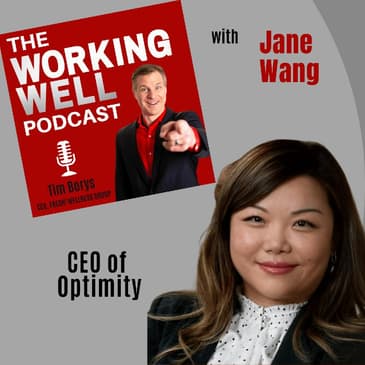
Today, we will meet Jane Wang, one of the amazing women driving this positive change and learn how her biochemistry and medical background led her to create a unique wellness technology company that’s transforming consumer health, corporate wellness, and influencing the future of the insurance industry!
Welcome to the Working Well Podcast, the show that explores the rapidly changing landscape of work and wellbeing. Each episode, We dive into the hottest topics in leadership, employee wellbeing, and the future of work! I’m your host Tim Borys.
Before we dive in, let’s learn more about Jane Wang.
Powered by the WRKdefined Podcast Network.
[00:00:00] These days, society has a love-hate relationship with technology.
[00:00:05] It's an integral part of our digitally driven world, yet if we aren't careful, getting sucked
[00:00:11] into the digital vortex can be disastrous for our mental and physical health.
[00:00:16] Thankfully, some great technology companies are using their coding and behavioral science
[00:00:21] skills for good.
[00:00:24] These companies are helping people live healthier, happier, more vibrant lives.
[00:00:28] They facilitate learning, engaging with nature and connecting with other humans.
[00:00:33] Today, we'll meet Jane Wang.
[00:00:36] She's one of the amazing women driving this positive change, and we'll learn how her
[00:00:40] biochemistry and medical background led her to create a unique wellness technology company
[00:00:46] that's transforming not just consumer health and corporate wellness, but influencing the
[00:00:51] future of the insurance industry.
[00:00:55] Welcome to The Working Well Podcast, the show that explores the rapidly changing
[00:00:59] landscape of work and well-being.
[00:01:02] Each episode, we dive into the hottest topics in leadership, employee well-being, and the
[00:01:07] future of work.
[00:01:08] I'm your host, Tim Borys.
[00:01:10] Here's a bit more about Jane.
[00:01:14] Jane Wang is the CEO of Optimity, an award-winning wellness engagement platform that delivers
[00:01:19] personalized holistic health programs with microlearning, wearable devices, and
[00:01:24] gamification to support healthy living.
[00:01:27] In the last nine years, she has led the team to codify 30-plus years of behavior science
[00:01:32] into a mobile app and digital program that serves 3 million members across North America.
[00:01:39] Prior to Optimity, Jane led innovations in dynamic health risk scoring and specialized
[00:01:44] in digital patient engagement programs for phase 2 and 3 global clinical trials.
[00:01:50] She's passionate about prevention and proactive health programs to improve population health
[00:01:54] and mortality using nudges and the joy of gamification.
[00:01:58] Hey, Jane.
[00:02:06] I'm excited to have you on the podcast.
[00:02:08] I really enjoyed our chat the other day and looking forward to diving into the two of
[00:02:13] the topics we discussed.
[00:02:14] How's your day going?
[00:02:16] It's great.
[00:02:17] It's a beautiful spring day and I'm excited to get outside for the latter part of
[00:02:23] it.
[00:02:24] Well, awesome.
[00:02:26] Outside is perfect.
[00:02:27] And what were you trying to do?
[00:02:29] I know you grew up in Alberta, so you love the outdoors as well, I'm sure.
[00:02:33] And we've got some snow here today, so I'm looking forward to getting out and experiencing
[00:02:40] a bit of the outdoors and the snow before it's gone.
[00:02:44] In our conversation the other day, you're a bit of an enigma to me.
[00:02:49] You've got this biochemistry background and now you're running a tech app and you
[00:02:57] are making all these great changes.
[00:02:58] Tell me a bit about the origin story of optimity and how you went from biochemistry to mompreneur
[00:03:08] and running this amazing app.
[00:03:11] Thanks so much.
[00:03:14] First of all, thank you for having me on here.
[00:03:16] I'm always interested in having really impactful conversations around my favorite
[00:03:23] topic, which is helping people live healthier and longer and with better financial wellness
[00:03:28] as well.
[00:03:30] It's been an evolution, as you said.
[00:03:32] I came from a family of developers and coders, so electrical engineers, so both my mom and
[00:03:40] dad.
[00:03:41] So I just coded growing up.
[00:03:42] I didn't really think much about it.
[00:03:49] We were just in a very supportive middle-class family where I got to choose what my interests
[00:03:56] were and I was really interested in health sciences.
[00:04:00] Because I did quite well in my biology and chemistry classes, I thought biochem was the
[00:04:04] right thing.
[00:04:05] But little did I know that biochem was a lot more medical.
[00:04:08] So as I am the first person in my family to be in the health sciences and then
[00:04:14] the whole point was I wanted to have a doctor in the family so that we, in case anybody got
[00:04:22] sick, I'll be there and I'll be able to help them out and do that.
[00:04:27] And it would be really fun.
[00:04:29] But the more I progressed and I did my MCATs and all the hospital internships and so
[00:04:37] on, I found that they were lacking a lot of scalable ways of doing things.
[00:04:43] There's not a lot of software in it and I just couldn't understand.
[00:04:47] So even in my research projects, I created code and scripts that they can run to analyze
[00:04:53] data.
[00:04:54] So I ended up actually just specializing in working on technology platforms for, started
[00:05:01] with hospital systems and then they went into clinical trials and Alphama Hospital
[00:05:06] Site to a CRL contract research organization working for Large Pharma.
[00:05:12] And I all along the way kind of brought my flavor of technology analytics.
[00:05:19] So I have a stats minor and so on, and then became the specialist and I worked on a lot
[00:05:25] of really amazing prevention type of projects.
[00:05:29] So I got to work on ovarian cancer prevention.
[00:05:31] I got to work on Alzheimer's.
[00:05:33] I worked in research in MS in also HIV.
[00:05:38] So it was really cool and I predict patient outcomes using kind of the best in class software
[00:05:44] and data.
[00:05:45] So this is from blood scans, patient assessments, health assessments, MRI.
[00:05:51] We kind of did the first versions and this is in like in the 2000s and early development
[00:05:59] of I guess now it's categorized as AI but back then it was really a script running
[00:06:07] on an MRI scan to detect lesions and to auto fill them and then the doctor would take a
[00:06:12] look at them to verify it.
[00:06:13] So I got to work on stuff like that and prediction of mortality and morbidity outcomes.
[00:06:19] So that kind of was the first 10 years of my professional life from my undergrad
[00:06:25] marrying what you know, my what I inherited from my family in terms of just skills
[00:06:33] and then also what my personal interests was.
[00:06:36] But unfortunately in 2011 kind of like took a turn and as I was doing these like world
[00:06:42] changing research across the world in my own backyard, my mom got sick and she was 52
[00:06:47] at the time and she had developed cancer.
[00:06:50] But it was a different type of cancer was leukemia and I couldn't do anything about
[00:06:55] it and that at the time my partner was also he was in he was an emergency
[00:07:00] physician and the two of us like it completely I realized my first hypothesis,
[00:07:07] which was hey, I'm in health care.
[00:07:08] Right.
[00:07:09] Like we have like we should be able to take care of my parents.
[00:07:13] It didn't work like that.
[00:07:14] And we were not able to take care of her and she passed away within six months.
[00:07:17] So I lost her.
[00:07:19] She was very young.
[00:07:20] She was 52 and that took me on a that was definitely a pivotal point
[00:07:25] in my life where I realized that the work that I was doing,
[00:07:31] although, you know, as glamorous and as interesting as it was for me
[00:07:37] professionally didn't really truly have the impact on my family.
[00:07:41] So or other families like mine.
[00:07:44] So that took me on kind of a soul searching journey.
[00:07:49] I ended up getting more education to kind of fill the time.
[00:07:52] So I went and got an MBA, a Disadvantaged Consulting.
[00:07:56] I worked in investment in private equity, just looking at investing
[00:08:00] in different types of health areas because I thought money would power.
[00:08:03] That's kind of what I learned from my MBA that money would power change.
[00:08:09] I didn't quite find the answer yet.
[00:08:10] And then I ended up doing some master's training and analytics work
[00:08:15] at in the Bay Area at Stanford and.
[00:08:19] During the time there, the year there, I saw so many.
[00:08:25] People like myself, like not not kind of like the Elon Musk,
[00:08:32] like I, you know, I quit school and I started doing this,
[00:08:35] but people that are kind of mid career,
[00:08:39] starting companies and making amazing change and, you know,
[00:08:43] supporting hundreds of thousands of patients, not like the few,
[00:08:46] you know, the tens of thousands, hundreds of thousands of patients
[00:08:49] and and doing prevention.
[00:08:52] And it was, you know, 2013, 2014, which is circa the rise of Fitbit.
[00:08:57] This little company and this little company, you know,
[00:09:01] Google had their, you know, Google Health thing,
[00:09:04] Apple started announcing their first watch, rolling that out.
[00:09:07] So it was such an interesting time.
[00:09:09] And I just caught the startup bug.
[00:09:11] And this is Optimities, actually the second startup
[00:09:14] that I'm worked on, like it's been amazing.
[00:09:18] And then during in throughout that journey, I've, you know,
[00:09:21] been able to also build my own family.
[00:09:25] And now I have two little ones and I really identify with being
[00:09:30] a non-traditional entrepreneur.
[00:09:32] So that's why I'm a mom printer and I'm in the tech industry.
[00:09:35] And now we support over three million people on their journey.
[00:09:39] Yeah.
[00:09:41] Looking for people like my mom, you know, that's that's.
[00:09:45] And congrats on the journey.
[00:09:46] And I do want to say I feel you on your mom.
[00:09:50] I just lost my father last fall and I know, like.
[00:09:56] It hits at the heart so so much.
[00:09:58] And yeah, so my thoughts are with you on that.
[00:10:03] Yeah, it's been actually very healing the last now.
[00:10:07] Really, it's 13 years.
[00:10:10] It's been very healing to be able to do something about it
[00:10:14] and to to to take a very active role and to wake up every day
[00:10:19] with that mission, as well as along with the team.
[00:10:23] So like my teams, like that they all have personal stories
[00:10:25] like yours because guess what?
[00:10:30] We all get touched by health tragedies at some point.
[00:10:34] And it's just part of the human experience.
[00:10:37] And it's really about how can we optimize that experience
[00:10:41] and have lots of joy in it and allow that to power a connection.
[00:10:47] And yeah, and I think all that is
[00:10:52] it's been hugely healing and impactful.
[00:10:56] Yeah. And we know your mom would be proud with what you built
[00:11:00] and how many people you're impacting.
[00:11:03] So as we're in our conversation the other day, we
[00:11:06] and I guess we originally connected by an excellence
[00:11:10] Canada webinar on workplace well-being.
[00:11:13] And that's that's an area directly aligned with.
[00:11:17] With where my passions are and my journey brought me from elite
[00:11:22] athletics to personal training all the way into this work,
[00:11:27] reforming or re transforming the world of workplace well-being.
[00:11:32] And I really am interested in to chat with you about
[00:11:37] optima because.
[00:11:39] I see what you're doing is is quite different than what else is out there.
[00:11:44] But I think a lot of people listening are probably going to say.
[00:11:48] We don't need another frigging app.
[00:11:51] Like what why like the user engagement is low.
[00:11:59] What's the house?
[00:11:59] Another app going to help people actually improve.
[00:12:03] People don't use the ones that are already on their phone anyway.
[00:12:05] So what's this?
[00:12:06] What's different about this and how is it going to help companies and individuals?
[00:12:12] Yeah, yeah, it depends on the person how they look at it.
[00:12:16] I don't really look at the the phenotype of which is like how it shows up.
[00:12:22] Right. So like this a cup as a cop.
[00:12:24] Right. Like we don't need another cup.
[00:12:25] I have 50 other cups in my cupboard.
[00:12:28] But I think it's really important to look at the problem itself and what we see
[00:12:32] and to find and to solve a problem for the person, for the who.
[00:12:37] So let's take the example of someone like my mother.
[00:12:41] Right. So she she was 52 at the time.
[00:12:43] She was working for a software company.
[00:12:45] They had a great benefit, health benefits.
[00:12:50] And but they also pay the people to do assessments.
[00:12:55] Right. So you could do your physical assessments and stuff like that.
[00:12:58] I think they paid like two hundred, two hundred fifty dollars and so on.
[00:13:01] But those benefits are not being used.
[00:13:04] And then you take that person now in our time, which is 20 the year 2024.
[00:13:09] You're going to find that it's a distributed workforce.
[00:13:12] People are coming from all kinds of places.
[00:13:13] Like how are you going to communicate those benefits to those people?
[00:13:16] How are you going to get their fingertips and where are they looking
[00:13:19] for this stuff at the time where they're not feeling super well?
[00:13:23] Are they, you know, are what is the first place that they're going to look for information?
[00:13:31] And how do you get it to them, you know, in the best way, most efficient way
[00:13:36] and most problem solving way.
[00:13:37] So you kind of look at solving the problem there.
[00:13:39] And I think optimity itself is a data driven health
[00:13:43] and wellness engagement program that allows anyone to connect within seconds
[00:13:50] and get access and communicate and find the benefits
[00:13:55] and be able to do an assessment quickly and be able to access
[00:14:00] their information and kind of do the do the health portion
[00:14:05] of it, the health benefit portion of it.
[00:14:08] And then the second part is culturally, I think we're at a time where
[00:14:15] in people's leaders are starting to understand
[00:14:19] that the organization is actually a fabric, right?
[00:14:23] It's not just like people
[00:14:27] clocking in and doing things like I can tell you from my team,
[00:14:30] people are very mission driven.
[00:14:32] You know, I'm here because I know my team and I know them
[00:14:36] not through just the work tasks that we're doing,
[00:14:39] but these other human connections and the social connections.
[00:14:43] And there's this whole sense of belonging that happens.
[00:14:47] And there's many micro habits that are part of our.
[00:14:53] Original work that was kind of eroded during the COVID years.
[00:14:56] And what we found that our particular version of optimity,
[00:15:01] which actually it's called FIGITAL, so it's physical and digital.
[00:15:05] It really enables these asynchronous connections around micro habits.
[00:15:10] So for example, you and I can do like, you know,
[00:15:16] around something that we already self discover that we don't do enough.
[00:15:19] For example, like I don't drink enough water.
[00:15:21] We can actually be in a synchronous challenge between you and I on this platform.
[00:15:26] So we're doing something physically, but it's trapped on the digital thing.
[00:15:30] So I think apps are still one of the most efficient ways to connect things.
[00:15:35] And then optimity is more than just an app.
[00:15:37] The app is just the place, the portal that you can pick up a mobile device.
[00:15:43] 98% of people have a mobile device so that they can connect in a way
[00:15:49] that's free to them, that's very accessible for them.
[00:15:51] And I can connect with someone around the topic.
[00:15:55] So right? The experience, the journey
[00:15:59] is what creates that engagement experience.
[00:16:01] And we work on a lot of different types of digital,
[00:16:06] I would say things that make sense for that company in their occupational
[00:16:14] in their occupational context.
[00:16:16] So for example, we have a Satori, which is a cheese factory.
[00:16:20] I don't know each Satori cheese, but I love their cheese and
[00:16:24] they came to us because traditional ones programs or those, you know,
[00:16:30] different things that what my mom experienced didn't
[00:16:34] doesn't work in their way.
[00:16:36] They have some admin staff at most of their people.
[00:16:38] Some of the most of people don't even have emails, right?
[00:16:41] So so how are they going to connect with them?
[00:16:44] Well, we help with that modern connectivity.
[00:16:47] Anyone can do it is bring your own device.
[00:16:49] You can bring your own phone.
[00:16:50] You can all connect that way.
[00:16:52] Now they can connect with over 80, 90% of their employees
[00:16:56] on something that brings the employee joy, brings them rewards
[00:17:00] and is really scientific and prevention based as well.
[00:17:03] So I think also the content of what's going in there is important
[00:17:07] because many people could say, oh, an app is an app.
[00:17:10] The same way people say, oh, there's too many streaming services.
[00:17:13] But guess what?
[00:17:14] The streaming service that you look at and that you really connect to
[00:17:18] is the one that delivers the content that you care about.
[00:17:21] Like, you know, it does Netflix is Netflix producing
[00:17:24] the right content that you care about.
[00:17:26] Then you're on that or if you have young kids, you know,
[00:17:29] is Disney the real platform?
[00:17:31] It's really about what's inside and what are the journeys?
[00:17:34] What are you getting from that?
[00:17:36] Love it.
[00:17:36] And yeah, you said it really well.
[00:17:39] Apps are apps.
[00:17:40] I always talk about apps as tools and you know,
[00:17:44] I put that out at the beginning
[00:17:45] but no one needs another frigging app because I hear that from
[00:17:49] people that are cynical in the workforce or employees.
[00:17:53] They're like, oh yeah, our company's throwing another app at us
[00:17:58] and they just roll their eyes and say, oh,
[00:18:02] like this is the flavor of the month essentially.
[00:18:05] And now you've been at this
[00:18:07] and years or whatever in in optimity.
[00:18:10] And I like how you talked about micro learning, micro habits
[00:18:15] because on the app side, we know that
[00:18:19] developers build apps for stickiness.
[00:18:24] You know, your Facebook feed or your Instagram feed
[00:18:27] or Snapchat or whatever, TikTok,
[00:18:30] they're all designed to draw you in and spend more time on the app.
[00:18:35] And when we know that behavioral science is there,
[00:18:39] how do we, I'm always like, how do we use it for good?
[00:18:42] Yeah, we talk about data for good.
[00:18:44] We talk about technology for good.
[00:18:45] And that's a really important concept
[00:18:49] that we've codified into our technology.
[00:18:52] So the optimal amount of time that we want someone
[00:18:54] that's in the app casually is around five to seven minutes,
[00:18:57] almost like recess, right?
[00:19:00] It's a recess, right?
[00:19:02] It's a, it's a recess from work.
[00:19:04] It's a, it's a, it's a, it's a learning break
[00:19:07] and it's a learning break that's joyful.
[00:19:10] And then the second type of fuse case that we have
[00:19:13] is people that are doing physical exercise in it.
[00:19:16] So if you, for example,
[00:19:17] if you are doing like a seven minute workout
[00:19:19] or you're doing a 30 minute workout or something like that,
[00:19:22] we want you to be in there
[00:19:24] and have the best experience to deliver that workout.
[00:19:26] So that's fine too.
[00:19:27] And then the last part is be able to sync in the background
[00:19:30] so you, you just walk and you just live.
[00:19:32] You just do your day to day, but in the background,
[00:19:34] we're tracking the information for the purpose
[00:19:38] of gamifying it and allowing you to connect with some,
[00:19:42] a colleague or accountability partner.
[00:19:45] So we have family and friends programs too to do that.
[00:19:47] So you don't have to like take out your phone
[00:19:49] and interrupt that beautiful physical experience
[00:19:53] to, to, to like log something out.
[00:19:57] You don't necessarily have to do that
[00:19:58] because we're doing that for you already in the background.
[00:20:00] So I think that's kind of the three key use cases
[00:20:03] and over the 10 years, yeah,
[00:20:05] we've been able to show a really great sustained usage.
[00:20:09] So the best in class stuff is, you know,
[00:20:11] monthly active 30 to 40%
[00:20:13] and that's what's kind of beautiful about having this type
[00:20:18] of a program.
[00:20:19] We are really not about attracting the users
[00:20:23] or they're sticking it on, you know,
[00:20:25] their nose into the phone for a very long time.
[00:20:28] It's really something to occupy everything we talk about
[00:20:31] like rest time, which could be like basically toilet time
[00:20:34] for people to like scroll through and do some micro learnings,
[00:20:37] do some learning and Ernie for them to get nudged
[00:20:41] to actually go outside and be physically active
[00:20:43] or, or to have something in their hands
[00:20:46] that they could do a short exercise
[00:20:49] and build an extra class.
[00:20:51] Short exercise and build a exercise thing
[00:20:54] within the timeframe that they have, right?
[00:20:56] If you only have 12 minutes,
[00:20:57] we'll build something for them that is in that,
[00:20:59] that happens literally within a clickable button.
[00:21:03] So.
[00:21:04] Great.
[00:21:05] And I like how you've talked about the,
[00:21:09] the engagement aspect of the,
[00:21:11] the platform and can you talk a bit more about
[00:21:16] belonging and how that really fits in particularly
[00:21:19] on the, on the corporate side.
[00:21:22] Yeah.
[00:21:23] So it's really a,
[00:21:25] it's a pretty complicated topic, isn't it?
[00:21:29] And we humans are pretty complex social creatures.
[00:21:35] So in just Canada, right?
[00:21:38] According to statistics,
[00:21:39] Canada more than 40% of Canadians like last year
[00:21:43] were really feeling lonely some or all the time.
[00:21:46] And I think the problem really is worse really about
[00:21:51] around single people and those who are really living alone.
[00:21:54] And guess what?
[00:21:56] During the pandemic,
[00:21:57] it forced a lot of people to be trapped within that.
[00:22:01] So, and you know, it's somewhat rebounding,
[00:22:05] but it's not fully rebounded.
[00:22:07] So we're kind of left with this scar tissue
[00:22:10] and some inertia around just mental health.
[00:22:15] And it's exerting itself and you're seeing this stats
[00:22:19] around loneliness as a, you know,
[00:22:22] as a lack of connection and really kind of the role
[00:22:27] of the employer in rebuilding that fabric
[00:22:32] of communities and belonging.
[00:22:34] And I think that's kind of a nice side benefit
[00:22:37] because in my research originally like way back
[00:22:41] in the health science days was really around holistic health,
[00:22:44] which is not just the physical health,
[00:22:47] but it also has many different pillars.
[00:22:50] And one of them is social connectedness,
[00:22:56] which is really around the prediction
[00:22:59] of how long a patient or how well a patient will do comes
[00:23:03] as a, it's influenced by do you have people caring for you?
[00:23:09] A caregiver, do you have an accountability partner?
[00:23:13] Do you have someone that supports you in your diet?
[00:23:17] You exercise your medication needs
[00:23:20] and you're right, like all this stuff.
[00:23:22] And I think this now in the corporate sense comes in also
[00:23:29] as a flavor of, hey, do people care about you?
[00:23:32] Do you have a work friend?
[00:23:34] Do you at least have one person that you feel comfortable
[00:23:38] to do something that is a non-work activity?
[00:23:43] What?
[00:23:44] And that turns out to be something that we can facilitate
[00:23:48] on a health and well-being platform, right?
[00:23:51] You walk every day.
[00:23:53] I hope you do and you sleep every day
[00:23:55] and you hopefully drink water and eat every day.
[00:23:57] Can we find you a partner to do something with?
[00:24:01] And it could be at work.
[00:24:03] We definitely highly encourage that.
[00:24:05] So we do nudge people towards that.
[00:24:07] We give them points and we incentivize
[00:24:09] and we do the matching and so on.
[00:24:11] But you could also bring someone that is in your family
[00:24:14] or friends, your neighbor.
[00:24:16] So many of our corporate partners, if they do have the budget,
[00:24:19] they do turn on the family and friends program
[00:24:22] because it's quite cost-effective.
[00:24:24] And it increases kind of the impact of a program like this.
[00:24:31] And then a lot of the other companies that we work with,
[00:24:34] some of them are like fraternal.
[00:24:36] So they have their own like a sense of belonging,
[00:24:40] which basically it's called a common bond.
[00:24:43] So it could be, you know, they're all of like a German immigrant descent, right?
[00:24:48] So they have that or they all volunteer
[00:24:51] and do a particular activity, right?
[00:24:53] We sponsor communities like the Diabetes Association
[00:24:57] or something like that.
[00:24:58] So these are participation in Canada.
[00:25:01] That's also on our platform.
[00:25:03] So in those type of things,
[00:25:05] it's helping to find like-minded individuals
[00:25:09] and create community things and rewarding them
[00:25:11] for the activities that they do together.
[00:25:13] So for example, we reward volunteer activities on Optimity
[00:25:17] and we help everything from like the people RSVPing for it
[00:25:22] to getting the information again as a communication platform
[00:25:25] to get them there.
[00:25:27] And then as they do the activities just in the background,
[00:25:29] you don't have to do much on it.
[00:25:31] It's just, you know, it's that you were there
[00:25:33] and then we reward you at the end.
[00:25:37] And yeah, you can gamify it with a leader board
[00:25:39] or recognition board or a gratitude board
[00:25:42] where people can share their experience
[00:25:44] and all that kind of adds into this sense of belonging
[00:25:49] and that like the collective and the community
[00:25:52] and that I had made a one-on-one connection with someone
[00:25:56] and then that me as part of my community,
[00:25:58] my work team, my, you know,
[00:26:00] the people that I showed up with
[00:26:02] did something bigger than myself.
[00:26:05] Yeah, and I, you know, in this digital world,
[00:26:09] especially distributed workforces and remote work, hybrid,
[00:26:14] people do get lonely and especially when those opportunities
[00:26:21] aren't available to them on a daily basis.
[00:26:23] So I love the fact that you're facilitating that.
[00:26:26] Now if we take a step back from the belonging
[00:26:28] and look at the bigger picture on your site,
[00:26:31] you mentioned five holistic health pillars.
[00:26:34] Tell me a little bit more about what your pillars are
[00:26:37] and how they might differ from what else is out there.
[00:26:40] Yeah.
[00:26:43] Well, okay. So for us, it's physical health, right?
[00:26:47] Nutrition, right?
[00:26:49] Abs are made in the kitchen, not just in the gym.
[00:26:52] So it's really important.
[00:26:54] Mental health, right?
[00:26:57] So this all has everything to do with like
[00:26:59] your self-care meditation stuff
[00:27:01] to everything from actually coping with
[00:27:05] certain types of trauma and so on.
[00:27:07] So in that bucket, social connectedness,
[00:27:09] which we just had a really, you know, kind of unpacked.
[00:27:14] And then the last is financial wellness
[00:27:17] because that's such an indicator of longevity
[00:27:19] and that shows up in the science everywhere as well.
[00:27:23] So being able to, you know, pay for the food
[00:27:26] and the exercise and be feel okay,
[00:27:29] not have the anxiety, be able to sleep
[00:27:31] and also coping with certain other coping mechanisms
[00:27:34] such as gambling and overspending
[00:27:39] and certain types of like financial behaviors
[00:27:42] that are a lot of times stemmed from some other sort
[00:27:47] of mental health or physical health related issues.
[00:27:53] It's all interconnected.
[00:27:55] So these are the five pillars of optimity
[00:27:58] and this is where we can help.
[00:28:00] There's actually a six pillar of prediction and longevity
[00:28:03] if we're going to talk about the science of it.
[00:28:05] It's really about the where you live
[00:28:08] because there's a lot of geographical factors
[00:28:11] that like for example, if you, you know,
[00:28:14] live next to a place where maybe it had
[00:28:18] a certain type of manufacturing plant or something like that.
[00:28:22] Like it really affects the cases of cancer.
[00:28:24] Like people that live in Asia have nose
[00:28:26] and throat cancers and stuff like that.
[00:28:28] We don't do that because it doesn't make sense for us.
[00:28:32] It doesn't, we're not trying to encourage people
[00:28:34] to move continents or move cities
[00:28:37] or move towns or do all that stuff.
[00:28:39] And some of the research that we've done across Canada
[00:28:42] really around the difference between rural
[00:28:44] and urban centers actually disproved
[00:28:47] some of the hypothesis that we had.
[00:28:49] There was a huge difference in like basically
[00:28:51] I guess the Colesnote version of that is in Canada.
[00:28:55] It's not super disparaging the difference between
[00:28:59] different postal codes or different, yeah, settings.
[00:29:05] So it's not that important for us in North America,
[00:29:08] I would say, but the other five pillars are
[00:29:11] and that's also within our control,
[00:29:13] like within not just the optimities control.
[00:29:15] I mean the users, the members control.
[00:29:18] So you can take really the rain for your own health
[00:29:21] and life optimization.
[00:29:24] Excellent.
[00:29:25] How do you see companies starting to work with that?
[00:29:30] Those five pillars and I guess fill in the holes
[00:29:36] in their existing programs.
[00:29:39] Yeah, I think the holes, it's actually kind of a matrix
[00:29:43] if I can unpack it kind of in a methodical analytical way.
[00:29:49] So I think the first thing is that these five pillars
[00:29:52] is very scientific, kind of our, this is our realm, right?
[00:29:56] This is decades and decades of research
[00:29:58] from different types of health programs all over the world
[00:30:02] and so on distilled into a codified kind of program
[00:30:06] with content that's available.
[00:30:08] So I don't necessarily think that's the company's job.
[00:30:11] That's why they like partner with us.
[00:30:13] They've hired us to do this for them and so,
[00:30:18] I do think that's kind of, they can leverage it
[00:30:21] and that's where I feel like we fulfill a particular purpose
[00:30:24] for them, which could be, hey, we want our people to belong.
[00:30:29] Can you do something along these pillars
[00:30:31] that make sense for the different populations,
[00:30:34] different generations of people that we work with, right?
[00:30:38] So on the opportunity,
[00:30:39] we have six generations of people.
[00:30:41] So it's different for someone who is in their early 20s
[00:30:44] and maybe they're really into the gym
[00:30:45] and the physical health part of it
[00:30:47] and the financial health part of it is really around
[00:30:49] like budgeting and learning to do the first,
[00:30:52] how do you not buy takeout every day
[00:30:54] and be able to eat nutritionally well?
[00:30:57] So their content is all personalized to them.
[00:30:59] So that's why our recommendation engine
[00:31:02] and the personalization of the content
[00:31:04] of the non one size fit all way that we work
[00:31:08] is very, very helpful for the corporate.
[00:31:10] So when the corporate thinks about rolling out a program,
[00:31:13] I think the most effective way to think about it
[00:31:15] is kind of the trifecta.
[00:31:18] The first one is, hey,
[00:31:22] is this going to be just a point solution?
[00:31:25] Is it just a point solution for let's say back pain
[00:31:29] or is it a point solution for diabetes
[00:31:34] and I think a lot of companies are really fatigued
[00:31:38] by point solutions that don't really triage up
[00:31:41] into anything and that's where when people talk about
[00:31:44] wellness program has low usage.
[00:31:45] Of course it's supposed to have low usage, right?
[00:31:48] Like if you're going to enroll something out
[00:31:50] for specifically heart, let's say,
[00:31:53] like heart surgery recovery in your population
[00:31:56] that maybe there's only two or three people that have it.
[00:31:59] Do they need it?
[00:32:00] They absolutely need it,
[00:32:01] but you're not expecting 80, 90% of your people
[00:32:04] to take advantage of that and you shouldn't.
[00:32:07] So that's why a for us and wellness operating system
[00:32:11] like ours we connect into all these different others
[00:32:14] third-point party solutions and we allow them to access them
[00:32:18] and then the company doesn't have to buy, you know,
[00:32:20] 1000 seats of the heart disease or the cancer prevention.
[00:32:25] Like that's actually a huge one that we do
[00:32:27] because you do want everyone to be on cancer prevention
[00:32:30] but you don't want them to go down.
[00:32:31] Like very few people are going to have go through
[00:32:33] the cancer journey.
[00:32:34] So you want to give them the best in class program
[00:32:36] but you don't want to buy it for, you know,
[00:32:38] all of your people.
[00:32:39] You just want to buy the prevention part of it.
[00:32:41] So opportunity does a prevention, the assessment
[00:32:43] and then we only triage the two, you know,
[00:32:46] two to 3% that really need it into this high quality
[00:32:50] and we have the partnerships already established
[00:32:52] with a lot of the best in class
[00:32:54] North American solutions, right?
[00:32:56] It's for diabetes for heart disease for cancer
[00:32:59] and so on.
[00:33:00] So I think that's kind of the first part.
[00:33:01] Like what job does it do?
[00:33:02] Does it help triage the right people?
[00:33:04] Does it assess everyone?
[00:33:05] Does it help kind of organize the work,
[00:33:12] the role that the employer has in the overall health
[00:33:16] of finding someone like my mom
[00:33:18] and treating them and doing that in a timely manner.
[00:33:20] So I think that's kind of the first bucket.
[00:33:24] Moving on to the second bucket maybe just quickly
[00:33:27] is the, if you think about the, for the HR,
[00:33:32] like they're not health experts, right?
[00:33:35] Like they're not, so they want to be able to have
[00:33:40] the right solutions maybe for virtual care
[00:33:42] or the right solutions for the benefits,
[00:33:44] the right solutions for all this
[00:33:45] and they want to be able to do the reporting accordingly.
[00:33:48] So when you look at optimally,
[00:33:50] we actually have spent quite a bit of time
[00:33:52] building up the reporting,
[00:33:54] the more strategic reporting, the data reporting,
[00:33:56] the things that they need from not just the HR leader level,
[00:33:59] but also a company executive level, right?
[00:34:02] Because we're seeing more of that in leader scorecards
[00:34:05] where an improvement in health and wellness
[00:34:07] is also good for business, right?
[00:34:10] So I think that's really good.
[00:34:12] And it's really, in that pillar,
[00:34:14] it's really about kind of the dollars in cents
[00:34:16] and the ability to keep people
[00:34:18] while keep your star sports players on the field healthy
[00:34:23] and longer or not injured.
[00:34:25] So, and this also reduces the cost of claims
[00:34:28] and the cost of insurance and stuff like that.
[00:34:30] So kind of the reporting aspect of it,
[00:34:32] you must have a platform that is kind of built for that
[00:34:35] and understand that.
[00:34:36] And I think, you know,
[00:34:38] that's where our 10 years of experience really helped us
[00:34:41] because I would say in the first year, one, two, three,
[00:34:45] we were really focused on kind of the user experience.
[00:34:47] The reporting wasn't really quite there
[00:34:49] until we had the chance to partner with over 100 employers
[00:34:52] and kind of get that strategic learning about
[00:34:56] what does that really, how does that fit into the world?
[00:35:01] I'm curious what you said about the executive leaders
[00:35:05] and that being part of their scorecard.
[00:35:08] Can you explain a bit more about that
[00:35:10] than what you're seeing some of the trends?
[00:35:12] Yeah, for sure I can.
[00:35:14] But before I do that, maybe just for completeness.
[00:35:16] Sorry, I'm like...
[00:35:17] Yes, yes, my apologies.
[00:35:19] In the last...
[00:35:21] Kind of in the trifecta, the last part of it is really about
[00:35:25] is it really refreshed?
[00:35:27] Right?
[00:35:28] Like is this something that you can put in there
[00:35:31] but every year after year, it's going to have the longevity
[00:35:34] and it's going to be not just the fad.
[00:35:36] It's not just a thing that like...
[00:35:39] For example, Netflix, right?
[00:35:41] Like go back to Prime or Disney.
[00:35:43] Like are they always rolling out new series
[00:35:45] and are they updating the content?
[00:35:47] Is it continuously engaging?
[00:35:49] Is it of good quality?
[00:35:51] And I think that's also something when people look at platforms
[00:35:54] you should think about is it kind of a platform that they built
[00:35:57] maybe a number of years ago and they invested a good time
[00:36:00] but now it's been sold to like a PE company
[00:36:02] or like a company that's no longer investing in it
[00:36:05] and it's kind of stale
[00:36:08] so that you...
[00:36:10] Maybe it does have some reporting and they have a lot of history
[00:36:12] but they're not actively investing in making it modern
[00:36:15] because in the end your employers are consumers, right?
[00:36:20] They're users and consumers are fickle
[00:36:23] and they want the latest and the greatest
[00:36:25] and they understand so even along all those five pillars
[00:36:28] like they want to understand,
[00:36:30] oh okay now Peter Adi has spoken on Outlive.
[00:36:33] It talks about code plunges and all these things
[00:36:35] like how does that work?
[00:36:36] You want them to be able to find that information
[00:36:38] in your own system or...
[00:36:42] Yeah, it's so dense.
[00:36:44] So I actually really, really love it
[00:36:46] because yeah, I had dumped into him anyways
[00:36:49] this is a long story but long story short
[00:36:51] this still really dense scary information
[00:36:54] like health and financial wellness information
[00:36:57] into digestible updated fresh takes
[00:37:01] that the people can use year over year
[00:37:05] and that they know that
[00:37:07] like we're continuously plowing resources
[00:37:11] and people and thought into refreshing that
[00:37:14] because we see this as a nevergreen platform.
[00:37:17] So those are the three, kind of the trifecta
[00:37:19] of how I interact with some of our client leaders
[00:37:26] because I know you have this leadership reporting question
[00:37:29] so about how they need to...
[00:37:31] Yeah and that brings us back to the leadership scorecard.
[00:37:37] I'm curious to see what you're seeing
[00:37:40] at that executive level around accountability for well-being.
[00:37:46] Yeah, it's evolving for sure.
[00:37:49] I think it's going to get better in the next three to five years.
[00:37:53] I feel like in that scorecard it's almost in the same era
[00:37:56] where I saw Fitbit and the rise of Apple Health.
[00:38:02] It's building.
[00:38:04] So I see the version one version 1.5 of these things
[00:38:09] because I think it came from two parts.
[00:38:14] The first part was like I've worked with this county in Ontario
[00:38:20] and their costs were crazy.
[00:38:23] So through three years it doubled.
[00:38:26] They're just their whole benefits cost or insurance stuff.
[00:38:32] Their average age was also like 53.
[00:38:35] So you're basically working with a lot of people
[00:38:39] that were like my mom that needed resources
[00:38:43] or had some sort of chronic condition
[00:38:47] or had something or going into it.
[00:38:50] So it was challenging for them.
[00:38:53] So leadership had pressure maybe in the second bucket
[00:38:56] that we talked about, which is the costs are going out of control.
[00:39:01] We need to get on top of it.
[00:39:03] We need to create a program that helps us assess the people,
[00:39:09] triage them into the things that they need in an SOS mode,
[00:39:12] but also does work in prevention
[00:39:14] and stopping it from stopping further bleeding, right?
[00:39:18] Cauterize the current thing and then stop the current bleeding.
[00:39:21] So I think it started there.
[00:39:24] So many people, I think most organizations,
[00:39:27] especially if they have rising costs,
[00:39:30] have that in their key things that they must address
[00:39:36] within leadership and also within HR budgets.
[00:39:40] So that's kind of easy.
[00:39:43] But we also see during...
[00:39:47] I mean, I'm a technology company and based in Toronto.
[00:39:53] So people are competitive.
[00:39:55] So when you want to hire and between the different things,
[00:40:00] the best employees value places where they belong
[00:40:04] and they value places that not just have good insurance.
[00:40:08] That's kind of almost like basic maslos.
[00:40:13] Like, of course, you have that.
[00:40:15] What else do you have?
[00:40:17] And in the past, people are like, oh, look at our fancy gym.
[00:40:21] Google offers lunch.
[00:40:24] It's free lunch for everyone, but pandemic stopped that.
[00:40:27] So how do we find other ways?
[00:40:29] So we almost challenged them and also even very...
[00:40:33] Facebook was so cash-rich that they were able to do whatever
[00:40:38] in terms of benefits, but then with the tightening
[00:40:42] and what's going on with the market,
[00:40:45] everyone got kind of somber about the overall cost
[00:40:48] of each employee.
[00:40:50] So people thought about, okay, it's not really just about adding
[00:40:52] benefits, it's about optimizing and making more efficient.
[00:40:56] Like how do you create more efficient ways to do that?
[00:40:59] So I think that's where the scorecard is starting to really
[00:41:02] take shape.
[00:41:04] The version one of it is like, what solutions solve
[00:41:08] the current problem?
[00:41:10] What are some of the KPIs we want to track around that?
[00:41:12] Maybe it's around just communication, right?
[00:41:15] Gone are the days where you can put in point solutions
[00:41:17] that have 2%, 3% engagement and be okay with that.
[00:41:22] So that's definitely a huge thing.
[00:41:24] So I would say if any company is serious about this,
[00:41:27] that number needs to be above 20%, 30%.
[00:41:30] And that's really hard because even when the messenger
[00:41:33] platforms are coming out, like the Microsoft teams
[00:41:36] and stuff like that, it was hard to get over 30%
[00:41:40] of the employees to adopt that.
[00:41:42] So you have to get into...
[00:41:45] You really have to think about a way to communicate with them.
[00:41:48] And we're proud to say that out of all of our clients,
[00:41:52] we've never had a client be under 30% adoption.
[00:41:55] So we actually have a satisfaction guarantee that way
[00:41:57] because we're pretty confident in our rollout strategy.
[00:42:00] But I think that's one of the key criteria now
[00:42:03] in reporting.
[00:42:06] And then the other thing is like, hey,
[00:42:08] a lot of wellness tool talk about value on investment
[00:42:11] and whatever.
[00:42:12] And that's for people that can't talk about ROI.
[00:42:14] So let's talk about real ROI,
[00:42:16] like what are we helping people do?
[00:42:18] Is it really truly delivering assessment value
[00:42:23] and are you getting people to do their health risk
[00:42:25] assessments?
[00:42:26] Are you actually getting the numbers that you need
[00:42:30] for diabetes prevention, heart disease, cancer screening,
[00:42:33] like all these things?
[00:42:34] Like be able to report that in a true way
[00:42:39] that a scientist, right?
[00:42:41] Someone in finance can look at and say, yeah, it makes sense.
[00:42:45] I think it's a real discipline.
[00:42:48] And we do that with a click of a button as well.
[00:42:51] So we kind of take on a lot of the work
[00:42:53] and that's really nice.
[00:42:54] And I think the third part,
[00:42:56] and we're seeing some inbound from Australia,
[00:42:58] people are aspirationally also thinking about like as leaders,
[00:43:01] you know, sometimes they get even paid
[00:43:04] on how the employees feel about working here,
[00:43:08] that sense of belonging, coming back to that sense
[00:43:10] of belonging and that sense of wellness.
[00:43:12] Like how do I feel as part of this team?
[00:43:16] And I think we can report on that too because over 92%
[00:43:19] of our clients have said that our programs
[00:43:24] have helped raise their employee ratings
[00:43:28] of the company and how they feel connected
[00:43:31] to the brand and the leadership
[00:43:33] and how they're investing in their people.
[00:43:35] So I think that's really important
[00:43:37] because then you can add that into your own engagement surveys
[00:43:40] and be able to like have that fit
[00:43:42] into more of a leadership scorecard.
[00:43:45] Yeah, so I'm excited to see like version two's
[00:43:48] and threes of it because we can tweak together
[00:43:52] what that looks like for different industries, right?
[00:43:55] Because right now it's kind of across all the different
[00:43:58] industries that we work with.
[00:44:00] Yeah, and you're probably working with fairly progressive
[00:44:04] companies and you summed up what I see as a sea change
[00:44:09] happening in the corporate world where the old mindset
[00:44:15] around wellness at the executive level was these are perks
[00:44:20] and yeah, theoretically we know it improves performance
[00:44:23] but we just see them as line item costs.
[00:44:26] And it's like, I guess the subtext in the executive's mind
[00:44:32] was hey we're not running a country club here.
[00:44:35] We want all these, we want people to have a nice experience
[00:44:40] but we need to solve some real problems.
[00:44:42] This cost center is exploding
[00:44:45] and we're seeing a huge turnover and and and and
[00:44:50] all these different challenges or fires in the business
[00:44:53] that need to be addressed.
[00:44:56] So many of them can be addressed through improved
[00:44:59] well-being of employees and I love the fact that you're
[00:45:03] saying, you're starting to see at the senior level
[00:45:06] that mindset of hey this is let's take a strategic approach
[00:45:11] to improving well-being and addressing these issues
[00:45:16] that's measurable predictable ROI and that we can start
[00:45:20] to say yes we now we can invest confidently in these areas
[00:45:24] knowing that we have direct control or pretty close
[00:45:28] to direct control over producing outcomes.
[00:45:31] Would you say that is a decent summary or did I miss the bill?
[00:45:36] I think it's a good summary.
[00:45:38] Yeah, absolutely agree with you.
[00:45:40] And I also want to give credit to trailblazers
[00:45:45] like yourself people who are so into fitness and athletics
[00:45:52] and I find that that was kind of when I looked at
[00:45:57] you know the original generation of health and wellness products
[00:46:01] I mean it's not even like participation.
[00:46:04] I love what they do, you know like the iconic characters
[00:46:08] of the 80s.
[00:46:09] I feel like it's really athletes that were leading the way
[00:46:13] and I want to just give kudos to that because that's just
[00:46:16] super aspirational and I think that really created this
[00:46:20] the first 5-10% of people being like okay like health is not
[00:46:25] a hobby right it's something we must do.
[00:46:29] And then I see my role, I'm not an athlete like I played
[00:46:33] you know high school volleyball at best like I'm you know
[00:46:36] I'm five foot four I'm like a little like I'm you know
[00:46:39] I'm not a very average very average right like I'm an average
[00:46:44] person that think like I but what I have is I'm hugely analytical
[00:46:52] and I have huge access to data.
[00:46:56] So I just look at these common threads of what does it take
[00:47:00] to help people live well be happy be fulfilled in right maybe
[00:47:07] live up to 100 years lived into the quality that the blue zones
[00:47:11] have and sometimes it is not about running actually I can tell
[00:47:15] you it's not about running a marathon right it's not about
[00:47:19] extreme like mountain planning like it's not about that
[00:47:22] it's really about taking small steps every day on micro habits
[00:47:27] like and it's also not 10,000 steps so there's a lot of
[00:47:30] really amazing science is really around 7,000 steps you
[00:47:33] just get yourself over that which is too little 15 minute
[00:47:36] breaks that you totally want to take and it's about connecting
[00:47:40] with someone that you care about once a day one person
[00:47:43] that one person makes is going to make your day it could be
[00:47:46] a barista it could be your neighbor that you say hi to
[00:47:49] it could be a work friend that you go on this mini like
[00:47:52] little side tangent not work related conversations about how
[00:47:57] you slept how much water you drank what you ate you
[00:48:00] know like that that's all it takes so it's all these micro
[00:48:03] little things and I think that's where it's exciting because
[00:48:06] these micro habits and micro activities is super accessible
[00:48:09] across 100% of the population and and that's going to what's
[00:48:15] it's going to lift everyone up in terms of longevity and
[00:48:20] overall assessment and so on.
[00:48:23] So I think that's kind of you know we needed the trail
[00:48:26] blazers and then now we have these massive pools of data from
[00:48:31] our smartphones and iPhones and like we have this democratized
[00:48:35] tool of apps and mobile phones and wearables for those
[00:48:39] people that want to invest further into themselves and
[00:48:42] self tracking.
[00:48:44] And then I think the next generation would be things that
[00:48:46] like are really well supported through layers of rewards
[00:48:51] right so from the government like rewards from the
[00:48:54] government rewards from communities amazing stuff that
[00:48:58] employers can do it's really kind of it takes a village to
[00:49:02] reward this type of behavior and even our health care system
[00:49:05] right going into more of a value based care system then
[00:49:08] it really aligns all the incentives towards people taking
[00:49:11] these tiny little steps that make their life better.
[00:49:15] Yeah, I love that so many areas we could go down.
[00:49:20] Comments about the athlete side and we'll say one of
[00:49:23] the biggest misconceptions I hear from people is they say
[00:49:27] I'm not an athlete and I always say whether you think
[00:49:31] you're an athlete or not.
[00:49:33] You are and we're all competing in the sport of life.
[00:49:36] We're humans competing in the sport of life and when we
[00:49:40] start to think a bit the way athletes do you can
[00:49:45] becomes much easier to improve your performance.
[00:49:48] You mentioned the micro habits and everything like that
[00:49:51] and athletes are data driven.
[00:49:54] They measure, they track, they improve and whether you
[00:49:59] don't have to be an Olympian but if you are tracking how
[00:50:03] much water you're drinking each day and being consistent
[00:50:07] with it you understand why you need to drink a certain
[00:50:09] amount of water how it's going to benefit you.
[00:50:12] Those basic foundational tools are at your disposal
[00:50:16] and having the right way and an easy way to track it
[00:50:21] without spreadsheets and all the engineers out there
[00:50:25] are going to love to do that but not everyone does.
[00:50:28] So when you have an easy way to build those foundations
[00:50:32] into your life then you start to see when things
[00:50:35] go sideways and those are future predictors
[00:50:40] or predictors of future health implications.
[00:50:43] If you're not drinking water, you're not sleeping well
[00:50:46] all these things if they start to go off track
[00:50:51] when you have the tracking ability and you can look
[00:50:54] at the data and say oh yeah I need to
[00:50:57] risk here and if you don't do anything for years
[00:51:02] then you're going to have more serious health
[00:51:04] outcomes than you would if you're doing it
[00:51:08] and tracking it in the moment.
[00:51:10] Yeah and that's exactly where we see our role which is
[00:51:13] the background risk analytics about people that are
[00:51:18] maybe they're not even aware that they're at you know
[00:51:22] they're at risk and you know they've been just
[00:51:25] as a product of being trapped in their own homes
[00:51:28] and the pandemic and so on are doing two to
[00:51:31] three thousand steps they don't know all these things
[00:51:33] everything from blood clots to actual like real
[00:51:37] like issues so we get them to do these like assessment
[00:51:41] measurement on movement and flexibility and fall risk
[00:51:45] because fall could be a huge killer for anyone over
[00:51:49] 60 so that's really really important but it's
[00:51:53] even a huge inhibitor for like you know for
[00:51:56] for people like myself like I took a fall
[00:52:01] during my second pregnancy and it took me a
[00:52:04] really long time to heal and that created a lot of health issues
[00:52:07] so I think all this that we see that as our role
[00:52:11] the to do the assessment to help people on a journey
[00:52:16] of recovery through small little things that they can do
[00:52:21] and then also to link them to best in class
[00:52:24] like disease specific journeys around specific things
[00:52:27] like obesity, hypertension all the high cost health issues.
[00:52:33] And I'm conscious of time I know there's so much more
[00:52:37] we could talk about I would be remiss if I didn't ask
[00:52:41] one last question and looking ahead especially over
[00:52:45] the past year or so with the exponential adoption of AI
[00:52:49] how does that how do you see that fitting into
[00:52:52] the future of health well-being
[00:52:55] and I guess on the corporate side particularly.
[00:52:58] Yeah, yeah it's so funny.
[00:53:02] I'm so we're definitely using parts of AI for to handle
[00:53:06] the personalization that we do to handle the
[00:53:09] recommendation so we've been doing that for a long time
[00:53:12] even before like we started this really in.
[00:53:17] Like eight years ago so so that the recommendation engine
[00:53:20] has always been built and Netflix actually published
[00:53:22] how they built the recommendation engine so ours is very similar
[00:53:25] to that.
[00:53:27] So I think there's versions of AI that we already use
[00:53:30] but generative AI which is what is catching on right now
[00:53:34] is also very exciting because it can create these possibilities
[00:53:38] and we actually have little resources where we tell people
[00:53:42] say hey like ask for complexity like make me a like a vegan
[00:53:46] recipe and give me a meal plan for the next seven days
[00:53:50] so that's awesome because I did that as part of my habit
[00:53:53] practice and it's something that we reward on
[00:53:55] optimity but now you have a tool that does it literally
[00:53:58] in two minutes.
[00:54:00] That's amazing like instead of me spending half an hour doing
[00:54:02] it every Sunday it takes me two minutes and I just have to tweak
[00:54:05] it so I think that will become a next set of little features
[00:54:08] that we will introduce and we're betaing them so we have
[00:54:11] you know really really amazing beta community that you can
[00:54:14] access it so if you're out there you know you can download
[00:54:17] the opportunity app and get on a beta community.
[00:54:20] I think that's the next set I think the third set which
[00:54:23] is really we gotta be very careful is
[00:54:27] AI's
[00:54:33] work like direct work in healthcare and I'm
[00:54:37] excited for all the regulation and
[00:54:41] basically governance of what that is because I do think
[00:54:45] that health is really important and my real stance is that
[00:54:49] like AI you know kind of the technology version of it but
[00:54:52] our body is like AI too but it's like ancient
[00:54:56] intelligence right we were billions of years of
[00:55:00] evolution your body really knows how to heal and knows all these things
[00:55:04] so I would you know ask people to really be more
[00:55:08] intuitive and be in their own bodies and trust that
[00:55:12] as much as
[00:55:16] what right like trust the ancient intelligence that
[00:55:20] I want to move I want to go outside I want to eat well I want to drink water I want to sleep
[00:55:24] like if you feel like sleeping please go sleep you know like that type of stuff
[00:55:28] versus sometimes the crazy
[00:55:32] AI hype because it's not fully tested yet so use it as a
[00:55:36] tool don't use it as a rule.
[00:55:40] Love that, that will be a quote I'll definitely use for sure
[00:55:44] Jane thank you so much it's been
[00:55:48] an absolute honor to have you on the podcast where can people
[00:55:52] find you obviously the optimity but where else
[00:55:56] Yeah they can find me out in different communities
[00:56:00] trying to help them with their health and wellness
[00:56:04] you can connect with me on LinkedIn just look for Jane Wang
[00:56:08] optimity there's a lot of Jane Wangs out there but only one that's
[00:56:12] doing this health and wellness engagement work
[00:56:16] and of course reach out to my team I have an amazing team
[00:56:20] you know they're mostly based in Canada
[00:56:24] and you just have to email engage at myoptimity.com
[00:56:28] or find us on any social media at my
[00:56:32] optimity and they will be happy to help you regardless if you're a client or not
[00:56:36] wonderful I'll make sure those links go into show notes
[00:56:40] thank you again Jane it's been an absolute honor
[00:56:44] the honor is mine stay well
Sponsors
