
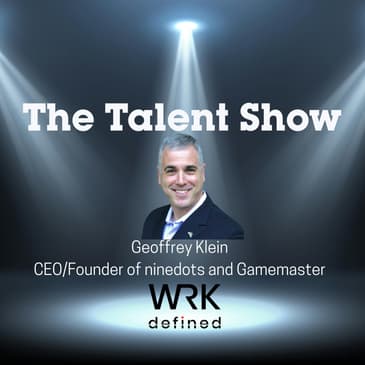
Geoffrey Klein is CEO and founder of ninedots, which helps businesses create compelling story-driven visual content. Geoffrey - which is the correct way to spell Geoffrey - is also an AI consultant, TEDx speaker, Wharton lecturer and best-selling author.
He is also a quote unquote game master. Growing up there was always the guy who initiated hide and seek and spin the bottle, was the banker in Monopoly, ran the betting pool in high school - though I’m not sure that qualifies as a game - the guy who organized the poker game and drinking game…you get the picture. But we don’t know that we’ve ever run across a bona fide game master.
We’ll ask Geoffrey about his talent for organizing games, inventing games, and getting people - adults - to play them - where this comes from, the skills required and how it’s part and parcel of his skills as a storyteller…let the games, er, begin.
Powered by the WRKdefined Podcast Network.
[00:00:17] Today on The Talent Show, we're delighted to welcome Jeffrey Klein, CEO and founder of Nine Dots, which helps businesses create compelling story-driven visual content. Jeffrey spelled G-E-O-F-F-R-E-Y, you'll note that, which is the correct way to spell Jeffrey, is also an AI consultant, TEDx speaker, Wharton lecturer, and best-selling author.
[00:00:46] That's a lot, if you've got your scorecard, you know. He is also a quote-unquote game master. Growing up, there was always the guy who, you know, initiated hide-and-seek, spin the bottle, was the banker in Monopoly, ran the betting pool in high school, though I'm not sure that qualifies as a game. The guy who organized the poker game and drinking game, well, you know, come on, you get the picture.
[00:01:13] But I'll tell you something, I don't know if I've ever run across a bona fide game master. Well, we will ask our friend Jeffrey about his talent for organizing games, inventing games, and getting people, adults that is, to play them, and where this comes from. The skills required, and how it's part and parcel of his skills as a storyteller. And we'll get all that and more when he joins us right after these words.
[00:01:42] Stay tuned. You know what you should know? You should know the You Should Know podcast. That's what you should know. Because then you'd be in the know on all things that are timely and topical. Subscribe to the You Should Know podcast. Thanks. We are back on The Talent Show.
[00:02:11] My name is Tom Alexander. My guest is Jeffrey Klein. And Jeffrey, game creator, game master, whatever title you want to call yourself. You refer to yourself as a game master, but what exactly is a game master? Yeah, I think, again, it's, I don't know if I love the term master, but I master because it's the full package of game enthusiasm.
[00:02:41] So I pull people into games that might not be into games. I kind of am the host when we play games. And I've made up games all the time. But I also use it, where I would say game master kind of fits in is how I've used games to elevate what I do professionally.
[00:03:00] And I think as a speaker in particular, but also as a adjunct professor and in terms of, because to me, there's two things that are important about games and having games in life, which is, it's the engagement with the people you're playing with, and it's about fun. And I kind of feel like fun is almost seen as a bad word in business and in professional life.
[00:03:28] And I'm trying hard to change that in my own way. Yeah, it's interesting you say that, that fun is not necessarily embraced in the world of business, which I find that somewhat troubling because I think it's almost speaks to, look, the way I see it, it's great to take your work seriously, but maybe not yourself so much. Right. And, and I think that's exactly what I say to people. Yeah.
[00:03:58] And I, that's, that to me is, is, uh, it should be fun. There should be fun at work. It, it, you know, and, and deriving fun from different things and challenges. But anyway, that's a whole other show. Uh, um, I gotta say when I was a kid, uh, I was good at Stratomatic baseball, uh, Bobby or hockey, Stratego. Remember those? Love Stratego. Oh yeah. Yeah. But I would never claim to be a game master, a game apprentice maybe.
[00:04:27] When did you discover, when did you discover you had this talent? High school. Uh, I think, I think, so I was very fortunate that growing up, um, I had parents that liked to play games and, and more, more importantly than that, my grandfather, um, well, my father's father, I don't, he was a judge for over 50 years.
[00:04:49] So the fact that, uh, he was a very esteemed, professional, respected person, but in, in kind of, you know, the, the privacy of his own home, him and I played cards all the time. And we played, you know, gin rummy and a game called casino. And it was such a wonderful experience for me to engage, not just in the game, which was awesome, but with the person I was playing with. And it was spending that time.
[00:05:15] I spent a lot of time when we had mother, dad or time, I often would start that time playing backgammon. So, you know, the first thing we would do, um, and my mother had a funny, um, habit, which today would, but so if we played backgammon, there was a, you know, instruction book. And in the book, it had suggested first moves.
[00:05:41] And so she would roll and no matter what, she was like, I can't do it unless I refer to what I'm, the recommended first move would be with that role. Um, and I always found that, but in high school, uh, I I'm a social creature. I like, you know, hang out, but I, I was one who would say, what are we going to do tonight? And I'd be like, let's play a game. And so we would have game that would, uh, bring both the energy of the fun.
[00:06:07] And I think that's what a game master does is it's, it spreads that enthusiasm to have a good time and to figure out what game is going to work. So in high school, we played a lot of Pictionary. We played a lot of Taboo, um, which were kind of popular games, but everything from trivial pursuit, you know, to poker, to all that, you know, it did for me, it was less important about the game itself as that. We were playing as a team. Um, now I have two brothers.
[00:06:35] I'm super competitive, which sometimes, um, was challenging because I didn't like to lose, especially as a younger person. Now at the time I played a lot of games, so I was pretty good at a lot of the games. So that helped that I would, um, uh, I mean, my, and I never heard of my brother and I, when we were in high school, we would play with my four first cousins.
[00:06:56] I had four boy cousins and we would play Pictionary and we devised a system of using visuals to mean things like sounds like, or first like, like we took it to another level. And my brother's is a huge game. Both my brothers are huge into games. And so I was surrounded by that healthy competition. Um, and so I was the one who was like, we're going to, I remember we went on a college tour, me and high school buddies, uh, up to Boston.
[00:07:24] And in the evening we didn't go out and try and get drunk, but we were playing games. Yeah. I'm like, we're going to, you know, I brought Pictionary and I brought Taboo with me because I thought it was a way for us to bond and have a good time. And, and it was always fun. Well, that makes complete sense. And, and it is, it is something that you can, uh, bond with and, and, uh, and enjoy together. It's like following, uh, sports, particularly a Superbowl champion, uh, Eagles team.
[00:07:54] Um, yes, I can say that we're recording this the day after the Eagles have won the Superbowl and you and I are both Eagles fans. You're from the Philadelphia Metro and I grew up just North of there in the Poconos and a lifelong Philadelphia sports fan. So those kinds of games, very important. And, uh, there's nothing like bonding on sports. Yeah. And again, like last, last night we watched the Superbowl with my family.
[00:08:21] And so again, it was my father who's been a diehard Eagles fan for 70 years, my two brothers and our children. And so it was, and, and just the environment of that collective enjoyment of watching the game, obviously a lot more enjoyable when they win. But even so it was about the fact that we're all there collectively rooting for our team. And I think that's when you're playing games, whether it's board games or sports, you're, you're, you're kind of trying.
[00:08:52] Yes. Win. Win. But it, but for me, I think it's partly about, um, the playing. That's the part, you know, I've played a win, but it's the playing. And I, and I love the quote, uh, I think George Bernard Shaw said, we don't stop playing because we grow old. We grow old because we stopped playing. Yes. And I'm a big kid. So that's how I am still a game master at my age. Cause I still like to play. It's very funny.
[00:09:18] You brought that quote up because that is the second time I've heard that quote in about the last 10 days. And, uh, it, it, it is very, very true. Um, and yes, a great quote by George Bernard Shaw. And I will say that having these, this, uh, united front on, on sports, love of sports, love of teams, doesn't matter where you are. And philosophically, dare I say politically, it, it brings everybody together, right? Uh, it's a great thing.
[00:09:48] Um, you know, game mastery, uh, can this be something that it, can it be learned? You're born with it. Uh, or perhaps maybe you come from a long line of game masters, reaching back to your ancestors, playing tic-tac-toe on the walls of their cave. You tell me. I like to think about that. Um, I think there are certain personality types that lean towards wanting to be the game host.
[00:10:17] Um, and I think it's partly someone who themselves, I think it's not completely, it's like, I get joy out of seeing other people play. So even when I'm, you know, if I'm playing a game where other people are, it's their turn and they're doing something interactive, I, I enjoy that. And so I think there has to be, you have to be a social creature. So, uh, I'm an extrovert.
[00:10:41] Uh, so it's not to say that introverts can't be intensely into games, but they may not be game masters. They may not be as interested in bringing groups of people together to play. Um, so I think there's an element, I think everyone can learn to love playing games. You just, there's enough games out there that you just find the one that, that suits you. And, um, you know, I have, I play, we've learned new, my wife, now I married someone who loves games as well.
[00:11:10] And that definitely, uh, was not accidental. And she's not a game master in terms of wanting to work. She loves playing games, but she's not the same where wanting to kind of, um, bring everyone into the fold of what's going on and whose turn is it. And my, my daughter, I have two daughters and son, they are, are definitely inherited some of the game master genes. And I see they play games at college with their friends and things like that.
[00:11:36] So, uh, and I think again, it's, I grew up loving playing games and bonding with people over it. And I think it's the type of thing that it's, it's real enjoyment. We have, um, a breakfast bar and we have cards and we play cribbage and canasta. Wow. I don't want to say every day, but most days over breakfast. Um, and my son. Those are two games that have been around a while. They've been around a while. Right. Well, we, we, we love old games.
[00:12:05] We love, we've got a new, a new game in the day called, you can't say, um, where you have to, it's about, you know, speaking. And if you say certain things, so we love old and new. And I think, you know, we play Moncala. I mean, I can, if I listed the games, we love Moncala. We love, uh, which is an old bead game. Uh, we even learned in the last couple of years, um, Mahjong.
[00:12:27] So I am a equal opportunity, uh, game, but I, you know, and it, and it comes down to murder mystery games and, and sports. So it's, um, I think that's, and I think because it's not the game itself that matters, but it's the playing that matters. And the interaction with others. Yeah. No, that's fascinating. And, uh, we're going to learn a lot more and take a quick break right here on the talent show. My guest is Jeffrey Klein.
[00:12:56] He's the CEO and founder of Nine Dots, but he's also, if he doesn't say it, I'll say it. He's a game master. That's a game master. Let's, let's, let's just lay it right out on the table. This is the talent show. Stay tuned back in just a moment. Before we move on, I need to let you know about my friend, Mark Pfeffer and his show, People Tech.
[00:13:23] If you're looking for the latest on product development, marketing, funding, big deals happening in talent acquisition, HR, HCM, that's the show you need to listen to. Go to the Work Defined Network, search up People Tech, Mark Pfeffer. You can find them anywhere.
[00:14:22] We are back on the talent show. My name is Tom Alexander. My guest is Jeffrey Klein. And Jeffrey, we're talking about games and we're talking about just the, the, the whole spirit of pulling people together to invest in having a good time. I'm going to put it that way. I think that's probably a good way to describe it and challenge each other and have fun and maybe learn something they didn't know before they went in. Right. I guess that can happen.
[00:14:51] I think there's a, depending on the game, it's, it's, you learn obviously from playing with others and there are certain games you learn even more, whether it's, you know, trivia games or things like that. But it's funny, the game that I played as a kid. I sort of feel remiss. You know, I played Dungeons and Dragons, but I was never a dungeon master. So I must somehow skip that line of game mastery.
[00:15:12] But I know I have friends who still play it even as adults and that's a thing, but that's a little, a little off center for me, I guess. But I love that. I love that people do it. Yeah. Can you give us an example or two maybe of a, of a game that you may have taught someone to play or run, or perhaps they've, they've hosted those games? I have to tell a story of teaching my daughter.
[00:15:39] I have twin daughters and I taught them to play poker when they were, oh, I don't know, 10, 11. And I remember being on their bed, on one of their beds and playing the cards and showing them what beat what. And I still play in a poker group and they still play poker and they like to play poker with their friends. But I'll never forget, I actually dealt, for anyone who knew it was poker, I dealt my daughter Gemma a royal flush.
[00:16:08] And I don't think she realized how rare it was to get a royal flush. But yeah, teaching them, the most enjoyment has definitely been through my children. You know, to see them then take that interest and enthusiasm and know when I call them up, I'm like, what are you guys doing tonight? You know, they're at college or sophomores in college. And they're like, oh, we're getting some people around to play games.
[00:16:33] So it's, it's, that is as fulfilling as any game that I play is to know how much they do it. But I had an impact in law school. So I went to law school, another story. But in law school, I was a student who was not, I didn't want to be a lawyer. I was there for somewhat other reasons. And during sort of in between classes, I would pull in friends and we would play games. Well, maybe we should have been studying.
[00:17:03] I don't know. But, but we had a lot of fun. I'm convinced I had more fun in law school than the average. And I attribute that a lot to encouraging and getting people to play games with me in the law school. It's paid off. And I think that's, that's, that's pretty cool. Let me ask you this, whether it's, let's say Monopoly or drinking games. I'm, I'm, I'm going to guess that games don't always go as planned.
[00:17:29] Is there an example or two, maybe a game master supreme? I'll call you. Would that you would, that you would say you couldn't hold it together. Maybe all hell broke loose. Is that, is that something that you recall ever occurring? Unfortunately, yes. I think it's because if you are with people who are competitive and I'm always one of those people
[00:17:55] and the game isn't going your way, sometimes emotions can play into it. There's a game that became very popular over the last few years called Settlers of Catan. And for a while, we didn't play that game to its completion because some sort of conflict arose in the game and it deteriorated and it was over.
[00:18:24] So, um, there's, it was, uh, you know, my kids were hormonal. Maybe I don't, I don't, although I was equally frustrated with, with, and I don't know why that game in particular was one that, uh, caused a lot of frustration. Um, but I, I'll, I'll be playing Canasta with my wife and, um, she'll be kicking my butt. I mean, that's the one thing about my wife. She loves games. She's not the game master, but she's a competitor and she's also very good at games.
[00:18:54] So, uh, unfortunately I have not always winning games and I have to deal with someone who's very good at games from backgammon to anything we play. Um, and so sometimes, and I like to win still now, I like to think I'm slightly more mature and evolved, but, uh, that's debatable. And so, um, there are times where games, um, personally for me get the best of me.
[00:19:20] Um, but it's, it's, it's, it's far and few between most of the time, uh, I've gotten pretty good at, at being a, um, well, actually I take that back. Being, I was going to say being a gracious loser. Uh, I play video games in particular, uh, NBA 2k on, on the Xbox with my son who beats me 95% of the time. Wow.
[00:19:45] Um, so when I win, I, I gloat a little, that's not, not the most sports would like thing to do, but it's so rare. It's so rare. And sometimes you have to celebrate the wins when they happen. I get that. I get that. Um, I, I had the. Uh, unusual occurrence of showing somebody a young person, how to, it wasn't my son, but it was a friend of his, how to play chess.
[00:20:15] And it was very basic. And I kind of gave him just the do's and don'ts and the where's and what for's. And wouldn't you believe it? He checkmated me in the first game he played. And I just was asleep at the switch and probably just, you know, thumbs in my suspenders and thinking I got this figured out. He beat me. And I thought. Okay. I, it's over for me now. I, I think I could just.
[00:20:45] I, I think I put the chess set away permanently. Uh, and who knows, maybe I'll blow the dust off it someday and, and, uh, get back at it. But, uh, uh, I could understand, you know, losing, uh, can be very frustrating. Right. We, we, we, none of us like to lose, lose those games. Yeah. And I, I like, you know, there's a quote that about life. And I think, again, you can extrapolate the experience of playing games to the kind of broader experience.
[00:21:13] Um, and I cut, you know, and the quote is, you know, the journey is the destination. And so while all these games typically have a winner and a loser at the end of it, um, I think the focal point is on the play. Um, and, and what happens. And so it's one of those things, I think, you know, I played sports growing up and I still play sports and I think it's the type of thing where there's a certain respect of the players and of the game itself.
[00:21:43] Um, where at the end of it, you kind of shake hands and say good game. And that's, that's still something I've tried hard to teach, um, my children and those, you know, and I try and model that most of the time when I'm playing whatever game with whoever I'm playing. Um, but I think, again, you know, it's just a game. And so I think that's part of it is like, it's not life and death. It's not, it's, it's an opportunity to kind of, and that's the other thing about games.
[00:22:11] I think is you get in your flow state and a lot of them where nothing else matters. You're not worried about whatever's going on in life because you're engaged in this little microcosm of experience. And that's, I think why I love games so much is because it enables you probably same reason. I love movies. It's a little escapism. Yeah.
[00:22:32] But the difference between movies and games is that you're, it's that collective shared experience that you're having, um, that I think elevates it to something that can be really meaningful. Um, and also useful, you know, from a professional perspective. So I use gamification both when I present, uh, at conferences and in my classes.
[00:22:54] And I think it's a tool that businesses can leverage for more engagement because you're bringing people in, uh, you know, I, I, I don't really like the term lecturer because it has a sense of that. I'm up here and I'm on, you know, speaking down or to someone. And I think the real learning occurs when the students are engaged in the material in a way. And I think gamification is one way you can do that.
[00:23:24] And it's, um, I have a friend who's a professional speaker named Rob Ferrer, who is, he's a game master. I mean, he actually is hired to perform games for organizations. Um, and, and it's funny, he said, sometimes event planners don't like the word game. You know, again, there's sort of, it's not serious, you know, like, oh, I'm going to play a game to help with this presentation. And they're like, oh, game. We can't, so he says, oh, no, no, no, it's not a game. It's an engagement activity.
[00:23:51] And I love that he's taking it to, because that's what it is. It's a, it's an opportunity to engage with the people that are there and have them be a part of the experience rather than just bystanders. Right. Right. Well, yeah. And, and, you know, you mentioned something that was interesting and talked about movies and then games being more of a communal, uh, experience in that you are directly involved in the experience.
[00:24:20] Whereas movies is a little more passive. Um, it could be argued that it can be, you know, active depending on the kind of movie you're seeing, but it's very, it's, and the ending is already chosen, right? You don't know how the ending is going to go in a game or a sport or whatever. It's unscripted, at least we think it's unscripted.
[00:24:40] Uh, but it, it's, you know, something that's really where I think movies can never match the excitement of a game or sports because the ending is unknown. And, and, uh, that's something I think that just is just inherently makes it special and fun. My guest is Jeffrey Klein game master. And, uh, we have one more question, Jeffrey.
[00:25:09] We're going to do that on the other side of this break. You're watching the talent show back in just a moment. Hey everybody. I'm Lori Rudiman. What are you doing? Working? Nah, you're listening to a podcast about work and that barely counts. So while you're at it, check out my show, punk rock HR. Now on the work defined network, we chat with smart people about work, power, politics, and money. Are we succeeding? Are we fixing work?
[00:25:40] Probably not work still sucks, but tune in for some fun, a little nonsense and a fresh take on how to fix work once and for all.
[00:26:26] Wrapping things up now on the talent show. My guest is Jeffrey Klein. Jeffrey is the CEO and founder of nine dots. And we're going to find out a little bit about that, but we want to ask one more question from your game mastery position. How does your mastery of games inform your work as a storyteller and your work at nine dots?
[00:26:53] I think part of it is the essence of what games are, which is having fun. And it's a mindset. I think there's a game mindset to how you approach business. And I think, again, there's a conventional idea that games or fun is not appropriate for business.
[00:27:16] But I actually believe that the clients I work with like working with me because I'm bringing in some of that levity, some of that gamesmanship into our relationship. That's a positive. You know, we're looking at ways, you know, when you think about problem solving and creativity, games in terms of how you mentioned about, you know, you don't know how it's going to end up. You know, it's one of those things where. And there are more than one ways to win in business.
[00:27:46] So I think there's a way of like, how can we play with this idea or with this challenge? And so I think there's a thing about. A game perspective and mindset that is really useful. In the ways that you interact with clients, with businesses in general and how you approach whatever it is that you're doing. And then, you know, in terms of storytelling.
[00:28:14] We're all involved in this huge game of life. And so it's in terms of what what is the story that you're telling in terms of if you think of any business challenge and as a marketer. What your story is, it's a game like you have a challenge and then you find a way around it and then you win. And so I think there's a way to look at kind of the structure of a story in terms of the structure or you lose.
[00:28:42] You know, there can be ways if you're talking about why we can help you, because the normal story is that you have a challenge and you don't do well. Let's play the game again. But this time we're going to help you win. So I think there are ways and elements to do that. And then in terms of just the engagement. So finding ways to incorporate how people can play, because everyone wants to play. Everyone wants to be, you know, to have a good time when I'm on stage presenting at a conference.
[00:29:11] I have a theory, which is if I'm having fun, then my audience will have fun. And so that's kind of how I approach business as well. So I think there's an element of and you said it earlier, which is, yes, I take what I do very seriously. But I don't take myself that seriously. And I think we sometimes fall into the trap of taking ourselves too seriously and not embracing the full extent of what life has to offer.
[00:29:41] Excellent. Excellent. And boy, this has been a lot of fun. Very interesting and enlightening, insightful. Thank you so much for your time. And hopefully we'll have the opportunity to do this again. And who knows, maybe we'll actually get to play some kind of a game the next time and do something, you know, to really inclusive and communal here on the tap. I love it.
[00:30:11] Thank you so much for having me. Thank you, Jeffrey. Jeffrey Klein, our guest. He is a game master and he is also, by the way, CEO and founder of Nine Dots. Before you go, Jeffrey, just a one or two sentence description on what you guys do over there. Sure. We do two things. We help people tell their story through visual arts. So whether that's I produce a video and animation.
[00:30:36] And then we're really obsessed with helping people overcome what I refer to as AI overwhelms. Why is this new big thing? It's really overwhelming. And we try and help you figure out how to take it in a systematic, structured approach to help you leverage this really powerful tool. Wonderful. That is great. And they can go to NineDots.com. Is that correct?
[00:31:02] It's NineDotsMedia.com for the video and animation or NineDots.ai for the AI. There you go, folks. There you go. Nine Dots. And the CEO and founder of Nine Dots, Jeffrey Klein, our guest today on The Talent Show. Thank you so much for listening and watching. My name is Tom Alexander. We'll see you again next time. So long, everybody.
Sponsors
