
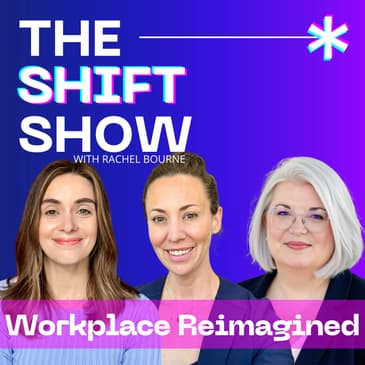
Why does work feel broken right now, and why does burnout feel so normal? In this episode of The Shift Show, Rachel Bourne sits down with workplace strategists and WORK then PLACE co-authors Corinne Murray and Sara Escobar to unpack why work was never truly designed for humans in the first place.
Together, they explore the real reasons behind return-to-office mandates, why “behavior before buildings” is a more useful lens for leaders, and how work design now has to account for physical, digital, and experiential environments. They also break down how knowledge work has changed, why AI is compressing and intensifying work, and what everyday professionals can do to create better ways of working without waiting for permission from the top.
If you are trying to make sense of hybrid work, burnout, AI pressure, workplace trust, or how to create a more human-centered way of working, this conversation gives you a practical starting point.
Sara Escobar utilizes knowledge built over her 20-year career leading Workplace for global companies, including CBRE, Riot Games, Netflix, Honey, and Hulu. She is the founder of Wielding Workplace, a consultancy that supports companies in using Workplace to attract and retain top talent. Her clients have included top companies in tech, media, hospitality, utility services, and finance.
Corrine Murray is a workplace strategist, advisor, and writer with 15 years of experience in organizational change, employee experience, and workplace transformation. She has spearheaded transformation initiatives for companies including WeWork, American Express, RXR, Gensler, and CBRE.
Key Takeaways
- Work feels broken because it was never intentionally designed around human behavior
- Return-to-office decisions are often driven by factors beyond collaboration
- Small, team-level changes can meaningfully improve how work actually gets done
Chapter Markers
00:00 — Why did Sara and Corrine write WORK then PLACE?
02:08 — What does “behavior before buildings” really mean?
06:18 — What are the real reasons behind return-to-office mandates?
12:02 — How can leaders make RTO less damaging?
14:09 — Can perks really “earn the commute”?
17:19 — Is work really built on relationships?
22:08 — Are broken workplaces caused by bad behavior or bad design?
24:00 — Is collaboration actually better in person?
27:06 — What changed about knowledge work?
31:34 — Is AI making work more intense?
34:23 — What can individuals do if work feels broken?
37:34 — How should teams measure better ways of working?
41:08 — What is the one takeaway listeners should act on now?
Find answers to the most frequent audience questions:
- Why does work feel so hard now?
- Why are companies making people come back to the office?
- Is hybrid work actually effective?
- Is AI making work worse?
- What can I do if I am not in charge?
Keywords/themes
why work feels broken, why burnout feels normal, human centered work design, return to office strategy, why companies want employees back in office, hybrid work problems, future of work podcast, knowledge work design, AI and burnout at work, workplace trust and flexibility, work design for hybrid teams, how to improve meetings at work, behavior before buildings, work then place, human centered workplace
Powered by the WRKdefined Podcast Network.
Sponsors
