
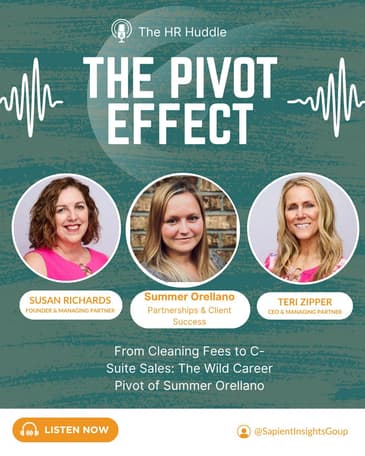
On this episode of The Pivot Effect, part of Sapient Insights Group's HR Huddle series, hosts Teri Zipper and Susan Richards sit down with Summer Orellano, who now leads sales at Sapient, to talk about her winding career journey from managing Airbnbs in Florida, to joining Sapient as a contract office administrator, to stepping into a sales leadership role while seven months pregnant with her third child.
Summer, Teri, and Susan dig into what it really takes to pivot: showing up even on the hard days, taking feedback well, bringing authenticity into sales, and recognizing skills you didn't know you had. It's an honest conversation about non-linear career paths, mentorship, and betting on yourself.
In this episode:
How Summer's move to Florida led to an unexpected connection with Susan
Why "right place, right time" isn't the whole story
Turning operations and admin experience into a sales career
Why authenticity and constructive criticism matter in sales
Summer's advice for anyone standing at the edge of a pivot
Connect with Summer Orellano on LinkedIn and Facebook.
Enjoyed this episode? Subscribe for more conversations on leadership, culture, change, and HR technology, and check out our other shows: Spilling the Tea on HR Tech, and HR We Have a Problem.
Powered by the WRKdefined Podcast Network.
[00:00:01] Welcome to the HR Huddle Podcast presented by Sapient Insights Group, the ultimate resource for all things HR. It's time to get in the huddle.
[00:00:20] Hello everyone. Welcome back to Sapient Insights Group's HR Huddle. I'm your host Terri Zipper, alongside my co-host Susan Richards, and we're back for another episode of The Pivot Effect. This is the show where we talk about you. We talk about you as an employee, as a leader, as a mentor or coach, and what's possible and how you might get there.
[00:00:48] If you're feeling stuck, if you're following rather than leading, if you want to lead or you just feel like you've outgrown what you're doing and you want more, we got you. We're focused on the skills and capabilities you need to thrive in the future of work, regardless of the work that you do, because we know there's a future. It's just sometimes we have to make it.
[00:01:14] Joining us today is our very own Summer Oreano. Summer is leading our sales effort today at Sapient, and I just felt like her story was a journey that I wanted this market to hear. And it's just been such a wonderful journey. I can't wait to get into it. But welcome, Summer. Thank you so much for having me. Yeah. And welcome back, Susan. Hi, everybody. And welcome, Summer. We cannot wait to hear your story.
[00:01:44] I'm a little nervous, but I'm excited. And we've kind of lived some of this story with you. So, you know, it's just there's a piece of the market out there. We've been doing a lot of these pivot effects, and it's just been a really compelling show. So what we haven't done, because a lot of the people are further along in their career. They've made some sort of really big pivots.
[00:02:11] And what I thought was really interesting about this story is you're still very early in your career. And to some extent, you know, your career, you've sort of been making pivots based on the things that are happening around you versus you making big decisions. So that's the thing I'm excited to hear about is sort of I think there's a lot of opportunity for people out there, and sometimes they miss it.
[00:03:07] Yeah. I'm excited to hear what I wanted to do. And you guys are going to laugh when you hear this. I really had a niche for cash registers. I really, I liked the tapping and the money exchange. So I always said that I was going to work a cash register. That was going to be my career. And as funny as that sounds, now I play with my children on their play cash registers. And that's how I fulfilled that goal of mine. So what you're really saying is you've always been focused on making money.
[00:03:37] Dollars and cents. Dollars exchanged, most definitely. But, you know, when I became of age and college was a thing, you know, I wanted to do what everybody else around me was doing and never going into nursing. And that was the big thing in my era of graduating high school was we're all going to go be nurses at the hospitals. And I guess now we're here and that didn't work out.
[00:04:04] But it didn't work out because it wasn't my calling, you know. Yeah. I didn't know that about you, actually. I think it's interesting because, you know, I have a blue collar family background. And so in my world, I thought nursing and teaching were the only two jobs available to women. Right. So I also started nursing and then was like, nah, this isn't going to work.
[00:04:32] So I did not know we had that in common. That's too funny. Funny. I never wanted to be a nurse. I tend to pass out at the words sickness and blood. And needles. And needles. So, you know, no nursing for me. But my mom was a nurse and she did really well with it coming out of a blue collar world. Yeah. Well, I have lots of nurses in my family and they're fantastic.
[00:05:02] But I realized it wasn't the thing for me. Yeah. Like you, Summer. Well, so was there a moment that you realized something was for you? Or were you just, you know, kind of going with the flow? I really just went with the flow. A lot of my life, I, you know, whenever you have a path, if you don't have the correct stepping stones to get to where you're, what your dream is, you tend to be let down.
[00:05:29] So I have always taken the go with the flow approach to my life. And I'm really happy where it led me. Well, Susan, that should make us feel good. Well, I guess you opened the right door, huh, Summer? Yes. Yes, I definitely did. Your story about how you even got to us, I just love. And you and Susan are the closest to that story.
[00:05:56] Maybe you could talk about that for a minute. Because I think it's one of the things that even if you're going with the flow or even if you've made a decision about a big career that you want to do, there's disappointment or there's uncertainty. There's just things that you start to feel and you know that something has to give, something has to change.
[00:06:22] Talk about that and then talk about how you sort of found your way to sapient. Sure. So it was 2022. I had just had my second child and I was going to be a stay-at-home mom. Shout out to all the stay-at-home moms out there that actually stay home with their children and they do not work. It is the hardest job you will ever do. And I give you all the praise because I couldn't do it.
[00:06:50] So I loaded my children up. My sister, Kelly Kuhn, lived in Florida. I loaded my kids up and we headed to live in Florida because I needed to get away. I was feeling very restrained. I was going through postpartum, which, you know, mothers, we can all relate to that in some way, shape or form. And I just needed an out. So I went to Florida to work alongside my sister in her Airbnb business, managing and cleaning Airbnbs.
[00:07:21] What's funny is, you know, I said I'm going to take a sabbatical in Florida and, you know, just relax and enjoy the beach. It wasn't even a week and I was back working because I couldn't do the stay-at-home mom life. You know, I felt like I didn't have my purpose. I felt like I didn't have anybody to talk to, no adult interaction. And that's hard during that stage of life. So Susan, she actually moved to Florida around the same time that I moved to Florida.
[00:07:50] And she was having an Airbnb. Yes. And she was pivoting. She was pivoting in her life and her life was changing. And she ended up renting one of our Airbnbs and staying there while her house, while she purchased her home. And during that season of my life, me and Susan, we became close even after she stopped staying at my Airbnb.
[00:08:16] And she was just a big supporter of everything I was doing. She had never offered me a job, but she was just always a supporter, a person that I could lean on when I was having a rough day. And I kept finding things for her to do. Yes. I was like, Summer, I need a dog sitter. Summer, I need a housekeeper. Summer, I need somebody to put order in my life. And she always showed up. And poof! Yeah. Like magic. There I was.
[00:08:46] Yeah. And for Susan, you know, she mentioned me being her housekeeper, which I'm so grateful I was. Because once she purchased her home, I could have, you know, never seen her again. I never, I honestly never intended to. You know, you were just a guest at where an Airbnb I was managing. And she asked me to be her housekeeper. We kind of did that on a rotating basis, which was really nice.
[00:09:14] But I remember I was having a really rough day at work. And I was supposed to go and clean her home at that evening. And I wasn't going to go. And I decided, I was like, because I'm just the person you have to say. Don't ruin your whole day, even if you're having a bad moment. So I head on over to Susan's house. And she opened the door. And she didn't even, I didn't say anything. She looked at me and she said, wine or vodka? And I, I didn't, I never said a word.
[00:09:44] I think she could just see it on my face. We weren't going to clean the house that day. But I showed up. But I think that that's the important part of that story is I showed up. I could have just called her and texted her and said, hey, I'm just, you know, I'm busy. And she would have understood. It's not like, you know, it would have been that big of a deal for me to come the next day. But I showed up when I was supposed to. That's huge.
[00:10:09] I mean, that is, is such a big, you know, I want to call it a skill because it is. I mean, you have to be able to motivate yourself to get up, get off the couch, get out of bed, whatever it is, like make the move. And it's hard sometimes. It really is. And I, people will say, well, you were in the right place at the right time. Maybe.
[00:10:36] But at the same time, you created an environment for that relationship to, to make that connection and for somebody else to see what you were capable of doing. Right. Beyond yourself. And I think that, that is also a critical skill, you know, is how do I connect myself to people and the things that I'm doing in the world?
[00:11:04] Even if, you know, they're not the, the big corporate job. The thing I do every day, even if it's flipping burgers, you know, somebody, if I'm, if I'm making the right connections and doing the right thing and showing up every day, it creates opportunities. Yeah. And, and, and people, and people listen to you. They, they, they, they listen to you. They watch you. They see you.
[00:11:32] And your actions speak a lot louder than your words. And I know that's, that's an easy cliche, but it's true. I mean, I, I watched Summer go at everything that she started with this gusto that I'm like, oh my God, I, I, I need to find things for her to do for, for me. And, and I think I need to find things for her to do for our firm. I just didn't know exactly when it was going to happen. Yeah.
[00:12:02] Yeah. Well, I didn't know that, Susan. I didn't know you had thought of that prior to the conversation that we had. And Terry, you mentioned right place, right time. I do believe in that. But in this situation, I don't think it was that. It was the skill that took me to continue doing what I was supposed to, what I had agreed to do. You know, right place, right time is when you win the lottery.
[00:12:25] And, you know, though, in those situations, this was truly a, you know, having the skill to continue on regardless of the bad day. And, and the thing that I remember about that day, Summer, is we sat down and I just started asking you questions. And, and you never shied away from any question that I asked. It didn't matter what it was. And, and you were honest and you were vulnerable.
[00:12:54] And I remember one of the things that you said was, well, I've never done that before. And it was like, well, it doesn't matter. Here, you know, here's what you've told me that you have done. And the more we did that, the easier it became for you to talk about what you could do in the future. Yeah, I, I agree, Susan. And, you know, I've done so many things prior to Sapient and during my time at Sapient.
[00:13:23] And I, I hate to be the person that's like, I could just do anything. But truly, if you put your mind to it, you can. I mean, I'm living proof that you can do anything. It's just about learning and having, you know, the skill set to learn how to do things. Yeah. Because that was, that's how I came into Sapient, is I was willing to learn how to do anything that was given to me. Yeah. Well, and I remember the person that was doing a lot of support for us was leaving.
[00:13:53] And we were just like, what are we going to do? And Susan said, I know somebody. I think I've got somebody who could do this work. Right. And it was the culmination of all of those individual skills. I mean, even parenting is a huge skill. Right. I think people underestimate the skills that they have. Right.
[00:14:23] And, and how those skills can transfer to something on the job. And putting the individual aside, who's looking, kudos to Susan. I don't think a lot of people look for resources outside of the standard place to find a resource, which is through a resume or, you know, through LinkedIn.
[00:14:46] And so, you know, knowing people and connecting with people who may be completely outside of your industry might be just the thing that, that you need to find people that are different, that can think differently, that can think bigger, that can bring different perspectives to, to the organization. Right. And that's just huge. Yeah.
[00:15:14] I guess the, the, the good and bad thing about being a leader in a small business is we don't have many job titles and job descriptions. And because we didn't have a job description for the work that we needed to get done, it didn't limit us to looking for somebody who had been doing that for the last five years or the last 10 years.
[00:15:40] And, you know, and, and, and sometimes, you know, my friends in HR and recruiting, we need to throw away the job description and think about what, what's the, what are the skills that are required to do this work? And what is the work that we really need to have done versus what's been done for the last 10 years?
[00:15:59] So, you know, Summer, I, yeah, I, I love this, the, you know, you coming into the organization and just stepping in and, you know, doing some parenting with Sapient. You know, we were, you know, we had some growing to do and, and it's funny because neither Terry nor I have children of our own.
[00:16:24] And, and, and so we, we mother a lot of people, but we, we never, we, we didn't mother our, our business very well. And so I think you brought some of that. Okay. Okay. Folks, let's get together and let's figure this out. I think you brought a lot of that to the table and, and then, then, you know, kudos to Terry, because when we needed somebody to step into a sales role after us,
[00:16:53] like stumbling and falling and not finding the right people, Terry said, I think I have the right person for this, this sales role. Summer can do this. Talk to us about pivoting inside the organization from that office manager role to being our sales leader. Well, Susan, I think you forget.
[00:17:17] I started as the office administrator and I know that's not a big jump to office or operations manager, but it truly is because at first you think that you're just going to be doing the little tasks, what everybody needs. And then I would say, well, first of all, I started as a contractor. And I remember when I came in, Terry was like, it'll probably be 20, maybe 25 hours a week as the office administrator. That lasted two weeks.
[00:17:45] And I was like, hey, Terry, there's a lot happening. So first that I think that that's something to highlight is this was never the or the office administrator, you know, 20 hour a week job that I when I came in. And I was I was OK with that because I was looking for full time. But I was willing to just take whatever was given at that point.
[00:18:05] Right. So from office administrator to operations manager, although it wasn't a big jump, it felt more like they were you guys were giving me a place to lead. You know, although I was leading in the office administrator role as I was parenting all of my children here at Sapient, I you know, I had the title to reflect that or the sense that I was leading something more.
[00:18:32] And, you know, whenever I was sought after for the sales role, you know, I was seven months pregnant with my third child. I was about to go out on maternity leave. And, you know, you you all sat me down and you said, look, you would be good at this. And I was nervous because about a month or two before I had mentioned to I believe it was Stacy that I could do this because I was, you know, sick of I could do it.
[00:19:01] You know, I just wanted to get it done. I'm a I'm a very big component of just get it done. And so it was funny when it actually came to fruition that, you know, you guys saw that in me that I could do it. And I wasn't just me saying it anymore. But I was nervous because I have never done sales. I had done client, you know, client work, you know, discussing invoicing and contracts and things of that nature with our clients.
[00:19:28] But I had never done the sales aspect of it. And I quickly realized that I had I had done the sales aspect of it without even meaning to. Yeah, I remember seeing you at our first the first HR tech that you went to with us. And I watched you in wandering around looking for swag and also selling the value of sapient at the same time.
[00:19:56] So while you might not have recognized that as as sales experience, we did. We saw it. Yeah, it was an aha. And again, I'm speaking to people who have, you know, staff who maybe you weren't, you know, you're looking at them in this sort of really linear path. Stop. Stop.
[00:20:22] Because people have very unique skills and they can do things that they don't even think they can do or they haven't just really haven't even thought about it. Right. Right. And and then to the individual, you know, recognizing in yourself, you know, problem solving and and confidence and resilience are like to me three of the really big things that just are.
[00:20:52] They go with everything, right? If you can do those three things that can get you to the next step. And maybe the next step is not linear. It's not I'm going to go from an accountant to an accountant to. Right. I mean, maybe I'm going to go from an accountant to I'm going to go do sales and I'm going to learn about the business and about what it is I'm doing all this accounting for. Sure.
[00:21:19] You know, and so I think we within ourselves don't even think about what we what we're capable of doing or how we could take the skills that we have and branch them into something else entirely. And Summer, that that brings up a question for me. It's talk to us about some of those skills that you brought forward from the office or the operations manager role, the office administrator role.
[00:21:48] And even before that, what were some of those skills that you brought forward into this sales role that you are absolutely blowing the doors off of right now at Sapient? Well, I appreciate that, Susan. Honestly, everyday life, that is the biggest just your everyday life being personable, I would say, is the biggest skill that you can bring to sales. You know, being human.
[00:22:17] You know, I know everything right now is about AI, but being human in sales is really where, you know, sales are soaring. Is there also some some element of authenticity to that? Like being real? Yes. Just being just being who you are. You know, people people like that because they're I think in the big corporate world, they're so used to, you know, sitting at a desk and only being able to ask specific questions.
[00:22:46] But when you come on to a call with a client or in person at a dinner and you you bring authenticity and who you truly are, you I mean, you're selling them on you. And I think that that's really important in sales, whether you're selling a product or a service, selling yourself and who you are is what makes people buy from you. If they enjoy working with you or having a conversation, having a cup of coffee, they'll come back to you. They'll remember you. And that spoke volumes at the end of last year. That came to fruition.
[00:23:14] All right, salespeople, if you don't take away anything else from this conversation, I need you to listen to that on repeat. And, you know, other skills that I brought forward. I mean, just everything I did in operations translated to sales, being able to understand your contracts and your proposals, because as a salesperson, they're asking you questions.
[00:23:43] Whether you have your executive assistant in the background writing it, you should understand what's happening within your contracts and your proposals. That's super important because they're not asking your executive assistant. Yeah. Yeah. Yeah. Yeah. One thing I noticed about, you know, you, Summer, is you rarely had to explain the same thing twice.
[00:24:08] Like once I explained something to you or I gave you some background or some history on something, being able to then take that and apply that to everything else you were doing seemed very easy for you. And I don't know if it was, but it seemed very easy. And I know that's a learned skill. You do have to kind of, you know, learn to take that on. But that was something that to me is also a critical skill.
[00:24:36] Like how do I incorporate what I just learned? It's not this one task. It applies to a lot of things that I'm doing and I need to think about that more broadly. Yeah. Fake it till you make it, Terry. That's exactly what that was. I was learning from the great women of Sapient on how to continue on and how to stay in the organization.
[00:25:03] You know, when I first started, if I'm being truly transparent, it was just keep going. Figure it out. Just keep moving forward in the right direction. Take criticism. Very important. That's a very hard skill to learn, especially if you've been beat down by personal or professional. It's very hard to learn to take constructive criticism and do what it's asking. So just keep moving forward.
[00:25:30] That is a great point, Summer, and I think something everybody can learn. It's very hard to learn to take constructive criticism and it's a critical skill. If you can't do it, you're going to jump from thing to thing to thing because it's too hard for you to face accepting that you did something.
[00:25:58] That you need to change the way you're doing something. It's not necessarily that you did something wrong. It's that you need to do something differently. Yeah. And that is a hard skill. Yeah. And for leaders who have trouble providing that constructive feedback or that constructive criticism or developmental feedback, you owe it to your staff to provide them with that. It's your job. It's your responsibility.
[00:26:27] Yeah. Even when it's hard. I mean, and I know I'm not good at it. But I know that if I don't provide that feedback, then how on earth is my staff or my team or whoever going to learn and grow from that? And to be kind with that feedback. You know, don't sugarcoat it.
[00:26:56] Don't be mean about it. And share what you wanted instead of what you got. You know, my millennial and Gen X or my millennial and Gen Z colleagues are hungry for that feedback. And Summer, I think you personify that for us. Thank you. And you ask for it a lot. I do.
[00:27:23] That is something I think people need to learn to do is ask for the feedback. Yeah. And I appreciate all constructive criticism. And remember, I'm putting the word constructive in front of it because belittling and the constant nag of some criticism can be really hard on people mentally. So constructive. This is what you gave me. This is what I was expecting. Here's how we resolve it. That's how criticism should be given.
[00:27:52] And to the employee, just keep doing it. You know, keep going back and trying again. You know, nothing is on fire. I know in corporate, it seems like everything is on fire all the time. Constructive criticism is not that. It's not on fire. No one is, you know, hanging off the side of a building. Just take the constructive criticism and do it better next time. And Terry, you mentioned I ask for it because I love to fix things.
[00:28:22] And sometimes I'll do something and I didn't like the way I did it or it maybe didn't turn out the way I thought it was going to. So I look for that feedback from others to figure out why. Because I only know how I did it. I don't know what actually is, you know, the right way. Yeah. And that's a good point. Sometimes there is no right way. But there's a different way or a better way. And those are the things we look for, right?
[00:28:52] There's not always the right way. You know, Summer, we could talk all day long about lessons that we've all learned in working together and things that you've taught us individually and as a firm. But we do need to be cognizant to our audience and not them all day long.
[00:29:19] So to sort of wrap this up, what's one piece of advice that you would give to someone who's standing at the edge of either a large pivot or maybe even a small pivot that would help them move forward? Jump. Do it happy. Do it sad. Do it mad. Do it crying. Do it excited. Jump. Because if you don't, you don't know.
[00:29:47] I'd rather make a mistake than not take the chance. If you don't take the chance, you don't get it. And trust that there will be somebody on the other side saying, wine or vodka. Exactly. And, you know, if it doesn't work out, remember, as long as you jump and you are respectful to the people you jumped from or the organization you jumped from, you can always go back. People who respect you and respect the way you work and understand personal and professional.
[00:30:17] They, they'll be happy for you to jump. And those are the types of people you should have in your corner. Don't burn bridges. Yeah. Yeah. Is there a, is there a book or a quote or a song or an idea that sort of captures your journey, Summer? So you guys are going to laugh, but I think my Gen Z audience will appreciate this. It is, I Can Do It With A Broken Heart by Taylor Swift. Okay.
[00:30:48] That's, that is it. I love it. I was thinking about, for that group, the, and this song is, this is a Gen X song, I think. Like, um, as I lose my voice, Susan, um, Chumba Wumba, remember that song? I get knocked down. Oh yeah. I get up again. Definitely Gen X. I, you know, that to me is like, this is life.
[00:31:17] You're going to get knocked down and you got to get back up. You started this conversation there. Like, I'm going to cancel my, my job tonight. No, I'm not. I'm going, I'm going to my job tonight. I'm going to get it done. I'm going to do it. And look at the doors that it opened for you is, I just, it's amazing. It is. Well, what's next for you? Have you thought about what's next?
[00:31:46] Are you still going with the flow? And, you know, I, I haven't really decided what's next. I'm really happy where I'm at right now in my life. But if there is a, what's next after Sapient, I think I'd be a great hire. But right now I'm truly, I'm not available. Available. She's not looking. She's not available. Right now.
[00:32:12] I feel like I'm truly supported both in my personal life and my professional life. And, you know, everything about Sapient embodies, embodies what I want. And, you know, for our clients out there that just know that the organization you're supporting by, you know, a product or a service that we sell. I mean, the organization alone is amazing. Yeah. Yeah.
[00:32:40] Summer, thank you so much for joining us today and for sharing this fun story and taking us on a memory, you know, a journey down memory lane and for challenging us to be better leaders and to keep showing up for our staff. Um, where can your friends and colleagues, not recruiters, find you on your social?
[00:33:06] I am on LinkedIn and Facebook and it's under Summer Oreano, O-R-E-L-L-A-N-O. Two L's in Spanish make a Y. And, um, I'm the only Summer Oreano out there. I have looked. It's a very unusual last name and a not so common first name. Yeah. Well, thank you, Summer. And thank you, Terry, for hosting this fabulous podcast.
[00:33:36] For our listeners, for more great content, visit our website for all things leadership, culture, change, and HR technology. We have information-packed reports on all those topics in our research center. Would love your feedback and suggestions on future reports. And also, be sure to listen to our other shows, Spilling the Tea on HR Tech and HR We Have a Problem.
[00:34:02] We want to give special thanks to our marketing team and producer, Kelly Kuhn, sister of the famous Summer Oreano. And thank you. Thank you for tuning in. Thank you for sharing time with us. And thank you for providing your feedback. You know, that's it for this episode of The Pivot Effect. If you enjoyed the episode, please hit subscribe on your favorite podcast app. Leave us a review.
[00:34:30] Tell us what other pivots you want to hear about. Drop us a line at our website. You can schedule a chat, a phone call. Summer is covering most of those. So you can talk with her directly. And we look forward to seeing you again next month with more tactics and strategies for your future pivots. And if you phone in and you want to just chat about your own pivot, I'm open ears. Fabulous. All right.
[00:35:00] Thanks, everybody. See you next time. Bye.
Sponsors
