
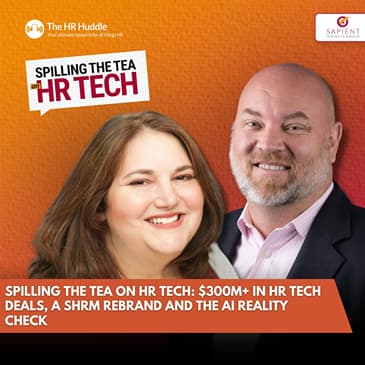
HR tech conference season is here, and this week's tea is piping hot. Stacey Harris and Cliff Stevenson of Sapient Insights Group cover the deals, the debates, and what it all means for your organization.
They start with a big round of deal news. Phoenix Education Partners agrees to acquire Fuel50. BoomerangHR raised $12.7M for its solution that tracks and manages former employees. Spott raised $21M for recruiting agency tech, and Dave Duffield led a $250M raise for Ridgeline, which offers an investment management solution. From there, they react to the rebrand of SHRM's annual conference and discuss whether the use of OKRs is actually the best way to assess performance. They also look at the growing strain on middle managers, why AI shouldn't be grading its own work, and Amazon’s rehiring of former employees, some of whom had been laid off.
Cliff also shares takeaways from NAPEO2026 and O.C. Tanner ‘s annual conference, and Stacey previews her HR Tech keynote and what's coming in this year's research.
Powered by the WRKdefined Podcast Network.
[00:00:01] [SPEAKER_00] Welcome to the HR Huddle, presented by Sapient Insights Group, the ultimate resource for all things HR. It's time to get in the huddle.
[00:00:22] [SPEAKER_02] Welcome everyone to Spilling The Tea on HR Tech, where we focus on the hottest HR Tech news everyone needs to know to be in the know. We break down the news the week and help you make sense of it and what it means for our industry and how it can impact your organization. We are recording today on September 28th, almost into October already, Cliff, which kind of scares me because normally we would have been past a lot of HR Tech conferences so far, but we haven't had a whole lot yet. So you have a couple updates, so we'll talk a little bit more about that today.
[00:00:51] [SPEAKER_02] I'm your host, Stacey Harris, the Chief Research Officer and Managing Partner for Sapient Insights Group, a research and advisory firm if you haven't worked with us previously. And joining me today is my co-host, Cliff Stevenson, who's Director of Research and Principal Analyst for Sapient Insights Group. Cliff, welcome back to the show. We have lots of tea this week. We said this was one of the longest overall scripts that we've had, I think, since at least the last couple of months at least, right? Which again makes sense. We're heading into the biggest HR Tech conference season I've seen in a while, right?
[00:01:18] [SPEAKER_02] Because AI has just blown everything up. So what's going on right now? Where are we going to start the conversation today?
[00:01:25] [SPEAKER_03] Yeah, well, we should mention, just because you mentioned HR Tech, that that is traditionally, right, the fall and the spring are the conference seasons, right? That's when a lot of software companies, really across the board, not just HR and work tech, tend to do their updates and releases. So it's no surprise that that falls in within hours, too. But as you said, this is going to be an especially busy one this year.
[00:01:53] [SPEAKER_03] And at HR Tech, which is for us, for Sapient Insights Group and for many people, that is kind of the premier conference of the year, the culmination of everything it's done. And it certainly is for us because we'll be releasing as the, I think they call them mega, what do they call them then? Mega sessions?
[00:02:14] [SPEAKER_02] It's our keynote. We call our keynote. We always call the keynote. But yeah, they call them mega sessions, I think, in the agenda, which means basically there's not as many people competing for your time. So I think there's maybe one or two other sessions at the same time. And I don't believe any other analysts. We actually looked at that the other day, which makes it nice. I always hate to compete against another analyst. Ours is always filled. It's just a matter of like, I like to be able to go to other people's events and see what they're reporting on and what they're saying, right?
[00:02:37] [SPEAKER_02] So it gives us a little bit more opportunity. But yeah, ours is on our mega session keynote is on Wednesday afternoon, the afternoon session, right before basically we head out to the expo hall sessions. So I believe it starts at like 2.15, 2.45, around 3 o'clock, somewhere in there, and wraps within 45 minutes. As usual, we never have enough time to deliver all of the information.
[00:03:05] [SPEAKER_02] So basically, make sure you sign up, make sure you come early, because we will start on the dot. I do not get chances to wait when it comes to those sessions. And we have some really interesting data this year. I've been data crunching all weekend. So you guys should know. I'm like, oh, oh, that's it. Oh, I thought it was going to go one way, and it flipped another way. And I'm like, well, this is interesting. So, you know, we've got some updates, I think, that are going to surprise some people. But also, I think, confirm where people are at, give you a little bit of feeling of you're not alone.
[00:03:35] [SPEAKER_02] The most important thing for us, right? Like the thing that we're spending a lot of time on. But there will also be at the intensive sessions that we're doing, which are workshop-style events on Tuesday and Thursday. You've got an Ask the Expert if people want to learn a little bit more about how organizations are thinking about pricing in the HR tech space, including some little benchmarking around that. So people should make sure they sign up for that if they have the ability to. And then I think the other thing that is kind of exciting is I've had more outreaches on LinkedIn this year
[00:04:04] [SPEAKER_02] than I usually do with people who I haven't seen in a while who are coming. Michelle Stewart, one of my very favorite people, who was one of my very first panelists. She's out of the Canadian market. She's worked on some very large organizations. She was an early survey participant and was a panelist for me many, many years ago. And we've been longtime friends. She was on IRON with me as well on the board. Leah Joyce is coming. We have Chiaro, who usually has been on her podcast, is coming.
[00:04:33] [SPEAKER_02] So it's going to be a good event. We've got lots of people commenting on the fact that they'll see us there. We do know at the same time the Unleashed Conference is happening over in the global in Paris. And we know many people will be there as well. I have heard of a few people who are trying to do like a Monday, Tuesday, Wednesday. Yeah, I thought about that. We couldn't make it work. There's no direct flight, right? So yeah, it's going to be a very, very busy couple of weeks heading up to this. There are some other events that we'll be going to. But you just got back from an event.
[00:05:03] [SPEAKER_02] So we did start off already with two events, actually. Talk a little bit about what you did the last two weeks. I think maybe it was one of them and OCTN, right?
[00:05:11] [SPEAKER_03] That's right. That was exactly the last two weeks. As you said, we've sort of started early. You've got a lot of events backloaded in October. That we'll talk about in just a second. But yeah, anyone doing the calendar math on when this was recorded is probably going, wait a second. That's way later. Well, yes, because of all of the writing that Stacey mentioned and trying to get some of this information. Which I think is really important at this time of year because it really helps inform what's going to be in the paper. What are people actually using?
[00:05:40] [SPEAKER_03] And an APO is a perfect time for that. That's the National Association for PEOs, Professional Employer Organizations. And it really, by the nature, if you know PEOs, I'm not going to get into it all here right now. But we talk about it in the paper. And in fact, our report this year and the survey that precluded it had a heavier focus on PEOs.
[00:06:05] [SPEAKER_03] We really dug deep into that entire, I guess you want to call it industry or category. And you'll find that they're mostly in small businesses. And so getting a chance to go to this event, the largest for that particular group, was pretty cool because it was so many small businesses. You know, I ran into some of the same solution providers that we normally see. But also some that I didn't know.
[00:06:35] [SPEAKER_03] And also a lot of companies that I just hadn't heard of. Well, how could you know of every small business? But really fascinating. And the one thing that stuck out from a sort of broad sense. And if you want to hear more about the sort of technical aspects or the economics or the new tech. This week's episode or last week's episode, I think, of HR We Have a Problem was all interviews from that event.
[00:07:02] [SPEAKER_03] That's something that I'd love to get everyone's feedback on, on what you think about that. Because we really want to start bringing our voice of the customer methodology and concept to these type of interviews. We're really hearing from you, the listener, viewer, however you're taking this in, about what is working for you. You know, that is the point of our research. We need to know what you're working on, what works, what doesn't. But from a broad sense at the NAPEO Conference, what was pretty cool.
[00:07:31] [SPEAKER_03] And this is really true across a lot of HR tech, but it was really true here. Is a sense of camaraderie and cooperation across what should be competing organizations. Stacey, you mentioned the advent of AI. And there's so much stuff that goes on in these big AI companies where they're trying to stop the competition. And cut each other down and be the only player in the room and all that stuff. That is not the case at this set of technologies and services and companies.
[00:08:00] [SPEAKER_03] They see, and the phrase I heard, even without people talking to each other, was the rising tide lifts all boats. The idea being that if things are going well for small businesses, for PEOs, even if we can't provide the sort of specialized service that another PEO can provide, we'll just refer to them. We're not even getting a cut. We just know that by people using a service, finding value in it, it'll help us all out. So there's a real sense of cooperation and camaraderie.
[00:08:27] [SPEAKER_03] I would talk to a company about what they were doing, and they would say, yeah, we do this. If you want to know who does education better, you should talk to them. And that's really their thing. And it was just really neat to see. So I really like that. Those sort of positive vibes carried through to a vendor-specific event I was at just last week, the week after an APO. And that was OC Tanner, one we've worked with and tracked for a very long time, one of the leaders in the rewards and recognition space.
[00:08:57] [SPEAKER_03] And the sort of meta story from that one is that they are going to be at their 100th anniversary as a company next year. So they just had their-
[00:09:07] [SPEAKER_01] Really? 100th? Wow. Yeah, 99th.
[00:09:09] [SPEAKER_02] I'm thinking that's 18- Am I- Did I have that right? 1926. 1926. Wow. Okay.
[00:09:17] [SPEAKER_03] Or 1927, I should say.
[00:09:19] [SPEAKER_02] Yeah. I was trying to do the math and obviously did it very poorly. Don't do math on TV or in a podcast. But wow. I mean, we're getting ready to do the 30th of the anniversary of the survey this next year. And I've been kind of thinking, well, that's 1997, right? So wow, that is amazing to think that they've been doing rewards and recognition. Because I think that the whole focus was like anniversary recognition back in the day, right?
[00:09:43] [SPEAKER_03] Yeah. I mean, they're a manufacturing company. They would create awards physically, make these. And they still do. They still have plant and manufacturing. And you can go there. And I have done and taken the tour. Sure. But one thing that is going on with their company that I just find fascinating is they, and I'll get some of the dates and times wrong here, but the core concept is that
[00:10:06] [SPEAKER_03] when the founder realized that he was no longer going to be there and it was time to kind of step down and think about the future of the organization that bears his name. I took all of, I believe, the shares of the business, his interest in the business, however you want to think of that ownership, and put it into a trust. It cannot be touched. In fact, there's 70 years, I believe, remaining on that trust, meaning that it cannot be sold.
[00:10:36] [SPEAKER_03] It can't be bought. There is no way for anyone to sort of wrest control and put it in the hands of making a public company, putting it into private equity. None of that can happen. So if you just heard that, you might think, okay, well, that's going to probably create a very conservative company in terms of you don't need a huge amount of growth. So you're probably just going to be like rest on your laurels. But I found that the opposite is the case.
[00:11:05] [SPEAKER_03] They have found ways to continue to grow, but they do it in a sense of let us see what is working and we will sort of try that. You know, like we will go for that. I made the sort of joke there that I think it's really great that they have their own research institute, even though it takes money directly out of our pockets.
[00:11:27] [SPEAKER_02] Hey, you know what? It's all, all, all, what is it? All boats? Yeah, the rise of time, raise all boats.
[00:11:34] [SPEAKER_03] And yeah, that's why I said it was a joke.
[00:11:35] [SPEAKER_02] Research is good no matter where it comes from, in my opinion. If it's solid research, right?
[00:11:38] [SPEAKER_03] That's right. And I did have a chance to talk to their researchers and happen to pass. And they still, they believe in validation of the research, which is why they work with us and other firms. But that's the idea is they need to figure out what do people really need? What works? What kind of advice can they give? So that, those two sort of overarching themes I found pretty interesting at each of those that will have specifics within post. But I really did like that. It was really nice to see the, a sort of different philosophy than what we might see,
[00:12:08] [SPEAKER_03] especially in this era of hyper growth that we're seeing in a lot of these AI native companies. In fact, we're going to be talking about a lot of investment and money going into these. And once we get into stories, including some new investment raised. But that was where we were. We also will be, we'll talk about where we'll physically be right at the end. But we have some virtual appearances as well. Stacey, you've got one coming up in a couple days.
[00:12:36] [SPEAKER_02] Yeah, I have one in a couple days. But before we jump into that, I just want to make a note about the Napio event, because I did listen to your session and podcast. And again, the new format, I think we're, we love it. We're still working on sort of how does it do with video versus audio. So I thought, you know, we're working on that. But what I really liked was they were commenting on how they, as an industry, felt they were 15% of the market and they were small and mighty and it hadn't grown a whole lot. Absolutely to a T is almost the number we have in our, in our research. I don't, I'm pretty sure they hadn't read our research, right?
[00:13:06] [SPEAKER_02] Like it's like that validation is so powerful when you see third part, because they do their own research as well at the Napio, I think event. And I love that, you know, you can see that distinct sort of like, yes, these numbers are clicking across all these organizations. And opportunities to grow is all about getting people to know what's going on in the industry. So I just wanted those call outs on, Cliff, to you to sort of asking the questions, I think that without even thinking about it,
[00:13:32] [SPEAKER_02] that really sort of highlight the value of what that data can bring to an organization, right?
[00:13:39] [SPEAKER_03] I didn't, I don't think I realized that either, Stacy. That's really cool. I think that when those things happen, and it's going to sound a little braggadocious, but this is, we're just reporting the facts. That's just what we do. So I was recently looking at some work we were doing with a client on contingent workforces. And we had a prediction on how much it would be. And I went and looked at the BLS data for that as well.
[00:14:05] [SPEAKER_03] Well, it was to the 10th, so to the first decimal point, exact what we had. And the usage of contingent workforces. We were like, this is what's reported. Now, most of that's just statistical truth. Once you have a certain number, everyone should get, if they're asked the same way, they should get the same number. But the difference is that we are saying what it probably will be, and we are down, we are that correct.
[00:14:34] [SPEAKER_04] Yes.
[00:14:35] [SPEAKER_03] That's a little different. I do want to give us some credit there on how we structure and word these things and how we validate our own data to get that.
[00:14:44] [SPEAKER_02] Yeah.
[00:14:45] [SPEAKER_03] Yeah, I do love seeing the data validated.
[00:14:48] [SPEAKER_02] Very powerful. And then, but yes, we will be doing some other events this week. I will be having an opportunity to talk to Meg Bear and Amy Wilson for The Meg and Amy Show. If you have not listened to The Meg and Amy Show, you really must. Just a shout out to both of them because I've done a lot of podcasts. I do a lot of podcasts, as you guys know, right? A lot of prep. A lot of times people send me scripts. They send me a series of questions. They, you know, but Meg and Amy sent me in prep for this session, not only the fact that they had read our research cliff,
[00:15:17] [SPEAKER_02] read it enough to actually get a series of questions about the research. And they've also gone back to some of my previous things I've said in articles and things that I've said in other podcasts. Now, Grant, I think AI makes this a lot easier these days, but I do think that, you know, the thoughtfulness of really sort of understanding who you're talking to and getting to the questions that like other people aren't asking, it's a really different, you know, it makes a unique setting for a podcast, right?
[00:15:46] [SPEAKER_02] Because there's a lot of times where you're kind of repeating the same thing over and over again, right? And what I really love is I got those questions like, oh, I'm going to be able to expand on these things. I'm going to be able to step up to the next conversation. So just a shout out to Meg and Amy on their preparation process. It's very, very good. So yeah, I'll be talking to them September 30th. And so by the time this airs, I'm not sure when it will be out and about. So we'll talk to them about getting it promoted so people can get access to it when it goes out. So we just launched this week,
[00:16:14] [SPEAKER_02] the Workday Future of Work podcast with Nancy Weidel on why adoption is failing at the point of work. That really turned out very nice. They did have like these quick takes on what we, the little things we had answered. I love that. It's also, you and I were talking a little bit about like, you know, the difference in the various videos and whether it's got filters and not filters. Everybody's going to Riverside these days, I think. And so I'm just, Riverside, we need filters. I don't even know how to explain this because look, we got to look at ourselves on these cameras. Even that one, I was like,
[00:16:44] [SPEAKER_02] my hair was just a little fuzzier than usual. I really wish you could. But it's so much fun. I love doing those things. And working with Nancy is amazing. She has such a unique perspective in this market. And she's quieter than most. You don't hear from her a lot because she kind of sits sometimes in the various sort of in-between areas of the HR technology space at Workday, working on sort of products in areas that oftentimes are sort of the workflow models and those kind of things. And so it was a really good conversation
[00:17:13] [SPEAKER_02] because there were places where she, as an industry person, you know, made some conversation about things that might be tough even for Workday audiences to hear. But then she also had some great questions for me about sort of where the market's heading. And we talked a little bit about how you maybe make a difference. So those were all really, really good conversations. And then Cliff, you were on a couple of events we just talked about, I think, recently, which is the HR Morning Show, right?
[00:17:40] [SPEAKER_03] Yeah. I was on the HR Morning Show live at the time. But you can go back. It is the August 11th recording. It's called Ditching AI Resumes, Human-Centric AI Council Agenda. I was on with Trent Cotton from iSIMS talking about the rise, not just of, as you mentioned, sort of AI's skills in reading large amounts of data, in this case, resumes, and helping to make recommendations, but also the phenomenon of users
[00:18:09] [SPEAKER_03] doing the exact same thing, of saying, hey, here's my resume. Find all the jobs that match up and send it out. And whether that's a good thing, right? Or how do we work with this? This is just the case. If we're using these texts, everyone's using texts. So pretty fascinating. And then I was on the Heroes of HR podcast with William Tincup and Amy Miller from iSolved. You know, not surprising, talking about some AI stuff as well,
[00:18:38] [SPEAKER_03] but also talking about the needs for small and medium-sized businesses as well. That, you know, I think we've mentioned on this podcast before. And, you know, normally I would say, check out our video, but as Stacey said, without the filters, just podcast.
[00:18:54] [SPEAKER_02] We're working on it.
[00:18:56] [SPEAKER_03] We'll start it out.
[00:18:58] [SPEAKER_02] And y'all know, y'all know who we're doing podcasts that you're thinking the same thing.
[00:19:02] [SPEAKER_04] That's right.
[00:19:03] [SPEAKER_02] Because we're just going to be pretty evictous by a lot of organizations, but which is a good promo for them, right? Yeah.
[00:19:08] [SPEAKER_03] But as I mentioned, I think I've mentioned this, that we really saw an increase in the amount of responses, percentage of responses we got from small businesses. Keep in mind, we have more responses from all sides overall. Like the raw numbers just up, up. Fascinating. I love it. But while higher percentage of small businesses, it's more reflective of what the actual landscape looks like. But it has made both of us pretty focused on what is happening there, right? That's going to be the moat,
[00:19:38] [SPEAKER_03] as they say, on these troubling economic times ahead of us. So speaking of predictions.
[00:19:46] [SPEAKER_02] Opportunities abound in that area. That's right. Speaking of where we're at, we are seeing small businesses mid-market being acquired. Cliff, so that is our very first conversation, right? Yeah.
[00:19:56] [SPEAKER_03] As I mentioned, there's money out there. It's not that troubling because Fuel 50 was purchased for $31.5 million. I should say that as of the time recording, I believe that the final agreement has not gone through. You know, they still have to kind of sign all the paperwork, but that is the agreement that Phoenix, Phoenix Education Partners, anyone in the United States don't know them as the people that run the University of Phoenix, Yeah. which does a lot of online but also physical
[00:20:27] [SPEAKER_03] in-class education, but with locations all over the place, not just Phoenix, right? Which can be confusing for anyone coming from outside the U.S. going, wait, what? Yeah. but they're probably the most well-known if not, I guess probably just number one in that space.
[00:20:42] [SPEAKER_02] One of the earliest founders of online degree models, right? Like that was their thing back in the, I know people in the 90s, right, was if you got a University of Phoenix degree, the first question was, was that online or did you get it in person? And it was before people were comfortable with online degrees, right? Like that was a thing and so University of Phoenix had to battle that. I know my husband was one of the people who went to their program, one of their programs, right, back in the day and it was, there was a lot of conversation as to whether universities would
[00:21:11] [SPEAKER_02] or whether businesses would accept that as a real degree. I mean, we now know that there is no difference and COVID completely smashed that model altogether that there was any concern about it but it is one of the things that in the early 90s was not a given, right?
[00:21:24] [SPEAKER_03] Yeah, absolutely. You know, quick aside, which we probably don't have time for but I worked for a while in Westboro, Massachusetts and the building next to ours was a University of Phoenix building where they had a lunchroom, everything. It was like a full, I guess, mini campus because they have those as well, right? Physical education centers and they offered me a teaching position but it wasn't just like
[00:21:54] [SPEAKER_03] here you can have it just because you have a master's degree. They said that was the minimum requirement to teach and then you had to be vetted and go through a normal hiring process and then I would have taught there and I considered it because, you know, the pay was good and a good supplement but I was impressed at the time because I was one of those people, Stacey, I was a bit of a snob on that and the first part it was like, oh wow, I didn't know they had physical things. I thought it was just online. Satellite campuses I guess they'd probably call them
[00:22:24] [SPEAKER_03] and then I went through that process and was like, okay, I don't think getting into a proper university is quite as difficult as this. I think they may have been extra sensitive to the fact that they needed to make sure but they really did like that if you were going to be teaching a class that you were working in that class and I think that is something I respect a lot from my professors at the university level.
[00:22:46] [SPEAKER_02] It was really, one of the big things I remember they touted was that you were being taught by people who were in the industry not just by people who had been teaching forever which again, not to say there's a wrong or right on that conversation it was a focus of theirs, right? My husband was in the military and so that was one of the reasons why the distance education was so important to him and there's a lot of programs and they've made it possible for many people who are traveling or in the military or in different situations where they needed to get their degree in environments where you don't have physical locations and so that was
[00:23:16] [SPEAKER_02] a really big thing for him and I think it made it possible. I think there was a lot of challenges and this is one of the things I think we've addressed but they tend to be a bit higher in cost than general education. Now everybody's that high. I can remember when I got my first undergraduate not my master's degree my first undergraduate you know you could get an undergraduate for under like $5,000 right? You know a year it was doable
[00:23:45] [SPEAKER_02] to do it on a waitress's salary which is what I did and that was not the case and Phoenix was one of those that had increased beyond sort of the allotted amount you could get in student loans and that was one of the things that people really got frustrated with them that then sort of the whole market changed and then we saw that happen everywhere right? They were just a little bit ahead of that conversation but part of it was because they had differing business models and they were not supported by any state government or anything like that right? And I think this this acquisition for me harkens back to their their focus
[00:24:15] [SPEAKER_02] on being very innovative now I don't know you know we didn't get a whole lot of details on what this acquisition is going to be for Phoenix but I know there's been a lot of speculation online about it and what I thought was interesting is when you think about Fuel 50 Fuel 50 has been sort of it's one of those I used to call them a 300 company right? A 300 club what you find in a lot of organizations is that their solutions are so tightly connected to big big enterprises and so tightly connected to very specific things inside of those big big enterprises that it's hard for them to break
[00:24:45] [SPEAKER_02] past 300 companies right?
[00:24:47] [SPEAKER_03] Oh I see
[00:24:47] [SPEAKER_02] To get beyond 300 customers you have to figure out how to do the long tail which is the idea that you can go mid market you can go SMB you've got something that fits different size groups inside of organizations right? At a certain point some organizations are just like we can make enough money by just serving these top 300 companies and they all and we'll see them like they have you'll go into these large companies and they all have some versions of these organizations that they have acquired or bought right? And used as a nature technology environment
[00:25:18] [SPEAKER_02] so for a long time we were kind of watching it through they had Fuel 50 had one of the most interesting career planning succession planning early skills modeling conversations right? in the hands of Phoenix my question is is this an investment or is this really just an opportunity to start to think about that kind of conversation from the education side for students leaving or is this internally that they're working on this and so they're creating another maybe
[00:25:47] [SPEAKER_02] business revenue model I don't know but it was interesting to hear the different speculations on what this might be used to hear inside the Phoenix environment right?
[00:25:56] [SPEAKER_03] It will be interesting to see how it goes I know that they are going to maintain Fuel 50 as its own standalone company I believe Joe Mills will be the CEO most of us in the NL Center probably know Ann Fulton Fuel 50 but it'll be Joe Mills so it'll be the CEO and it will be its own subsidiary but or subsidiary I do think the natural progression would be especially based on my experience with them right thinking about how much they value workplace experience
[00:26:25] [SPEAKER_03] is to have those two where you know you're in the University of Phoenix system and then when you go into a workplace that uses Fuel 50 you would then be able to go back and have those resources or work in a situation you are familiar with use those resources to help grow or maintain your skills or even change the skills needed for the job
[00:26:51] [SPEAKER_02] and we've talked about this for a while with universities that was the direction that we were heading with some of the blockchain conversations continuous credentialing the global conversation about a skills tool that could go across businesses and across organizations and around the globe right we're seeing some organizations take it in different routes I'm interested to see where this goes I would love to hear more from Phoenix once they get their arms around all this right
[00:27:20] [SPEAKER_03] yeah and then going from people so it's like we're getting a whole life cycle here right we've got people that have left university gone to a job now they've left the job maybe they want to go back well that's where boomerang HR I guess would step in for whatever reason if you don't know the term a boomerang employee is one who has left an organization then come back so you can probably guess that is the focus for boomerang HR
[00:27:50] [SPEAKER_03] funding they're raising money to go public or at least to be a viable solution this was sent to us by our friends at Devin so thank you Jeannie and I thank you for letting us know this but it's pretty interesting so it'll be offboarding and what's called corporate alumni right keeping track of those people that have left your organization but you still want to maintain connections with and bring back to the organization one day so probably not surprising
[00:28:20] [SPEAKER_03] this was one that is an AI native they rely on a lot of AI technology for the information gathering and that sort of stuff but pretty cool because although we've seen these functionalities in systems I don't think I've seen one that's just hyper focused on just this
[00:28:42] [SPEAKER_02] not this much I think the closest might be onwards HR but that's more about managing reductions in the workforce and sort of managing making sure you have a good relationship with people as they leave the organization I think there will be maybe a little bit of this not as much strategy about how you handle that but a little bit more about how to handle probably employees and making sure you keep that relationship long term what's interesting here I think in this boomerang there's been and I'm going to get this wrong because I don't actually go to it so my friend
[00:29:12] [SPEAKER_02] my friends who are out there you can correct me but I believe if you have been part or were once part of Deloitte Accenture one of the big five big consulting firms there's a site out there I think it's called Fishbowl I could be wrong it's something like that but it's a place where a lot of people who worked in those big organizations go and have conversations on the down low right see what's happening it's this idea that you've got past employees having conversations and the thing that I always tell people about you know getting upset that employee
[00:29:41] [SPEAKER_02] might leave you to go someplace else so we've seen a little bit of this going on with the big AI firms right now you know Anthropics person went over to AI you know OpenAI OpenAI's person went over to Anthropic the people who left OpenAI created Anthropic then you're seeing you know some people from like work day go to Anthropic you know so it's it's this constant like well who's going where and can they take my IP and all that stuff right and I think the one thing I've always said as a leader and as a business owner is that
[00:30:11] [SPEAKER_02] you know understanding the needs of your employees and understanding the value of who they are as a professional in the market connected to you is something most organizations oftentimes forget about right that is one of the reasons why you see good packages is they want people to speak kindly about them but oftentimes I cannot tell you how many people we have a story in here possibly about how many people are rehiring back layoffs from the AI bad decision making right boomerang HR I think is an attempt we've seen
[00:30:41] [SPEAKER_02] a couple solutions like this in the past I think this might be the time where there is a real opportunity we oftentimes saw them set out as talent pools a lot of organizations have alumni programs inside of their organization to make sure especially those large consulting firms right but I do think that this is an opportunity for every organization to think about it we've got boomerang people who come
[00:31:35] [SPEAKER_02] back I'm looking forward to getting an update on this
[00:31:38] [SPEAKER_03] yeah I am too another organization now this one's already in the field and this is spot with two t's they are an applicant tracking system and CRM customer relationship management I should point out and not candidates strangely enough but specifically for recruiting agencies your RPOs and those type of staffing agencies that type of thing and I will tell you just again from past experience you do use completely different systems right because
[00:32:08] [SPEAKER_03] a normal ATS applicant tracking system you're just going to have it listed and you're going to have the hiring managers and you're going to have all the date information but you're not going to all legal things so pretty
[00:32:38] [SPEAKER_03] interesting that it's focused on that as we're talking about these but they've been around I think a year since 2026 and they've just raised 21 million in series A and interestingly Stacey the people that
[00:33:08] [SPEAKER_03] these last two stories have been pretty interesting because this is significant money it's not the billions that we've sometimes seen in some of these huge acquisitions of well known players but these are sort of specialized tech and services for what's clearly a need or that kind as I just mentioned these
[00:33:38] [SPEAKER_03] agencies probably used cobbled together tech or tech that's meant for something else and at the same time like we mentioned with boomerang there may only be one other company that's doing it if that so you can kind of see where they're addressing needs in the market
[00:33:54] [SPEAKER_02] yeah and the of 2026 right so what I the one one addition I
[00:34:09] [SPEAKER_02] used to do a lot of work with manpower those kind of organizations as well and these are kind of very different systems but there is an ongoing conversation I have this interesting conversation with someone who's doing recruiting in a large pharmaceutical company just last week and they said you know we're trying to make a decision how much of a CRM do we need now with AI and that's an interesting I hadn't heard that previously you know AI
[00:34:34] [SPEAKER_02] oftentimes you know is it's an interesting you know is it's an interesting you know is it going to change the dynamics of what a tech stack looks like maybe not in the RPO space here but maybe for the practitioners on the other side that might so that's an interesting you know play in the market right yeah
[00:34:46] [SPEAKER_03] yeah then speaking of raising money but now this one's kind of tangentially related because it involves raising money 250 million and now we're talking some big bucks again for Ridgeline and although Ridgeline I believe does investment the founder we're getting back into the the sort of you know repeating you know where people worked it's Dave Duffield who founded Ridgeline but also PeopleSoft and Workday
[00:35:16] [SPEAKER_03] yeah so you know good track record right is leading the capital raise right so pretty pretty interesting also AI native I it's getting to be I feel like it would be I'll just point out if it's not AI native how about that yeah
[00:35:38] [SPEAKER_02] this one I think is really so again people who know the industry know the Dave Duffield name he's been around and and and I don't know I mean Dave Duffield getting up there a little bit in age right so but they do have the CEO is Patrick Shaughnessy I believe right is that maybe I'm reading that backwards Motley Venture Management and Patrick Shaughnessy CEO oh positive some host oh sorry those were people who hosted see this is why I got to read my my notes a little bit better Cliff but so they got a Motley
[00:36:07] [SPEAKER_02] Motley Fool investment along with a bunch of other ones I mean this is really this is I think we had heard industry what do you want to say kibitzing is a good way to put it I don't know if that's the right word but a lot of whispering about the fact that there was this sort of entity that was being built by some former Workday or professionals and leaders and many people who had left Workday had gone over there to work on this fintech is a growing area
[00:36:37] [SPEAKER_02] you and I have talked about this we know that the HR tech space is getting slightly commoditized right there's a lot of standards a lot of the same across a lot of the applications we've had this conversation with many of the vendors in this space right but what it hasn't gotten there yet depending on what side of it you're looking there's a lot of financial technology right financial technology there's only a few big players it is a very standard market but there's a lot of room to do a lot of the kind of transformation that we've seen in the HR space I don't know much about this technology but I do know
[00:37:07] [SPEAKER_02] that you know Dave Dufffield and the people who surround him tend to have ideas about how to sort of break the norm and become sort of the next version of things so if I were competing with him I'd be watching this carefully right yeah
[00:37:19] [SPEAKER_03] absolutely some other things to watch this one this one's sorry I'm just going to throw this out here and I want to see your thoughts on it SHRM I think we all know SHRM right Society of Human Resource Management have rebranded their annual conference as SHRM HR HRX Live exclamation point I'm a little annoyed here and I'm going to tell you why I think we talked about this at the top of the podcast
[00:37:48] [SPEAKER_03] where we are kind of trying out some ideas of ways to bring the voice of the customer research that we do in our annual report to these events that we're going to and just in a more ongoing sense you know monthly let's hear from these customers let's give them a chance so I was like oh you know kind of like Total Request Live I want to do Voice of the Customer Live Vocal for short you know keep an eye out on your podcast for that one but then I saw them do it
[00:38:18] [SPEAKER_03] and I was like oh man I just realized that's like some very like Gen X I'm just like I just fell for the same trap like oh what a cool idea now they're like oh what a cool idea and I'm like oh it's not cool SHRM's doing it
[00:38:29] [SPEAKER_02] it's live right yeah yeah no I know and this what sort of got me on this one is that it harkened back to Gen X right which is again very much although I will say we've got some data that shows that maybe you should be focused on Gen X right now you should really probably be focused on Millennials just to be honest yeah it's really I mean I know us Gen Xers like our stuff but what I but the idea is that they're taking that credentialing academy which credentials are really important to the HR professionals it has been
[00:38:58] [SPEAKER_02] for many years because it is a profession profession requires credentials requires that you are certified in certain things that are important to the industry because you're held accountable to them on sometimes a legal level right and so those are really really important things to get credentialed but they're shifting them into what they're calling four dimensions that Shurm said most contribute a stronger business growth so I'm not sure what that's going to look like but the more important thing here is it sounds like they are going to force is probably not the right
[00:39:28] [SPEAKER_02] word but they're going to push people to kind of pick tracks to pick focus areas and to really drive sort of more like they're going to kind of categorize you when you kind of come in and tell them who you are and what you're doing and that that just hit me the wrong way because I don't like to be categorized I don't like to be told which things I can or can't attend I get it there are some things that maybe senior people should attend and people who are influencers should attend I understand a little bit of what they're trying to do and trying to sort of
[00:39:58] [SPEAKER_02] get an audience that is relevant for each organization that might support that audience right but I will say what if I'm someone who wants to learn from the next level how do I get to that without being kind of so that just pushed a couple buttons for me that I didn't feel comfortable with right because I think that's been the nice thing about Sherm is it's always been kind of this open platform that again you
[00:40:44] [SPEAKER_03] track I'm going to read you the four that they have talent optimization organizational impact functional acceleration market discernment first of all those sound like horoscopes and they're so vague that I could see myself being interested in any of them but more than that a lot of times conference people will do this and they'll say oh you want the talent optimization track and then it kind of helps you choose which sessions to see and which events to attend and I could see from a conference designer's mind
[00:41:13] [SPEAKER_03] being like well why not just continue that through and we'll get a whole credentials around that but that's done more for ease of use there I can't we'll see how it goes but my immediate thought maybe this is me being a Gen X rebellious nature but I would say I'm interested in all of those if I was in talent optimization I'm like okay I want to get my people the best they can be do I somehow means I'm not interested in organizational impact I'm doing that for organizational impact that's why I'm doing it and that will create
[00:41:43] [SPEAKER_03] functional acceleration which will allow us to discern ourselves in the market at what point am I going to heck with those other things I know that's not what Sherm's trying to do here but still it can be read that way
[00:41:54] [SPEAKER_02] it would be almost better if they would flip it make it more but Gen X we just do not like being categorized the minute you tell us we have to go one direction we go the other that is who we are because that was how we were raised and so we are having conversations with them we will definitely continue to support some of that work
[00:42:24] [SPEAKER_02] on an event space because we see it in our data that people appreciate it they need some place to be able to think it would be great for them to get some other voices in the conversations as they're thinking through some of this so hopefully they'll take that to heart speaking of that we have we're kind of shifting gears to how do you think about what's important inside your organization I don't know if that was a good segue Cliff it's not
[00:42:52] [SPEAKER_03] as easy it's not that easy when you see these awkward ones but yeah so this was pretty interesting and something we'll probably talk about a little bit in the report as well but this idea and this is from Paul Rubenstein on whether it's a pretty controversial title but I love it has anyone actually used OKRs and had it work and you know he's kind of talking about some
[00:43:22] [SPEAKER_03] of the software more behind you know but even though he admits it's not really the software but it's that not unlike what we were just talking about with SHRM that you know there's a bunch of different things going on at the same time it's not so simple as just being like here is just these metrics and that alone gives us an indication of where we are right that that's part of it right and then there's that's
[00:43:52] [SPEAKER_03] what he's calling a declared signal right those are you're saying we're we're putting this out here we're showing that we are interested we're declaring our interest that's going to be through OKRs or through town halls big meetings the things leadership says but then he said there's another signal and that's behavioral signal and that's like how many meetings do I have what sort of business is my organization actually doing who are we doing business with what does that work look like does it feel like make work
[00:44:22] [SPEAKER_03] or does it feel meaningful not just you're being told you're doing meaningful work but I will see it when I'm doing it right yeah
[00:44:30] [SPEAKER_02] this is huge I love this one Paul and so I think this was when I was reading this and I was like oh Paul Paul sometimes we we commit a little bit because we think along the same wavelength on our conversations and this particular one I was like you and I talk about it all the time culture eats strategy for breakfast and that's really what this is right is that you can say all the things you want about OKR which by the way even I have to always look it up because I never remember it's objectives key results and initiatives I
[00:45:00] [SPEAKER_03] couldn't remember so I just skipped it
[00:45:02] [SPEAKER_02] right like we all it's OKR we kind of know there are things that AI is going to do that's going to drive us all nuts
[00:45:32] [SPEAKER_02] and it's terrible but one of the things I think we can do with AI is start to understand the realities of what our company does because before this we could never look at these big data sets and see any analysis out of them right and now you can look at all the meetings all the commitments all the deal activity you could look at how much you're paying for various roles and the competencies that are tied to those roles and you could start to actually see what your
[00:46:18] [SPEAKER_02] private equity also probably has a margin number and an efficiency number that they have to hit to do the business model the way they do they have a price they're trying to get out of the to
[00:46:48] [SPEAKER_02] have but we need to have them right
[00:46:49] [SPEAKER_03] yeah it's super interesting right because think about that OC Tanner example I gave their ability to dissociate themselves to separate themselves out from those hidden metrics or hidden drivers of just saying look that's all trust our business is our business allows them to be a little more upfront about what it is they're trying to achieve it may not be 6% growth that's that is pretty
[00:47:19] [SPEAKER_03] interesting and that gap between what you're saying and what you're doing
[00:47:27] [SPEAKER_02] looking backwards and not looking backwards for the series of just saying historically what we've done but looking at how we made those decisions what really happened in the company and then being honest with ourselves about whether that is what we wanted to happen or whether it would happen because we
[00:47:47] [SPEAKER_03] great HR executive article from Jen Coletta that she just put out talking about really this crisis that's going on with managers we're talking middle managers and what's happening is that that's really where we're losing the most people right if we are going to talk about the impact of AI I think it's probably at that level obviously there's industry variations and there's types of tasks and types of jobs
[00:48:17] [SPEAKER_03] but generally the people stacking groceries can't be replaced with AI people folding shirts can't do that either you're going but you could see some of the decision making is going that way but whatever the case of why that's happening it definitely is happening this isn't just our research I think Corn Ferry ADP a few others have looked at some of these numbers and they saw see this one is from Corn Ferry 42% of organizations cut back
[00:48:47] [SPEAKER_03] on managers in the last year so there was another one that was 62% of employees say their workload has increased in the last year and that's up to 70% for managers so basically we're in a real sense it's basically managers being asked to manage more people than they ever have before right and that's causing a lot of stress and just making jobs harder and they're feeling maxed out but the pay has not gone
[00:49:17] [SPEAKER_03] that way commensurately Stacey you pointed out that one of the reasons executive pay is as high as it is is because they are making decisions for to be hit on return on investment on these values so where can we do that we can push these managers as far as they go we may be near that breaking point
[00:49:47] [SPEAKER_02] yeah this here is I early recession then a real recession so we didn't quite get into a depression but we were heading there and we were able to pull ourselves out of it and one of the things that pulled us out of it was
[00:50:16] [SPEAKER_02] a lot of the banking investment work that was done at our government level bailing out some of banks but there was also this sort of once we laid a bunch of people off this huge uptick you had all these managers who were just
[00:50:47] [SPEAKER_02] just and that started what was the talent wars of 2011 and 2012 people don't remember this but that was the start of the big talent management solutions and being sold off and all that stuff like there was a cycle that happened there which is that yeah you can get a lot out of people for a short amount of time and then they start to basically break and we're hitting some of that I think in this space we're ready to hit it pretty clearly especially when we think about the number of available labor that we will have
[00:51:17] [SPEAKER_02] heading into the next round of things the other thing that's a little bit different though in this dynamic and in 2000 I did an analysis this will be in my my big annual report but I think it's worth noting here did analysis of those who were laid off in the 2007 2008 crisis without a doubt the largest percentage were in between the 25 to 35 year range this time round even though we're not in a full recession yet depending on which industry you might be feeling it
[00:51:48] [SPEAKER_02] there are a lot of layoffs most of these layoffs when we look at the numbers it is more likely that if you're over 40 that's the highest percentage of people being laid off because what we're seeing is again that help us the we get it on both sides 10 years ago we were on the younger side too if you're over 40 now you're in a management position those management positions are more likely to be laid off versus what we saw in the early career and some of the other roles now there's the lack of early career hiring that's another issue that we're having right
[00:52:32] [SPEAKER_02] so there is going to be an impact to these decisions that these big companies and mid-market companies are making now about their decisions to lay off and to reduce support for these managers and those decisions will have an impact long term based off of what we're seeing in our data from just what happened 10 years ago right
[00:52:53] [SPEAKER_03] yeah and speaking of impacts we are starting to feel the impact of I would say the downturn we we've been predicting so all right we kind of talked at the beginning about you know some of the predictions we made I'm going to just hammer this home because I this is something that happened in the last couple conferences I started getting I'll just admit a little annoyed of hearing some of the analysts and some of the people talking about
[00:53:23] [SPEAKER_03] like you know I don't know about this AI stuff and I was saying that a year ago I
[00:53:29] [SPEAKER_01] was getting
[00:53:30] [SPEAKER_03] mocked for being like I wouldn't put too much trust here but whatever but Mary Kate Simler who's not one of those people I had some pretty interesting stuff on looking at what's happening in the AI industry as they're scrambling to create some sort of business case for themselves anything and it was
[00:54:00] [SPEAKER_03] basically they had all done this exercise of figuring out a way to prove their value by using their own tools so she said I gave a time but she looks at the methodology she's not just making fun she talks about things for instance one of things that I took personally in a good way they asked for
[00:54:30] [SPEAKER_03] how much time does a specific task take and Claude estimated the coding task time versus what it actually took and it was at 0.44 with 0.1 being exact so it's not great it's basically less than the coin flip but real developers were even better but even that was 0.50 meaning they're also bad at estimating how long tasks take which anyone who's ever tried to figure out how long does this take to do something that's very important in our industry knows that yeah that's not easy and the fact that my terrible guesses are
[00:55:00] [SPEAKER_03] better than this thing that's supposed to be hyper intelligent doesn't tell you much but she gives a bunch of examples of basically AI being asked to grade its own work and how that's not really helpful right we have to make decisions on whether it's valuable to us using our own metrics because if we're just going by the hype and I think we've passed that point as a whole as a people we're no longer listening to these claims wide
[00:55:30] [SPEAKER_03] eyed we know we're going yeah let me see on that because we we've worked with these tools long enough we know their strengths and we definitely know their limitations that's my take on
[00:56:00] [SPEAKER_02] that is you know yes it can move faster but it can also move just as fast in doing the wrong thing as it can in doing the right thing and so what is that cost what is that impact what is that outcome those are all the things you might have one person who can ring up the cash register 10 times faster than the other person but if they make 10 more mistakes is that really of value to you right that you know it's no difference than that conversation right
[00:56:27] [SPEAKER_03] yeah absolutely and another sort of danger too right is that because these are for-profit businesses you know the providers of the big we'll just call it the big two right Anthropic and OpenAI ChatGBT and Claude they are facing some pretty staggering economic realities and Jessica Miller Merrill just wrote an article kind of talking about how the chatGBT 4.0 they shut
[00:56:57] [SPEAKER_03] it down as they're sort of migrating and she's like any organization that had sort of been relying on that as their entire bound you know bedrock of how all their systems are going to run found it kind of overnight that they didn't have that now I found that to be a pretty rare occurrence most people just would shift to a older models I think Stacy you and I have both probably been there we're like you know we don't need this
[00:57:26] [SPEAKER_03] much inference or much compute we'll switch a model that's faster or maybe we find sometimes an updated model that actually doesn't do as well despite its update because it's now being trained on different data that may not be as reliable etc. so it was a bit of a scare tactic a jump scare of a headline bring up a point like I was just saying that there's a danger of tools
[00:57:56] [SPEAKER_03] not being economically useful for us meaning the amount we're spending on it is the amount of return that we're getting at but there's also the danger that they just may not be available right if that is your entire foundation who knows
[00:58:09] [SPEAKER_02] yeah I mean and I think Jess has got a very her position on this is if you are building on various models and that model changes right like and even the pricing or the approach to letting you buy it right like there's some of that that she had built into this conversation too right like anytime you're dependent on
[00:59:19] [SPEAKER_02] chaotic buy and will price go through the roof to the point which you cannot handle this cloud model anymore we don't know the answer to that but it is something you have to keep in mind right I'm working on sort of what are the next things business leaders are thinking about right now and one of my big things is it's not even a risk management anymore it's now kind of the sort of assumed there is a conversation we had about sort of assuming that there is going to just be something that will eventually
[00:59:49] [SPEAKER_02] price you out of your business you have to be constantly thinking about how you shift doing business like flexing business not just risk mitigation where you have maybe duplicates of things but now you have to have a direction you might shift if your business model becomes unsustainable from a pricing perspective right
[01:00:06] [SPEAKER_03] yeah absolutely and talking about companies that use this use the technology one that we have mentioned on the show a few times I think we bring up in a lot of conversations because you know earlier we talked about some businesses that we're creating tech for a need or creating a business for a need using tech as a platform to do so one that I really like I think you probably do too is
[01:00:36] [SPEAKER_03] Lanai right where they're saying okay we need someone needs to sort of watch the watchman right someone needs to see what's going on in AI and so now this was an article from Lanai right yeah but it's interesting because you know they're talking about everyone wants to be the goat that's a grace of all time just a shorthand for that of AI and almost
[01:01:05] [SPEAKER_03] nobody is right that there was this big rush to be the number one AI out there and what we're finding is just not the case right that it's really going to be a collection of tools and that does help protect you somewhat too against you know if you put all your eggs in one basket there's a lot of metaphors being thrown around here but yeah it's that sort of complexity and
[01:01:36] [SPEAKER_03] things that all bring everything together and being able to see all those connections Stacy you mentioned before you wouldn't just hire one person to do everything in your company right so why would you think the same way around the tech is Lexi's point here which is in fact I think that's something they say is there one person accountable for an important business who has authority and resources to achieve it right so yeah
[01:02:05] [SPEAKER_03] you would bring in a bunch of people right so I and this sounds like management 101 of course we would have a group of people across that so yeah
[01:02:20] [SPEAKER_02] I loved your comment and we are making this so much harder than it needs to be you know you and I've talked about this right like sometimes it's just look you need you need to have a mix of tools you need to have a mix of you need to have a collaborative people making reviewing these things it can't be a single person in the loop but there are just so many things here that are just kind of basic um 101 management and I think I think people have just they've lost their heads in some cases about just how to manage things in general right and we saw this we saw this during the early
[01:02:50] [SPEAKER_02] days of the internet you see this all the time when there's what I always like about Lexi reason is funny because I've yet to be able to get a briefing with them so just a shout out to Lanai you and I have tried but they're not in our industry if they don't quite know what to do with us we're like look really they do sort of analysis of and helping organizations ensure that their AI is not compromising the company externally or internally there's some things they do for that but she's I found her early on
[01:03:20] [SPEAKER_02] on a podcast that I listened to which was really great which is the greatest things in AI and it was one of my favorite podcasters and she's I think her writing has been measured in a way that you don't see from many of the other people who are either like oh we need to have protections or oh we need to have this but it's been very balanced and I like balanced it's always something I gravitate towards right
[01:03:43] [SPEAKER_03] yeah absolutely I yeah and I do kind of just like the whole the model that they've built too right so and I do urge people we'll put as always links in but they've kind of made it easy to digest of being like almost like personas of which one is your organization and it's very easy to see like yourself in there like the kind that are like oh we just buy as many licenses we need you know okay everyone use this new tool oh cool new tool we'll buy that one too
[01:04:14] [SPEAKER_03] and then there's the one that's just all you know only focused on how much you're getting for your money on and on I think they've got fun little names
[01:04:23] [SPEAKER_01] oh you've got to give the names cliff the roi cosplayer yes
[01:04:26] [SPEAKER_03] yes roi cosplayer I love that
[01:04:29] [SPEAKER_01] cliff definitely got sort of the sci-fi genre
[01:04:35] [SPEAKER_02] market rate and I was just like oh my gosh an roi cosplayer and then the seat counter the one where all I'm looking at is license and token spend ups and I'm like oh you're just a seat counter these are perfect terms
[01:04:47] [SPEAKER_03] yeah I do like the roi cosplayer let's give me some ideas for next year
[01:04:51] [SPEAKER_02] yeah
[01:04:51] [SPEAKER_03] but yeah but it's good you know and I think at its core that is what lanai does right is trying to take very complex issues and make it something understandable so I thought they did a pretty good job yeah then there was a article from this was from Jeffrey Pohl on AI employment litigation and looking at what's been sort of coming through so I
[01:05:21] [SPEAKER_03] let's see the stat that was thrown out that I will have to validate because it would take a long time but it seems pretty interesting over the past two years more than 3,000 AI related laws have been proposed and over around 150 have been passed so this is extremely fast regulatory response which is true this is that is noticeable anecdotally and from the data that we have seen a lot of regulation
[01:05:50] [SPEAKER_03] step up but for the first time that I can remember at least as far as technology goes Europe has come faster than we have meaning that normally we sort of set this tone and everyone else follows on these things but not this time
[01:06:05] [SPEAKER_02] at a federal level I would say yes and I think what Jeff was pointing out was that most people think EU is moving faster and they are on a federal and a consolidated we're all kind of on the same page level which makes it easier for businesses to invest in AI in that environment but what he is saying is that the US employment litigation at the city and county and individual state level is actually moving faster than anyone
[01:06:35] [SPEAKER_02] else because they are creating all these new laws and regulations which is making it very hard for anybody to understand what they should or cannot do increasing the value of compliance content rapidly in the market right New York just had a huge employment law that we'll talk a little bit about on compliance now it wasn't AI per se but they used AI to make some judgment calls which caught them into some hot water about compensation
[01:07:04] [SPEAKER_02] and so I do think what he is basically saying is that don't count the US out because the federal government isn't doing this we know recently announcements have been that we want to support and take care of AI let's hope that's not our long-term stance on this but the states are holding us accountable to it right yes we've talked a little bit not about them per se but other organizations like that
[01:07:34] [SPEAKER_02] they are a measurement tool similar to lanai in this same frame so obviously what he's talking about is something that's near and dear to his heart but it was an interesting commentary on how the US decentralized approach to this might be having an impact right all right I know yeah so it was right when
[01:07:57] [SPEAKER_03] you said judgment calls and I'm going yeah and we should mention too that the organization Jeff is with is warden AI and sort of the reason for bringing this all up is that they have a tool warden watch which tracks a lot of the AI compliance in hiring NHR and that's another one that we've
[01:08:26] [SPEAKER_03] been kind of keeping an eye on so we're going to be looking into that because as we said requires sometimes new solutions some of those might be a company like lanai and sometimes it could be something as important as keeping track of all these new regulations yeah
[01:08:45] [SPEAKER_02] huge issue in the market compliance on this right and who knew that decentralized might give us the future guardian on this I don't know we'll see
[01:08:54] [SPEAKER_03] warden
[01:08:55] [SPEAKER_02] warden I don't know but up next is a conversation about meta which takes this in the whole other direction on this with their muse AI agent will take a free from transactions I'm not sure on this one a whole new business model I'm not sure where this is going Cliff I have a lot of feelings on this yeah
[01:09:20] [SPEAKER_03] risk of yeah risk of losing meta as a potential client I'll tell you where it's going and it's going in the trash like all of his ideas listen buddy you lost 90 trillion trying to push metaverse you're clearly out of ideas if you haven't seen this by the way the meta muse got a lot of press but you might have missed it it's a pendant that you wear so you know we've got the perfect glasses now you can get a perfect thing here to record stuff
[01:09:47] [SPEAKER_04] yeah
[01:09:48] [SPEAKER_03] whatever I'm done with him I have no interest Stacy what are your thoughts sorry to be piece of what
[01:09:55] [SPEAKER_02] I read a little bit about this I think part of it is that they have they've connected it to a very cute and cuddly image right which makes it very attractive to children someone the other day someone posted about how this could impact kids and someone was like well they're staying 18 and over they're not targeting children the minute you put a cute cuddly thing you're targeting children right and I do I mean I grew up in the era of cabbage patch kids and Tamagotchis the whole bit right
[01:10:24] [SPEAKER_02] but like the pet rocks people love to have things that they can feel like they're taking care of right particularly if they interact with them I mean we didn't have to have a whole lot of movement on anything to make it feel like we were taking care of it right there is a danger there in that perspective I will say my parents were the parents who didn't buy the cabbage patch dolls they didn't buy the Tamagotchi tools we had a computer and we had to learn how to program if we wanted to have it interact with us that was my dad's take on that
[01:10:55] [SPEAKER_02] and having a six year old granddaughter I'm kind of the same vent of I don't mind her having a tablet but I don't want her feeling like she's taking care of something or maybe maybe if we keep putting
[01:11:25] [SPEAKER_02] the warnings out there but there is a real risk here and there's a lot of people highlighting that risk of what it looks like when
[01:11:46] [SPEAKER_03] you were that Amazon is rehiring workers that it laid off and they're calling it a boomerang re-engagement initiative so huh that's interesting it's cool when these things come together but now this is reported by Business Insider who got a hold of a number of different emails that have gone out from recruiters as well as some comments but they're deliberately going
[01:12:16] [SPEAKER_03] after former specifically AWS workers Amazon web services workers which I only just recently found out will just be Amazon fairly soon there was an AWS person at the OC Tanner one but yeah the idea that this was the comment that was made in there which was a lot has changed since you were here and there's some
[01:12:52] [SPEAKER_03] stat here returning employees made up 35% of new hires in March 2025 up 31% meaning 31% change not percentage points obviously now it's from ADP across the
[01:13:06] [SPEAKER_02] board right it's just right like this is mind blowing right that that people made these and I just don't even understand how the stock continues to but no stock is hit by this like it got the uptick from laying the people off right
[01:13:22] [SPEAKER_03] yeah and see this is my advice to everyone out there you can't be replaced by artificial intelligence if you have no intelligence to start with that's why Stacey keeps me on so that's the trick everyone that's that's me coming back down off me doing I told you so to everyone else humility if you want to be at you cannot say that to Stacey because she hasn't been wrong yet
[01:13:52] [SPEAKER_03] and I'm not saying that in a sarcastic sense I'm still waiting so that I can gloat but it
[01:14:17] [SPEAKER_02] I enjoy talking to at the corner stone event with their connect event I think it's the largest they're having the entire these regional events is sort of their
[01:14:47] [SPEAKER_02] attendance seemed to be the biggest uptick in events that people wanted to go to. So, so a shout out to those who have been able to make that happen. Right. Yeah.
[01:14:54] [SPEAKER_03] But you'll be also going to the big national event, right. In Vegas to start your, you have to get the tax and apartments and stuff because you're going to be there for a while.
[01:15:03] [SPEAKER_02] We will be there for a while. I'll first be doing work day rising. So I'll be there October 12th to 15th. That'll be a good opportunity. We're going to meet up with lots of people. I have a full agenda already, including a big podcast there with several people in the organization. We are also then right after that going to be at the HR tech conference. We've kind of walked through all of that earlier today. So we won't go back through it. Just make sure you're there and sign up for everything. And then Cliff, you and I will both then stay over that weekend to the Oracle AI world, which I've had a couple of people who have also told them that they're going to be staying over for that.
[01:15:32] [SPEAKER_02] So all these back to back, I think people have created, my bet is that all the Airbnbs or apartment rentals are booked solid for three weeks. All three of these events been back to back. And then you'll be staying over for the Dayforce event as well. Correct?
[01:15:48] [SPEAKER_03] Yeah. Dayforce Discover. I'll be back home for a couple of days as will you. And I literally mean a couple because then I'll be back to Chicago for Unit 4's event. I'll be just down the road from you, Stacy. You'll be in New York.
[01:16:04] [SPEAKER_02] And I'll be in New York at the UKG event. And then we're both going to stay in the area. You'll be going to Code Signal, right? For San Francisco.
[01:16:12] [SPEAKER_03] Yeah. I'm going directly from Chicago to San Francisco. I'll be at Code Signal.
[01:16:21] [SPEAKER_02] I'll be doing the podcast platform there with Richard Rosenow and the Icona team. And so we'll be doing that as well.
[01:16:48] [SPEAKER_03] And that's People Analytics World.
[01:16:50] [SPEAKER_02] People Analytics World. Thank you. Yeah. So we're very excited about doing that. We haven't had a chance to do that before, but I've already got people who are excited to talk to us there. So Cliff, I mean, as usual, we have a lot of stuff going on. That sounds like it. It's crazy, but it's all good. By the time you guys are hearing this, we'll be right up next to HR Tech. We'll be doing some recording at HR Tech. So hopefully you guys have a chance.
[01:17:11] [SPEAKER_03] We'll definitely get the filters needed by then.
[01:17:14] [SPEAKER_02] It's going to be amazing. You can see us in all our glory of pink and must-up hair and the whole bit because we do nothing but walk around that event. But anyways, just to remind everybody, as we wrap up today, make sure, as we said, to sign up for everything at the HR Tech Conference. The full report and everything will be out the week of November 6th. So do watch for that when you're ready to sort of acquire and buy and download the full report. Also, for all of our HR Technology Voice to Customer winners, we'll be sending out notices for number ones and top fives by the end of October.
[01:17:42] [SPEAKER_02] So if you haven't received your commentary by the 1st of October, feel free to reach out to us if you have any questions. Also, go to our website, sign up for our newsletter to get ongoing updates on research launches where we'll be speaking and visiting and when you can participate in our annual survey, which will reopen sometime next year. Be sure to listen to all of our shows on the HR Huddle podcast on Work Defined. And if you'd like to help support the podcast, please subscribe and leave a rating and review where you grab your podcast. Stay up to date with immediately breaking HR Tech News and get all behind-the-scenes content.
[01:18:10] [SPEAKER_02] You can follow us at Sapient Insights on LinkedIn and Instagram. Thank you, Cliff, as usual, for pulling together all the content and the information. Kelly Kuhn, Linda Galloway, our production team for supporting all this, our marketing team, Summer Lano, Cole Harris, Caitlin Diamond, for all the work that you guys do. As well as thanks to our listeners and our communities, we couldn't do this without you. You guys are the actual goat. That's the most important thing, right? So that's it for this episode of Spill in the Tea on HR Tech. We hope it's been just the brew you need to start at the end of this week.
[01:18:37] [SPEAKER_02] And we'll be back in two weeks with some very hot HR Tech tea. Well, with another pot of boiling hot HR Tech updates and insights. All right. Thanks, everyone.
Sponsors
